
Class 10 Science Chapter 1 MCQs (Set 1) | Chemical Reactions and Equations
Answered: 0/50
Score: 0/50
✓ 0 | ✗ 0
Section A: Activity & Diagram-Based Questions
1. A student performs the combustion of a magnesium ribbon as shown in the experimental setup below:
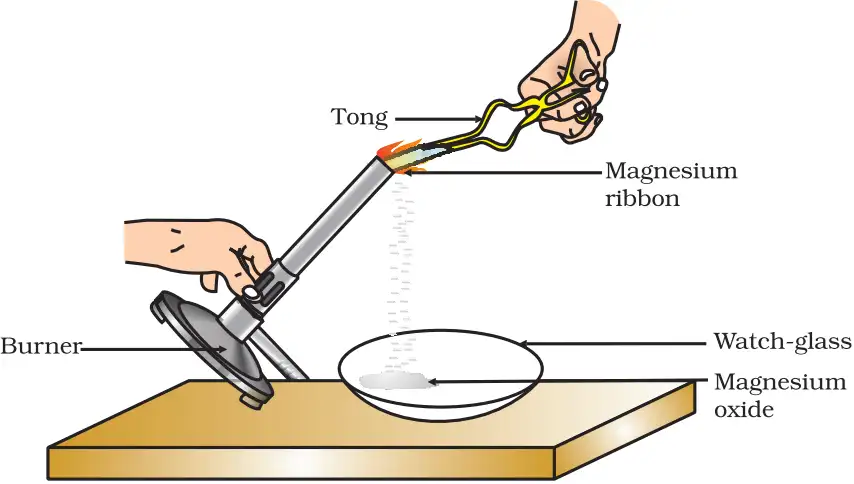
Why is the magnesium ribbon rubbed with sandpaper before ignition, and what is the nature of the residue collected in the watch-glass?
Explanation: Magnesium forms an inert magnesium oxide/carbonate layer on standing, which prevents clean burning; cleaning exposes the fresh metal. The product formed is MgO, which is basic in nature.
2. In an activity, dilute sulphuric acid is poured onto zinc granules contained in a conical flask:
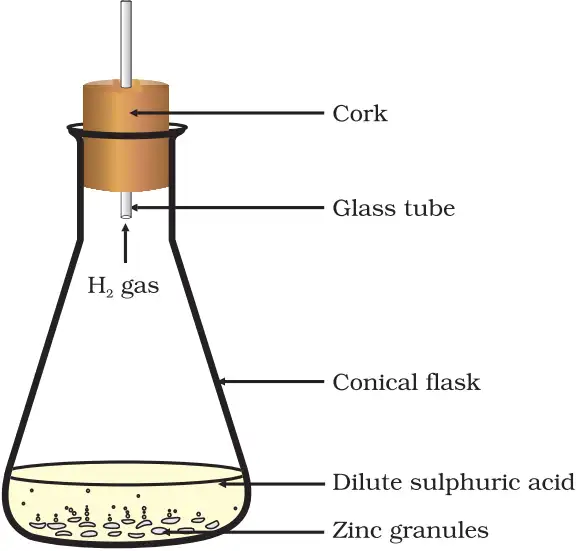
Which observations confirm that a chemical reaction has taken place in the flask?
Explanation: The reaction Zn + H₂SO₄ → ZnSO₄ + H₂ produces effervescence (H₂ gas) and releases heat (exothermic reaction), changing both temperature and state.
3. Look at the setup below where water is added to calcium oxide in a glass beaker:
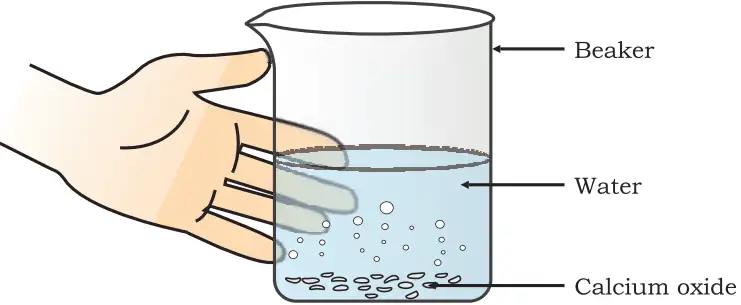
When a hand touches the beaker from the outside during the reaction, it feels hot. What type of reaction is this?
Explanation: CaO(s) + H₂O(l) → Ca(OH)₂(aq) + Heat. Two reactants synthesize a single product (combination), releasing a large amount of thermal energy (exothermic).
4. A boiling tube containing green ferrous sulphate crystals is heated over a burner flame as illustrated:
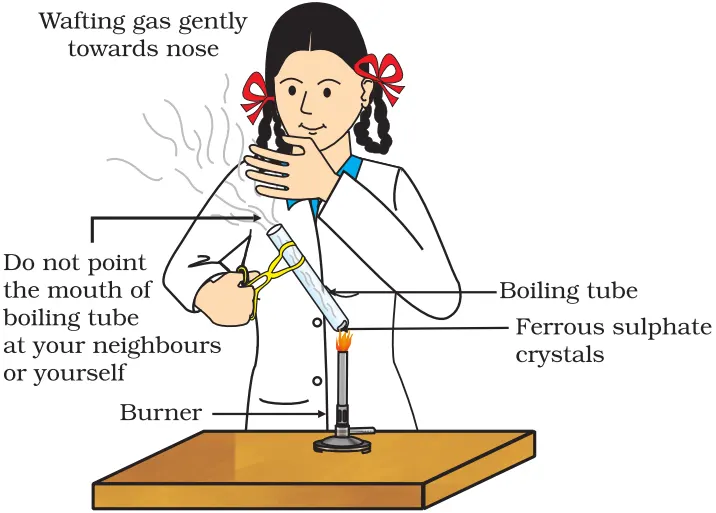
What are the correct color change and the characteristic smell of the gases evolved?
Explanation: Green hydrated crystals FeSO₄·7H₂O lose water, then decompose to reddish-brown solid Fe₂O₃ and release pungent acidic gases SO₂ and SO₃ (burning sulphur odor).
5. A student heats 2 g of dry lead nitrate powder in a boiling tube as shown:
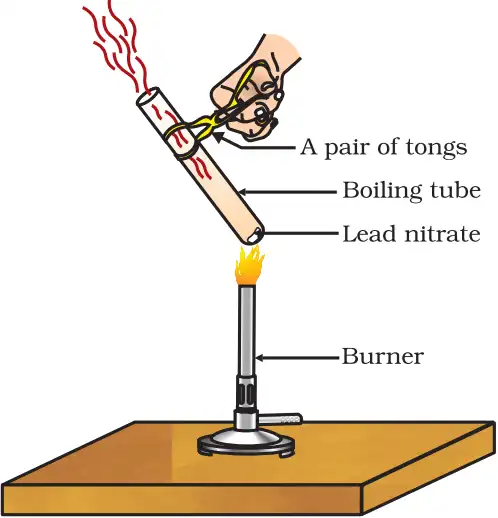
What observation confirms thermal decomposition in this experiment?
Explanation: 2Pb(NO₃)₂(s) → 2PbO(s) + 4NO₂(g) + O₂(g). Nitrogen dioxide is characterized by dense reddish-brown fumes, and lead oxide residue is yellow when cold.
6. Study the apparatus for the electrolytic decomposition of acidified water:
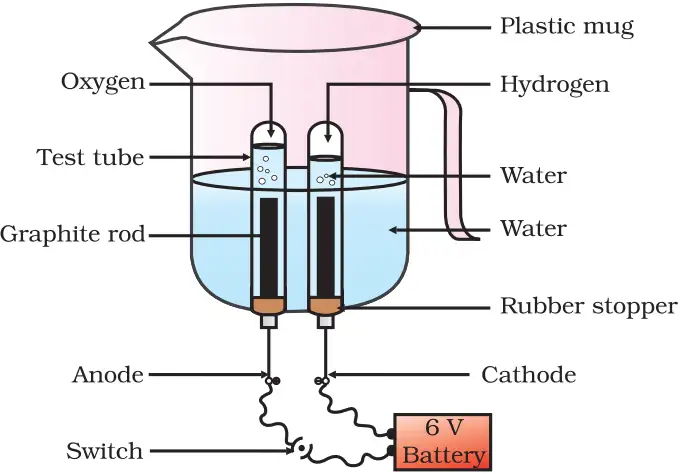
Why is the volume of gas collected in the test tube at the cathode double that at the anode?
Explanation: Decomposition of water follows: 2H₂O(l) → 2H₂(g) + O₂(g). Two moles of H₂ collect at the cathode for every one mole of O₂ collected at the anode (2:1 volume ratio).
7. In Activity 1.8, white silver chloride is placed in a china dish under direct sunlight:
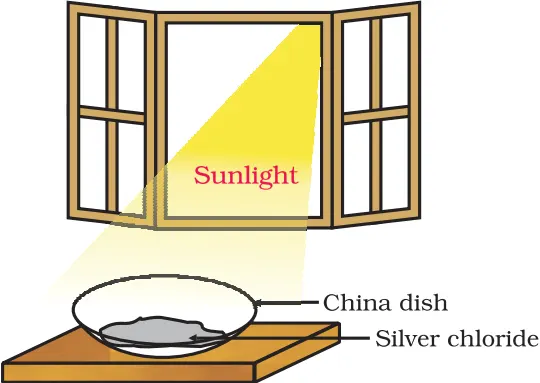
What causes the white compound to turn grey after a few minutes?
Explanation: 2AgCl(s) → 2Ag(s) + Cl₂(g) in the presence of sunlight. The white salt photolytically breaks down into finely divided grey metallic silver.
8. Clean iron nails are suspended in a test tube containing blue copper sulphate solution:
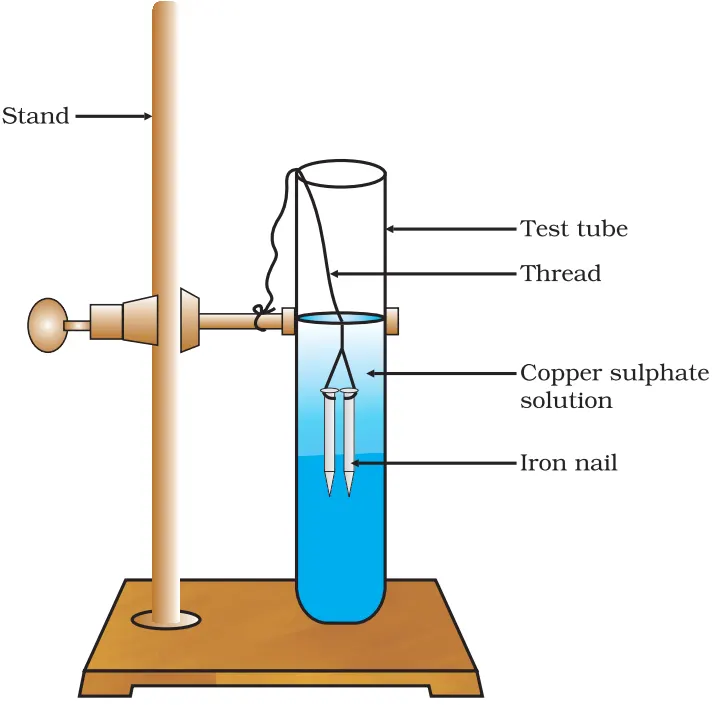
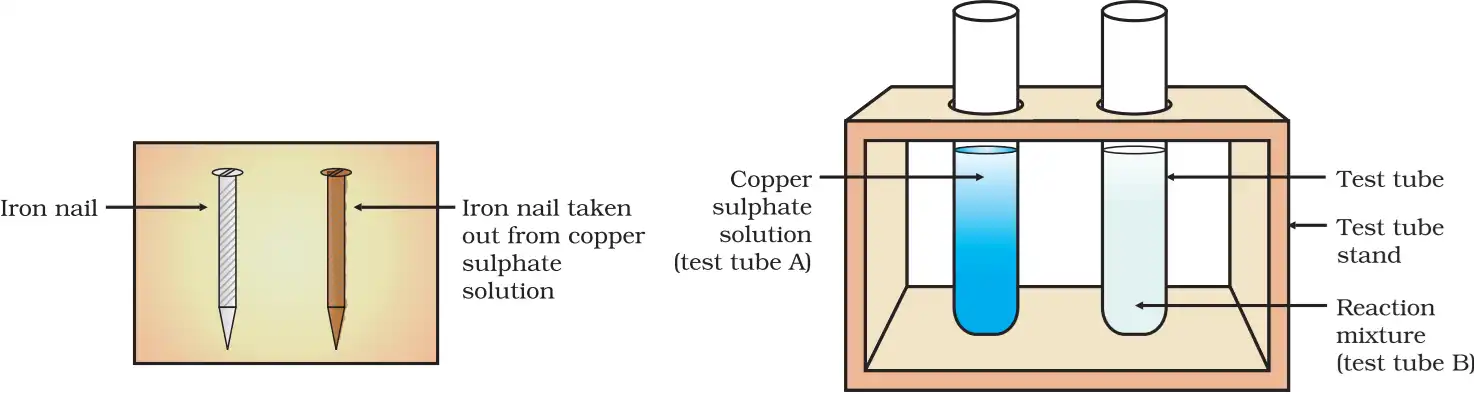
What changes are observed in the color of the solution and the iron nails after 20 minutes?
Explanation: Fe is more reactive than Cu: Fe + CuSO₄(blue) → FeSO₄(pale green) + Cu(s). The displaced metallic copper forms a reddish-brown deposit over the iron nails.
Section B: Assertion & Reasoning (CBSE Pattern)
9.
Assertion (A): Calcium oxide reacts vigorously with water to form slaked lime, releasing a large amount of heat.
Reason (R): The reaction between quicklime and water is a combination as well as an exothermic reaction.
Reason (R): The reaction between quicklime and water is a combination as well as an exothermic reaction.
Explanation: Quicklime (CaO) and water combine to form a single substance, Ca(OH)₂, and release substantial thermal energy (exothermic combination). Both statements are true and R explains A.
10.
Assertion (A): Respiration is considered an exothermic chemical reaction.
Reason (R): Photosynthesis in green plants absorbs solar energy to synthesize glucose from carbon dioxide and water.
Reason (R): Photosynthesis in green plants absorbs solar energy to synthesize glucose from carbon dioxide and water.
Explanation: Both assertions are scientifically accurate facts from the chapter, but the endothermic nature of photosynthesis does not explain why respiration is exothermic (cellular oxidation of glucose releasing energy).
11.
Assertion (A): Silver chloride powder is stored in dark amber-colored bottles in chemical laboratories.
Reason (R): Silver chloride reacts with air at room temperature to form toxic chlorine gas without requiring light.
Reason (R): Silver chloride reacts with air at room temperature to form toxic chlorine gas without requiring light.
Explanation: Amber bottles block ambient light to prevent silver chloride from undergoing photolytic decomposition. Reason (R) is false because light energy is required for decomposition.
12.
Assertion (A): A skeletal chemical equation is always balanced in mass according to the law of conservation of mass.
Reason (R): In a balanced chemical equation, the total number of atoms of each element remains identical on both reactant and product sides.
Reason (R): In a balanced chemical equation, the total number of atoms of each element remains identical on both reactant and product sides.
Explanation: A skeletal equation is an unbalanced equation where the mass is not equal on both sides. Statement A is false, while Reason R accurately defines a balanced equation.
13.
Assertion (A): Bags of potato chips are flushed with nitrogen gas during industrial packaging.
Reason (R): Nitrogen is an unreactive antioxidant gas that prevents oxidative rancidity of fats and oils.
Reason (R): Nitrogen is an unreactive antioxidant gas that prevents oxidative rancidity of fats and oils.
Explanation: Flushing sealed packets with nitrogen prevents oxygen from coming into contact with fried oils, preventing foul odor and rancid taste.
14.
Assertion (A): The reaction of copper oxide with hydrogen gas to yield copper and water is a redox reaction.
Reason (R): The substance gaining oxygen is oxidised, while the substance losing oxygen is reduced.
Reason (R): The substance gaining oxygen is oxidised, while the substance losing oxygen is reduced.
Explanation: In CuO + H₂ → Cu + H₂O, CuO loses oxygen (reduced) and H₂ gains oxygen (oxidised). Both statements are correct, but R defines oxidation/reduction without identifying the specific substances in this reaction.
15.
Assertion (A): Rusting of iron is an example of an endothermic displacement reaction.
Reason (R): Iron reacts slowly with moisture and oxygen in the air to form hydrated iron(III) oxide.
Reason (R): Iron reacts slowly with moisture and oxygen in the air to form hydrated iron(III) oxide.
Explanation: Rusting is an oxidation/corrosion process that is exothermic, not an endothermic displacement reaction. Assertion A is false, Reason R is true. (Selected option D reflects this).
Section C: Matching & Tabular Competencies
16. Match the chemical reactions in Column I with their correct reaction classifications in Column II:
| Column I (Chemical Equation) | Column II (Type of Reaction) |
|---|---|
| (A) 2H₂ + O₂ → 2H₂O | (1) Thermal Decomposition |
| (B) CaCO₃ → CaO + CO₂ | (2) Displacement Reaction |
| (C) Zn + CuSO₄ → ZnSO₄ + Cu | (3) Double Displacement Reaction |
| (D) Na₂SO₄ + BaCl₂ → BaSO₄ + 2NaCl | (4) Combination Reaction |
Explanation: Synthesis of water = Combination (4); Limestone heating = Thermal Decomposition (1); Zinc displacing copper = Displacement (2); Sodium sulphate + barium chloride = Double displacement precipitation (3).
17. Match the industrial compound in Column I with its correct chemical formula and usage in Column II:
| Column I (Common Name) | Column II (Formula & Application) |
|---|---|
| (A) Quicklime | (1) CaO; used in cement manufacture |
| (B) Slaked lime | (2) Ca(OH)₂; used for whitewashing walls |
| (C) Limestone / Marble | (3) CaCO₃; provides shiny finish to walls |
| (D) Green vitriol crystals | (4) FeSO₄·7H₂O; yields ferric oxide on heating |
Explanation: All matches are directly aligned: Quicklime = CaO (cement), Slaked lime = Ca(OH)₂ (whitewashing), Limestone/Marble = CaCO₃, Ferrous sulphate crystals = FeSO₄·7H₂O.
18. Match the metal in Column I with the distinctive color of its corrosion product in Column II:
| Column I (Metal) | Column II (Corrosion Product Coating) |
|---|---|
| (A) Iron | (1) Black coating |
| (B) Silver | (2) Reddish-brown flaky powder |
| (C) Copper | (3) Dull green layer |
Explanation: Iron rusts to a reddish-brown coating, silver forms a black sulphide tarnish, and copper forms a green basic carbonate coating upon exposure to moist air.
Section D: Balancing & Stoichiometric Coefficients
19. In the balanced equation: a Fe(s) + b H₂O(g) → c Fe₃O₄(s) + d H₂(g), what are the values of the stoichiometric coefficients a, b, c, and d?
Explanation: Balancing atoms step-by-step: 3 Fe atoms produce Fe₃O₄, 4 H₂O provide 4 oxygen atoms, and 4 H₂ molecules balance 8 hydrogen atoms: 3Fe + 4H₂O → Fe₃O₄ + 4H₂.
20. What are the values of coefficients x, y, and z required to balance the thermal decomposition of lead nitrate: x Pb(NO₃)₂ → y PbO + z NO₂ + O₂?
Explanation: The balanced equation from Activity 1.6 is: 2Pb(NO₃)₂(s) → 2PbO(s) + 4NO₂(g) + O₂(g). Therefore, x = 2, y = 2, and z = 4.
21. In the chemical equation for photosynthesis: a CO₂(aq) + b H₂O(l) → C₆H₁₂O₆(aq) + c O₂(aq) + d H₂O(l), what are the values of a, b, and c?
Explanation: According to Eq. 1.12 in NCERT: 6CO₂ + 12H₂O —(sunlight/chlorophyll)→ C₆H₁₂O₆ + 6O₂ + 6H₂O. Thus, a = 6, b = 12, and c = 6.
Section E: Comprehensive Concept & Competency Practice
22. When lead nitrate solution is mixed with potassium iodide solution in a test tube (Activity 1.2), a precipitate forms. What is the color and formula of this precipitate?
Explanation: Pb(NO₃)₂ + 2KI → PbI₂(s) + 2KNO₃. Lead iodide (PbI₂) precipitates as an insoluble brilliant yellow solid.
23. Walls whitewashed with slaked lime solution develop a shiny, lustrous finish after two to three days. Which compound is formed on the wall surface?
Explanation: Ca(OH)₂ slowly reacts with atmospheric carbon dioxide (CO₂) to produce a smooth, hard layer of calcium carbonate (CaCO₃), the same chemical constituent found in marble.
24. Which of the following reactions is used in black-and-white photography?
Explanation: Both silver chloride and silver bromide break down under sunlight (photochemical decomposition) to produce silver metal and halogen gases; both are used in black and white photography.
25. When barium hydroxide is mixed with ammonium chloride in a test tube, the bottom of the vessel becomes freezing cold. What type of reaction is this?
Explanation: Reactions that absorb thermal energy from their immediate surroundings cause a drop in temperature and are termed endothermic reactions.
26. In the reaction: MnO₂ + 4HCl → MnCl₂ + 2H₂O + Cl₂, which substance acts as the reducing agent?
Explanation: HCl loses hydrogen and is oxidised to Cl₂. The substance that is oxidised supplies electrons / loses hydrogen, acting as the reducing agent.
27. A shiny brown element ‘X’ on heating in air in a china dish becomes coated with a black compound ‘Y’. What are X and Y?
Explanation: Shiny reddish-brown copper metal (X) reacts with oxygen on heating to form black copper(II) oxide, CuO (Y): 2Cu + O₂ → 2CuO.
28. Which of the following represents a precipitation double displacement reaction?
Explanation: Aqueous solutions of sodium sulphate and barium chloride exchange ions to yield an insoluble white precipitate of barium sulphate (BaSO₄).
29. What happens when dilute hydrochloric acid is added to iron filings in a beaker?
Explanation: Fe(s) + 2HCl(aq) → FeCl₂(aq) + H₂(g). Iron displaces hydrogen from dilute acid, releasing hydrogen gas and forming iron chloride.
30. In the redox reaction: 2PbO(s) + C(s) → 2Pb(s) + CO₂(g), which statement is correct?
Explanation: Carbon (C) gains oxygen to form CO₂ (oxidised), while lead oxide (PbO) loses oxygen to yield metallic lead (reduced).
31. What state symbol notation is used to represent a reactant or product dissolved in water as a solution?
Explanation: The notation (aq) denotes ‘aqueous’, indicating that the compound is dissolved in water.
32. The decomposition of vegetable matter into organic compost is an example of which type of reaction?
Explanation: Microbial decay of organic agricultural matter releases heat energy as biomass is broken down, classifying composting as exothermic.
33. Why is black copper oxide coating converted back to shiny brown copper when hydrogen gas is passed over heated CuO?
Explanation: CuO + H₂ → Cu + H₂O. Hydrogen removes oxygen from CuO, reducing it back to elemental brown copper.
34. Which of the following metals can displace copper from an aqueous solution of copper sulphate?
Explanation: Lead and zinc are more reactive than copper and can displace copper from its salt solutions: Pb + CuCl₂ → PbCl₂ + Cu.
35. Which of the following is an example of a thermal decomposition reaction used in the manufacturing of cement?
Explanation: Thermal decomposition of limestone (calcium carbonate) yields quicklime (CaO), an essential raw material in the cement industry.
36. What is the fundamental law of nature that mandates balancing of all chemical equations?
Explanation: Mass cannot be created or destroyed in a chemical reaction; hence, the number of atoms of each element must remain equal on both sides.
37. In the reaction ZnO + C → Zn + CO, what is the oxidizing agent?
Explanation: ZnO provides oxygen to oxidise carbon, and is itself reduced to Zn. Therefore, ZnO acts as the oxidizing agent.
38. Why are airtight containers recommended for storing fried food items containing oils and fats?
Explanation: Airtight storage minimizes exposure to atmospheric oxygen, substantially retarding the oxidation process that causes rancidity.
39. Which of the following represents a balanced displacement reaction involving silver recovery in metallurgical refining?
Explanation: In silver refining (NCERT Exercise Q14), copper metal displaces silver from silver nitrate: Cu + 2AgNO₃ → Cu(NO₃)₂ + 2Ag.
40. In which of the following reactions does a combination reaction occur between two elements?
Explanation: Carbon (element) and oxygen (element) combine to form a compound (CO₂). In A, B, and C, at least one reactant is a compound.
41. Why is the reaction: Fe₂O₃ + 2Al → Al₂O₃ + 2Fe categorized as a displacement reaction?
Explanation: Aluminium displaces iron from its oxide because of its higher reactivity in the activity series.
42. What is the coefficient of HCl when the following equation is balanced: Al(OH)₃ + HCl → AlCl₃ + H₂O?
Explanation: Al(OH)₃ + 3HCl → AlCl₃ + 3H₂O. The stoichiometric coefficient of HCl is 3.
43. When sodium metal reacts with cold water, which products are formed?
Explanation: 2Na(s) + 2H₂O(l) → 2NaOH(aq) + H₂(g). Sodium reacts violently with water to liberate hydrogen gas and form a basic solution.
44. Which of the following is NOT an indicator that a chemical change has taken place?
Explanation: Altering shape without changing chemical identity is purely a physical change, not a chemical reaction.
45. What happens when hydrogen sulphide gas burns in air?
Explanation: 2H₂S + 3O₂ → 2H₂O + 2SO₂. Hydrogen sulphide combusts in oxygen to yield water and sulphur dioxide.
46. In the balanced equation: 2HNO₃ + Ca(OH)₂ → Ca(NO₃)₂ + x H₂O, what is the value of x?
Explanation: Two H⁺ from nitric acid and two OH⁻ from calcium hydroxide combine to produce 2 molecules of water: x = 2.
47. What occurs when sodium hydroxide solution reacts with dilute hydrochloric acid?
Explanation: NaOH(aq) + HCl(aq) → NaCl(aq) + H₂O(l). This is a classic neutralization double displacement reaction.
48. Why is respiration classified as a combustion-like exothermic process in humans?
Explanation: C₆H₁₂O₆ + 6O₂ → 6CO₂ + 6H₂O + Energy. Biochemical oxidation of glucose provides cellular ATP, releasing heat.
49. What type of reaction is represented by: 2KClO₃ → 2KCl + 3O₂ in the presence of heat?
Explanation: A single complex compound breaks down under heat into simpler chemical products (potassium chloride and oxygen gas).
50. Which observation proves that a chemical reaction occurs when potassium iodide reacts with lead nitrate?
Explanation: Combining two clear colorless solutions yields an insoluble yellow precipitate of lead iodide, confirming a chemical transformation.
Quiz Performance Summary
Attempted
0 / 50
Correct
0
Incorrect
0
Percentage
0%