Class 10 Science Chapter 1 MCQs (Set 2) | Chemical Reactions and Equations
Answered: 0/50
Score: 0/50
✓ 0 | ✗ 0
Section A: Activity & Lab Setup Competencies
1. A student performs Activity 1.1 by burning a cleaned magnesium ribbon in air:
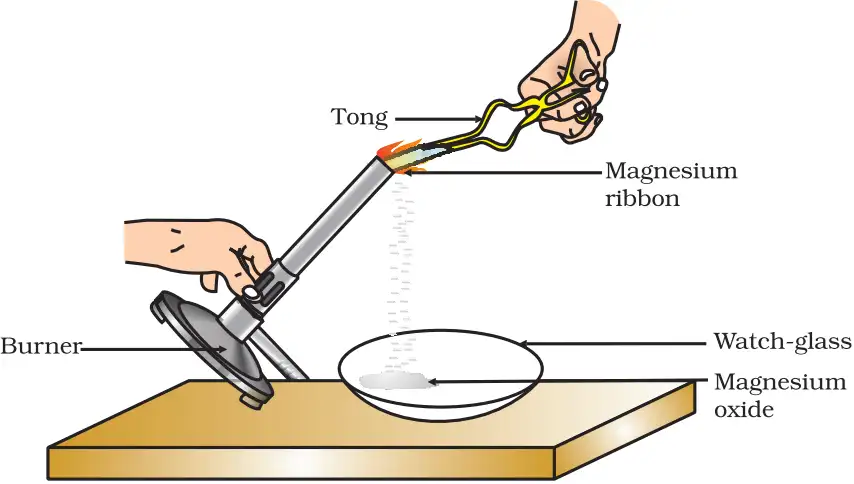
What is the color of the flame produced during burning, and what is the nature of the aqueous solution of the collected powder when tested with red litmus?
Explanation: Magnesium burns with a dazzling white flame to form white MgO powder (Activity 1.1). MgO dissolves partially in water to form Mg(OH)₂, a basic oxide that turns red litmus blue.
2. A lit matchstick is brought near the mouth of the delivery tube in the zinc-dilute acid experiment shown below:
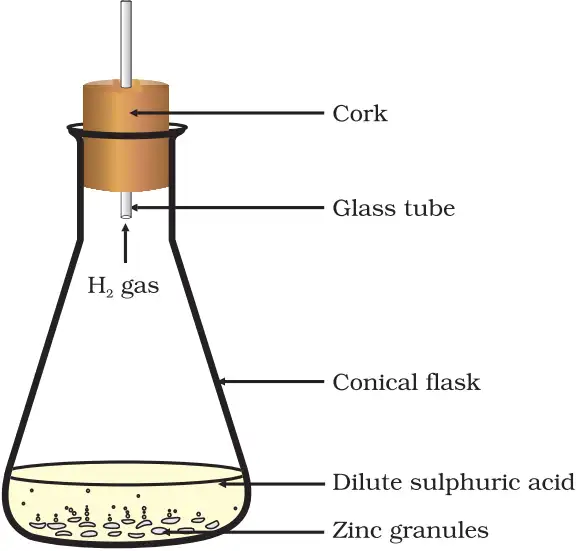
What observation is recorded when the gas ignites?
Explanation: Zinc reacts with dilute sulphuric acid to liberate hydrogen gas (Zn + H₂SO₄ → ZnSO₄ + H₂). Hydrogen is combustible and burns with a characteristic pop sound.
3. During Activity 1.4, quicklime is slowly treated with water in a beaker:
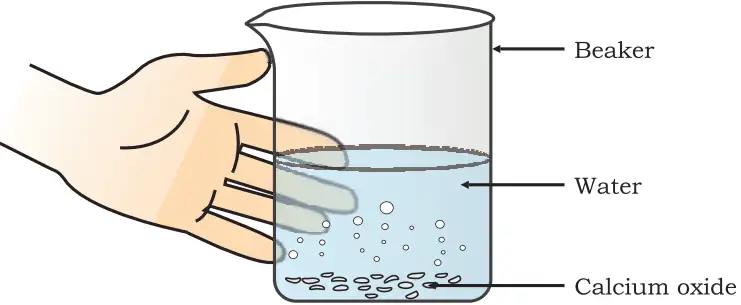
Which of the following correctly pairs the common name and the IUPAC chemical name of the solid reactant taken initially?
Explanation: Quicklime is the common name for calcium oxide (CaO). When water is added, it forms slaked lime, Ca(OH)₂.
4. In Activity 1.5, dry crystals of ferrous sulphate are heated strongly in a dry boiling tube:
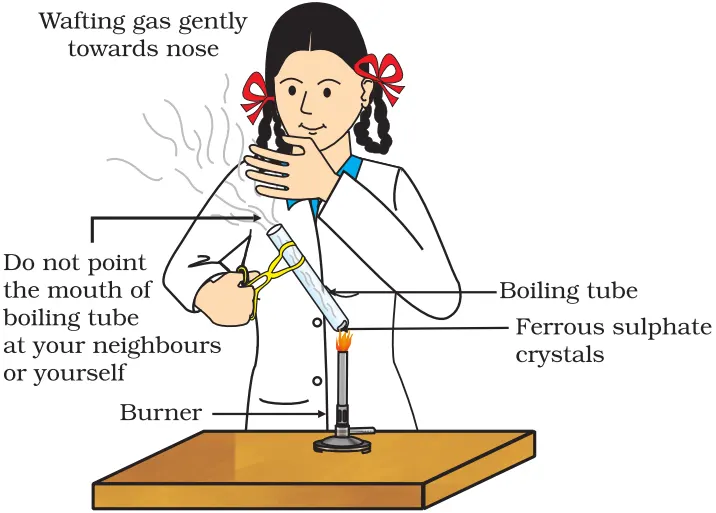
Why must the mouth of the boiling tube be pointed away from the student and peers, and how should the escaping gas be smelled?
Explanation: The thermal decomposition of FeSO₄ releases acidic, choking gases SO₂ and SO₃. The mouth of the tube is pointed away and fumes must be wafted gently toward the nose.
5. A boiling tube containing white lead nitrate powder is heated over a flame (Activity 1.6):
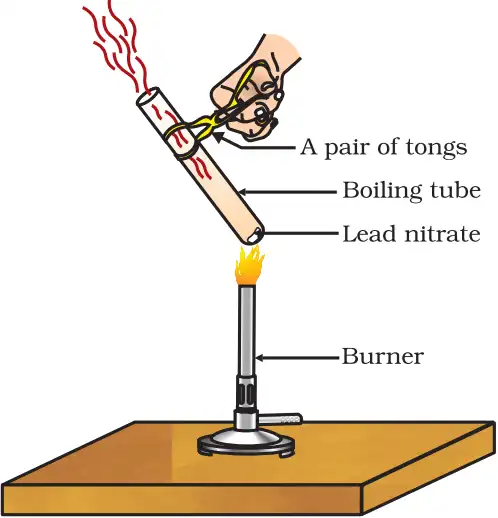
Which gas is responsible for the dense reddish-brown fumes observed during heating?
Explanation: 2Pb(NO₃)₂(s) → 2PbO(s) + 4NO₂(g) + O₂(g). The reddish-brown fumes are nitrogen dioxide gas (NO₂).
6. Study the electrolysis of water setup shown in Figure 1.6:
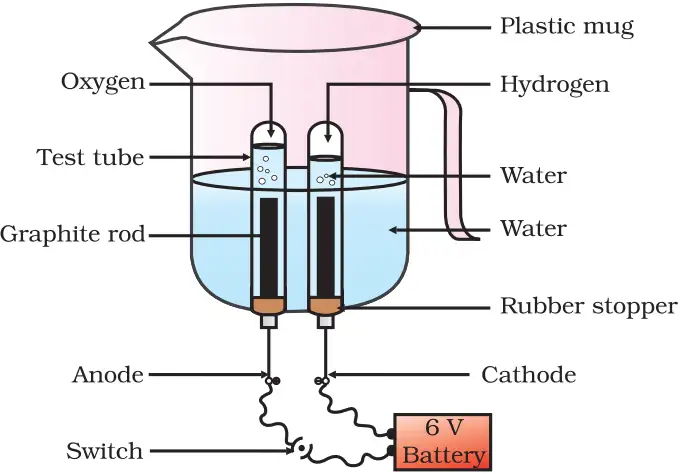
Why are a few drops of dilute sulphuric acid added to pure distilled water prior to passing electric current?
Explanation: Pure water is a poor conductor of electricity. Adding a few drops of dilute sulphuric acid ionizes the solution, providing ions that conduct electric current.
7. Two test tubes containing sodium sulphate and barium chloride solutions are mixed (Activity 1.10):
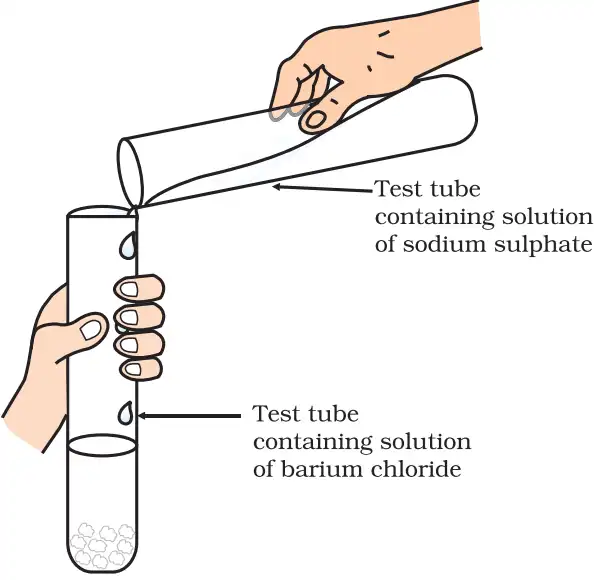
Which ions combine together to precipitate the insoluble white solid?
Explanation: In this double displacement reaction, Ba²⁺ ions combine with SO₄²⁻ ions to form insoluble barium sulphate (BaSO₄), while NaCl remains dissolved in the solution.
8. Copper powder in a china dish is heated over a burner flame as illustrated:
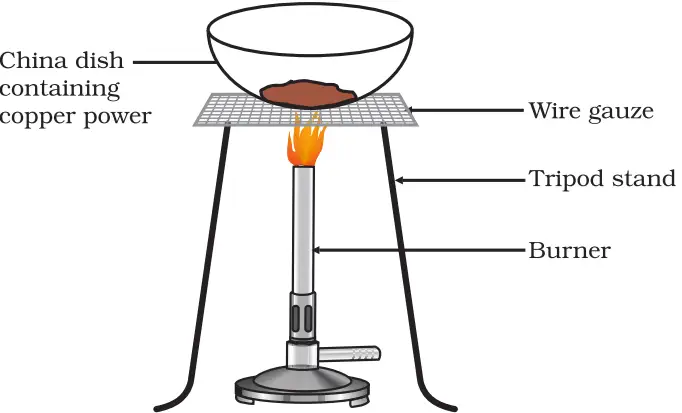
What chemical transformation occurs on the surface of the copper powder during heating?
Explanation: 2Cu + O₂ → 2CuO. Oxygen is added to copper (oxidation), forming a black surface layer of copper(II) oxide.
Section B: Assertion & Reasoning (CBSE Pattern)
9.
Assertion (A): Burning of natural gas is an exothermic reaction.
Reason (R): In the combustion of methane, carbon dioxide and water are formed along with the liberation of heat energy.
Reason (R): In the combustion of methane, carbon dioxide and water are formed along with the liberation of heat energy.
Explanation: CH₄(g) + 2O₂(g) → CO₂(g) + 2H₂O(g) + Heat. The release of heat during combustion classifies it as an exothermic reaction. Both are true and R explains A.
10.
Assertion (A): Decomposition reactions are called the opposite of combination reactions.
Reason (R): Photosynthesis is an endothermic reaction in green plants.
Reason (R): Photosynthesis is an endothermic reaction in green plants.
Explanation: Both statements are true, but R does not explain why decomposition is opposite to combination (decomposition involves a single reactant breaking into two or more products, whereas combination unites multiple reactants into a single product).
11.
Assertion (A): When an iron nail is dipped in copper sulphate solution, iron displaces copper.
Reason (R): Copper is more reactive than iron in the electrochemical reactivity series.
Reason (R): Copper is more reactive than iron in the electrochemical reactivity series.
Explanation: Assertion is true. Reason is false because iron is more reactive than copper, allowing iron to displace copper ions from solution.
12.
Assertion (A): In the reaction: CuO + H₂ → Cu + H₂O, hydrogen acts as an oxidizing agent.
Reason (R): The substance that gains oxygen during a chemical reaction undergoes oxidation.
Reason (R): The substance that gains oxygen during a chemical reaction undergoes oxidation.
Explanation: Hydrogen gains oxygen and is oxidised; therefore, hydrogen is the reducing agent, not an oxidizing agent. Thus, A is false and R is true.
13.
Assertion (A): White silver chloride turns grey when exposed to sunlight.
Reason (R): Sunlight supplies photon energy that photolytically decomposes silver chloride into elemental silver and chlorine gas.
Reason (R): Sunlight supplies photon energy that photolytically decomposes silver chloride into elemental silver and chlorine gas.
Explanation: 2AgCl(s) —(sunlight)→ 2Ag(s) + Cl₂(g). Grey metallic silver forms due to photolytic decomposition, so both are true and R explains A.
14.
Assertion (A): Antioxidants are commonly added to commercial foods containing fats and oils.
Reason (R): Corrosion of iron structures causes massive economic loss worldwide each year.
Reason (R): Corrosion of iron structures causes massive economic loss worldwide each year.
Explanation: Both are true facts mentioned in the chapter, but corrosion of iron does not explain why antioxidants are added to food items (which prevents rancidity).
15.
Assertion (A): When water is added to calcium oxide, the temperature of the reaction mixture rises sharply.
Reason (R): The combination of calcium oxide with water is an endothermic process.
Reason (R): The combination of calcium oxide with water is an endothermic process.
Explanation: Quicklime reacting with water evolves significant heat (exothermic reaction). Hence, Assertion is true, but Reason is false.
Section C: Matching & Tabular Competencies
16. Match the chemical reaction in Column I with the corresponding energy form in Column II that drives the decomposition:
| Column I (Decomposition Reaction) | Column II (Form of Energy Required) |
|---|---|
| (A) 2H₂O → 2H₂ + O₂ | (1) Heat (Thermal) |
| (B) 2AgBr → 2Ag + Br₂ | (2) Light (Photolytic) |
| (C) CaCO₃ → CaO + CO₂ | (3) Electricity (Electrolytic) |
Explanation: Electrolysis of water uses electricity (3); silver bromide breaks down via sunlight (2); calcium carbonate decomposes through thermal heating (1).
17. Match the daily life phenomenon in Column I with its chemical nature in Column II:
| Column I (Phenomenon) | Column II (Chemical Process) |
|---|---|
| (A) Fermentation of grapes | (1) Biochemical change / Chemical reaction |
| (B) Tarnishing of silver ornaments | (2) Corrosion / Oxidation |
| (C) Spoilage of butter with foul smell | (3) Rancidity |
| (D) Breakdown of food during digestion | (4) Decomposition into simpler units |
Explanation: Fermentation is a chemical change (1); silver tarnishing is corrosion (2); butter spoil is rancidity (3); digestion breaks carbohydrates into glucose (4).
18. Match the chemical reaction in Column I with its observed sign of chemical reaction in Column II:
| Column I (Reaction) | Column II (Visible Sign) |
|---|---|
| (A) Lead nitrate + Potassium iodide | (1) Evolution of gas with effervescence |
| (B) Zinc granules + Dilute sulphuric acid | (2) Formation of yellow precipitate |
| (C) Heating hydrated ferrous sulphate | (3) Change in color from green to reddish-brown |
| (D) Quicklime + Water | (4) Substantial rise in temperature |
Explanation: Pb(NO₃)₂ + KI gives yellow PbI₂ precipitate (2); Zn + H₂SO₄ releases H₂ gas bubbles (1); FeSO₄ changes from green to reddish-brown Fe₂O₃ (3); CaO + H₂O generates heat (4).
Section D: Balancing & Stoichiometry Competencies
19. In the balanced chemical equation: p NaOH + q H₂SO₄ → r Na₂SO₄ + s H₂O, what are the values of p, q, r, and s?
Explanation: 2NaOH + H₂SO₄ → Na₂SO₄ + 2H₂O. Two moles of sodium hydroxide balance one mole of sulfuric acid, giving p = 2, q = 1, r = 1, s = 2.
20. What are the values of x and y in the balanced combustion equation: CH₄(g) + x O₂(g) → CO₂(g) + y H₂O(g)?
Explanation: CH₄ + 2O₂ → CO₂ + 2H₂O. The carbon atoms are 1:1, hydrogen atoms balance with 2H₂O (4 H), requiring 2O₂ (4 O). Thus, x = 2 and y = 2.
21. In the chemical synthesis of ammonia: N₂(g) + 3H₂(g) → 2NH₃(g), how many moles of hydrogen gas are needed to react completely with 2 moles of nitrogen gas?
Explanation: The stoichiometric ratio between N₂ and H₂ is 1:3. Therefore, 2 moles of N₂ require 2 × 3 = 6 moles of H₂ gas.
Section E: Comprehensive Concept & Reaction Questions
22. Which of the following conditions is indicated above the arrow in the reaction producing methanol from carbon monoxide and hydrogen: CO(g) + 2H₂(g) → CH₃OH(l)?
Explanation: Equation 1.11 specifies that CO(g) + 2H₂(g) combines to form CH₃OH(l) under a high pressure of 340 atm.
23. In the reaction: 2FeSO₄(s) —(Heat)→ Fe₂O₃(s) + SO₂(g) + SO₃(g), what is the oxidation state of iron in the product Fe₂O₃?
Explanation: In ferric oxide (Fe₂O₃), iron has a valency / oxidation state of +3 (ferric state), formed from ferrous sulphate (+2).
24. What happens when carbon dioxide gas is passed through lime water for a short duration?
Explanation: Ca(OH)₂(aq) + CO₂(g) → CaCO₃(s) + H₂O(l). The suspension of white insoluble calcium carbonate turns the clear solution milky.
25. Which of the following is an example of an endothermic physical or chemical process?
Explanation: Decomposing CaCO₃ requires continuous absorption of thermal energy from a furnace (endothermic). The others release heat (exothermic).
26. In the redox reaction: 4Na(s) + O₂(g) → 2Na₂O(s), which element is oxidised?
Explanation: Sodium (Na) gains oxygen to form sodium oxide (Na₂O); gaining oxygen constitutes oxidation.
27. When lead strips are placed in a solution of copper chloride, CuCl₂(aq), the reaction that takes place is:
Explanation: Pb(s) + CuCl₂(aq) → PbCl₂(aq) + Cu(s). Lead is more reactive than copper and displaces it, demonstrating a single displacement reaction.
28. Which gas evolved during the heating of green vitriol (ferrous sulphate) turns acidified potassium dichromate solution green?
Explanation: Sulphur dioxide (SO₂) gas evolved in the thermal decomposition of FeSO₄ is a strong reducing agent that reduces orange dichromate to green chromium sulphate.
29. What is the chemical formula of marble?
Explanation: NCERT ‘Do You Know?’ box on page 7 explicitly states: “It is interesting to note that the chemical formula for marble is also CaCO₃.”
30. Why is painting iron railings and car bodies considered an effective prevention against corrosion?
Explanation: Corrosion requires simultaneous exposure to moisture and oxygen. A protective coat of paint blocks air and water from reaching the surface of iron.
31. What happens when barium chloride solution reacts with aluminium sulphate solution?
Explanation: 3BaCl₂ + Al₂(SO₄)₃ → 3BaSO₄(s) + 2AlCl₃. Barium sulphate precipitates as a thick, insoluble white solid.
32. Which of the following equations represents an unbalanced (skeletal) chemical equation?
Explanation: In Mg + O₂ → MgO, there are 2 oxygen atoms on the LHS but only 1 on the RHS; hence, it is a skeletal (unbalanced) equation.
33. What are the products formed during the thermal decomposition of zinc carbonate?
Explanation: ZnCO₃(s) —(Heat)→ ZnO(s) + CO₂(g). Heating metallic carbonates causes thermal decomposition into metallic oxide and carbon dioxide gas.
34. In the hit-and-trial method of balancing equations, why can we NOT alter subscripts inside chemical formulas like writing H₂O₄ instead of 4H₂O?
Explanation: Chemical formulas reflect fixed valency and bonding ratios; altering subscripts creates nonexistent or entirely different chemical species.
35. In an experiment, four beakers A, B, C, and D are set up with liquids. Potassium sulphate is added to A, ammonium nitrate to B, anhydrous copper sulphate to C, and iron filings to D. In which beaker is an endothermic dissolution observed with a drop in temperature?
Explanation: Dissolving ammonium nitrate (NH₄NO₃) in water absorbs heat energy from the solvent, causing a marked drop in temperature (endothermic process).
36. Which of the following is true for the reaction: 2H₂(g) + O₂(g) → 2H₂O(l)?
Explanation: Two elements combine into a single product with the evolution of heat; hence, it is a combination reaction and exothermic in nature.
37. When hydrogen gas is passed over heated copper(II) oxide, the black surface coating turns brown. What role does copper(II) oxide play in this reaction?
Explanation: CuO supplies oxygen to oxidise H₂ to H₂O, and is itself reduced to Cu. The substance that supplies oxygen / gets reduced is the oxidizing agent.
38. Which of the following statements correctly differentiates displacement from double displacement reactions?
Explanation: In displacement, one element takes the place of another in a compound; in double displacement, there is an exchange of ions between two reactant compounds.
39. A green coating formed on the surface of old copper coins and statues left exposed to moist air is chemically composed of:
Explanation: Copper reacts with moist carbon dioxide, oxygen, and water in air to form a green coating of basic copper carbonate.
40. In which test tube does the gas collected ignite with a popping flame during the electrolysis of water?
Explanation: Hydrogen gas (H₂) is liberated at the negative cathode electrode. Testing with a burning splinter produces the characteristic ‘pop’ sound.
41. Why does the blue color of copper sulphate solution fade when zinc granules are added to it?
Explanation: Zn(s) + CuSO₄(aq) → ZnSO₄(aq) + Cu(s). Cu²⁺ ions giving the blue color are displaced and deposited as copper metal, leaving colorless ZnSO₄ solution.
42. What is observed when potassium metal is dropped into cold water?
Explanation: 2K(s) + 2H₂O(l) → 2KOH(aq) + H₂(g) + Heat. The reaction of potassium with water is so violent and exothermic that the liberated H₂ catches fire immediately.
43. Which of the following equations correctly shows the states of reactants and products for the formation of slaked lime?
Explanation: Equation 1.13 in NCERT: CaO(s) + H₂O(l) → Ca(OH)₂(aq) + Heat. Solid quicklime dissolves into liquid water to yield an aqueous solution of slaked lime.
44. What happens when electric current is passed through molten sodium chloride?
Explanation: Electrolytic decomposition of molten NaCl breaks the ionic compound into elemental sodium at the cathode and chlorine gas at the anode (2NaCl → 2Na + Cl₂).
45. In the reaction: CuO + H₂ → Cu + H₂O, which substance is being reduced?
Explanation: Copper(II) oxide loses oxygen to form copper metal; loss of oxygen is reduction, so CuO is reduced.
46. Which of the following is NOT an essential requirement for a fully balanced chemical equation?
Explanation: Mass and number of atoms must be conserved, but volume is not conserved during chemical reactions (e.g., 2 volumes of H₂ + 1 volume of O₂ gives 2 volumes of water vapor).
47. A student burns sulphur in air and dissolves the resulting gas in water. What is the nature of the solution formed?
Explanation: S + O₂ → SO₂. Sulphur dioxide is a non-metallic oxide that dissolves in water to form sulphurous acid (H₂SO₃), an acidic solution that turns blue litmus red.
48. Which of the following pairs of solutions will produce an insoluble precipitate upon mixing?
Explanation: BaCl₂(aq) + Na₂SO₄(aq) forms an insoluble white precipitate of barium sulphate, BaSO₄(s).
49. In the reaction: 2AgBr(s) —(Sunlight)→ 2Ag(s) + Br₂(g), what color change is observed in the solid?
Explanation: Pale yellow silver bromide decomposes under sunlight to yield grey metallic silver and bromine gas.
50. Which of the following is an example of a chemical change occurring inside the human body?
Explanation: Breaking down complex carbohydrates into glucose and its subsequent cellular oxidation during respiration are biochemical reactions (chemical changes).
Quiz Performance Summary
Attempted
0 / 50
Correct
0
Incorrect
0
Percentage
0%