
Class 10 Science Chapter 1 Activities | Chemical Reactions and Equations
Activity 1.1: Combustion of Magnesium Ribbon
Burning of Magnesium Ribbon in Air and Collection of Magnesium Oxide
Experimental Procedure
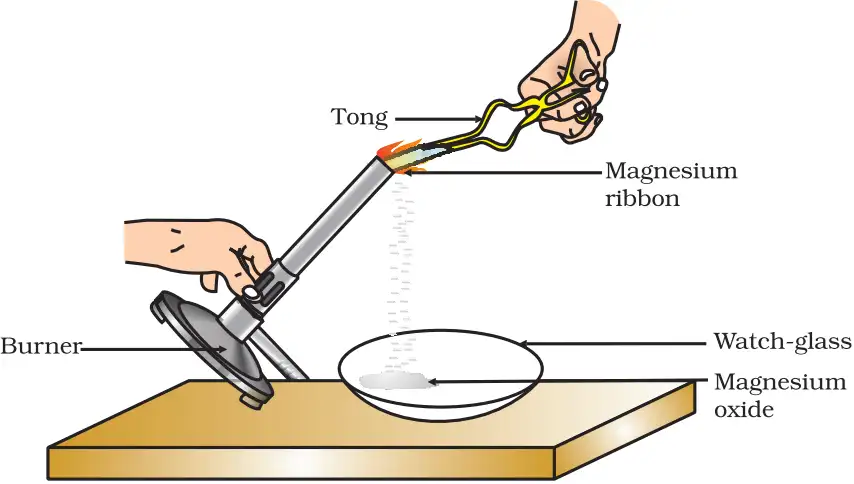
- Clean a magnesium ribbon about 3–4 cm long by rubbing it thoroughly with sandpaper to expose the pure metal surface.
- Hold the cleaned ribbon firmly using a pair of laboratory tongs.
- Ignite it using the flame of a spirit lamp or Bunsen burner, keeping it as far away from the eyes as possible with suitable protective eyewear.
- Collect the powdery white residue formed into a watch-glass positioned directly below.
Observations & Chemical Mechanism
- Observation: The magnesium ribbon burns with a dazzling, brilliant white flame and changes into a white powder.
- Chemical Identity: The white powder is magnesium oxide (MgO), formed by the direct combination of magnesium with atmospheric oxygen.
- Chemical Equation:
2Mg(s) + O₂(g) → 2MgO(s) + Heat - Classification: Combination reaction, exothermic reaction, and oxidation of magnesium.
Q1: Why should a magnesium ribbon be cleaned with sandpaper before burning in air?
Answer: On standing in atmospheric air, magnesium metal reacts slowly with oxygen to form a thin, stable protective layer of basic magnesium oxide on its surface. Rubbing with sandpaper strips off this non-reactive coating, enabling the metal underneath to make direct contact with oxygen and burn completely.
Q2: What is the nature of the aqueous solution formed when the collected ash is dissolved in water?
Answer: The ash consists of magnesium oxide (MgO), which is a basic metallic oxide. When mixed with water, it produces magnesium hydroxide:
MgO(s) + H₂O(l) → Mg(OH)₂(aq). This alkaline solution turns moist red litmus paper blue.Q3 (Application Based): A student finds that an uncleaned magnesium ribbon does not ignite easily when placed over a burner flame. Explain why, and suggest how this principle is applied to protect certain metals from corrosion.
Answer: The uncleaned ribbon has a compact layer of magnesium oxide that acts as an impermeable physical and thermal barrier, shielding the inner metal from oxygen. In industrial metallurgy, this natural passivation phenomenon protects metals like aluminium, zinc, and magnesium from deep atmospheric corrosion by forming an adherent self-protective oxide barrier.
Q4 (Application Based): Why are students advised to wear eye protection and avoid staring directly at the flame while performing this activity?
Answer: The combustion of magnesium emits intense visible light along with high-energy ultraviolet (UV) radiation. Looking directly at the dazzling white flame can cause photochemical retinal damage, temporary flash blindness, and severe strain to ocular tissues.
Activity 1.2: Precipitation of Lead Iodide
Reaction Between Lead Nitrate and Potassium Iodide Solutions
Experimental Procedure
- Pour approximately 2 mL of clear lead nitrate solution, Pb(NO₃)₂, into a clean glass test tube.
- Add an equal volume of colorless potassium iodide solution, KI, to the tube.
- Observe the instantaneous transformation in physical state and color.

Observations & Chemical Mechanism
- Observation: An insoluble, bright yellow precipitate forms immediately within the liquid mixture.
- Chemical Identity: Lead ions (Pb²⁺) combine with iodide ions (I⁻) to yield insoluble lead(II) iodide, leaving potassium nitrate in solution.
- Chemical Equation:
Pb(NO₃)₂(aq) + 2KI(aq) → PbI₂(s)↓ + 2KNO₃(aq) - Classification: Double displacement reaction and precipitation reaction.
Q1: Name the insoluble compound precipitated in Activity 1.2 and state its color.
Answer: The precipitated compound is lead(II) iodide, represented by the chemical formula
PbI₂. It exhibits an insoluble, bright yellow color.Q2: Why is this process classified as both a double displacement and a precipitation reaction?
Answer: It is a double displacement reaction because an exchange of ions occurs between the two soluble reactant salts (Pb²⁺ pairs with I⁻, while K⁺ pairs with NO₃⁻). Because one of the products formed (PbI₂) is insoluble in water and separates out as a solid residue, it is also called a precipitation reaction.
Q3 (Application Based): If lead nitrate is unavailable in the laboratory, which alternative lead compound can be used to yield the same yellow precipitate, and why cannot lead sulphate be used?
Answer: Lead acetate,
(CH₃COO)₂Pb, can be used because it is soluble in water and dissociates to supply free Pb²⁺ ions. Lead sulphate (PbSO₄) cannot be used because it is completely insoluble in water and cannot dissociate into mobile ions to participate in a double displacement reaction.Q4 (Application Based): When the yellow precipitate of PbI₂ is heated in water, it dissolves, but upon cooling, glittering golden-yellow spangles reappear. What does this indicate about the solubility of PbI₂?
Answer: This shows that lead(II) iodide has a positive temperature coefficient of solubility—it is sparingly soluble in cold water but dissolves readily in boiling water. When the hot saturated solution cools down, recrystallization occurs, forming characteristic shiny crystalline flakes known as “golden rain.”
Activity 1.3: Action of Dilute Acids on Zinc Granules
Evolution of Hydrogen Gas and Exothermic Temperature Rise
Experimental Procedure
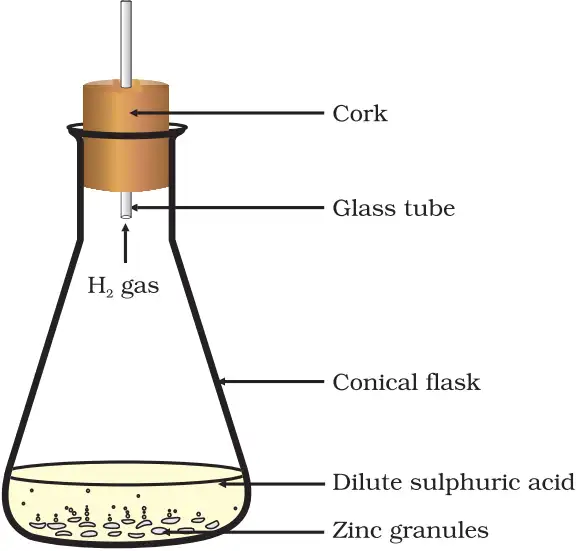
- Place a few zinc granules into a conical flask or test tube.
- Carefully add dilute sulphuric acid or dilute hydrochloric acid.
- Fit the flask with a cork carrying a narrow glass delivery tube to guide evolved gas.
- Observe the granules for gas evolution and touch the bottom of the flask with your hand.
Observations & Chemical Mechanism
- Observation: Effervescence is observed as bubbles of a colorless, odorless gas evolve around the zinc granules; the vessel becomes noticeably warm to the touch.
- Chemical Identity: Zinc displaces hydrogen from the acid to form zinc sulphate and liberate hydrogen gas.
- Chemical Equation:
Zn(s) + H₂SO₄(aq) → ZnSO₄(aq) + H₂(g)↑ + Heat - Classification: Single displacement reaction and exothermic reaction.
Q1: How can you confirm that the gas liberated in Activity 1.3 is hydrogen?
Answer: Bring a burning splinter or lighted candle near the mouth of the delivery tube. The gas ignites with a characteristic sharp “pop” sound and burns with a pale blue flame, confirming that the evolved gas is hydrogen (H₂).
Q2: What thermal variation is noticed upon touching the flask, and what does it indicate?
Answer: The conical flask becomes warm to the touch. This confirms that thermal energy is released alongside product formation, identifying it as an exothermic chemical reaction.
Q3 (Application Based): Why are granulated zinc pieces preferred over a solid zinc sheet or block for laboratory hydrogen gas preparation?
Answer: Granulated zinc provides a much larger specific surface area per unit mass compared to a single compact block of zinc. A larger surface area allows a higher frequency of collisions between reactant molecules, accelerating the rate of the displacement reaction and generating hydrogen gas steadily.
Q4 (Application Based): What will happen if dilute nitric acid (HNO₃) is substituted in place of dilute sulphuric acid with zinc granules?
Answer: Hydrogen gas is generally not evolved because nitric acid is a strong oxidizing agent. It oxidizes the hydrogen produced into water (H₂O) while being itself reduced to various nitrogen oxides (such as NO, NO₂, or N₂O).
Activity 1.4: Reaction of Quicklime with Water
Formation of Slaked Lime by Combination Reaction
Experimental Procedure
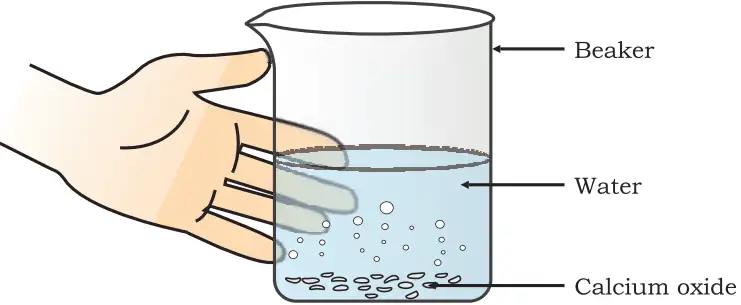
- Take a small amount of solid calcium oxide (quicklime) in a 250 mL glass beaker.
- Slowly add water to the beaker.
- Observe the reaction and touch the beaker from the outside.
Observations & Chemical Mechanism
- Observation: Calcium oxide reacts vigorously with a hissing sound, crumbles into a suspension, and releases large amounts of heat, making the beaker very hot.
- Chemical Identity: Quicklime combines with water to synthesize slaked lime (calcium hydroxide).
- Chemical Equation:
CaO(s) + H₂O(l) → Ca(OH)₂(aq) + Heat - Classification: Combination reaction and highly exothermic reaction.
Q1: Explain how the product of Activity 1.4 gives a shiny finish to walls two to three days after whitewashing.
Answer: Slaked lime, Ca(OH)₂, applied on walls reacts slowly with atmospheric carbon dioxide (CO₂) to produce a thin, hard layer of insoluble calcium carbonate:
Ca(OH)₂(aq) + CO₂(g) → CaCO₃(s) + H₂O(l). This layer forms over two to three days, giving the walls a shiny, durable white finish chemically identical to marble.Q2: Write the chemical formulas and common names of the reactant and product involved in this activity.
Answer: The solid reactant is calcium oxide (
CaO), commonly called quicklime. The product formed is calcium hydroxide (Ca(OH)₂), commonly called slaked lime.Q3 (Application Based): Why is the slaking of quicklime utilized in self-heating food containers and military ready-to-eat meal ration warmers?
Answer: The reaction
CaO(s) + H₂O(l) → Ca(OH)₂(s) is intensely exothermic and releases substantial thermal energy without producing open flames or hazardous sparks, making it an efficient, portable heat-generating source for warming canned food and beverages in field conditions.Q4 (Application Based): When carbon dioxide gas is passed through clear lime water for a prolonged duration, the initial milkiness disappears. Give reasons with balanced equations.
Answer: Lime water first turns milky due to the formation of insoluble calcium carbonate:
Ca(OH)₂(aq) + CO₂(g) → CaCO₃(s) + H₂O(l). On passing excess carbon dioxide, the insoluble calcium carbonate is converted into calcium bicarbonate [Ca(HCO₃)₂], which is completely soluble in water, causing the milky turbidity to disappear: CaCO₃(s) + H₂O(l) + CO₂(g) → Ca(HCO₃)₂(aq).Activity 1.5: Thermal Decomposition of Ferrous Sulphate
Heating of Ferrous Sulphate Crystals and Gas Identification
Experimental Procedure
- Take about 2 g of green ferrous sulphate crystals (FeSO₄·7H₂O) in a clean, dry boiling tube.
- Note the initial pale green color of the crystals.
- Heat the boiling tube over the flame of a burner while holding it with a pair of tongs.
- Point the open mouth of the tube away from everyone and waft the escaping gas gently toward your nose.
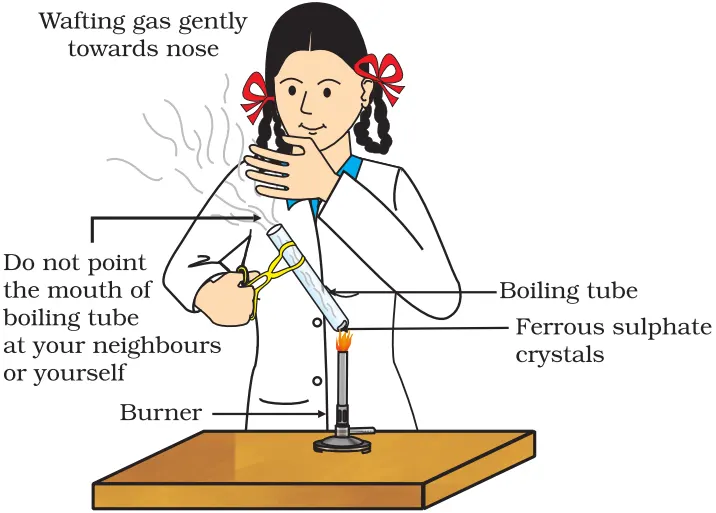
Observations & Chemical Mechanism
- Observation: Water droplets condense on the cooler upper walls of the tube; the green crystals lose water of crystallization, turning white, and then decompose into a dark reddish-brown solid residue while releasing choking fumes of burning sulphur.
- Chemical Identity: Anhydrous ferrous sulphate breaks down thermally into solid ferric oxide, sulphur dioxide gas, and sulphur trioxide gas.
- Chemical Equations:
Loss of water:FeSO₄·7H₂O(s) ⎯⎯Δ→ FeSO₄(s) + 7H₂O(g)
Decomposition:2FeSO₄(s) ⎯⎯Δ→ Fe₂O₃(s) + SO₂(g) + SO₃(g) - Classification: Thermal decomposition reaction and endothermic reaction.
Q1: Identify the solid residue and the gases evolved during the strong heating of ferrous sulphate crystals.
Answer: The reddish-brown solid residue is ferric oxide (
Fe₂O₃). The gases evolved are sulphur dioxide (SO₂) and sulphur trioxide (SO₃), both of which are acidic and emit the characteristic odor of burning sulphur.Q2: Why is this chemical reaction described as an endothermic thermal decomposition reaction?
Answer: It is a decomposition reaction because a single reactant compound (FeSO₄) breaks down into three simpler substances (Fe₂O₃, SO₂, and SO₃). Because this breakdown requires continuous absorption of thermal energy from the burner flame, it is endothermic.
Q3 (Application Based): How can the gaseous products of this activity be tested using acidified potassium dichromate paper and moist blue litmus paper?
Answer: Both SO₂ and SO₃ are acidic non-metallic anhydrides; when exposed to moist blue litmus paper, they turn it red. Furthermore, sulphur dioxide (SO₂) is a strong reducing agent; it reduces orange acidified potassium dichromate paper (K₂Cr₂O₇) to green chromium sulphate [Cr₂(SO₄)₃].
Q4 (Application Based): Why is a dry test tube specifically recommended for this activity, and what happens in the first phase before decomposition begins?
Answer: A dry tube is required to prevent cold water droplets from shattering the hot borosilicate glass. In the first phase, green ferrous sulphate heptahydrate (FeSO₄·7H₂O) undergoes dehydration by losing its seven molecules of water of crystallization, turning into white anhydrous FeSO₄ before true chemical decomposition sets in.
Activity 1.6: Thermal Decomposition of Lead Nitrate
Emission of Nitrogen Dioxide and Formation of Lead Oxide
Experimental Procedure
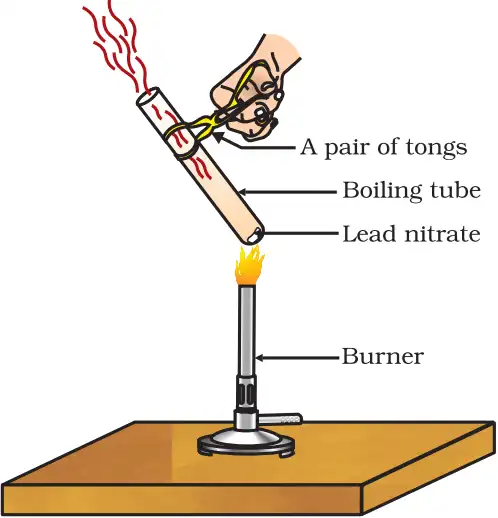
- Take approximately 2 g of dry, white lead nitrate powder, Pb(NO₃)₂, in a clean boiling tube.
- Hold the boiling tube with a pair of tongs over a flame.
- Heat the powder strongly and observe any change in color and gas emission.
Observations & Chemical Mechanism
- Observation: Crackling sounds are heard as the salt decrepitates; dense reddish-brown fumes pour out of the tube, and a solid residue remains that is brown when hot and yellow when cold.
- Chemical Identity: Lead nitrate decomposes under heat into lead(II) oxide, nitrogen dioxide gas, and oxygen gas.
- Chemical Equation:
2Pb(NO₃)₂(s) ⎯⎯Δ→ 2PbO(s) + 4NO₂(g)↑ + O₂(g)↑ - Classification: Thermal decomposition reaction.
Q1: Which specific gas is responsible for the dense brown fumes released during the heating of lead nitrate?
Answer: The brown fumes are caused by nitrogen dioxide gas, having the chemical formula
NO₂. The accompanying colorless, odorless gas that supports combustion is oxygen (O₂).Q2: What is the formula and characteristic color of the solid compound left behind in the boiling tube?
Answer: The solid residue is lead(II) oxide, with the chemical formula
PbO. It is reddish-brown while hot and turns yellow upon cooling to room temperature.Q3 (Application Based): Two colorless gases are produced in Activity 1.6, but only one is visible as brown fumes. How can the other invisible gas be tested experimentally?
Answer: The invisible gas is oxygen (O₂). When a glowing wooden splinter is placed near the mouth of the boiling tube, the splinter rekindles and bursts back into flame, confirming the presence of oxygen gas, which supports combustion.
Q4 (Application Based): Why does this thermal decomposition produce decrepitation (audible cracking sounds) during heating?
Answer: Lead nitrate crystals contain unequal internal stresses and microscopic air inclusions. Rapid, uneven thermal expansion and pressure build-up within the crystal lattices cause them to shatter violently with a distinct snapping/crackling sound known as decrepitation.
Activity 1.7: Electrolytic Decomposition of Water
Electrolysis of Acidified Water and Volumetric Analysis
Experimental Procedure
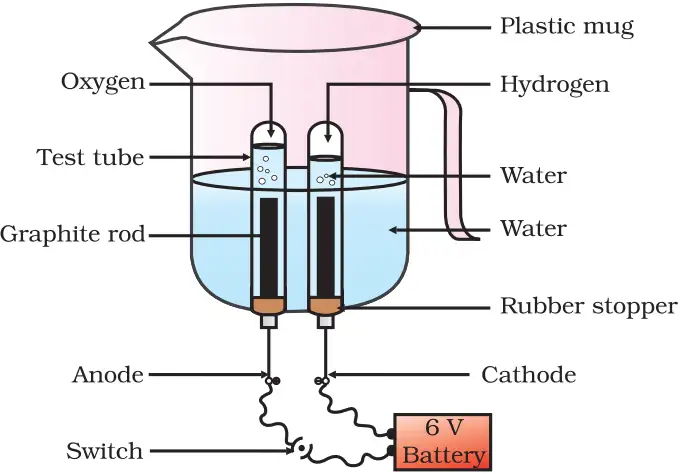
- Drill two holes at the base of a plastic vessel and fit them with rubber stoppers carrying two graphite electrodes.
- Connect the electrodes to the terminals of a 6 V battery through a switch.
- Fill the vessel with water until the electrodes are immersed, and add a few drops of dilute sulphuric acid.
- Invert two water-filled test tubes over the two carbon electrodes.
- Switch on the electric current, leave undisturbed, and observe the displacement of water in both tubes.
Observations & Chemical Mechanism
- Observation: Bubbles form at both electrodes; the volume of gas collected above the cathode is double the volume collected above the anode.
- Chemical Identity: Water decomposes into hydrogen gas at the cathode (negative terminal) and oxygen gas at the anode (positive terminal).
- Chemical Equation:
2H₂O(l) ⎯⎯Electricity→ 2H₂(g) + O₂(g) - Classification: Electrolytic decomposition reaction (Electrolysis).
Q1: Why is the volume of gas collected in one test tube exactly double that collected in the other?
Answer: Water consists of two hydrogen atoms combined with one oxygen atom (H₂O). During electrolytic decomposition, 2 moles of hydrogen gas are liberated at the cathode for every 1 mole of oxygen gas liberated at the anode, yielding a 2:1 volume ratio.
Q2: Why are a few drops of dilute sulphuric acid added to pure distilled water prior to passing current?
Answer: Pure distilled water is covalent and lacks free mobile ions, making it a poor electrical conductor. Adding dilute sulphuric acid introduces free H⁺ and SO₄²⁻ ions that allow electric current to pass through the liquid.
Q3 (Application Based): What will happen if graphite rods are substituted with active iron electrodes in the electrolysis of acidified water?
Answer: Graphite is an inert electrode that does not take part in chemical reactions. If iron electrodes are used, the iron anode will undergo sacrificial oxidation (Fe → Fe²⁺ + 2e⁻) and dissolve into the electrolyte instead of producing pure oxygen gas, disrupting the observation of the 2:1 gas volume ratio.
Q4 (Application Based): How can this activity be connected to green hydrogen production technologies used in clean energy transitions?
Answer: The electrolysis of water demonstrated in Activity 1.7 represents the fundamental chemical mechanism behind zero-carbon industrial green hydrogen generation. By powering this water-splitting electrolytic process with renewable energy (such as solar or wind power), pure hydrogen fuel is produced without generating greenhouse gas emissions.
Activity 1.8: Photochemical Decomposition of Silver Halides
Action of Sunlight on Silver Chloride and Silver Bromide
Experimental Procedure
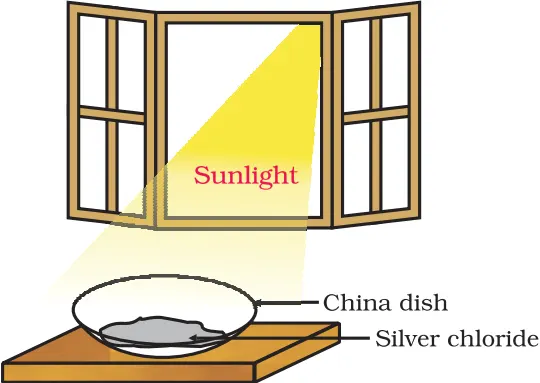
- Place about 2 g of white silver chloride powder in a clean china dish.
- Leave the dish exposed to direct sunlight for some time.
- Observe the change in color of the powder.
Observations & Chemical Mechanism
- Observation: White silver chloride powder turns grey in sunlight.
- Chemical Identity: Light energy decomposes silver chloride into elemental grey metallic silver and greenish-yellow chlorine gas.
- Chemical Equations:
2AgCl(s) ⎯⎯Sunlight→ 2Ag(s) + Cl₂(g)
2AgBr(s) ⎯⎯Sunlight→ 2Ag(s) + Br₂(g) - Classification: Photochemical (photolytic) decomposition reaction and endothermic reaction.
Q1: Why does white silver chloride powder turn grey when left in sunlight?
Answer: In the presence of sunlight, silver chloride absorbs light energy and decomposes photolytically into elemental metallic silver and chlorine gas. The formed silver metal is finely divided and grey in color.
Q2: Name an important commercial application of the decomposition of silver chloride and silver bromide.
Answer: The light-sensitive decomposition of silver chloride and silver bromide is used in traditional black-and-white photography.
Q3 (Application Based): Why do photochromic eyeglass lenses darken when going outdoors in the sun and become transparent indoors?
Answer: Photochromic lenses contain microcrystalline silver halides embedded inside the glass matrix. When exposed to solar ultraviolet rays outdoors, photolytic reduction forms minute particles of elemental silver, darkening the lens. Indoors, away from UV light, the silver and halogen recombine reversibly into clear silver halide, restoring optical clarity.
Q4 (Application Based): Why does this reaction not occur when silver chloride is kept inside a dark cupboard or illuminated by a low-energy yellow safety lamp?
Answer: Photolytic decomposition requires photons with energy equal to or greater than the activation bond energy of Ag–Cl. Low-frequency yellow safety light and dark conditions lack the threshold photon energy required to overcome this activation barrier, leaving the chemical bonds intact.
Activity 1.9: Displacement in Iron and Copper Sulphate
Reaction of Iron Nails Dipped in Blue Copper Sulphate Solution
Experimental Procedure
- Clean three iron nails with sandpaper.
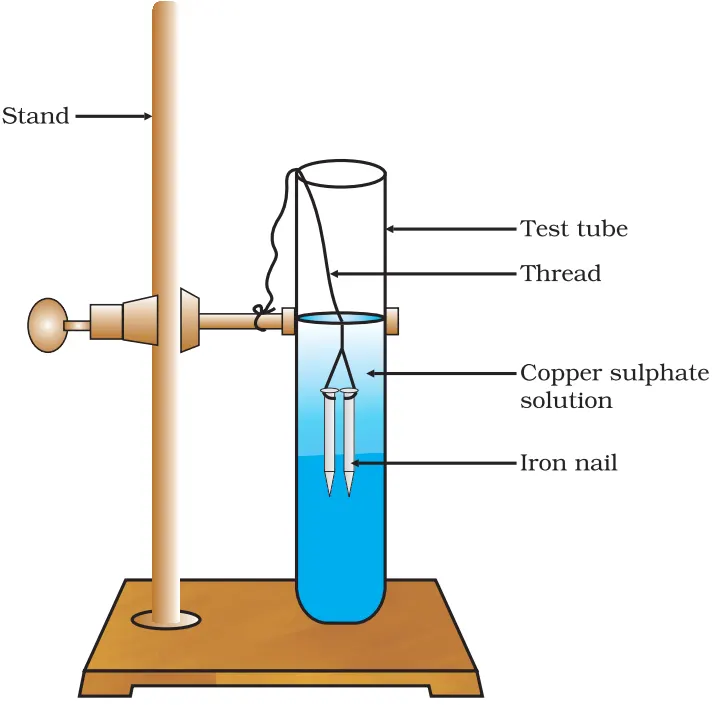
- Take two test tubes marked (A) and (B), each containing about 10 mL of blue copper sulphate solution.
- Immerse two cleaned iron nails into tube B using a thread for 20 minutes; keep the third nail aside for comparison.
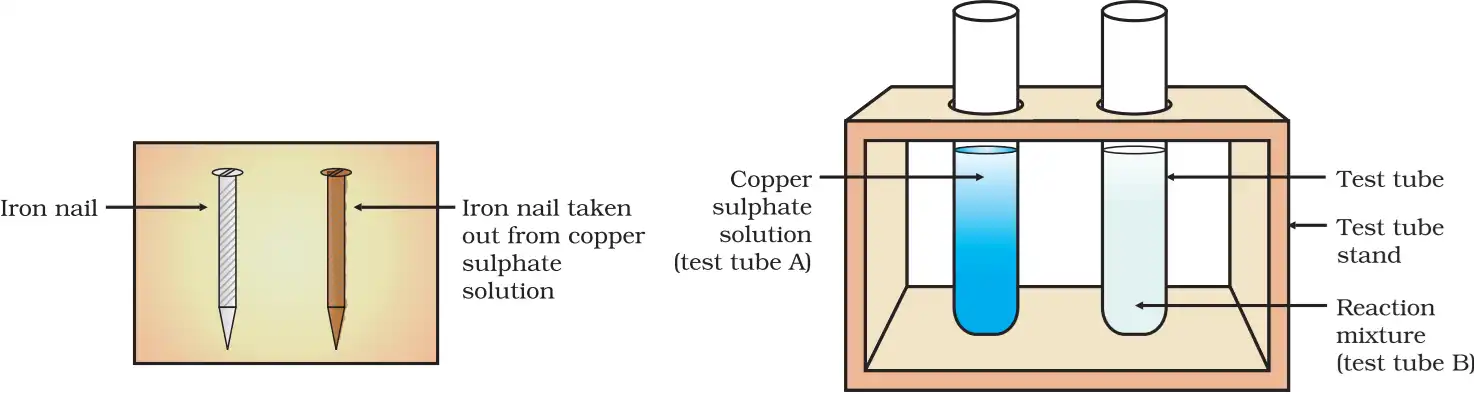
- Remove the nails after 20 minutes and compare their surface color as well as the solution colors of tubes A and B.
Observations & Chemical Mechanism
- Observation: The deep blue color of the copper sulphate solution in tube B fades to a light pale green. The immersed nails become coated with a reddish-brown deposit.
- Chemical Identity: Iron, being more reactive than copper, displaces copper from copper sulphate solution to form ferrous sulphate and copper metal.
- Chemical Equation:
Fe(s) + CuSO₄(aq) → FeSO₄(aq) + Cu(s) - Classification: Single displacement reaction and redox reaction.
Q1: Why does the deep blue color of the copper sulphate solution change to pale green?
Answer: The blue color is due to hydrated Cu²⁺ ions. Iron, being more reactive, displaces copper from the solution to form iron(II) sulphate (FeSO₄). Fe²⁺ ions in aqueous solution impart a characteristic pale green color.
Q2: What is the composition and color of the coating deposited on the iron nails?
Answer: The deposit on the nails is metallic copper (
Cu), which forms a rough, reddish-brown layer.Q3 (Application Based): A farmer stores blue copper sulphate solution in an iron container. After a few days, holes appear at the bottom of the container. Explain the chemical reason for this damage.
Answer: Iron is chemically more reactive than copper. The iron metal of the vessel container displaces copper ions from the CuSO₄ solution:
Fe(s) + CuSO₄(aq) → FeSO₄(aq) + Cu(s). In doing so, solid iron dissolves continuously into solution as Fe²⁺ ions, thinning the metal walls and eventually creating perforations and leaks.Q4 (Application Based): If a copper wire is dipped into an iron(II) sulphate solution, will any color change be observed? Justify your answer.
Answer: No change will be observed. Copper is lower than iron in the reactivity series; it lacks the electropositive reducing power to displace Fe²⁺ ions from ferrous sulphate solution. Therefore, no chemical reaction takes place.
Activity 1.10: Double Displacement and Precipitation
Reaction of Sodium Sulphate with Barium Chloride
Experimental Procedure
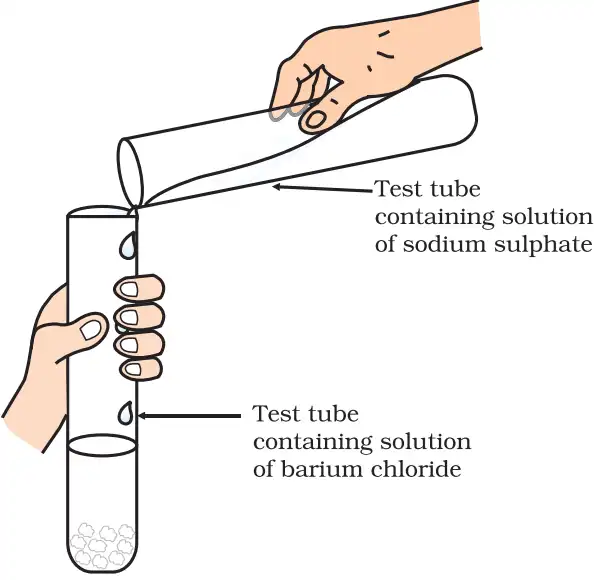
- Take about 3 mL of sodium sulphate solution (Na₂SO₄) in a test tube.
- In another test tube, take about 3 mL of barium chloride solution (BaCl₂).
- Mix the two colorless solutions together and observe.
Observations & Chemical Mechanism
- Observation: A white, water-insoluble precipitate forms instantly upon mixing the two clear liquids.
- Chemical Identity: Barium cations (Ba²⁺) and sulphate anions (SO₄²⁻) combine to produce insoluble barium sulphate, while sodium chloride remains dissolved.
- Chemical Equation:
Na₂SO₄(aq) + BaCl₂(aq) → BaSO₄(s)↓ + 2NaCl(aq) - Classification: Double displacement reaction and precipitation reaction.
Q1: Define a precipitation reaction based on the observations in Activity 1.10.
Answer: Any chemical reaction between two aqueous solutions that produces an insoluble solid product that separates from the solution is termed a precipitation reaction. The insoluble solid is known as a precipitate.
Q2: Write the net ionic equation showing the ions that combine to form the precipitate.
Answer: The net ionic precipitation equation is:
Ba²⁺(aq) + SO₄²⁻(aq) → BaSO₄(s)↓. Barium sulphate is insoluble and forms the white precipitate.Q3 (Application Based): In medical radiology, patients consume a suspension of barium sulphate (a “barium meal”) before stomach X-rays. Why is BaSO₄ safe to ingest despite barium ions being toxic?
Answer: Barium sulphate has an extremely low solubility product (it is virtually insoluble in water, stomach acids, and digestive fluids). Because it cannot dissolve, toxic free Ba²⁺ ions are not absorbed into the bloodstream. Its high electron density blocks X-rays, making the digestive tract visible on radiographic film.
Q4 (Application Based): How is this reaction applied in qualitative analytical chemistry to detect the presence of sulphate ions in an unknown salt sample?
Answer: When an aqueous solution of barium chloride (acidified with dilute HCl) is added to an unknown salt solution, the instant formation of a thick white precipitate that remains insoluble in dilute hydrochloric acid confirms the presence of sulphate (SO₄²⁻) ions.
Activity 1.11: Oxidation and Reduction of Copper
Oxidation of Copper to Copper Oxide and Its Reduction with Hydrogen
Experimental Procedure
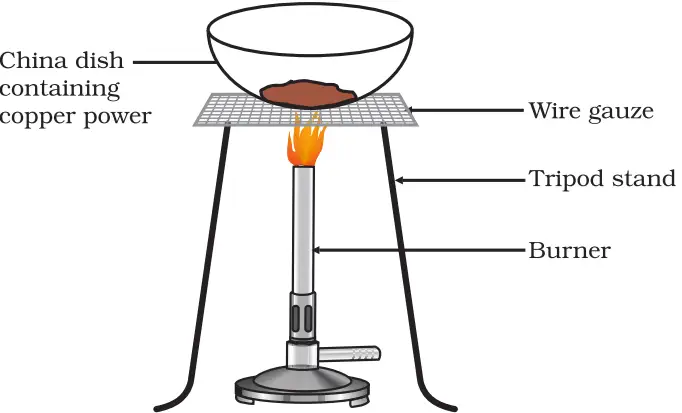
- Heat about 1 g of fine brown copper powder in a china dish over a wire gauze and tripod stand.
- Observe the color change on the powder’s surface.
- Pass dry hydrogen gas (H₂) over the resulting hot black material and observe.
Observations & Chemical Mechanism
- Observation: Upon heating in air, brown copper turns black due to the formation of copper(II) oxide. When hydrogen gas passes over the hot black compound, the surface turns back into shiny reddish-brown copper.
- Chemical Identity: Copper is oxidised by oxygen to copper(II) oxide; hydrogen then reduces copper(II) oxide back to copper metal.
- Chemical Equations:
Oxidation:2Cu(s) + O₂(g) ⎯⎯Δ→ 2CuO(s)
Reduction:CuO(s) + H₂(g) ⎯⎯Δ→ Cu(s) + H₂O(g) - Classification: Oxidation reaction in step 1; Redox (oxidation-reduction) reaction in step 2.
Q1: In the reaction CuO + H₂ ⎯⎯Δ→ Cu + H₂O, identify the substance oxidised, substance reduced, oxidizing agent, and reducing agent.
Answer:
• Substance oxidised:
• Substance reduced:
• Oxidizing agent:
• Reducing agent:
• Substance oxidised:
H₂ (gains oxygen to form H₂O)• Substance reduced:
CuO (loses oxygen to form Cu)• Oxidizing agent:
CuO (provides oxygen)• Reducing agent:
H₂ (removes oxygen from CuO)
Q2: A shiny brown element ‘X’ on heating in air turns black, forming compound ‘Y’. When hydrogen gas is passed over heated ‘Y’, element ‘X’ is regenerated. Identify ‘X’ and ‘Y’.
Answer: Element ‘X’ is metallic copper (
Cu). The black compound ‘Y’ formed on heating in air is copper(II) oxide (CuO).Q3 (Application Based): Why are potato chips and fried oily foods flushed with unreactive nitrogen gas, and how is this related to the oxidation process observed here?
Answer: Just as copper oxidizes in air to form an oxide layer, the unsaturated fats and oils in fried foods react with atmospheric oxygen over time. This oxidation produces volatile aldehydes and carboxylic acids with a foul smell and rancid taste (rancidity). Flushing sealed bags with unreactive nitrogen gas displaces oxygen, preventing oxidation and preserving food freshness.
Q4 (Application Based): In metallurgical copper extraction, why is carbon or carbon monoxide used as a reducing agent instead of expensive hydrogen gas?
Answer: Carbon (coke) and carbon monoxide are inexpensive, easily transported, and thermally stable reducing agents at high smelting temperatures. The reaction
2CuO + C → 2Cu + CO₂ is economically viable and energy-efficient for large-scale extraction compared to the high cost of producing and handling pure, flammable hydrogen gas.