Class 10 Economics Chapter 2 – Sectors of Indian Economy MCQs (Set 1)
Class 10 Economics Chapter 2 MCQs: Sectors of the Indian Economy (Quiz & Solutions)
Class 10 Economics Chapter 2 MCQs: Sectors of the Indian Economy
Looking for the most comprehensive collection of Class 10 Economics Chapter 2 MCQs? This interactive practice set covers every critical concept from NCERT Class 10 Social Science: Sectors of the Indian Economy. Formatted strictly as per the latest CBSE Board exam pattern, these questions test theoretical clarity, analytical ability, and data interpretation.
Key Concepts Covered in this Practice Test:
Three Sectors of Economic Activities: Classification into Primary (Agriculture), Secondary (Industrial), and Tertiary (Services).
GVA and GDP Measurement: Distinction between intermediate and final goods, avoiding double counting.
Employment Trends & Structural Shifts: Analysis of NSSO/NSO data and historical changes across sectors.
Types of Unemployment: Open unemployment vs. disguised unemployment (underemployment) in rural and urban areas.
Employment Generation Schemes: Role of rural credit, infrastructure, agro-processing, and MGNREGA (Right to Work).
Classification by Employment Conditions & Ownership: Organised vs. Unorganised sectors, and Public vs. Private enterprises.
Tip: Select your answer for each question to see the step-by-step reasoning, textbook reference, and real-time score tracking.
Interactive Quiz: 50 Class 10 Economics Chapter 2 Sectors of the Indian Economy MCQs (Set 1)
Answered: 0/50Score: 0/50✓ 0 | ✗ 0
Section A: Picture & Graph Interpretation
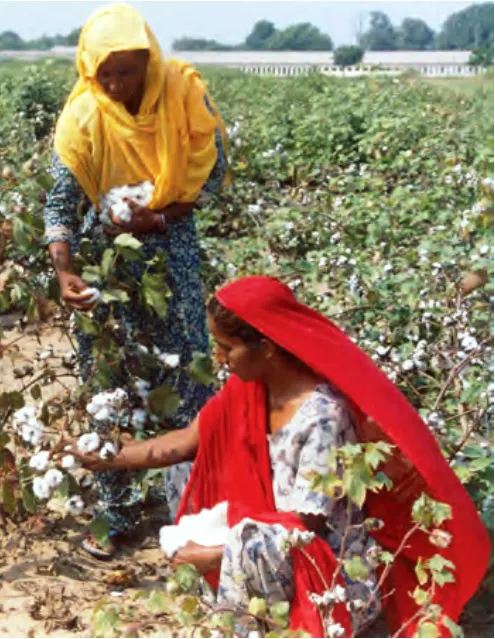
1. Observe the economic activity shown in the picture below:
To which sector of the economy does this activity belong, and what type of product is obtained?
Explanation: Cotton cultivation involves the direct exploitation of natural resources (sunlight, rainfall, climate), producing a natural good belonging to the primary sector.
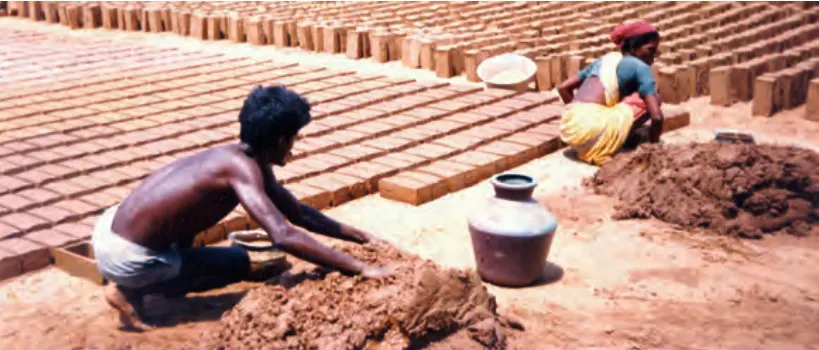
2. Study the manufacturing process shown in the image below:
Why is brick making classified as a secondary sector activity?
Explanation: The secondary sector covers activities in which natural products (like earth/clay) are converted into other forms (like bricks) through manufacturing.
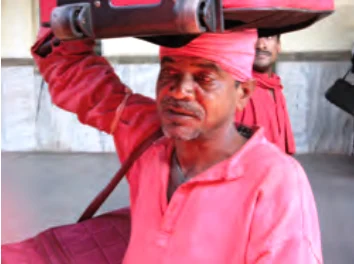
3. Look at the service worker shown carrying luggage at a railway platform:
Which sector does this worker belong to, and what characterizes the output?
Explanation: Porters provide physical transport aid that supports human movement and commerce, generating services rather than goods in the tertiary sector.
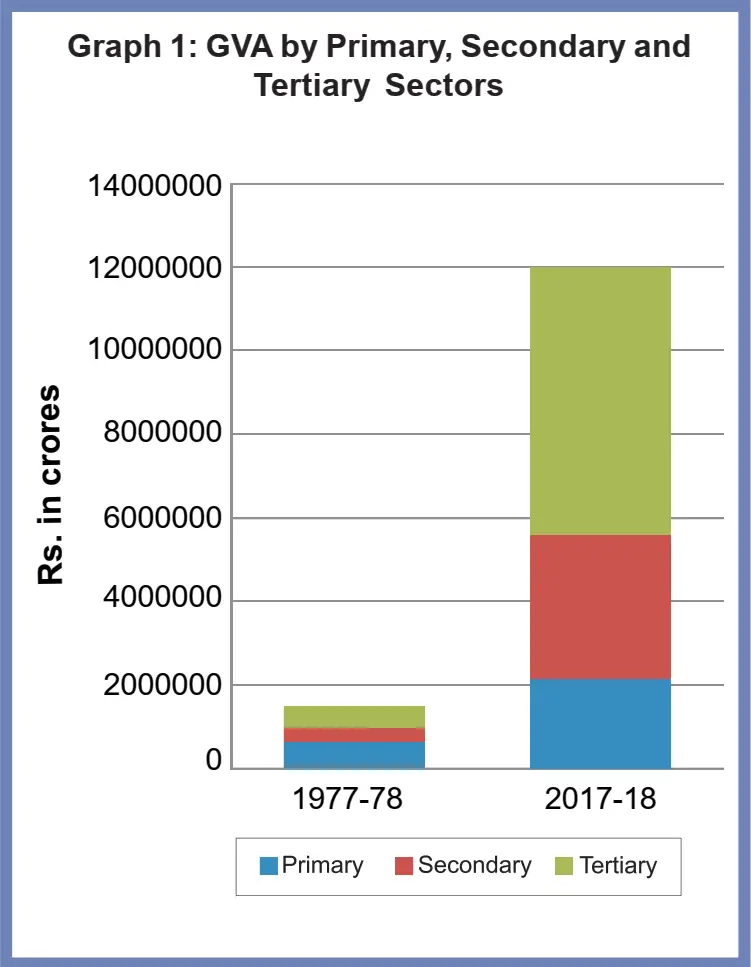
4. Observe Graph 1 from the textbook comparing Gross Value Added (GVA) across sectors:
Which sector emerged as the largest producing sector in India in 2017-18, replacing the primary sector?
Explanation: Over the 40 years between 1977-78 and 2017-18, production in the tertiary sector expanded most rapidly, making it the largest contributor to GVA in India.
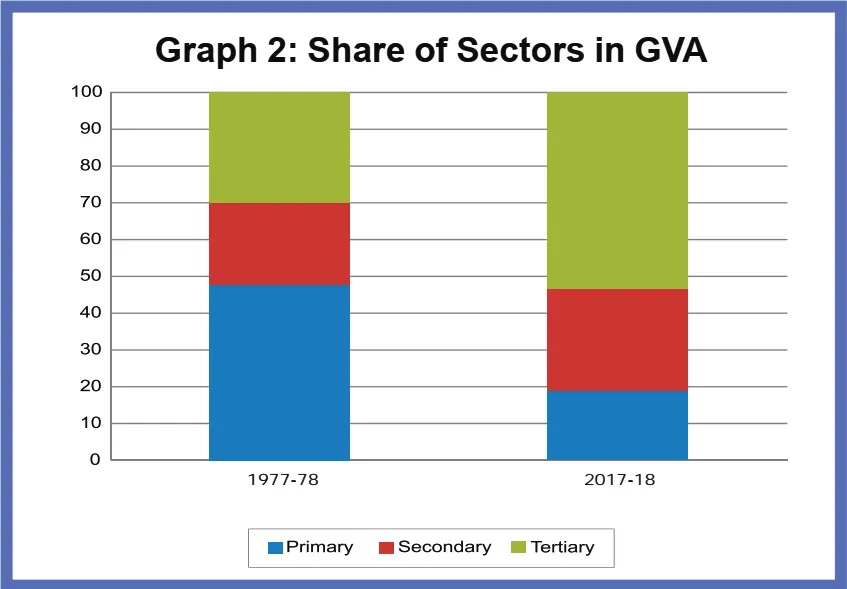
5. Examine Graph 2 showing the percentage share of sectors in India’s GVA:
In 2017-18, the share of the tertiary sector in India’s GVA was approximately between:
Explanation: As illustrated in Graph 2 and textbook exercise 2(d), the share of the tertiary sector in GVA for 2017-18 was between 50 and 60 per cent.
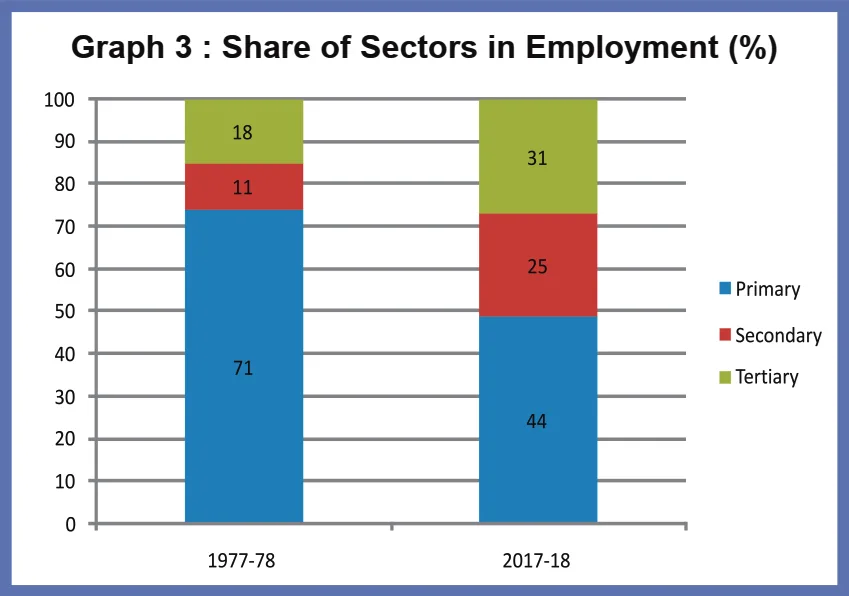
6. Study Graph 3 illustrating the sectoral share of employment in India:
What was the share of the primary sector in total employment in India in 2017-18?
Explanation: According to Graph 3, the share of the primary sector in employment decreased from 71% in 1977-78 to 44% in 2017-18, yet it remained the largest employer.
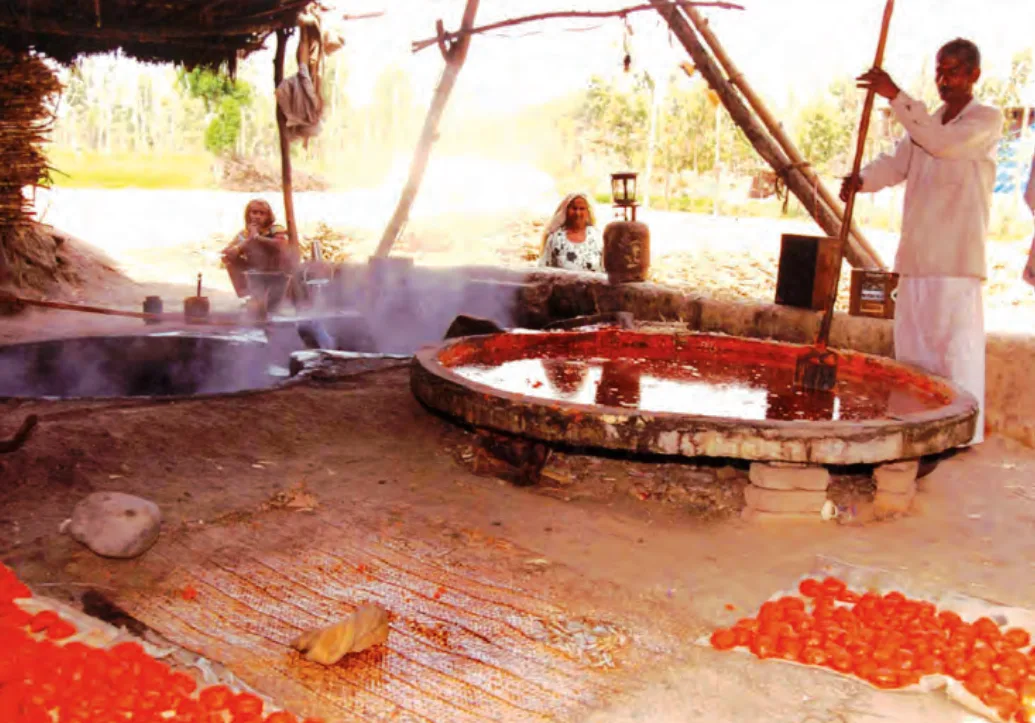
7. Observe the illustration of rural semi-industrial processing shown below:
Which type of industry does gur making from sugarcane represent, and where is its ideal location?
Explanation: Processing sugarcane into gur is an agro-based manufacturing activity. Locating such units in semi-rural areas provides vital non-farm employment.
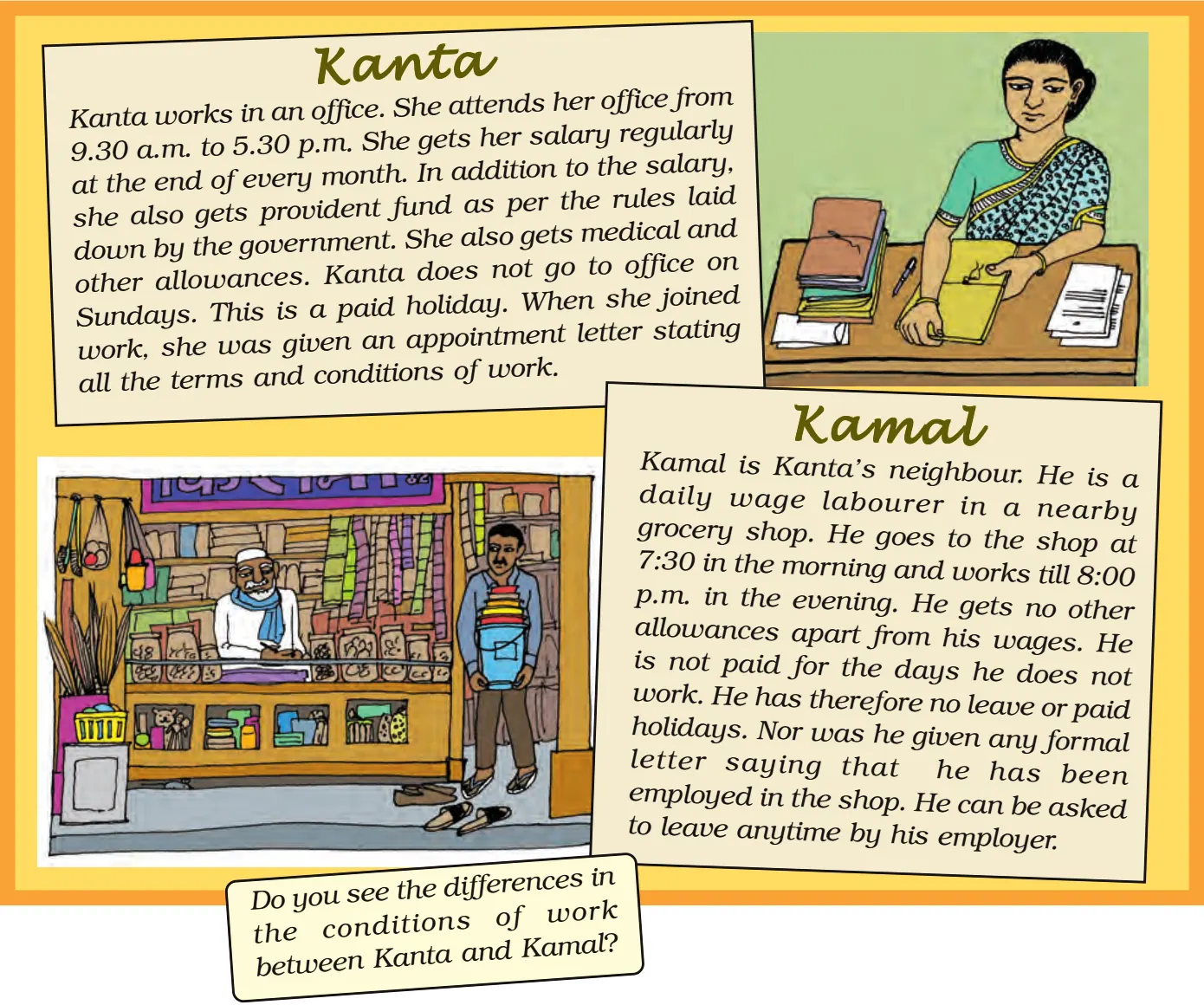
8. Study the contrasting workplace conditions of Kanta and Kamal depicted in the textbook:
Which key feature differentiates Kanta’s employment in the organised sector from Kamal’s job?
Explanation: Kanta works in the organised sector where employment terms are regular, workers enjoy security of tenure, fixed hours, medical benefits, and provident fund.
Section B: Competency & Case-Based Scenarios
9. Case Scenario: Laxmi owns a 2-hectare unirrigated plot of land. All 5 members of her family work on the farm throughout the year growing jowar and arhar. If 2 members move to work on a landlord’s field, total farm output from Laxmi’s plot remains unchanged. What economic phenomenon does this illustrate?
Explanation: When more people work on land than required, their individual effort gets divided. Even if some are removed, total output is unaffected. This hidden joblessness is disguised unemployment.
10. Competency Calculation: A farmer sells wheat to a flour mill for Rs 20/kg. The mill sells flour to a biscuit company for Rs 25/kg. The biscuit manufacturer uses flour, sugar, and oil to make biscuits and sells them to consumers for Rs 80. How is GDP computed in this chain to avoid double counting?
Explanation: To prevent multiple counting of the same commodities, only final goods and services purchased by end consumers (Rs 80 for biscuits) are counted in GDP, as they already incorporate intermediate values.
11. Case Scenario: In an urban city, thousands of casual painters, plumbers, electricians, and daily wage construction labourers gather at labour chowks every morning. Many fail to find work on several days. This underemployment in urban services occurs because:
Explanation: Many people in low-end tertiary jobs work long hours for low earnings because the organized economy has generated insufficient productive opportunities.
12. A policy study by the erstwhile Planning Commission (NITI Aayog) revealed that nearly 60% of India’s population is aged 5–29 years, but only about 51% attend schools and colleges. According to this report, how many jobs can be created in the education sector alone if all children attend school?
Explanation: Planning Commission estimates indicate that expanding school buildings, teachers, and support personnel to educate all children could create nearly 20 lakh jobs in education.
13. According to NITI Aayog research, if regional craft, cultural heritage, and tourism facilities across states are systematically planned and promoted, how many additional livelihoods could be generated annually?
Explanation: The Planning Commission study estimated that developing regional tourism could provide additional employment to more than 35 lakh people every year.
14. Why does the central government step in to supply electricity to small-scale industries at subsidised rates below the full cost of generation?
Explanation: If power were charged at full generation cost, small units would face soaring expenses and close down; government absorbs part of the cost to sustain industrial production.
15. A survey of the workforce in a manufacturing hub discovered that 80% of workers lack written appointment letters, get no paid leaves or medical aid, and are dismissed when demand slumps. Which sector absorbs these workers?
Explanation: Lack of formal contracts, absence of benefits, insecure tenure, and seasonal wage employment define jobs in the unorganised sector.
Section C: Assertion & Reasoning (CBSE Pattern)
16. Assertion (A): In India, a major shift in GDP from agriculture to services was accompanied by an equal shift of employment out of the primary sector. Reason (R): Secondary and tertiary sectors failed to create adequate employment opportunities for workers.
Explanation: Assertion is false: although tertiary output surged, a matching employment migration did not occur; primary sector still employed 44% of workers in 2017-18 because industry and services created too few jobs.
17. Assertion (A): The tertiary sector is fundamentally different from the primary and secondary sectors. Reason (R): Tertiary activities do not produce tangible goods themselves; they provide support services that assist the production and distribution of goods.
Explanation: The tertiary sector is distinct because it yields services (transport, banking, trade) that aid production rather than creating tangible commodities.
18. Assertion (A): While calculating Gross Domestic Product (GDP), the value of intermediate goods is excluded. Reason (R): GDP represents the total market value of all final goods and services produced within a country during a particular year.
Explanation: Both statements are true, but R does not fully explain A: intermediate goods are excluded specifically to prevent double counting, since their value is already included in final goods.
19. Assertion (A): Workers in the organised sector are entitled to paid leaves, medical benefits, and provident funds. Reason (R): Organised sector units operate completely outside government control and are exempt from labour laws.
Explanation: Assertion is true, but Reason is false: organised sector enterprises are formally registered with the government and are legally bound to follow statutes like the Factories Act and Minimum Wages Act.
20. Assertion (A): Construction of heavy infrastructure like railways, highways, and mega dams is predominantly undertaken by private corporate firms without government involvement. Reason (R): Projects requiring massive capital investment and long gestation periods yield low immediate private profits, making public sector leadership essential.
Explanation: Assertion is false: the private sector cannot easily mobilize massive funds or collect user fees from millions at low prices; thus, the government must undertake heavy infrastructure spending.
Section D: Core Concepts & Practices (Q21 to Q50)
21. Activities that produce a good by exploiting natural resources belong to which sector?
Explanation: When a good is produced by directly using natural resources (agriculture, dairy, mining, forestry), it is classified under the primary sector.
22. Why is the primary sector also referred to as the ‘agriculture and related sector’?
Explanation: Since the majority of natural goods produced come from agriculture, forestry, dairy, and fishing, it is also called the agriculture and related sector.
23. Converting sugarcane into sugar or gur in a mill is an example of which sector?
Explanation: Processing raw agricultural output into manufactured goods through industrial activity is the core function of the secondary sector.
24. Transport, storage, communication, banking, and trade are examples of activities belonging to the:
Explanation: Activities that assist the production process and facilitate trade and communication generate services and constitute the tertiary sector.
25. Services provided by teachers, doctors, lawyers, barbers, and washermen are included in the tertiary sector because:
Explanation: The service sector includes essential personal and professional services that do not directly produce material goods.
26. Which of the following is a newly emerging, IT-based service in the tertiary sector?
Explanation: Information technology services like software enterprises, call centres, ATM booths, and internet kiosks are modern tertiary activities.
27. If transporters go on strike and lorries refuse to carry vegetables and milk from villages to cities, which sectors are affected?
Explanation: Farmers cannot sell produce (primary suffers), food becomes scarce in urban industries and households (secondary/tertiary suffer), proving interdependence.
28. What is the total monetary value of all final goods and services produced within a country in a year called?
Explanation: Gross Domestic Product (GDP) is the sum of the monetary value of all final goods and services produced inside a nation in a given year.
29. In India, which authority coordinates with departments of states and union territories to estimate GDP?
Explanation: In India, the task of measuring GDP is conducted by a Central Government Ministry in collaboration with state and union territory statistical bodies.
30. What metric has the Indian government adopted in place of GDP to measure sectoral contributions adjusted for taxes and subsidies?
Explanation: India adopted Gross Value Added (GVA) to measure the net contribution of each sector after adjusting for taxes and subsidies.
31. What historical trend was observed in now developed nations during their early stages of growth?
Explanation: During early stages of economic development in advanced countries, agriculture (primary sector) accounted for the bulk of production and jobs.
32. With the introduction of factory manufacturing more than a century ago, what structural shift occurred in developed countries?
Explanation: Industrialization shifted the economic centre of gravity to factories, making the secondary sector the leader in output and jobs.
33. Over the past 100 years, what further structural transition occurred in advanced developed economies?
Explanation: Developed nations experienced a transition from industrial dominance toward a service-led economy where services generate most output and jobs.
34. Why is the government primarily responsible for providing basic services like hospitals, schools, and defense in developing nations?
Explanation: Basic infrastructure and welfare facilities (police, healthcare, courts, defense) are public goods that the state must guarantee for all citizens.
35. As personal income levels rise in urban cities, which services experience surging consumer demand?
Explanation: Rising disposable incomes create lifestyle demand for recreational, commercial, hospitality, and private medical/educational services.
36. Between 1977-78 and 2017-18, industrial production in India grew over 9 times, while industrial employment grew by about:
Explanation: Industrial output grew more than 9 times, but industrial job creation was sluggish, rising only around 3 times during the same period.
37. While service sector production in India expanded 14 times between 1977-78 and 2017-18, service sector employment grew by approximately:
Explanation: Tertiary production rose 14-fold, yet service sector employment grew by only around 5 times, highlighting jobless growth tendencies.
38. In 2017-18, workers in Indian agriculture produced roughly what share of total GVA?
Explanation: Agricultural workers, representing nearly half the working populace, contributed only about one-sixth of India’s GVA, showing lower labor productivity.
39. Underemployment is called ‘disguised’ because:
Explanation: Unlike open unemployment where joblessness is visible, here people are visibly working, but working less than their full productive capacity.
40. How can the construction of a village check-dam and irrigation canal increase rural employment?
Explanation: Canal construction hires workers immediately and provides water for growing second and third crops (rabi), generating farm work.
41. Why is affordable institutional bank credit vital for small and marginal cultivators?
Explanation: Cheap credit prevents exploitation by moneylenders and lets farmers acquire agricultural inputs timely for viable farming.
42. How does setting up cold storages and dal mills in semi-rural areas assist farmers?
Explanation: Processing units and cold storages prevent distress selling of potatoes, onions, or pulses while establishing non-farm employment.
43. What statutory guarantee was provided under the historic Mahatma Gandhi National Rural Employment Guarantee Act (MGNREGA 2005)?
Explanation: MGNREGA guaranteed 100 days of rural wage employment per year for unskilled manual labor, with unemployment allowances if unprovided.
44. In the updated rural employment framework, which mission succeeded the earlier rural guarantee model?
Explanation: In 2025, the Act was replaced by Viksit Bharat-Guarantee for Rozgar and Ajeevika Mission (Viksit Bharat-G RAM G 2025).
45. Enterprises in the organised sector are legally required to comply with which statutory framework?
Explanation: Organised enterprises must follow laws formulated by the government including the Factories Act, Minimum Wages Act, Gratuity Act, and Shops Act.
46. Why do some private enterprises operate informally within the unorganised sector despite employing numerous workers?
Explanation: Many firms remain unregistered or operate informally to evade taxes and avoid paying mandatory employee benefits like gratuity and overtime.
47. In rural India, what percentage of farming households belong to the small and marginal farmer category needing protection?
Explanation: Nearly 80 per cent of rural households in India are in the small and marginal farmer category requiring input, credit, and storage support.
48. Economic activities are categorised into public and private sectors primarily on the basis of:
Explanation: Sector classification as public or private depends on who owns the capital assets and directs service delivery (government vs private individuals).
49. Which of the following is a private sector enterprise guided primarily by the motive to earn profit?
Explanation: TISCO and Reliance Industries Limited are privately owned corporations driven by profit motives, unlike government-operated public utilities.
50. How does the government’s Food Corporation procurement and ration shop system support both farmers and consumers?
Explanation: The government procures wheat and rice at fair support prices from farmers and sells them at lower prices via ration shops, absorbing budgetary subsidies for social welfare.
Q1. Why are only final goods and services counted while calculating GDP?
Final goods already include the monetary value of all intermediate goods used during production. Counting intermediate commodities separately would lead to double counting, inflating the GDP value.
Q2. What is disguised unemployment, and where is it most prevalent in India?
Disguised unemployment (underemployment) occurs when more workers are engaged in an activity than required, so their individual productivity is reduced. If some workers are withdrawn, total output remains unaffected. It is most prevalent in India’s agricultural (primary) sector.
Q3. Why has the tertiary sector grown so rapidly in India?
The tertiary sector has grown rapidly due to government provision of basic services (hospitals, schools, transport), expansion of agriculture and industry requiring support services, rising household income levels, and the rapid boom in IT and communication technologies.
Q4. How do organized and unorganized sectors differ?
The organised sector is registered with the government, guarantees security of tenure, fixed working hours, paid leave, and follows labour statutes. The unorganised sector consists of small, scattered units outside state regulation with low wages, no job security, and no benefits.