
Class 10 History Chapter 1 MCQS | The Rise of Nationalism in Europe (Set 1)
Answered: 0/30
Score: 0/30
✓ 0 | ✗ 0
Section A: Picture-Based & Source Questions
1. Which of the following aspects best signifies this image?
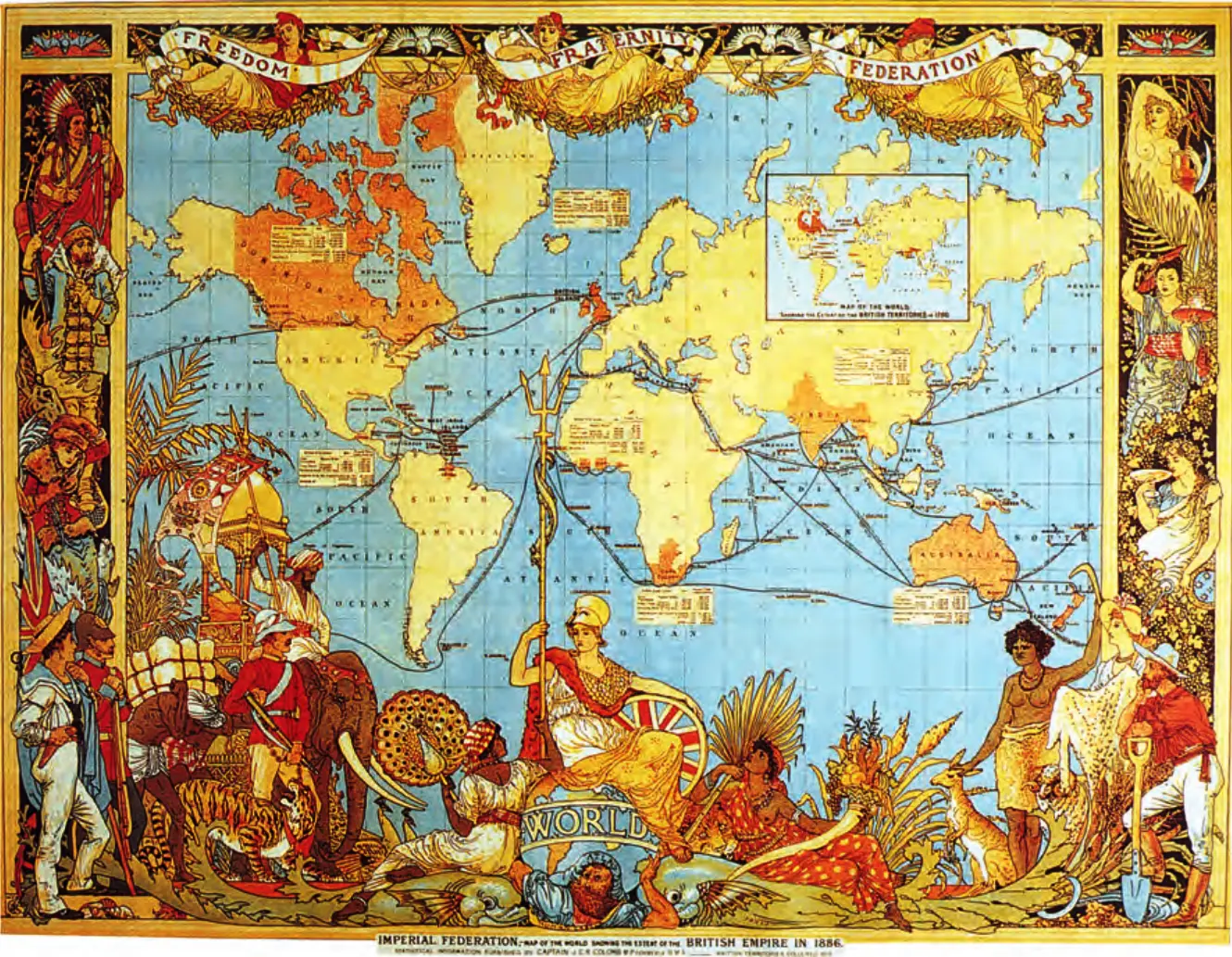
Explanation: In Fig. 20 of the textbook, Britannia is seated over the globe with angels carrying banners of freedom, celebrating the reach of the British Empire.
2. In the picture of Frédéric Sorrieu’s utopian vision, what do the saints, angels, and Christ symbolise?
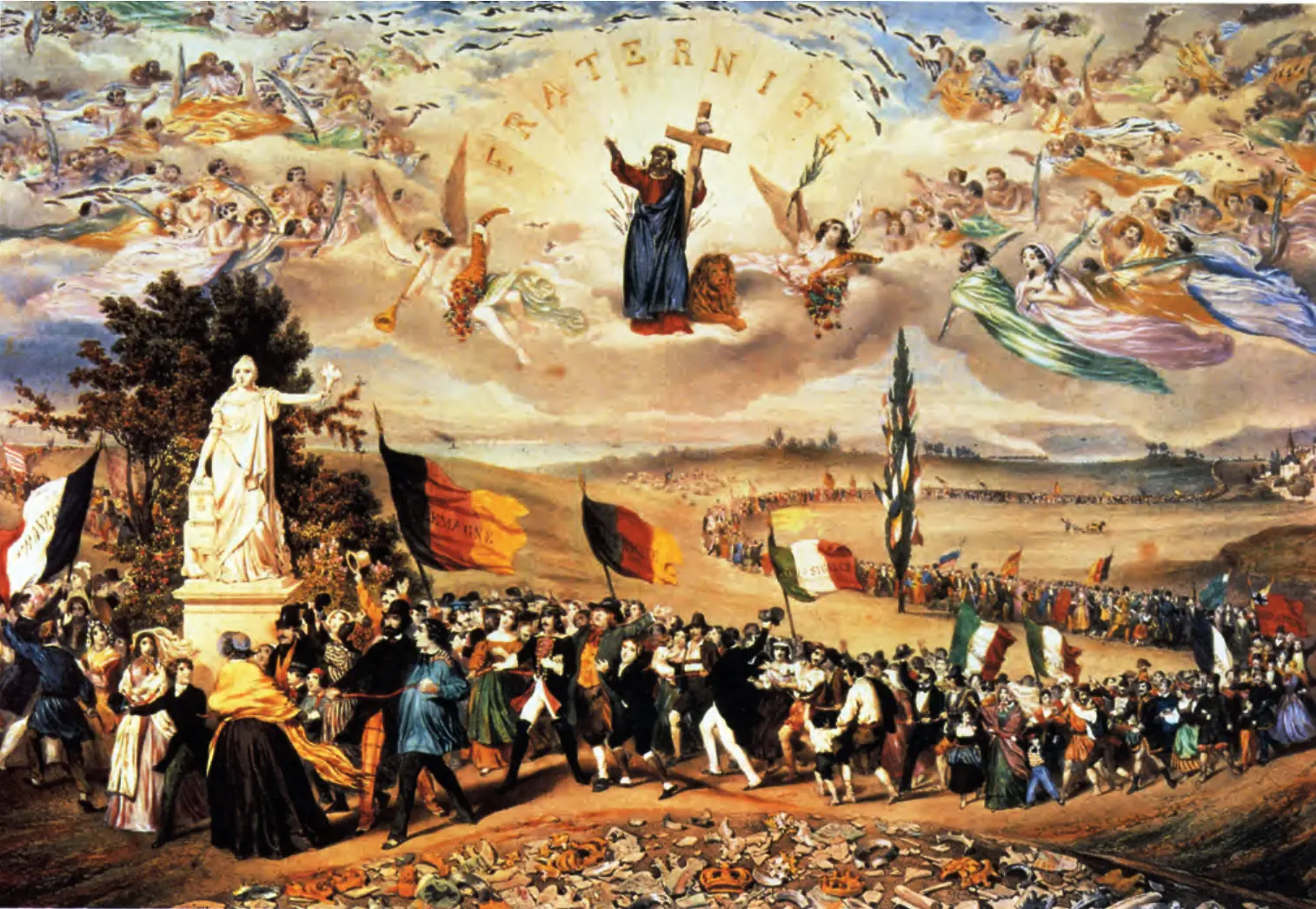
Explanation: According to the textbook (page 4), Christ, saints, and angels gazing from the heavens symbolise fraternity among the nations of the world.
3. Study the picture and answer the question: What do each of the letters dropping out of Napoleon’s bag bear?
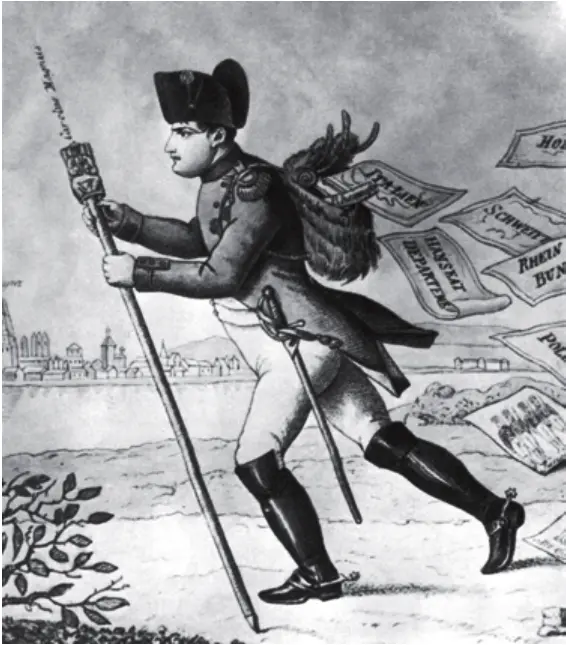
Explanation: Napoleon is portrayed as a courier returning home after his defeat at Leipzig in 1813; each dropping letter bears the name of a lost territory.
4. Study the picture and answer the question: Who designed the cover of this German almanac?
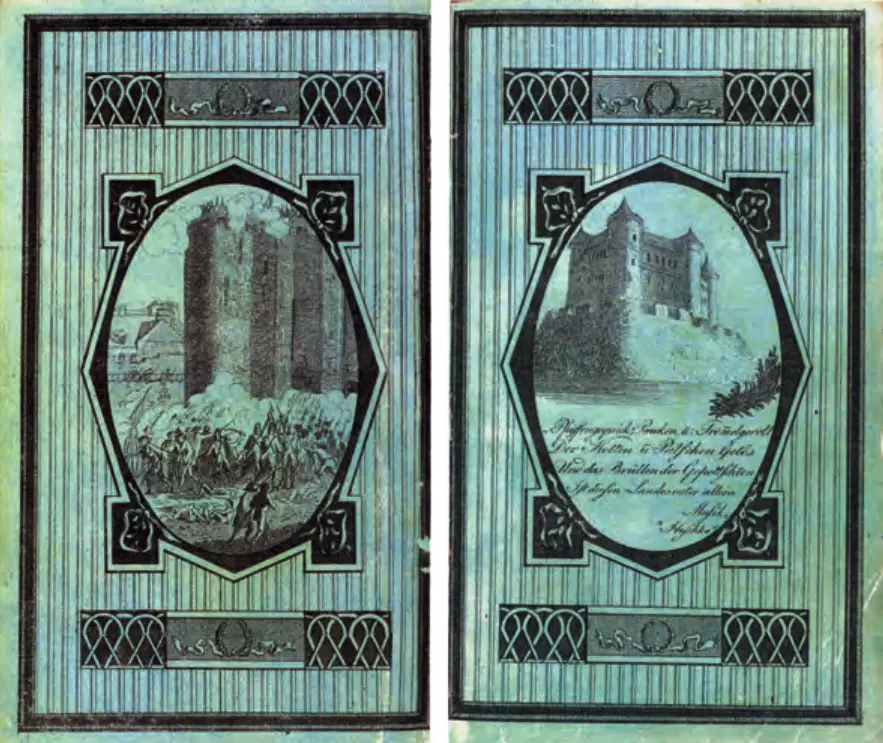
Explanation: The cover of the German almanac of 1798 was designed by journalist and German Jacobin member Andreas Rebmann.
Section B: Assertion & Reasoning Questions
5.
Assertion (A): Serfdom and bonded labour were abolished in Habsburg dominions and Russia.
Reason (R): Monarchs had realised that revolution could be resisted only by granting concessions to liberal nationalist rebels.
Reason (R): Monarchs had realised that revolution could be resisted only by granting concessions to liberal nationalist rebels.
Explanation: Conservative rulers realized that granting concessions to liberal-nationalists was the only way to halt recurring revolutions, leading to the abolition of serfdom after 1848.
6.
Assertion (A): The growth of revolutionary nationalism in Europe sparked off a struggle for independence amongst the Greeks which began in 1821.
Reason (R): Greece had been under the subjugation of the Ottoman Empire since the fifteenth century.
Reason (R): Greece had been under the subjugation of the Ottoman Empire since the fifteenth century.
Explanation: Greeks mobilized for national liberation in 1821 specifically to end long-standing foreign subjugation under the Ottoman Empire, influenced by revolutionary nationalist developments across Europe.
7.
Assertion (A): The most serious source of nationalist tension in Europe after 1871 was the Balkans.
Reason (R): A large part of the Balkans was under the control of the Ottoman Empire, whose disintegration made the region explosive.
Reason (R): A large part of the Balkans was under the control of the Ottoman Empire, whose disintegration made the region explosive.
Explanation: The disintegration of the Ottoman Empire alongside competing romantic nationalist aspirations made the Balkan states an explosive zone of conflict after 1871.
8.
Assertion (A): In Britain the formation of the nation-state was not the result of a sudden upheaval or revolution.
Reason (R): The first clear expression of nationalism came with the French Revolution in 1789.
Reason (R): The first clear expression of nationalism came with the French Revolution in 1789.
Explanation: Both statements are historically true, but the French Revolution in 1789 does not explain why Britain developed its nation-state via a prolonged parliamentary process.
Section C: Matching & Tabular Competencies
9. Match the Italian leaders in Column A with their roles in Column B:
| Leader (Column A) | Role (Column B) |
|---|---|
| (A) Victor Emmanuel II | (1) Chief Minister of Italy |
| (B) Giuseppe Mazzini | (2) Young Italy Movement |
| (C) Giuseppe Garibaldi | (3) Conquered the Kingdom of Two Sicilies |
| (D) Count Cavour | (4) Proclaimed king of Unified Italy |
Explanation: Victor Emmanuel II was proclaimed King of unified Italy (4), Mazzini founded Young Italy (2), Garibaldi led the Expedition of the Thousand (3), and Cavour served as Chief Minister (1).
10. Complete the table with the correct information regarding the Act of Union:
| Name of Act | Year | Leads to Creation of | Passed by Parliament of |
|---|---|---|---|
| Act of Union | 1707 | A – ? | B – ? |
Explanation: The Act of Union (1707) between England and Scotland resulted in the establishment of the United Kingdom of Great Britain.
11. Complete the table regarding the Congress of Vienna:
| Name of Meeting | Held in (Year) | Hosted by | Main Objective |
|---|---|---|---|
| Congress of Vienna | A – ? | B – ? | To restore conservative order in Europe |
Explanation: In 1815, representatives of the victorious European powers met at Vienna for a peace settlement hosted by Austrian Chancellor Duke Metternich.
12. Complete the table with the correct information:
| Column A | Column B |
|---|---|
| A – ? | Giuseppe Mazzini |
| King of united Italy in 1861 | B – ? |
Explanation: Giuseppe Mazzini was an Italian revolutionary nationalist, and Victor Emmanuel II was proclaimed King of united Italy in 1861.
Section D: Chronological & Sequencing Competencies
13. Arrange the following events in chronological order:
I. Treaty of Constantinople
II. Defeat of Napoleon
III. Unification of Italy
IV. Unification of Germany
I. Treaty of Constantinople
II. Defeat of Napoleon
III. Unification of Italy
IV. Unification of Germany
Explanation: II. Defeat of Napoleon (1815) → I. Treaty of Constantinople (1832) → III. Unification of Italy (1859–1870) → IV. Unification of Germany (1866–1871). Correct order is II, I, III, IV.
14. Arrange the following events in the correct sequence:
1. Frédéric Sorrieu prepared a series of 4 prints
2. French Revolution
3. Napoleon was defeated
4. Victor Emmanuel II was proclaimed king of united Italy
1. Frédéric Sorrieu prepared a series of 4 prints
2. French Revolution
3. Napoleon was defeated
4. Victor Emmanuel II was proclaimed king of united Italy
Explanation: 2. French Revolution (1789) → 3. Napoleon defeated (1815) → 1. Sorrieu’s prints (1848) → 4. Victor Emmanuel II proclaimed king (1861). Sequence is 2, 3, 1, 4.
15. Arrange the following events in the correct sequence:
1. Fall of Napoleon
2. Napoleon invades Italy
3. The defeat of Napoleon by Britain, Russia, Prussia, Austria
4. Napoleon lost the battle of Leipzig
1. Fall of Napoleon
2. Napoleon invades Italy
3. The defeat of Napoleon by Britain, Russia, Prussia, Austria
4. Napoleon lost the battle of Leipzig
Explanation: 2. Napoleon invades Italy (1797) → 4. Loses Battle of Leipzig (1813) → 1. Fall of Napoleon (1814) → 3. Final defeat at Waterloo (1815). Sequence is 2, 4, 1, 3.
Section E: Core Conceptual Questions
16. Which of the following option(s) is/are correct about Balkan nationalism?
I. The Balkan region became part of the conflict because of the Ottoman Empire.
II. The region comprised ethnic groups including Greeks, Serbs, Montenegro, etc.
III. British and ethnic nationalities struggled to establish their identity.
I. The Balkan region became part of the conflict because of the Ottoman Empire.
II. The region comprised ethnic groups including Greeks, Serbs, Montenegro, etc.
III. British and ethnic nationalities struggled to establish their identity.
Explanation: Statements I and II are correct according to the textbook (page 26). Statement III is false because British nationalities were not native inhabitants of the Balkans.
17. Who was proclaimed German Emperor in a ceremony held at Versailles in January 1871?
Explanation: On 18 January 1871, Kaiser William I of Prussia was proclaimed German Emperor in the Hall of Mirrors at Versailles.
18. Which of the following was the direct result of the Act of Union, 1707?
Explanation: The Act of Union (1707) between England and Scotland formed the United Kingdom of Great Britain.
19. Which of the following revolutions is called the first clear expression of nationalism?
Explanation: As stated on page 5 of the textbook, the first clear expression of nationalism came with the French Revolution in 1789.
20. Identify the personality:
• He was an English poet, peer, and politician.
• He organised funds and later went to fight in the Greek War of Independence.
• He died of fever in 1824.
• He fought on behalf of the Greeks against the Ottoman empire.
• He was an English poet, peer, and politician.
• He organised funds and later went to fight in the Greek War of Independence.
• He died of fever in 1824.
• He fought on behalf of the Greeks against the Ottoman empire.
Explanation: English poet Lord Byron raised funds and went to fight in Greece, where he succumbed to fever in 1824.
21. Which of the following countries were involved in the Three Wars over seven years with Prussia that ended with the unification of Germany?
Explanation: Prussia fought three wars against Austria, Denmark, and France, emerging victorious in all three to unify Germany.
22. Which one of the following was NOT included in the ‘Napoleonic Code’ of 1804?
Explanation: The Napoleonic Code of 1804 abolished all privileges based on birth, making Option A the correct answer.
23. Identify the ideology under which people demanded freedom of markets and abolition of tariff barriers in early nineteenth-century Europe:
Explanation: In the economic sphere, nineteenth-century liberalism stood for the freedom of markets and the abolition of state-imposed restrictions on trade.
24. Which of the following treaties recognized Greece as an independent nation in 1832?
Explanation: The Treaty of Constantinople of 1832 recognized Greece as an independent sovereign nation.
25. Which among the following best signifies the idea of liberal nationalism in nineteenth-century Europe?
Explanation: For the new middle classes, liberalism stood for freedom for the individual and equality of all before the law.
26. Identify the correct statement with regard to the ‘Zollverein’ from the following options:
Explanation: Formed in 1834 at the initiative of Prussia, the Zollverein was a customs union that abolished tariff barriers and unified trade.
27. Why did the weavers in Silesia revolt against contractors in 1845?
Explanation: Contractors had drastically slashed payments to weavers despite high product demand, triggering the revolt of 4 June 1845.
28. Identify the female allegories:
• Two female allegories of France and Germany.
• Personifications of the ‘Republic’ and ‘Liberty’.
• National symbols portrayed to express abstract ideas of the nation in concrete form.
• Two female allegories of France and Germany.
• Personifications of the ‘Republic’ and ‘Liberty’.
• National symbols portrayed to express abstract ideas of the nation in concrete form.
Explanation: Marianne was the female allegory of France and Germania was the allegory of the German nation.
29. From which of the following countries did Giuseppe Garibaldi originate?
Explanation: Giuseppe Garibaldi was an Italian revolutionary hero who led the Expedition of the Thousand in southern Italy.
30. Who among the following was the founder of the ‘Young Europe’ underground secret society in Berne?
Explanation: Giuseppe Mazzini founded Young Italy in Marseilles and Young Europe in Berne in 1833.
Quiz Performance Summary
Attempted
0 / 30
Correct
0
Incorrect
0
Percentage
0%