Class 10 History Chapter 1 MCQS | The Rise of Nationalism in Europe (Set 2)
Answered: 0/30
Score: 0/30
✓ 0 | ✗ 0
Section A: Picture-Based & Source Questions
1. Who is shown in this caricature sitting on his knees helping the King pull on the boot named ‘Italy’?
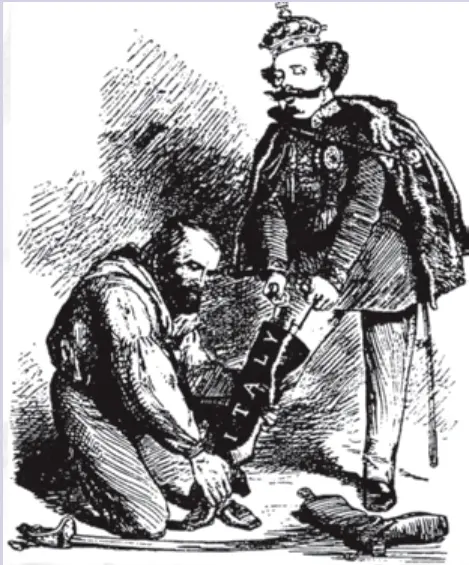
Explanation: In Fig. 15 (page 22 of the textbook), Giuseppe Garibaldi is depicted kneeling on the ground, helping King Victor Emmanuel II of Sardinia-Piedmont pull on the boot labeled ‘Italy'[cite: 403].
2. The postage stamp below displays the female allegory Marianne. Which country does she represent?
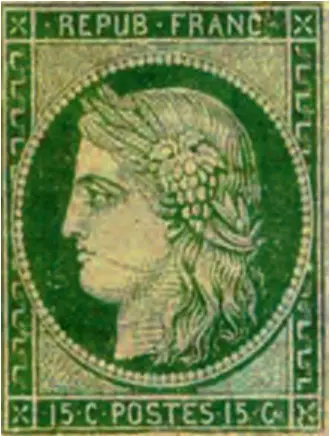
Explanation: As stated on page 23 (Fig. 16), Marianne was chosen by artists to represent the French Republic as a people’s nation, and her figure was stamped on coins and postage stamps[cite: 404].
3. Who painted the allegorical representation titled ‘The fallen Germania’ shown below?
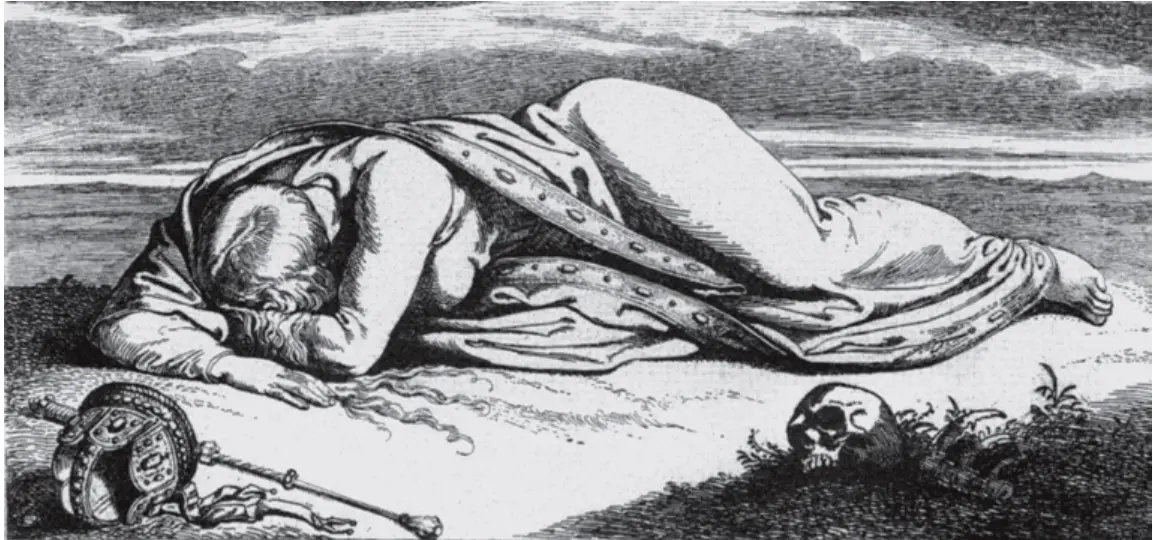
Explanation: Fig. 18 on page 24 shows ‘The fallen Germania’, created by artist Julius Hübner in 1850 in the aftermath of the collapsed Frankfurt Parliament[cite: 405].
4. Consider the following statements about the caricature shown below:
1. The title of this caricature is “The Club of Thinkers”.
2. The plaque on the left bears the inscription: ‘The most important question of today’s meeting: How long will thinking be allowed to us?’
3. This was a caricature of a meeting called by liberals.
4. This caricature was created in c. 1820.
Which of the above statement(s) is/are correct?
1. The title of this caricature is “The Club of Thinkers”.
2. The plaque on the left bears the inscription: ‘The most important question of today’s meeting: How long will thinking be allowed to us?’
3. This was a caricature of a meeting called by liberals.
4. This caricature was created in c. 1820.
Which of the above statement(s) is/are correct?
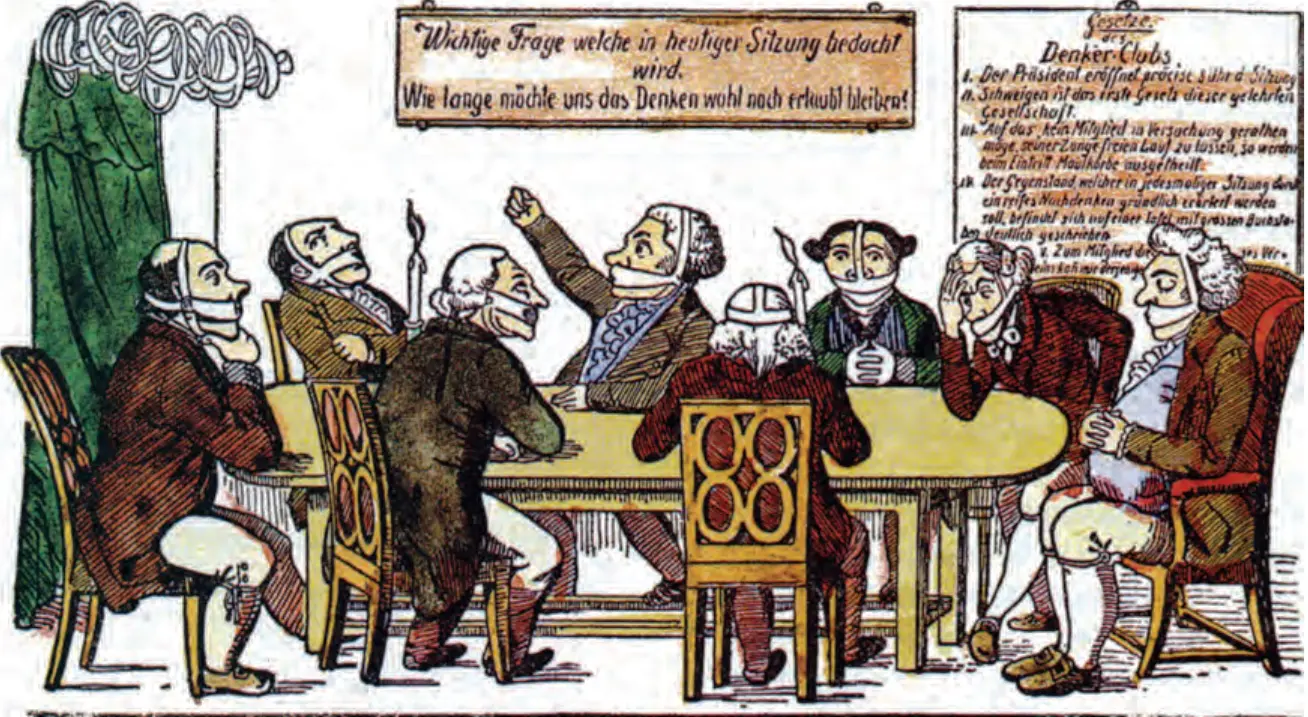
Explanation: Statements 1, 2, and 4 are correct (page 11, Fig. 6)[cite: 392]. Statement 3 is incorrect because the caricature mocks the conservative censorship regime that muzzled free thought, rather than depicting a meeting convened by liberals[cite: 392].
5. Choose the correct statement regarding the painting shown below:
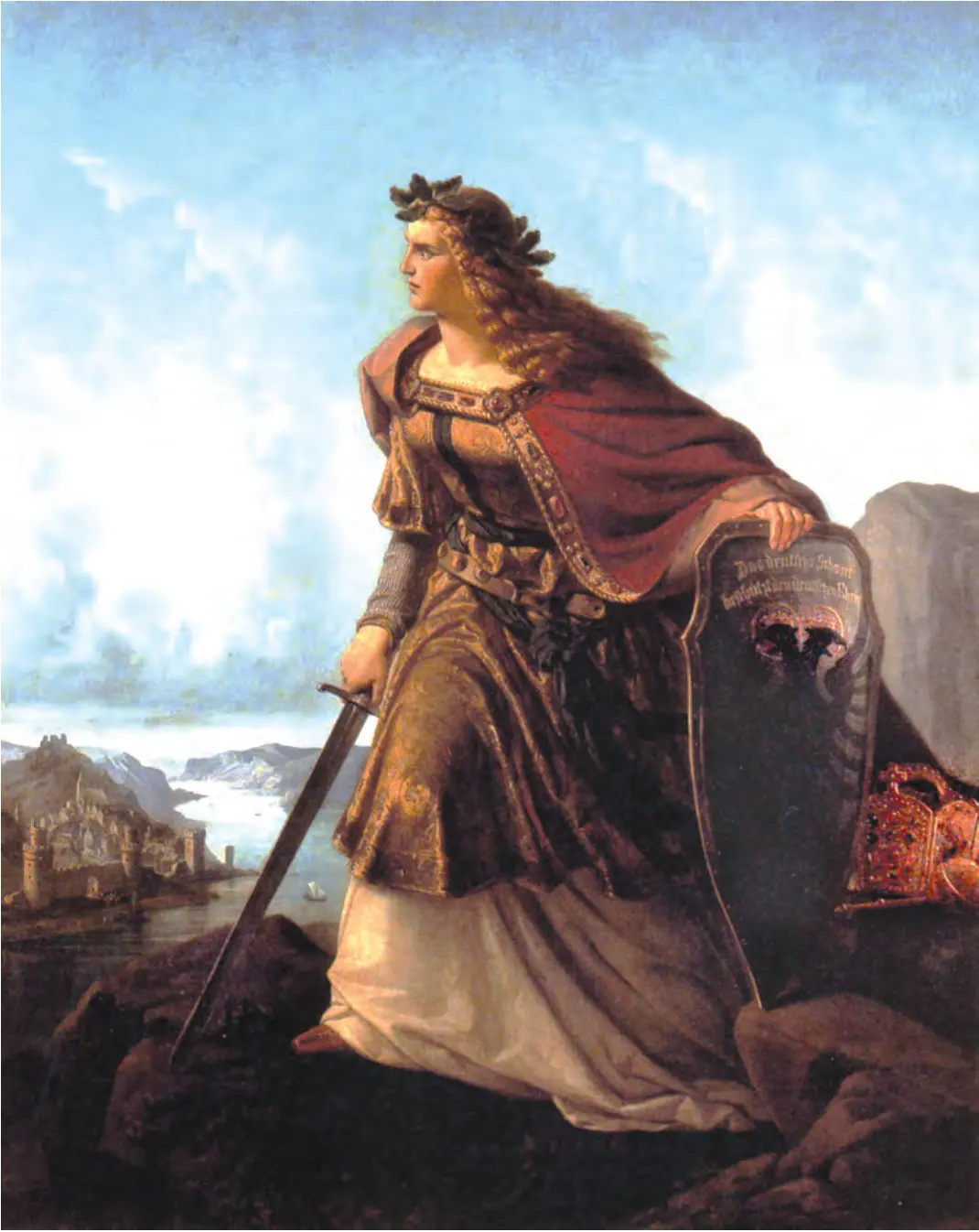
Explanation: Fig. 19 on page 25 depicts ‘Germania guarding the Rhine’, painted in 1860 by Lorenz Clasen, with the sword inscribed: ‘The German sword protects the German Rhine.'[cite: 406]
Section B: Assertion & Reasoning Questions
6.
Assertion (A): The issue of extending political rights to women was a controversial one within the liberal movement.
Reason (R): Women were considered superior and independent of men by nineteenth-century European society because of their enthusiastic performance in the liberal movement.
Reason (R): Women were considered superior and independent of men by nineteenth-century European society because of their enthusiastic performance in the liberal movement.
Explanation: Assertion (A) is true (page 17)[cite: 398], but Reason (R) is false because women were denied suffrage and legal equality, and patriarchal society regarded them as dependent and subordinate to men[cite: 398].
7.
Assertion (A): King Victor Emmanuel II sought to unify the Italian states through war.
Reason (R): In the eyes of the ruling elites of this region, a unified Italy offered them the possibility of economic development and political dominance.
Reason (R): In the eyes of the ruling elites of this region, a unified Italy offered them the possibility of economic development and political dominance.
Explanation: As stated on page 20, following the failed uprisings of 1831 and 1848, the mantle fell on Sardinia-Piedmont because the ruling elite recognized that unification would grant them economic growth and geopolitical supremacy[cite: 401].
Section C: Matching & Tabular Competencies
8. Match the allegorical symbols in Column I with their historical meanings in Column II:
| Column I (Symbol) | Column II (Significance) |
|---|---|
| (A) Broken chains | (1) Symbol of the German empire – strength |
| (B) Breastplate with eagle | (2) Readiness to fight |
| (C) Sword | (3) Being freed |
| (D) Rays of the rising sun | (4) Beginning of a new era |
Explanation: According to Box 3 (page 24): Broken chains = Being freed (3); Breastplate with eagle = Strength of German empire (1); Sword = Readiness to fight (2); Rays of rising sun = Beginning of a new era (4)[cite: 405].
9. Match the Italian leaders in Column I with their historical contributions in Column II:
| Column I (Leader) | Column II (Contribution) |
|---|---|
| (A) Giuseppe Mazzini | (1) Ruler of Sardinia-Piedmont who unified Italy |
| (B) King Victor Emmanuel II | (2) Revolutionary founder of Young Italy |
| (C) Chief Minister Cavour | (3) Led armed volunteers in Expedition of the Thousand |
| (D) Giuseppe Garibaldi | (4) Formed diplomatic alliance with France to defeat Austria in 1859 |
Explanation: Mazzini founded Young Italy (2)[cite: 393]; Victor Emmanuel II was the monarch of Sardinia-Piedmont (1)[cite: 401]; Cavour arranged the 1859 alliance with France (4)[cite: 402]; Garibaldi led the Red Shirts (3)[cite: 402, 403].
10. Match the terms in Column I with their definitions in Column II:
| Column I | Column II |
|---|---|
| (A) Absolutist | (1) An ideal vision of society unlikely to actually exist |
| (B) Utopian | (2) A centralized, militarized, repressive monarchical rule |
| (C) Plebiscite | (3) Direct vote by all citizens to accept or reject a proposal |
| (D) Suffrage | (4) The legal right to vote in political elections |
Explanation: Defined in chapter vocabulary: Absolutist = repressive monarchical government (2)[cite: 384]; Utopian = ideal society unlikely to exist (1)[cite: 384]; Plebiscite = direct citizen vote (3)[cite: 385]; Suffrage = right to vote (4)[cite: 390].
Section D: Chronological & Sequencing Competencies
11. Arrange the following historical events in the correct chronological sequence:
1. Unification of Germany
2. Act of Union
3. Unification of Italy
4. Vienna Peace Settlement
1. Unification of Germany
2. Act of Union
3. Unification of Italy
4. Vienna Peace Settlement
Explanation: 2. Act of Union (1707)[cite: 403] → 4. Vienna Peace Settlement (1815)[cite: 389, 391] → 3. Unification of Italy (1859–1870)[cite: 389, 402] → 1. Unification of Germany (1866–1871)[cite: 389, 400]. Correct order: 2, 4, 3, 1.
12. Arrange the following events related to the formation of the nation-state of Britain in chronological order:
I. Act of Union between England and Scotland
II. English Parliament seized power from the Monarchy
III. Ireland was forcibly incorporated into the United Kingdom
IV. Failed Catholic revolt led by Wolfe Tone and United Irishmen
I. Act of Union between England and Scotland
II. English Parliament seized power from the Monarchy
III. Ireland was forcibly incorporated into the United Kingdom
IV. Failed Catholic revolt led by Wolfe Tone and United Irishmen
Explanation: II. English Parliament seized power (1688)[cite: 403] → I. Act of Union (1707)[cite: 403] → IV. Wolfe Tone’s revolt (1798)[cite: 403] → III. Ireland incorporated into the UK (1801)[cite: 403]. Order: II – I – IV – III.
Section E: Core Concepts & Thinkers
13. Select the correct definition of the term ‘Plebiscite’:
Explanation: Textbook definition (page 4): “Plebiscite – A direct vote by which all the people of a region are asked to accept or reject a proposal.”[cite: 385]
14. Which among the following was the main reason for the weavers’ uprising in Silesia in 1845?
Explanation: In Silesia in 1845, contractors took advantage of widespread poverty and desperate need for jobs to drastically reduce prices and payments for finished goods[cite: 397].
15. Choose the incorrectly matched pair from the options below:
Explanation: Frédéric Sorrieu was a French artist (page 3) who prepared the famous 1848 series of four utopian prints, not a British artist[cite: 384].
16. Who among the following founded the underground secret society called ‘Young Italy’ in Marseilles?
Explanation: Giuseppe Mazzini founded ‘Young Italy’ in Marseilles and later ‘Young Europe’ in Berne to promote the ideal of a unified democratic republic[cite: 393].
17. Which one of the following statements is true regarding a modern nation-state?
Explanation: On page 4, a nation-state is defined as one where the majority of citizens, and not only rulers, develop a sense of common identity and shared history or descent[cite: 385].
18. Identify the philosopher:
• He was a French philosopher who delivered a famous lecture at Sorbonne in 1882.
• He insisted that a heroic past and glory form the social capital of a national idea.
• He rejected the notion that nations are formed merely by common language, race, religion, or territory.
• He proclaimed that a nation’s existence is a ‘daily plebiscite’.
• He was a French philosopher who delivered a famous lecture at Sorbonne in 1882.
• He insisted that a heroic past and glory form the social capital of a national idea.
• He rejected the notion that nations are formed merely by common language, race, religion, or territory.
• He proclaimed that a nation’s existence is a ‘daily plebiscite’.
Explanation: Ernst Renan outlined his famous conception of a nation in the 1882 essay ‘Qu’est-ce qu’une nation?’ (‘What is a Nation?’), featured in Source A (page 4)[cite: 385].
19. “When France sneezes, the rest of Europe catches cold.” Who stated this famous line?
Explanation: Austrian Chancellor Duke Metternich made this famous remark regarding France’s revolutionary upheavals triggering chain reactions across Europe[cite: 394].
20. Which of the following was NOT an integral geographic region of the British Isles or the United Kingdom?
Explanation: The ethnic identities of the British Isles were English, Welsh, Scot, and Irish (page 22)[cite: 403]. Poland is situated in Central/Eastern Europe and was partitioned by Russia, Prussia, and Austria[cite: 396].
21. Which among the following best signifies the idea of liberal nationalism in nineteenth-century Europe?
Explanation: In early 19th-century Europe, liberalism derived from Latin ‘liber’ (free) stood for personal liberty, equality before the law, and representative governance by consent[cite: 390].
22. Which of the following was NOT visualised by Frédéric Sorrieu in his first 1848 print?
Explanation: In Fig. 1 (page 3), the people offer homage to the Statue of Liberty (personified with the torch of Enlightenment and the Charter of the Rights of Man), not the Statue of Unity[cite: 384].
23. Identify the social class:
• They owned vast estates in the countryside and also town-houses.
• They spoke French for purposes of diplomacy and in high society.
• Their families were connected by inter-regional ties of marriage.
• They owned vast estates in the countryside and also town-houses.
• They spoke French for purposes of diplomacy and in high society.
• Their families were connected by inter-regional ties of marriage.
Explanation: As detailed on page 8, the landed aristocracy formed a small, powerful dominant class across Europe, united by common customs, French language in diplomacy, and marriage alliances[cite: 389].
24. Who was proclaimed the first German Emperor of the unified German Empire in January 1871?
Explanation: King William I of Prussia was proclaimed Kaiser (German Emperor) in the Hall of Mirrors at Versailles on 18 January 1871[cite: 400].
25. Identify the correct historical statement regarding ‘The Act of Union – 1707’:
Explanation: The Act of Union (1707) between England and Scotland formed the ‘United Kingdom of Great Britain’, establishing English dominance over Scotland[cite: 403].
26. What were the major political consequences of the July Revolution of 1830 in Europe?
Explanation: The July 1830 Revolution in France overthrew the restored Bourbon monarchy, placed Louis Philippe at the head of a constitutional monarchy, and sparked the Belgian secession from the Netherlands[cite: 394].
27. Identify the group described below:
• Committed to opposing monarchical systems established after the 1815 Congress of Vienna.
• Willing to fight for personal liberty, freedom, and an end to autocracy.
• Viewed the creation of independent nation-states as an essential part of this struggle.
• Committed to opposing monarchical systems established after the 1815 Congress of Vienna.
• Willing to fight for personal liberty, freedom, and an end to autocracy.
• Viewed the creation of independent nation-states as an essential part of this struggle.
Explanation: On page 12 (Section 2.4), revolutionaries are defined as those committed to underground struggle against the post-Vienna autocratic monarchies and fighting for sovereign nation-states[cite: 393].
28. Why was Otto von Bismarck considered the chief architect of German unification?
Explanation: Prussian Chief Minister Otto von Bismarck spearheaded German unification using the disciplined Prussian military and state bureaucracy, winning three wars in seven years[cite: 400].
29. Which of the following was NOT an objective of the Treaty of Vienna of 1815?
Explanation: The delegates at Vienna were conservatives whose primary goal was to restore autocratic monarchies and re-establish a conservative order, not to institute liberal democracy[cite: 391, 392].
30. Consider the following statements:
1. During the French Revolution, artists used female allegories to portray ideas like Liberty, Justice, and the Republic.
2. In France, the female allegory was christened Marianne.
3. Germania was depicted by Kaiser William I.
4. The idea behind Marianne was to represent France as a people’s nation.
Which of the above statement(s) is/are correct?
1. During the French Revolution, artists used female allegories to portray ideas like Liberty, Justice, and the Republic.
2. In France, the female allegory was christened Marianne.
3. Germania was depicted by Kaiser William I.
4. The idea behind Marianne was to represent France as a people’s nation.
Which of the above statement(s) is/are correct?
Explanation: Statements 1, 2, and 4 are correct (page 23)[cite: 404]. Statement 3 is false because Germania was an artistic visual allegory created by painters (such as Philipp Veit), not created or depicted by Kaiser William I[cite: 404, 406].
Quiz Performance Summary
Attempted
0 / 30
Correct
0
Incorrect
0
Percentage
0%