Class 10 History Chapter 1 MCQS | The Rise of Nationalism in Europe (Set 3)
Answered: 0/30
Score: 0/30
✓ 0 | ✗ 0
Section A: Picture-Based & Source Questions
1. Study the picture and answer the question that follows: Which of the following aspects best suits the ‘sword’ in the image?
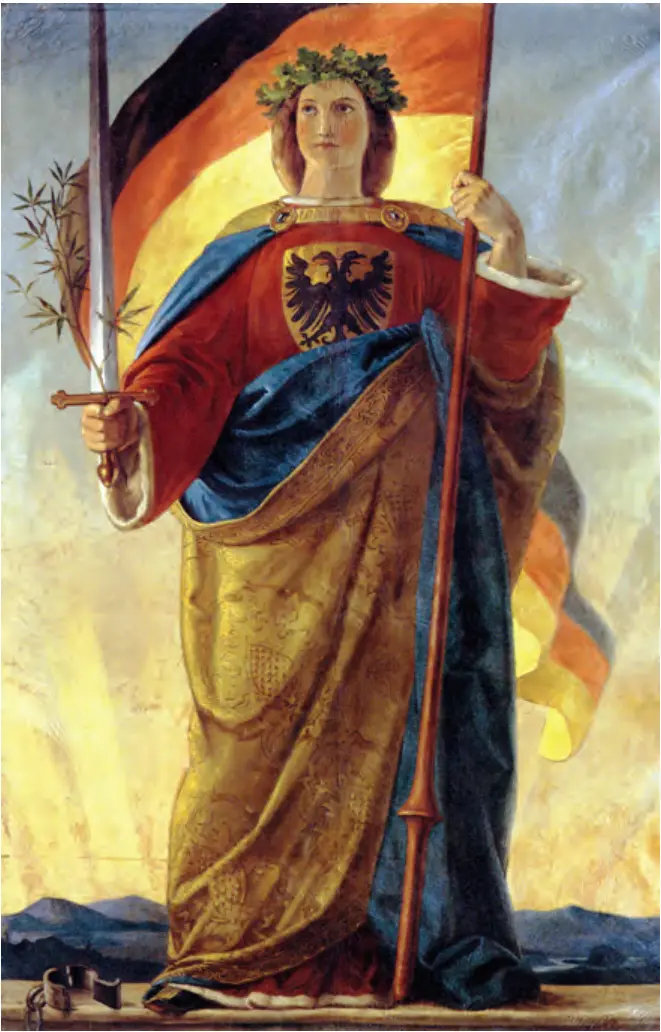
Explanation: According to Box 3 (page 24), the ‘Sword’ signifies ‘Readiness to fight’, whereas breastplate with eagle represents strength, oak leaves signify heroism, and broken chains stand for being freed.
2. The following image is the personification of Germany commonly associated with the Romantic Era and the Revolutions of 1848. Identify its name from among the following options:
Explanation: Fig. 17 depicts ‘Germania’, painted on cotton banner by Philipp Veit in 1848 to hang from the ceiling of St Paul’s Church in Frankfurt.
3. Study the picture and answer the question that follows: Which of the following aspects best signifies the above image?
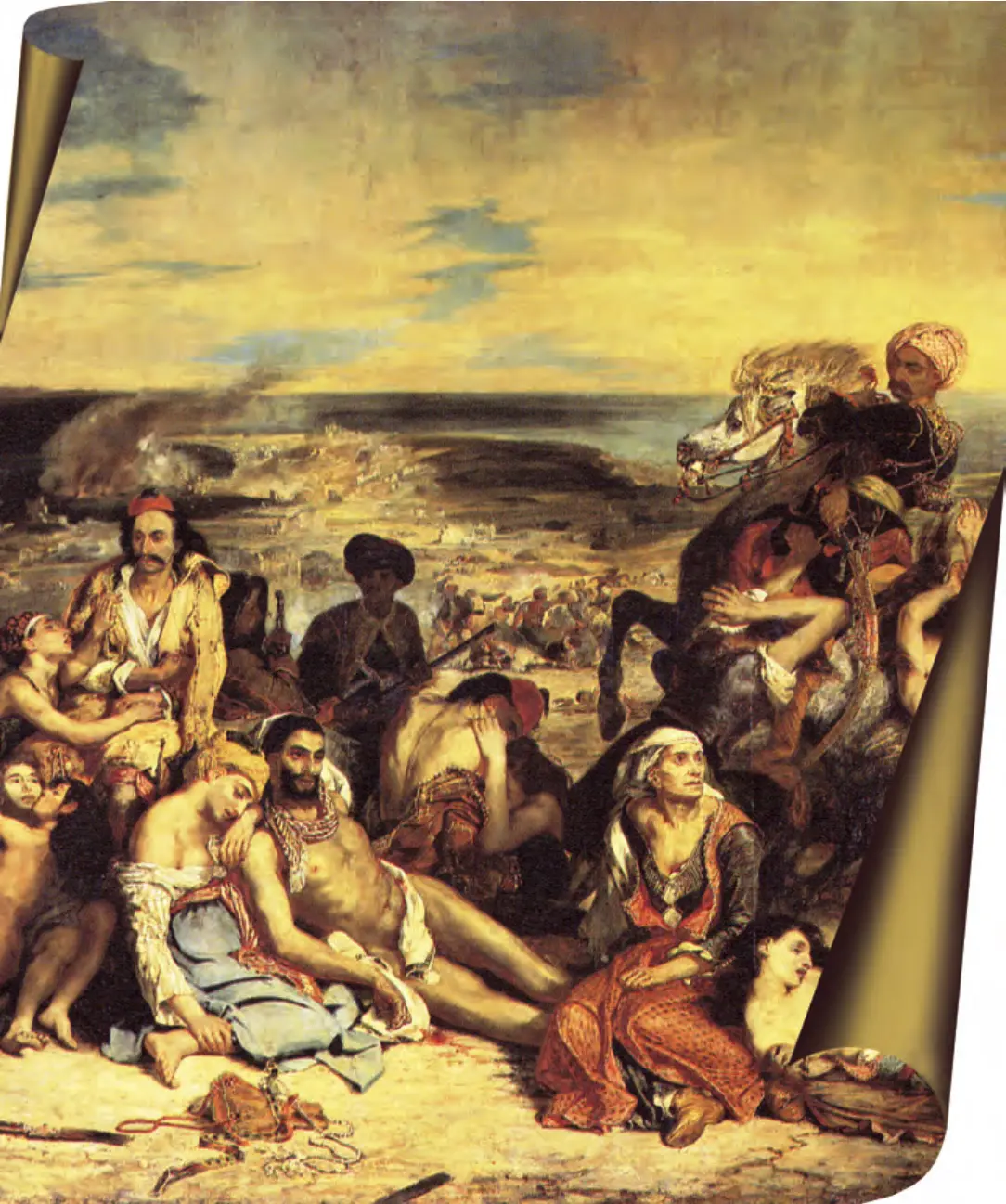
Explanation: The painting *The Massacre at Chios* (1824) by French painter Eugène Delacroix illustrates Romanticism, using emotional drama and vivid colors to mobilize European sympathy for the Greeks.
4. Which of the following aspects best signifies this image?
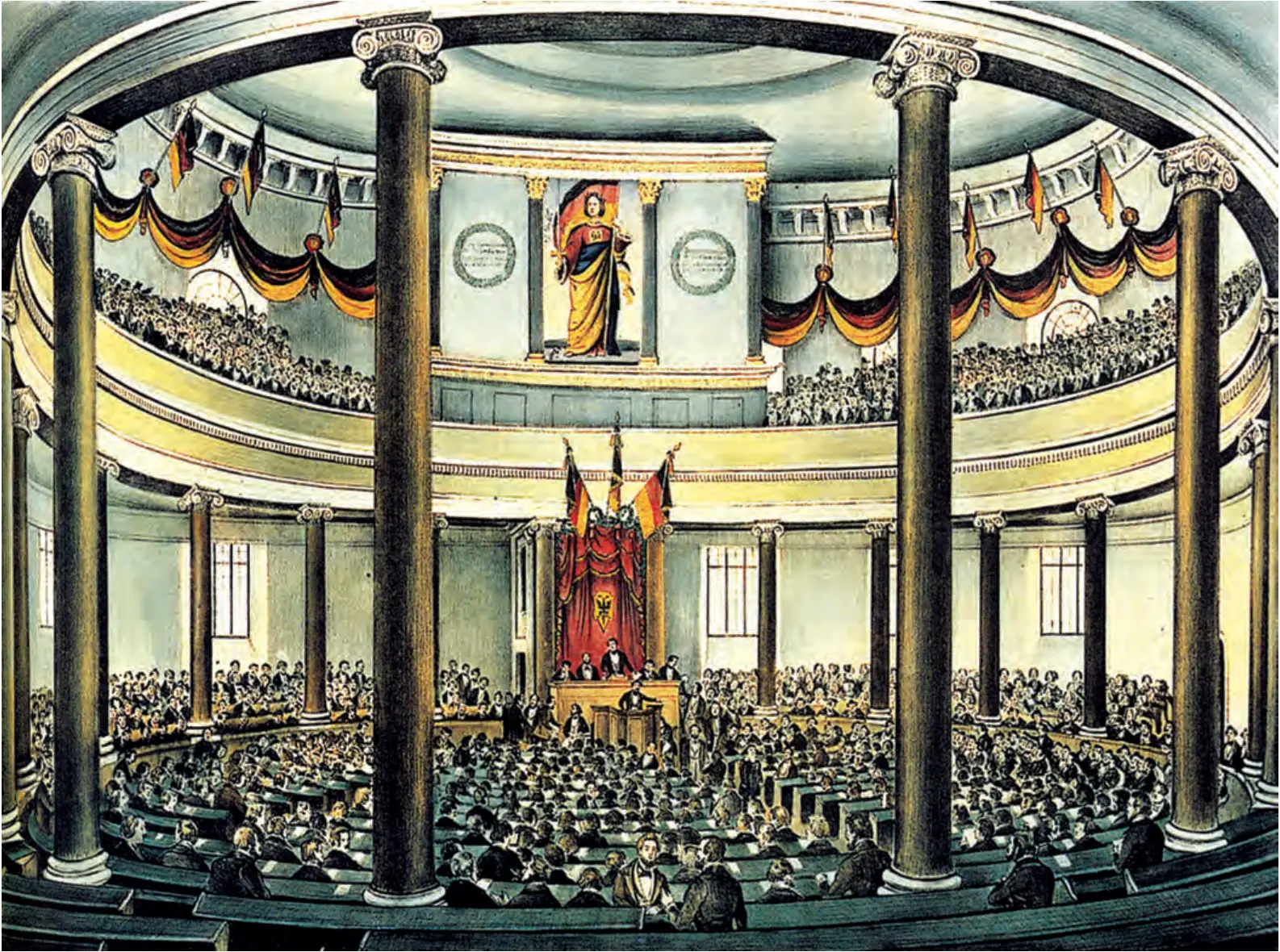
Explanation: Fig. 10 illustrates the elected deputies of the Frankfurt Parliament convened on 18 May 1848 in the Church of St Paul, with women seated in the upper gallery.
5. Which of the following aspects best signifies this image of ‘Germania’?
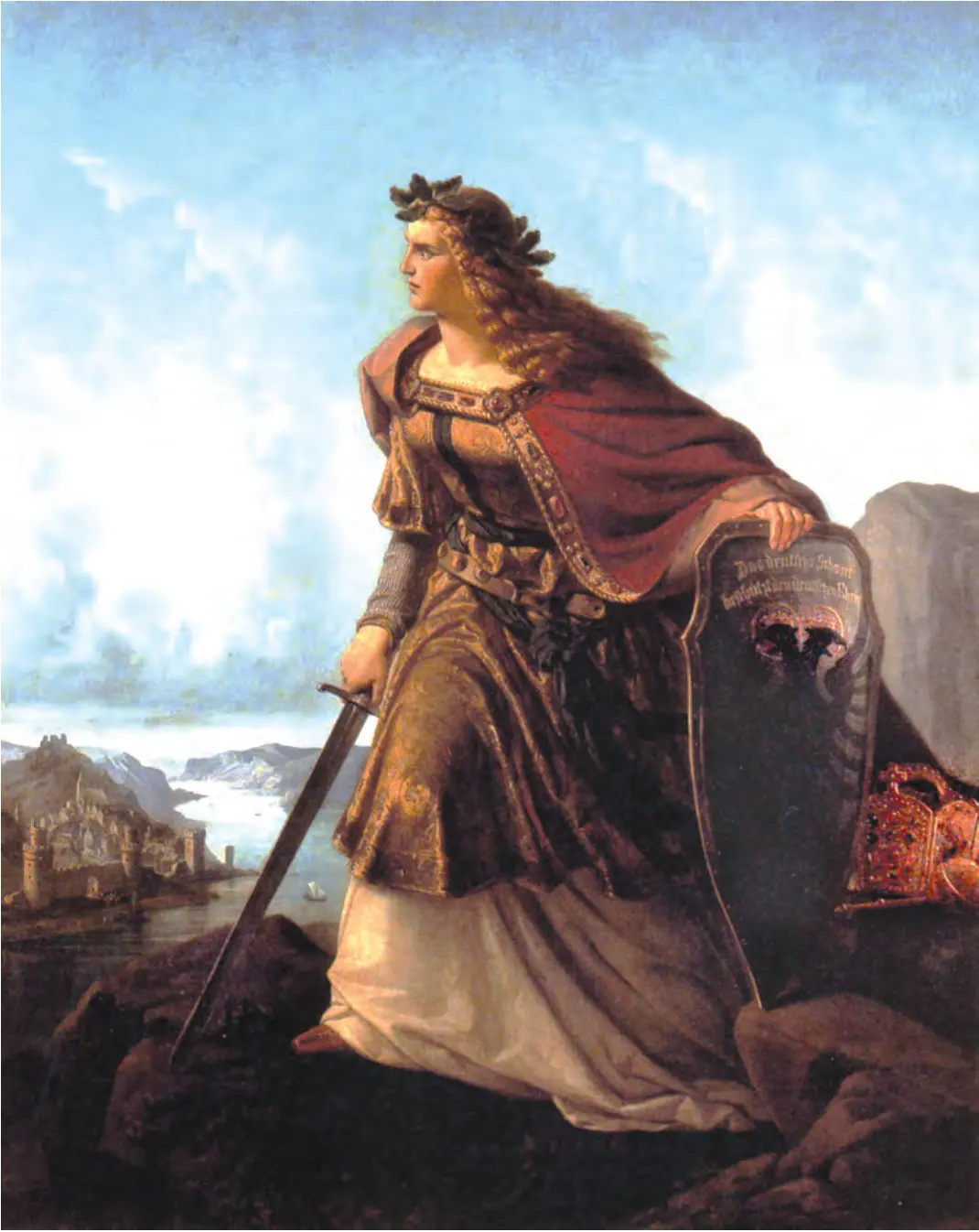
Explanation: Germania personifies the German nation through attributes like the crown of oak leaves (heroism) and the sword (readiness to defend and administer justice).
6. Study the picture and answer the question that follows: Who among the following painted this image of Germania guarding the Rhine?
Explanation: In 1860, artist Lorenz Clasen was commissioned to paint *Germania guarding the Rhine* (Fig. 19, page 25).
Section B: Assertion & Reasoning Questions
7.
Assertion (A): Italy was divided into seven states, of which only one was ruled by an Italian princely house.
Reason (R): The north was under the domination of the Bourbon kings of Spain.
Reason (R): The north was under the domination of the Bourbon kings of Spain.
Explanation: Assertion is true (only Sardinia-Piedmont was ruled by an Italian prince). Reason is false because the north was under Austrian Habsburgs, while the southern regions were under Bourbon kings of Spain.
8.
Assertion (A): The Balkan area became an area of intense conflict.
Reason (R): The Balkan states were fiercely jealous of each other and each hoped to gain more territory at the expense of the others.
Reason (R): The Balkan states were fiercely jealous of each other and each hoped to gain more territory at the expense of the others.
Explanation: Both statements are true and Reason correctly explains why the Balkans became intensely conflicting: the Slavic states were jealous of each other and sought expansion alongside big power rivalries.
Section C: Matching & Tabular Competencies
9. Match the historical years in Column I with the key events in Column II:
| Column I (Year) | Column II (Event) |
|---|---|
| (A) 1797 | (1) Vienna Peace Settlement |
| (B) 1814 | (2) Invasion of Italy by Napoleon |
| (C) 1821 | (3) Revolutions in Europe across several states |
| (D) 1848 | (4) Greek struggle for independence begins |
Explanation: From ‘Some important dates’ (page 8): 1797 = Napoleon invades Italy (2); 1814-1815 = Vienna Peace Settlement (1); 1821 = Greek struggle begins (4); 1848 = Revolutions in Europe (3).
Section D: Chronological & Sequencing Competencies
10. Arrange the following events of German unification in chronological order of their occurrence:
1. Friedrich Wilhelm IV rejected the crown of the German national assembly
2. The Frankfurt parliament convened in the Church of St Paul
3. Kaiser William I of Prussia was proclaimed German Emperor
4. Three wars over 7 years with Austria, Denmark, and France were fought
1. Friedrich Wilhelm IV rejected the crown of the German national assembly
2. The Frankfurt parliament convened in the Church of St Paul
3. Kaiser William I of Prussia was proclaimed German Emperor
4. Three wars over 7 years with Austria, Denmark, and France were fought
Explanation: Frankfurt Parliament met on 18 May 1848 (2) → Friedrich Wilhelm IV rejected the crown in 1848 (1) → Three wars fought between 1864–1871 (4) → Proclamation of Kaiser William I on 18 Jan 1871 (3). Correct sequence: 2, 1, 4, 3.
11. Arrange the following events of European history in chronological order:
1. Unification of Italy
2. Vienna Peace Settlement
3. Napoleonic wars begin
4. Unification of Germany
1. Unification of Italy
2. Vienna Peace Settlement
3. Napoleonic wars begin
4. Unification of Germany
Explanation: 3. Napoleonic wars begin (1797) → 2. Vienna Settlement (1814–1815) → 1. Unification of Italy (1859–1870) → 4. Unification of Germany (1866–1871). Correct order: 3, 2, 1, 4.
Section E: Core Concepts & Thinkers
12. Which of the following statements about the ‘French Revolution’ are correct?
1. It was proclaimed that the people would henceforth constitute the nation and shape its destiny.
2. France will have a constitutional monarchy headed by a member of the royal family.
3. A centralised administrative system will formulate uniform laws for all citizens.
4. Imposition of internal customs duties and dues will continue to exist in France.
1. It was proclaimed that the people would henceforth constitute the nation and shape its destiny.
2. France will have a constitutional monarchy headed by a member of the royal family.
3. A centralised administrative system will formulate uniform laws for all citizens.
4. Imposition of internal customs duties and dues will continue to exist in France.
Explanation: Statements 1 and 3 are correct (page 5). Monarchy was displaced by citizen sovereignty, and internal customs duties were abolished rather than retained.
13. Consider the following statements regarding the Balkans:
1. The Balkans was a region of geographical and ethnic variation.
2. A large part of the Balkans was free from the Ottoman Empire.
3. The disintegration of the Ottoman Empire made the Balkan states a scene of big power rivalry.
4. The Balkan states were fiercely jealous of each other.
Which of the above statements are correct?
1. The Balkans was a region of geographical and ethnic variation.
2. A large part of the Balkans was free from the Ottoman Empire.
3. The disintegration of the Ottoman Empire made the Balkan states a scene of big power rivalry.
4. The Balkan states were fiercely jealous of each other.
Which of the above statements are correct?
Explanation: Statements 1, 3, and 4 are correct (page 26). Statement 2 is incorrect because a large part of the Balkans was under Ottoman control, not free from it.
14. Which of the following is the correct historical definition of ‘Conservatism’?
Explanation: Textbook definition (page 10): Conservatism stressed tradition, established institutions (monarchy, Church), and favored gradual evolution over rapid change.
15. What was the major political impact of the activities and campaigns of the Jacobin clubs in Europe?
Explanation: As stated on page 5, educated middle-class Jacobin clubs paved the way for French armies to march into neighbouring European territories in the 1790s.
16. With reference to the cause of the Silesian Weavers’ uprising, consider the following statements:
1. The uprising was sparked by contractors exploiting and cheating the weavers.
2. Contractors supplied raw materials and placed orders for finished textiles but drastically reduced payments.
Which of the above statement(s) is/are correct?
1. The uprising was sparked by contractors exploiting and cheating the weavers.
2. Contractors supplied raw materials and placed orders for finished textiles but drastically reduced payments.
Which of the above statement(s) is/are correct?
Explanation: Both statements are correct (page 16). The extreme misery and arbitrary wage reductions by contractors caused 18,000 weavers to rebel in 1845.
17. Which of the following reforms were introduced under the Napoleonic Code and French administration?
1. The feudal system was abolished.
2. Guild restrictions were removed in towns.
3. Weights and measures were standardised.
4. A common national currency was introduced.
1. The feudal system was abolished.
2. Guild restrictions were removed in towns.
3. Weights and measures were standardised.
4. A common national currency was introduced.
Explanation: Napoleon simplified administrative divisions, abolished feudalism, removed guild restrictions, improved transport, and established uniform weights, measures, and currency (pages 6–7).
18. What did Napoleon do to make the administrative system more rational and efficient in the regions under his control?
Explanation: On page 6: “in the administrative field he had incorporated revolutionary principles in order to make the whole system more rational and efficient.”
19. Identify the personality:
• She was a political activist in 19th-century Germany.
• She founded a women’s journal in 1849 and a feminist political association.
• She strongly argued that Liberty is indivisible and must include women.
• She was a political activist in 19th-century Germany.
• She founded a women’s journal in 1849 and a feminist political association.
• She strongly argued that Liberty is indivisible and must include women.
Explanation: Source C (page 17) highlights Louise Otto-Peters (1819–95), a feminist political activist who founded a pioneering women’s journal and argued for women’s suffrage.
20. Which one of the following statements is FALSE regarding the Act of Union 1707?
Explanation: The Act of Union of 1707 was between England and Scotland (page 22). Ireland was forcibly incorporated into the UK much later, in 1801.
21. Which of the following events are NOT directly associated with the February 1848 popular uprising in Paris?
1. Small producers faced stiff competition from cheap imports from England.
2. Food shortages and widespread unemployment brought the Paris population onto the roads.
3. The National Assembly proclaimed a constitutional monarchy under Louis Philippe.
4. Liberal middle classes combined demands for constitutionalism with national unification in Germany.
1. Small producers faced stiff competition from cheap imports from England.
2. Food shortages and widespread unemployment brought the Paris population onto the roads.
3. The National Assembly proclaimed a constitutional monarchy under Louis Philippe.
4. Liberal middle classes combined demands for constitutionalism with national unification in Germany.
Explanation: In 1848 Paris, the assembly proclaimed a *republic* (Louis Philippe fled; monarchy was abolished). Statement 4 refers to liberal developments in Germany, not the Parisian revolt. Thus, 3 and 4 are not associated with the Paris event.
22. Identify the historical event:
• Marked the first clear expression of nationalism in 1789.
• Led to the transfer of sovereignty from monarchy to a body of French citizens.
• Replaced the royal standard with a new French tricolour.
• Proclaimed the mission to liberate European peoples from despotism.
• Marked the first clear expression of nationalism in 1789.
• Led to the transfer of sovereignty from monarchy to a body of French citizens.
• Replaced the royal standard with a new French tricolour.
• Proclaimed the mission to liberate European peoples from despotism.
Explanation: All listed features characterize the 1789 French Revolution as described on page 5.
23. Which of the following was NOT a feature or belief of post-1815 European ‘Conservatism’?
Explanation: On page 10, the text clarifies that most conservatives did *not* propose a return to pre-revolutionary days; they recognized modernization could strengthen traditional autocratic monarchy.
24. Identify the major historical factor that forged the modern British nation-state:
Explanation: The English Parliament seized power from the monarchy in 1688, serving as the central institutional instrument through which the British nation-state was formed (page 22).
25. With reference to the unification of Italy, consider the following statements:
1. Chief Minister Cavour, who led the movement to unify Italy, was neither a revolutionary nor a democrat.
2. After the unification of Italy, the Habsburg rulers granted more autonomy to the Hungarians in 1867.
Which of the above statement(s) is/are correct?
1. Chief Minister Cavour, who led the movement to unify Italy, was neither a revolutionary nor a democrat.
2. After the unification of Italy, the Habsburg rulers granted more autonomy to the Hungarians in 1867.
Which of the above statement(s) is/are correct?
Explanation: Statement 1 is correct regarding Cavour (page 21). Statement 2 is true in world history but unrelated to Italian unification (autonomy to Hungarians resulted from Austrian internal compromises post-1848, page 18). Hence, regarding Italy’s unification, only statement 1 is directly correct.
26. Which of the following statements about the French Revolution are correct?
1. It proclaimed that people would constitute the nation and shape its destiny.
2. France will remain an absolute monarchy headed by a Bourbon king.
3. A centralised administrative system will formulate uniform laws for all citizens.
4. Internal customs barriers will continue to be enforced.
1. It proclaimed that people would constitute the nation and shape its destiny.
2. France will remain an absolute monarchy headed by a Bourbon king.
3. A centralised administrative system will formulate uniform laws for all citizens.
4. Internal customs barriers will continue to be enforced.
Explanation: Statements 1 and 3 are correct (page 5). Sovereignty shifted to the body of citizens, and internal customs duties and dues were abolished.
27. What did the concept of ‘Nationalism’ fundamentally come to mean in nineteenth-century Europe?
Explanation: Nineteenth-century nationalism forged a sense of shared descent, common cultural identity, and sovereign self-determination replacing dynastic rule (page 4).
28. Which of the following territorial decisions was NOT part of the Treaty of Vienna of 1815?
Explanation: On page 11, the text notes: “the German confederation of 39 states that had been set up by Napoleon was left untouched.”
29. Which of the following demands was associated with the ‘Revolution of the Liberals’ in 1848?
1. Re-establishing the Holy Alliance in the Ottoman Empire.
2. Demands for constitutionalism combined with national unification.
3. Creation of a nation-state based on parliamentary principles, freedom of the press, and freedom of association.
1. Re-establishing the Holy Alliance in the Ottoman Empire.
2. Demands for constitutionalism combined with national unification.
3. Creation of a nation-state based on parliamentary principles, freedom of the press, and freedom of association.
Explanation: Statements 2 and 3 are correct (page 17). The liberal revolution was led by educated middle classes demanding constitutions, parliamentary governance, and civil liberties.
30. What happened to Poland at the end of the eighteenth century?
Explanation: As stated on page 15, Poland was partitioned at the end of the eighteenth century by Russia, Prussia, and Austria, but maintained its national identity through language and music.
Quiz Performance Summary
Attempted
0 / 30
Correct
0
Incorrect
0
Percentage
0%