The Rise of Nationalism in Europe
Complete, authoritative textbook solutions for Class 10 History Chapter 1. Features exhaustive in-text activities, source discussions, caricature interpretations, and NCERT exercise questions formatted in clear, board-aligned structure with designated visual references.
In-Text Activities, Source Discussions & Caricature Analyses
Page 4 — Activity (Fig. 1: Frédéric Sorrieu’s Print)
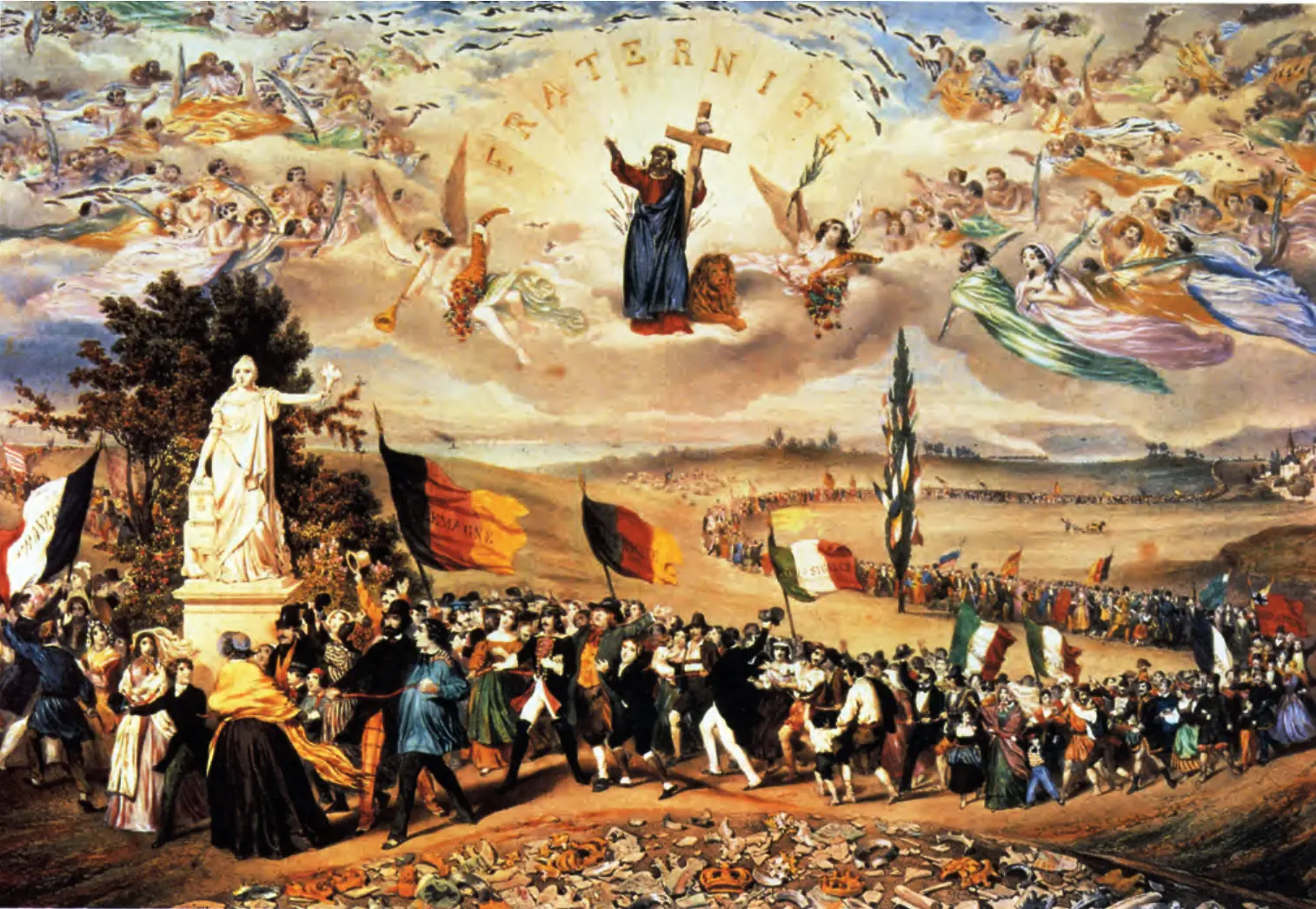
- Meaning of Utopian: A ‘utopian’ vision refers to an idealized concept of society so perfect that it is unlikely to actually exist in reality.
- Frédéric Sorrieu’s Utopian Elements:
- Peaceful March of Distinct Nation-States: Sorrieu visualises diverse peoples of Europe and America marching together in harmony, distinguished by their national flags and costumes. In 1848, most of these groups (like Germany, Poland, and Italy) were not unified, independent nation-states, but divided territories under autocratic empires.
- Brotherhood under Heavenly Approval: Christ, saints, and angels gaze from the heavens, blessing this international fraternity. In contrast, 19th-century European states were characterized by geopolitical rivalry, autocracy, and warfare.
- Complete Overthrow of Monarchy: The foreground shows absolute monarchical regalia lying shattered. Historically, absolute dynasties still retained significant military power and suppressed liberal revolts during that period.
Page 5 — Discuss (Source A: Ernst Renan, ‘What is a Nation?’)
- Attributes of a Nation according to Ernst Renan:
- Culmination of Shared Past: A nation is built on a long history of devotion, sacrifice, and collective heroic deeds, not merely on common language, race, religion, or geographical borders.
- Social Capital: A shared historical legacy coupled with the collective will to perform more great deeds in the present forms the essential social capital of a people.
- Daily Plebiscite: Renan terms a nation’s ongoing existence as a “daily plebiscite”, meaning it rests on the continuous consent and collective solidarity of its citizens.
- Why Nations are Important: In Renan’s view, the existence of separate nations guarantees individual and collective liberty. If the world were governed under a single despotic law and a single master, freedom would be lost.
Page 11 — Discuss (Source B: Friedrich List on Zollverein)
Friedrich List, Professor of Economics, argued that economic unification through the Zollverein (customs union formed in 1834) served critical political purposes:
- Forging National Unity: Economic integration across the 39 German states bound isolated principalities into a single economic unit, generating mutual material interests.
- Awakening National Sentiment: By merging provincial and individual interests, economic freedom helped arouse a unified German national sentiment.
- Strengthening Sovereignty: External protection coupled with internal commercial stimulation turned economic vitality into a platform for achieving a unified German nation-state.
Page 12 — Activity (Vienna Congress Mapping)
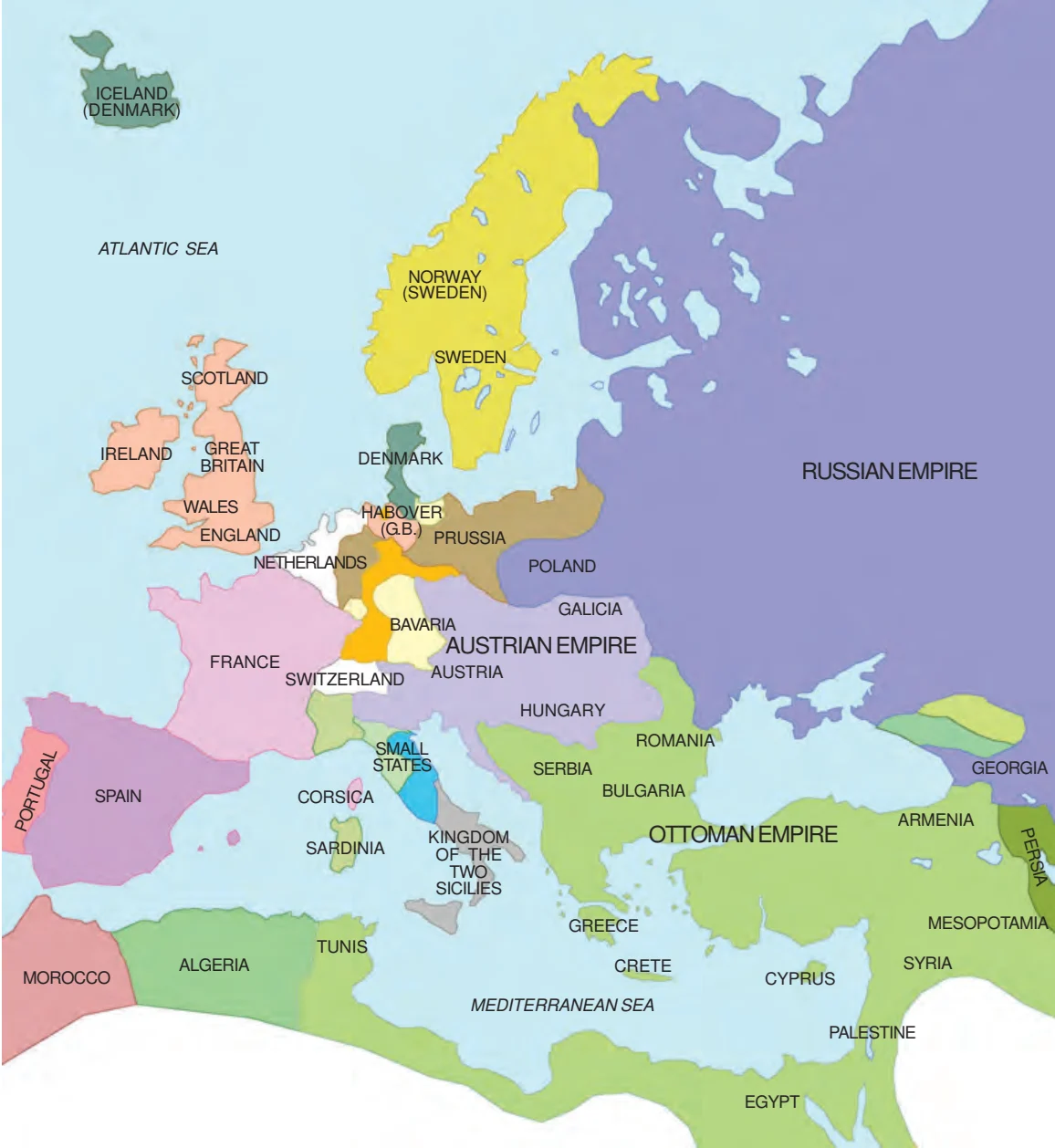
Step-by-Step Cartographic Guide:
- North of France: Mark the Kingdom of the Netherlands (which included Belgium).
- South of France: Mark Genoa merged into Piedmont in the south.
- Prussian Frontiers: Highlight Westphalia, Rhineland, and a portion of Saxony given to Prussia.
- Northern Italy: Shade Lombardy and Venetia placed under Austrian control.
- Eastern Frontier: Shade the region of Poland given to Russia.
Page 12 — Discuss (Fig. 6: The Club of Thinkers)
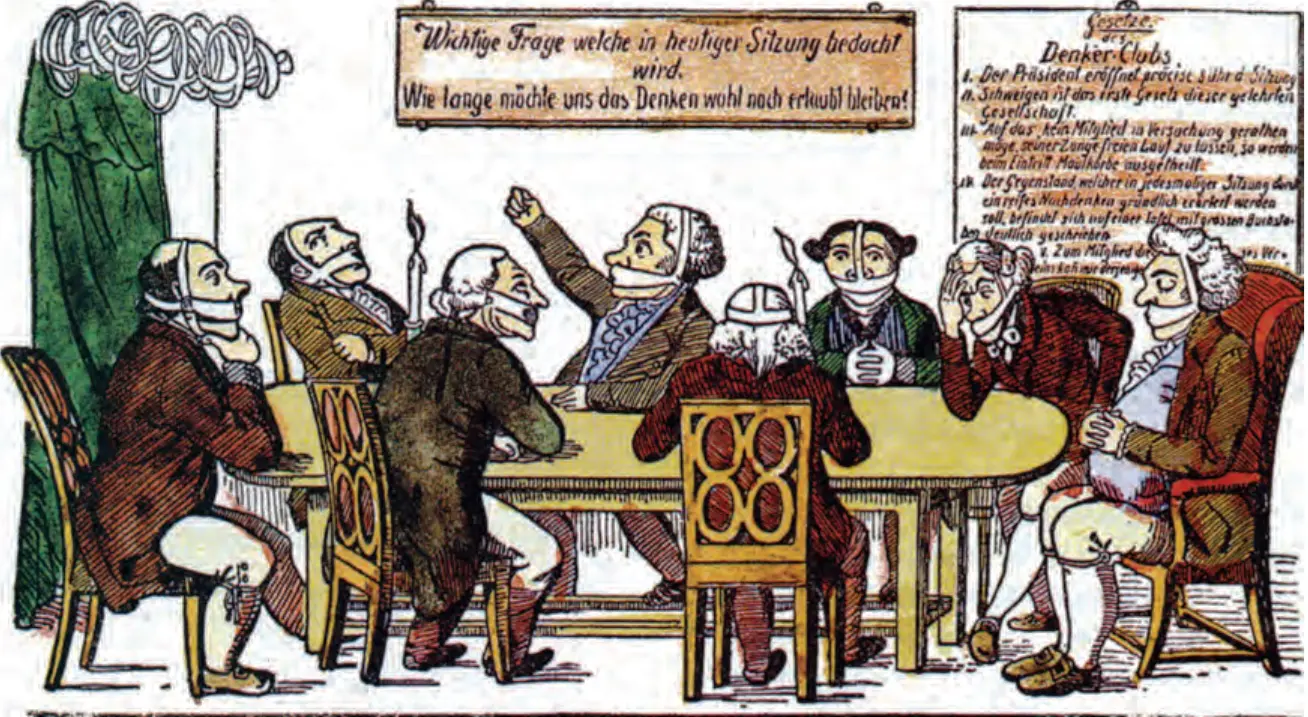
- Satire on Autocratic Censorship: The cartoon ridicules the repressive conservative order established after 1815, where open dissent and critical thought were strictly prohibited.
- Key Symbolic Elements:
- Muzzled Scholars: The thinkers seated around the conference table are fitted with cloth muzzles over their mouths, indicating state gag orders and restrictions on free speech.
- Plaque Inscription: The banner asks: “How long will thinking be allowed to us?”, highlighting the regime’s extreme paranoia toward independent thought.
- Club Rules: The rules mandate silence and specify that muzzles are distributed at entry to prevent members from giving in to the urge to speak, illustrating how conservative regimes throttled the press and civic freedom.
Page 16 — Discuss (Source: The Grimm Brothers)
- Carrying the Message to the Masses: Vernacular language and oral folklore conveyed modern nationalist ideas to large audiences who were mostly illiterate and could not engage with abstract political pamphlets.
- Preserving Authentic National Spirit (Volksgeist): The Grimm Brothers collected traditional German folktales to preserve what they identified as pure and authentic German spirit against foreign (French) cultural dominance.
- Instrument of Political Resistance: Under foreign subjugation—such as Russian rule in Poland—preserving traditional music (Karol Kurpinski’s polonaise and mazurka) and celebrating mass in the vernacular Polish tongue served as acts of patriotic resistance against imperial assimilation.
Page 17 — Discuss & Activity (Silesian Weavers’ Uprising)
Part B: Activity: Imagine you are a weaver who saw the events as they unfolded. Write a report on what you saw.
Part A: Causes of the Uprising and Journalist’s Viewpoint
- Causes of the Uprising (1845):
- Contractors supplied raw cotton and placed orders for finished textiles, but drastically reduced payments, exploiting the weavers’ desperate need for livelihoods.
- Extreme poverty and hunger pushed the weavers to march to the contractor’s mansion on 4 June 1845, demanding higher wages.
- Commentary on Journalist Wilhelm Wolff’s Viewpoint:
- Wolff expressed genuine empathy for the weavers, highlighting their severe exploitation and extreme misery.
- He documented the arrogance of the wealthy contractor, whose contemptuous threats triggered the riot, while noting the disproportionate military reaction that left eleven weavers dead.
Part B: Eyewitness Report from a Weaver’s Perspective
Location: Silesian Village
“For months, our families lived on the brink of starvation as contractors cut our textile wages lower and lower. Yesterday, unable to watch our children go hungry, we marched in orderly pairs to the contractor’s estate, asking only for a living wage. We were met with arrogance and open insults. Driven past our breaking point, our brothers broke into the mansion, smashing the fine porcelain and tearing up the cloth in the warehouses. The contractor fled, but returned guarded by armed troops. Without mercy, the soldiers opened fire on unarmed working men. Eleven of our comrades fell dead on the road. Our hands weave the wealth of this nation, yet we are answered with bullets.”
Page 19 — Discuss (Source C: Debates on Women’s Rights)
- Comparison of the Three Viewpoints:
- Carl Welcker (Conservative/Mainstream Liberal Deputy): Argued that nature created men and women to carry out different functions: men are strong and public-facing (defence, law, production), while women are weak, dependent, and meant for home, care of children, and family nurturing. He claimed gender equality would only endanger harmony and destroy family dignity.
- Louise Otto-Peters (Feminist Activist & Writer): Argued that liberty is indivisible. She called out male reformers who claimed to fight for universal freedom while their untiring efforts benefited only one half of humanity—men—leaving women unfree.
- Anonymous Female Reader (1850): Pointed out the legal and economic injustice: women who owned considerable property, performed functions, and assumed responsibilities were barred from voting, whereas uneducated male cattle-herders possessed the franchise simply because they were men.
- What this Reveals about 19th-Century Liberal Ideology: It exposes a core contradiction in 19th-century liberalism: while liberals championed equality before the law and representative governance, their vision was overwhelmingly patriarchal, defining political citizenship as an exclusive male privilege.
Page 21 — Activity (Fig. 13: Bismarck Caricature)
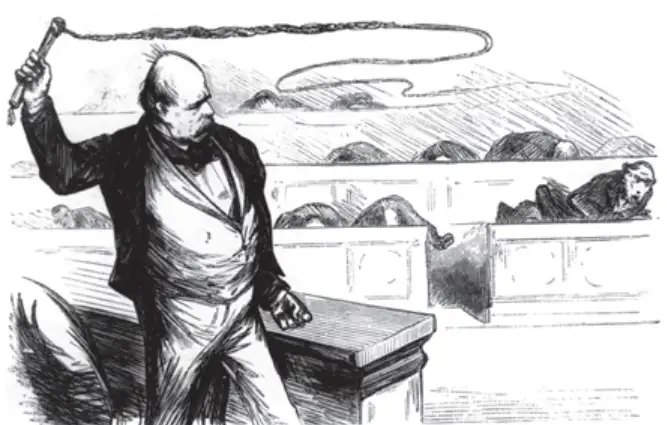
- Visual Description: Otto von Bismarck stands aggressively in the German Reichstag holding a raised whip, while elected parliamentarians cower in fear underneath their benches.
- Relationship Represented: It illustrates Bismarck’s authoritarian dominance over elected institutions, showing how parliamentary debate was subordinated to autocratic Prussian military authority.
- Interpretation of Democracy: The artist portrays parliamentary democracy in unified Germany as superficial—real authority was driven by royal command and executive force (“Blood and Iron”), reducing the legislature to a rubber-stamp body.
Page 22 — Activity (Fig. 14(a) & 14(b): Maps of Italian Unification)
1. Look at Fig. 14(a). Do you think that the people living in any of these regions thought of themselves as Italians?
2. Examine Fig. 14(b). Which was the first region to become a part of unified Italy? Which was the last region to join? In which year did the largest number of states join?
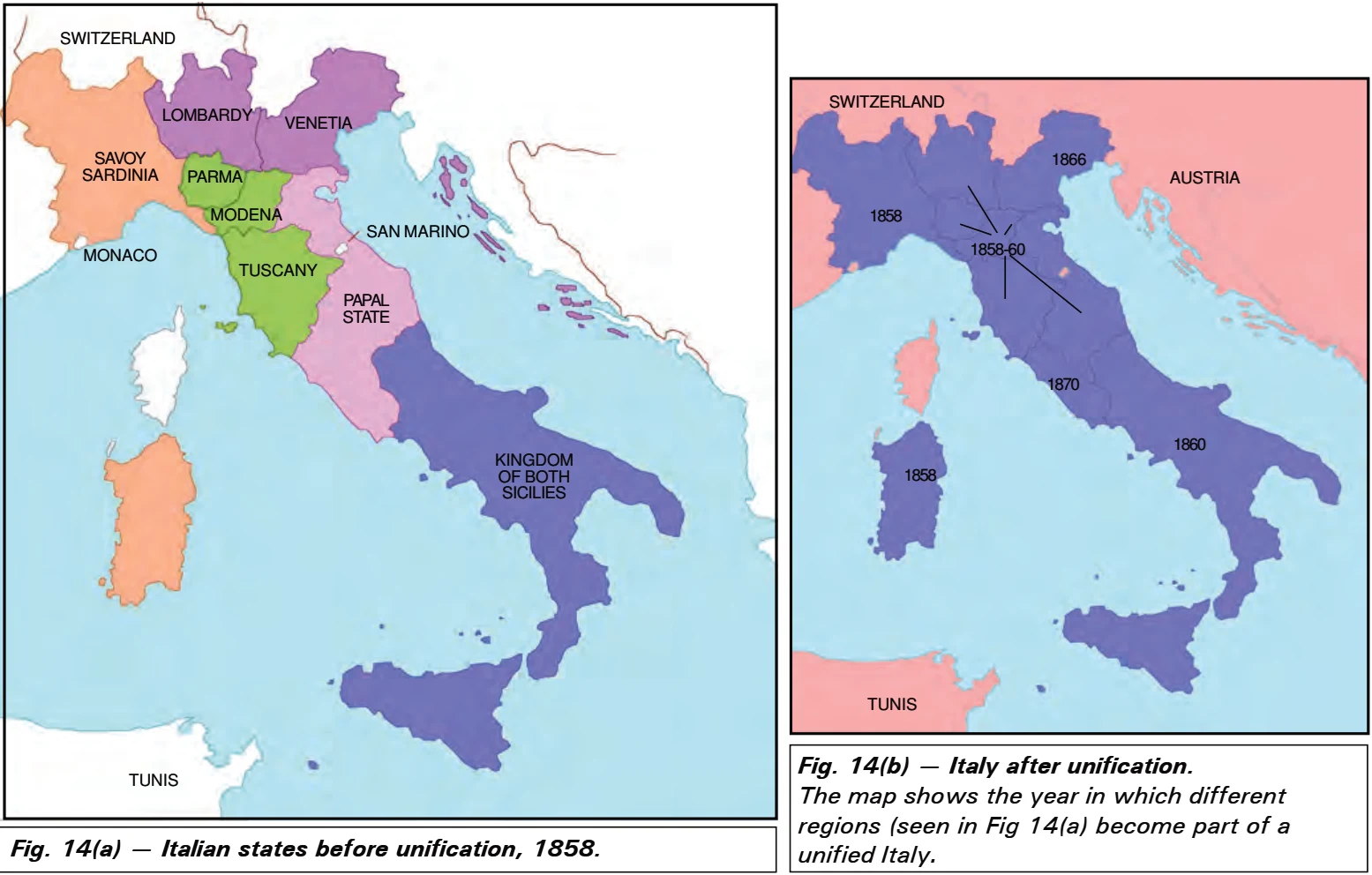
- 1. Regional Identity vs. Italian Identity: No; mid-19th century inhabitants primarily identified with their regional dynasties and dialects (e.g., Piedmontese, Tuscan, Sicilian, Neapolitan). Standard Italian was not spoken across the peninsula, and many southern peasants believed “La Talia” was Victor Emmanuel’s wife rather than their country.
- 2. Analysis of Map Fig. 14(b):
- First Region: Sardinia-Piedmont (formed the core kingdom that initiated unification in 1858–1859).
- Last Region: The Papal States (Rome), which joined in 1870 (along with Venetia joining in 1866).
- Year of Largest Accession: 1860, when Parma, Modena, Tuscany, Lombardy, and the Kingdom of the Two Sicilies were merged into the new Italian state.
Page 23 — Activity (Fig. 15: Garibaldi & the Boot of Italy)
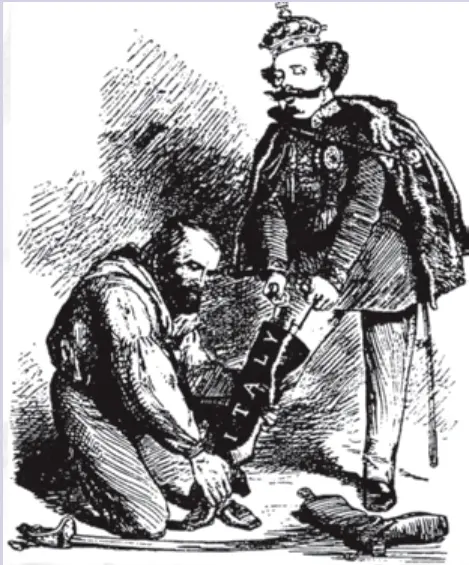
- Geographical & Political Metaphor: The Italian peninsula is shaped like a riding boot. Garibaldi conquered the southern base (Sicily and Naples) during the Expedition of the Thousand.
- Core Statement: Garibaldi is shown kneeling, selflessly holding open the southern boot for King Victor Emmanuel II to step into. This illustrates how Garibaldi surrendered his southern conquests to the Piedmontese monarchy, prioritizing a unified Italian Kingdom over his personal republican preferences.
Page 25 — Activity (Box 3 & Figs. 17, 18: Interpreting Allegories of Germania)
Part A: Box 3 Chart and Veit’s Germania (Fig. 17)
- Symbolic Interpretations:
- Broken chains = Freedom from autocratic oppression (being freed).
- Breastplate with eagle = Symbol of the German empire — strength.
- Crown of oak leaves = Traditional German heroism.
- Sword wrapped in olive branches = Readiness to fight, but willingness to make peace.
- Black, red, and gold tricolour = Flag of the liberal-nationalists in 1848, banned by the Dukes of the German states.
- Rays of the rising sun = The beginning of a new era.
- Significance of replacing Kaiser’s Crown with Broken Chains (1836 vs 1848): In 1836, Germany looked toward traditional monarchical institutions. By 1848, the emphasis shifted to liberal constitutionalism and liberation from despotic dynastic rule.
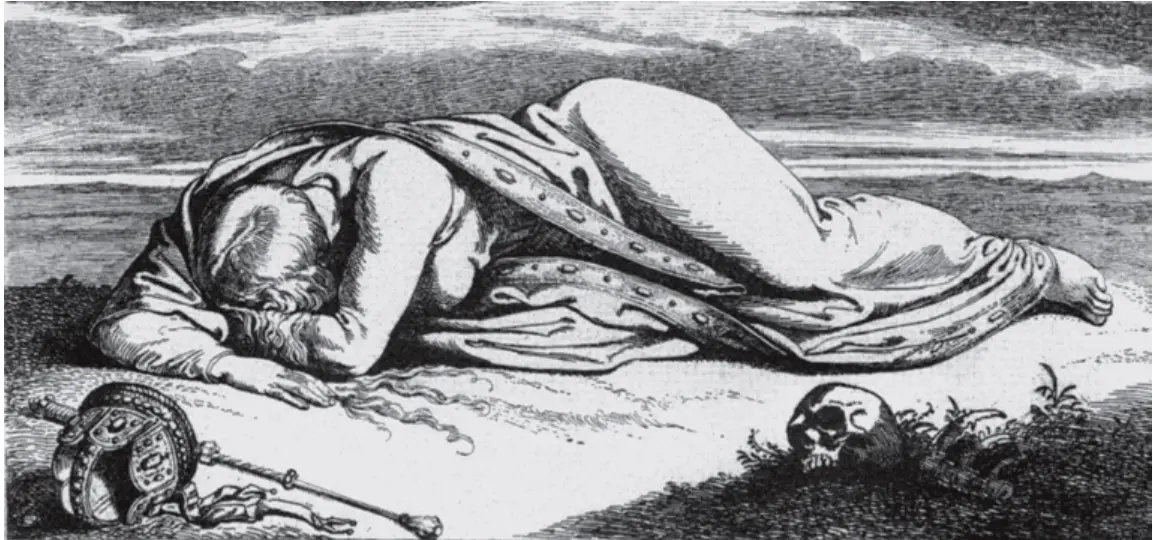
Part B: Julius Hübner’s “The Fallen Germania”, 1850 (Fig. 18)
- Visual Description: Germania lies collapsed, head bowed in sorrow, with the imperial crown and sword discarded on the ground.
- Historical Reference: Hübner depicts the collapse of the Frankfurt Parliament of 1848–1849. King Friedrich Wilhelm IV of Prussia had rejected the elected assembly’s constitution, and troops forcibly disbanded the parliament, shattering liberal hopes for a democratic, unified Germany.
Page 26 — Activity (Viewpoints under the Germania Banner in St. Paul’s Church)
- (a) Perspective of an Elected Male Deputy:
- Views the Germania banner with pride and patriotic optimism.
- Associates her broken chains and sword with the emergence of a unified, sovereign German fatherland founded on constitutional liberty and legislative debate.
- (b) Perspective of a Female Observer in the Gallery:
- Views the banner with bittersweet irony.
- While the nation is depicted as a strong woman bearing the torch of freedom, real living women are denied political franchise and relegated to silent observers in the upper gallery, without voting rights or voice.
NCERT Textbook Exercises (Write in Brief & Discuss)
Write in brief: Question 1 — Write a note on:
(a) Giuseppe Mazzini
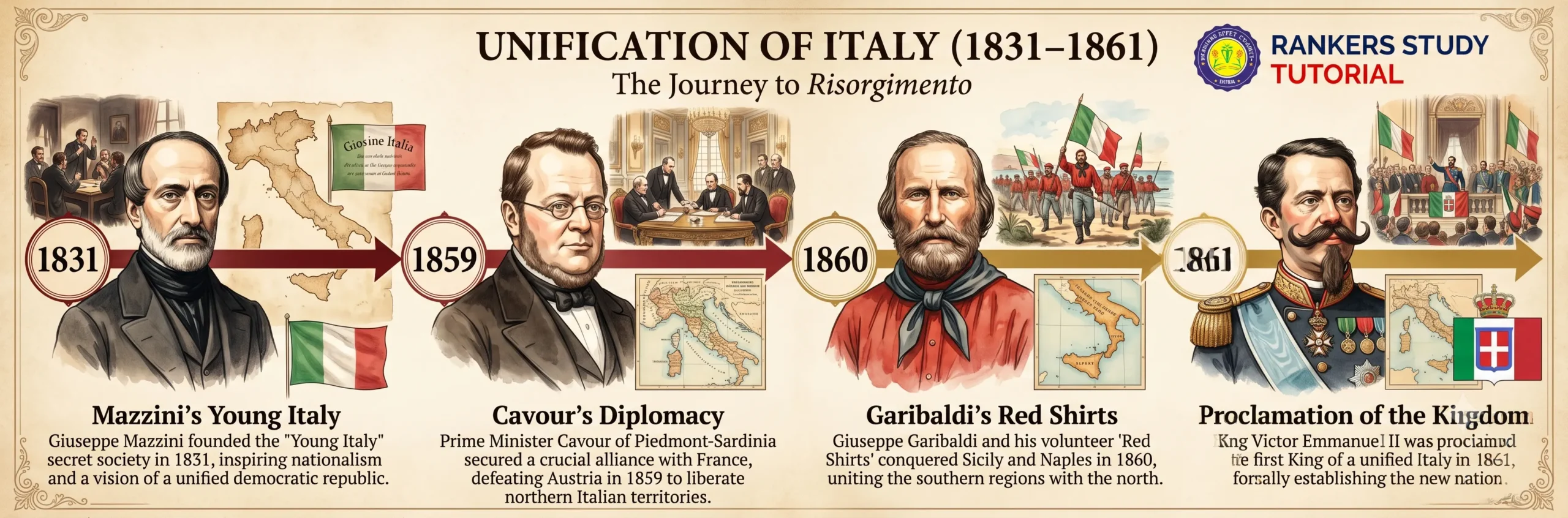
- Background: Born in Genoa in 1805, Mazzini was an Italian revolutionary thinker, patriot, and member of the secret society of the Carbonari.
- Exile & Secret Societies: Exiled at age 26 in 1831 for organizing an insurrection in Liguria, he subsequently founded two major underground movements: Young Italy in Marseilles and Young Europe in Berne.
- Ideological Vision: He believed that “God had intended nations to be the natural units of mankind” and that Italy had to be forged into a single unified republic within a wider alliance of nations rather than a patchwork of small states.
- Impact: His relentless opposition to monarchy frightened conservatives, prompting Austrian Chancellor Metternich to describe him as “the most dangerous enemy of our social order”.
(b) Count Camillo de Cavour
- Role: Chief Minister of Sardinia-Piedmont who led the movement to unify the regions of Italy.
- Pragmatic Statesman: Neither a revolutionary nor a democrat, Cavour belonged to the wealthy and educated Italian elite and spoke French much better than Italian.
- Diplomacy: In 1859, through a tactful diplomatic alliance with France engineered by Cavour, Sardinia-Piedmont succeeded in defeating the Austrian forces in northern Italy.
- Legacy: His diplomacy, combined with Garibaldi’s military campaigns in the south, led to Victor Emmanuel II being proclaimed king of united Italy in 1861.
(c) The Greek War of Independence
- Historical Background: Greece had been part of the Ottoman Empire since the fifteenth century. Inspired by revolutionary nationalism in Europe, the struggle for independence began in 1821.
- Support Base: Greek nationalists received support from other Greeks living in exile and from West Europeans who had sympathies for ancient Greek culture.
- Role of Cultural Figures: Poets and artists lauded Greece as the cradle of European civilisation; the English poet Lord Byron organized funds and went to fight in the war, dying of fever in 1824.
- Outcome: The Treaty of Constantinople of 1832 formally recognized Greece as an independent nation.
(d) Frankfurt Parliament
- Formation: On 18 May 1848, 831 elected middle-class representatives marched in a festive procession to take their places in the Frankfurt parliament convened in the Church of St Paul.
- Constitutional Framework: They drafted a constitution for a German nation to be headed by a monarchy subject to a parliament.
- Collapse:
- King Friedrich Wilhelm IV of Prussia rejected the crown offered on these terms and joined other monarchs to oppose the elected assembly.
- The parliament was dominated by the middle classes, who resisted the demands of workers and artisans and consequently lost their support.
- Troops were called in, and the assembly was forced to disband.
(e) The Role of Women in Nationalist Struggles
- Active Mobilization: Large numbers of women participated actively over the years, forming their own political associations, founding newspapers, and taking part in political meetings and demonstrations.
- Denial of Franchise: Despite their active participation, they were denied suffrage rights during the election of the Assembly.
- Marginalization: When the Frankfurt parliament convened in the Church of St Paul, women were admitted only as observers to stand in the visitors’ gallery.
Write in brief: Question 2 — French Revolutionary Collective Identity
- Ideological Symbols (La Patrie & Le Citoyen): Promoted the ideas of la patrie (the fatherland) and le citoyen (the citizen), emphasising the notion of a united community enjoying equal rights under a constitution.
- National Tricolour: A new French flag, the tricolour, was chosen to replace the former royal standard.
- Reorganized Representative Body: The Estates General was elected by the body of active citizens and renamed the National Assembly.
- Patriotic Rituals: New hymns were composed, oaths taken, and martyrs commemorated, all in the name of the nation.
- Centralized Administration: A centralised administrative system was put in place and it formulated uniform laws for all citizens within its territory.
- Economic Integration: Internal customs duties and dues were abolished and a uniform system of weights and measures was adopted.
- Linguistic Standardization: Regional dialects were discouraged and French, as it was spoken and written in Paris, became the common language of the nation.
Write in brief: Question 3 — Female Allegories (Marianne & Germania)
- Who They Were:
- Marianne: The female allegory of France, representing a people’s nation with characteristics drawn from Liberty and the Republic—the red cap, the tricolour, and the cockade.
- Germania: The female allegory of the German nation, depicted wearing a crown of oak leaves, as the German oak stands for heroism.
- Importance of Their Portrayal:
- Giving Concrete Form to Abstract Ideas: Visual artists represented nations as female figures to give the abstract idea of the nation a concrete form.
- Instilling Civic Pride and Unity: Statues of Marianne were erected in public squares to remind the public of the national symbol of unity and persuade them to identify with it, with her image marked on coins and stamps.
- Cultural Mobilization: Germania was depicted wearing an oak-leaf crown (representing German heroism) and carrying a sword wrapped in olive branches, conveying both cultural pride and readiness for self-defence.
Write in brief: Question 4 — German Unification Process
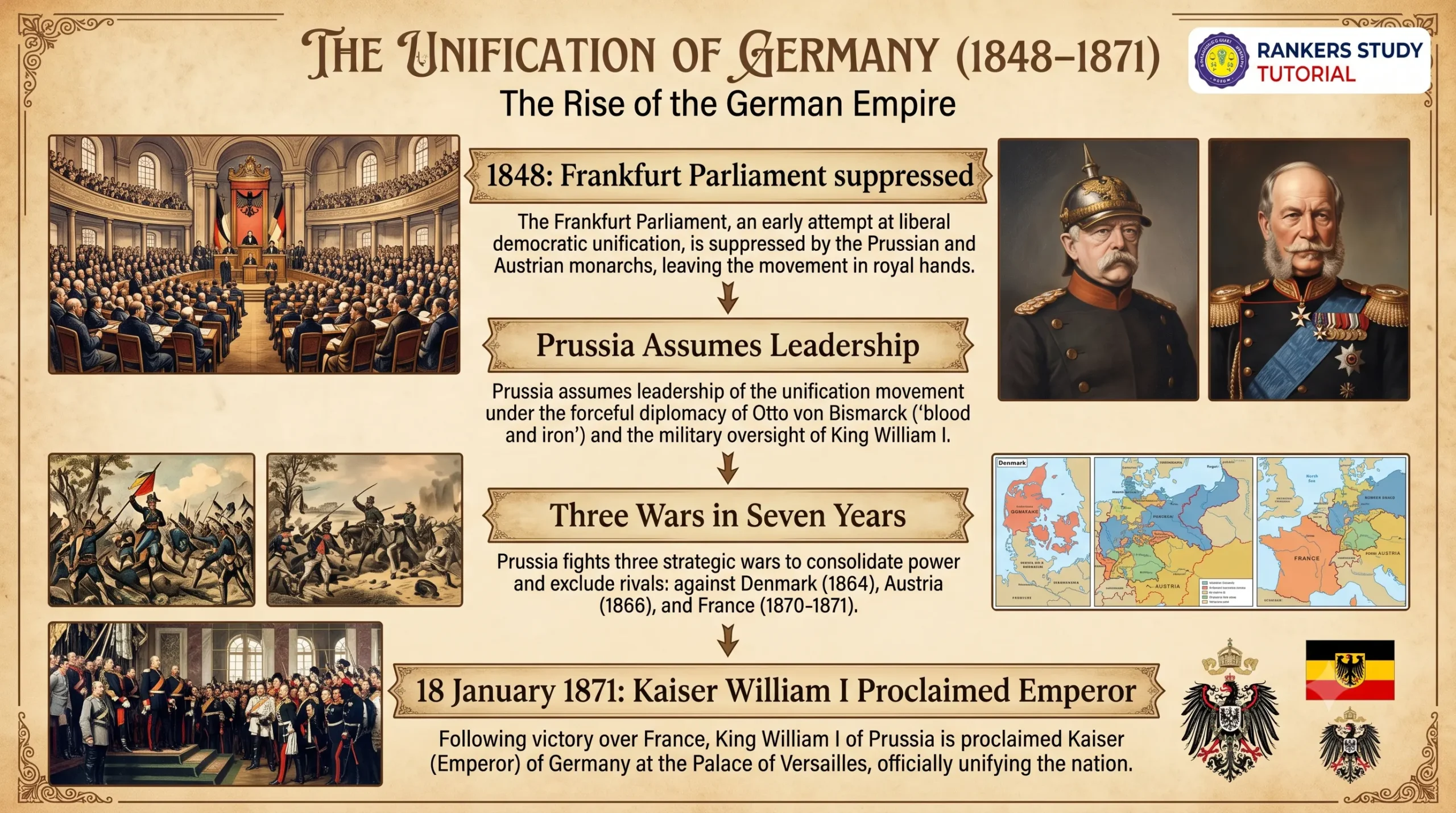
- Failed Liberal Initiative (1848): German middle-class liberals attempted to unite the German confederation into a nation-state governed by an elected parliament in Frankfurt, but this initiative was repressed by the monarchy, military, and Prussian Junkers.
- Prussian Leadership: From then on, Prussia took on the leadership of the movement for national unification.
- Bismarck’s Strategy: Chief Minister Otto von Bismarck was the architect of this process, carried out with the help of the Prussian army and bureaucracy.
- Three Decisive Wars: Three wars over seven years—with Austria, Denmark, and France—ended in Prussian victory and completed the process of unification:
- Danish War (1864): Secured Schleswig and Holstein.
- Austro-Prussian War (1866): Defeated Austria and formed the North German Confederation.
- Franco-Prussian War (1870–71): Defeated France and joined southern German states with Prussia.
- Proclamation of the German Empire (1871): On 18 January 1871, an assembly of princes, army representatives, and Bismarck gathered in the Hall of Mirrors at Versailles to proclaim Kaiser William I of Prussia as the German Emperor.
Write in brief: Question 5 — Napoleonic Administrative Reforms
Through the Civil Code of 1804 (Napoleonic Code), Napoleon introduced several administrative reforms:
- Abolition of Birth Privileges: Did away with all privileges based on birth and established equality before the law.
- Protection of Property Rights: Secured the right to property under the legal code.
- Dismantling of Feudalism: In the Dutch Republic, Switzerland, Italy, and Germany, he simplified administrative divisions, abolished the feudal system, and freed peasants from serfdom and manorial dues.
- Removal of Guild Restrictions: In towns, guild restrictions were removed.
- Infrastructure Improvements: Transport and communication systems were improved.
- Standardized Commerce: Businessmen and small-scale producers benefited from uniform laws, standardized weights and measures, and a common national currency that facilitated the movement of goods and capital.
Discuss: Question 1 — The 1848 Revolution of the Liberals
Meaning of the 1848 Liberal Revolution: Parallel to the revolts of poor, unemployed, and starving peasants and workers in many European countries in 1848, a revolution led by the educated middle classes was under way. Men and women of the liberal middle classes combined demands for constitutionalism with national unification, pushing for nation-states based on parliamentary principles.
- 1. Political Ideas:
- Replacing autocracy and clerical privileges with a constitution and representative government through parliament.
- Government based on consent and the rule of law.
- Demanded freedom of the press and freedom of association.
- Limitation: Equality before the law did not necessarily mean universal suffrage; voting rights were granted primarily to property-owning men, excluding women and non-propertied males.
- 2. Economic Ideas:
- Stood for the freedom of markets and the abolition of state-imposed restrictions on the movement of goods and capital.
- Creation of a unified economic territory allowing unhindered commercial movement (exemplified by the Zollverein).
- Stressed the inviolability of private property.
- 3. Social Ideas:
- Abolition of aristocratic privileges, feudal dues, and serfdom.
- Promoting social mobility based on merit rather than birthright.
- Limitation: Mainstream male liberals retained patriarchal views, opposing political rights for women and asserting that women’s place was confined to the home.
Discuss: Question 2 — Contribution of Culture to European Nationalism
- 1. Romantic Literature & Philosophy (Johann Gottfried Herder):
- Romantic artists and poets criticized the glorification of reason and science, focusing instead on emotions, intuition, and mystical feelings to create a shared collective heritage.
- German philosopher Johann Gottfried Herder claimed that true German culture was to be discovered among the common people—das Volk—and that the true spirit of the nation (volksgeist) was popularized through folk songs, poetry, and dances.
- 2. Folk Music and Polish Resistance (Karol Kurpinski):
- Even though Poland had been partitioned by Russia, Prussia, and Austria and no longer existed as an independent territory, national feelings were kept alive through music and language.
- Karol Kurpinski celebrated the national struggle through his operas and music, turning traditional folk dances like the polonaise and mazurka into nationalist symbols.
- 3. Language as an Instrument of Resistance (Poland):
- After the Russian occupation, the Polish language was forced out of schools and Russian was imposed everywhere.
- Following the crushed 1831 rebellion, members of the Catholic clergy in Poland used Polish for Church gatherings and religious instruction.
- Even though many priests and bishops were jailed or exiled to Siberia, the use of Polish became an enduring symbol of struggle against Russian dominance.
Discuss: Question 3 — Development of Nations in Germany and Italy
1. Germany (State-Driven Military Unification)
- Fragmentation: The German Confederation comprised 39 disparate principalities created after the Napoleonic wars.
- Shift from Popular Revolt to Autocratic Policy: When middle-class liberals failed to establish a constitutional state at the Frankfurt Parliament in 1848, the Prussian state assumed control of the process.
- Role of Bismarck and the Military: Otto von Bismarck bypassed parliamentary debate, relying on the Prussian army, bureaucratic efficiency, and three strategic wars (against Denmark, Austria, and France) to unify the German territories under Prussian dominance by January 1871.
2. Italy (Coalition of Revolutionary Agitation and Monarchical Diplomacy)
- Fragmentation: Italy was divided into seven separate dynastic states; only Sardinia-Piedmont was governed by an indigenous Italian dynasty.
- Ideological Spark: Giuseppe Mazzini founded the secret society Young Italy, popularizing the goal of an indivisible, democratic Italian republic.
- Diplomatic Realism: Count Cavour, Prime Minister of Piedmont-Sardinia, forged a strategic alliance with France in 1859 to defeat the Austrians in northern Italy.
- Popular Armed Movement: In 1860, Giuseppe Garibaldi led his armed volunteer force (the Red Shirts) into southern Italy, securing peasant support to overthrow the Spanish Bourbon monarchy.
- Resolution: Garibaldi transferred his southern gains to King Victor Emmanuel II, leading to the proclamation of the unified Kingdom of Italy in 1861.
Discuss: Question 4 — The Strange Case of Britain
- 1. Evolutionary Process Rather Than Violent Revolution: In Britain, the formation of the nation-state was not the result of a sudden upheaval or revolution, but the result of a long-drawn-out parliamentary process.
- 2. Primacy of the English Parliament: There was no British nation prior to the 18th century; identities were ethnic (English, Welsh, Scot, Irish). The English parliament seized power from the monarchy in 1688 and became the instrument through which the nation-state was forged.
- 3. Legislative Subjugation of Scotland: The Act of Union (1707) between England and Scotland formed the ‘United Kingdom of Great Britain’. English dominance led to the systematic suppression of Scotland’s distinctive culture, banning Gaelic language and Highland dress, and driving Highlanders from their lands.
- 4. Imposition of Dominance over Ireland: Ireland was deeply divided between Catholics and Protestants; the English supported Protestants to establish dominance over the Catholic majority. After Wolfe Tone’s failed revolt in 1798, Ireland was forcibly incorporated into the UK in 1801.
- 5. Promotion of British State Symbols: A new ‘British nation’ was forged through the propagation of dominant English culture, actively promoting symbols like the British flag (Union Jack), the national anthem (God Save Our Noble King), and the English language, leaving older nations as subordinate partners.
Project Guidance & Visual Comparisons
Project Work: Nationalist Symbols Outside Europe (India vs. 19th-Century Europe)
Comparative Case Study: India vs. 19th-Century Europe
| Comparative Parameter | 19th-Century European Examples | Indian Nationalist Examples |
|---|---|---|
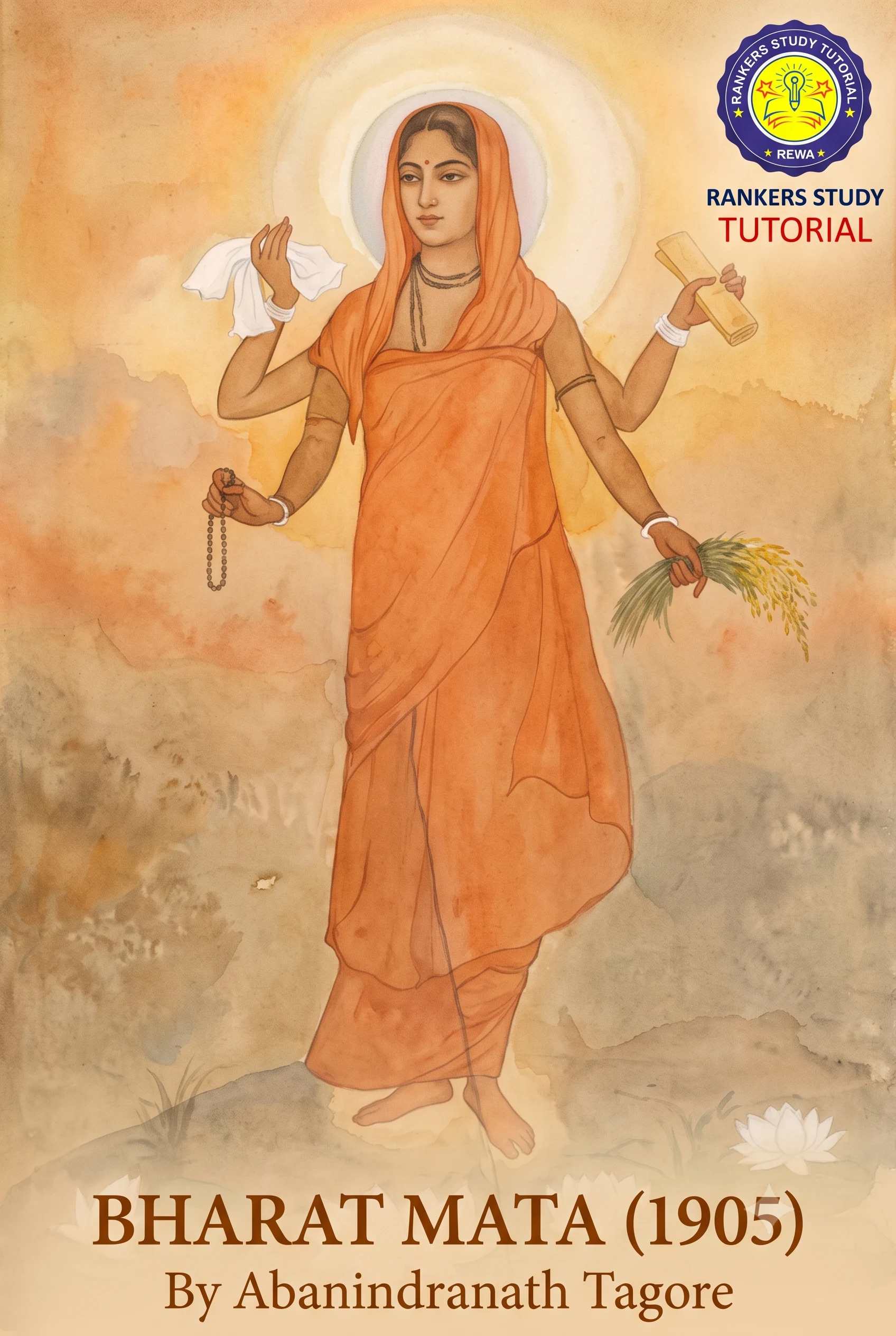
| Visual Allegory | Marianne and Germania carried symbols of military readiness and civic authority—swords, breastplates with eagles, red Phrygian liberty caps, and broken chains. | Bharat Mata (Abanindranath Tagore, 1905) was depicted as an ascetic, spiritual figure dressed in saffron robes, offering food, cloth, and education (ann, vastra, shiksha, diksha), reflecting traditional values of sacrifice and spiritual motherhood. |
| Flag Motifs | Emphasized liberal republican breaks with old monarchical coats of arms (e.g., the French tricolour or German 1848 flag). | The 1921 Swaraj flag incorporated eight lotuses (eight provinces), a crescent moon (Hindu-Muslim unity), and a spinning wheel (charkha), representing self-reliance and the dignity of rural manual labour. |
| Core Political Character | Late 19th-century European nationalism frequently aligned with territorial competition, militarism, and imperial conquest over foreign colonies. | Non-European nationalism was fundamentally anti-imperialist, drawing on cultural symbols to resist colonial subjugation and unite diverse populations against foreign economic exploitation. |
Visual Study References