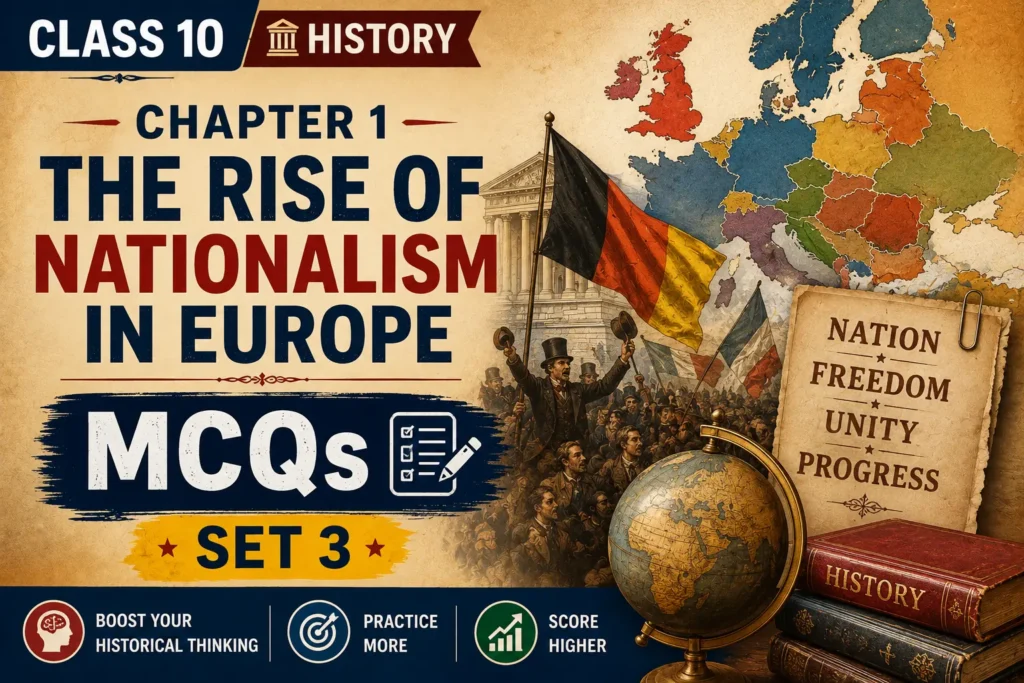
1.
Which of the following aspect best signifies this image of ‘Germania’?
2.
Arrange the following events of world history in increasing order of their date of occurrence-
- Unification of Italy
- Vienna Peace Settlement
- Napoleon wars begin
- Unification of Germany
3.
Which of the following is not a feature or belief of ‘Conservatism’?
4.
Study the picture and answer the question that follows.
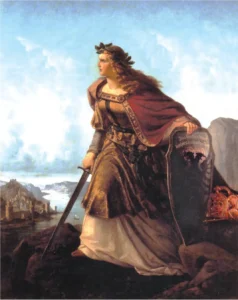
Who among the following has painted this image of Germania.
5.
Assertion-Reason
- Assertion (A) : The Balkan area became an area of intense conflict.
- Reason (R) : The Balkan states were fiercely jealous of each other and each hoped to gain more territory at the expense of the others.
Codes :
6.
Arrange the following events of German unification in increasing order of their date of occurrence:
- Friedrich Wilhelm IV rejected the demand of all German national assembly
- The Frankfurt parliament convened in the Church of St Paul.
- Kaiser William I of Prussia was proclaimed as the new German emperor.
- Three wars over 7 years with Austria, Denmark and France was fought.
7.
Study the picture and answer the question that follows:
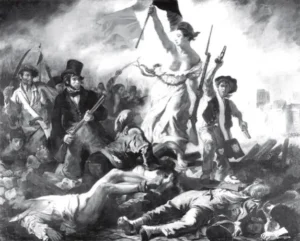
Which of the following aspect best signifies the above image?
8.
Which of the following is associated with the ‘Revolution of the liberals 1848’ ?
- Unlike the revolt of poor in France it was led by educated middle class in Ottoman empire.
- Men and women of the liberal middle classes combined their demands for constitutionalism with national unification
- Demands for the creation of a nation-state on parliamentary principles – a constitution, freedom of the press and freedom of association.
9.
‘Nationalism’, which emerged as a force in the late 19th century, means
10.
With reference to the cause of Silesian Weavers consider the following statements-
- The cause of the silesian weavers uprising was the contractors cheating on the weavers.
- The contractors who supplied the weavers raw materials and gave order for finished materials reduced the payments of the weavers.
Which one of the above statement(s) is/are correct?
11.
With reference to unification of Italy consider the following statements.
- Cavour who led the movement to unify the regions of Italy was neither a revolutionary nor a democrat.
- After the unification of Italy, the Habsburg rulers had more autonomy to the Hungarians.
Which one of the above statement(s) is/are correct?
12.
Which of the following aspect best signifies this image?
13.
Which of the following is the correct definition of Conservatism?
14.
Which of the following statements about the ‘French Revolution’ are correct?
- After the end of the French Revolution it was proclaimed that it was the people who would henceforth constitute the nation and shape its destiny.
- France will have a constitutional monarchy and the new republic will be headed by a member of the royal family.
- A centralised administrative system will be put in place to formulate uniform laws for all citizens.
- Imposition of internal custom duties and dues will continue to exist in France.
15.
Identify the event-
- The first clear expression of nationalism in France.
- The transfer of sovereignty from the monarchy to a body of French citizen.
- A new French Flag, the tricolour was chosen to replace the former royal standards
- The liberation of the people of Europe from despotism.
16.
Consider the following statements -
- Balkans was a region of geographical and ethnic regions.
- A large part of Balkans was free from the Ottomon empire.
- The dismembering of Ottomon empire with its Balkan states became a scene of big power rivalry.
- Balkan states were jealous of each other.
Which of the above statements are correct?
17.
What was the result of the activities and campaigns held at the Jacobin clubs?
18.
What did Napoleon do to make the system efficient and rational in France?
19.
Which of the following is not associated with the revolt of 1848 in Paris?
- Small producers in towns were often faced with stiff competition from imports of cheap machine-made goods from England.
- Food shortages and widespread unemployment brought the population of Paris out on the roads.
- National Assembly proclaimed a constitutional monarchy, granted suffrage to all adult males above 21.
- Men and women of the liberal middle classes combined their demands for constitutionalism with national unification.
20.
Identify the personality -
- She was a political activist.
- She was an elected member of Frankfurt parliament.
- She founded a political association who was feminist in nature.
- She founded a women’s journal.
21.
Which one of the following statement is false regarding the Act of Union 1707?
22.
Which one of the following was not implemented under the Treaty of Vienna of 1815?
23.
Which of the following statements about the ‘French Revolution’ are correct?
- 1. After the end of the French Revolution it was proclaimed that it was the people who would henceforth constitute the nation and shape its destiny.
- France will have a monarchy and will be headed by a member of the royal family.
- A centralised administrative system will be put in place to formulate uniform laws for all citizens.
- Imposition of internal custom duties and dues will continue to exist in France.
24.
Following image is the personification of Germany commonly associated with the Romantic Era and the Revolutions of 1848.
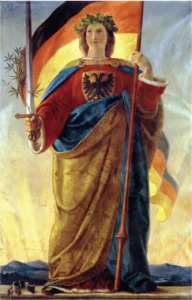
Identify its name from among the following options.
25.
Match the columns and choose correct option.
| Column I | Column II |
| (A) 1797 | (1) Vienna Peace Settlement |
| (B) 1814 | (2) Invasion of Italy |
| (C) 1821 | (3) Revolution in Europe |
| (D) 1848 | (4) Struggle for Independence in Greek |
26.
Which of the following was a part of the Napoleonic Code?
- The feudal system was abolished.
- Guild restrictions were removed.
- Weights and measures were standardised.
- A common national currency was introduced.
27.
Study the picture and answer the question that follows:
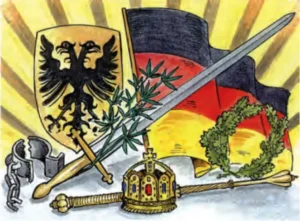
Which of the following aspects best suits the ‘sword’ in the image?
28.
What happened to Poland at the end of 18th century. Select the correct option?
29.
Identify the major aspect that helped in the formation of a nation-state in Britain.
30.
Assertion-Reason
- Assertion (A) : Italy was divided into seven states, of which only one was ruled by an Italian princely house.
- Reason (R) : The north was under the domination of the Bourbon kings of Spain.