Class 10 History Chapter 2 MCQs | Natioanlism in India (Set 1)
Answered: 0/50
Score: 0/50
✓ 0 | ✗ 0
Section A: Picture-Based Questions
1. Examine the photograph showing Indian workers marching through Volksrust in November 1913:
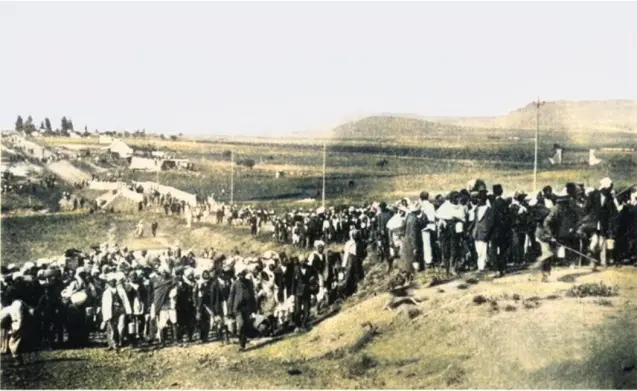
Against which specific injustice was this satyagraha organized under Mahatma Gandhi’s leadership in South Africa?
Explanation: Fig. 2 portrays Indian miners and laborers marching through Volksrust against oppressive racist laws denying civil rights to non-whites in South Africa.
2. Examine the historical image depicting British soldiers enforcing ‘crawling orders’ in Amritsar:

What was the primary psychological objective behind the colonial regime’s punitive measures following the Jallianwala Bagh incident?
Explanation: Following Jallianwala Bagh, General Dyer and colonial forces inflicted brutal humiliations to strike terror and awe into the minds of protesters[cite: 7].
3. Examine the archival photograph showing public bonfires and picketing of foreign textiles in July 1922:
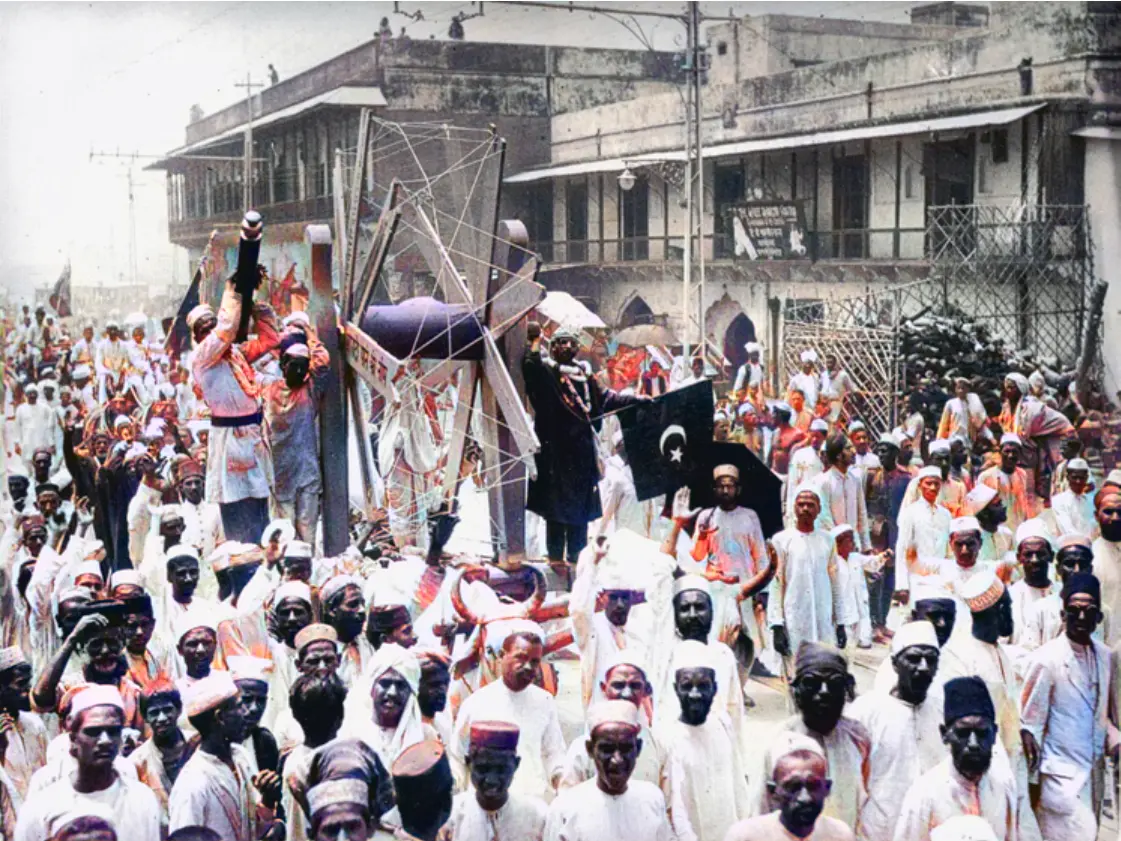
Why was foreign cloth singled out as the chief target of the Non-Cooperation Movement across urban centers?
Explanation: Imported textiles represented British economic exploitation; discarding them asserted national economic self-reliance[cite: 9].
4. Examine the historical scene showing the aftermath at Chauri Chaura in Gorakhpur district, 1922:
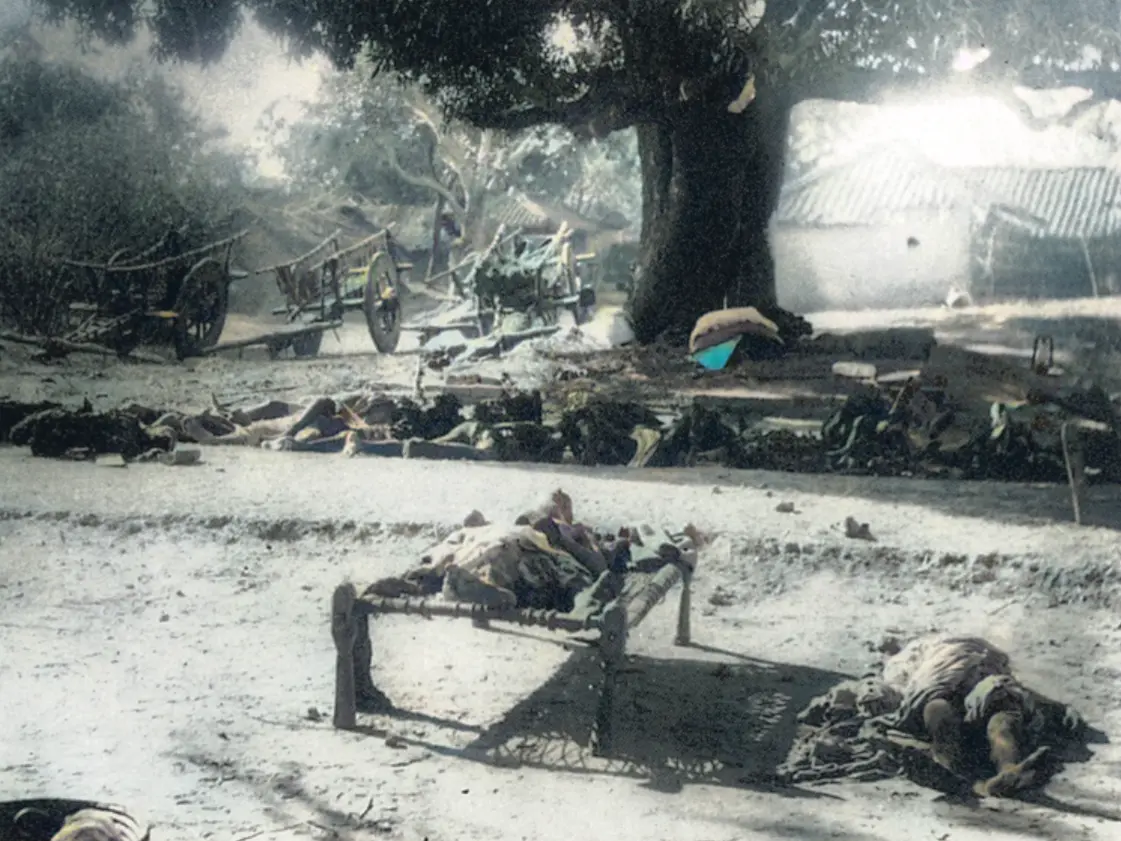
What immediate policy decision did Mahatma Gandhi undertake upon receiving news of this event?
Explanation: The violent clash at Chauri Chaura convinced Gandhiji that satyagrahis required thorough discipline before launching mass agitations, prompting him to call off the movement in February 1922[cite: 12, 13].
5. Examine the portrait of Bharat Mata created by Abanindranath Tagore in 1905:
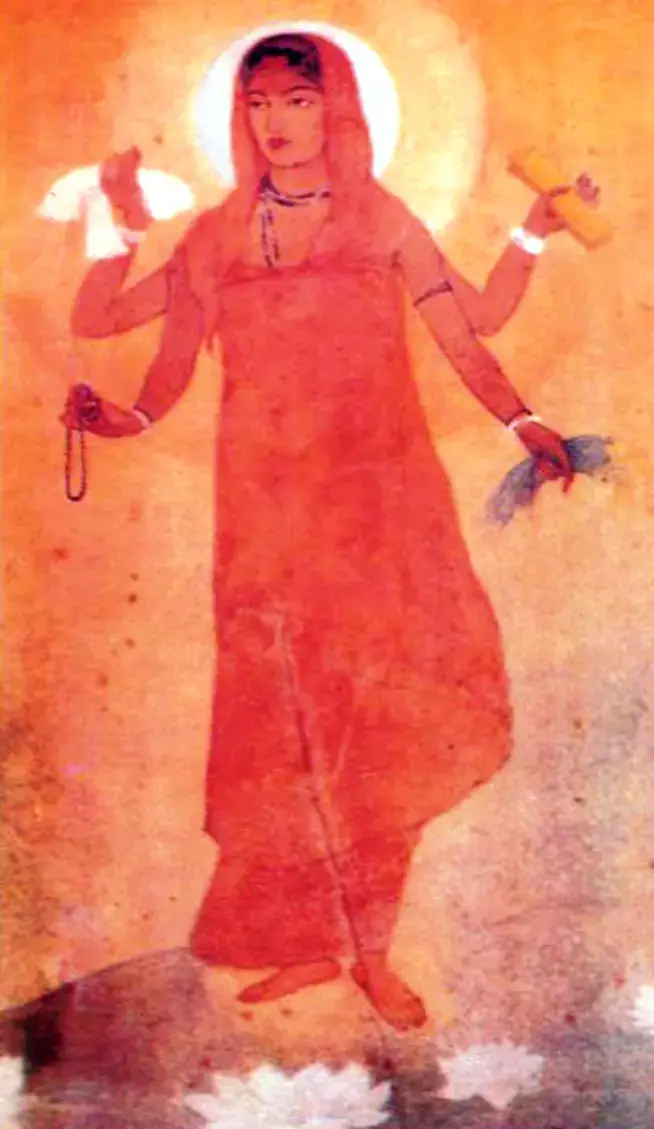
How is the mother figure allegorically portrayed in this pioneering nationalist artwork?
Explanation: Abanindranath Tagore portrayed Bharat Mata as an ascetic, serene, and divine figure bestowing basic sustenance, knowledge, and clothing[cite: 22].
Section B: Matching & Tabular Competencies
6. Match List-I (Early Satyagraha Movement) with List-II (Specific Purpose / Context):
| List-I | List-II |
|---|---|
| 1. Champaran (1917) | a. Supported cotton mill workers’ wage demands |
| 2. Kheda (1918) | b. Resisted oppressive indigo plantation system |
| 3. Ahmedabad (1918) | c. Demanded relaxation of land revenue due to crop failure and plague |
| 4. Rowlatt Satyagraha (1919) | d. Opposed detention without trial for up to two years |
Explanation: Champaran targeted indigo plantation abuses[cite: 6]; Kheda peasants sought revenue relief during crop failure and epidemic[cite: 6]; Ahmedabad supported cotton mill workers[cite: 6]; Rowlatt satyagraha opposed arbitrary detention[cite: 6].
7. Match List-I (Social Group) with List-II (Notion of Swaraj during Non-Cooperation):
| List-I | List-II |
|---|---|
| 1. Awadh Peasants | a. Freedom to move out of enclosed tea estates and retain ties with native villages |
| 2. Gudem Tribal Peasants | b. Reduction of high revenue, abolition of begar, and social boycott of landlords |
| 3. Assam Plantation Laborers | c. Restoration of customary forest grazing and gathering rights without forced road-building labor |
| 4. Urban Middle Class | d. Promotion of swadeshi textiles and boycott of government-run schools and courts |
Explanation: Awadh peasants fought landlords over rents and begar[cite: 10]; Gudem tribals fought forest closures[cite: 11]; tea laborers defied the Inland Emigration Act to return home[cite: 11]; urban classes boycotted schools, courts, and foreign clothes[cite: 9].
8. Match List-I (Historic Date / Session) with List-II (Nationalist Milestone):
| List-I | List-II |
|---|---|
| 1. Nagpur Congress (Dec 1920) | a. Adoption of the historic Purna Swaraj resolution |
| 2. Lahore Congress (Dec 1929) | b. Adoption and formal endorsement of the Non-Cooperation programme |
| 3. Poona Pact (Sept 1932) | c. Compromise granting reserved seats to Depressed Classes in general electorates |
| 4. 26 January 1930 | d. Pledged and celebrated nationwide as the first Independence Day |
Explanation: Nagpur adopted the Non-Cooperation programme[cite: 8]; Lahore proclaimed Purna Swaraj[cite: 14]; Poona Pact resolved separate electorates[cite: 19]; 26 January 1930 was marked as Independence Day[cite: 14].
9. Match List-I (Nationalist Leader / Figure) with List-II (Associated Organization / Movement):
| List-I | List-II |
|---|---|
| 1. Baba Ramchandra | a. Oudh Kisan Sabha in Awadh |
| 2. Alluri Sitaram Raju | b. Guerrilla rebellion in Gudem Hills |
| 3. C. R. Das and Motilal Nehru | c. Depressed Classes Association |
| 4. Dr. B. R. Ambedkar | d. Swaraj Party within Congress |
Explanation: Baba Ramchandra helped establish the Oudh Kisan Sabha[cite: 10]; Alluri Sitaram Raju led the Gudem hill revolt[cite: 11]; C.R. Das and Motilal Nehru formed the Swaraj Party[cite: 13]; Ambedkar founded the Depressed Classes Association[cite: 17, 19].
10. Match List-I (Nationalist Symbol / Work) with List-II (Creator / Description):
| List-I | List-II |
|---|---|
| 1. ‘Vande Mataram’ hymn | a. Swaraj tricolour flag with a spinning wheel |
| 2. The Folklore of Southern India | b. Bankim Chandra Chattopadhyay |
| 3. Swadeshi Tricolour Flag (Bengal) | c. Natesa Sastri’s four-volume Tamil collection |
| 4. 1921 Gandhian Flag | d. Red, green, and yellow banner featuring eight lotuses and a crescent moon |
Explanation: Bankim Chandra wrote Vande Mataram[cite: 22]; Natesa Sastri published Tamil folklore volumes[cite: 23]; the Swadeshi flag had eight lotuses and a crescent moon[cite: 23]; the 1921 Swaraj flag featured a spinning wheel[cite: 23].
Section C: Data & Source Interpretation
11. Data Analysis: According to the official Census of 1921, how many people perished across India as a consequence of famines and the influenza epidemic?
During the First World War and its aftermath, severe agricultural failures and an influenza epidemic impacted several provinces of British India[cite: 5].
Explanation: The 1921 Census estimated that between 12 and 13 million people died due to the combined effect of famines and the influenza epidemic[cite: 5].
12. Economic Data Analysis: By what proportion did the value of foreign cloth imports drop between 1921 and 1922 according to colonial trade records?
The boycott of foreign merchandise during the Non-Cooperation Movement heavily disrupted trade between Britain and India between 1921 and 1922[cite: 9].
Explanation: The import of foreign cloth halved between 1921 and 1922, its value dropping from Rs 102 crore to Rs 57 crore[cite: 9].
13. Numerical Journey Data: What was the total distance covered and the duration taken by Gandhiji and his 78 trusted volunteers during the Dandi March?
Mahatma Gandhi’s historic Salt March from Sabarmati to Dandi galvanized the country into civil disobedience in the spring of 1930[cite: 14].
Explanation: The march covered over 240 miles from Sabarmati to Dandi across 24 days, with the marchers covering roughly 10 miles daily[cite: 14].
14. Consider the following statements regarding the Rowlatt Act of 1919:
1. It was passed unanimously by the Imperial Legislative Council with full consent of Indian members.
2. It authorized the colonial government to detain political prisoners without trial for up to two years.
3. Mahatma Gandhi proposed to launch a nationwide non-violent satyagraha starting with a hartal on 6 April 1919.
Which of the statements given above are correct?
1. It was passed unanimously by the Imperial Legislative Council with full consent of Indian members.
2. It authorized the colonial government to detain political prisoners without trial for up to two years.
3. Mahatma Gandhi proposed to launch a nationwide non-violent satyagraha starting with a hartal on 6 April 1919.
Which of the statements given above are correct?
Explanation: Statement 1 is incorrect because the Act was rushed through despite the united opposition of all Indian members[cite: 6]. Statements 2 and 3 are correct[cite: 6].
15. Consider the following statements regarding council elections under Non-Cooperation in 1920-21:
1. Council elections were boycotted in most provinces across British India.
2. In Madras, the Justice Party supported the boycott and refused to contest.
3. The Justice Party contested elections because they felt entering councils offered non-Brahmans a path to political power.
Which of the statements is/are correct?
1. Council elections were boycotted in most provinces across British India.
2. In Madras, the Justice Party supported the boycott and refused to contest.
3. The Justice Party contested elections because they felt entering councils offered non-Brahmans a path to political power.
Which of the statements is/are correct?
Explanation: Statement 2 is false: the Justice Party did NOT boycott elections; they contested because they saw it as a venue for non-Brahmans to gain political access[cite: 9].
16. Evaluate the following statements regarding the Simon Commission:
1. It was constituted by the new Tory government in Britain under Sir John Simon.
2. It included three elected Indian legislative representatives to ensure constitutional fairness.
3. Upon arriving in India in 1928, it was greeted everywhere with black flags and the slogan ‘Go Back Simon’.
Which of the statements are correct?
1. It was constituted by the new Tory government in Britain under Sir John Simon.
2. It included three elected Indian legislative representatives to ensure constitutional fairness.
3. Upon arriving in India in 1928, it was greeted everywhere with black flags and the slogan ‘Go Back Simon’.
Which of the statements are correct?
Explanation: Statement 2 is false because the commission did not have a single Indian member—all seven commissioners were British[cite: 13].
17. Consider the following statements regarding the business classes and the Civil Disobedience Movement:
1. Industrialists supported the movement initially to resist colonial policies restricting Indian enterprise.
2. They founded the Federation of Indian Chambers of Commerce and Industry (FICCI) in 1927.
3. Following the failure of the Round Table Conference, business groups became uniformly enthusiastic and intensified factory strikes.
Which of the statements given above are correct?
1. Industrialists supported the movement initially to resist colonial policies restricting Indian enterprise.
2. They founded the Federation of Indian Chambers of Commerce and Industry (FICCI) in 1927.
3. Following the failure of the Round Table Conference, business groups became uniformly enthusiastic and intensified factory strikes.
Which of the statements given above are correct?
Explanation: Statement 3 is incorrect because merchants and industrialists grew apprehensive of militant disruption and youth socialism after the London talks failed, waning in enthusiasm[cite: 17].
Section D: Assertion & Reasoning Questions
18.
Assertion (A): The Non-Cooperation Movement in urban cities gradually slowed down after an initial period of intense participation.
Reason (R): Khadi cloth was often much more expensive than British mill-made cloth, and alternative Indian educational and legal institutions were slow to be established.
Reason (R): Khadi cloth was often much more expensive than British mill-made cloth, and alternative Indian educational and legal institutions were slow to be established.
Explanation: Both statements are correct[cite: 9]. High khadi prices and the lack of alternative Indian schools and courts forced poor consumers, students, and lawyers to return to colonial institutions[cite: 9].
19.
Assertion (A): The Congress leadership felt uneasy about the methods adopted by peasant agitators in Awadh in 1921.
Reason (R): Peasant bands looted grain hoards, attacked talukdars’ residences, and invoked Gandhiji’s name to sanction non-payment of taxes and land redistribution.
Reason (R): Peasant bands looted grain hoards, attacked talukdars’ residences, and invoked Gandhiji’s name to sanction non-payment of taxes and land redistribution.
Explanation: Both statements are true[cite: 10]. Peasant militancy and violent property attacks conflicted with the Congress’s preferred constitutional methods of non-violent agitation[cite: 10].
20.
Assertion (A): Mahatma Gandhi undertook a fast unto death in September 1932 against the British award of separate electorates for Dalits.
Reason (R): Gandhiji believed that separate communal electorates for Depressed Classes would permanently divide society and stall their social integration into mainstream national life.
Reason (R): Gandhiji believed that separate communal electorates for Depressed Classes would permanently divide society and stall their social integration into mainstream national life.
Explanation: Gandhiji feared that separate electorates would perpetuate caste fragmentation, prompting his fast that led to the compromise Poona Pact[cite: 19].
21.
Assertion (A): Large sections of Muslim organizations remained lukewarm towards the Civil Disobedience Movement in 1930.
Reason (R): Following the collapse of the Khilafat-Non Cooperation alliance, the Congress appeared more visibly associated with Hindu nationalist groups like the Hindu Mahasabha, breeding mutual suspicion.
Reason (R): Following the collapse of the Khilafat-Non Cooperation alliance, the Congress appeared more visibly associated with Hindu nationalist groups like the Hindu Mahasabha, breeding mutual suspicion.
Explanation: Growing communal distrust, unresolved minority representation demands, and visible Hindu Mahasabha involvement made Muslim political groups hesitant to join the 1930 movement[cite: 19, 20].
Section E: Core Movements, Case Studies & Events
22. Case Study Application: Who was the peasant leader described below, and which organization was formed under his and Jawaharlal Nehru’s leadership in October 1920?
A sanyasi who had earlier served as an indentured labourer in Fiji traveled through rural Uttar Pradesh in 1920, organizing peasants against exorbitant cesses and begar[cite: 10].
Explanation: Baba Ramchandra led the Awadh tenants, and alongside Jawaharlal Nehru, formed the Oudh Kisan Sabha in October 1920[cite: 10].
23. Case Study Application: Which local leader led the armed guerrilla struggle in this area, claiming to possess healing powers and astrological foresight?
In a heavily forested highland tract of Andhra Pradesh, colonial forest acts restricted indigenous villagers from grazing their herds or collecting firewood, while officials demanded free begar labor for constructing roads[cite: 11].
Explanation: Alluri Sitaram Raju led the Gudem Hills guerrilla movement against colonial forest laws, professing spiritual powers while blending Gandhian praise with guerrilla methods[cite: 11].
24. Source-Based Insight: Why did Mahatma Gandhi insist that satyagraha is NOT passive resistance?
Source A: ‘Passive resistance is a weapon of the weak, but the power which is the subject of this article can be used only by the strong… Satyagraha is pure soul-force.'[cite: 6]
Explanation: Gandhiji clarified that satyagraha involves active spiritual resolve and intense moral strength rather than weak, passive submission[cite: 6].
25. Which of the following fiscal measures was introduced for the very first time in British India to finance heavy defense expenditures during World War I?
Explanation: To fund mounting war debt, the colonial government raised customs duties and introduced income tax for the first time[cite: 5].
26. According to Mahatma Gandhi’s philosophical formulation, what is the core operative mechanism of Satyagraha in overcoming oppression?
Explanation: Satyagraha seeks to persuade the oppressor to recognize truth through love and non-violence rather than coercing them through destruction[cite: 6].
27. What specific event in Amritsar on 10 April 1919 provoked violent attacks on civil communication infrastructure, leading to the imposition of martial law?
Explanation: On 10 April 1919, police fired upon an unarmed procession, provoking attacks on banks and post offices and prompting General Dyer to take command[cite: 6].
28. Why had many peaceful villagers gathered inside the enclosed grounds of Jallianwala Bagh on 13 April 1919?
Explanation: Many visitors were rural folk attending the annual Baisakhi festivities who had no knowledge that public assemblies had been outlawed under martial law[cite: 7].
29. Where and when was the Khilafat Committee established by Muslim leaders to defend the temporal powers of the Ottoman Khalifa?
Explanation: The Khilafat Committee was established in Bombay in March 1919 by leaders including the Ali brothers[cite: 7].
30. In which seminal book written in 1909 did Mahatma Gandhi assert that British rule was established and maintained in India only through the active cooperation of Indians?
Explanation: In Hind Swaraj (1909), Gandhiji argued that British rule persisted because Indians cooperated, and would collapse within a year if that cooperation stopped[cite: 7, 8].
31. According to Mahatma Gandhi’s phased plan, how was the Non-Cooperation Movement intended to begin?
Explanation: Gandhiji envisioned the campaign unfolding in stages, opening with the surrender of imperial titles and boycotts of official institutions and goods[cite: 8].
32. What unique community boycott measure was initiated by local panchayats in Awadh to deprive landlords of basic everyday services?
Explanation: Panchayats formed nai-dhobi bandhs to cut off the services of washermen and barbers to oppressive landlords[cite: 10].
33. Under whose leadership was the famous Bardoli Satyagraha of 1928 organized against the colonial hike in land revenue?
Explanation: Vallabhbhai Patel led the successful 1928 Bardoli Satyagraha in Gujarat against enhanced land revenue[cite: 10].
34. Under which colonial statute were tea garden laborers in Assam prohibited from leaving estates without permission, which was rarely granted?
Explanation: Under the Inland Emigration Act of 1859, tea plantation workers were confined to the estates without liberty to leave without permission[cite: 11].
35. Which leaders founded the Swaraj Party within the Indian National Congress in 1923 to argue for a return to provincial council politics?
Explanation: C. R. Das and Motilal Nehru formed the Swaraj Party to contest elections and critique government policies from within legislative councils[cite: 13].
36. What was the direct impact of the worldwide Great Depression on agricultural commodities in India from 1926 to 1930?
Explanation: Plummeting international prices left Indian cultivators unable to sell surplus produce or clear land revenue demands[cite: 13].
37. At the December 1929 Congress session held under the presidency of Jawaharlal Nehru at Lahore, which core political objective was formalized?
Explanation: The Lahore session formalized the goal of Purna Swaraj, declaring that full independence was the sole acceptable outcome[cite: 14].
38. Why did Mahatma Gandhi single out the British monopoly on salt and the salt tax as the central rallying symbol of the Civil Disobedience Movement?
Explanation: Salt unified all classes because it was an indispensable daily necessity; taxing it highlighted state exploitation of the poorest citizen[cite: 14].
39. In his letter of 31 January 1930 to Viceroy Lord Irwin, how many wide-ranging demands did Mahatma Gandhi present before launching civil disobedience?
Explanation: Gandhiji forwarded an ultimatum containing 11 demands reflecting agrarian, industrial, and public grievances[cite: 14].
40. On which date did Mahatma Gandhi arrive at the coastal village of Dandi and ceremonially violate the colonial salt law by boiling sea water?
Explanation: Gandhiji reached the coast at Dandi and manufactured salt on 6 April 1930, marking the official launch of the Civil Disobedience Movement[cite: 14].
41. How did the Civil Disobedience Movement fundamentally differ in scope from the earlier Non-Cooperation Movement of 1921-22?
Explanation: Non-Cooperation focused on withholding cooperation; Civil Disobedience added the deliberate, peaceful violation of unjust colonial laws[cite: 14, 15].
42. When Abdul Ghaffar Khan was arrested in April 1930, where did spontaneous demonstrations erupt in which unarmed citizens faced police gunfire and armored vehicles?
Explanation: The arrest of ‘Frontier Gandhi’ Abdul Ghaffar Khan led to mass street demonstrations facing armored cars and gunfire in Peshawar[cite: 15].
43. Following the arrest of Mahatma Gandhi in May 1930, industrial workers in which manufacturing town attacked municipal buildings, courts, and railway stations?
Explanation: In Sholapur, enraged textile mill laborers attacked government structures following Gandhiji’s arrest[cite: 15].
44. What were the primary terms agreed upon under the Gandhi-Irwin Pact signed on 5 March 1931?
Explanation: Gandhiji agreed to participate in the Second Round Table Conference and suspend agitation in exchange for the release of incarcerated satyagrahis[cite: 15, 16].
45. Why did rich peasant communities like the Patidars of Gujarat and the Jats of Uttar Pradesh refuse to support the movement when Gandhiji relaunched it in 1932?
Explanation: Rich peasants felt let down when the movement was called off in 1931 without achieving the reduction in land revenue rates they sought[cite: 16].
46. Which radical socialist revolutionary organization was founded in 1928 at the Ferozeshah Kotla ground in Delhi by Bhagat Singh, Jatin Das, and Ajoy Ghosh?
Explanation: The Hindustan Socialist Republican Army (HSRA) was established at Ferozeshah Kotla in Delhi in 1928[cite: 16].
47. In April 1929, who threw a bomb into the Central Legislative Assembly in Delhi to protest against colonial repression, proclaiming ‘Inquilab Zindabad’?
Explanation: Bhagat Singh and Batukeswar Dutta threw a non-lethal bomb into the Legislative Assembly to protest repressive measures and publicize the revolution[cite: 16].
48. During the Civil Disobedience Movement, what prevailing social convention characterized the Congress’s organizational perspective on women’s participation?
Explanation: While women participated actively in marches and picketing, the leadership viewed their domestic duties as paramount and was slow to award them executive roles[cite: 18].
49. What political arrangement was concluded between Dr. B. R. Ambedkar and Mahatma Gandhi in the Poona Pact of September 1932?
Explanation: The Poona Pact replaced separate communal electorates with reserved seats for Depressed Classes within the joint general electorate[cite: 19].
50. How did Indian nationalist intellectuals use the reinterpretation of history in the late nineteenth and early twentieth centuries to foster a sense of collective belonging?
Explanation: Nationalist historians looked to the ancient past to restore pride in India’s artistic, scientific, and philosophical accomplishments to dispute colonial stereotypes of backwardness[cite: 23].
Quiz Performance Summary
Attempted
0 / 50
Correct
0
Incorrect
0
Percentage
0%