1.
Which of the following was NOT visualised by Frederic Sorrieu in his first print of series of four prints made up of ‘Democratic and social republic’?
2.
Identify the personality-
- He was a French philosopher.
- He insisted on social capital.
- According to him, nations are not formed by common language, race and religion.
- According to him liberty would be lost if there was only one law and only one master.
3.
Consider the following statements -
- During 1789 paintings of females appeared as symbols of liberty.
- Female figure in France was named as Marianne.
- Germania was depicted by Kaiser William I.
- The idea behind Marianne was to represent the French nation as people’s nation.
Which of the above statement(s) is/are correct?
4.
The postage stamp shows the female allegory - Marianne. Which country does she represents?
5.
Why was Otto von Bismarck considered as the chief architect of German unification ? Choose the correct option from the following:
6.
Select the name of painter in following image?
7.
Who is shown in this picture sitting on knees?
8.
Consider these statements about the Image given below:
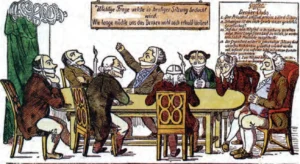
- Title of this caricature is “The Club of Thinkers”.
- The plaque on the left bears the inscription: ‘The most important question of today’s meeting: How long will thinking be allowed to us?”
- This was a caricature of meeting called by liberals.
- This caricature was created in 1820.
Which of the above statement(s) is/are correct?
9.
Which of the following is not a part of the ‘United Kingdom of Great Britain’?
10.
Arrange the following events in the correct sequence and select correct option.
- Unification of Germany.
- Acts of Union.
- Unification of Italy.
- Vienna Peace Settlement.
11.
Arrange the following events related to the formation of nation-state of Britain in chronological order :
- I. Act of Union between England and Scotland.
- II. English Parliament seized power from Monarchy.
- III. Ireland was forcibly incorporated into the United Kingdom.
- IV. Catholic revolt against British dominance.
Options :
12.
Choose the correct statement about the image given below:
13.
Identify the group of people who had -
- Commitment to oppose monarchical forms that had been established after the Vienna Congress
- Willingness to to fight for liberty and freedom.
- They saw the creation of nation-states as a necessary part of this struggle for freedom.
14.
Which among the following was the main reasons for the weavers to revolt against contractors in Silesia, in 1845?
15.
Identify the correct statement with regard to ‘The Act of Union -1707’ from the following options.
16.
Who among the following leaders formed a secret society called ‘Young Italy’ ?
17.
Which one of the following statements is true about nation-states?
18.
Match the column A and column B and choose the correct option.
| Column I | Column II |
| (A) Giuseppe Mazzini | (1) Ruler of an Italian princely house |
| (B) King Victor Emmanuel II | (2) Revolutionary who tried to unify Italy |
| (C) Chief Minister Cavour | (3) led an army of volunteers to Rome to fight the last obstacle to the unification of Italy, the Papal States where a French garrison was stationed. |
| (D) Giuseppe Garibaldi | (4) Through a tactful diplomatic alliance with France he succeeded in defeating the Austrian forces in 1859 |
19.
Who among the following was proclaimed as the ‘German Emperor’ in 1871 ?
20.
What were the consequences of the July revolution of 1830 ?
21.
“When France sneezes, the rest of Europe catches cold”. Who among the following said this popular line?
22.
Choose the incorrect matched option from the following:
23.
Match column A and column B and choose the correct option.
| Column I | Column II |
| (A) Absolutist | (1) A vision of society |
| (B) Utopian | (2) A form of government |
| (C) Plebiscite | (3) A system of direct vote |
| (D) Suffrage | (4) A system of holding election |
24.
Assertion-Reason
- Assertion (A) : King Victor Emmanuel II tried to unify the Italian states through war.
- Reason (R) : In the eyes of the ruling elites of this region, a unified Italy offered them the possibility of economic development and political dominance.
25.
Which among the following best signifies the idea of liberal nationalism of nineteenth century Europe?
26.
Identify the class -
- They owned states in the countryside and also town houses.
- They spoke French for purposes of diplomacy and in high society.
- Their families were often connected by ties of marriage.
27.
Assertion-Reason
- Assertion (A) : The issue of extending political rights to women was a controversial one within the liberal movement.
- Reason (R) : Women were considered more superior and independent of men by the society, because of their enthusiastic performance in liberal movement.
28.
Which of the following was not the objective of Treaty of Vienna 1815 ?
29.
Select the correct definition to define the term ‘Plebiscite’.
30.
Choose the correct option from column A and column B -
| Column I | Column II |
| (A) Broken chains | (1) Symbol of the German empire – strength |
| (B) Breastplate with eagle | (2) Readiness to fight |
| (C) Sword | (3) Being freed |
| (D) Rays of the rising sun | (4) Beginning of a new era |