
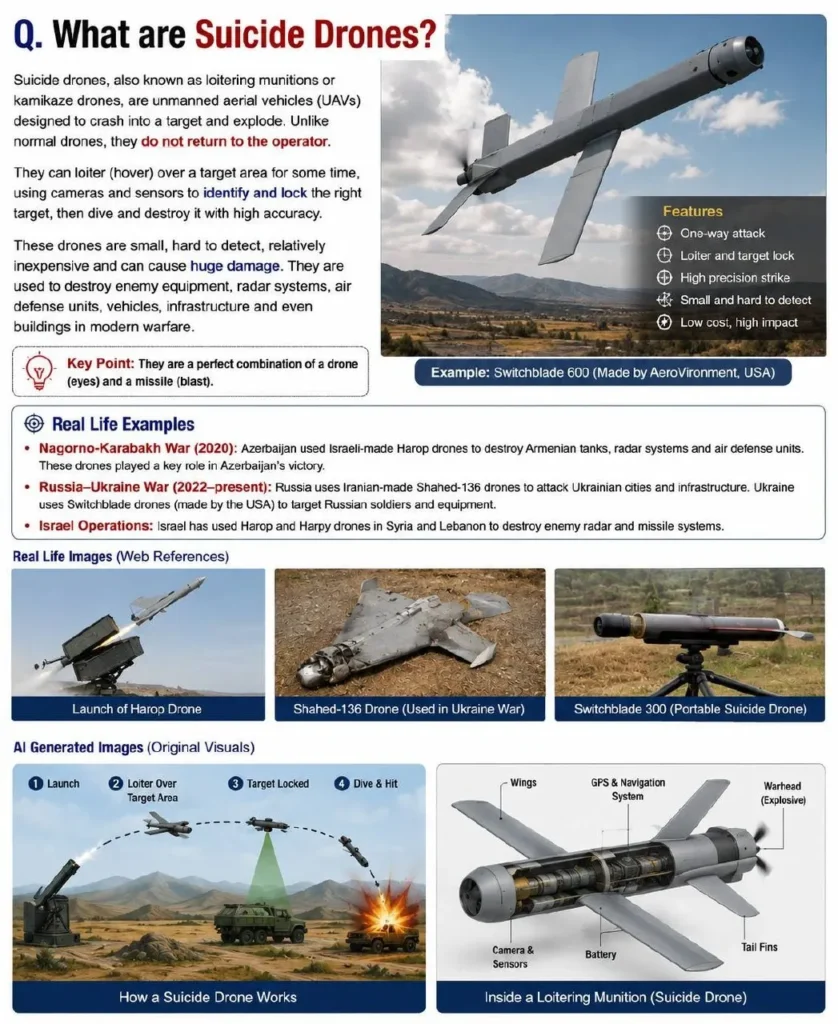
“Suicide drones” are unmanned aerial vehicles (UAVs) designed to destroy a target by crashing into it and detonating their onboard warhead. They are also called kamikaze drones or, more formally, loitering munitions. Unlike conventional military drones, which can return after completing a mission, these drones are generally designed for one-way use.
A major feature is their ability to loiter—remain over an area while searching for a suitable target. Once the target is identified, the drone attacks it directly. Some systems are remotely controlled, while others have varying degrees of automated targeting capability.
Real-life examples:
1. Russia–Ukraine War: Iran’s Shahed-136, known in Russian service as Geran-2, has been widely used by Russia for long-range attacks against Ukrainian targets.
2. Nagorno-Karabakh War (2020): Loitering munitions such as Israel’s Harop were used by Azerbaijan against Armenian military targets, demonstrating their importance in modern warfare.
Thus, suicide drones occupy a space between traditional drones and missiles, providing militaries with a relatively inexpensive way to conduct one-way precision attacks.