
Class 10 Maths Chapter 4 MCQs: Quadratic Equations (Set 1)
Answered: 0/50
Score: 0/50
✓ 0 | ✗ 0
Section A: Diagram & Graphical Competencies
1. The parabolic trajectory of a basketball thrown into a hoop is modelled by a quadratic equation. The graph intersects the horizontal ground axis at two distinct points.
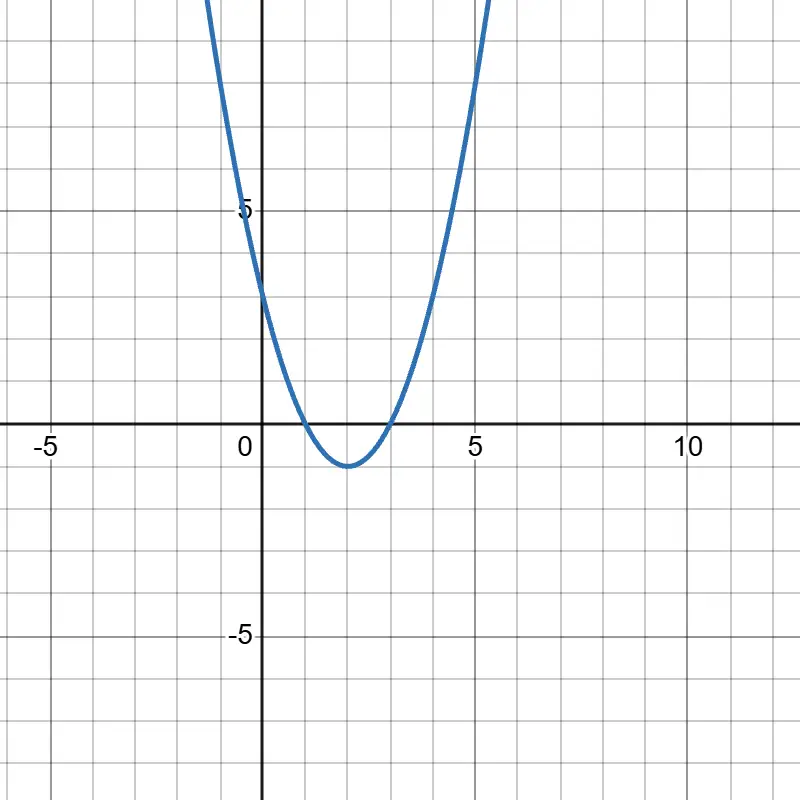
What can be concluded about the discriminant (D) of the corresponding quadratic equation?
Explanation: A parabola intersects the horizontal axis at two distinct points when the quadratic equation has two distinct real roots, which implies D = b² – 4ac > 0.
2. A parabolic suspension cable of a bridge just touches the roadway at a single point (vertex on the road line) before rising again.
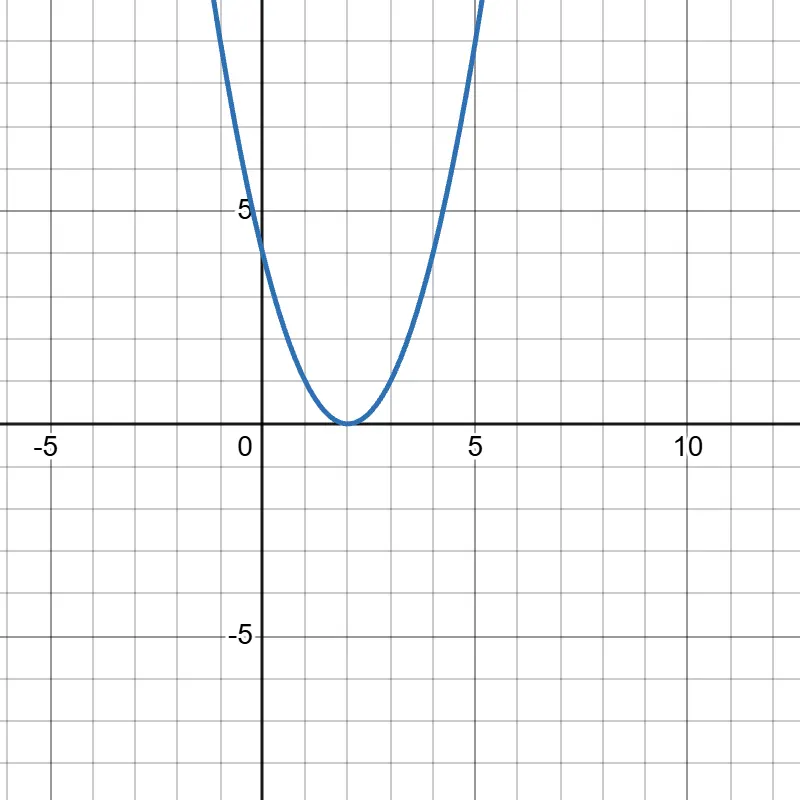
What does this geometric setup indicate regarding the roots of the quadratic equation?
Explanation: When the curve touches the horizontal axis at exactly one point, the roots are real and coincident (equal roots), meaning D = 0.
3. The graph of a quadratic polynomial y = ax² + bx + c lies completely above the X-axis without touching or intersecting it.
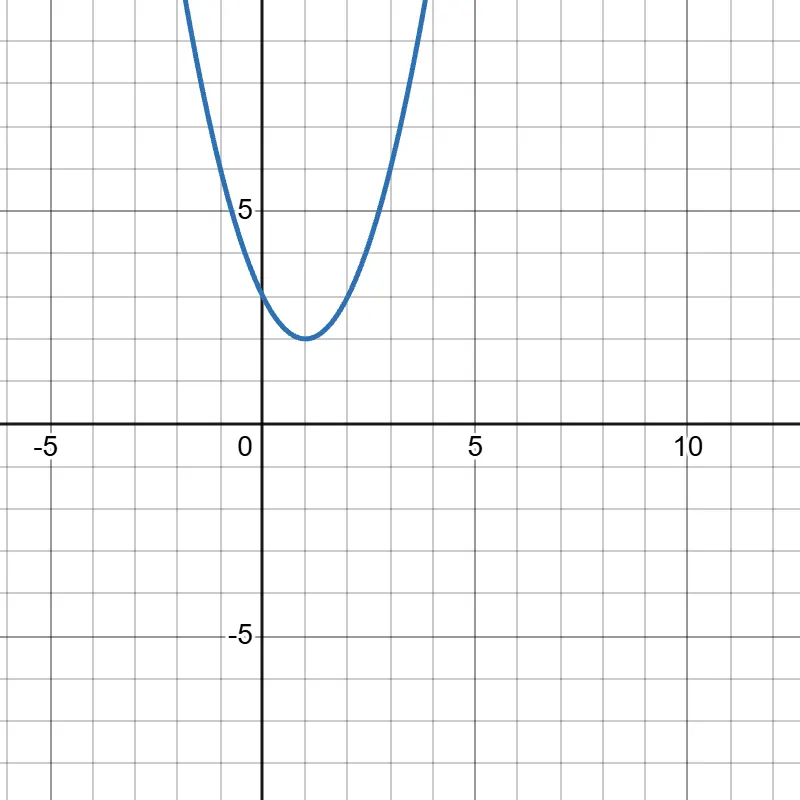
Which of the following conditions holds true for this equation?
Explanation: Opening upwards implies a > 0, and not intersecting or touching the X-axis means there are no real roots, so D = b² – 4ac < 0.
4. A rectangular prayer hall has a floor area of 300 m². Its length is 1 metre more than twice its breadth.
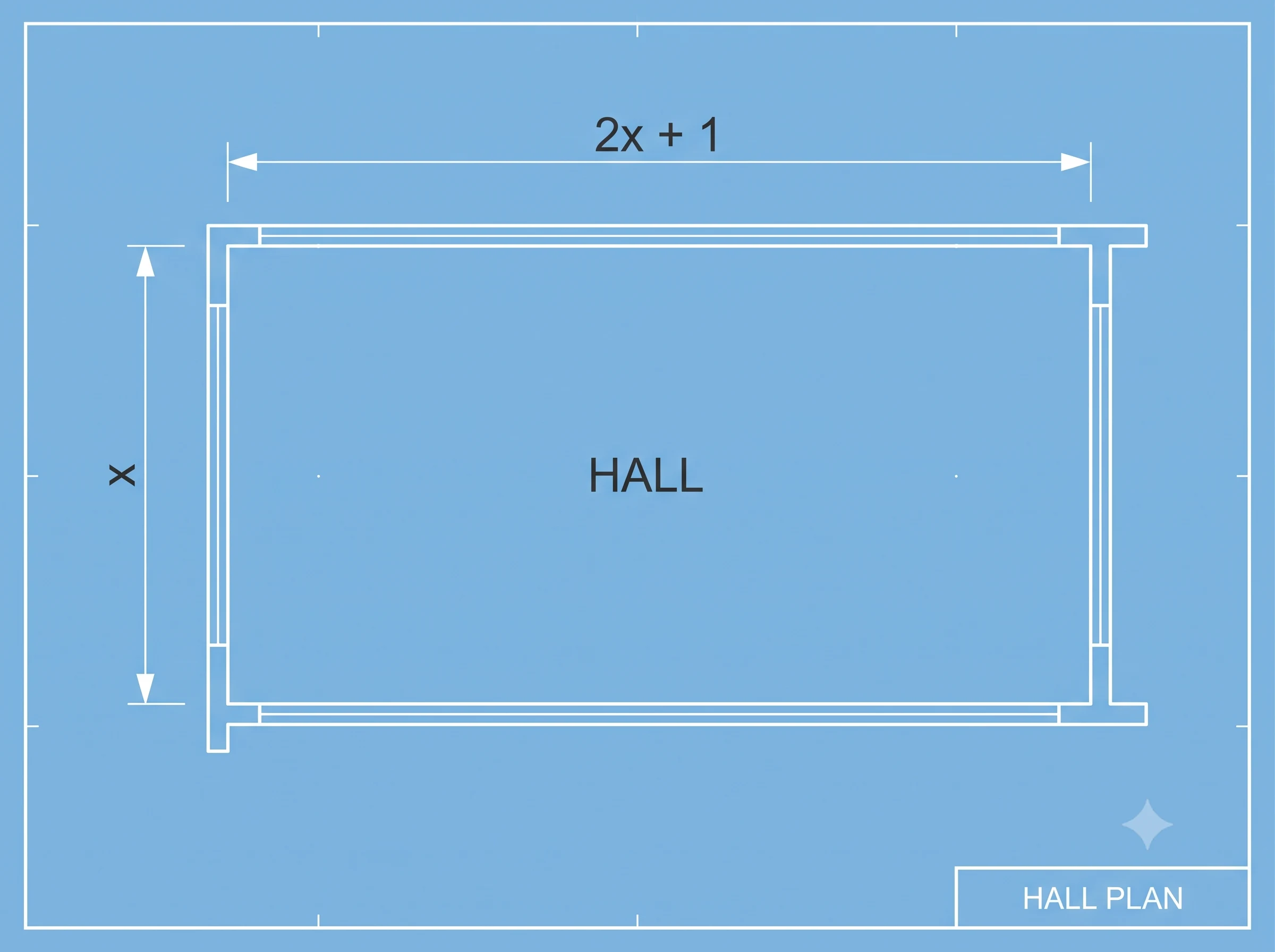
If breadth is represented by x metres, which quadratic equation models this situation?
Explanation: Length = 2x + 1. Area = x(2x + 1) = 300 ⇒ 2x² + x – 300 = 0.
5. A square field of side x metres has a 2-metre wide pathway constructed around its outer boundary.
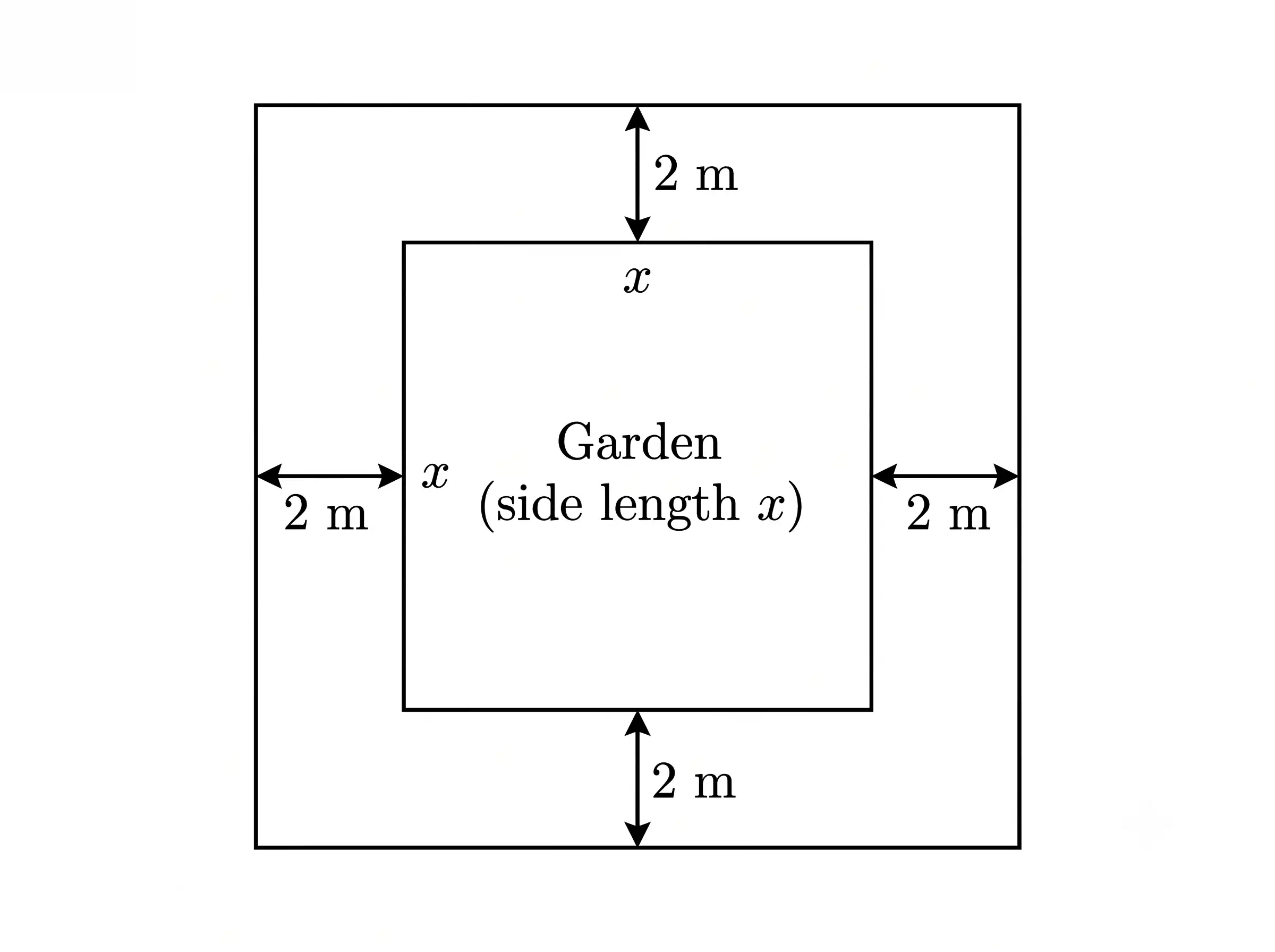
If the total area of the field including the pathway is 256 m², what is the quadratic equation for side x?
Explanation: New side length = x + 2(2) = x + 4. Total area = (x + 4)² = 256 ⇒ x² + 8x + 16 – 256 = 0 ⇒ x² + 8x – 240 = 0.
6. A right-angled triangle has an altitude 7 cm less than its base. The hypotenuse is 13 cm.
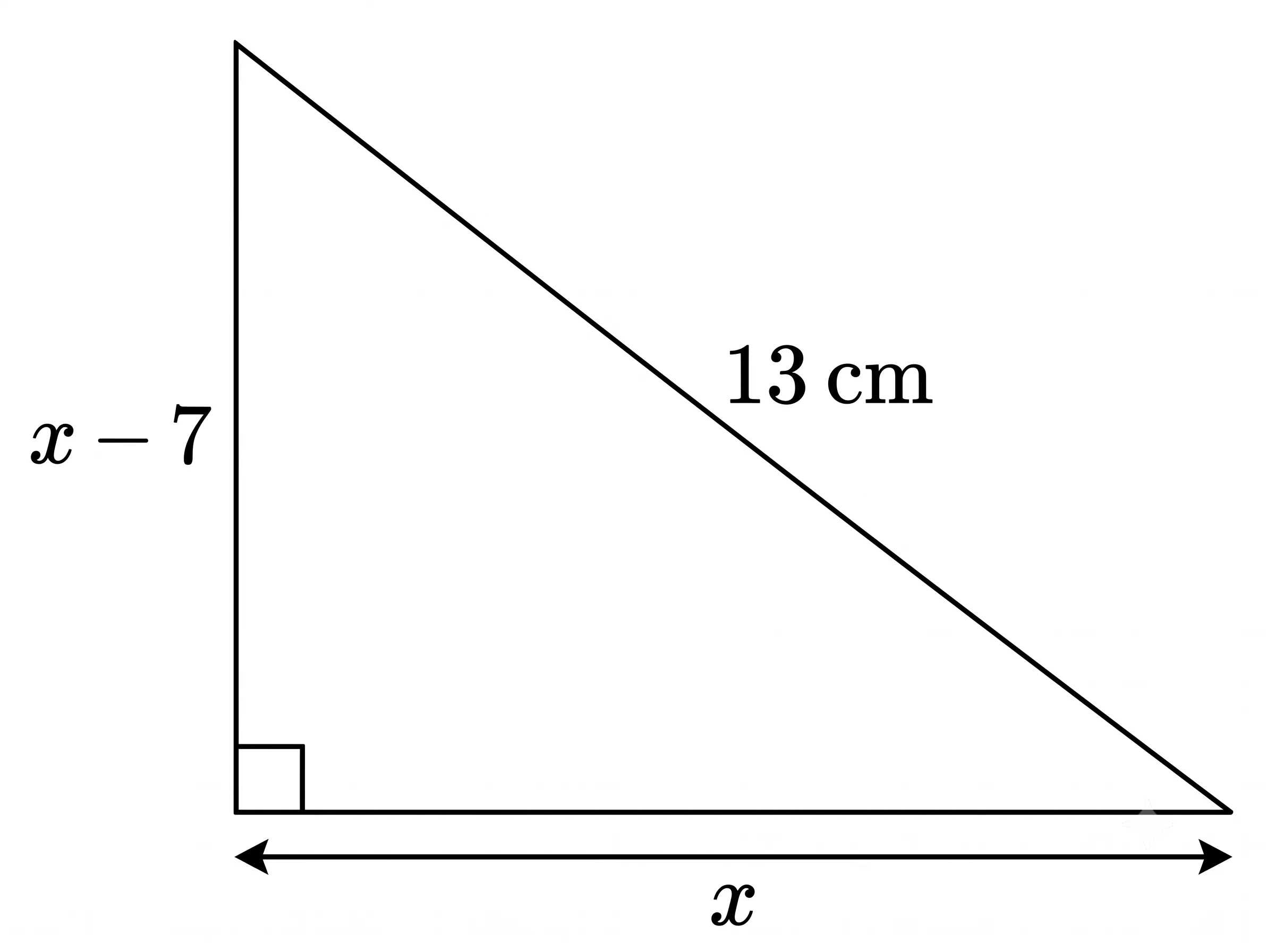
Taking the base as x cm, which quadratic equation models this triangle?
Explanation: By Pythagoras Theorem: x² + (x – 7)² = 13² ⇒ x² + x² – 14x + 49 = 169 ⇒ 2x² – 14x – 120 = 0 ⇒ x² – 7x – 60 = 0.
7. A rectangular park of length 20 m and breadth 15 m is designed with a flower bed of uniform width x metres bordering its inner perimeter.
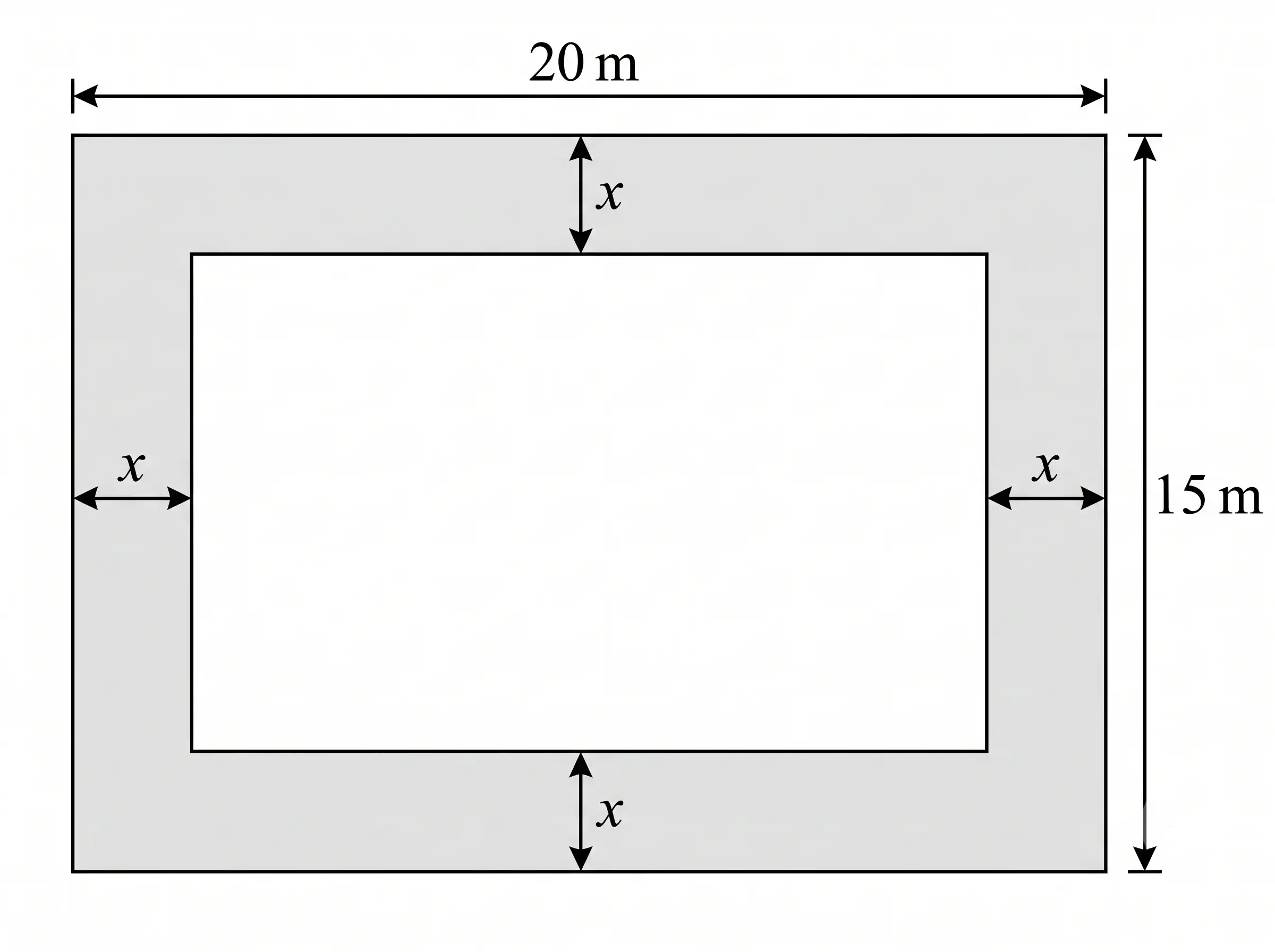
If the remaining inner central lawn has an area of 204 m², what is the corresponding quadratic equation?
Explanation: Inner dimensions are (20 – 2x) and (15 – 2x). Area = (20 – 2x)(15 – 2x) = 300 – 70x + 4x² = 204 ⇒ 4x² – 70x + 96 = 0 (or 2x² – 35x + 48 = 0).
8. A speed-time graph models a train travelling a uniform distance of 360 km. When speed increases by 5 km/h, the trip takes 1 hour less.
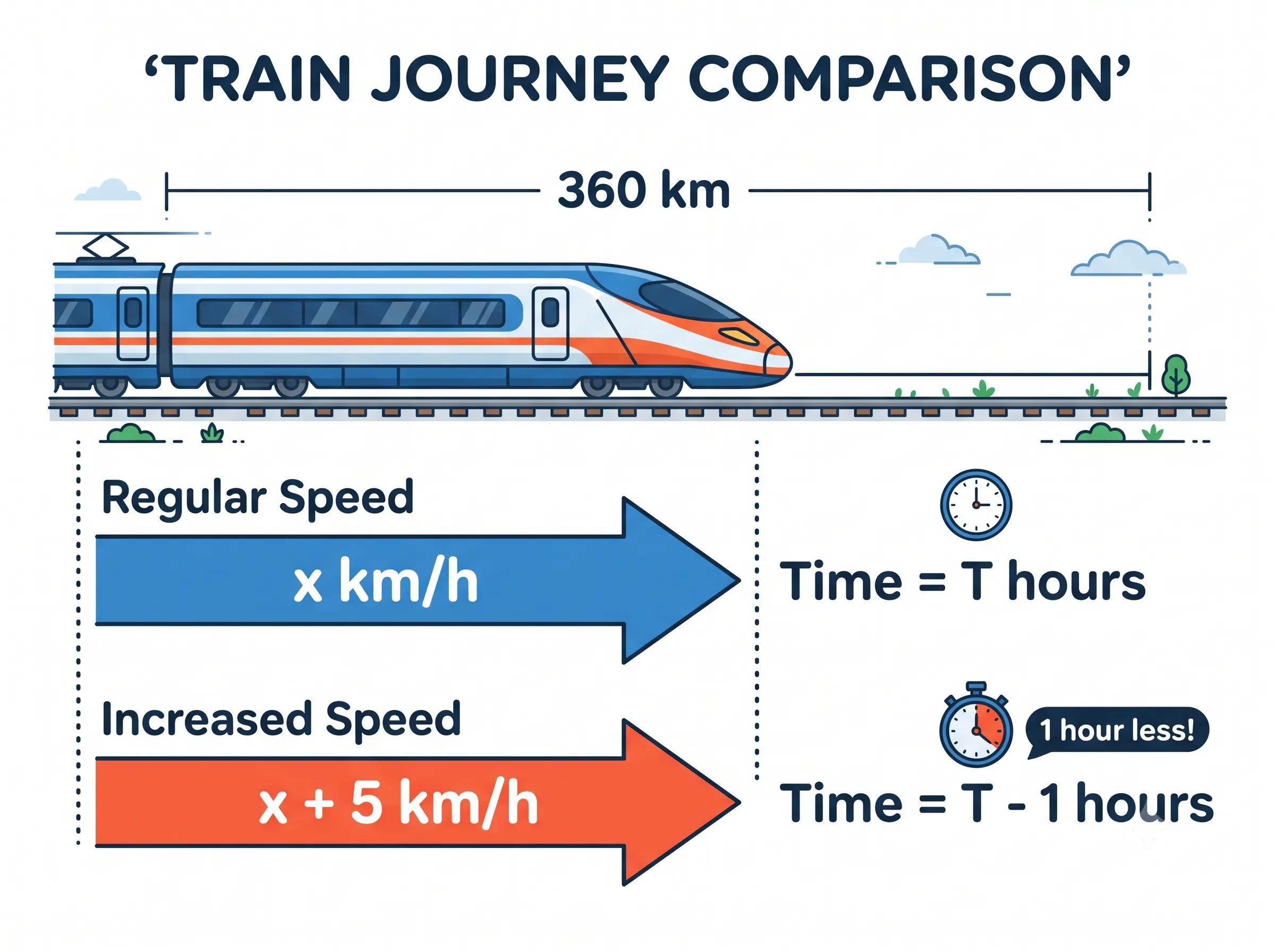
If original speed is x km/h, which quadratic equation represents the journey?
Explanation: 360/x – 360/(x + 5) = 1 ⇒ 360[(x + 5 – x)/(x(x + 5))] = 1 ⇒ 360(5) = x² + 5x ⇒ x² + 5x – 1800 = 0.
Section B: Competency & Case-Based Scenarios
9. Case Scenario: A cottage industry manufactures a certain number of pottery articles each day. On a particular day, the production cost per article was Rs. 3 more than twice the total number of articles produced that day. The total cost of production was Rs. 90. How many articles were produced?
Explanation: Let articles = x. Cost per article = 2x + 3. Total cost = x(2x + 3) = 90 ⇒ 2x² + 3x – 90 = 0 ⇒ (2x + 15)(x – 6) = 0 ⇒ x = 6 (since count cannot be negative).
10. Case Scenario: Two water taps together can fill a swimming pool in 9⅜ hours (75/8 hours). The tap of larger diameter takes 10 hours less than the smaller tap to fill the tank separately. How much time does the smaller tap take alone?
Explanation: 1/x + 1/(x – 10) = 8/75 ⇒ (2x – 10)/(x² – 10x) = 8/75 ⇒ 8x² – 230x + 750 = 0 ⇒ (8x – 30)(x – 25) = 0. If x = 30/8 = 3.75, x – 10 is negative. Hence, x = 25 hours.
11. A motor boat whose speed in still water is 18 km/h takes 1 hour more to go 24 km upstream than to return downstream to the same spot. What is the speed of the stream?
Explanation: Upstream speed = 18 – x, Downstream speed = 18 + x. 24/(18 – x) – 24/(18 + x) = 1 ⇒ 24(2x) = 324 – x² ⇒ x² + 48x – 324 = 0 ⇒ (x + 54)(x – 6) = 0 ⇒ x = 6 km/h.
12. An express train takes 1 hour less than a passenger train to travel 132 km between Mysore and Bangalore. If the average speed of the express train is 11 km/h more than that of the passenger train, find the average speed of the passenger train.
Explanation: 132/x – 132/(x + 11) = 1 ⇒ 132(11) = x² + 11x ⇒ x² + 11x – 1452 = 0 ⇒ (x + 44)(x – 33) = 0 ⇒ x = 33 km/h.
13. The sum of the areas of two squares is 468 m². If the difference of their perimeters is 24 m, what are the side lengths of the two squares?
Explanation: 4x – 4y = 24 ⇒ x – y = 6 ⇒ x = y + 6. Area sum: (y + 6)² + y² = 468 ⇒ 2y² + 12y + 36 = 468 ⇒ y² + 6y – 216 = 0 ⇒ (y + 18)(y – 12) = 0 ⇒ y = 12 m, x = 18 m.
14. Competency check: Is it possible to design a rectangular mango grove whose length is twice its breadth, and the area is 800 m²? If yes, what is its breadth?
Explanation: Area = x(2x) = 2x² = 800 ⇒ x² = 400 ⇒ x = ±20. Since x > 0, breadth = 20 m and length = 40 m. The discriminant D = 0² – 4(2)(-800) = 6400 > 0, so it is possible.
15. Is it mathematically possible to design a rectangular park of perimeter 80 m and area 400 m²? If so, what are its dimensions?
Explanation: 2(l + b) = 80 ⇒ l + b = 40 ⇒ b = 40 – l. Area = l(40 – l) = 400 ⇒ l² – 40l + 400 = 0 ⇒ (l – 20)² = 0 ⇒ l = 20 m, b = 20 m. Every square is a rectangle.
Section C: Assertion & Reasoning (CBSE Pattern)
16. Assertion (A): The equation (x + 1)² = 2(x – 3) is a linear equation.
Reason (R): A quadratic equation has degree 2 in standard form ax² + bx + c = 0 (a ≠ 0).
Reason (R): A quadratic equation has degree 2 in standard form ax² + bx + c = 0 (a ≠ 0).
Explanation: (x + 1)² = 2(x – 3) simplifies to x² + 2x + 1 = 2x – 6 ⇒ x² + 7 = 0, which has degree 2 (quadratic, not linear). Thus, A is false and R is true.
17. Assertion (A): The equation x² + 4x + 5 = 0 has no real roots.
Reason (R): For any quadratic equation ax² + bx + c = 0, no real roots exist if the discriminant D = b² – 4ac < 0.
Reason (R): For any quadratic equation ax² + bx + c = 0, no real roots exist if the discriminant D = b² – 4ac < 0.
Explanation: Discriminant D = 4² – 4(1)(5) = 16 – 20 = -4 < 0. Hence, the equation has no real roots. Both statements are true and R explains A.
18. Assertion (A): The roots of the quadratic equation 2x² – 6x + 3 = 0 are real and distinct.
Reason (R): The roots of ax² + bx + c = 0 are given by the quadratic formula x = [-b ± √(b² – 4ac)] / 2a.
Reason (R): The roots of ax² + bx + c = 0 are given by the quadratic formula x = [-b ± √(b² – 4ac)] / 2a.
Explanation: D = (-6)² – 4(2)(3) = 36 – 24 = 12 > 0, so roots are real and distinct. Both statements are correct, but R does not state the condition D > 0 as the reason for distinct real roots.
19. Assertion (A): The equation 4x² – 12x + 9 = 0 has two equal real roots.
Reason (R): The discriminant of 4x² – 12x + 9 = 0 is equal to 144.
Reason (R): The discriminant of 4x² – 12x + 9 = 0 is equal to 144.
Explanation: D = (-12)² – 4(4)(9) = 144 – 144 = 0. Since D = 0, roots are real and equal. Thus A is true, but R is false (D = 0, not 144).
20. Assertion (A): Every quadratic equation must have at least one real root.
Reason (R): A quadratic equation has at most two roots.
Reason (R): A quadratic equation has at most two roots.
Explanation: Equations with D < 0 (such as x² + 1 = 0) have no real roots. Thus Assertion A is false, while Reason R is a true property of polynomial degree 2.
Section D: Core Concepts & Practice (Q21 to Q50)
21. Which of the following expressions is a quadratic equation?
Explanation: Option A simplifies to x² – 4x + 4 + 1 = 2x – 3 ⇒ x² – 6x + 8 = 0, which is of the form ax² + bx + c = 0 with a ≠ 0. In B and C, the x² terms cancel out.
22. If x = 2 is a solution of the quadratic equation kx² + 2x – 3 = 0, what is the value of k?
Explanation: Substitute x = 2: k(2)² + 2(2) – 3 = 0 ⇒ 4k + 4 – 3 = 0 ⇒ 4k + 1 = 0 ⇒ k = -1/4.
23. What are the roots of the quadratic equation x² – 3x – 10 = 0?
Explanation: Factorising: x² – 5x + 2x – 10 = 0 ⇒ x(x – 5) + 2(x – 5) = 0 ⇒ (x – 5)(x + 2) = 0 ⇒ x = 5, -2.
24. What are the roots of the equation 2x² – x + 1/8 = 0?
Explanation: Multiply by 8: 16x² – 8x + 1 = 0 ⇒ (4x – 1)² = 0 ⇒ 4x – 1 = 0 ⇒ x = 1/4, 1/4.
25. Find two numbers whose sum is 27 and product is 182.
Explanation: x(27 – x) = 182 ⇒ x² – 27x + 182 = 0 ⇒ (x – 13)(x – 14) = 0 ⇒ Numbers are 13 and 14.
26. Find two consecutive positive integers, sum of whose squares is 365.
Explanation: x² + (x + 1)² = 365 ⇒ 2x² + 2x + 1 – 365 = 0 ⇒ x² + x – 182 = 0 ⇒ (x + 14)(x – 13) = 0 ⇒ x = 13 (positive). Integers are 13 and 14.
27. What is the discriminant (D) of the quadratic equation 2x² – 4x + 3 = 0?
Explanation: D = b² – 4ac = (-4)² – 4(2)(3) = 16 – 24 = -8.
28. For what values of k does the quadratic equation 2x² + kx + 3 = 0 have two equal roots?
Explanation: For equal roots, D = 0 ⇒ k² – 4(2)(3) = 0 ⇒ k² – 24 = 0 ⇒ k² = 24 ⇒ k = ±√24 = ±2√6.
29. Find the non-zero value of k for which kx(x – 2) + 6 = 0 has two equal roots.
Explanation: kx² – 2kx + 6 = 0. For equal roots: (-2k)² – 4(k)(6) = 0 ⇒ 4k² – 24k = 0 ⇒ 4k(k – 6) = 0. Since k ≠ 0 for a quadratic equation, k = 6.
30. What is the nature of the roots of the quadratic equation 3x² – 4√3 x + 4 = 0?
Explanation: D = (-4√3)² – 4(3)(4) = 48 – 48 = 0. Since D = 0, roots are real and equal.
31. What are the roots of the equation 3x² – 4√3 x + 4 = 0?
Explanation: Roots = -b / (2a) = -(-4√3) / (2 × 3) = 4√3 / 6 = 2√3 / 3 = 2 / √3.
32. If 1/2 is a root of the equation x² + kx – 5/4 = 0, then find the value of k.
Explanation: (1/2)² + k(1/2) – 5/4 = 0 ⇒ 1/4 + k/2 – 5/4 = 0 ⇒ k/2 – 1 = 0 ⇒ k/2 = 1 ⇒ k = 2.
33. Which quadratic equation has roots (2 + √3) and (2 – √3)?
Explanation: Sum of roots = (2 + √3) + (2 – √3) = 4. Product of roots = (2 + √3)(2 – √3) = 4 – 3 = 1. Equation is x² – (Sum)x + Product = x² – 4x + 1 = 0.
34. If α and β are the roots of the equation 2x² – 5x + 2 = 0, what is the value of (α + β + αβ)?
Explanation: α + β = -(-5)/2 = 5/2. αβ = 2/2 = 1. Thus, α + β + αβ = 5/2 + 1 = 7/2.
35. What is the value of (α² + β²) if α and β are the roots of the equation x² – 7x + 12 = 0?
Explanation: α + β = 7, αβ = 12. α² + β² = (α + β)² – 2αβ = 7² – 2(12) = 49 – 24 = 25.
36. What is the value of (1/α + 1/β) where α, β are the roots of ax² + bx + c = 0?
Explanation: 1/α + 1/β = (α + β)/(αβ) = (-b/a) / (c/a) = -b/c.
37. If one root of the quadratic equation 2x² + kx – 6 = 0 is 2, what is the other root?
Explanation: Product of roots αβ = c/a = -6/2 = -3. If α = 2, then 2β = -3 ⇒ β = -3/2.
38. For what values of p does the equation px² + 4x + 1 = 0 have real roots?
Explanation: Real roots require D ≥ 0 ⇒ 4² – 4(p)(1) ≥ 0 ⇒ 16 – 4p ≥ 0 ⇒ 4p ≤ 16 ⇒ p ≤ 4 (with p ≠ 0 for degree 2).
39. The equation x² – 8x + k = 0 has real and distinct roots if:
Explanation: Distinct real roots require D > 0 ⇒ (-8)² – 4(1)(k) > 0 ⇒ 64 – 4k > 0 ⇒ 4k < 64 ⇒ k < 16.
40. Find the roots of the equation √2 x² + 7x + 5√2 = 0.
Explanation: √2 × 5√2 = 10. Split 7 into 5 and 2: √2 x² + 2x + 5x + 5√2 = 0 ⇒ √2 x(x + √2) + 5(x + √2) = 0 ⇒ (√2 x + 5)(x + √2) = 0 ⇒ x = -5/√2, -√2.
41. Find the roots of the quadratic equation 100x² – 20x + 1 = 0.
Explanation: 100x² – 20x + 1 = (10x – 1)² = 0 ⇒ 10x – 1 = 0 ⇒ x = 1/10, 1/10.
42. If the roots of ax² + bx + c = 0 are reciprocal to each other, which condition must be satisfied?
Explanation: Let roots be α and 1/α. Product of roots = α × (1/α) = 1. By formula, product = c/a. Thus, c/a = 1 ⇒ a = c.
43. If the roots of ax² + bx + c = 0 are equal in magnitude but opposite in sign, which condition is true?
Explanation: Let roots be α and -α. Sum of roots = α + (-α) = 0. By formula, sum = -b/a. Thus, -b/a = 0 ⇒ b = 0.
44. Solve for x: x + 1/x = 3 (where x ≠ 0).
Explanation: Multiply by x: x² + 1 = 3x ⇒ x² – 3x + 1 = 0. x = [-(-3) ± √((-3)² – 4(1)(1))] / 2 = (3 ± √(9 – 4)) / 2 = (3 ± √5) / 2.
45. Solve for x: 1/x – 1/(x – 2) = 3 (where x ≠ 0, 2).
Explanation: (x – 2 – x) / (x(x – 2)) = 3 ⇒ -2 = 3(x² – 2x) ⇒ 3x² – 6x + 2 = 0. x = [6 ± √(36 – 24)] / 6 = (6 ± √12) / 6 = (6 ± 2√3) / 6 = (3 ± √3) / 3.
46. The sum of the reciprocals of Rehman’s ages (in years) 3 years ago and 5 years from now is 1/3. Find his present age.
Explanation: 1/(x – 3) + 1/(x + 5) = 1/3 ⇒ (2x + 2)/(x² + 2x – 15) = 1/3 ⇒ 6x + 6 = x² + 2x – 15 ⇒ x² – 4x – 21 = 0 ⇒ (x – 7)(x + 3) = 0 ⇒ x = 7 years.
47. In a class test, the sum of Shefali’s marks in Mathematics and English is 30. Had she got 2 marks more in Mathematics and 3 marks less in English, the product of their marks would have been 210. What are her marks in Mathematics?
Explanation: Let Maths marks = x, English = 30 – x. (x + 2)(30 – x – 3) = 210 ⇒ (x + 2)(27 – x) = 210 ⇒ -x² + 25x + 54 = 210 ⇒ x² – 25x + 156 = 0 ⇒ (x – 12)(x – 13) = 0 ⇒ x = 12 or 13.
48. The diagonal of a rectangular field is 60 metres more than the shorter side. If the longer side is 30 metres more than the shorter side, find the length of the shorter side.
Explanation: Shorter side = x, diagonal = x + 60, longer side = x + 30. By Pythagoras: (x + 60)² = x² + (x + 30)² ⇒ x² + 120x + 3600 = x² + x² + 60x + 900 ⇒ x² – 60x – 2700 = 0 ⇒ (x – 90)(x + 30) = 0 ⇒ x = 90 m.
49. The difference of squares of two numbers is 180. The square of the smaller number is 8 times the larger number. Find the two numbers.
Explanation: Larger = x, smaller² = 8x. x² – 8x = 180 ⇒ x² – 8x – 180 = 0 ⇒ (x – 18)(x + 10) = 0. Since x = -10 gives smaller² = -80 (not possible), x = 18. Smaller² = 8(18) = 144 ⇒ smaller = ±12.
50. A natural number, when increased by 12, equals 160 times its reciprocal. Find the number.
Explanation: x + 12 = 160/x ⇒ x² + 12x – 160 = 0 ⇒ (x + 20)(x – 8) = 0. Since x is a natural number, x = 8.
Quiz Performance Summary
Attempted
0 / 50
Correct
0
Incorrect
0
Percentage
0%