CBSE 2026-27 Syllabus Scope Note:
This post covers in-syllabus NCERT Exemplar questions strictly based on the rationalised curriculum: area of sectors and segments of circles, problems based on areas and perimeter / circumference of plane figures with central angles limited to standard angles (\(60^\circ, 90^\circ,\) and \(120^\circ\)). All in-syllabus questions from Exercises 11.1 to 11.4 are solved below with dedicated image containers.
Exercise 11.1: Multiple Choice Questions (MCQs)
Section B — Sample 1
If the area of a circle is \(154\text{ cm}^2\), then its perimeter is:
(A) \(11\text{ cm}\)
(B) \(22\text{ cm}\)
(C) \(44\text{ cm}\)
(D) \(55\text{ cm}\)
Solution: Correct Option (C)
Let radius be \(r\):
\[\pi r^2 = 154 \implies \frac{22}{7} r^2 = 154 \implies r^2 = \frac{154 \times 7}{22} = 49 \implies r = 7\text{ cm}\]
\[\text{Perimeter} = 2\pi r = 2 \times \frac{22}{7} \times 7 = 44\text{ cm}\]
Section B — Sample 2
If \(\theta\) is the angle (in degrees) of a sector of a circle of radius \(r\), then area of the sector is:
(A) \(\frac{\pi r^2 \theta}{360}\)
(B) \(\frac{\pi r^2 \theta}{180}\)
(C) \(\frac{2\pi r \theta}{360}\)
(D) \(\frac{2\pi r \theta}{180}\)
Solution: Correct Option (A)
By standard formula, area of sector with radius \(r\) and central angle \(\theta\) is \(\frac{\theta}{360} \times \pi r^2\).
Exercise 11.1 — Q1
1. If the sum of the areas of two circles with radii \(R_1\) and \(R_2\) is equal to the area of a circle of radius \(R\), then:
(A) \(R_1 + R_2 = R\)
(B) \(R_1^2 + R_2^2 = R^2\)
(C) \(R_1 + R_2 < R\)
(D) \(R_1^2 + R_2^2 < R^2\)
Solution: Correct Option (B)
\[\pi R_1^2 + \pi R_2^2 = \pi R^2 \implies \pi(R_1^2 + R_2^2) = \pi R^2 \implies R_1^2 + R_2^2 = R^2\]
Exercise 11.1 — Q2
2. If the sum of the circumferences of two circles with radii \(R_1\) and \(R_2\) is equal to the circumference of a circle of radius \(R\), then:
(A) \(R_1 + R_2 = R\)
(B) \(R_1 + R_2 > R\)
(C) \(R_1 + R_2 < R\)
(D) Nothing definite can be said
Solution: Correct Option (A)
\[2\pi R_1 + 2\pi R_2 = 2\pi R \implies 2\pi(R_1 + R_2) = 2\pi R \implies R_1 + R_2 = R\]
Exercise 11.1 — Q3
3. If the circumference of a circle and the perimeter of a square are equal, then:
(A) Area of circle = Area of square
(B) Area of circle > Area of square
(C) Area of circle < Area of square
(D) Nothing definite can be said
Solution: Correct Option (B)
Let circumference \(2\pi r = 4a \implies a = \frac{\pi r}{2}\):
\[\text{Area of square} = a^2 = \frac{\pi^2 r^2}{4} = \frac{\pi}{4}(\pi r^2) \approx \frac{3.14}{4}(\text{Area of circle}) = 0.785 \times \text{Area of circle}\]
Hence, \(\text{Area of circle} > \text{Area of square}\).
Exercise 11.1 — Q4
4. Area of the largest triangle that can be inscribed in a semicircle of radius \(r\) units is:
(A) \(r^2\text{ sq. units}\)
(B) \(\frac{1}{2}r^2\text{ sq. units}\)
(C) \(2r^2\text{ sq. units}\)
(D) \(\sqrt{2}r^2\text{ sq. units}\)
Solution: Correct Option (A)
The base is the diameter \(= 2r\). The maximum altitude to this base is the radius \(r\):
\[\text{Area} = \frac{1}{2} \times \text{Base} \times \text{Altitude} = \frac{1}{2} \times 2r \times r = r^2\text{ sq. units}\]
Exercise 11.1 — Q5
5. If the perimeter of a circle is equal to that of a square, then the ratio of their areas is:
(A) \(22 : 7\)
(B) \(14 : 11\)
(C) \(7 : 22\)
(D) \(11 : 14\)
Solution: Correct Option (B)
\[2\pi r = 4a \implies \frac{r}{a} = \frac{2}{\pi} = \frac{2}{22/7} = \frac{7}{11}\]
\[\frac{\text{Area of circle}}{\text{Area of square}} = \frac{\pi r^2}{a^2} = \pi \left(\frac{r}{a}\right)^2 = \frac{22}{7} \times \left(\frac{7}{11}\right)^2 = \frac{22}{7} \times \frac{49}{121} = \frac{14}{11}\]
Exercise 11.1 — Q6
6. A single circular park is built equal in area to the sum of areas of two circular parks of diameters \(16\text{ m}\) and \(12\text{ m}\). The radius of the new park would be:
(A) \(10\text{ m}\)
(B) \(15\text{ m}\)
(C) \(20\text{ m}\)
(D) \(24\text{ m}\)
Solution: Correct Option (A)
Radii are \(r_1 = 8\text{ m}\) and \(r_2 = 6\text{ m}\):
\[R^2 = r_1^2 + r_2^2 = 8^2 + 6^2 = 64 + 36 = 100 \implies R = 10\text{ m}\]
Exercise 11.1 — Q7
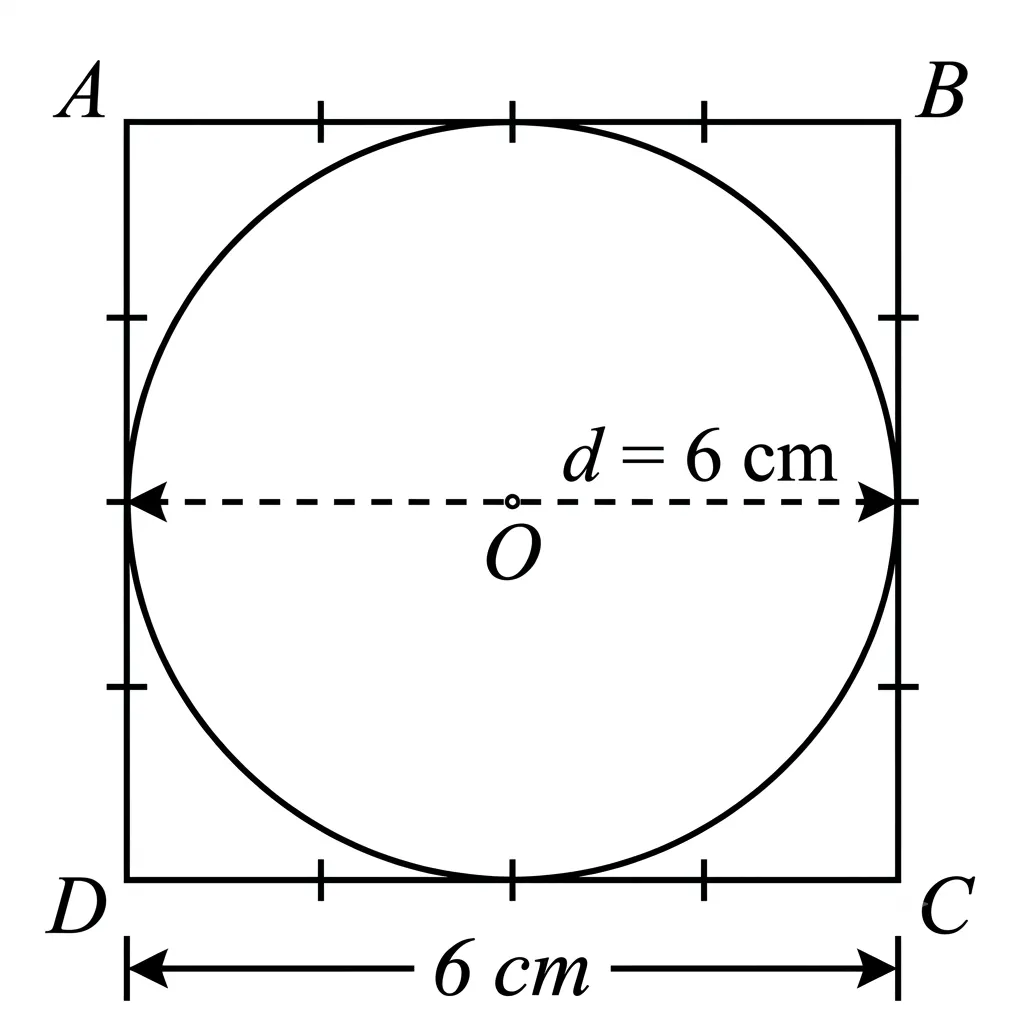
7. The area of the circle that can be inscribed in a square of side \(6\text{ cm}\) is:
(A) \(36\pi\text{ cm}^2\)
(B) \(18\pi\text{ cm}^2\)
(C) \(12\pi\text{ cm}^2\)
(D) \(9\pi\text{ cm}^2\)
Solution: Correct Option (D)
Diameter of the circle equals the side of the square \(= 6\text{ cm} \implies r = 3\text{ cm}\):
\[\text{Area} = \pi r^2 = \pi(3)^2 = 9\pi\text{ cm}^2\]
Exercise 11.1 — Q8
8. The area of the square that can be inscribed in a circle of radius \(8\text{ cm}\) is:
(A) \(256\text{ cm}^2\)
(B) \(128\text{ cm}^2\)
(C) \(64\sqrt{2}\text{ cm}^2\)
(D) \(64\text{ cm}^2\)
Solution: Correct Option (B)
Diagonal of the square equals the diameter of the circle \(= 2 \times 8 = 16\text{ cm}\):
\[\text{Area of square} = \frac{1}{2} d^2 = \frac{1}{2} \times 16^2 = \frac{256}{2} = 128\text{ cm}^2\]
Exercise 11.1 — Q9
9. The radius of a circle whose circumference is equal to the sum of circumferences of two circles of diameters \(36\text{ cm}\) and \(20\text{ cm}\) is:
(A) \(56\text{ cm}\)
(B) \(42\text{ cm}\)
(C) \(28\text{ cm}\)
(D) \(16\text{ cm}\)
Solution: Correct Option (C)
\(r_1 = 18\text{ cm}\), \(r_2 = 10\text{ cm}\):
\[R = r_1 + r_2 = 18 + 10 = 28\text{ cm}\]
Exercise 11.1 — Q10
10. The diameter of a circle whose area is equal to the sum of areas of two circles of radii \(24\text{ cm}\) and \(7\text{ cm}\) is:
(A) \(31\text{ cm}\)
(B) \(25\text{ cm}\)
(C) \(62\text{ cm}\)
(D) \(50\text{ cm}\)
Solution: Correct Option (D)
\[R^2 = 24^2 + 7^2 = 576 + 49 = 625 \implies R = 25\text{ cm}\]
\[\text{Diameter} = 2R = 2 \times 25 = 50\text{ cm}\]
Exercise 11.2: True / False with Reasoning
Section C — Sample 1
Is the following statement true? “Area of a segment of a circle = area of corresponding sector – area of corresponding triangle.” Give reasons.
Solution: False
This statement is true only for a minor segment. In the case of a major segment, the area of the triangle must be added to the area of the corresponding major sector (or subtracted from the total circle area).
Section C — Sample 2
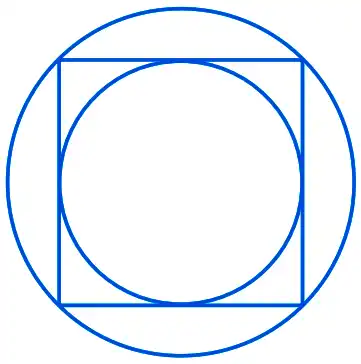
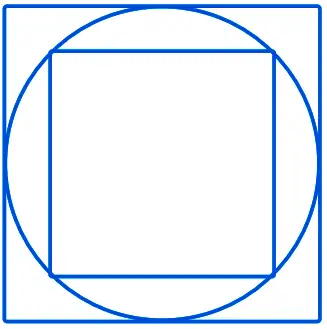
In Fig. 11.2, a circle is inscribed in a square of side \(5\text{ cm}\) and another circle circumscribes the square. Is it true to say that area of outer circle is two times the area of inner circle?
Solution: True
Diameter of inner circle \(= 5\text{ cm} \implies r_1 = \frac{5}{2}\text{ cm}\).
Diameter of outer circle \(=\) diagonal of square \(= 5\sqrt{2}\text{ cm} \implies r_2 = \frac{5\sqrt{2}}{2}\text{ cm}\).
\[\frac{A_2}{A_1} = \frac{\pi r_2^2}{\pi r_1^2} = \frac{\left(\frac{5\sqrt{2}}{2}\right)^2}{\left(\frac{5}{2}\right)^2} = \frac{50/4}{25/4} = 2\]
Exercise 11.2 — Q1
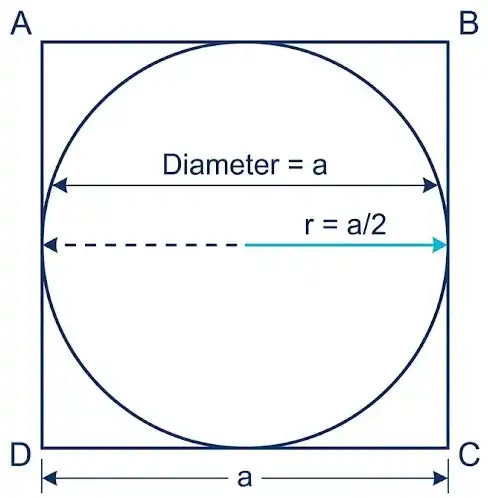
1. Is the area of the circle inscribed in a square of side \(a\text{ cm}\), \(\pi a^2\text{ cm}^2\)? Give reasons.
Solution: False
The diameter of the inscribed circle is equal to side \(a\), so its radius is \(r = \frac{a}{2}\):
\[\text{Area} = \pi \left(\frac{a}{2}\right)^2 = \frac{\pi a^2}{4}\text{ cm}^2 \neq \pi a^2\text{ cm}^2\]
Exercise 11.2 — Q2
2. Will it be true to say that the perimeter of a square circumscribing a circle of radius \(a\text{ cm}\) is \(8a\text{ cm}\)? Give reasons.
Solution: True
The side of the circumscribing square equals the diameter of the circle \(= 2a\text{ cm}\):
\[\text{Perimeter} = 4 \times \text{side} = 4 \times 2a = 8a\text{ cm}\]
Exercise 11.2 — Q3
3. In Fig 11.3, a square is inscribed in a circle of diameter \(d\) and another square circumscribes the circle. Is the area of the outer square four times the area of the inner square?
Solution: False
Side of outer square \(= d \implies \text{Area}_{\text{outer}} = d^2\).
Diagonal of inner square \(= d \implies \text{Area}_{\text{inner}} = \frac{d^2}{2}\).
\[\frac{\text{Area}_{\text{outer}}}{\text{Area}_{\text{inner}}} = \frac{d^2}{d^2/2} = 2 \neq 4\]
It is two times, not four times.
Exercise 11.2 — Q4
4. Is it true to say that area of a segment of a circle is less than the area of its corresponding sector? Why?
Solution: False
This holds true only for a minor segment. For a major segment, its area is greater than the area of the corresponding sector.
Exercise 11.2 — Q5
5. Is it true that the distance travelled by a circular wheel of diameter \(d\text{ cm}\) in one revolution is \(2\pi d\text{ cm}\)? Why?
Solution: False
Distance in one revolution equals circumference \(C = \pi \times \text{diameter} = \pi d\text{ cm}\), not \(2\pi d\text{ cm}\).
Exercise 11.2 — Q6
6. In covering a distance \(s\text{ metres}\), a circular wheel of radius \(r\text{ metres}\) makes \(\frac{s}{2\pi r}\) revolutions. Is this statement true? Why?
Solution: True
\[\text{Number of revolutions} = \frac{\text{Total distance}}{\text{Circumference}} = \frac{s}{2\pi r}\]
Exercise 11.2 — Q7
7. The numerical value of the area of a circle is greater than the numerical value of its circumference. Is this statement true? Why?
Solution: False
For radius \(r < 2\) (e.g., \(r = 1\)), \(\text{Area} = \pi(1)^2 = \pi \approx 3.14\) while \(\text{Circumference} = 2\pi(1) = 2\pi \approx 6.28\), so area is numerically smaller.
Exercise 11.2 — Q8
8. If the length of an arc of radius \(r\) is equal to that of an arc of radius \(2r\), then angle of sector of first circle is double the angle of sector of other circle. Is this false?
Solution: No, the statement is True (hence not false)
\[l_1 = l_2 \implies \frac{\theta_1}{360} \times 2\pi r = \frac{\theta_2}{360} \times 2\pi (2r) \implies \theta_1 r = 2\theta_2 r \implies \theta_1 = 2\theta_2\]
Exercise 11.2 — Q9
9. The areas of two sectors of two different circles with equal corresponding arc lengths are equal. Is this statement true? Why?
Solution: False
Area of a sector can be written as \(A = \frac{1}{2} l r\). Even if arc lengths \(l\) are equal, if radii \(r\) are different, the areas will not be equal.
Exercise 11.2 — Q10
10. The areas of two sectors of two different circles are equal. Is it necessary that their corresponding arc lengths are equal? Why?
Solution: No
Since \(A = \frac{1}{2}lr\), if radii \(r_1 \neq r_2\), then for equal areas \(l_1 r_1 = l_2 r_2\), which implies \(l_1 \neq l_2\).
Exercise 11.2 — Q11
11. Is the area of the largest circle that can be drawn inside a rectangle of length \(a\text{ cm}\) and breadth \(b\text{ cm}\) \((a > b)\) equal to \(\pi b^2\text{ cm}^2\)? Why?
Solution: False
The maximum diameter cannot exceed breadth \(b\), so radius is \(r = \frac{b}{2}\):
\[\text{Area} = \pi \left(\frac{b}{2}\right)^2 = \frac{\pi b^2}{4}\text{ cm}^2 \neq \pi b^2\text{ cm}^2\]
Exercise 11.2 — Q12
12. Circumferences of two circles are equal. Is it necessary that their areas be equal? Why?
Solution: Yes
\(2\pi r_1 = 2\pi r_2 \implies r_1 = r_2\). Equal radii imply equal areas: \(\pi r_1^2 = \pi r_2^2\).
Exercise 11.2 — Q13
13. Areas of two circles are equal. Is it necessary that their circumferences are equal? Why?
Solution: Yes
\(\pi r_1^2 = \pi r_2^2 \implies r_1 = r_2\). Equal radii imply equal circumferences: \(2\pi r_1 = 2\pi r_2\).
Exercise 11.2 — Q14
14. Is it true to say that area of a square inscribed in a circle of diameter \(p\text{ cm}\) is \(p^2\text{ cm}^2\)? Why?
Solution: False
Diagonal of the square equals diameter \(p\):
\[\text{Area} = \frac{1}{2} d^2 = \frac{p^2}{2}\text{ cm}^2 \neq p^2\text{ cm}^2\]
Exercise 11.3: Short Answer Questions
Section D — Sample 3
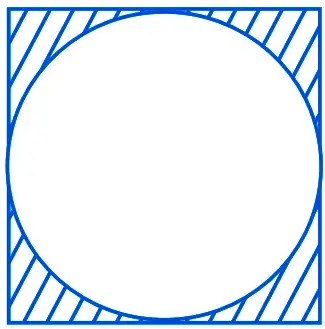
In Fig 11.4, a circle of radius \(7.5\text{ cm}\) is inscribed in a square. Find the area of the shaded region (Use \(\pi = 3.14\)).
Solution
Side of square \(s = 2r = 2 \times 7.5 = 15\text{ cm}\):
\[\text{Area of square} = 15^2 = 225\text{ cm}^2\]
\[\text{Area of circle} = 3.14 \times (7.5)^2 = 176.625\text{ cm}^2\]
\[\text{Shaded area} = 225 – 176.625 = \mathbf{48.375\text{ cm}^2}\]
Exercise 11.3 — Q1
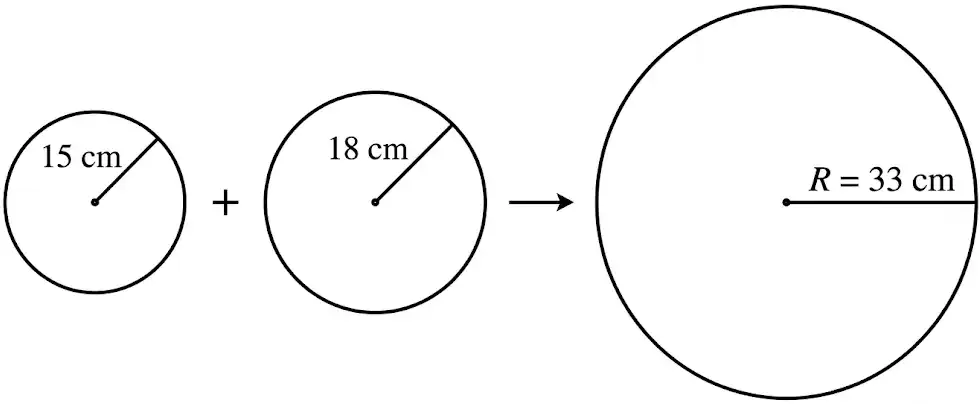
1. Find the radius of a circle whose circumference is equal to the sum of circumferences of two circles of radii \(15\text{ cm}\) and \(18\text{ cm}\).
Solution
\[2\pi R = 2\pi(15) + 2\pi(18) \implies R = 15 + 18 = \mathbf{33\text{ cm}}\]
Exercise 11.3 — Q2
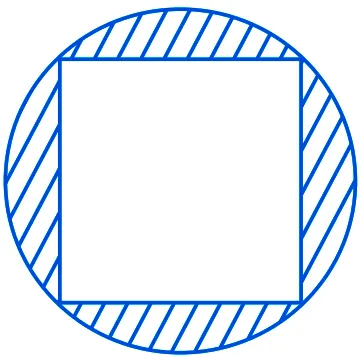
2. In Fig. 11.5, a square of diagonal \(8\text{ cm}\) is inscribed in a circle. Find the area of the shaded region.
Solution
Diameter of circle \(= 8\text{ cm} \implies r = 4\text{ cm}\):
\[\text{Area of circle} = \pi(4)^2 = \frac{22}{7} \times 16 = \frac{352}{7} = 50.28\text{ cm}^2\]
\[\text{Area of square} = \frac{1}{2} d^2 = \frac{1}{2} \times 8^2 = 32\text{ cm}^2\]
\[\text{Shaded area} = \frac{352}{7} – 32 = \frac{128}{7} = \mathbf{18.28\text{ cm}^2}\]
Exercise 11.3 — Q3
3. Find the area of a sector of a circle of radius \(28\text{ cm}\) and central angle \(45^\circ\).
Solution
\[\text{Area} = \frac{45}{360} \times \frac{22}{7} \times 28^2 = \frac{1}{8} \times \frac{22}{7} \times 784 = \frac{1}{8} \times 2464 = \mathbf{308\text{ cm}^2}\]
Exercise 11.3 — Q4
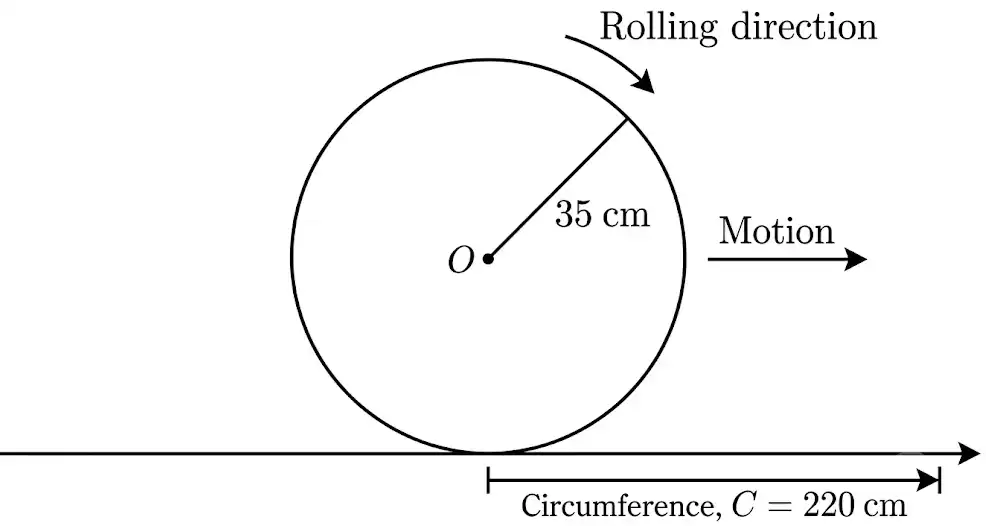
4. The wheel of a motorcycle is of radius \(35\text{ cm}\). How many revolutions per minute must the wheel make to keep a speed of \(66\text{ km/h}\)?
Solution
Distance in 1 minute:
\[\frac{66 \times 1000 \times 100}{60} = 110000\text{ cm}\]
\[\text{Circumference} = 2 \times \frac{22}{7} \times 35 = 220\text{ cm}\]
\[\text{Revolutions per minute} = \frac{110000}{220} = \mathbf{500}\]
Exercise 11.3 — Q5
5. A cow is tied with a rope of length \(14\text{ m}\) at the corner of a rectangular field of dimensions \(20\text{ m} \times 16\text{ m}\). Find the grazing area.
Solution
The cow grazes a circular quadrant of radius \(r = 14\text{ m}\) (\(\theta = 90^\circ\)):
\[\text{Area} = \frac{90}{360} \times \frac{22}{7} \times 14^2 = \frac{1}{4} \times \frac{22}{7} \times 196 = \frac{616}{4} = \mathbf{154\text{ m}^2}\]
Exercise 11.3 — Q6
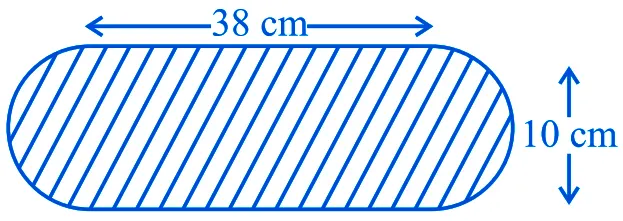
6. Find the area of the flower bed with semicircular ends shown in Fig. 11.6.
Solution
Rectangle length \(= 38\text{ cm}\), width (diameter of semicircles) \(= 10\text{ cm} \implies r = 5\text{ cm}\):
\[\text{Area of rectangle} = 38 \times 10 = 380\text{ cm}^2\]
\[\text{Area of two semicircles} = \pi r^2 = 3.14 \times 5^2 = 78.5\text{ cm}^2\]
\[\text{Total area} = 380 + 78.5 = \mathbf{458.5\text{ cm}^2}\]
Exercise 11.3 — Q7
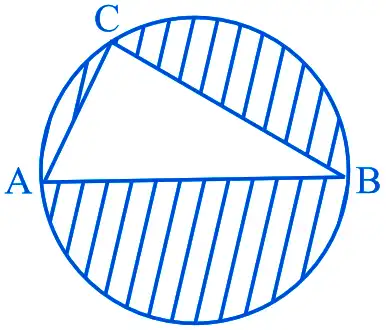
7. In Fig. 11.7, \(AB\) is a diameter of the circle, \(AC = 6\text{ cm}\) and \(BC = 8\text{ cm}\). Find the area of the shaded region (Use \(\pi = 3.14\)).
Solution
\(\angle ACB = 90^\circ\) (angle in semicircle):
\[AB = \sqrt{6^2 + 8^2} = 10\text{ cm} \implies r = 5\text{ cm}\]
\[\text{Area of circle} = 3.14 \times 5^2 = 78.5\text{ cm}^2\]
\[\text{Area of } \Delta ABC = \frac{1}{2} \times 6 \times 8 = 24\text{ cm}^2\]
\[\text{Shaded area} = 78.5 – 24 = \mathbf{54.5\text{ cm}^2}\]
Exercise 11.3 — Q8
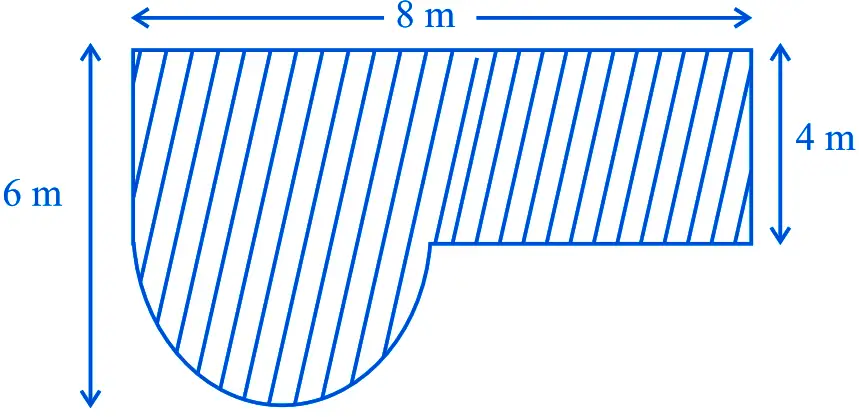
8. Find the area of the shaded field shown in Fig. 11.8.
Solution
Taking semicircle radius \(r = 2\text{ m}\) with rectangle parts:
\[\text{Area of rectangular portion} = (8 \times 4) = 32\text{ m}^2\]
\[\text{Area of semicircle} = \frac{1}{2} \pi (2)^2 = 2\pi \approx 6.28\text{ m}^2\]
\[\text{Total area} = 32 + 6.28 = \mathbf{38.28\text{ m}^2}\]
Exercise 11.3 — Q9
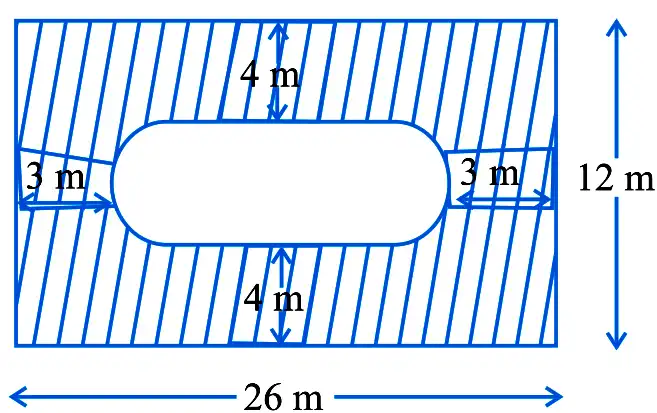
9. Find the area of the shaded region in Fig. 11.9.
Solution
Outer rectangle: \(26\text{ m} \times 12\text{ m} \implies \text{Area} = 312\text{ m}^2\).
Inner unshaded shape has width \(12 – 4 – 4 = 4\text{ m} \implies r = 2\text{ m}\) for semicircular ends.
Inner straight length \(= 26 – 3 – 3 – 2(2) = 16\text{ m}\):
\[\text{Area of inner shape} = (16 \times 4) + \pi(2)^2 = 64 + 4(3.14) = 76.56\text{ m}^2\]
\[\text{Shaded area} = 312 – 76.56 = \mathbf{235.44\text{ m}^2}\]
Exercise 11.3 — Q10
10. Find the area of minor segment of a circle of radius \(14\text{ cm}\) when the central angle is \(60^\circ\).
Solution
\[\text{Area of sector} = \frac{60}{360} \times \frac{22}{7} \times 14^2 = \frac{1}{6} \times 616 = \frac{308}{3}\text{ cm}^2\]
\[\text{Area of equilateral } \Delta = \frac{\sqrt{3}}{4} r^2 = \frac{\sqrt{3}}{4} \times 196 = 49\sqrt{3}\text{ cm}^2\]
\[\text{Area of segment} = \frac{308}{3} – 49\sqrt{3} \approx 102.67 – 84.87 = \mathbf{17.80\text{ cm}^2}\]
Exercise 11.3 — Q11
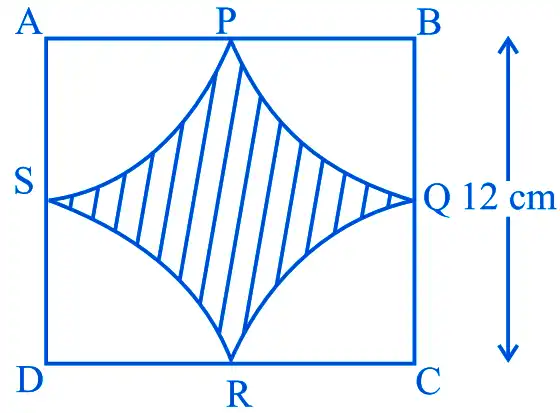
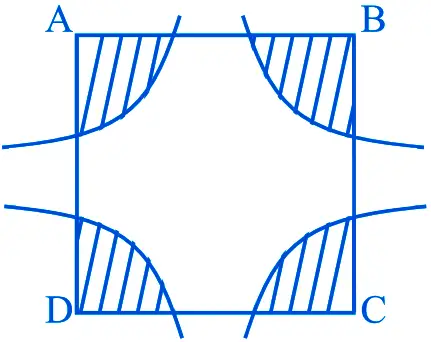
11. Find the area of shaded region in Fig. 11.10 where arcs drawn from vertices of square \(ABCD\) of side \(12\text{ cm}\) meet at midpoints (Use \(\pi = 3.14\)).
Solution
Radius of each quadrant arc is \(r = \frac{12}{2} = 6\text{ cm}\):
\[\text{Area of square} = 12^2 = 144\text{ cm}^2\]
\[\text{Combined area of 4 quadrants} = \pi r^2 = 3.14 \times 6^2 = 113.04\text{ cm}^2\]
\[\text{Shaded central area} = 144 – 113.04 = \mathbf{30.96\text{ cm}^2}\]
Exercise 11.3 — Q12
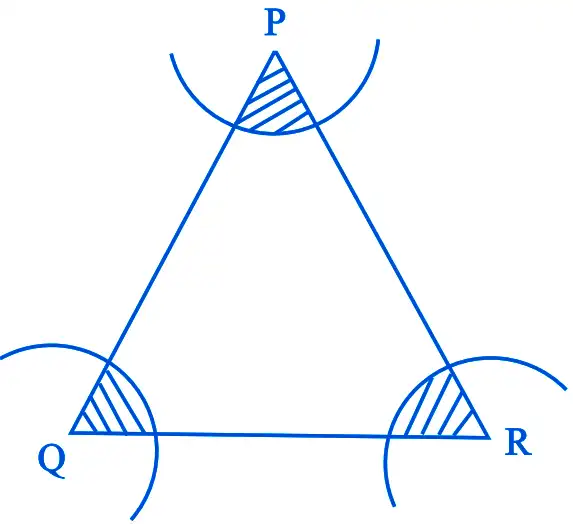
12. In Fig. 11.11, arcs of radius \(5\text{ cm}\) are drawn from vertices of an equilateral triangle of side \(10\text{ cm}\). Find the shaded area (Use \(\pi = 3.14\)).
Solution
\[\text{Area of equilateral } \Delta = \frac{\sqrt{3}}{4} (10)^2 = 25\sqrt{3} \approx 43.30\text{ cm}^2\]
\[\text{Sum of 3 sectors } (3 \times 60^\circ = 180^\circ) = \frac{1}{2} \pi (5)^2 = \frac{1}{2} \times 3.14 \times 25 = 39.25\text{ cm}^2\]
\[\text{Shaded area} = 43.30 – 39.25 = \mathbf{4.05\text{ cm}^2}\]
Exercise 11.3 — Q13
13. In Fig. 11.12, arcs have been drawn with radii \(14\text{ cm}\) each and centres \(P, Q, R\). Find the area of the shaded region.
Solution
Sum of angles in any triangle is \(180^\circ\). Sum of the three sectors forms a semicircle:
\[\text{Area} = \frac{180}{360} \times \frac{22}{7} \times 14^2 = \frac{1}{2} \times \frac{22}{7} \times 196 = \mathbf{308\text{ cm}^2}\]
Exercise 11.3 — Q14
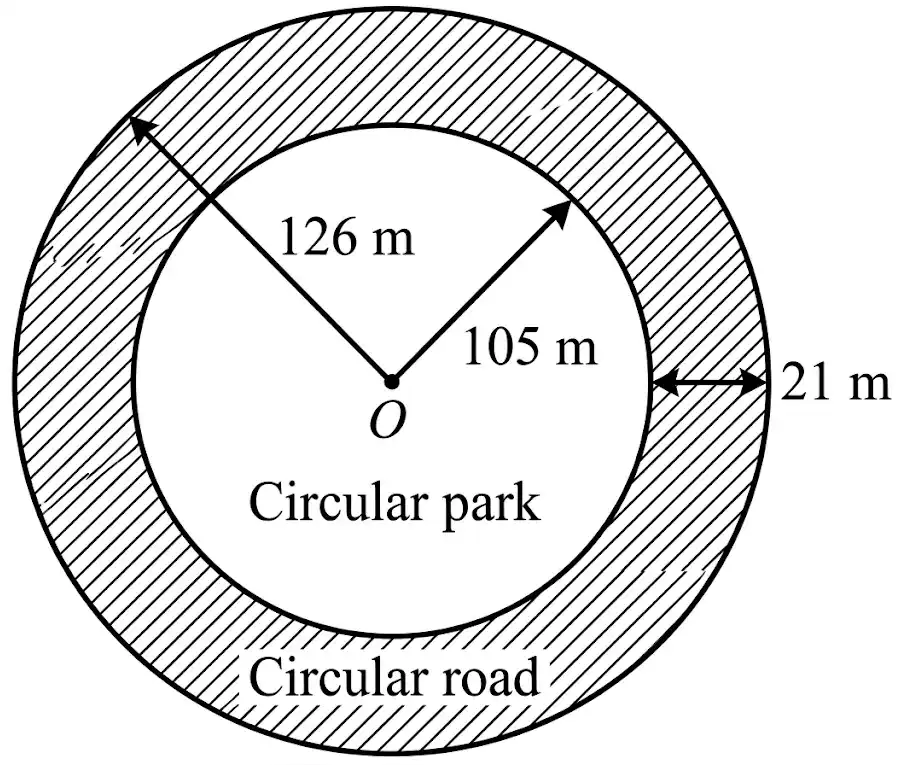
14. A circular park is surrounded by a road \(21\text{ m}\) wide. If the radius of the park is \(105\text{ m}\), find the area of the road.
Solution
Inner radius \(r = 105\text{ m}\), Outer radius \(R = 105 + 21 = 126\text{ m}\):
\[\text{Area of road} = \pi(R^2 – r^2) = \frac{22}{7}(126^2 – 105^2) = \frac{22}{7}(126 + 105)(126 – 105)\]
\[= \frac{22}{7} \times 231 \times 21 = 22 \times 231 \times 3 = \mathbf{15246\text{ m}^2}\]
Exercise 11.3 — Q15
15. In Fig. 11.13, arcs have been drawn of radius \(21\text{ cm}\) each with vertices \(A, B, C, D\) of quadrilateral \(ABCD\) as centres. Find the shaded area.
Solution
Sum of interior angles of a quadrilateral is \(360^\circ\). The four sectors combine into one complete circle of radius \(21\text{ cm}\):
\[\text{Area} = \pi r^2 = \frac{22}{7} \times 21^2 = \frac{22}{7} \times 441 = \mathbf{1386\text{ cm}^2}\]
Exercise 11.3 — Q16
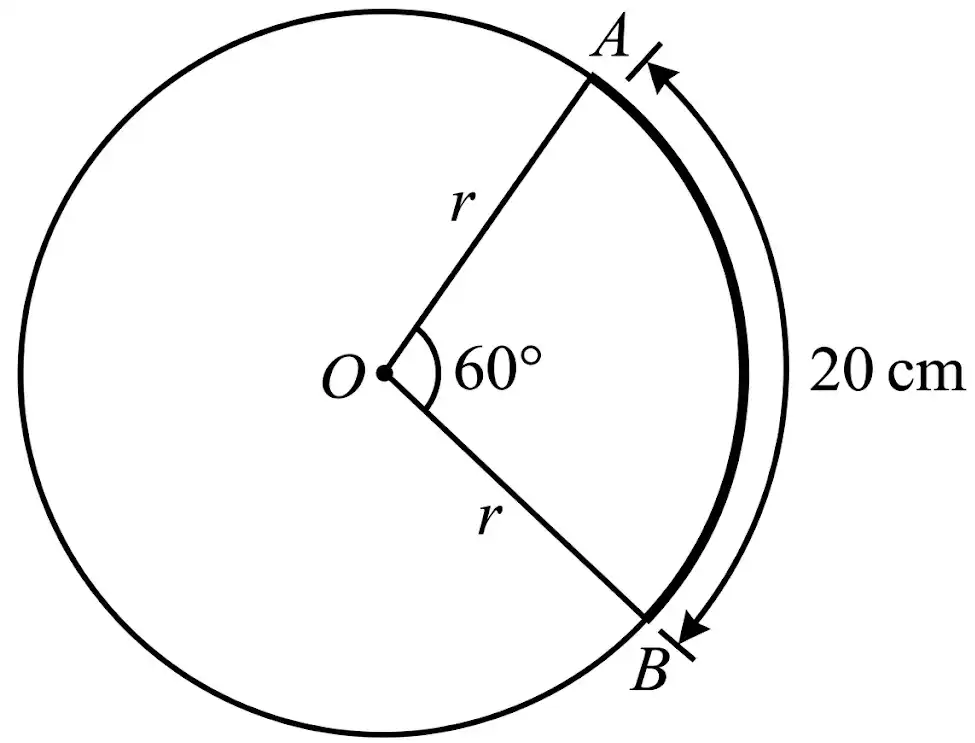
16. A piece of wire \(20\text{ cm}\) long is bent into an arc of a circle subtending an angle of \(60^\circ\) at its centre. Find the radius of the circle.
Solution
\[l = \frac{\theta}{360} \times 2\pi r \implies 20 = \frac{60}{360} \times 2 \times \frac{22}{7} \times r\]
\[20 = \frac{1}{6} \times \frac{44}{7} \times r \implies r = \frac{20 \times 42}{44} = \frac{840}{44} = \frac{210}{11} \approx \mathbf{19.09\text{ cm}}\]
Exercise 11.4: Long Answer Questions
Section E — Sample 1
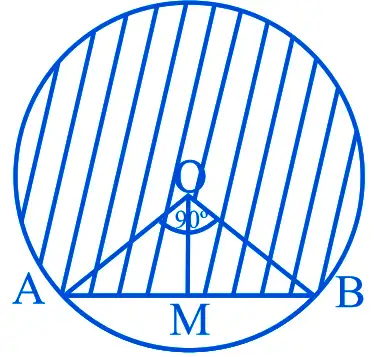
A chord of a circle of radius \(10\text{ cm}\) subtends \(90^\circ\) at the centre. Find the area of the corresponding major segment (Use \(\pi = 3.14\)) (Fig. 11.14).
Solution
Major sector central angle \(= 360^\circ – 90^\circ = 270^\circ\):
\[\text{Area of major sector} = \frac{270}{360} \times 3.14 \times 10^2 = \frac{3}{4} \times 314 = 235.5\text{ cm}^2\]
\[\text{Area of } \Delta OAB = \frac{1}{2} \times 10 \times 10 = 50\text{ cm}^2\]
\[\text{Area of major segment} = 235.5 + 50 = \mathbf{285.5\text{ cm}^2}\]
Section E — Sample 2
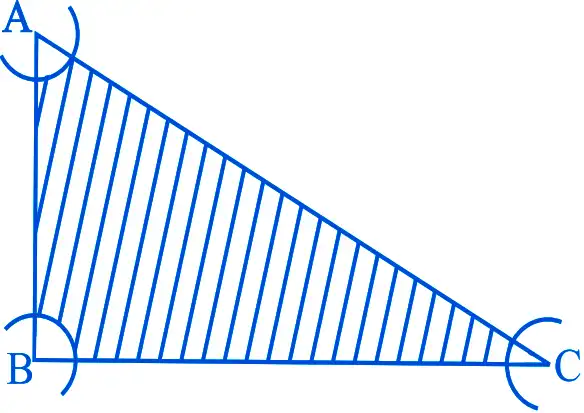
With vertices \(A, B, C\) of \(\Delta ABC\) as centres, arcs of radius \(5\text{ cm}\) are drawn (Fig. 11.15). If \(AB = 14\text{ cm}, BC = 48\text{ cm}, CA = 50\text{ cm}\), find the shaded area (Use \(\pi = 3.14\)).
Solution
Since \(14^2 + 48^2 = 196 + 2304 = 2500 = 50^2\), \(\Delta ABC\) is right-angled at \(B\):
\[\text{Area of } \Delta ABC = \frac{1}{2} \times 14 \times 48 = 336\text{ cm}^2\]
\[\text{Sum of 3 sectors} = \frac{180}{360} \times 3.14 \times 5^2 = \frac{1}{2} \times 78.5 = 39.25\text{ cm}^2\]
\[\text{Shaded area} = 336 – 39.25 = \mathbf{296.75\text{ cm}^2}\]
Section E — Sample 3
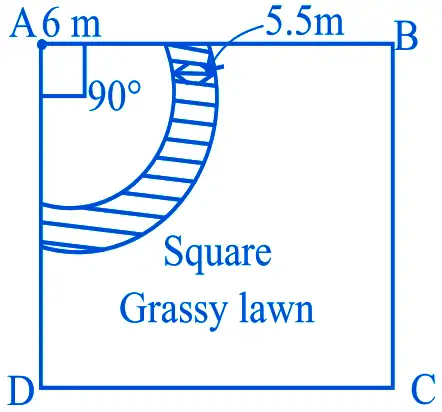
A calf is tied with a rope of length \(6\text{ m}\) at the corner of a square lawn of side \(20\text{ m}\). If rope is increased by \(5.5\text{ m}\), find increase in grazing area (Fig. 11.16).
Solution
New radius \(R = 6 + 5.5 = 11.5\text{ m}\), old radius \(r = 6\text{ m}\):
\[\text{Increase} = \frac{90}{360} \pi (11.5^2 – 6^2) = \frac{1}{4} \times \frac{22}{7} \times (17.5 \times 5.5) = \mathbf{75.625\text{ m}^2}\]
Exercise 11.4 — Q1
1. The area of a circular playground is \(22176\text{ m}^2\). Find the cost of fencing this ground at \(\text{Rs } 50\text{ per metre}\).
Solution
\[\frac{22}{7} r^2 = 22176 \implies r^2 = \frac{22176 \times 7}{22} = 7056 \implies r = 84\text{ m}\]
\[\text{Circumference} = 2 \times \frac{22}{7} \times 84 = 528\text{ m}\]
\[\text{Cost} = 528 \times 50 = \mathbf{\text{Rs } 26400}\]
Exercise 11.4 — Q2
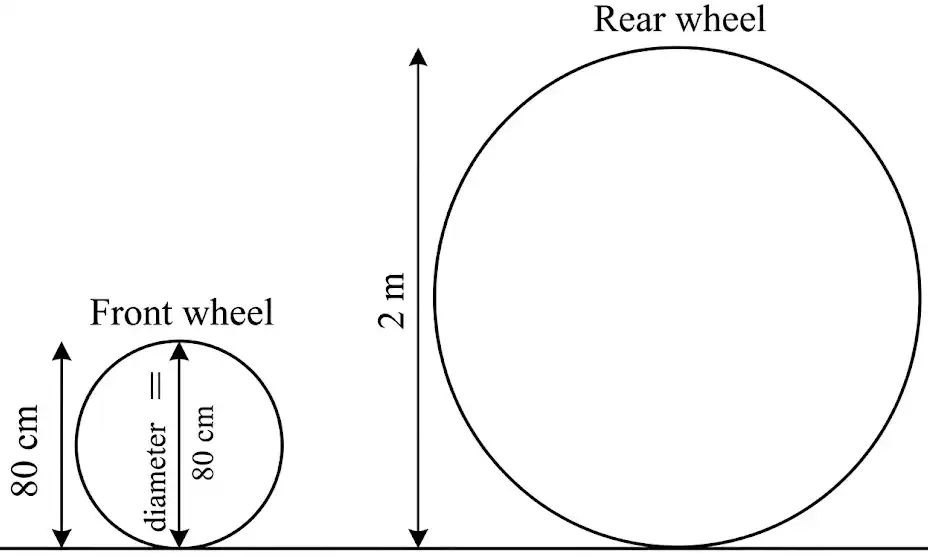
2. Diameters of front and rear wheels of a tractor are \(80\text{ cm}\) and \(2\text{ m}\). Find the revolutions made by rear wheel when front makes \(1400\) revolutions.
Solution
\[\text{Distance} = 1400 \times (\pi \times 80) = 112000\pi\text{ cm}\]
Rear wheel diameter \(= 2\text{ m} = 200\text{ cm} \implies \text{Circumference} = 200\pi\text{ cm}\):
\[\text{Revolutions} = \frac{112000\pi}{200\pi} = \mathbf{560}\]
Exercise 11.4 — Q3
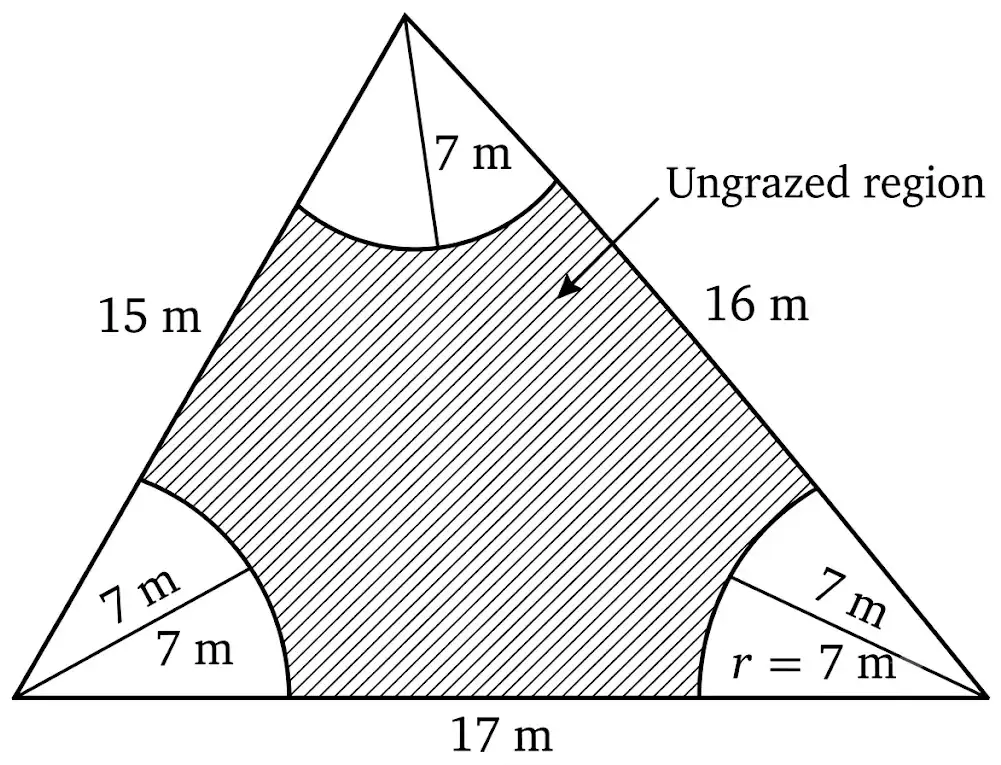
3. Sides of a triangular field are \(15\text{ m}, 16\text{ m}, 17\text{ m}\). Three animals are tied at corners with ropes of \(7\text{ m}\). Find the ungrazed area.
Solution
Semi-perimeter \(s = \frac{15 + 16 + 17}{2} = 24\text{ m}\):
\[\text{Area of triangle} = \sqrt{24(24 – 15)(24 – 16)(24 – 17)} = \sqrt{24 \times 9 \times 8 \times 7} = \sqrt{12096} \approx 109.98\text{ m}^2\]
\[\text{Grazed area (3 sectors combine to semicircle)} = \frac{1}{2} \times \frac{22}{7} \times 7^2 = 77\text{ m}^2\]
\[\text{Ungrazed area} = 109.98 – 77 = \mathbf{32.98\text{ m}^2}\]
Exercise 11.4 — Q4
4. Find the area of the segment of a circle of radius \(12\text{ cm}\) whose sector has a central angle of \(60^\circ\) (Use \(\pi = 3.14\)).
Solution
\[\text{Sector area} = \frac{60}{360} \times 3.14 \times 12^2 = \frac{1}{6} \times 3.14 \times 144 = 75.36\text{ cm}^2\]
\[\text{Triangle area} = \frac{\sqrt{3}}{4} \times 12^2 = 36\sqrt{3} \approx 36 \times 1.732 = 62.35\text{ cm}^2\]
\[\text{Segment area} = 75.36 – 62.35 = \mathbf{13.01\text{ cm}^2}\]
Exercise 11.4 — Q5
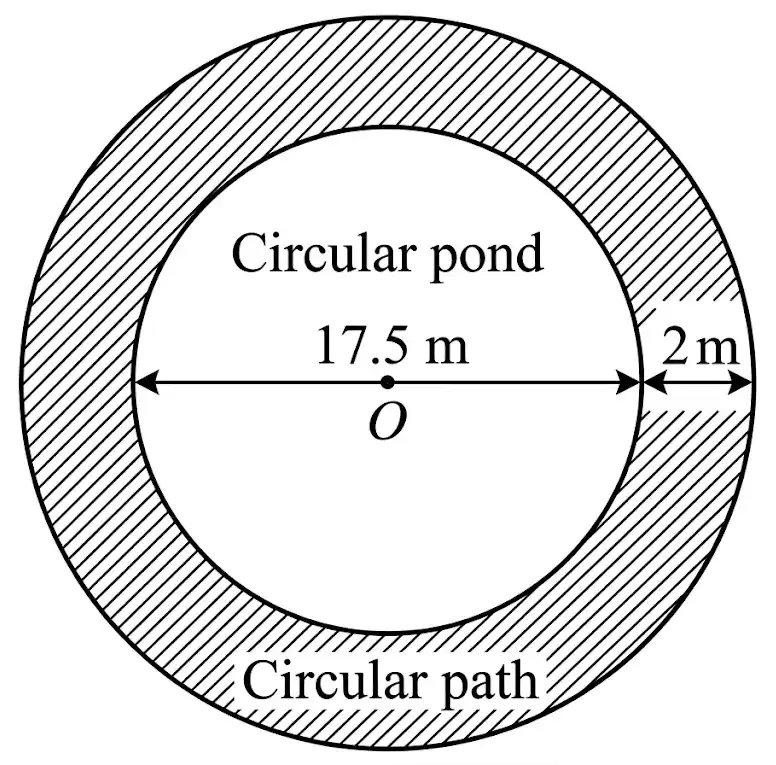
5. A circular pond of diameter \(17.5\text{ m}\) is surrounded by a \(2\text{ m}\) wide path. Find cost of constructing path at \(\text{Rs } 25\text{ per m}^2\).
Solution
Inner radius \(r = 8.75\text{ m}\), Outer radius \(R = 8.75 + 2 = 10.75\text{ m}\):
\[\text{Area} = \frac{22}{7}(10.75^2 – 8.75^2) = \frac{22}{7}(10.75 + 8.75)(10.75 – 8.75) = \frac{22}{7} \times 19.5 \times 2 = \frac{858}{7} \approx 122.57\text{ m}^2\]
\[\text{Cost} = \frac{858}{7} \times 25 = \mathbf{\text{Rs } 3064.29}\]
Exercise 11.4 — Q6
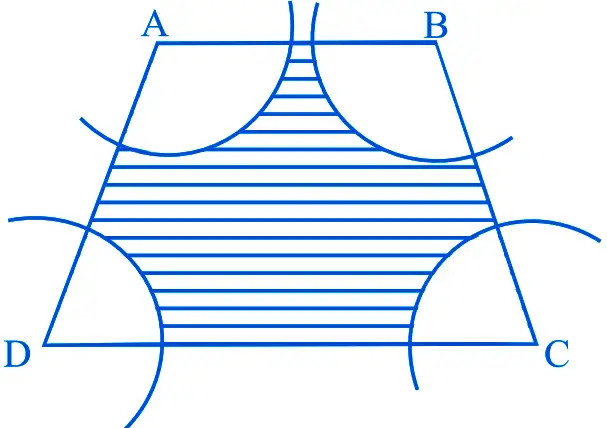
6. In Fig. 11.17, \(ABCD\) is a trapezium with \(AB \parallel DC, AB = 18\text{ cm}, DC = 32\text{ cm},\) and height \(14\text{ cm}\). Arcs of radius \(7\text{ cm}\) are drawn from all 4 vertices. Find shaded area.
Solution
\[\text{Area of trapezium} = \frac{1}{2}(18 + 32) \times 14 = 50 \times 7 = 350\text{ cm}^2\]
\[\text{Area of 4 sectors } (\text{sum of angles } = 360^\circ) = \pi r^2 = \frac{22}{7} \times 7^2 = 154\text{ cm}^2\]
\[\text{Shaded area} = 350 – 154 = \mathbf{196\text{ cm}^2}\]
Exercise 11.4 — Q7
7. Three circles each of radius \(3.5\text{ cm}\) touch each other. Find the area enclosed between them.
Solution
Centres form an equilateral triangle of side \(2r = 7\text{ cm}\):
\[\text{Area of triangle} = \frac{\sqrt{3}}{4} \times 7^2 = \frac{49\sqrt{3}}{4} \approx 21.218\text{ cm}^2\]
\[\text{Area of 3 sectors } (3 \times 60^\circ = 180^\circ) = \frac{1}{2} \times \frac{22}{7} \times (3.5)^2 = 19.25\text{ cm}^2\]
\[\text{Enclosed area} = 21.218 – 19.25 = \mathbf{1.968\text{ cm}^2}\]
Exercise 11.4 — Q8
8. Find the area of the sector of a circle of radius \(5\text{ cm}\), if the corresponding arc length is \(3.5\text{ cm}\).
Solution
\[\text{Area} = \frac{1}{2} l r = \frac{1}{2} \times 3.5 \times 5 = \mathbf{8.75\text{ cm}^2}\]
Exercise 11.4 — Q9
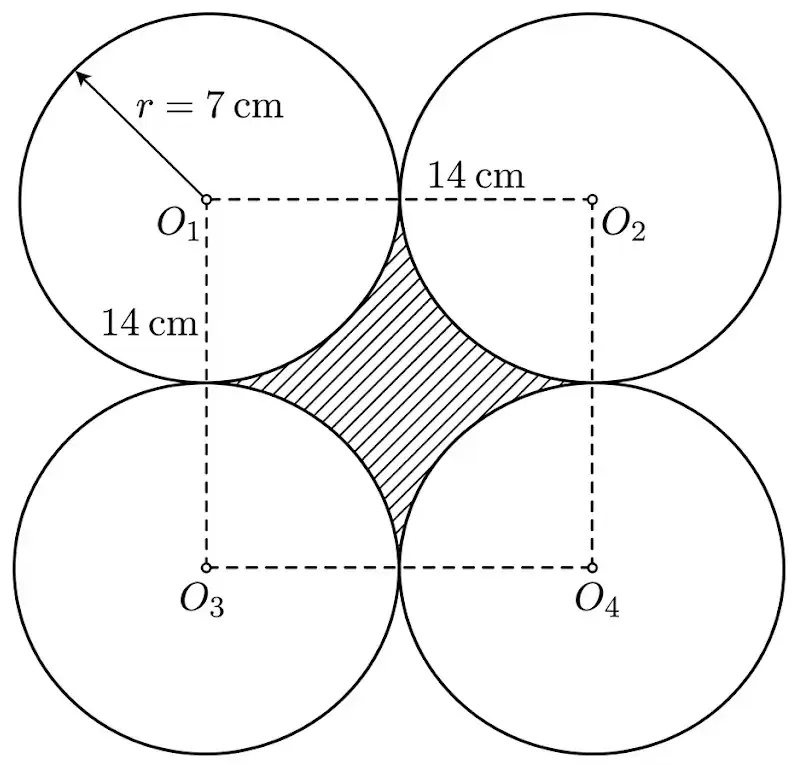
9. Four circular cardboard pieces of radii \(7\text{ cm}\) touch each other. Find the portion enclosed between them.
Solution
Centres form a square of side \(2r = 14\text{ cm}\):
\[\text{Area of square} = 14^2 = 196\text{ cm}^2\]
\[\text{Area of 4 sectors} = \pi r^2 = \frac{22}{7} \times 7^2 = 154\text{ cm}^2\]
\[\text{Enclosed area} = 196 – 154 = \mathbf{42\text{ cm}^2}\]
Exercise 11.4 — Q10
10. On a square sheet of area \(784\text{ cm}^2\), four congruent circular plates of maximum size are placed. Find the area of sheet not covered.
Solution
Side of square \(= \sqrt{784} = 28\text{ cm}\). Diameter of each plate \(= \frac{28}{2} = 14\text{ cm} \implies r = 7\text{ cm}\):
\[\text{Area of 4 circular plates} = 4 \times \left(\frac{22}{7} \times 7^2\right) = 4 \times 154 = 616\text{ cm}^2\]
\[\text{Uncovered area} = 784 – 616 = \mathbf{168\text{ cm}^2}\]
Exercise 11.4 — Q11
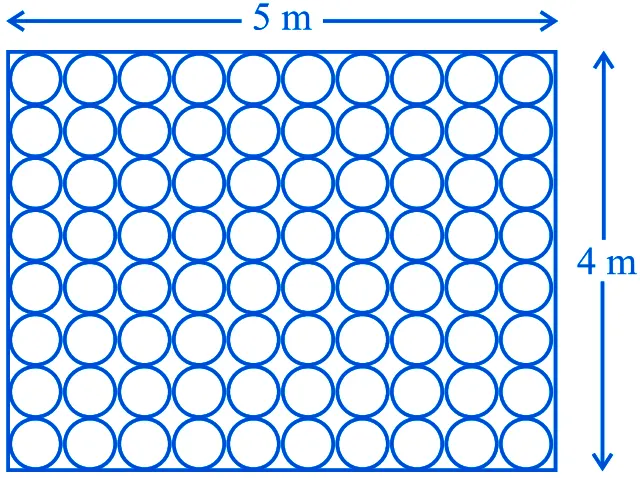
11. A floor of \(5\text{ m} \times 4\text{ m}\) is covered with circular tiles of diameter \(50\text{ cm}\) each (Fig. 11.18). Find uncovered area (Use \(\pi = 3.14\)).
Solution
Floor: \(500\text{ cm} \times 400\text{ cm}\). Number of tiles \(= \frac{500}{50} \times \frac{400}{50} = 10 \times 8 = 80\) tiles:
\[\text{Area of floor} = 5 \times 4 = 20\text{ m}^2 = 200000\text{ cm}^2\]
\[\text{Area of 80 tiles} = 80 \times [3.14 \times 25^2] = 80 \times 1962.5 = 157000\text{ cm}^2 = 15.7\text{ m}^2\]
\[\text{Uncovered area} = 20 – 15.7 = \mathbf{4.3\text{ m}^2}\]
Exercise 11.4 — Q12
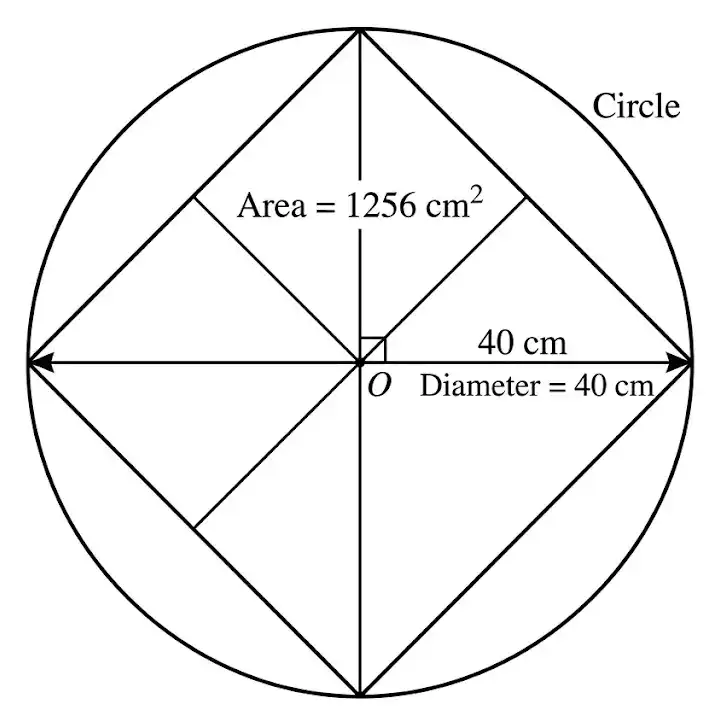
12. All vertices of a rhombus lie on a circle. Find the area of the rhombus, if area of the circle is \(1256\text{ cm}^2\) (Use \(\pi = 3.14\)).
Solution
A cyclic rhombus is necessarily a square. Both diagonals are diameters of the circle:
\[3.14 \times r^2 = 1256 \implies r^2 = 400 \implies r = 20\text{ cm} \implies d = 40\text{ cm}\]
\[\text{Area of rhombus/square} = \frac{1}{2} d_1 d_2 = \frac{1}{2} \times 40 \times 40 = \mathbf{800\text{ cm}^2}\]
Exercise 11.4 — Q13
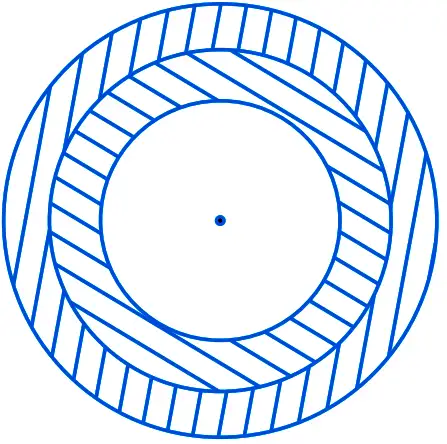
13. An archery target has 3 concentric regions with diameters in ratio \(1 : 2 : 3\) (Fig. 11.19). Find the ratio of areas of the three regions.
Solution
Radii are \(r, 2r, 3r\):
\[A_1 = \pi r^2\]
\[A_2 = \pi(2r)^2 – \pi r^2 = 4\pi r^2 – \pi r^2 = 3\pi r^2\]
\[A_3 = \pi(3r)^2 – \pi(2r)^2 = 9\pi r^2 – 4\pi r^2 = 5\pi r^2\]
\[\text{Ratio} = 1 : 3 : 5\]
Exercise 11.4 — Q14
14. The minute hand of a clock is \(5\text{ cm}\) long. Find the area swept between 6:05 AM and 6:40 AM.
Solution
Time elapsed \(= 35\text{ minutes}\). Angle swept \(= 35 \times 6^\circ = 210^\circ\):
\[\text{Area} = \frac{210}{360} \times \frac{22}{7} \times 5^2 = \frac{7}{12} \times \frac{22}{7} \times 25 = \frac{550}{12} = \mathbf{45.83\text{ cm}^2}\]
Exercise 11.4 — Q15
15. Area of a sector of central angle \(200^\circ\) is \(770\text{ cm}^2\). Find the length of the corresponding arc.
Solution
\[\frac{200}{360} \times \frac{22}{7} \times r^2 = 770 \implies \frac{5}{9} \times \frac{22}{7} r^2 = 770 \implies r^2 = \frac{770 \times 63}{110} = 441 \implies r = 21\text{ cm}\]
\[l = \frac{200}{360} \times 2 \times \frac{22}{7} \times 21 = \frac{5}{9} \times 132 = \mathbf{73.33\text{ cm}}\]
Exercise 11.4 — Q16
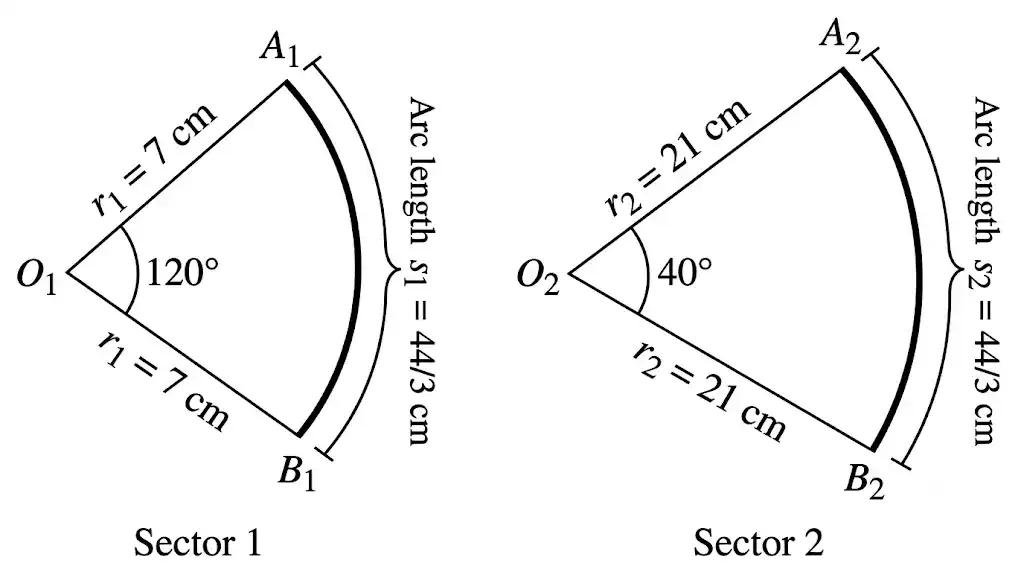
16. The central angles of two sectors of radii \(7\text{ cm}\) and \(21\text{ cm}\) are \(120^\circ\) and \(40^\circ\). Find areas and arc lengths. What do you observe?
Solution
First Sector (\(r = 7\text{ cm}, \theta = 120^\circ\)):
\[l_1 = \frac{120}{360} \times 2 \times \frac{22}{7} \times 7 = \frac{44}{3}\text{ cm}, \quad A_1 = \frac{120}{360} \times \frac{22}{7} \times 7^2 = \frac{154}{3}\text{ cm}^2\]
Second Sector (\(r = 21\text{ cm}, \theta = 40^\circ\)):
\[l_2 = \frac{40}{360} \times 2 \times \frac{22}{7} \times 21 = \frac{44}{3}\text{ cm}, \quad A_2 = \frac{40}{360} \times \frac{22}{7} \times 21^2 = 154\text{ cm}^2\]
Observation: The arc lengths of both sectors are equal (\(\frac{44}{3}\text{ cm}\)), but their areas are not equal (\(A_2 = 3 A_1\)).
Exercise 11.4 — Q17
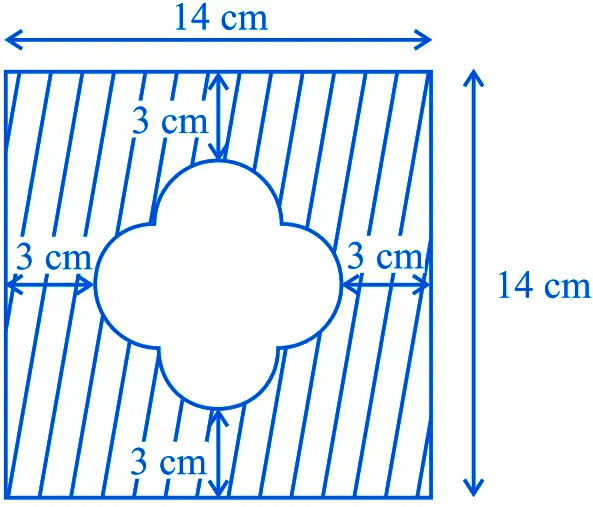
17. Find the area of the shaded region given in Fig. 11.20.
Solution
Outer square: \(14\text{ cm} \times 14\text{ cm} \implies \text{Area} = 196\text{ cm}^2\).
Inner unshaded region: side of central square \(= 14 – 3 – 3 = 8\text{ cm}\) minus lobe diameters. With central square \(4\text{ cm} \times 4\text{ cm}\) and 4 semicircles of radius \(2\text{ cm}\):
\[\text{Inner unshaded area} = 4^2 + 4 \times \left(\frac{1}{2} \pi \times 2^2\right) = 16 + 2\pi(4) = 16 + 8\left(\frac{22}{7}\right) = 16 + 25.14 = 41.14\text{ cm}^2\]
\[\text{Shaded area} = 196 – 41.14 = \mathbf{154.86\text{ cm}^2}\]
Exercise 11.4 — Q18
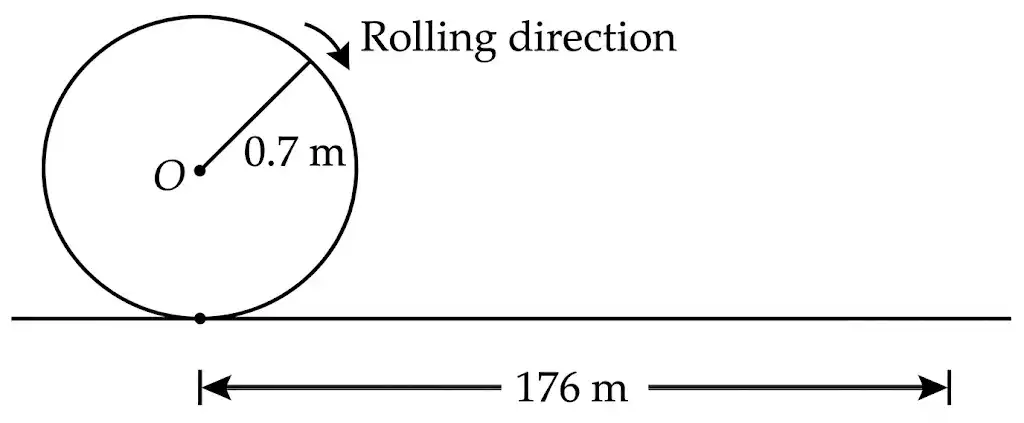
18. Find the number of revolutions made by a circular wheel of area \(1.54\text{ m}^2\) in rolling \(176\text{ m}\).
Solution
\[\frac{22}{7} r^2 = 1.54 \implies r^2 = 0.49 \implies r = 0.7\text{ m}\]
\[\text{Circumference} = 2 \times \frac{22}{7} \times 0.7 = 4.4\text{ m}\]
\[\text{Revolutions} = \frac{176}{4.4} = \mathbf{40}\]
Exercise 11.4 — Q19
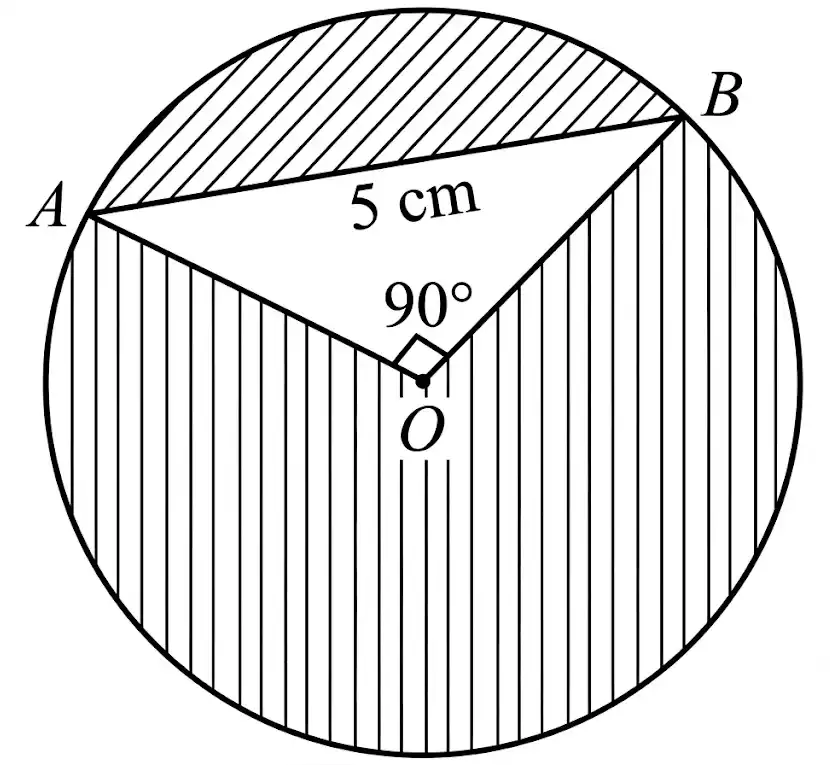
19. Find the difference of areas of two segments formed by a chord of length \(5\text{ cm}\) subtending \(90^\circ\) at the centre.
Solution
Chord length \(AB = 5\text{ cm}\). In right \(\Delta OAB\) (\(90^\circ\)): \(r^2 + r^2 = 5^2 \implies 2r^2 = 25 \implies r^2 = \frac{25}{2}\):
\[\text{Area of minor segment} = \text{Area of sector} – \text{Area of triangle} = \frac{90}{360}\pi r^2 – \frac{1}{2}r^2 = r^2\left(\frac{\pi}{4} – \frac{1}{2}\right)\]
\[= \frac{25}{2}\left(\frac{22}{28} – \frac{14}{28}\right) = \frac{25}{2} \times \frac{8}{28} = \frac{25}{7}\text{ cm}^2\]
\[\text{Area of major segment} = \pi r^2 – \text{Minor segment} = \frac{22}{7}\left(\frac{25}{2}\right) – \frac{25}{7} = \frac{275}{7} – \frac{25}{7} = \frac{250}{7}\text{ cm}^2\]
\[\text{Difference} = \frac{250}{7} – \frac{25}{7} = \frac{225}{7} = \mathbf{32.14\text{ cm}^2}\]
Exercise 11.4 — Q20
20. Find the difference of areas of a sector of angle \(120^\circ\) and its corresponding major sector of a circle of radius \(21\text{ cm}\).
Solution
Major sector angle \(= 360^\circ – 120^\circ = 240^\circ\). Angle difference \(= 240^\circ – 120^\circ = 120^\circ\):
\[\text{Difference} = \frac{120}{360} \times \pi r^2 = \frac{1}{3} \times \frac{22}{7} \times 21^2 = \frac{1}{3} \times \frac{22}{7} \times 441 = \mathbf{462\text{ cm}^2}\]