
Question.1. A quadrilateral PKMN is shown below.
(a) 124°
(b) 104°
(c) 84°
(d) 64°
Question.2. In quadrilateral BDGH, if \angleBDG = 2\angleDGH and \angleBHG = 3\angleHBD, which of the following is true about \angleBDG?
(a) \angleDGH = \frac{1}{3}(360° – 3\angleHBD)
(b) \angleDGH = \frac{1}{2}(360° – 4\angleHBD)
(c) \angleDGH = \frac{1}{3}(360° – 4\angleHBD)
(d) \angleDGH = \frac{1}{2}(360° – 3\angleHBD)
Question.3. Ravi cut two pieces of marble as shown.
(a) Both are squares.
(b) Both are rhombus.
(c) Both are rectangles.
(d) Both are parallelograms.
Question.4. A clock and a scale are shown below.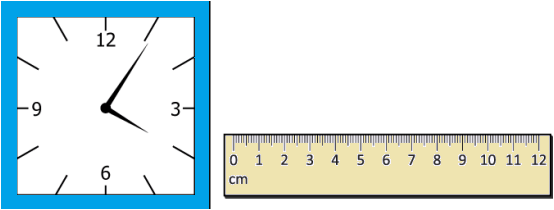
Whose claim is/are correct?
(a) Only Arjun
(b) Only Vinod
(c) Both of them
(d) None of them
Question.5. Which of the following is NOT a property of a quadrilateral that is a parallelogram?
(a) Diagonals of a quadrilateral bisect each other
(b) A pair of adjacent sides of a quadrilateral is equal
(c) Each pair of opposite sides of a quadrilateral is equal
(d) Each pair of opposite angles of a quadrilateral is equal
Question.6. Some quadrilaterals are shown below.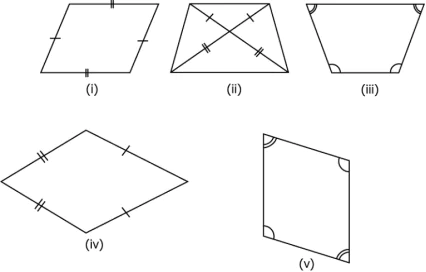
(a) Only i and v
(b) Only i, ii and v
(c) Only ii, iii and iv
(d) Only ii, iv and v
Question.7. A parallelogram ABCD is shown below.
(a) 5 cm
(b) 8 cm
(c) 10 cm
(d) 12 cm
Question.8. In the parallelogram shown below,
What is the length of the diagonal SQ?
(a) 6 cm
(b) 8 cm
(c) 12 cm
(d) 16 cm
Question.9. A figure is shown below where B and D are midpoints of sides MK and MA. 
He proves ∆MBD is congruent to ∆KBR by ASA congruency. Which of the following is the next step in the proof of the midpoint theorem?
(a) show that BD = RB
(b) show that BD = BK
(c) show that MB = RK
(d) show that MD = BK
Question.10. In the figure shown, Points N and O are midpoints of sides KL and KM of ∆KLM. 
She first proves ∆KON ≅ ∆MOP. Which of the following justifies her step of proof?
(a) ∆KON ≅ ∆MOP by SAS congruency because KO = OM, NO = OP and \angleKON = \angleMOP.
(b) ∆KON ≅ ∆MOP by SAS congruency because KO = OM, KN = MP and \angleNKO = \anglePMO.
(c) ∆KON ≅ ∆MOP by ASA congruency because NO = OP, \angleKON = \angleMOP and \angleNKO = \anglePMO.
(d) ∆KON ≅ ∆MOP by ASA congruency because KO = OM, \angleKON = \angleMOP and \angleNKO = \anglePMO.


