
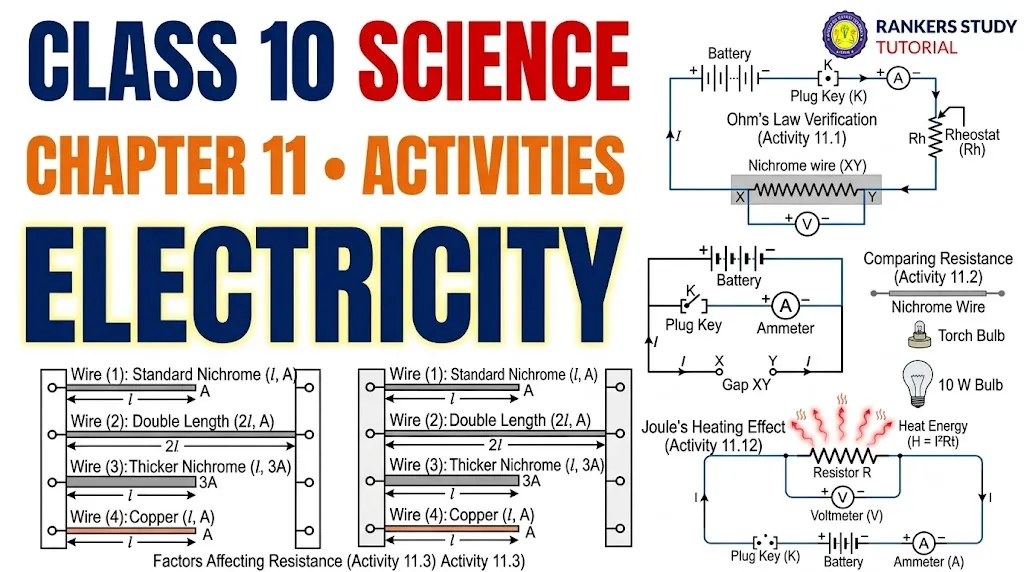
Activity 11.1: Studying Ohm’s Law (V-I Relationship)
Determining the Linear Relationship Between Potential Difference and Current
Experimental Procedure
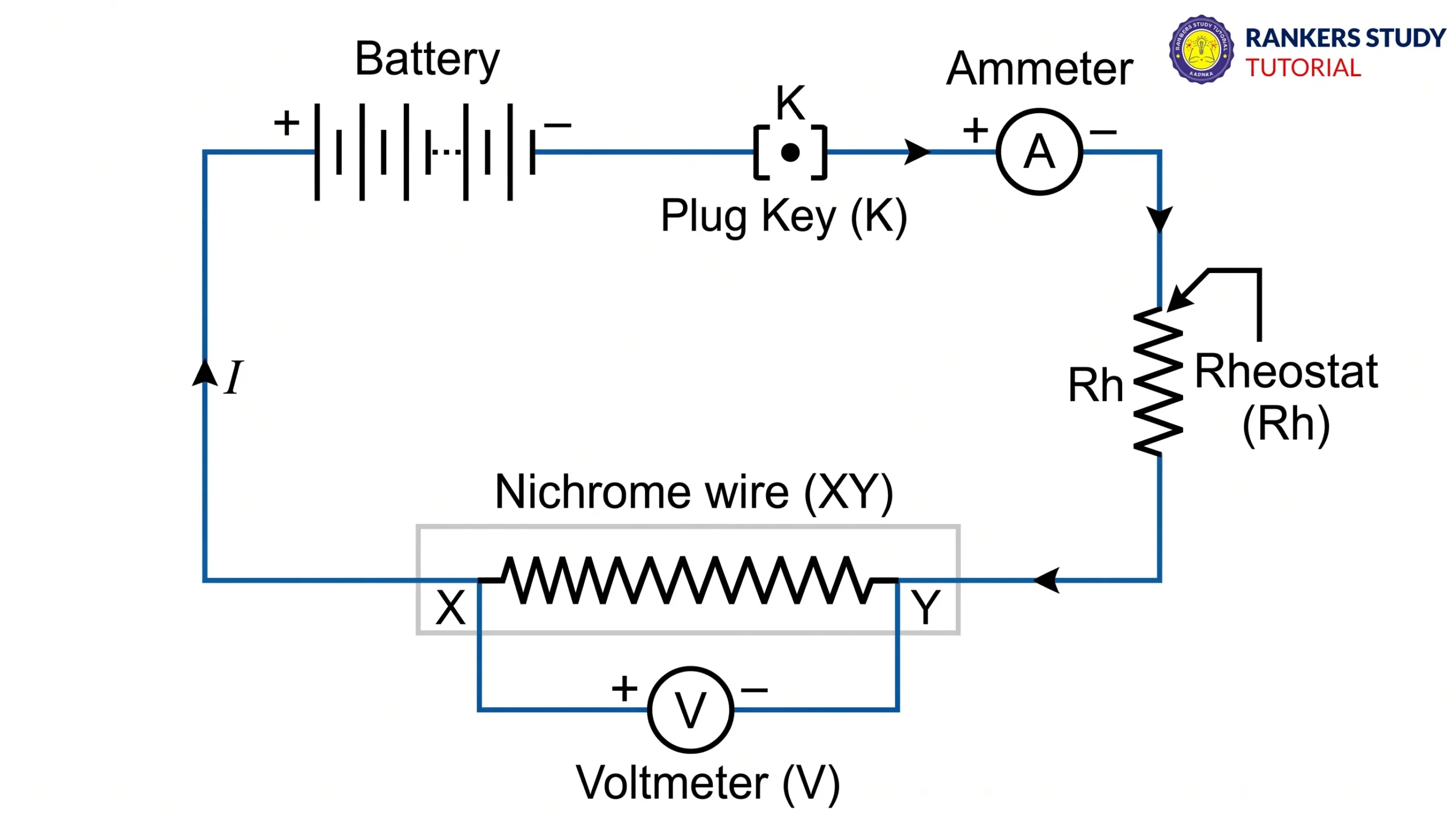
- Set up a circuit consisting of a nichrome wire \(XY\) of length \(0.5\text{ m}\), an ammeter, a voltmeter, and four cells of \(1.5\text{ V}\) each.
- Use only one cell initially, note the current (\(I\)) from the ammeter and potential difference (\(V\)) from the voltmeter across wire \(XY\).
- Repeat the observations sequentially using two, three, and four cells in the circuit.
- Calculate the ratio of \(V\) to \(I\) for each pair and plot a graph between \(V\) and \(I\).
Observations & Optical Mechanism
- Constant Ratio: Approximately the same value for \(V/I\) is obtained in each case.
- Linear Graph: The \(V-I\) graph is a straight line passing through the origin, showing that potential difference increases linearly with current.
- Ohm’s Law: Confirms that \(V \propto I\) at a constant temperature, where the slope of the line represents the resistance \(R\).
Q1: What is nichrome, and why is it used in this activity?
Answer: Nichrome is an alloy of nickel, chromium, manganese, and iron metals chosen for its stable and measurable resistance.
Q2: What does the straight-line graph passing through the origin signify for a nichrome wire?
Answer: It signifies that the potential difference across the wire is directly proportional to the current flowing through it.
Q3 (Application Based): State Ohm’s mathematical expression and define the unit of resistance.
Answer:
\(V = IR\)
. One ohm (\(1\ \Omega\)) is resistance when a potential difference of \(1\text{ V}\) drives a current of \(1\text{ A}\).Q4 (Additional Practice): What happens to the current through a resistor if its resistance is doubled while voltage stays constant?
Answer: The current gets halved according to \(I = V/R\).
Q5 (Advanced Mastery): Why must temperature remain constant during verification of Ohm’s law?
Answer: Because the resistance of metallic conductors varies with temperature, which would alter the \(V/I\) ratio.
Activity 11.2: Comparing Resistance of Different Components
Observing Ammeter Variations with Different Gap Components
Experimental Procedure
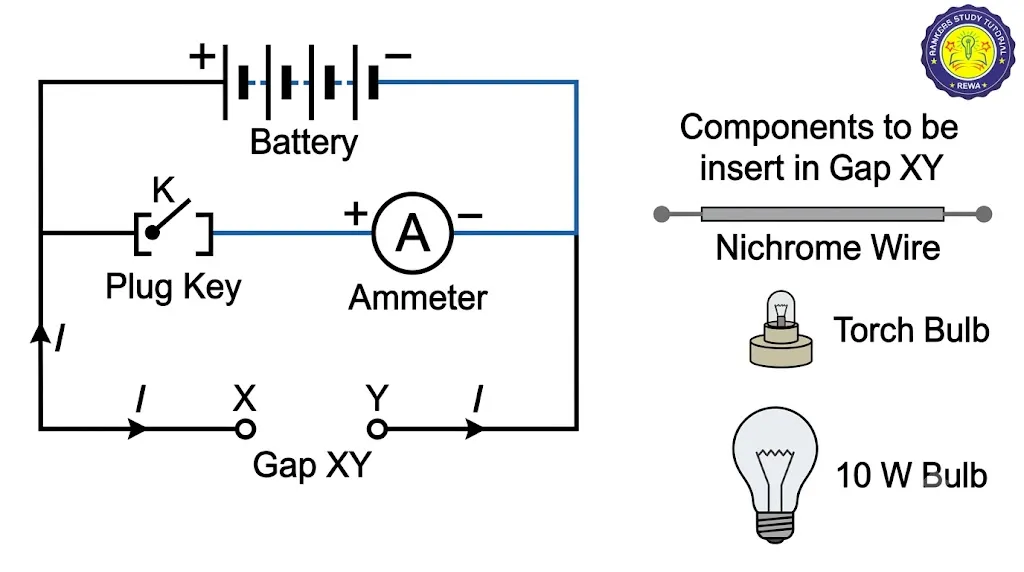
- Set up a circuit with four dry cells (\(1.5\text{ V}\) each) in series, an ammeter, and a gap \(XY\).
- Connect a nichrome wire in gap \(XY\), plug the key, and note the ammeter reading.
- Replace the nichrome wire with a torch bulb and measure the current.
- Repeat the step using a \(10\text{ W}\) bulb or other material components in gap \(XY\).
Observations & Optical Mechanism
- Current Variation: Ammeter readings differ for different components connected in gap \(XY\).
- Path Resistance: Certain components offer easy paths (good conductors) while others strongly restrain electron motion (resistors or poor conductors).
Q1: Why are ammeter readings different for different components connected in gap \(XY\)?
Answer: Because different materials and components offer varying degrees of resistance to the flow of electrons.
Q2 (Application Based): What microscopic factor causes resistance inside a metallic conductor?
Answer: The motion of electrons is restrained and retarded by the attractive forces of the fixed metal atoms among which they move.
Q3 (Additional Practice): Distinguish between a good conductor, a resistor, and an insulator based on resistance.
Answer: Good conductors offer low resistance, resistors have appreciable resistance, and insulators offer exceptionally high resistance.
Activity 11.3: Factors Affecting Conductor Resistance
Studying the Effect of Length, Area, and Material on Resistance
Experimental Procedure
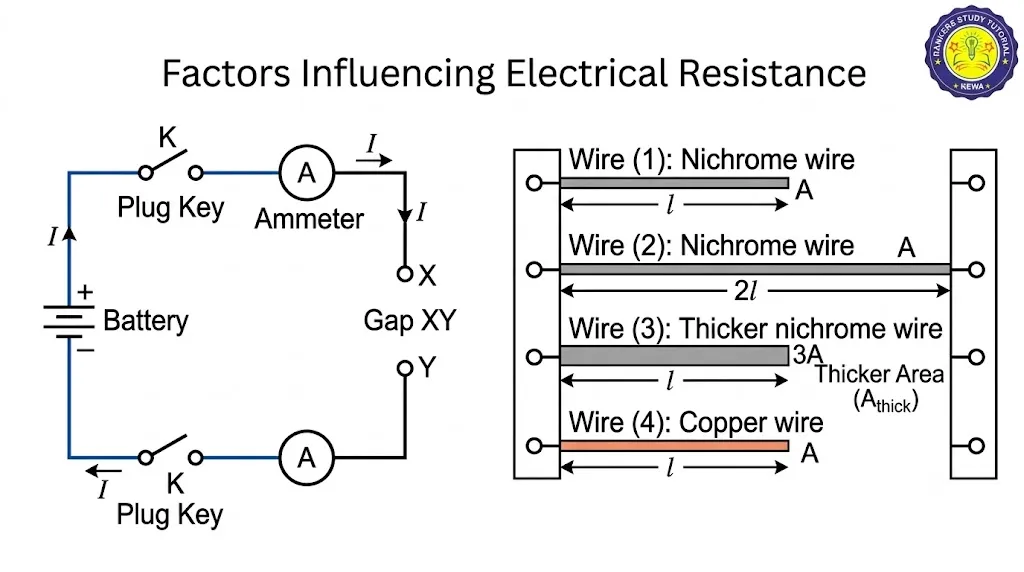
- Set up a circuit with a cell, ammeter, plug key, and a nichrome wire of length \(l\).
- Plug the key and note the current reading.
- Replace with a nichrome wire of the same thickness but double the length (\(2l\)) and record current.
- Replace with a thicker nichrome wire (larger cross-sectional area \(A\)) and a copper wire of identical dimensions to observe current differences.
Observations & Optical Mechanism
- Length Dependency: Doubling the length halves the ammeter reading, indicating resistance doubles (\(R \propto l\)).
- Area Dependency: Increasing cross-sectional area increases current, showing resistance decreases (\(R \propto 1/A\)).
- Material Dependency: Resistivity (\(\rho\)) varies depending on the nature of the substance.
Q1: State the formula combining length and cross-sectional area to define electrical resistivity.
Answer:
\(R = \rho \frac{l}{A}\)
Q2 (Application Based): What is the SI unit of electrical resistivity, and why are alloys commonly used in heating devices?
Answer: The unit is \(\Omega\text{ m}\). Alloys are used because they have higher resistivity than pure metals and do not oxidize readily at high temperatures.
Q3 (Additional Practice): Calculate the resistance change if a wire’s length is doubled and its cross-sectional area is halved.
Answer: Resistance becomes four times the original value since \(R \propto l/A\).
Activity 11.4 & 11.5: Resistors in Series Combination
Investigating Current and Potential Difference in Series Circuits
Experimental Procedure
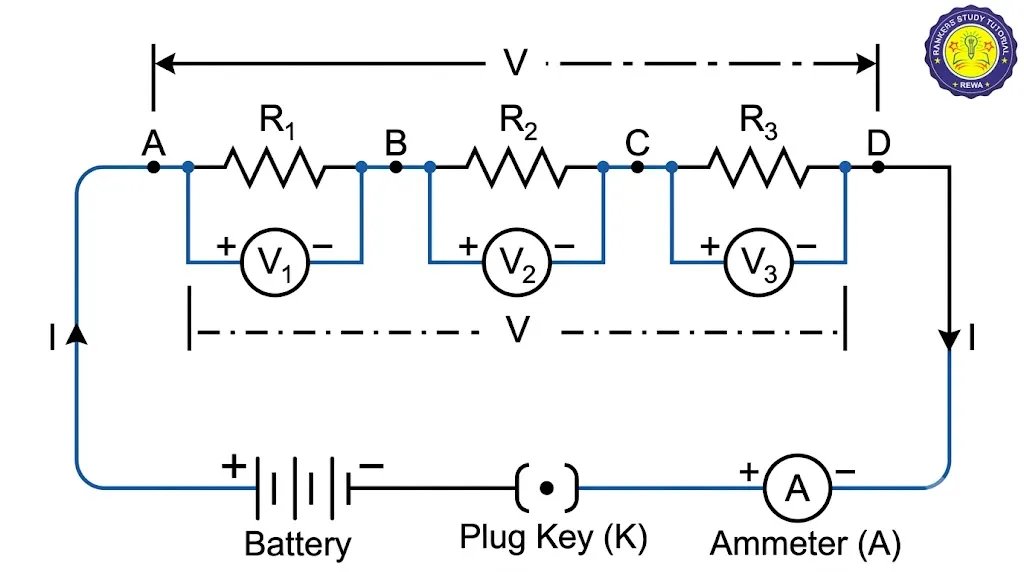
- Join three resistors of different values (e.g., \(1\ \Omega, 2\ \Omega, 3\ \Omega\)) in series with a \(6\text{ V}\) battery and an ammeter.
- Move the ammeter to different positions between resistors and note readings.
- Insert a voltmeter across the entire combination (\(X-Y\)) and then across individual resistors (\(X-P\), etc.) to record potential differences.
Observations & Optical Mechanism
- Constant Current: Ammeter shows identical current regardless of its position in a series circuit.
- Additive Potential: Total voltage equals the sum of individual voltage drops (\(V = V_1 + V_2 + V_3\)).
- Equivalent Resistance: \(R_s = R_1 + R_2 + R_3\).
Q1: Why is a series arrangement impracticable for domestic electrical circuits?
Answer: If one component fails, the circuit breaks and all appliances stop working; furthermore, appliances requiring different currents cannot operate together.
Q2 (Application Based): Three resistors of \(2\ \Omega\), \(3\ \Omega\), and \(6\ \Omega\) are connected. How to get total resistance of \(9\ \Omega\)?
Answer: Connect all three in series so that \(R_s = 2 + 3 + 6 = 9\ \Omega\).
Activity 11.6: Resistors in Parallel Combination
Investigating Current Splitting and Equivalent Resistance in Parallel
Experimental Procedure
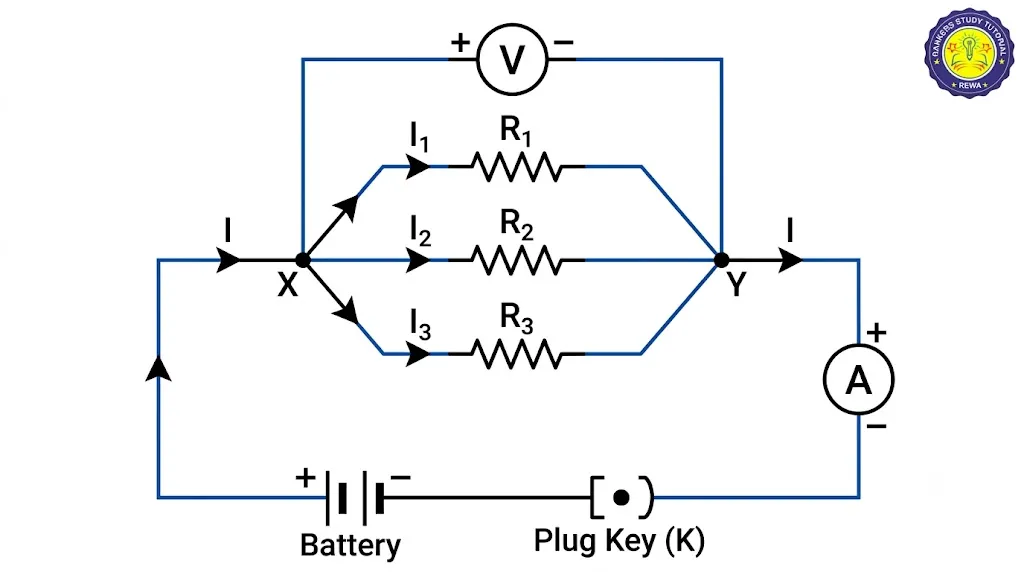
- Connect three resistors in parallel between points \(X\) and \(Y\) with a battery, ammeter, and plug key.
- Measure the total circuit current (\(I\)) and the potential difference (\(V\)) across the combination.
- Insert the ammeter in series with each individual branch resistor (\(R_1, R_2, R_3\)) to measure branch currents (\(I_1, I_2, I_3\)).
Observations & Optical Mechanism
- Constant Voltage: Potential difference across each parallel branch is identical to the source voltage.
- Additive Current: Total current equals the sum of branch currents (\(I = I_1 + I_2 + I_3\)).
- Parallel Reciprocal Rule: \(\frac{1}{R_p} = \frac{1}{R_1} + \frac{1}{R_2} + \frac{1}{R_3}\).
Q1: What are the main advantages of connecting electrical devices in parallel?
Answer: Each appliance gets the same voltage, operates independently, and failure of one does not affect the others.
Q2 (Application Based): How can resistors of \(2\ \Omega\), \(3\ \Omega\), and \(6\ \Omega\) be combined to yield an equivalent resistance of \(1\ \Omega\)?
Answer: By connecting all three in parallel: \(\frac{1}{R_p} = \frac{1}{2} + \frac{1}{3} + \frac{1}{6} = \frac{3+2+1}{6} = 1\ \Omega^{-1}\), giving \(R_p = 1\ \Omega\).
Q3 (Advanced Mastery): What happens to total circuit resistance when more resistors are added in parallel?
Answer: The total equivalent resistance decreases, which allows higher total current draw from the source.
Core Concepts: Heating Effect of Current & Electric Power
Joule’s Law of Heating, Fuses, and Power Formulas
Theoretical Principles & Formulas
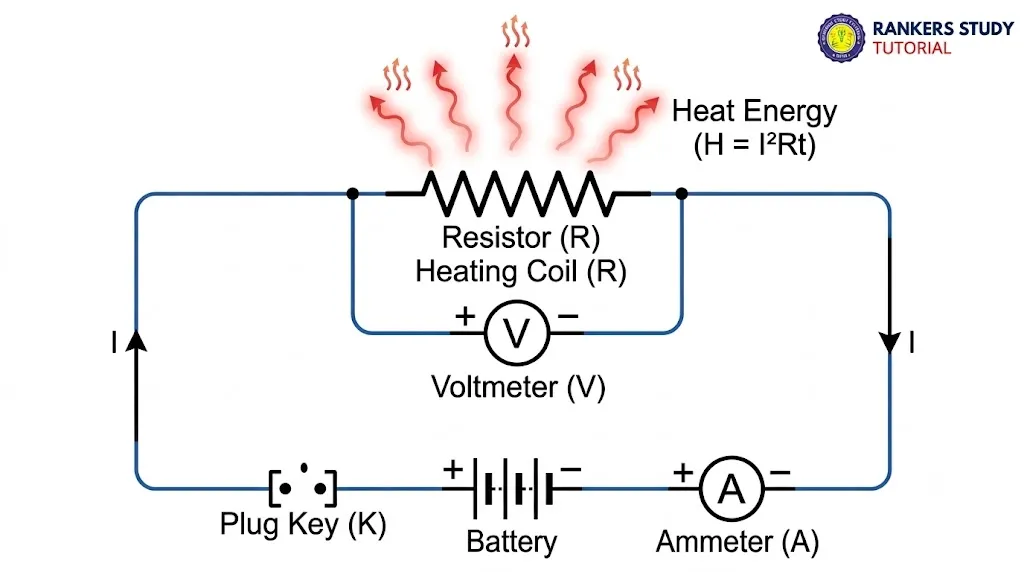
- Joule’s Law of Heating: Heat produced in a resistor is given by
\(H = I^2Rt\) - Electric Power: The rate of consumption of electrical energy, expressed as
\(P = VI = I^2R = \frac{V^2}{R}\) - Commercial Unit: Electrical energy is measured in kilowatt-hour (\(\text{kWh}\)), where \(1\text{ kWh} = 3.6 \times 10^6\text{ J}\).
Practical Applications
- Heating Appliances: Devices like irons, toasters, and heaters use high-resistivity alloy coils.
- Bulb Filaments: Made of tungsten (high melting point \(3380^\circ\text{C}\)) enclosed in inactive nitrogen/argon gas.
- Electric Fuse: Safety wire of low melting point connected in series that melts and breaks the circuit during excessive current surges.
Q1: Why does the cord of an electric heater not glow while the heating element does?
Answer: The heating element has a very high resistance causing extreme heat and glow, whereas the connecting cord has extremely low resistance, generating negligible heat.
Q2: State the commercial unit of electrical energy and convert it into joules.
Answer: Kilowatt-hour (\(\text{kWh}\)), equivalent to \(3.6 \times 10^6\text{ J}\).
Q3 (Application Based): Why is tungsten exclusively used for electric lamp filaments?
Answer: Because it has a very high melting point (\(3380^\circ\text{C}\)) and retains heat to emit bright light without melting.
Q4 (Additional Practice): How does an electric fuse protect domestic appliances?
Answer: When current exceeds a safe rating, the fuse wire’s temperature rises, causing it to melt and disconnect the circuit safely.
Q5 (Advanced Mastery): An electric refrigerator rated \(400\text{ W}\) operates \(8\text{ hours/day}\) for \(30\text{ days}\). Calculate the total energy consumed in \(\text{kWh}\).
Answer: \(\text{Energy} = 0.4\text{ kW} \times 8\text{ h/day} \times 30\text{ days} = 96\text{ kWh}\).