Practice Class 10 Science Chapter 10 The Human Eye and the Colourful World Activities with answers and explanations. Test your NCERT concepts and prepare for your science exams with this practice set.
Class 10 Science Chapter 10 Activities | The Human Eye and the Colourful World
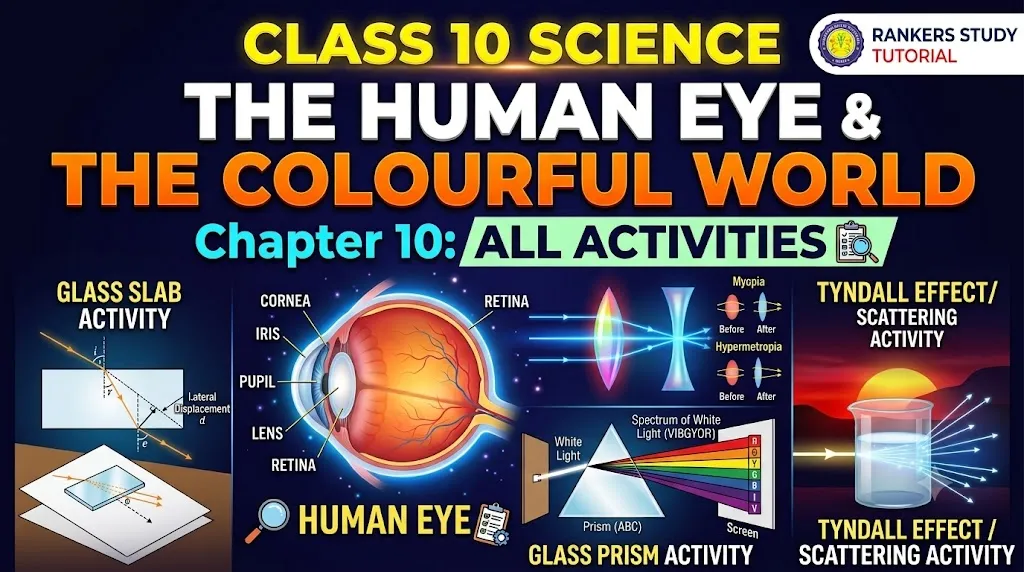
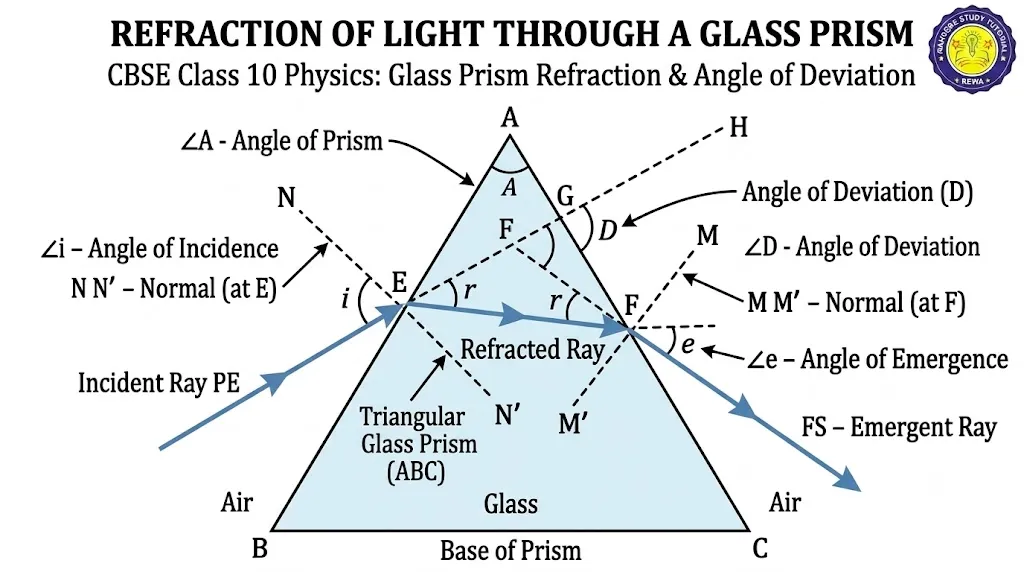
Activity 10.1: Refraction of Light Through a Triangular Glass Prism
Tracing Incident, Refracted, and Emergent Rays Across a Glass Prism
Experimental Procedure
- Fix a sheet of white paper on a drawing board using drawing pins and place a glass prism on it resting on its triangular base.
- Trace the outline of the prism using a pencil and draw a straight line \(PE\) inclined to one of the refracting surfaces (\(AB\)).
- Fix two pins at points \(P\) and \(Q\) on line \(PE\), look through the other face \(AC\) for their images, and fix two more pins at \(R\) and \(S\) in a straight line with those images.
- Remove the prism, join and produce lines to meet boundaries at \(E\) and \(F\), draw normals, and mark angles \(i\), \(r\), and \(e\).
Observations & Optical Mechanism
- First Interface (\(AB\)): Light enters from air to glass and bends towards the normal.
- Second Interface (\(AC\)): Light enters from glass to air and bends away from the normal.
- Angle of Deviation: The peculiar shape of the prism makes the emergent ray bend at an angle (\(\angle D\)) to the direction of the incident ray.
Q1: What is the angle between the two lateral faces of a glass prism called?
Answer: The angle of the prism.
Q2: How does a ray of light bend when entering from air to glass at the first surface of a prism?
Answer: It bends towards the normal.
Q3 (Application Based): What defines the angle of deviation (\(\angle D\)) in a prism experiment?
Answer: It is the angle at which the emergent ray bends relative to the direction of the incident ray due to the prism’s shape.
Q4 (Additional Practice): How does the bending of light at the prism surfaces compare to that in a rectangular glass slab?
Answer: Unlike a glass slab where parallel surfaces cause the emergent ray to be parallel to the incident ray, a prism’s inclined surfaces cause a distinct net angle of deviation.
Activity 10.2: Dispersion of White Light by a Glass Prism
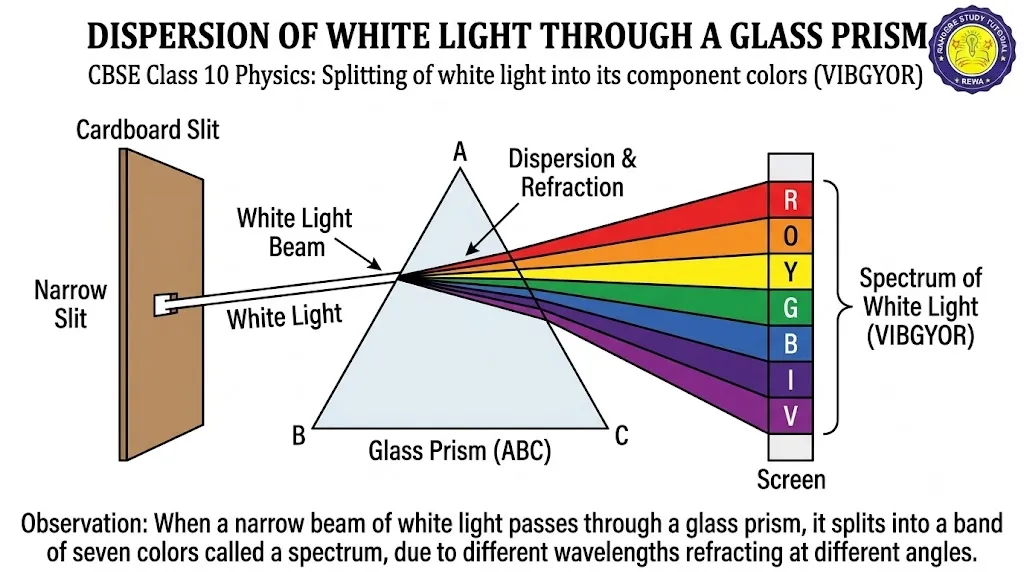
Splitting Sunlight into a Spectrum of Colours
Experimental Procedure
- Take a thick sheet of cardboard and make a small hole or narrow slit in its middle to allow a narrow beam of sunlight.
- Take a glass prism and allow the light from the slit to fall on one of its faces.
- Turn the prism slowly until the emerging light appears on a nearby screen.
- Observe the band of distinct colours formed on the screen.
Observations & Optical Mechanism
- Spectrum Formation: The prism splits the incident white light into a band of seven colours: Violet, Indigo, Blue, Green, Yellow, Orange, and Red (VIBGYOR).
- Differential Bending: Different colours bend through different angles; red light bends the least while violet bends the most.
- Dispersion: The splitting of light into its component colours is called dispersion.
Q1: What is the sequence of colours seen on the screen when white light passes through a prism?
Answer: Violet, Indigo, Blue, Green, Yellow, Orange, and Red (remembered via the acronym VIBGYOR).
Q2: Which colour of light bends the most and which bends the least during dispersion through a prism?
Answer: Violet light bends the most, while red light bends the least.
Q3 (Application Based): How did Isaac Newton prove that sunlight is composed of seven colours?
Answer: He placed a second identical prism in an inverted position relative to the first prism, allowing all spectrum colours to pass through, which recombined them into a beam of white light.
Q4 (Additional Practice): What is a natural spectrum appearing in the sky after a rain shower called?
Answer: A rainbow.
Q5 (Extra Concept): What role do tiny water droplets play in the formation of a natural rainbow?
Answer: They act like small prisms that refract, disperse, internally reflect, and refract sunlight again.
Core Concepts: The Human Eye and Vision Defects
Anatomy, Accommodation, and Corrective Lenses
Structural & Functional Overview
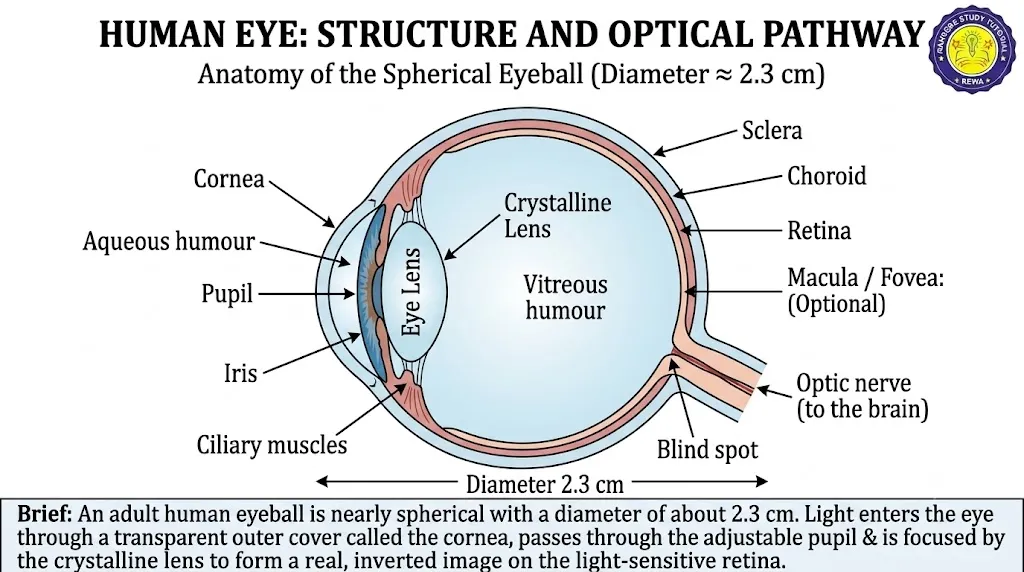
- Cornea & Iris: Light enters through the transparent cornea; the iris regulates the size of the pupil, controlling the amount of light entering the eye.
- Retina & Accommodation: The eye lens forms an inverted real image on the light-sensitive retina. Ciliary muscles adjust the curvature and focal length of the eye lens to focus objects at varying distances.
- Near and Far Points: The near point (least distance of distinct vision) for a normal young adult is about \(25\text{ cm}\), and the far point is infinity.
Refractive Defects and Corrections
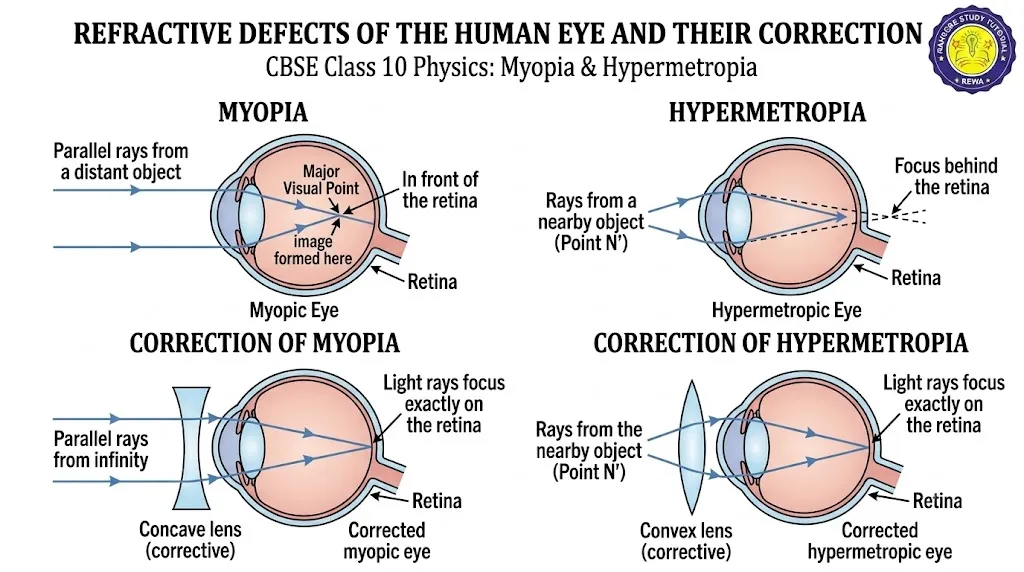
- Myopia (Near-sightedness): Distant objects appear blurred because images form in front of the retina due to excessive curvature or elongated eyeball; corrected using a concave lens.
- Hypermetropia (Far-sightedness): Nearby objects appear blurred because images form behind the retina due to long focal length or small eyeball; corrected using a convex lens.
- Presbyopia: Loss of accommodation due to aging and weakened ciliary muscles; often corrected with bi-focal lenses.
Q1: What is meant by the power of accommodation of the eye?
Answer: The ability of the eye lens to adjust its focal length to focus on both near and distant objects clearly.
Q2: Why do stars twinkle while planets do not?
Answer: Stars are distant point-sized light sources whose light fluctuates due to atmospheric refraction, causing a twinkling effect. Planets are closer, extended sources whose individual point variations average out to zero.
Q3 (Application Based): Why is the Sun visible about 2 minutes before actual sunrise and 2 minutes after actual sunset?
Answer: Due to atmospheric refraction of sunlight through layers of gradually changing refractive index.
Q4 (Additional Practice): Explain why the clear sky appears blue during the day.
Answer: Fine air molecules scatter light of shorter wavelengths (blue end) much more strongly than longer wavelengths (red end) via the Tyndall effect.
Q5 (Extra Concept): Why are ‘danger’ signal lights colored red?
Answer: Because red light has the longest wavelength and is least scattered by fog or smoke, allowing it to be seen clearly over long distances.
List
CBSE Competency-Based Questions Class 10 & 12 PDF Download (Free Official Sets)
Download Free Official CBSE Competency-Based Question Banks (Class 10 & 12) One-Stop Resource: Download Free Official CBSE Competency-Based Question Banks …
NCERT Exemplar Class 10 Maths Chapter 11 Areas Related to Circles Solutions (CBSE 2026-27)
NCERT Exemplar Class 10 Maths Chapter 11 Areas Related to Circles Solutions (CBSE 2026-27) NCERT Exemplar Class 10 Maths Chapter …
NCERT Exemplar Class 10 Maths Chapter 12 Surface Areas and Volumes Solutions (CBSE 2026-27)
NCERT Exemplar Class 10 Maths Chapter 12 Surface Areas and Volumes Solutions (CBSE 2026-27) NCERT Exemplar Class 10 Maths Chapter …
NCERT Exemplar Class 10 Maths Chapter 13 Statistics and Probability Solutions (CBSE 2026-27)
NCERT Exemplar Class 10 Maths Chapter 13 Statistics and Probability Solutions (CBSE 2026-27) NCERT Exemplar Class 10 Maths Chapter 13 …
Class 10 Maths Chapter 9 Circles NCERT Exemplar Solutions (All Exercises Solved)
NCERT Exemplar Class 10 Maths Chapter 9 Circles Solutions (CBSE 2026-27) NCERT Exemplar Class 10 Maths Chapter 9 Circles Solutions …
Class 10 Maths Chapter 8 Trigonometry NCERT Exemplar Solutions (Updated Syllabus)
NCERT Exemplar Class 10 Maths Chapter 8 Introduction to Trigonometry Solutions (CBSE 2026-27) NCERT Exemplar Class 10 Maths Chapter 8 …