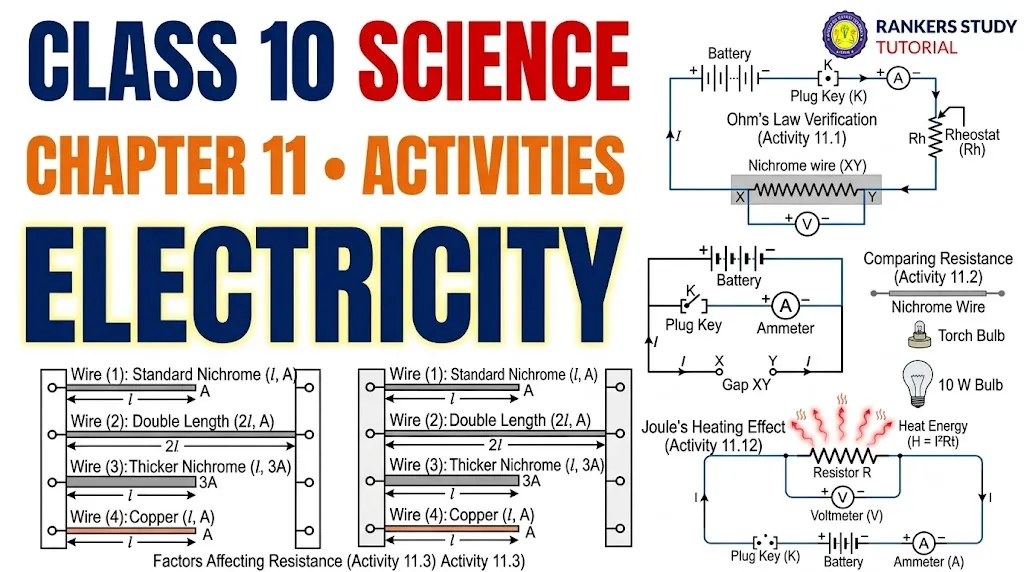
Practice Class 10 Science Class 10 Science Chapter 11 Electricity Activities with answers and explanations. Test your NCERT concepts and prepare for your science exams with this practice set.
Activity 11.1: Studying Ohm’s Law (V-I Relationship)
Determining the Linear Relationship Between Potential Difference and Current
Experimental Procedure
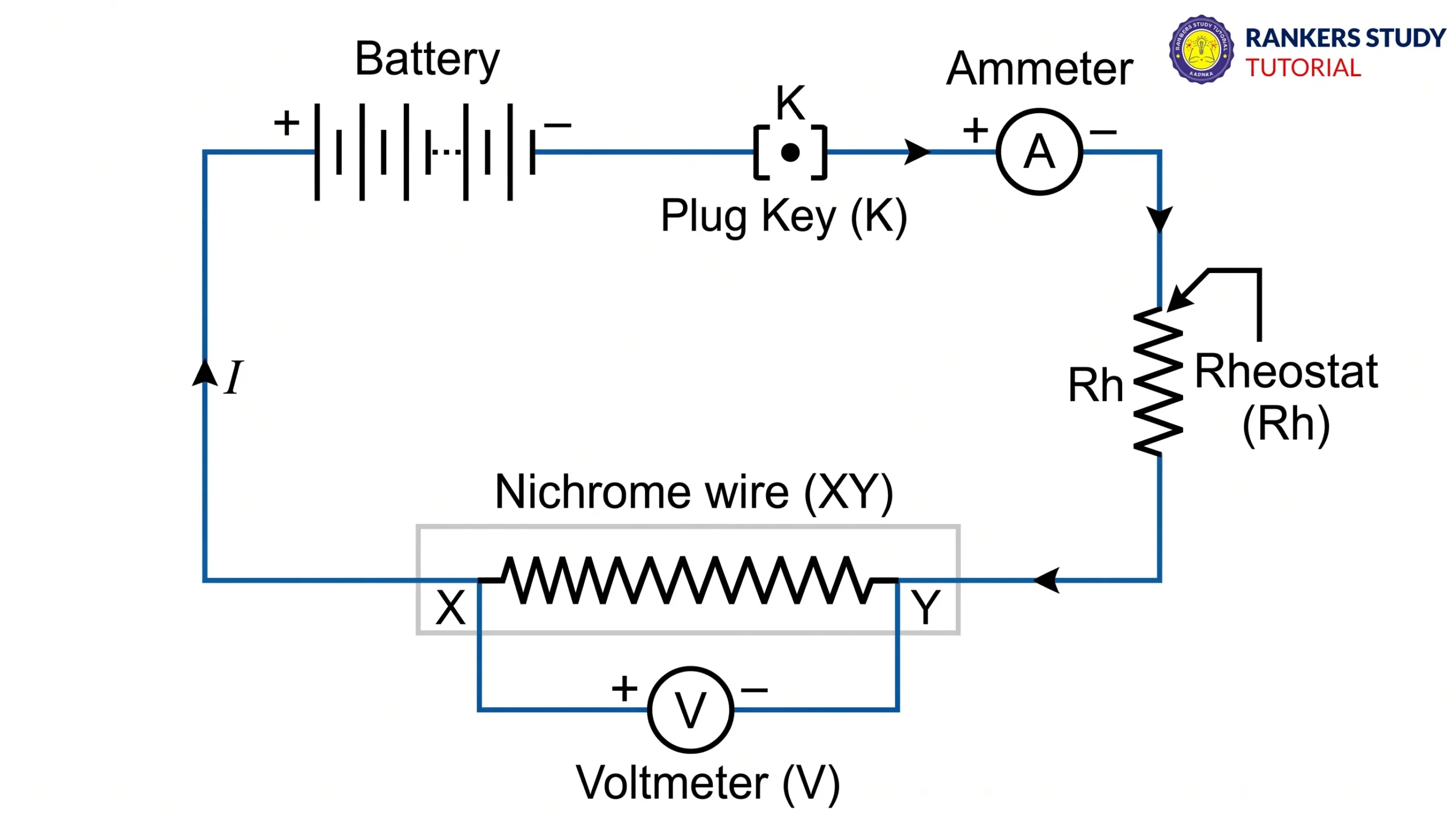
- Set up a circuit consisting of a nichrome wire \(XY\) of length \(0.5\text{ m}\), an ammeter, a voltmeter, and four cells of \(1.5\text{ V}\) each.
- Use only one cell initially, note the current (\(I\)) from the ammeter and potential difference (\(V\)) from the voltmeter across wire \(XY\).
- Repeat the observations sequentially using two, three, and four cells in the circuit.
- Calculate the ratio of \(V\) to \(I\) for each pair and plot a graph between \(V\) and \(I\).
Observations & Optical Mechanism
- Constant Ratio: Approximately the same value for \(V/I\) is obtained in each case.
- Linear Graph: The \(V-I\) graph is a straight line passing through the origin, showing that potential difference increases linearly with current.
- Ohm’s Law: Confirms that \(V \propto I\) at a constant temperature, where the slope of the line represents the resistance \(R\).
Q1: What is nichrome, and why is it used in this activity?
Answer: Nichrome is an alloy of nickel, chromium, manganese, and iron metals chosen for its stable and measurable resistance.
Q2: What does the straight-line graph passing through the origin signify for a nichrome wire?
Answer: It signifies that the potential difference across the wire is directly proportional to the current flowing through it.
Q3 (Application Based): State Ohm’s mathematical expression and define the unit of resistance.
Answer:
\(V = IR\)
. One ohm (\(1\ \Omega\)) is resistance when a potential difference of \(1\text{ V}\) drives a current of \(1\text{ A}\).Q4 (Additional Practice): What happens to the current through a resistor if its resistance is doubled while voltage stays constant?
Answer: The current gets halved according to \(I = V/R\).
Q5 (Advanced Mastery): Why must temperature remain constant during verification of Ohm’s law?
Answer: Because the resistance of metallic conductors varies with temperature, which would alter the \(V/I\) ratio.
Activity 11.2: Comparing Resistance of Different Components
Observing Ammeter Variations with Different Gap Components
Experimental Procedure
- Set up a circuit with four dry cells (\(1.5\text{ V}\) each) in series, an ammeter, and a gap \(XY\).
- Connect a nichrome wire in gap \(XY\), plug the key, and note the ammeter reading.
- Replace the nichrome wire with a torch bulb and measure the current.
- Repeat the step using a \(10\text{ W}\) bulb or other material components in gap \(XY\).
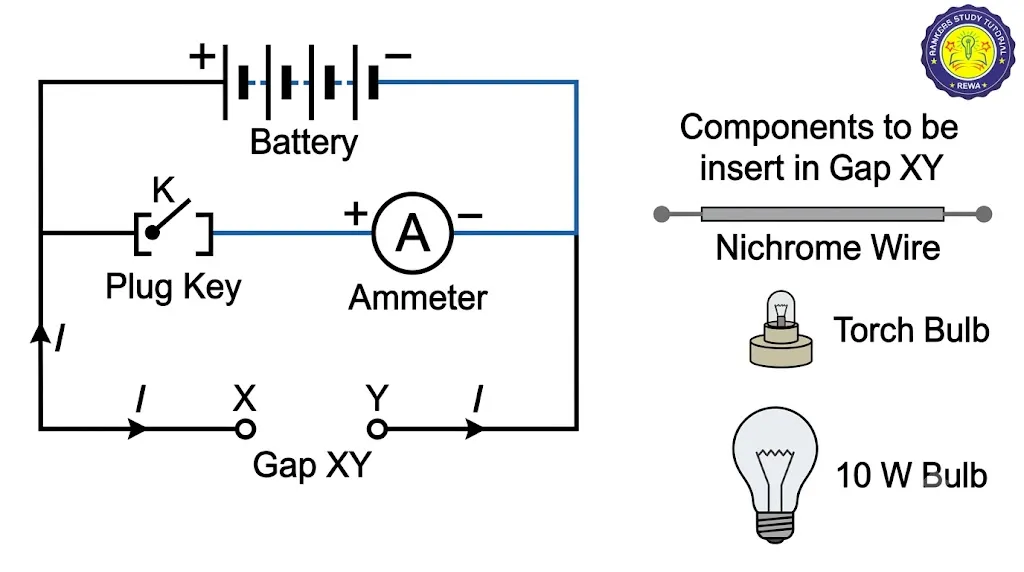
Observations & Optical Mechanism
- Current Variation: Ammeter readings differ for different components connected in gap \(XY\).
- Path Resistance: Certain components offer easy paths (good conductors) while others strongly restrain electron motion (resistors or poor conductors).
Q1: Why are ammeter readings different for different components connected in gap \(XY\)?
Answer: Because different materials and components offer varying degrees of resistance to the flow of electrons.
Q2 (Application Based): What microscopic factor causes resistance inside a metallic conductor?
Answer: The motion of electrons is restrained and retarded by the attractive forces of the fixed metal atoms among which they move.
Q3 (Additional Practice): Distinguish between a good conductor, a resistor, and an insulator based on resistance.
Answer: Good conductors offer low resistance, resistors have appreciable resistance, and insulators offer exceptionally high resistance.
Activity 11.3: Factors Affecting Conductor Resistance
Studying the Effect of Length, Area, and Material on Resistance
Experimental Procedure
- Set up a circuit with a cell, ammeter, plug key, and a nichrome wire of length \(l\).
- Plug the key and note the current reading.
- Replace with a nichrome wire of the same thickness but double the length (\(2l\)) and record current.
- Replace with a thicker nichrome wire (larger cross-sectional area \(A\)) and a copper wire of identical dimensions to observe current differences.
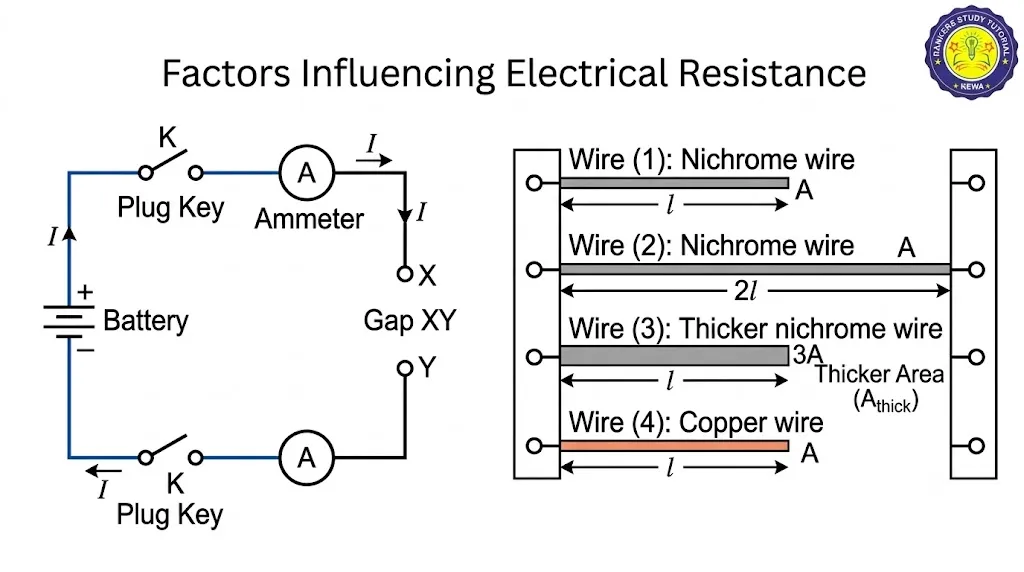
Observations & Optical Mechanism
- Length Dependency: Doubling the length halves the ammeter reading, indicating resistance doubles (\(R \propto l\)).
- Area Dependency: Increasing cross-sectional area increases current, showing resistance decreases (\(R \propto 1/A\)).
- Material Dependency: Resistivity (\(\rho\)) varies depending on the nature of the substance.
Q1: State the formula combining length and cross-sectional area to define electrical resistivity.
Answer:
\(R = \rho \frac{l}{A}\)
Q2 (Application Based): What is the SI unit of electrical resistivity, and why are alloys commonly used in heating devices?
Answer: The unit is \(\Omega\text{ m}\). Alloys are used because they have higher resistivity than pure metals and do not oxidize readily at high temperatures.
Q3 (Additional Practice): Calculate the resistance change if a wire’s length is doubled and its cross-sectional area is halved.
Answer: Resistance becomes four times the original value since \(R \propto l/A\).
Activity 11.4 & 11.5: Resistors in Series Combination
Investigating Current and Potential Difference in Series Circuits
Experimental Procedure
- Join three resistors of different values (e.g., \(1\ \Omega, 2\ \Omega, 3\ \Omega\)) in series with a \(6\text{ V}\) battery and an ammeter.
- Move the ammeter to different positions between resistors and note readings.
- Insert a voltmeter across the entire combination (\(X-Y\)) and then across individual resistors (\(X-P\), etc.) to record potential differences.
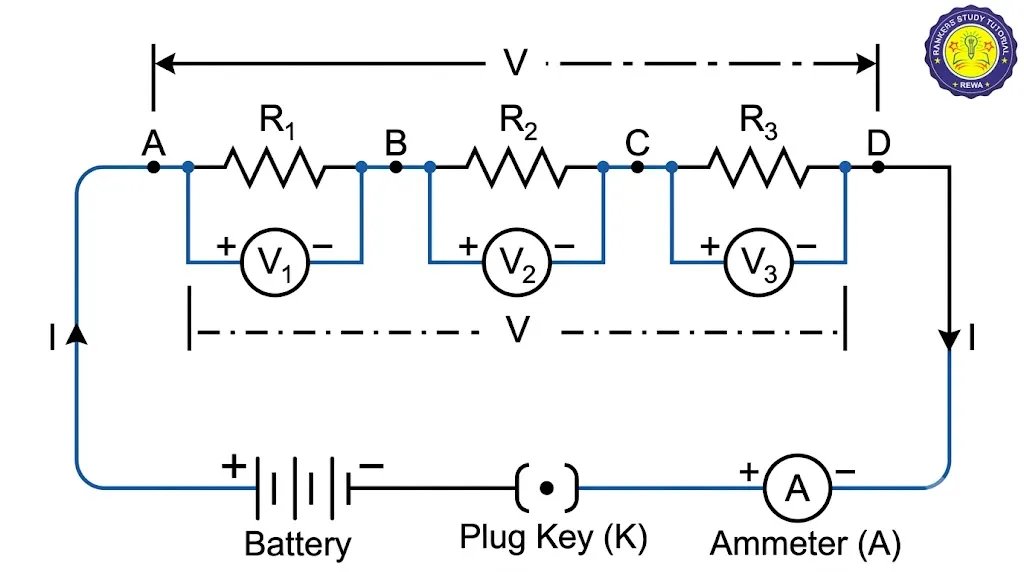
Observations & Optical Mechanism
- Constant Current: Ammeter shows identical current regardless of its position in a series circuit.
- Additive Potential: Total voltage equals the sum of individual voltage drops (\(V = V_1 + V_2 + V_3\)).
- Equivalent Resistance: \(R_s = R_1 + R_2 + R_3\).
Q1: Why is a series arrangement impracticable for domestic electrical circuits?
Answer: If one component fails, the circuit breaks and all appliances stop working; furthermore, appliances requiring different currents cannot operate together.
Q2 (Application Based): Three resistors of \(2\ \Omega\), \(3\ \Omega\), and \(6\ \Omega\) are connected. How to get total resistance of \(9\ \Omega\)?
Answer: Connect all three in series so that \(R_s = 2 + 3 + 6 = 9\ \Omega\).
Activity 11.6: Resistors in Parallel Combination
Investigating Current Splitting and Equivalent Resistance in Parallel
Experimental Procedure
- Connect three resistors in parallel between points \(X\) and \(Y\) with a battery, ammeter, and plug key.
- Measure the total circuit current (\(I\)) and the potential difference (\(V\)) across the combination.
- Insert the ammeter in series with each individual branch resistor (\(R_1, R_2, R_3\)) to measure branch currents (\(I_1, I_2, I_3\)).
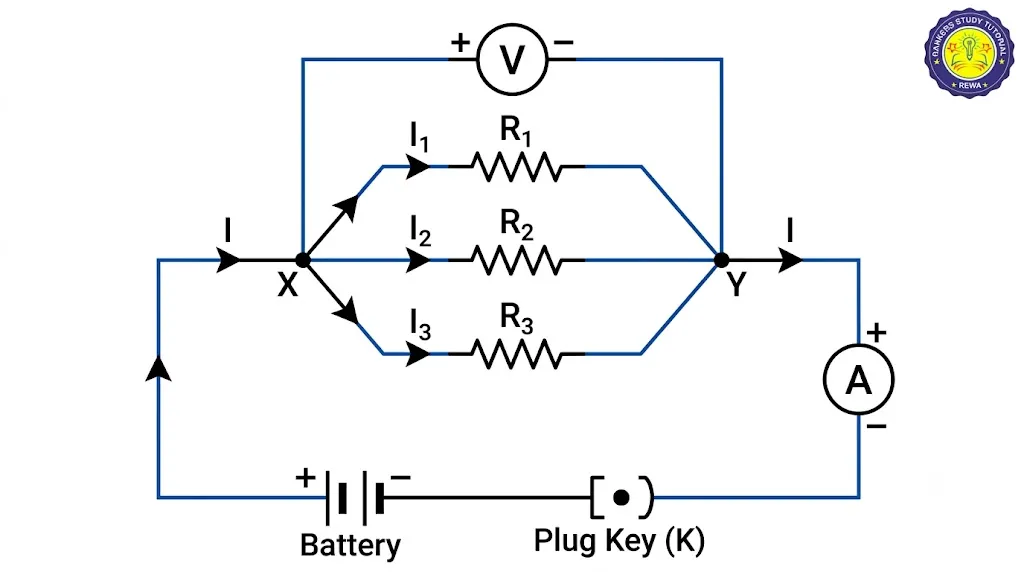
Observations & Optical Mechanism
- Constant Voltage: Potential difference across each parallel branch is identical to the source voltage.
- Additive Current: Total current equals the sum of branch currents (\(I = I_1 + I_2 + I_3\)).
- Parallel Reciprocal Rule: \(\frac{1}{R_p} = \frac{1}{R_1} + \frac{1}{R_2} + \frac{1}{R_3}\).
Q1: What are the main advantages of connecting electrical devices in parallel?
Answer: Each appliance gets the same voltage, operates independently, and failure of one does not affect the others.
Q2 (Application Based): How can resistors of \(2\ \Omega\), \(3\ \Omega\), and \(6\ \Omega\) be combined to yield an equivalent resistance of \(1\ \Omega\)?
Answer: By connecting all three in parallel: \(\frac{1}{R_p} = \frac{1}{2} + \frac{1}{3} + \frac{1}{6} = \frac{3+2+1}{6} = 1\ \Omega^{-1}\), giving \(R_p = 1\ \Omega\).
Q3 (Advanced Mastery): What happens to total circuit resistance when more resistors are added in parallel?
Answer: The total equivalent resistance decreases, which allows higher total current draw from the source.
Core Concepts: Heating Effect of Current & Electric Power
Joule’s Law of Heating, Fuses, and Power Formulas
Theoretical Principles & Formulas
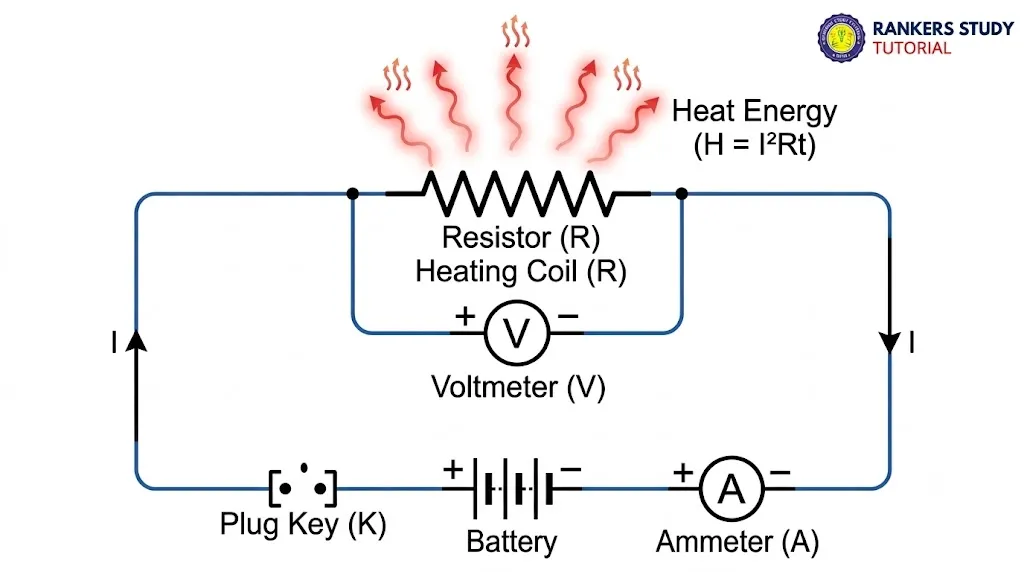
- Joule’s Law of Heating: Heat produced in a resistor is given by
\(H = I^2Rt\) - Electric Power: The rate of consumption of electrical energy, expressed as
\(P = VI = I^2R = \frac{V^2}{R}\) - Commercial Unit: Electrical energy is measured in kilowatt-hour (\(\text{kWh}\)), where \(1\text{ kWh} = 3.6 \times 10^6\text{ J}\).
Practical Applications
- Heating Appliances: Devices like irons, toasters, and heaters use high-resistivity alloy coils.
- Bulb Filaments: Made of tungsten (high melting point \(3380^\circ\text{C}\)) enclosed in inactive nitrogen/argon gas.
- Electric Fuse: Safety wire of low melting point connected in series that melts and breaks the circuit during excessive current surges.
Q1: Why does the cord of an electric heater not glow while the heating element does?
Answer: The heating element has a very high resistance causing extreme heat and glow, whereas the connecting cord has extremely low resistance, generating negligible heat.
Q2: State the commercial unit of electrical energy and convert it into joules.
Answer: Kilowatt-hour (\(\text{kWh}\)), equivalent to \(3.6 \times 10^6\text{ J}\).
Q3 (Application Based): Why is tungsten exclusively used for electric lamp filaments?
Answer: Because it has a very high melting point (\(3380^\circ\text{C}\)) and retains heat to emit bright light without melting.
Q4 (Additional Practice): How does an electric fuse protect domestic appliances?
Answer: When current exceeds a safe rating, the fuse wire’s temperature rises, causing it to melt and disconnect the circuit safely.
Q5 (Advanced Mastery): An electric refrigerator rated \(400\text{ W}\) operates \(8\text{ hours/day}\) for \(30\text{ days}\). Calculate the total energy consumed in \(\text{kWh}\).
Answer: \(\text{Energy} = 0.4\text{ kW} \times 8\text{ h/day} \times 30\text{ days} = 96\text{ kWh}\).
List
CBSE Competency-Based Questions Class 10 & 12 PDF Download (Free Official Sets)
Download Free Official CBSE Competency-Based Question Banks (Class 10 & 12) One-Stop Resource: Download Free Official CBSE Competency-Based Question Banks …
NCERT Exemplar Class 10 Maths Chapter 11 Areas Related to Circles Solutions (CBSE 2026-27)
NCERT Exemplar Class 10 Maths Chapter 11 Areas Related to Circles Solutions (CBSE 2026-27) NCERT Exemplar Class 10 Maths Chapter …
NCERT Exemplar Class 10 Maths Chapter 12 Surface Areas and Volumes Solutions (CBSE 2026-27)
NCERT Exemplar Class 10 Maths Chapter 12 Surface Areas and Volumes Solutions (CBSE 2026-27) NCERT Exemplar Class 10 Maths Chapter …
NCERT Exemplar Class 10 Maths Chapter 13 Statistics and Probability Solutions (CBSE 2026-27)
NCERT Exemplar Class 10 Maths Chapter 13 Statistics and Probability Solutions (CBSE 2026-27) NCERT Exemplar Class 10 Maths Chapter 13 …
Class 10 Maths Chapter 9 Circles NCERT Exemplar Solutions (All Exercises Solved)
NCERT Exemplar Class 10 Maths Chapter 9 Circles Solutions (CBSE 2026-27) NCERT Exemplar Class 10 Maths Chapter 9 Circles Solutions …
Class 10 Maths Chapter 8 Trigonometry NCERT Exemplar Solutions (Updated Syllabus)
NCERT Exemplar Class 10 Maths Chapter 8 Introduction to Trigonometry Solutions (CBSE 2026-27) NCERT Exemplar Class 10 Maths Chapter 8 …