
NCERT Exemplar Class 10 Maths Chapter 8 Introduction to Trigonometry Solutions (CBSE 2026-27)
This post covers in-syllabus NCERT Exemplar questions strictly based on the rationalised curriculum: trigonometric ratios of acute angles, specific angles (\(0^\circ, 30^\circ, 45^\circ, 60^\circ, 90^\circ\)), fundamental trigonometric identities, and heights and distances applications. Questions based on Trigonometric Ratios of Complementary Angles have been pruned.
Exercise 8.1: Multiple Choice Questions (MCQs)
Substituting specific trigonometric values:
\[\sin 30^\circ = \frac{1}{2}, \quad \cos 30^\circ = \frac{\sqrt{3}}{2}, \quad \sin 60^\circ = \frac{\sqrt{3}}{2}, \quad \cos 60^\circ = \frac{1}{2}\] \[\left(\frac{1}{2} + \frac{\sqrt{3}}{2}\right) – \left(\frac{\sqrt{3}}{2} + \frac{1}{2}\right) = 0\]Using the identity \(\sin^2 A + \cos^2 A = 1\):
\[\sin A = \sqrt{1 – \cos^2 A} = \sqrt{1 – \left(\frac{4}{5}\right)^2} = \sqrt{1 – \frac{16}{25}} = \sqrt{\frac{9}{25}} = \frac{3}{5}\] \[\tan A = \frac{\sin A}{\cos A} = \frac{\frac{3}{5}}{\frac{4}{5}} = \frac{3}{4}\]Since \(\sin A = \frac{1}{2}\), for acute angle \(A\), \(A = 30^\circ\):
\[\cot A = \cot 30^\circ = \sqrt{3}\]In \(\Delta ABC\), \(A + B + C = 180^\circ\). Since \(\angle C = 90^\circ\):
\[A + B = 180^\circ – 90^\circ = 90^\circ\] \[\cos(A + B) = \cos 90^\circ = 0\]Given \(\sin A + \sin^2 A = 1 \implies \sin A = 1 – \sin^2 A = \cos^2 A\).
Squaring both sides:
\[\sin^2 A = \cos^4 A\]Therefore:
\[\cos^2 A + \cos^4 A = \sin A + \sin^2 A = 1\]For acute angles:
\[\sin\alpha = \frac{1}{2} \implies \alpha = 30^\circ\] \[\cos\beta = \frac{1}{2} \implies \beta = 60^\circ\] \[\alpha + \beta = 30^\circ + 60^\circ = 90^\circ\]Divide the numerator and denominator by \(\cos\theta\):
\[\frac{4\left(\frac{\sin\theta}{\cos\theta}\right) – 1}{4\left(\frac{\sin\theta}{\cos\theta}\right) + 1} = \frac{4\tan\theta – 1}{4\tan\theta + 1}\]Given \(4\tan\theta = 3\):
\[\frac{3 – 1}{3 + 1} = \frac{2}{4} = \frac{1}{2}\]\(\sin\theta = \cos\theta \implies \tan\theta = 1 \implies \theta = 45^\circ\).
\[\sin^4 45^\circ + \cos^4 45^\circ = \left(\frac{1}{\sqrt{2}}\right)^4 + \left(\frac{1}{\sqrt{2}}\right)^4 = \frac{1}{4} + \frac{1}{4} = \frac{1}{2}\]Let \(\theta\) be the angle of elevation of the Sun:
\[\tan\theta = \frac{\text{Height of pole}}{\text{Length of shadow}} = \frac{6}{2\sqrt{3}} = \frac{3}{\sqrt{3}} = \sqrt{3}\] \[\tan\theta = \sqrt{3} \implies \theta = 60^\circ\]Exercise 8.2: Short Answer Questions with Reasoning
Using identities \(1 – \cos^2\theta = \sin^2\theta\) and \(\sec^2\theta = \frac{1}{\cos^2\theta}\):
\[\sqrt{\sin^2\theta \cdot \sec^2\theta} = \sqrt{\frac{\sin^2\theta}{\cos^2\theta}} = \sqrt{\tan^2\theta} = \tan\theta\]\(\cos A + \cos^2 A = 1 \implies \cos A = 1 – \cos^2 A = \sin^2 A\).
Squaring both sides gives \(\cos^2 A = \sin^4 A\).
\[\sin^2 A + \sin^4 A = \cos A + \cos^2 A = 1\]Expanding the left hand side:
\[\text{LHS} = 2\tan^2\theta + \tan\theta + 4\tan\theta + 2 = 2\tan^2\theta + 5\tan\theta + 2\]Expanding the right hand side using \(\sec^2\theta = 1 + \tan^2\theta\):
\[\text{RHS} = 5\tan\theta + (1 + \tan^2\theta) = \tan^2\theta + 5\tan\theta + 1\]Since \(\text{LHS} \neq \text{RHS}\), the statement is false.
Let tower height be \(h\) and shadow length be \(x\). Then \(\cot\theta = \frac{x}{h}\) or \(\tan\theta = \frac{h}{x}\). As shadow length \(x\) increases, \(\tan\theta\) decreases, which means \(\theta\) decreases, not increases.
By the AM-GM inequality, for any positive real number \(a \neq 1\):
\[a + \frac{1}{a} > 2\]This would imply \(2\sin\theta > 2 \implies \sin\theta > 1\), which is impossible because the maximum value of \(\sin\theta\) is \(1\).
Since \(a \neq b\), \((a – b)^2 > 0 \implies a^2 + b^2 – 2ab > 0 \implies a^2 + b^2 > 2ab\).
Since \(ab > 0\), dividing by \(2ab\) gives:
\[\frac{a^2 + b^2}{2ab} > 1\]However, \(\cos\theta\) cannot exceed \(1\). Hence, the statement is false.
Let original height be \(h\) and distance be \(d\):
\[\tan 30^\circ = \frac{h}{d} = \frac{1}{\sqrt{3}} \implies d = \sqrt{3}h\]When height is doubled to \(2h\):
\[\tan\theta’ = \frac{2h}{d} = \frac{2h}{\sqrt{3}h} = \frac{2}{\sqrt{3}} \approx 1.155\]Since \(\tan 60^\circ = \sqrt{3} \approx 1.732 \neq \frac{2}{\sqrt{3}}\), \(\theta’ \neq 60^\circ\).
Let initial angle be \(\theta\), height be \(h\), and distance be \(d\): \(\tan\theta = \frac{h}{d}\).
New height \(h’ = 1.1h\) and new distance \(d’ = 1.1d\):
\[\tan\theta’ = \frac{h’}{d’} = \frac{1.1h}{1.1d} = \frac{h}{d} = \tan\theta \implies \theta’ = \theta\]Exercise 8.3: Identities & Applications
Since \(\sin^2\theta + \cos^2\theta = 1\):
\[= \frac{1 + 1 + 2\cos\theta}{\sin\theta(1 + \cos\theta)} = \frac{2(1 + \cos\theta)}{\sin\theta(1 + \cos\theta)} = \frac{2}{\sin\theta} = 2\operatorname{cosec}\theta = \text{RHS}\]Since \(\sec^2 A – 1 = \tan^2 A\):
\[= \tan A \left[ \frac{2\sec A}{\tan^2 A} \right] = \frac{2\sec A}{\tan A} = 2 \cdot \frac{1/\cos A}{\sin A/\cos A} = \frac{2}{\sin A} = 2\operatorname{cosec} A = \text{RHS}\]In a right triangle with \(\tan A = \frac{\text{Opposite}}{\text{Adjacent}} = \frac{3}{4}\):
\[\text{Hypotenuse} = \sqrt{3^2 + 4^2} = 5\] \[\sin A = \frac{3}{5}, \quad \cos A = \frac{4}{5}\] \[\sin A \cos A = \left(\frac{3}{5}\right)\left(\frac{4}{5}\right) = \frac{12}{25}\]Evaluate LHS using \(\cot 30^\circ = \sqrt{3}\):
\[\text{LHS} = (\sqrt{3} + 1)(3 – \sqrt{3}) = 3\sqrt{3} – 3 + 3 – \sqrt{3} = 2\sqrt{3}\]Evaluate RHS using \(\tan 60^\circ = \sqrt{3}\) and \(\sin 60^\circ = \frac{\sqrt{3}}{2}\):
\[\text{RHS} = (\sqrt{3})^3 – 2\left(\frac{\sqrt{3}}{2}\right) = 3\sqrt{3} – \sqrt{3} = 2\sqrt{3}\]Since \(\text{LHS} = \text{RHS} = 2\sqrt{3}\), the identity is verified.
Using \(\cot^2\alpha = \operatorname{cosec}^2\alpha – 1 = (\operatorname{cosec}\alpha – 1)(\operatorname{cosec}\alpha + 1)\):
\[\text{LHS} = 1 + \frac{(\operatorname{cosec}\alpha – 1)(\operatorname{cosec}\alpha + 1)}{\operatorname{cosec}\alpha + 1} = 1 + (\operatorname{cosec}\alpha – 1) = \operatorname{cosec}\alpha = \text{RHS}\]Let wall height be \(h\). The angle made with the wall is \(60^\circ\), so the wall is the adjacent side to this angle:
\[\cos 60^\circ = \frac{h}{15} \implies \frac{1}{2} = \frac{h}{15} \implies h = \frac{15}{2} = 7.5\text{ m}\]Substitute \(\cos^2\theta = 1 – \sin^2\theta\):
\[2\sin^2\theta – (1 – \sin^2\theta) = 2 \implies 3\sin^2\theta – 1 = 2 \implies 3\sin^2\theta = 3\] \[\sin^2\theta = 1 \implies \sin\theta = 1 \implies \theta = 90^\circ\]Height of tower above observer’s eye level:
\[h = 22 – 1.5 = 20.5\text{ m}\]Distance from tower \(d = 20.5\text{ m}\):
\[\tan\theta = \frac{h}{d} = \frac{20.5}{20.5} = 1 \implies \theta = 45^\circ\]Exercise 8.4: Long Answer Questions & Applications
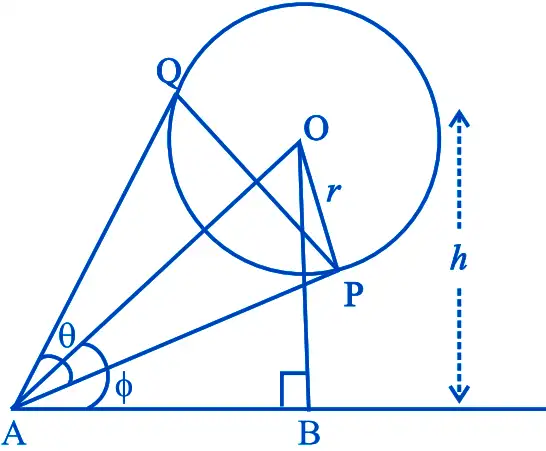
In \(\Delta OAP\), \(\angle OAP = \frac{\theta}{2}\) and \(\angle OPA = 90^\circ\):
\[\sin\frac{\theta}{2} = \frac{OP}{OA} = \frac{r}{d} \implies d = \frac{r}{\sin\frac{\theta}{2}} \quad \text{— (1)}\]In right-angled \(\Delta OAB\), height of centre is \(h = OB\):
\[\sin\phi = \frac{h}{d} \implies h = d\sin\phi \quad \text{— (2)}\]Substituting (1) into (2):
\[h = \frac{r\sin\phi}{\sin\frac{\theta}{2}} = r\sin\phi\operatorname{cosec}\frac{\theta}{2}\]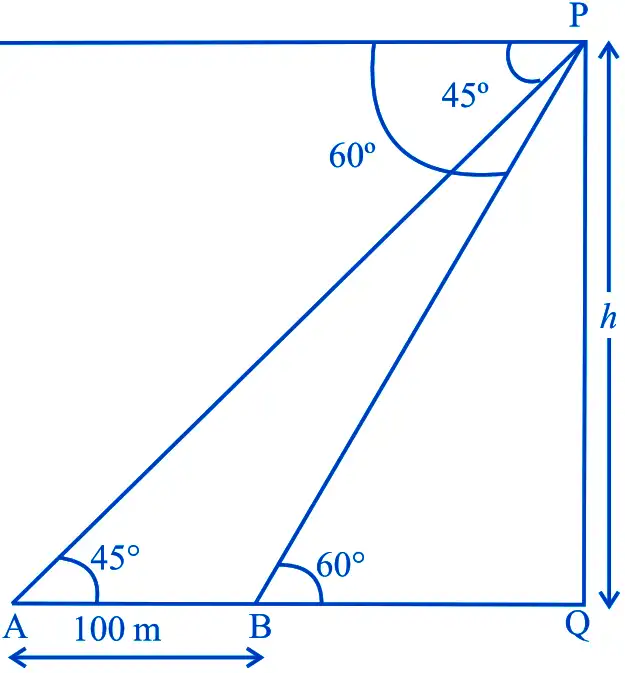
Let height of balloon be \(h\text{ metres}\). From \(\Delta PAQ\): \(\angle PAQ = 45^\circ \implies AQ = h\).
From \(\Delta PBQ\): \(\angle PBQ = 60^\circ \implies BQ = \frac{h}{\tan 60^\circ} = \frac{h}{\sqrt{3}}\).
Distance between cars \(AB = AQ – BQ = 100\text{ m}\):
\[h – \frac{h}{\sqrt{3}} = 100 \implies h\left(\frac{\sqrt{3} – 1}{\sqrt{3}}\right) = 100\] \[h = \frac{100\sqrt{3}}{\sqrt{3} – 1} = \frac{100\sqrt{3}(\sqrt{3} + 1)}{2} = 50(3 + \sqrt{3})\text{ m}\]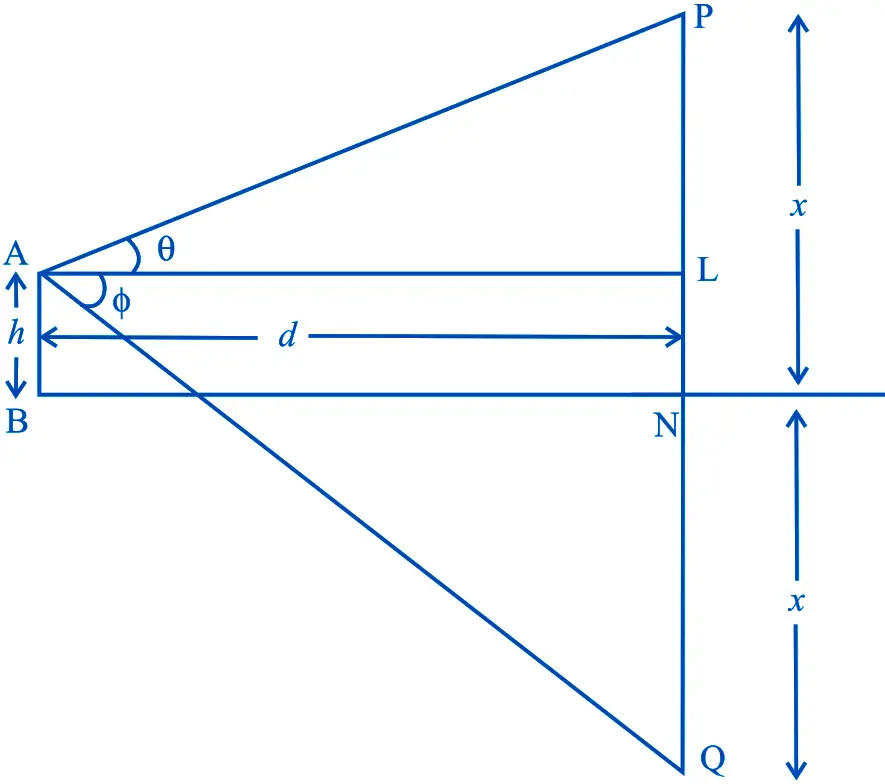
Let height of cloud above lake be \(x\). The distance of reflection below lake surface is also \(x\).
Observation point \(A\) is at height \(h\). Horizontal distance \(AL = d\):
\[\tan\theta = \frac{x – h}{d} \implies d = \frac{x – h}{\tan\theta} \quad \text{— (1)}\] \[\tan\phi = \frac{x + h}{d} \implies d = \frac{x + h}{\tan\phi} \quad \text{— (2)}\]Equating (1) and (2):
\[\frac{x + h}{x – h} = \frac{\tan\phi}{\tan\theta}\]Applying componendo and dividendo:
\[\frac{(x + h) + (x – h)}{(x + h) – (x – h)} = \frac{\tan\phi + \tan\theta}{\tan\phi – \tan\theta} \implies \frac{2x}{2h} = \frac{\tan\phi + \tan\theta}{\tan\phi – \tan\theta}\] \[x = h\left(\frac{\tan\phi + \tan\theta}{\tan\phi – \tan\theta}\right)\]We know that \(\operatorname{cosec}^2\theta – \cot^2\theta = 1 \implies (\operatorname{cosec}\theta – \cot\theta)(\operatorname{cosec}\theta + \cot\theta) = 1\):
\[\operatorname{cosec}\theta – \cot\theta = \frac{1}{p}\]Adding the two equations:
\[2\operatorname{cosec}\theta = p + \frac{1}{p} = \frac{p^2 + 1}{p} \implies \operatorname{cosec}\theta = \frac{p^2 + 1}{2p} \implies \sin\theta = \frac{2p}{p^2 + 1}\]Subtracting the two equations:
\[2\cot\theta = p – \frac{1}{p} = \frac{p^2 – 1}{p} \implies \cot\theta = \frac{p^2 – 1}{2p}\]Therefore:
\[\cos\theta = \frac{\cot\theta}{\operatorname{cosec}\theta} = \frac{\frac{p^2 – 1}{2p}}{\frac{p^2 + 1}{2p}} = \frac{p^2 – 1}{p^2 + 1}\]Since \(\text{LHS} = \text{RHS}\), the identity is established.
The new angle of elevation is \(30^\circ + 15^\circ = 45^\circ\). Let height of tower be \(h\).
At \(45^\circ\) elevation: distance from tower base is \(d = h\).
At initial point: distance was \(d + 20 = h + 20\):
\[\tan 30^\circ = \frac{h}{h + 20} \implies \frac{1}{\sqrt{3}} = \frac{h}{h + 20} \implies h + 20 = \sqrt{3}h\] \[h(\sqrt{3} – 1) = 20 \implies h = \frac{20}{\sqrt{3} – 1} = \frac{20(\sqrt{3} + 1)}{2} = 10(\sqrt{3} + 1)\text{ m}\]Dividing both sides by \(\cos^2\theta\) (assuming \(\cos\theta \neq 0\)):
\[\frac{1}{\cos^2\theta} + \frac{\sin^2\theta}{\cos^2\theta} = \frac{3\sin\theta\cos\theta}{\cos^2\theta}\] \[\sec^2\theta + \tan^2\theta = 3\tan\theta\]Using \(\sec^2\theta = 1 + \tan^2\theta\):
\[(1 + \tan^2\theta) + \tan^2\theta = 3\tan\theta \implies 2\tan^2\theta – 3\tan\theta + 1 = 0\] \[(2\tan\theta – 1)(\tan\theta – 1) = 0 \implies \tan\theta = 1 \quad \text{or} \quad \tan\theta = \frac{1}{2}\]Let \(x = 2\sin\theta – \cos\theta\). Squaring both equations and adding:
\[(\sin\theta + 2\cos\theta)^2 + (2\sin\theta – \cos\theta)^2 = 1^2 + x^2\] \[(\sin^2\theta + 4\cos^2\theta + 4\sin\theta\cos\theta) + (4\sin^2\theta + \cos^2\theta – 4\sin\theta\cos\theta) = 1 + x^2\] \[5\sin^2\theta + 5\cos^2\theta = 1 + x^2\] \[5(\sin^2\theta + \cos^2\theta) = 1 + x^2 \implies 5(1) = 1 + x^2 \implies x^2 = 4 \implies x = 2\] \[2\sin\theta – \cos\theta = 2\]Let height of tower be \(h\). When elevation is \(60^\circ\), shadow length is \(x = \frac{h}{\tan 60^\circ} = \frac{h}{\sqrt{3}}\).
When elevation is \(30^\circ\), shadow length is \(x + 50\):
\[\tan 30^\circ = \frac{h}{x + 50} \implies \frac{1}{\sqrt{3}} = \frac{h}{\frac{h}{\sqrt{3}} + 50} \implies \frac{h}{\sqrt{3}} + 50 = \sqrt{3}h\] \[50 = \sqrt{3}h – \frac{h}{\sqrt{3}} = \frac{3h – h}{\sqrt{3}} = \frac{2h}{\sqrt{3}} \implies h = \frac{50\sqrt{3}}{2} = 25\sqrt{3}\text{ m}\]Let height of tower be \(H\) and distance of observation point from tower base be \(x\):
\[\tan\alpha = \frac{H}{x} \implies x = \frac{H}{\tan\alpha} \quad \text{— (1)}\] \[\tan\beta = \frac{H + h}{x} \implies x = \frac{H + h}{\tan\beta} \quad \text{— (2)}\]Equating (1) and (2):
\[\frac{H}{\tan\alpha} = \frac{H + h}{\tan\beta} \implies H\tan\beta = H\tan\alpha + h\tan\alpha\] \[H(\tan\beta – \tan\alpha) = h\tan\alpha \implies H = \frac{h\tan\alpha}{\tan\beta – \tan\alpha}\]Using the identity \(\sec^2\theta – \tan^2\theta = 1 \implies (\sec\theta – \tan\theta)(\sec\theta + \tan\theta) = 1\):
\[\sec\theta – \tan\theta = \frac{1}{l}\]Given \(\sec\theta + \tan\theta = l\). Adding the two equations:
\[2\sec\theta = l + \frac{1}{l} = \frac{l^2 + 1}{l} \implies \sec\theta = \frac{l^2 + 1}{2l}\]Let \(x = a\cos\theta – b\sin\theta\). Squaring and adding both equations:
\[(a\sin\theta + b\cos\theta)^2 + (a\cos\theta – b\sin\theta)^2 = c^2 + x^2\] \[(a^2\sin^2\theta + b^2\cos^2\theta + 2ab\sin\theta\cos\theta) + (a^2\cos^2\theta + b^2\sin^2\theta – 2ab\sin\theta\cos\theta) = c^2 + x^2\] \[a^2(\sin^2\theta + \cos^2\theta) + b^2(\cos^2\theta + \sin^2\theta) = c^2 + x^2\] \[a^2 + b^2 = c^2 + x^2 \implies x^2 = a^2 + b^2 – c^2 \implies x = \sqrt{a^2 + b^2 – c^2}\]In the numerator, substitute \(1 = \sec^2\theta – \tan^2\theta\):
\[\text{Numerator} = (\sec^2\theta – \tan^2\theta) + (\sec\theta – \tan\theta) = (\sec\theta – \tan\theta)(\sec\theta + \tan\theta + 1)\]Now simplify the fraction:
\[\frac{(\sec\theta – \tan\theta)(1 + \sec\theta + \tan\theta)}{1 + \sec\theta + \tan\theta} = \sec\theta – \tan\theta = \frac{1}{\cos\theta} – \frac{\sin\theta}{\cos\theta} = \frac{1 – \sin\theta}{\cos\theta} = \text{RHS}\]Let the first tower be \(AB = 30\text{ m}\), the second tower be \(CD = H\), and distance between them be \(d\):
\[\tan 60^\circ = \frac{AB}{d} \implies \sqrt{3} = \frac{30}{d} \implies d = \frac{30}{\sqrt{3}} = 10\sqrt{3}\text{ m}\] \[\tan 30^\circ = \frac{CD}{d} \implies \frac{1}{\sqrt{3}} = \frac{H}{10\sqrt{3}} \implies H = \frac{10\sqrt{3}}{\sqrt{3}} = 10\text{ m}\]Answer: Distance \(= \mathbf{10\sqrt{3}\text{ m}}\), Height of second tower \(= \mathbf{10\text{ m}}\).
Let height of tower be \(H\) and horizontal distance be \(d\):
\[\tan 60^\circ = \frac{H}{d} \implies d = \frac{H}{\sqrt{3}}\]From the second point at height \(10\text{ m}\), height above point is \(H – 10\):
\[\tan 45^\circ = \frac{H – 10}{d} = 1 \implies d = H – 10\]Equating the two expressions for \(d\):
\[\frac{H}{\sqrt{3}} = H – 10 \implies H = \sqrt{3}H – 10\sqrt{3} \implies H(\sqrt{3} – 1) = 10\sqrt{3}\] \[H = \frac{10\sqrt{3}}{\sqrt{3} – 1} = \frac{10\sqrt{3}(\sqrt{3} + 1)}{2} = 5(3 + \sqrt{3})\text{ m}\]Let height of balloon above ground be \(H\) and horizontal distance be \(x\).
Lower window is at height \(2\text{ m}\): elevation is \(60^\circ\):
\[\tan 60^\circ = \frac{H – 2}{x} \implies \sqrt{3}x = H – 2 \implies x = \frac{H – 2}{\sqrt{3}} \quad \text{— (1)}\]Upper window is at height \(2 + 4 = 6\text{ m}\): elevation is \(30^\circ\):
\[\tan 30^\circ = \frac{H – 6}{x} \implies \frac{1}{\sqrt{3}} = \frac{H – 6}{x} \implies x = \sqrt{3}(H – 6) \quad \text{— (2)}\]Equating (1) and (2):
\[\frac{H – 2}{\sqrt{3}} = \sqrt{3}(H – 6) \implies H – 2 = 3(H – 6) = 3H – 18\] \[2H = 16 \implies H = 8\text{ m}\]Answer: The height of the balloon above the ground is \(8\text{ metres}\).