CBSE 2026-27 Syllabus Scope Note:
This post covers in-syllabus NCERT Exemplar questions strictly based on the rationalised curriculum: review of coordinate geometry concepts, distance formula, and section formula (internal division only). Questions requiring the Area of a Triangle formula have been pruned. Collinearity questions are solved using the distance formula or ratio concepts.
Exercise 7.1: Multiple Choice Questions (MCQs)
Section B — Sample 1
If the distance between the points \((2, -2)\) and \((-1, x)\) is \(5\), one of the values of \(x\) is:
(A) \(-2\)
(B) \(2\)
(C) \(-1\)
(D) \(1\)
Solution: Correct Option (B)
Using the distance formula:
\[\sqrt{(-1 – 2)^2 + (x – (-2))^2} = 5\]
\[(-3)^2 + (x + 2)^2 = 25 \implies 9 + (x + 2)^2 = 25 \implies (x + 2)^2 = 16\]
\[x + 2 = \pm 4 \implies x = 2 \quad \text{or} \quad x = -6\]
Section B — Sample 2
The mid-point of the line segment joining the points \(A(-2, 8)\) and \(B(-6, -4)\) is:
(A) \((-4, -6)\)
(B) \((2, 6)\)
(C) \((-4, 2)\)
(D) \((4, 2)\)
Solution: Correct Option (C)
\[M = \left(\frac{-2 + (-6)}{2}, \frac{8 + (-4)}{2}\right) = \left(\frac{-8}{2}, \frac{4}{2}\right) = (-4, 2)\]
Section B — Sample 3
The points \(A(9, 0), B(9, 6), C(-9, 6)\) and \(D(-9, 0)\) are the vertices of a:
(A) square
(B) rectangle
(C) rhombus
(D) trapezium
Solution: Correct Option (B)
Side lengths using the distance formula:
\[AB = \sqrt{(9 – 9)^2 + (6 – 0)^2} = 6\]
\[BC = \sqrt{(-9 – 9)^2 + (6 – 6)^2} = 18\]
\[CD = \sqrt{(-9 – (-9))^2 + (0 – 6)^2} = 6\]
\[DA = \sqrt{(9 – (-9))^2 + (0 – 0)^2} = 18\]
Diagonals:
\[AC = \sqrt{(-9 – 9)^2 + (6 – 0)^2} = \sqrt{324 + 36} = \sqrt{360}\]
\[BD = \sqrt{(-9 – 9)^2 + (0 – 6)^2} = \sqrt{324 + 36} = \sqrt{360}\]
Opposite sides are equal and diagonals are equal, so \(ABCD\) is a rectangle.
Exercise 7.1 — Q1
1. The distance of the point \(P(2, 3)\) from the x-axis is:
(A) \(2\)
(B) \(3\)
(C) \(1\)
(D) \(5\)
Solution: Correct Option (B)
The perpendicular distance of any point \((x, y)\) from the x-axis is given by \(|y|\). Here, \(|3| = 3\).
Exercise 7.1 — Q2
2. The distance between the points \(A(0, 6)\) and \(B(0, -2)\) is:
(A) \(6\)
(B) \(8\)
(C) \(4\)
(D) \(2\)
Solution: Correct Option (B)
\[AB = \sqrt{(0 – 0)^2 + (-2 – 6)^2} = \sqrt{(-8)^2} = 8\]
Exercise 7.1 — Q3
3. The distance of the point \(P(-6, 8)\) from the origin is:
(A) \(8\)
(B) \(2\sqrt{7}\)
(C) \(10\)
(D) \(6\)
Solution: Correct Option (C)
\[OP = \sqrt{(-6)^2 + 8^2} = \sqrt{36 + 64} = \sqrt{100} = 10\]
Exercise 7.1 — Q4
4. The distance between the points \((0, 5)\) and \((-5, 0)\) is:
(A) \(5\)
(B) \(5\sqrt{2}\)
(C) \(2\sqrt{5}\)
(D) \(10\)
Solution: Correct Option (B)
\[d = \sqrt{(-5 – 0)^2 + (0 – 5)^2} = \sqrt{25 + 25} = \sqrt{50} = 5\sqrt{2}\]
Exercise 7.1 — Q5
5. \(AOBC\) is a rectangle whose three vertices are \(A(0, 3), O(0, 0)\) and \(B(5, 0)\). The length of its diagonal is:
(A) \(5\)
(B) \(3\)
(C) \(\sqrt{34}\)
(D) \(4\)
Solution: Correct Option (C)
The diagonal joining \(A(0, 3)\) and \(B(5, 0)\) has length:
\[AB = \sqrt{(5 – 0)^2 + (0 – 3)^2} = \sqrt{25 + 9} = \sqrt{34}\]
Exercise 7.1 — Q6
6. The perimeter of a triangle with vertices \((0, 4), (0, 0)\) and \((3, 0)\) is:
(A) \(5\)
(B) \(12\)
(C) \(11\)
(D) \(7 + \sqrt{5}\)
Solution: Correct Option (B)
Let vertices be \(A(0, 4), O(0, 0), B(3, 0)\):
\[OA = 4, \quad OB = 3, \quad AB = \sqrt{(3 – 0)^2 + (0 – 4)^2} = \sqrt{9 + 16} = 5\]
\[\text{Perimeter} = 4 + 3 + 5 = 12\]
Exercise 7.1 — Q8
7. The points \((-4, 0), (4, 0), (0, 3)\) are the vertices of a:
(A) right triangle
(B) isosceles triangle
(C) equilateral triangle
(D) scalene triangle
Solution: Correct Option (B)
Let points be \(A(-4, 0), B(4, 0), C(0, 3)\):
\[AC = \sqrt{(0 – (-4))^2 + (3 – 0)^2} = \sqrt{16 + 9} = 5\]
\[BC = \sqrt{(0 – 4)^2 + (3 – 0)^2} = \sqrt{16 + 9} = 5\]
\[AB = \sqrt{(4 – (-4))^2 + 0^2} = 8\]
Since \(AC = BC = 5 \neq AB\), the triangle is isosceles.
Exercise 7.1 — Q9
8. The point which divides the line segment joining the points \((7, -6)\) and \((3, 4)\) in ratio \(1 : 2\) internally lies in the:
(A) I quadrant
(B) II quadrant
(C) III quadrant
(D) IV quadrant
Solution: Correct Option (D)
Using the section formula with \(m_1 = 1, m_2 = 2\):
\[x = \frac{1(3) + 2(7)}{1 + 2} = \frac{3 + 14}{3} = \frac{17}{3} > 0\]
\[y = \frac{1(4) + 2(-6)}{1 + 2} = \frac{4 – 12}{3} = -\frac{8}{3} < 0\]
Since \(x > 0\) and \(y < 0\), the point lies in the IV quadrant.
Exercise 7.1 — Q10
9. The point which lies on the perpendicular bisector of the line segment joining \(A(-2, -5)\) and \(B(2, 5)\) is:
(A) \((0, 0)\)
(B) \((0, 2)\)
(C) \((2, 0)\)
(D) \((-2, 0)\)
Solution: Correct Option (A)
The mid-point of \(AB\) lies on its perpendicular bisector:
\[M = \left(\frac{-2 + 2}{2}, \frac{-5 + 5}{2}\right) = (0, 0)\]
Exercise 7.1 — Q11
10. The fourth vertex \(D\) of a parallelogram \(ABCD\) whose three vertices are \(A(-2, 3), B(6, 7)\) and \(C(8, 3)\) is:
(A) \((0, 1)\)
(B) \((0, -1)\)
(C) \((-1, 0)\)
(D) \((1, 0)\)
Solution: Correct Option (B)
Diagonals of a parallelogram bisect each other, so mid-point of \(AC\) equals mid-point of \(BD\):
\[x_D = x_A + x_C – x_B = -2 + 8 – 6 = 0\]
\[y_D = y_A + y_C – y_B = 3 + 3 – 7 = -1\]
Thus, \(D = (0, -1)\).
Exercise 7.1 — Q12
11. If the point \(P(2, 1)\) lies on the line segment joining points \(A(4, 2)\) and \(B(8, 4)\), then:
(A) \(AP = \frac{1}{3}AB\)
(B) \(AP = PB\)
(C) \(PB = \frac{1}{3}AB\)
(D) \(AP = \frac{1}{2}AB\)
Solution: Correct Option (D)
Evaluating distances using the distance formula:
\[AP = \sqrt{(2 – 4)^2 + (1 – 2)^2} = \sqrt{4 + 1} = \sqrt{5}\]
\[AB = \sqrt{(8 – 4)^2 + (4 – 2)^2} = \sqrt{16 + 4} = \sqrt{20} = 2\sqrt{5}\]
\[AP = \frac{\sqrt{5}}{2\sqrt{5}}AB = \frac{1}{2}AB\]
Exercise 7.1 — Q13
12. If \(P\left(\frac{a}{3}, 4\right)\) is the mid-point of the line segment joining the points \(Q(-6, 5)\) and \(R(-2, 3)\), then the value of \(a\) is:
(A) \(-4\)
(B) \(-12\)
(C) \(12\)
(D) \(-6\)
Solution: Correct Option (B)
\[\frac{a}{3} = \frac{-6 + (-2)}{2} = \frac{-8}{2} = -4 \implies a = 3 \times (-4) = -12\]
Exercise 7.1 — Q14
13. The perpendicular bisector of the line segment joining the points \(A(1, 5)\) and \(B(4, 6)\) cuts the y-axis at:
(A) \((0, 13)\)
(B) \((0, -13)\)
(C) \((0, 12)\)
(D) \((13, 0)\)
Solution: Correct Option (A)
Let the point on the y-axis be \(P(0, y)\). Since \(P\) lies on the perpendicular bisector, \(PA = PB \implies PA^2 = PB^2\):
\[(0 – 1)^2 + (y – 5)^2 = (0 – 4)^2 + (y – 6)^2\]
\[1 + y^2 – 10y + 25 = 16 + y^2 – 12y + 36\]
\[-10y + 26 = -12y + 52 \implies 2y = 26 \implies y = 13\]
The point is \((0, 13)\).
Exercise 7.1 — Q15
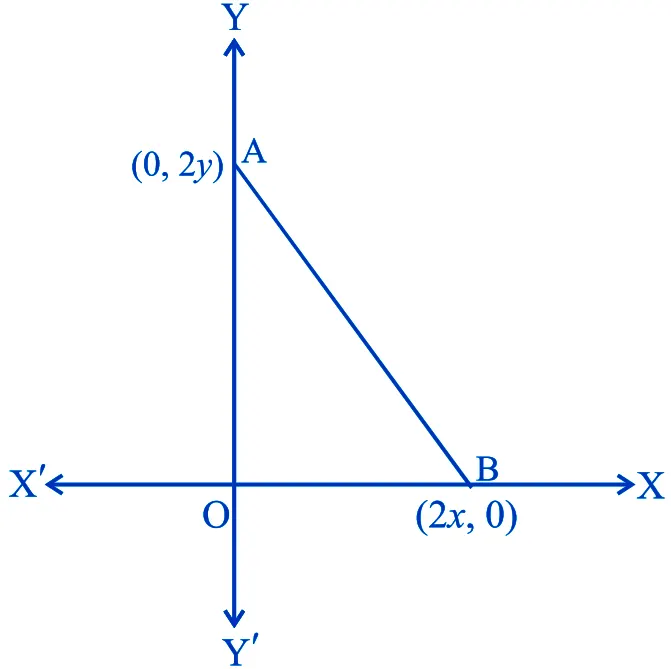
14. The coordinates of the point which is equidistant from the three vertices of \(\Delta AOB\) as shown in Fig. 7.1 is:
(A) \((x, y)\)
(B) \((y, x)\)
(C) \(\left(\frac{x}{2}, \frac{y}{2}\right)\)
(D) \(\left(\frac{y}{2}, \frac{x}{2}\right)\)
Solution: Correct Option (A)
\(\Delta AOB\) is right-angled at origin \(O(0, 0)\) with vertices \(A(0, 2y)\) and \(B(2x, 0)\). The circumcentre of a right triangle is the mid-point of its hypotenuse \(AB\):
\[M = \left(\frac{0 + 2x}{2}, \frac{2y + 0}{2}\right) = (x, y)\]
Exercise 7.1 — Q16
15. A circle drawn with origin as centre passes through \(\left(\frac{13}{2}, 0\right)\). The point which does not lie in the interior of the circle is:
(A) \(\left(-\frac{3}{4}, 1\right)\)
(B) \(\left(2, \frac{7}{3}\right)\)
(C) \(\left(5, -\frac{1}{2}\right)\)
(D) \(\left(-6, \frac{5}{2}\right)\)
Solution: Correct Option (D)
Radius \(r = \frac{13}{2} = 6.5 \implies r^2 = 42.25\). For point (D):
\[(-6)^2 + \left(\frac{5}{2}\right)^2 = 36 + 6.25 = 42.25 = r^2\]
Point \(\left(-6, \frac{5}{2}\right)\) lies on the boundary of the circle, hence it does not lie in its interior.
Exercise 7.1 — Q17
16. A line intersects the y-axis and x-axis at \(P\) and \(Q\), respectively. If \((2, -5)\) is the mid-point of \(PQ\), then coordinates of \(P\) and \(Q\) are, respectively:
(A) \((0, 5)\) and \((2, 0)\)
(B) \((0, 10)\) and \((-4, 0)\)
(C) \((0, 4)\) and \((-10, 0)\)
(D) \((0, -10)\) and \((4, 0)\)
Solution: Correct Option (D)
Let \(P(0, y)\) and \(Q(x, 0)\):
\[\frac{0 + x}{2} = 2 \implies x = 4 \implies Q(4, 0)\]
\[\frac{y + 0}{2} = -5 \implies y = -10 \implies P(0, -10)\]
Exercise 7.1 — Q19
17. If the distance between the points \((4, p)\) and \((1, 0)\) is \(5\), then the value of \(p\) is:
(A) \(4\) only
(B) \(\pm 4\)
(C) \(-4\) only
(D) \(0\)
Solution: Correct Option (B)
\[(4 – 1)^2 + (p – 0)^2 = 5^2 \implies 9 + p^2 = 25 \implies p^2 = 16 \implies p = \pm 4\]
Exercise 7.1 — Q20
18. If the points \(A(1, 2), O(0, 0)\) and \(C(a, b)\) are collinear, then:
(A) \(a = b\)
(B) \(a = 2b\)
(C) \(2a = b\)
(D) \(a = -b\)
Solution: Correct Option (C)
Using the slope concept (or section division on the line through origin):
\[\text{Slope of } OA = \frac{2 – 0}{1 – 0} = 2\]
\[\text{Slope of } OC = \frac{b – 0}{a – 0} = \frac{b}{a}\]
For collinearity, slopes must be equal: \(\frac{b}{a} = 2 \implies 2a = b\).
Exercise 7.2: Short Answer Questions with Reasoning
Exercise 7.2 — Q1
1. \(\Delta ABC\) with vertices \(A(-2, 0), B(2, 0), C(0, 2)\) is similar to \(\Delta DEF\) with vertices \(D(-4, 0), E(4, 0), F(0, 4)\). True or False? Justify.
Solution: True
Sides of \(\Delta ABC\) using the distance formula:
\[AB = 4, \quad BC = \sqrt{2^2 + 2^2} = 2\sqrt{2}, \quad CA = 2\sqrt{2}\]
Sides of \(\Delta DEF\):
\[DE = 8, \quad EF = \sqrt{4^2 + 4^2} = 4\sqrt{2}, \quad FD = 4\sqrt{2}\]
\[\frac{AB}{DE} = \frac{BC}{EF} = \frac{CA}{FD} = \frac{1}{2}\]
By SSS similarity criterion, \(\Delta ABC \sim \Delta DEF\).
Exercise 7.2 — Q2
2. Point \(P(-4, 2)\) lies on the line segment joining the points \(A(-4, 6)\) and \(B(-4, -6)\). True or False? Justify.
Solution: True
All three points share the same x-coordinate \(-4\), which means they lie on the straight line \(x = -4\). Since the y-coordinate of \(P\) (\(2\)) lies between \(-6\) and \(6\), \(P\) lies on the line segment \(AB\).
Exercise 7.2 — Q3
3. The points \((0, 5), (0, -9)\) and \((3, 6)\) are collinear. True or False? Justify.
Solution: False
Let points be \(A(0, 5), B(0, -9), C(3, 6)\). The line through \(A\) and \(B\) has equation \(x = 0\) (y-axis). Since the x-coordinate of \(C\) is \(3 \neq 0\), \(C\) does not lie on this line. Hence, the points are not collinear.
Exercise 7.2 — Q4
4. Point \(P(0, 2)\) is the point of intersection of y-axis and perpendicular bisector of line segment joining \(A(-1, 1)\) and \(B(3, 3)\). True or False? Justify.
Solution: False
Check if \(P\) is equidistant from \(A\) and \(B\):
\[PA^2 = (0 – (-1))^2 + (2 – 1)^2 = 1 + 1 = 2\]
\[PB^2 = (0 – 3)^2 + (2 – 3)^2 = 9 + 1 = 10\]
Since \(PA \neq PB\), \(P\) does not lie on the perpendicular bisector of \(AB\).
Exercise 7.2 — Q5
5. Points \(A(3, 1), B(12, -2)\) and \(C(0, 2)\) cannot be the vertices of a triangle. True or False? Justify.
Solution: True
Checking collinearity via distances:
\[CA = \sqrt{(3 – 0)^2 + (1 – 2)^2} = \sqrt{9 + 1} = \sqrt{10}\]
\[AB = \sqrt{(12 – 3)^2 + (-2 – 1)^2} = \sqrt{81 + 9} = \sqrt{90} = 3\sqrt{10}\]
\[CB = \sqrt{(12 – 0)^2 + (-2 – 2)^2} = \sqrt{144 + 16} = \sqrt{160} = 4\sqrt{10}\]
Since \(CA + AB = \sqrt{10} + 3\sqrt{10} = 4\sqrt{10} = CB\), the points are collinear and cannot form a triangle.
Exercise 7.2 — Q6
6. Points \(A(4, 3), B(6, 4), C(5, -6)\) and \(D(-3, 5)\) are the vertices of a parallelogram. True or False? Justify.
Solution: False
\[\text{Mid-point of diagonal } AC = \left(\frac{4 + 5}{2}, \frac{3 – 6}{2}\right) = \left(\frac{9}{2}, -\frac{3}{2}\right)\]
\[\text{Mid-point of diagonal } BD = \left(\frac{6 – 3}{2}, \frac{4 + 5}{2}\right) = \left(\frac{3}{2}, \frac{9}{2}\right)\]
Since the mid-points of diagonals do not coincide, \(ABCD\) is not a parallelogram.
Exercise 7.2 — Q7
7. A circle has its centre at the origin and point \(P(5, 0)\) lies on it. The point \(Q(6, 8)\) lies outside the circle. True or False? Justify.
Solution: True
\[\text{Radius } r = OP = \sqrt{5^2 + 0^2} = 5\]
\[OQ = \sqrt{6^2 + 8^2} = \sqrt{36 + 64} = 10 > 5\]
Since distance \(OQ > r\), \(Q\) lies outside the circle.
Exercise 7.2 — Q8
8. The point \(A(2, 7)\) lies on the perpendicular bisector of line segment joining \(P(6, 5)\) and \(Q(0, -4)\). True or False? Justify.
Solution: False
\[AP^2 = (2 – 6)^2 + (7 – 5)^2 = 16 + 4 = 20\]
\[AQ^2 = (2 – 0)^2 + (7 – (-4))^2 = 4 + 121 = 125\]
Since \(AP \neq AQ\), \(A\) does not lie on the perpendicular bisector.
Exercise 7.2 — Q9
9. Point \(P(5, -3)\) is one of the two points of trisection of the line segment joining \(A(7, -2)\) and \(B(1, -5)\). True or False? Justify.
Solution: True
Trisection points divide the segment in internal ratios \(1 : 2\) and \(2 : 1\). Finding the point dividing \(AB\) in ratio \(1 : 2\):
\[x = \frac{1(1) + 2(7)}{1 + 2} = \frac{15}{3} = 5, \quad y = \frac{1(-5) + 2(-2)}{1 + 2} = \frac{-9}{3} = -3\]
This matches \(P(5, -3)\).
Exercise 7.2 — Q10
10. Points \(A(-6, 10), B(-4, 6)\) and \(C(3, -8)\) are collinear such that \(AB = \frac{2}{9}AC\). True or False? Justify.
Solution: True
\[AB = \sqrt{(-4 – (-6))^2 + (6 – 10)^2} = \sqrt{4 + 16} = 2\sqrt{5}\]
\[BC = \sqrt{(3 – (-4))^2 + (-8 – 6)^2} = \sqrt{49 + 196} = 7\sqrt{5}\]
\[AC = \sqrt{(3 – (-6))^2 + (-8 – 10)^2} = \sqrt{81 + 324} = 9\sqrt{5}\]
Since \(AB + BC = 2\sqrt{5} + 7\sqrt{5} = 9\sqrt{5} = AC\), points are collinear, and \(AB = \frac{2\sqrt{5}}{9\sqrt{5}}AC = \frac{2}{9}AC\).
Exercise 7.2 — Q11
11. The point \(P(-2, 4)\) lies on a circle of radius \(6\) and centre \(C(3, 5)\). True or False? Justify.
Solution: False
\[CP = \sqrt{(-2 – 3)^2 + (4 – 5)^2} = \sqrt{25 + 1} = \sqrt{26} \neq 6\]
Since \(CP \neq 6\), \(P\) does not lie on the circle.
Exercise 7.2 — Q12
12. The points \(A(-1, -2), B(4, 3), C(2, 5)\) and \(D(-3, 0)\) in that order form a rectangle. True or False? Justify.
Solution: True
\[AB^2 = (4 – (-1))^2 + (3 – (-2))^2 = 25 + 25 = 50\]
\[BC^2 = (2 – 4)^2 + (5 – 3)^2 = 4 + 4 = 8\]
\[CD^2 = (-3 – 2)^2 + (0 – 5)^2 = 25 + 25 = 50\]
\[DA^2 = (-1 – (-3))^2 + (-2 – 0)^2 = 4 + 4 = 8\]
Diagonals:
\[AC^2 = (2 – (-1))^2 + (5 – (-2))^2 = 9 + 49 = 58\]
\[BD^2 = (-3 – 4)^2 + (0 – 3)^2 = 49 + 9 = 58\]
Opposite sides are equal and diagonals are equal, so \(ABCD\) forms a rectangle.
Exercise 7.3: Short Answer Questions
Section D — Sample 1
If the mid-point of the segment joining \(A(3, 4)\) and \(B(k, 6)\) is \(P(x, y)\) and \(x + y – 10 = 0\), find the value of \(k\).
Solution
\[x = \frac{3 + k}{2}, \quad y = \frac{4 + 6}{2} = 5\]
\[x + y – 10 = 0 \implies \frac{3 + k}{2} + 5 – 10 = 0 \implies \frac{3 + k}{2} = 5 \implies 3 + k = 10 \implies k = 7\]
Section D — Sample 3
Name the type of triangle formed by the points \(P(\sqrt{2}, \sqrt{2}), Q(-\sqrt{2}, -\sqrt{2})\) and \(R(-\sqrt{6}, \sqrt{6})\).
Solution
\[PQ^2 = (\sqrt{2} – (-\sqrt{2}))^2 + (\sqrt{2} – (-\sqrt{2}))^2 = (2\sqrt{2})^2 + (2\sqrt{2})^2 = 8 + 8 = 16 \implies PQ = 4\]
\[PR^2 = (\sqrt{2} + \sqrt{6})^2 + (\sqrt{2} – \sqrt{6})^2 = 2(2 + 6) = 16 \implies PR = 4\]
\[RQ^2 = (-\sqrt{2} + \sqrt{6})^2 + (-\sqrt{2} – \sqrt{6})^2 = 2(2 + 6) = 16 \implies RQ = 4\]
Since \(PQ = PR = RQ = 4\), \(\Delta PQR\) is an equilateral triangle.
Section D — Sample 4
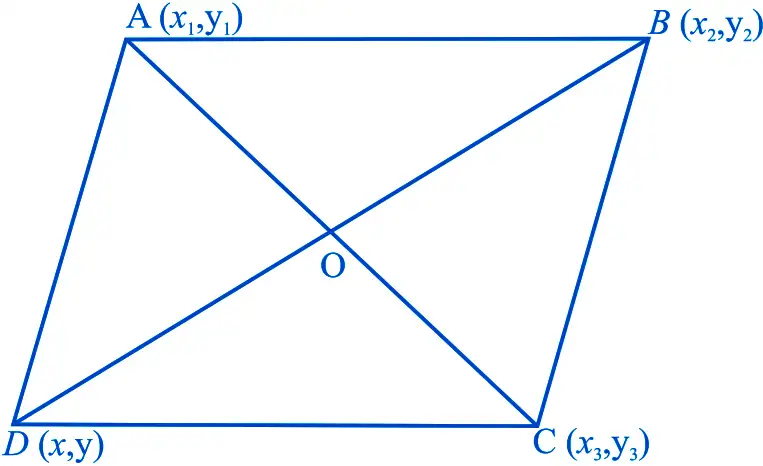
\(ABCD\) is a parallelogram with vertices \(A(x_1, y_1), B(x_2, y_2)\) and \(C(x_3, y_3)\). Find the coordinates of the fourth vertex \(D\) in terms of these coordinates (Fig. 7.2).
Solution
Diagonals of a parallelogram bisect each other:
\[\text{Mid-point of } AC = \text{Mid-point of } BD\]
\[\frac{x_1 + x_3}{2} = \frac{x_2 + x_D}{2} \implies x_D = x_1 + x_3 – x_2\]
\[\frac{y_1 + y_3}{2} = \frac{y_2 + y_D}{2} \implies y_D = y_1 + y_3 – y_2\]
Coordinates of \(D\): \(\mathbf{(x_1 + x_3 – x_2, \, y_1 + y_3 – y_2)}\).
Exercise 7.3 — Q1
1. Name the type of triangle formed by the points \(A(-5, 6), B(-4, -2)\) and \(C(7, 5)\).
Solution
\[AB^2 = (-4 – (-5))^2 + (-2 – 6)^2 = 1 + 64 = 65\]
\[BC^2 = (7 – (-4))^2 + (5 – (-2))^2 = 121 + 49 = 170\]
\[AC^2 = (7 – (-5))^2 + (5 – 6)^2 = 144 + 1 = 145\]
Since all sides are of unequal lengths and do not satisfy Pythagoras theorem, it is a scalene triangle.
Exercise 7.3 — Q2
2. Find the points on the x-axis which are at a distance of \(2\sqrt{5}\) from the point \((7, -4)\). How many such points are there?
Solution
Let point on x-axis be \(P(x, 0)\):
\[(x – 7)^2 + (0 – (-4))^2 = (2\sqrt{5})^2 \implies (x – 7)^2 + 16 = 20\]
\[(x – 7)^2 = 4 \implies x – 7 = \pm 2 \implies x = 9 \quad \text{or} \quad x = 5\]
Answer: Two points: \(\mathbf{(5, 0)}\) and \(\mathbf{(9, 0)}\).
Exercise 7.3 — Q3
3. What type of a quadrilateral do the points \(A(2, -2), B(7, 3), C(11, -1)\) and \(D(6, -6)\) taken in that order form?
Solution
\[AB^2 = (7 – 2)^2 + (3 – (-2))^2 = 25 + 25 = 50\]
\[BC^2 = (11 – 7)^2 + (-1 – 3)^2 = 16 + 16 = 32\]
\[CD^2 = (6 – 11)^2 + (-6 – (-1))^2 = 25 + 25 = 50\]
\[DA^2 = (2 – 6)^2 + (-2 – (-6))^2 = 16 + 16 = 32\]
\[AC^2 = (11 – 2)^2 + (-1 – (-2))^2 = 81 + 1 = 82\]
\[BD^2 = (6 – 7)^2 + (-6 – 3)^2 = 1 + 81 = 82\]
Opposite sides are equal and diagonals are equal (\(AC = BD = \sqrt{82}\)), so \(ABCD\) is a rectangle.
Exercise 7.3 — Q4
4. Find the value of \(a\), if the distance between the points \(A(-3, -14)\) and \(B(a, -5)\) is \(9\) units.
Solution
\[(a – (-3))^2 + (-5 – (-14))^2 = 9^2 \implies (a + 3)^2 + 81 = 81 \implies (a + 3)^2 = 0 \implies a = -3\]
Exercise 7.3 — Q5
5. Find a point which is equidistant from the points \(A(-5, 4)\) and \(B(-1, 6)\). How many such points are there?
Solution
The mid-point of \(AB\) is:
\[M = \left(\frac{-5 – 1}{2}, \frac{4 + 6}{2}\right) = (-3, 5)\]
Any point on the perpendicular bisector \(2x + y + 1 = 0\) is equidistant from \(A\) and \(B\). Hence, there are infinitely many such points.
Exercise 7.3 — Q6
6. Find the coordinates of point \(Q\) on the x-axis which lies on the perpendicular bisector of \(A(-5, -2)\) and \(B(4, -2)\). Name the triangle formed by \(Q, A, B\).
Solution
Let \(Q(x, 0)\). Since \(QA = QB \implies QA^2 = QB^2\):
\[(x + 5)^2 + (0 + 2)^2 = (x – 4)^2 + (0 + 2)^2 \implies (x + 5)^2 = (x – 4)^2\]
\[x^2 + 10x + 25 = x^2 – 8x + 16 \implies 18x = -9 \implies x = -\frac{1}{2}\]
Coordinates of \(Q\): \(\mathbf{\left(-\frac{1}{2}, 0\right)}\). Since \(QA = QB\), \(\Delta QAB\) is an isosceles triangle.
Exercise 7.3 — Q7
7. Find the value of \(m\) if the points \(A(5, 1), B(-2, -3)\) and \(C(8, 2m)\) are collinear.
Solution
Using equality of slopes:
\[\text{Slope of } AB = \frac{-3 – 1}{-2 – 5} = \frac{-4}{-7} = \frac{4}{7}\]
\[\text{Slope of } AC = \frac{2m – 1}{8 – 5} = \frac{2m – 1}{3}\]
\[\frac{2m – 1}{3} = \frac{4}{7} \implies 7(2m – 1) = 12 \implies 14m – 7 = 12 \implies 14m = 19 \implies m = \frac{19}{14}\]
Exercise 7.3 — Q8
8. If \(A(2, -4)\) is equidistant from \(P(3, 8)\) and \(Q(-10, y)\), find the values of \(y\). Also find distance \(PQ\).
Solution
\[AP^2 = (2 – 3)^2 + (-4 – 8)^2 = 1 + 144 = 145\]
\[AQ^2 = (2 – (-10))^2 + (-4 – y)^2 = 144 + (y + 4)^2\]
\[144 + (y + 4)^2 = 145 \implies (y + 4)^2 = 1 \implies y + 4 = \pm 1 \implies y = -3 \quad \text{or} \quad y = -5\]
Distance \(PQ\):
If \(y = -3\): \(PQ = \sqrt{(-10 – 3)^2 + (-3 – 8)^2} = \sqrt{169 + 121} = \mathbf{\sqrt{290}}\)
If \(y = -5\): \(PQ = \sqrt{(-10 – 3)^2 + (-5 – 8)^2} = \sqrt{169 + 169} = \mathbf{13\sqrt{2}}\)
Exercise 7.3 — Q10
9. In what ratio does the x-axis divide the line segment joining the points \((-4, -6)\) and \((-1, 7)\)? Find the coordinates of the point of division.
Solution
Let the ratio be \(k : 1\) and point on the x-axis be \(P(x, 0)\):
\[y = \frac{k(7) + 1(-6)}{k + 1} = 0 \implies 7k – 6 = 0 \implies k = \frac{6}{7}\]
The ratio is \(\mathbf{6 : 7}\). Finding x-coordinate:
\[x = \frac{\frac{6}{7}(-1) + 1(-4)}{\frac{6}{7} + 1} = \frac{-6 – 28}{13} = -\frac{34}{13}\]
Point of division: \(\mathbf{\left(-\frac{34}{13}, 0\right)}\).
Exercise 7.3 — Q11
10. Find the ratio in which the point \(P\left(\frac{3}{4}, \frac{5}{12}\right)\) divides the line segment joining \(A\left(\frac{1}{2}, \frac{3}{2}\right)\) and \(B(2, -5)\).
Solution
Let the ratio be \(k : 1\):
\[\frac{3}{4} = \frac{k(2) + 1\left(\frac{1}{2}\right)}{k + 1} \implies 3(k + 1) = 4\left(2k + \frac{1}{2}\right) \implies 3k + 3 = 8k + 2\]
\[5k = 1 \implies k = \frac{1}{5}\]
Ratio: \(\mathbf{1 : 5}\).
Exercise 7.3 — Q12
11. If \(P(9a – 2, -b)\) divides the line segment joining \(A(3a + 1, -3)\) and \(B(8a, 5)\) in ratio \(3 : 1\), find the values of \(a\) and \(b\).
Solution
\[9a – 2 = \frac{3(8a) + 1(3a + 1)}{3 + 1} \implies 4(9a – 2) = 27a + 1 \implies 36a – 8 = 27a + 1 \implies 9a = 9 \implies a = 1\]
\[-b = \frac{3(5) + 1(-3)}{3 + 1} = \frac{15 – 3}{4} = 3 \implies b = -3\]
Answer: \(a = 1, \, b = -3\).
Exercise 7.3 — Q13
12. If \((a, b)\) is the mid-point of the segment joining \(A(10, -6)\) and \(B(k, 4)\) and \(a – 2b = 18\), find the value of \(k\) and distance \(AB\).
Solution
\[a = \frac{10 + k}{2}, \quad b = \frac{-6 + 4}{2} = -1\]
\[a – 2(-1) = 18 \implies a + 2 = 18 \implies a = 16\]
\[\frac{10 + k}{2} = 16 \implies 10 + k = 32 \implies k = 22\]
\[AB = \sqrt{(22 – 10)^2 + (4 – (-6))^2} = \sqrt{144 + 100} = \sqrt{244} = \mathbf{2\sqrt{61}\text{ units}}\]
Exercise 7.3 — Q14
13. The centre of a circle is \((2a, a – 7)\). Find the values of \(a\) if the circle passes through \((11, -9)\) and has diameter \(10\sqrt{2}\) units.
Solution
Radius \(r = \frac{10\sqrt{2}}{2} = 5\sqrt{2} \implies r^2 = 50\):
\[(2a – 11)^2 + [(a – 7) – (-9)]^2 = 50\]
\[(2a – 11)^2 + (a + 2)^2 = 50\]
\[4a^2 – 44a + 121 + a^2 + 4a + 4 = 50 \implies 5a^2 – 40a + 75 = 0 \implies a^2 – 8a + 15 = 0\]
\[(a – 3)(a – 5) = 0 \implies a = 3 \quad \text{or} \quad a = 5\]
Exercise 7.3 — Q15
14. The line segment joining \(A(3, 2)\) and \(B(5, 1)\) is divided at \(P\) in ratio \(1 : 2\) and lies on \(3x – 18y + k = 0\). Find the value of \(k\).
Solution
\[x = \frac{1(5) + 2(3)}{3} = \frac{11}{3}, \quad y = \frac{1(1) + 2(2)}{3} = \frac{5}{3}\]
\[3\left(\frac{11}{3}\right) – 18\left(\frac{5}{3}\right) + k = 0 \implies 11 – 30 + k = 0 \implies k = 19\]
Exercise 7.3 — Q17
15. The points \(A(2, 9), B(a, 5)\) and \(C(5, 5)\) are the vertices of a triangle right-angled at \(B\). Find the values of \(a\).
Solution
By Pythagoras theorem, \(AB^2 + BC^2 = AC^2\):
\[[(a – 2)^2 + (5 – 9)^2] + [(5 – a)^2 + (5 – 5)^2] = (5 – 2)^2 + (5 – 9)^2\]
\[(a – 2)^2 + 16 + (5 – a)^2 = 9 + 16 = 25\]
\[(a^2 – 4a + 4) + (a^2 – 10a + 25) = 9 \implies 2a^2 – 14a + 20 = 0 \implies a^2 – 7a + 10 = 0\]
\[(a – 2)(a – 5) = 0 \implies a = 2 \quad \text{or} \quad a = 5\]
If \(a = 5\), point \(B(5, 5)\) coincides with \(C(5, 5)\), which cannot form a triangle. Hence, \(\mathbf{a = 2}\).
Exercise 7.3 — Q18
16. Find the coordinates of point \(R\) on the segment joining \(P(-1, 3)\) and \(Q(2, 5)\) such that \(PR = \frac{3}{5}PQ\).
Solution
\(PR : RQ = 3 : 2\):
\[x = \frac{3(2) + 2(-1)}{3 + 2} = \frac{6 – 2}{5} = \frac{4}{5}\]
\[y = \frac{3(5) + 2(3)}{3 + 2} = \frac{15 + 6}{5} = \frac{21}{5}\]
Coordinates: \(\mathbf{\left(\frac{4}{5}, \frac{21}{5}\right)}\).
Exercise 7.3 — Q19
17. Find the values of \(k\) if the points \(A(k + 1, 2k), B(3k, 2k + 3)\) and \(C(5k – 1, 5k)\) are collinear.
Solution
Equating slopes of line segments \(AB\) and \(BC\):
\[\text{Slope of } AB = \frac{(2k + 3) – 2k}{3k – (k + 1)} = \frac{3}{2k – 1}\]
\[\text{Slope of } BC = \frac{5k – (2k + 3)}{(5k – 1) – 3k} = \frac{3k – 3}{2k – 1}\]
\[\frac{3}{2k – 1} = \frac{3k – 3}{2k – 1}\]
Since \(2k – 1 \neq 0\) (so \(k \neq \frac{1}{2}\)):
\[3k – 3 = 3 \implies 3k = 6 \implies k = 2\]
Also, if \(2k – 1 = 0 \implies k = \frac{1}{2}\), all points become \(A\left(\frac{3}{2}, 1\right), B\left(\frac{3}{2}, 4\right), C\left(\frac{3}{2}, \frac{5}{2}\right)\), which all lie on the vertical line \(x = \frac{3}{2}\) and are therefore collinear.
Answer: \(\mathbf{k = 2}\) or \(\mathbf{k = \frac{1}{2}}\).
Exercise 7.3 — Q20
18. Find the ratio in which \(2x + 3y – 5 = 0\) divides the segment joining \((8, -9)\) and \((2, 1)\). Also find the point of division.
Solution
Let the ratio be \(k : 1\):
\[x = \frac{2k + 8}{k + 1}, \quad y = \frac{k – 9}{k + 1}\]
\[2\left(\frac{2k + 8}{k + 1}\right) + 3\left(\frac{k – 9}{k + 1}\right) – 5 = 0 \implies 4k + 16 + 3k – 27 – 5k – 5 = 0\]
\[2k – 16 = 0 \implies k = 8\]
The ratio is \(\mathbf{8 : 1}\). Point of division:
\[x = \frac{2(8) + 8}{9} = \frac{24}{9} = \frac{8}{3}, \quad y = \frac{8 – 9}{9} = -\frac{1}{9}\]
Coordinates: \(\mathbf{\left(\frac{8}{3}, -\frac{1}{9}\right)}\).
Exercise 7.4: Long Answer Questions & Applications
Section E — Sample 1
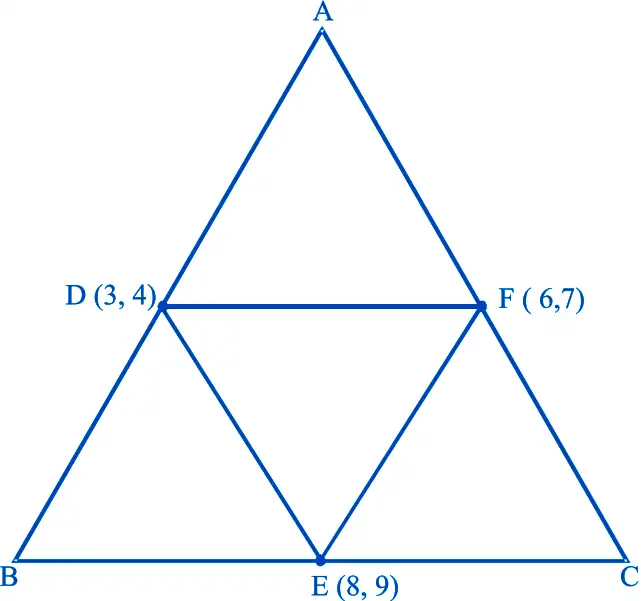
The mid-points \(D, E, F\) of the sides of \(\Delta ABC\) are \((3, 4), (8, 9)\) and \((6, 7)\). Find the vertices of the triangle (Fig. 7.3).
Solution
Using the property that opposite vertices and midpoints form parallelograms:
\[A = D + F – E = (3 + 6 – 8, 4 + 7 – 9) = \mathbf{(1, 2)}\]
\[B = D + E – F = (3 + 8 – 6, 4 + 9 – 7) = \mathbf{(5, 6)}\]
\[C = E + F – D = (8 + 6 – 3, 9 + 7 – 4) = \mathbf{(11, 12)}\]
Exercise 7.4 — Q1
1. If \((-4, 3)\) and \((4, 3)\) are two vertices of an equilateral triangle, find the third vertex, given that origin lies in the interior of the triangle.
Solution
Let \(A(-4, 3), B(4, 3)\). Side length \(AB = 8\). The midpoint of \(AB\) is \(M(0, 3)\). The third vertex \(C\) lies on the line \(x = 0\) (y-axis):
\[AC^2 = 8^2 \implies (0 – (-4))^2 + (y – 3)^2 = 64 \implies 16 + (y – 3)^2 = 64\]
\[(y – 3)^2 = 48 \implies y – 3 = \pm 4\sqrt{3} \implies y = 3 \pm 4\sqrt{3}\]
Since the origin \((0, 0)\) lies in the interior of the triangle, \(y\) must be below the origin. Thus, \(y = 3 – 4\sqrt{3}\).
Third vertex: \(\mathbf{(0, 3 – 4\sqrt{3})}\).
Exercise 7.4 — Q3
2. The points \(A(x_1, y_1), B(x_2, y_2)\) and \(C(x_3, y_3)\) are the vertices of \(\Delta ABC\).
(i) The median from \(A\) meets \(BC\) at \(D\). Find the coordinates of \(D\).
(ii) Find the coordinates of point \(P\) on \(AD\) such that \(AP : PD = 2 : 1\).
(iii) Find the coordinates of points \(Q\) and \(R\) on medians \(BE\) and \(CF\) such that \(BQ : QE = 2 : 1\) and \(CR : RF = 2 : 1\).
(iv) What are the coordinates of the centroid of the triangle?
Solution
(i) \(D\) is the midpoint of \(BC\): \(\mathbf{\left(\frac{x_2 + x_3}{2}, \frac{y_2 + y_3}{2}\right)}\)
(ii) Using section formula on \(AD\) in ratio \(2 : 1\):
\[x = \frac{2\left(\frac{x_2 + x_3}{2}\right) + 1(x_1)}{2 + 1} = \frac{x_1 + x_2 + x_3}{3}, \quad y = \frac{y_1 + y_2 + y_3}{3}\]
\[P = \mathbf{\left(\frac{x_1 + x_2 + x_3}{3}, \frac{y_1 + y_2 + y_3}{3}\right)}\]
(iii) Medians are concurrent: \(Q\) and \(R\) both have coordinates \(\mathbf{\left(\frac{x_1 + x_2 + x_3}{3}, \frac{y_1 + y_2 + y_3}{3}\right)}\).
(iv) Centroid: \(\mathbf{\left(\frac{x_1 + x_2 + x_3}{3}, \frac{y_1 + y_2 + y_3}{3}\right)}\).
Exercise 7.4 — Q4
3. If the points \(A(1, -2), B(2, 3), C(a, 2)\) and \(D(-4, -3)\) form a parallelogram, find the value of \(a\).
Solution
Diagonals of a parallelogram bisect each other \(\implies \text{Mid-point of } AC = \text{Mid-point of } BD\):
\[\frac{1 + a}{2} = \frac{2 + (-4)}{2} \implies 1 + a = -2 \implies \mathbf{a = -3}\]
Exercise 7.4 — Q5
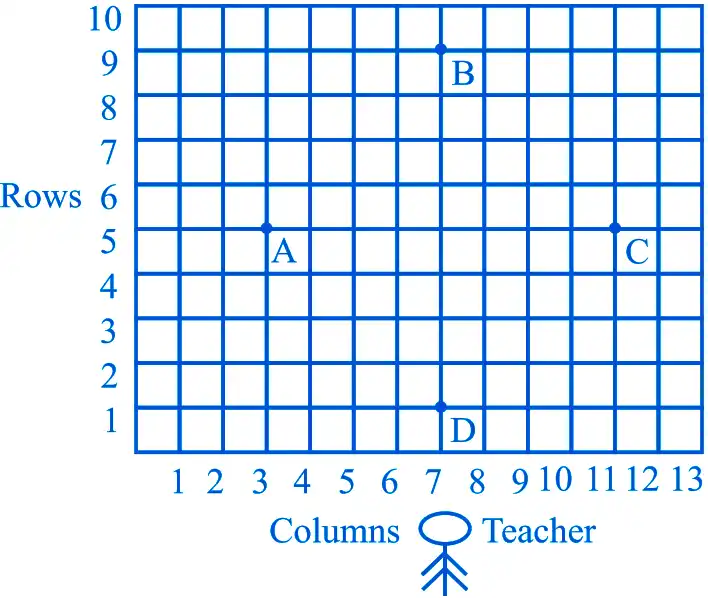
4. Positions of four students \(A, B, C, D\) are shown in Fig. 7.4. Is it possible to place Jaspal in the drill in such a way that he is equidistant from each of the four students? If so, what should be his position?
Solution
Coordinates from the grid: \(A(3, 5), B(7, 9), C(11, 5), D(7, 1)\).
Side lengths using the distance formula:
\[AB = \sqrt{(7 – 3)^2 + (9 – 5)^2} = \sqrt{16 + 16} = 4\sqrt{2}\]
\[BC = \sqrt{(11 – 7)^2 + (5 – 9)^2} = 4\sqrt{2}\]
\[CD = \sqrt{(7 – 11)^2 + (1 – 5)^2} = 4\sqrt{2}, \quad DA = \sqrt{(3 – 7)^2 + (5 – 1)^2} = 4\sqrt{2}\]
Diagonals:
\[AC = 11 – 3 = 8, \quad BD = 9 – 1 = 8\]
All sides are equal and diagonals are equal, so \(ABCD\) forms a square. The point equidistant from all four vertices is the centre (intersection of diagonals):
\[M = \left(\frac{3 + 11}{2}, \frac{5 + 5}{2}\right) = (7, 5)\]
Answer: Yes, Jaspal should be placed at position \(\mathbf{(7, 5)}\).
Exercise 7.4 — Q6
5. Ayush walks from house \((2, 4)\) to bank \((5, 8)\), then to school \((13, 14)\), and then to office \((13, 26)\). What is the extra distance travelled compared to going directly from house to office?
Solution
Let House \(= H(2, 4)\), Bank \(= B(5, 8)\), School \(= S(13, 14)\), Office \(= O(13, 26)\):
\[HB = \sqrt{(5 – 2)^2 + (8 – 4)^2} = \sqrt{9 + 16} = 5\text{ km}\]
\[BS = \sqrt{(13 – 5)^2 + (14 – 8)^2} = \sqrt{64 + 36} = 10\text{ km}\]
\[SO = \sqrt{(13 – 13)^2 + (26 – 14)^2} = 12\text{ km}\]
\[\text{Total distance travelled via route} = 5 + 10 + 12 = 27\text{ km}\]
Direct distance from House to Office:
\[HO = \sqrt{(13 – 2)^2 + (26 – 4)^2} = \sqrt{11^2 + 22^2} = \sqrt{121 + 484} = \sqrt{605} = 11\sqrt{5} \approx 24.596\text{ km}\]
\[\text{Extra distance} = 27 – 11\sqrt{5} \approx \mathbf{2.4\text{ km}}\]