
NCERT Exemplar Class 10 Maths Chapter 9 Circles Solutions (CBSE 2026-27)
Chapter 9 (Circles) is fully retained in the curriculum: tangent to a circle at a point of contact, the tangent at any point of a circle is perpendicular to the radius through the point of contact, and the lengths of tangents drawn from an external point to a circle are equal. All questions from Exercises 9.1 to 9.4 are solved below with diagram placeholders.
Exercise 9.1: Multiple Choice Questions (MCQs)
The angle between the tangents and the angle subtended by the radii at the centre are supplementary, as the radii are perpendicular to the tangents at the points of contact (\(90^\circ\) each):
\[\text{Angle between tangents} = 180^\circ – 130^\circ = 50^\circ\]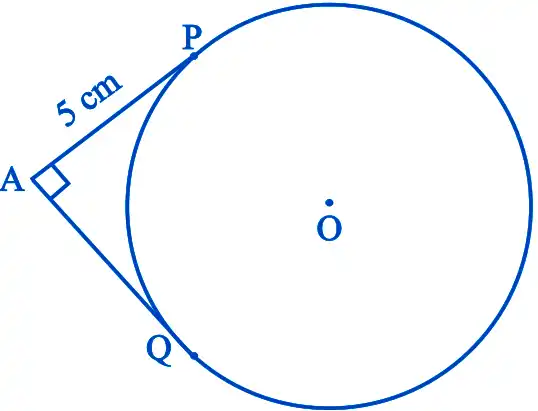
In quadrilateral \(OPAQ\), \(\angle OPA = 90^\circ\) and \(\angle OQA = 90^\circ\) (radius is perpendicular to tangent). Given \(\angle PAQ = 90^\circ\), the fourth angle \(\angle POQ = 360^\circ – (90^\circ \times 3) = 90^\circ\).
Adjacent sides \(OP = OQ = r\) and \(AP = AQ = 5\text{ cm}\). Thus, \(OPAQ\) is a square, which gives \(r = 5\text{ cm}\).
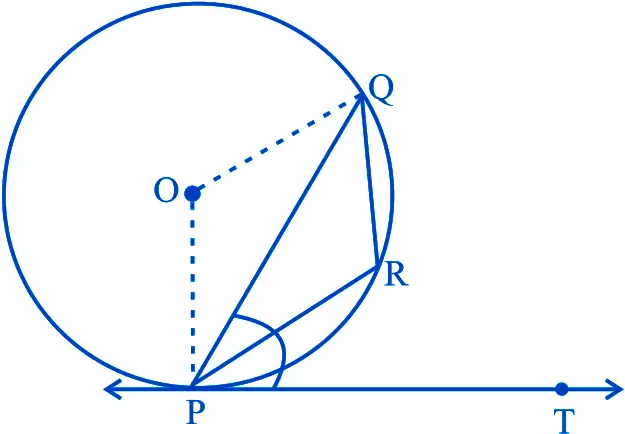
\(OP \perp PT \implies \angle OPT = 90^\circ\). Therefore:
\[\angle OPQ = 90^\circ – \angle QPT = 90^\circ – 60^\circ = 30^\circ\]Since \(OP = OQ\) (radii), \(\angle OQP = \angle OPQ = 30^\circ\). In \(\Delta OPQ\):
\[\angle POQ = 180^\circ – (30^\circ + 30^\circ) = 120^\circ\]Reflex \(\angle POQ = 360^\circ – 120^\circ = 240^\circ\). The angle subtended at the remaining part of the circle is:
\[\angle PRQ = \frac{1}{2} \text{reflex } \angle POQ = \frac{1}{2} \times 240^\circ = 120^\circ\]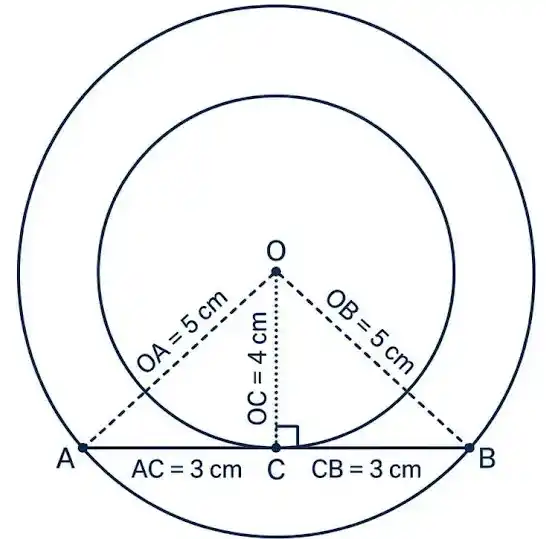
Let \(AB\) be the chord of the larger circle touching the smaller circle at \(C\). The radius to point of contact \(OC \perp AB\), and \(OC\) bisects \(AB\):
\[AC = \sqrt{OA^2 – OC^2} = \sqrt{5^2 – 4^2} = \sqrt{25 – 16} = 3\text{ cm}\] \[AB = 2 \times AC = 2 \times 3 = 6\text{ cm}\]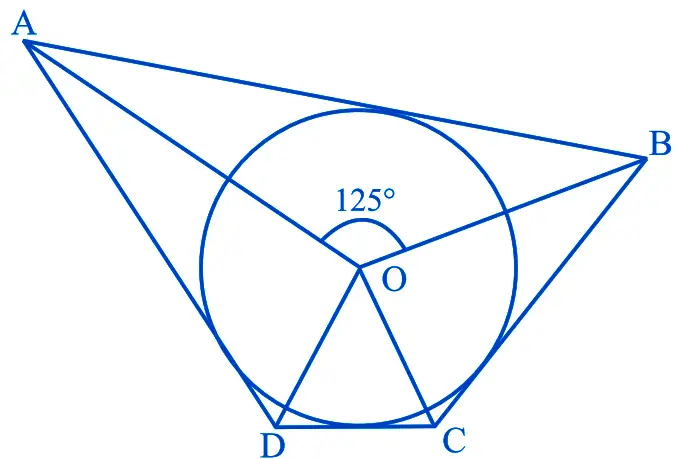
The opposite sides of a quadrilateral circumscribing a circle subtend supplementary angles at the centre of the circle:
\[\angle AOB + \angle COD = 180^\circ \implies 125^\circ + \angle COD = 180^\circ \implies \angle COD = 180^\circ – 125^\circ = 55^\circ\]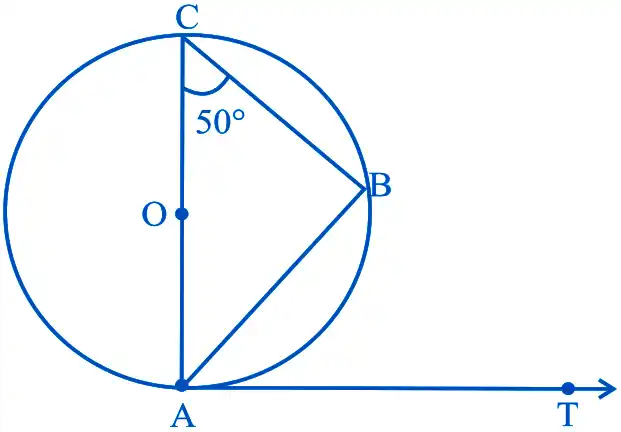
Since \(AC\) is a diameter, \(\angle ABC = 90^\circ\) (angle in a semicircle). In \(\Delta ABC\):
\[\angle CAB = 180^\circ – (90^\circ + 50^\circ) = 40^\circ\]Diameter \(AC \perp AT \implies \angle CAT = 90^\circ\):
\[\angle BAT = \angle CAT – \angle CAB = 90^\circ – 40^\circ = 50^\circ\]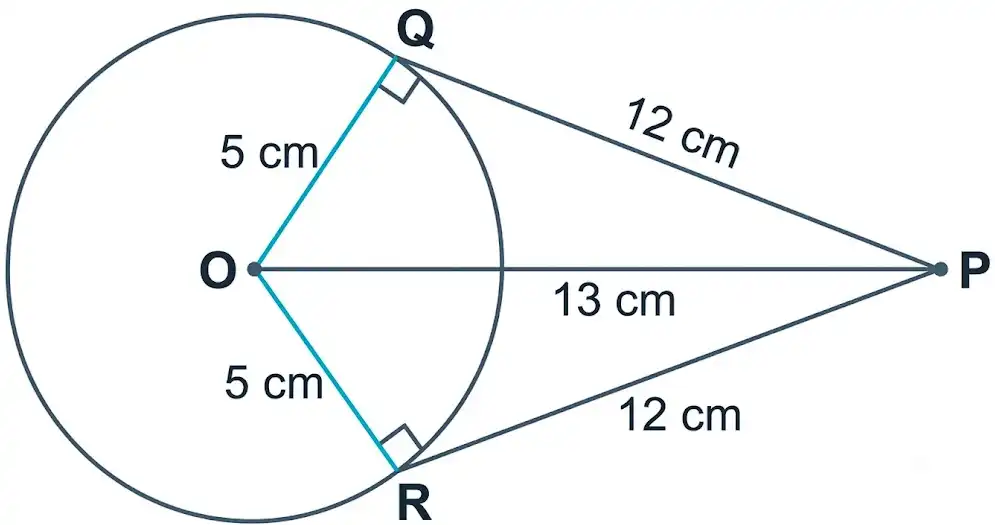
In right \(\Delta PQO\) with \(\angle PQO = 90^\circ\):
\[PQ = \sqrt{OP^2 – OQ^2} = \sqrt{13^2 – 5^2} = \sqrt{169 – 25} = 12\text{ cm}\] \[\text{Area of } \Delta PQO = \frac{1}{2} \times OQ \times PQ = \frac{1}{2} \times 5 \times 12 = 30\text{ cm}^2\] \[\text{Area of quadrilateral } PQOR = 2 \times \text{Area of } \Delta PQO = 2 \times 30 = 60\text{ cm}^2\]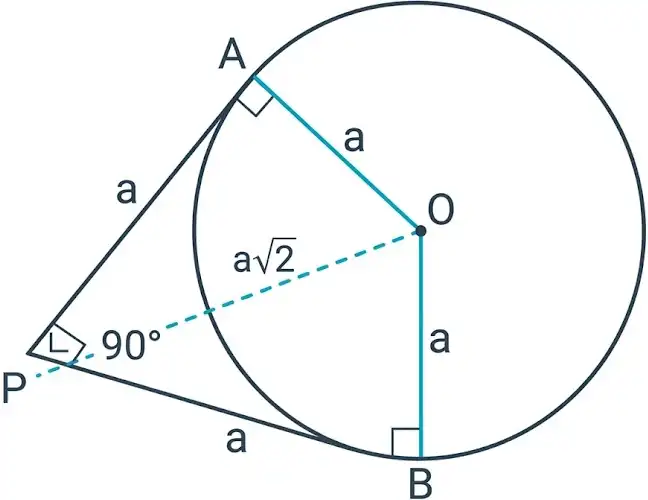
Radius \(OA = 5\text{ cm}\). The chord \(CD\) is at distance \(8\text{ cm}\) from tangent \(XY\) at \(A\). Since \(OA \perp XY\), the distance of \(CD\) from centre \(O\) is:
\[OM = 8 – OA = 8 – 5 = 3\text{ cm}\]In right \(\Delta OMC\) (where \(OC = 5\text{ cm}\) is the radius):
\[CM = \sqrt{OC^2 – OM^2} = \sqrt{5^2 – 3^2} = 4\text{ cm}\] \[CD = 2 \times CM = 2 \times 4 = 8\text{ cm}\]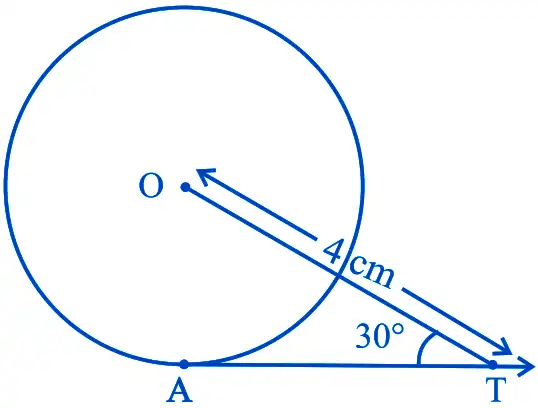
In right \(\Delta OAT\), \(\angle OAT = 90^\circ\):
\[\cos 30^\circ = \frac{AT}{OT} \implies \frac{\sqrt{3}}{2} = \frac{AT}{4} \implies AT = 4 \times \frac{\sqrt{3}}{2} = 2\sqrt{3}\text{ cm}\]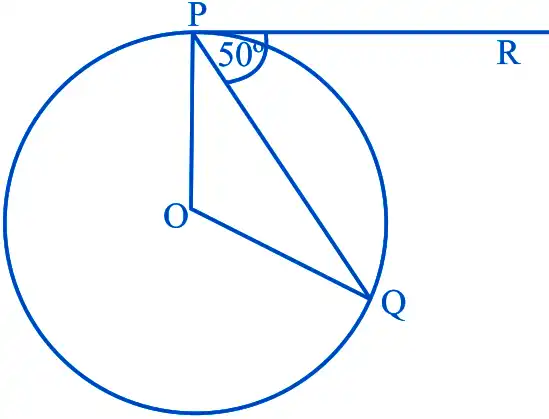
\(OP \perp PR \implies \angle OPR = 90^\circ\):
\[\angle OPQ = 90^\circ – \angle QPR = 90^\circ – 50^\circ = 40^\circ\]Since \(OP = OQ\) (radii), \(\angle OQP = 40^\circ\). In \(\Delta OPQ\):
\[\angle POQ = 180^\circ – (40^\circ + 40^\circ) = 100^\circ\]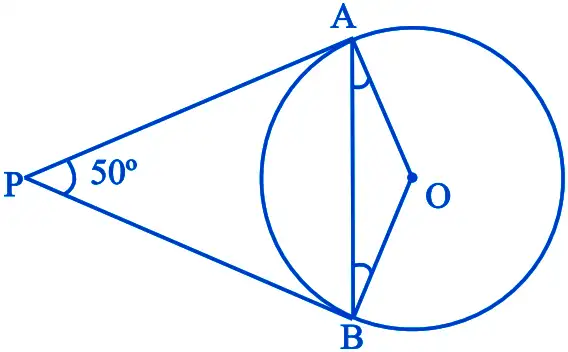
The central angle is supplementary to \(\angle APB\):
\[\angle AOB = 180^\circ – 50^\circ = 130^\circ\]In isosceles \(\Delta OAB\) (\(OA = OB\)):
\[\angle OAB = \frac{180^\circ – 130^\circ}{2} = \frac{50^\circ}{2} = 25^\circ\]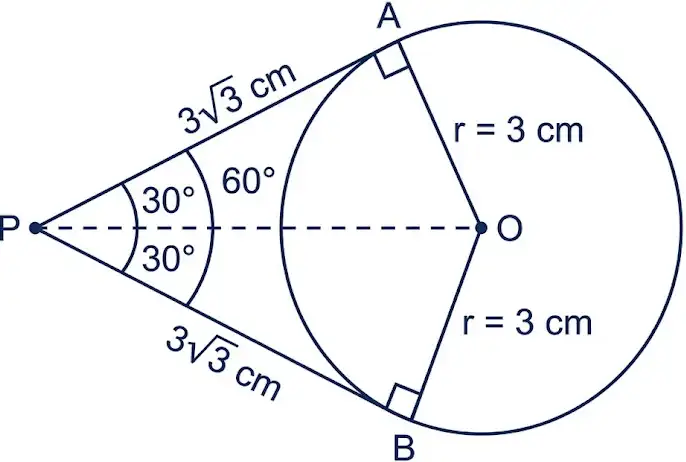
The line joining the external point \(P\) to centre \(O\) bisects the angle between tangents: \(\angle OPA = \frac{60^\circ}{2} = 30^\circ\). In right \(\Delta OAP\):
\[\tan 30^\circ = \frac{OA}{AP} \implies \frac{1}{\sqrt{3}} = \frac{3}{AP} \implies AP = 3\sqrt{3}\text{ cm}\]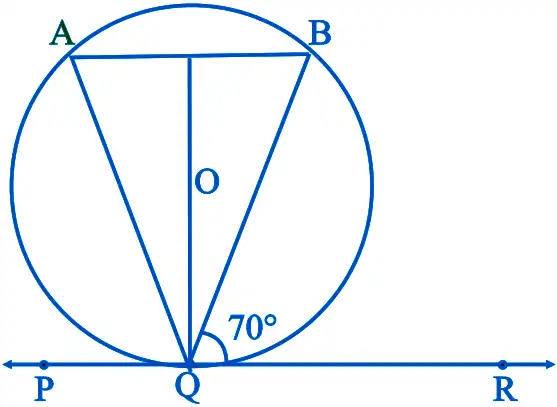
Since \(AB \parallel PR\), \(\angle ABQ = \angle BQR = 70^\circ\) (alternate interior angles).
By the Alternate Segment Theorem, \(\angle BAQ = \angle BQR = 70^\circ\). In \(\Delta ABQ\):
\[\angle AQB = 180^\circ – (70^\circ + 70^\circ) = 180^\circ – 140^\circ = 40^\circ\]Exercise 9.2: True / False with Reasoning
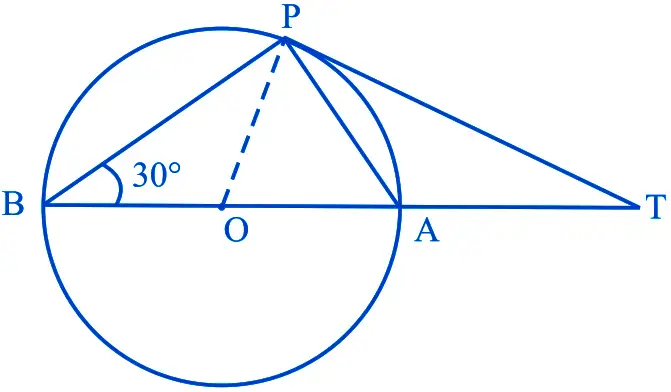
Join \(OP\). Since \(OB = OP\) (radii), \(\angle OPB = \angle PBO = 30^\circ\). The exterior angle of \(\Delta POB\) is \(\angle POA = 30^\circ + 30^\circ = 60^\circ\). Since \(OP \perp PT\) (\(\angle OPT = 90^\circ\)), in right \(\Delta OPT\):
\[\angle PTA = 90^\circ – \angle POA = 90^\circ – 60^\circ = 30^\circ\]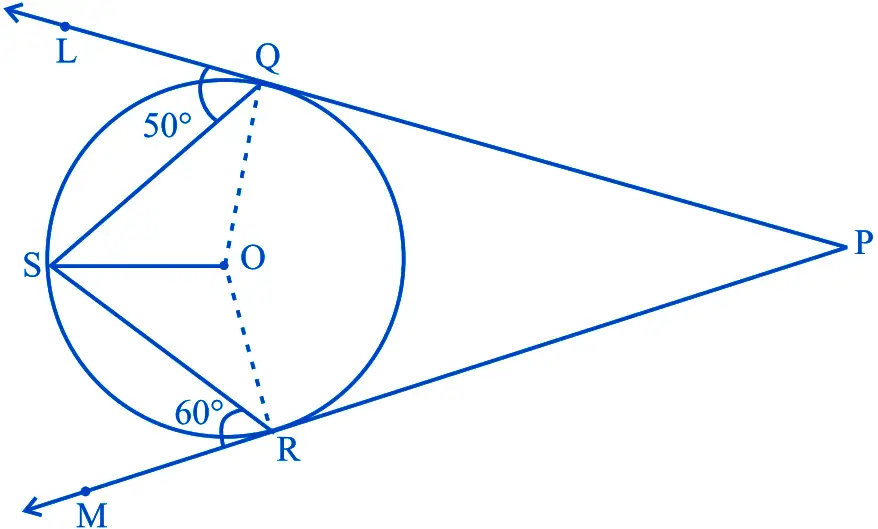
\(OQ \perp PQL \implies \angle OQS = 90^\circ – 50^\circ = 40^\circ\). Since \(OS = OQ\), \(\angle OSQ = 40^\circ\).
\(OR \perp PRM \implies \angle ORS = 90^\circ – 60^\circ = 30^\circ\). Since \(OS = OR\), \(\angle OSR = 30^\circ\).
\[\angle QSR = \angle OSQ + \angle OSR = 40^\circ + 30^\circ = 70^\circ \neq 40^\circ\]The angle between the tangents and the central angle subtended by the chord are supplementary:
\[\text{Angle between tangents} = 180^\circ – 60^\circ = 120^\circ \neq 60^\circ\]If the external point \(P\) is at distance \(OP = \sqrt{2}r\), tangent length \(L = \sqrt{(\sqrt{2}r)^2 – r^2} = r\) (equal to radius). If \(OP < \sqrt{2}r\), the tangent length is strictly less than the radius. Hence, it is not always greater.
In right \(\Delta OPT\), \(OP\) is the hypotenuse. Since the hypotenuse is the longest side in a right-angled triangle, tangent length \(PT < OP\) always.
If the two tangents are parallel, they never intersect, meaning the angle between them can be considered \(0^\circ\).
The line \(OP\) bisects the \(90^\circ\) angle: \(\angle OPT = 45^\circ\). In right \(\Delta OPT\):
\[\sin 45^\circ = \frac{OT}{OP} \implies \frac{1}{\sqrt{2}} = \frac{a}{OP} \implies OP = a\sqrt{2}\]\(OP\) bisects the \(60^\circ\) angle: \(\angle OPT = 30^\circ\). In right \(\Delta OPT\):
\[\sin 30^\circ = \frac{OT}{OP} \implies \frac{1}{2} = \frac{a}{OP} \implies OP = 2a \neq a\sqrt{3}\]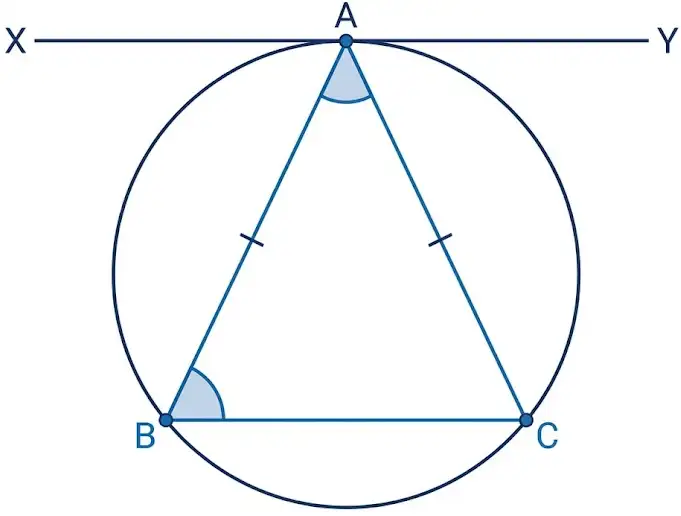
Let \(XAY\) be the tangent at \(A\). By the alternate segment theorem, \(\angle XAB = \angle ACB\). Since \(\Delta ABC\) is isosceles with \(AB = AC\), \(\angle ACB = \angle ABC\). Thus, \(\angle XAB = \angle ABC\). Since alternate interior angles are equal, the tangent is parallel to \(BC\).
The centres of all circles touching \(PQ\) at \(A\) lie on the line perpendicular to \(PQ\) at the specific point of contact \(A\). This perpendicular is not the perpendicular bisector of \(PQ\) unless \(A\) happens to be the midpoint of \(PQ\).
For any circle passing through \(P\) and \(Q\), \(PQ\) is a chord. The perpendicular bisector of a chord passes through the centre of the circle. Hence, the centres of all such circles lie on the perpendicular bisector of \(PQ\).
In \(\Delta ABC\), \(\angle ACB = 90^\circ\) (angle in semicircle) and \(\angle BAC = 30^\circ \implies \angle ABC = 60^\circ\).
Join \(OC\). In \(\Delta OAC\), \(OA = OC \implies \angle OCA = 30^\circ\). Since \(OC \perp CD\), \(\angle BCD = 90^\circ – \angle OCB = 90^\circ – 60^\circ = 30^\circ\).
In \(\Delta BCD\), exterior angle \(\angle ABC = \angle BDC + \angle BCD \implies 60^\circ = \angle BDC + 30^\circ \implies \angle BDC = 30^\circ\).
Since \(\angle BCD = \angle BDC = 30^\circ\), sides opposite to equal angles are equal: \(BC = BD\).
Exercise 9.3: Short Answer & Proof Questions
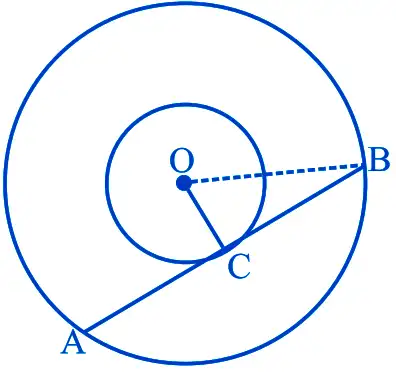
Let chord \(AB = c\) touch the inner circle at \(C\). Then \(OC \perp AB\) and \(C\) bisects \(AB\):
\[OC = \frac{d_1}{2}, \quad OB = \frac{d_2}{2}, \quad CB = \frac{c}{2}\]In right \(\Delta OCB\), by Pythagoras theorem:
\[OC^2 + CB^2 = OB^2 \implies \left(\frac{d_1}{2}\right)^2 + \left(\frac{c}{2}\right)^2 = \left(\frac{d_2}{2}\right)^2\] \[\frac{d_1^2}{4} + \frac{c^2}{4} = \frac{d_2^2}{4} \implies d_2^2 = c^2 + d_1^2\]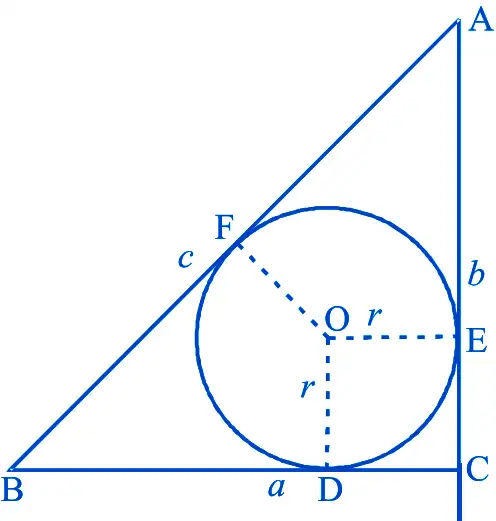
Let the incircle touch sides \(BC = a, CA = b, AB = c\) at \(D, E, F\). The tangents from vertices are equal: \(AF = AE, BF = BD\). In quadrilateral \(ODCE\), all angles are \(90^\circ\) and \(OD = OE = r\), so \(ODCE\) is a square, giving \(CD = CE = r\).
\[AF = b – r, \quad BF = a – r\] \[c = AB = AF + BF = (b – r) + (a – r) = a + b – 2r\] \[2r = a + b – c \implies r = \frac{a + b – c}{2}\]The perpendicular from centre \(O\) to chord \(AC\) bisects it at the point of contact \(M\):
\[AM = \frac{8}{2} = 4\text{ cm}, \quad OA = 5\text{ cm}\] \[r = OM = \sqrt{OA^2 – AM^2} = \sqrt{5^2 – 4^2} = \sqrt{25 – 16} = 3\text{ cm}\]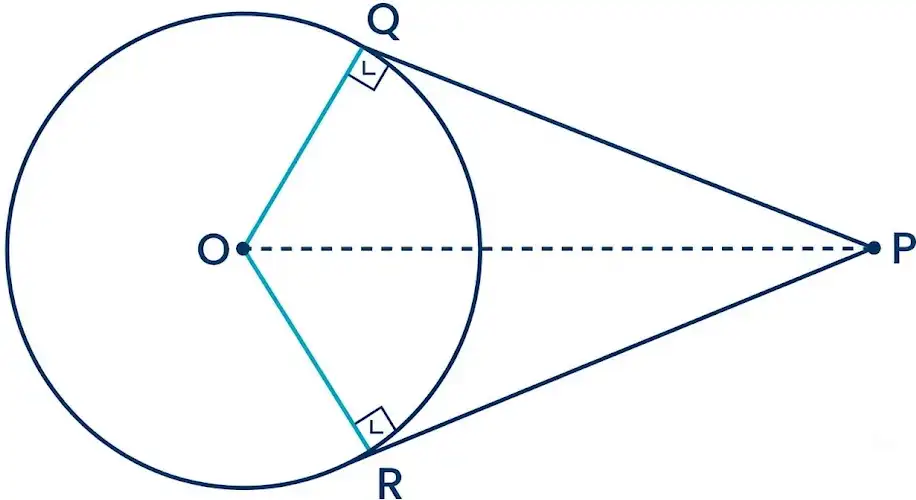
Tangents are perpendicular to the radii at the points of contact:
\[\angle OQP = 90^\circ \quad \text{and} \quad \angle ORP = 90^\circ\] \[\angle OQP + \angle ORP = 90^\circ + 90^\circ = 180^\circ\]Since the sum of a pair of opposite angles of quadrilateral \(QORP\) is \(180^\circ\), \(QORP\) is a cyclic quadrilateral.
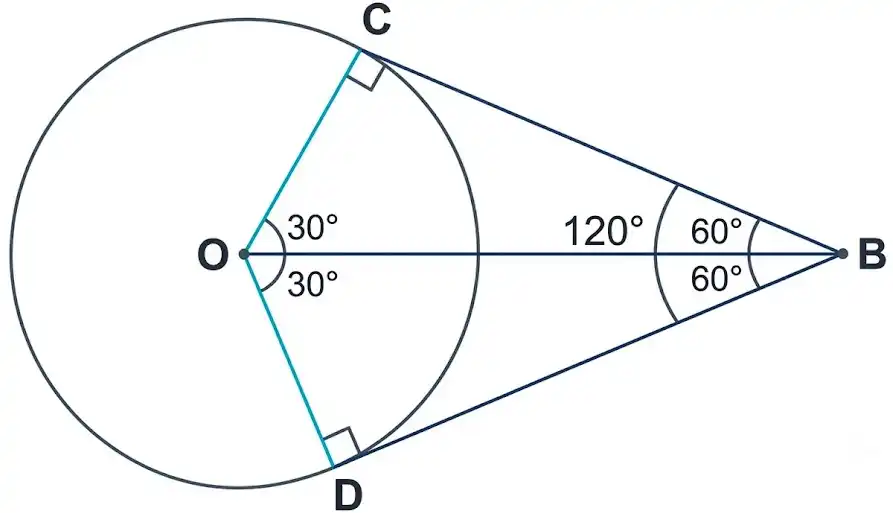
The line \(BO\) bisects \(\angle DBC\): \(\angle OBC = \frac{120^\circ}{2} = 60^\circ\). In right \(\Delta OCB\) (\(\angle OCB = 90^\circ\)):
\[\cos 60^\circ = \frac{BC}{BO} \implies \frac{1}{2} = \frac{BC}{BO} \implies BO = 2BC\]Since tangent lengths from an external point are equal (\(BD = BC\)):
\[BC + BD = BC + BC = 2BC = BO\]Let lines intersect at \(P\), and let circle with centre \(O\) touch them at \(A\) and \(B\). In \(\Delta OAP\) and \(\Delta OBP\):
\[OA = OB \quad (\text{radii})\] \[OP = OP \quad (\text{common})\] \[\angle OAP = \angle OBP = 90^\circ \quad (\text{radius } \perp \text{ tangent})\]By RHS congruence criterion, \(\Delta OAP \cong \Delta OBP\). By CPCT, \(\angle OPA = \angle OPB\). Hence, \(OP\) bisects \(\angle APB\), meaning \(O\) lies on the angle bisector of the lines.
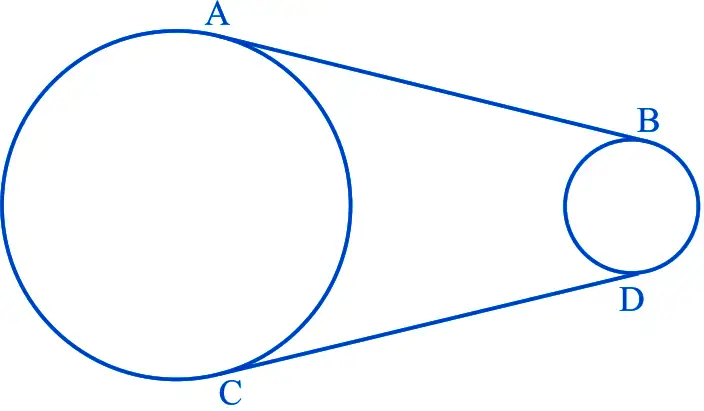
Extend non-parallel tangents \(AB\) and \(CD\) to intersect at an external point \(P\). Tangents from \(P\) to the larger circle are equal:
\[PA = PC \quad \text{— (1)}\]Tangents from \(P\) to the smaller circle are equal:
\[PB = PD \quad \text{— (2)}\]Subtracting (2) from (1):
\[PA – PB = PC – PD \implies AB = CD\]Let centres be \(O_1, O_2\). Radii \(O_1A \perp AB, O_2B \perp AB \implies O_1A \parallel O_2B\) and \(O_1A = O_2B = r\). Thus, \(O_1ABO_2\) is a rectangle, which gives \(AB = O_1O_2\). Similarly, \(O_1CDO_2\) is a rectangle, giving \(CD = O_1O_2\). Hence, \(AB = CD\).
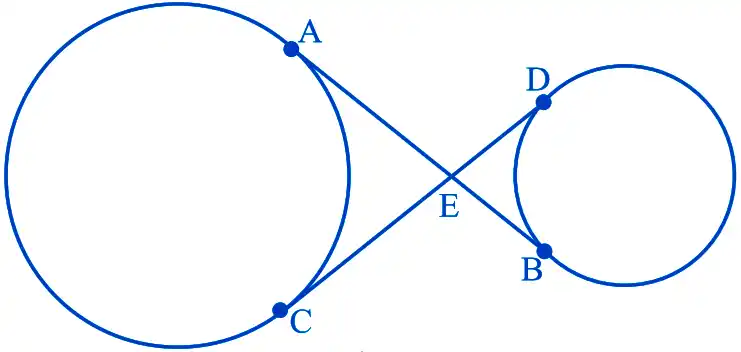
Tangents from external point \(E\) to the first circle are equal:
\[EA = EC \quad \text{— (1)}\]Tangents from external point \(E\) to the second circle are equal:
\[EB = ED \quad \text{— (2)}\]Adding (1) and (2):
\[EA + EB = EC + ED \implies AB = CD\]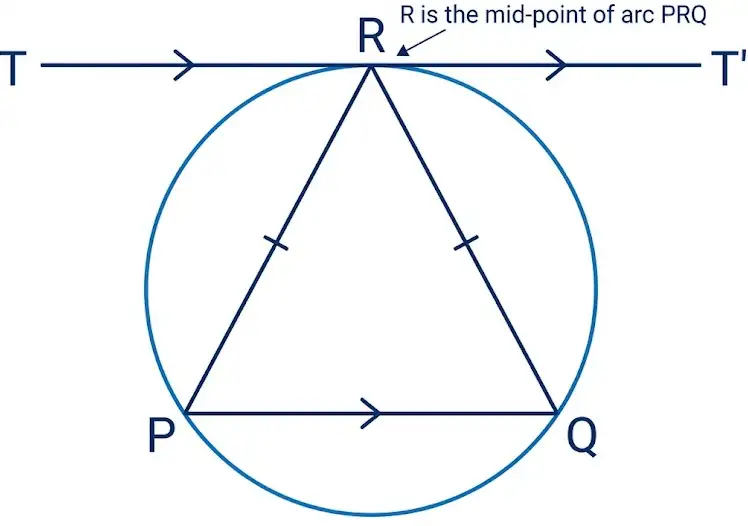
Let line \(TRT’\) be the tangent parallel to chord \(PQ\). Then alternate interior angles are equal:
\[\angle TRP = \angle RPQ\]By the Alternate Segment Theorem, \(\angle TRP = \angle PQR\). Therefore:
\[\angle RPQ = \angle PQR\]In \(\Delta PQR\), sides opposite to equal angles are equal: \(PR = QR\). In a circle, equal chords subtend equal arcs: \(\text{arc } PR = \text{arc } QR\). Hence, \(R\) bisects arc \(PRQ\).
Let tangents at ends of chord \(AB\) meet at external point \(P\). Tangents from \(P\) are equal: \(PA = PB\). In \(\Delta PAB\), sides opposite to equal sides have equal angles:
\[\angle PAB = \angle PBA\]Hence, the tangents make equal angles with the chord.
Let line \(XY\) be the tangent at \(A\). Since \(AB\) is a diameter, \(AB \perp XY\). Any chord \(CD \parallel XY\) is perpendicular to diameter \(AB\) (\(AB \perp CD\)). Since the perpendicular from the centre to a chord bisects the chord, diameter \(AB\) bisects \(CD\).
Exercise 9.4: Long Answer Questions & Detailed Proofs
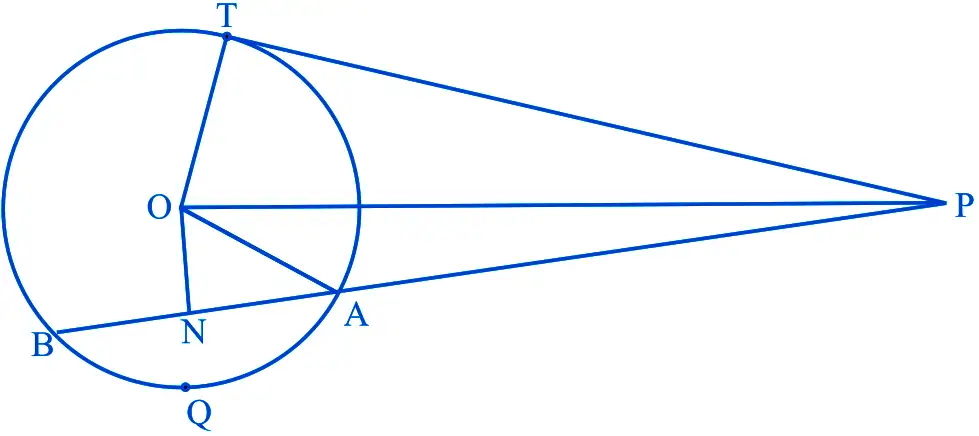
(i) \(ON \perp AB \implies AN = BN\).
\[PA \cdot PB = (PN – AN)(PN + BN) = (PN – AN)(PN + AN) = PN^2 – AN^2\](ii) In right \(\Delta ONP\), \(PN^2 = OP^2 – ON^2\). In right \(\Delta ONA\), \(ON^2 + AN^2 = OA^2 = OT^2\):
\[PN^2 – AN^2 = (OP^2 – ON^2) – AN^2 = OP^2 – (ON^2 + AN^2) = OP^2 – OT^2\](iii) In right \(\Delta OTP\), \(OP^2 – OT^2 = PT^2\):
\[PA \cdot PB = OP^2 – OT^2 = PT^2\]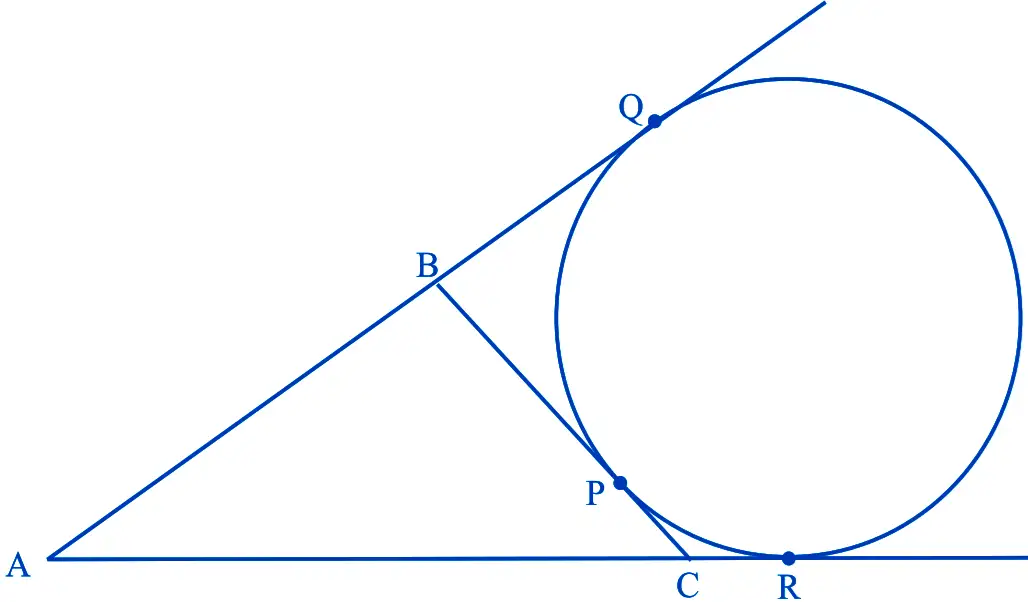
Tangents from the same external point are equal: \(AQ = AR, BQ = BP, CP = CR\):
\[2AQ = AQ + AR = (AB + BQ) + (AC + CR) = AB + BP + AC + CP\] \[2AQ = (BP + CP) + AC + AB = BC + CA + AB\] \[AQ = \frac{1}{2}(BC + CA + AB)\]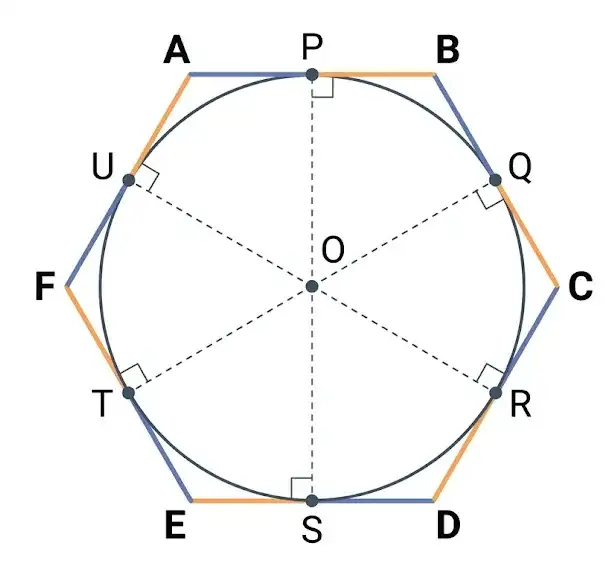
Let the circle touch sides \(AB, BC, CD, DE, EF, FA\) at \(P, Q, R, S, T, U\). Tangents from each vertex are equal:
\[AP = AU, \quad BP = BQ, \quad CR = CQ, \quad DR = DS, \quad ET = ES, \quad FT = FU\] \[AB + CD + EF = (AP + PB) + (CR + RD) + (ET + TF)\] \[= (AU + BQ) + (CQ + DS) + (ES + FU) = (BQ + QC) + (DS + SE) + (FU + UA)\] \[= BC + DE + FA\]Let \(BD = BF = x, CD = CE = y, AF = AE = z\):
\[x + y = a, \quad y + z = b, \quad z + x = c\] \[2(x + y + z) = a + b + c = 2s \implies x + y + z = s\] \[BD = x = (x + y + z) – (y + z) = s – b\]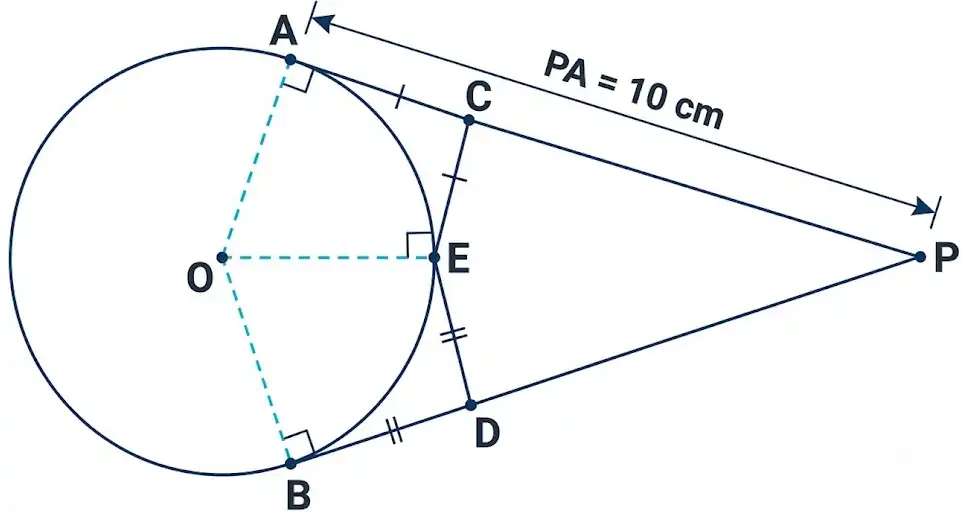
Tangents from an external point are equal: \(CA = CE, DB = DE\) and \(PA = PB = 10\text{ cm}\):
\[\text{Perimeter of } \Delta PCD = PC + CD + PD = PC + (CE + ED) + PD\] \[= (PC + CA) + (PD + DB) = PA + PB = 10 + 10 = 20\text{ cm}\]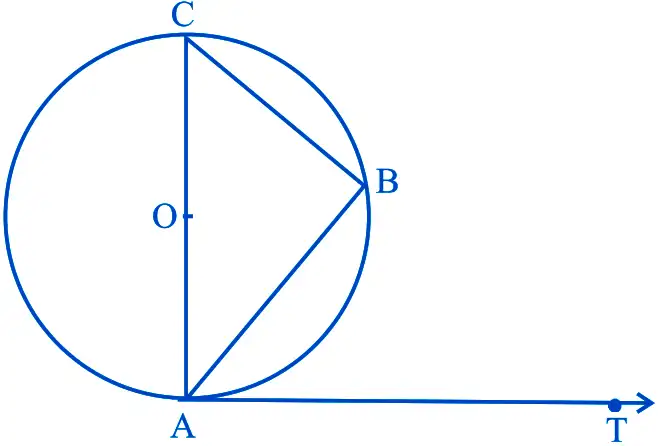
In \(\Delta ABC\), \(\angle ABC = 90^\circ\) (angle in semicircle):
\[\angle BAC + \angle ACB = 90^\circ \implies \angle ACB = 90^\circ – \angle BAC\]Diameter \(AC \perp AT \implies \angle CAT = 90^\circ\):
\[\angle BAT = 90^\circ – \angle BAC\]Hence, \(\angle BAT = \angle ACB\).
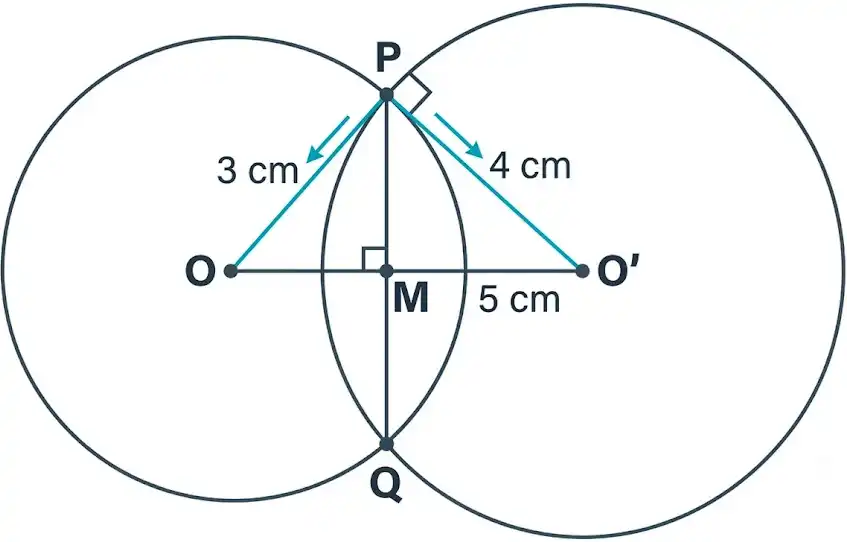
Since \(OP\) and \(O’P\) are tangents, \(\angle OPO’ = 90^\circ\):
\[OO’ = \sqrt{OP^2 + O’P^2} = \sqrt{3^2 + 4^2} = 5\text{ cm}\]The line of centres \(OO’\) is the perpendicular bisector of common chord \(PQ\) intersecting at \(M\):
\[\text{Area of } \Delta OPO’ = \frac{1}{2} \times OP \times O’P = \frac{1}{2} \times OO’ \times PM\] \[3 \times 4 = 5 \times PM \implies PM = \frac{12}{5} = 2.4\text{ cm}\] \[PQ = 2 \times PM = 2 \times 2.4 = 4.8\text{ cm}\]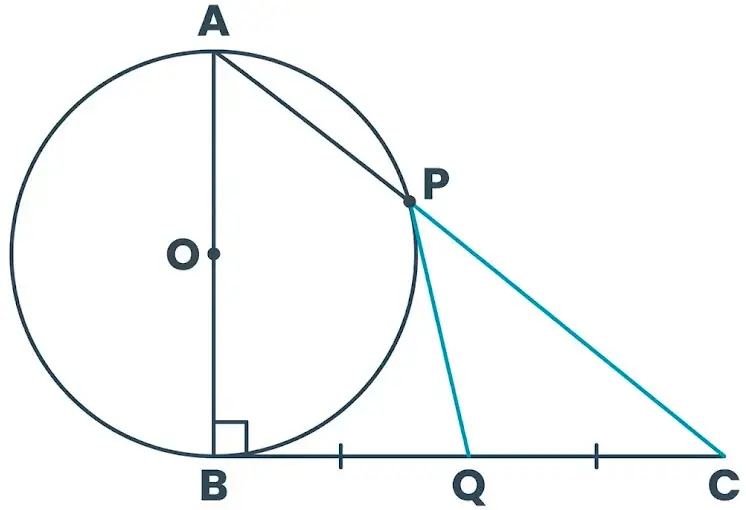
Let the tangent at \(P\) intersect \(BC\) at \(Q\). \(QB\) is also a tangent since \(AB \perp BC\) at \(B\):
\[QP = QB \implies \angle QPB = \angle QBP \quad \text{— (1)}\]\(\angle APB = 90^\circ\) (angle in semicircle) \(\implies \angle BPC = 90^\circ \implies \angle QPC = 90^\circ – \angle QPB\).
In right \(\Delta ABC\), \(\angle C = 90^\circ – \angle QBP\). Using (1), \(\angle QPC = \angle C \implies QP = QC\).
Therefore, \(QB = QC\), proving \(Q\) bisects \(BC\).
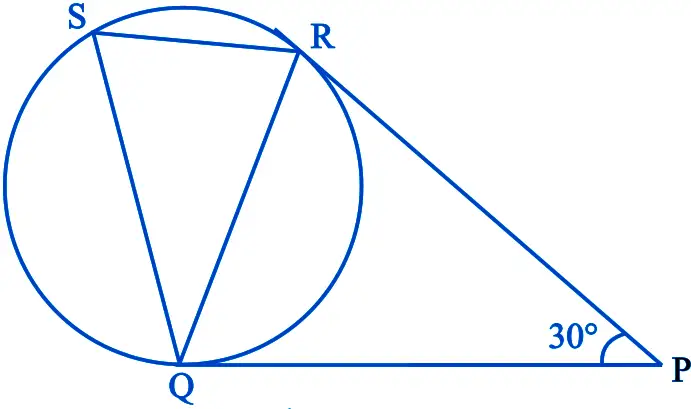
Tangents \(PQ = PR \implies \Delta PQR\) is isosceles:
\[\angle PQR = \angle PRQ = \frac{180^\circ – 30^\circ}{2} = 75^\circ\]Since \(RS \parallel PQ\), alternate interior angles are equal: \(\angle QRS = \angle PQR = 75^\circ\).
By alternate segment theorem, \(\angle QSR = \angle PQR = 75^\circ\). In \(\Delta QRS\):
\[\angle RQS = 180^\circ – (75^\circ + 75^\circ) = 30^\circ\]Join \(OC\). In \(\Delta OAC\), \(OA = OC \implies \angle OCA = 30^\circ\). Exterior angle \(\angle COB = 30^\circ + 30^\circ = 60^\circ\). Since \(OC \perp CD\) (\(\angle OCD = 90^\circ\)):
\[\angle BDC = 90^\circ – 60^\circ = 30^\circ\]In \(\Delta ABC\), \(\angle ACB = 90^\circ \implies \angle B = 60^\circ\). Exterior angle of \(\Delta BCD\) at \(B\) gives \(\angle B = \angle BCD + \angle BDC \implies 60^\circ = \angle BCD + 30^\circ \implies \angle BCD = 30^\circ\).
Since \(\angle BCD = \angle BDC = 30^\circ\), \(BC = BD\).
Let \(C\) be the midpoint of arc \(AB\) (\(\text{arc } AC = \text{arc } BC\)), so chord \(AC = BC\). Draw tangent \(XCY\) at \(C\). By alternate segment theorem, \(\angle ACX = \angle ABC\) and \(\angle BCY = \angle BAC\). Since \(AC = BC\), \(\angle ABC = \angle BAC\), which means \(\angle ACX = \angle BAC\). Since alternate interior angles are equal, \(XY \parallel AB\).
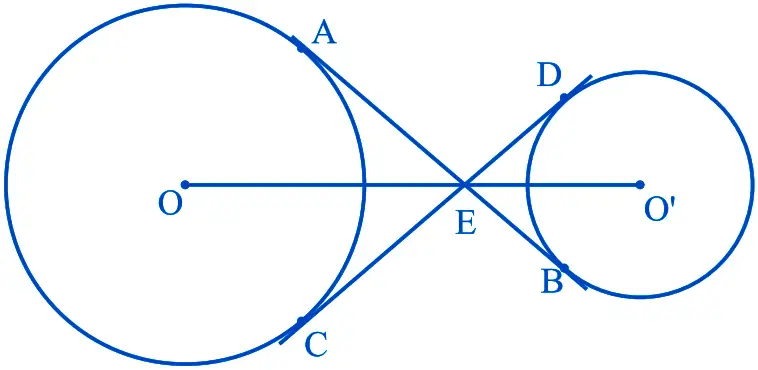
The line joining the external point \(E\) to the centre of a circle bisects the angle between the tangents:
\(EO\) bisects \(\angle AEC\), so \(\angle AEO = \frac{1}{2}\angle AEC\).
\(EO’\) bisects \(\angle DEB\), so \(\angle DEO’ = \frac{1}{2}\angle DEB\).
Since \(\angle AEC\) and \(\angle DEB\) are vertically opposite angles, \(\angle AEC = \angle DEB\). Line \(AB\) is straight, so:
\[\angle AEO + \angle OEB = 180^\circ \implies O, E, O’ \text{ lie on a single straight line, hence collinear.}\]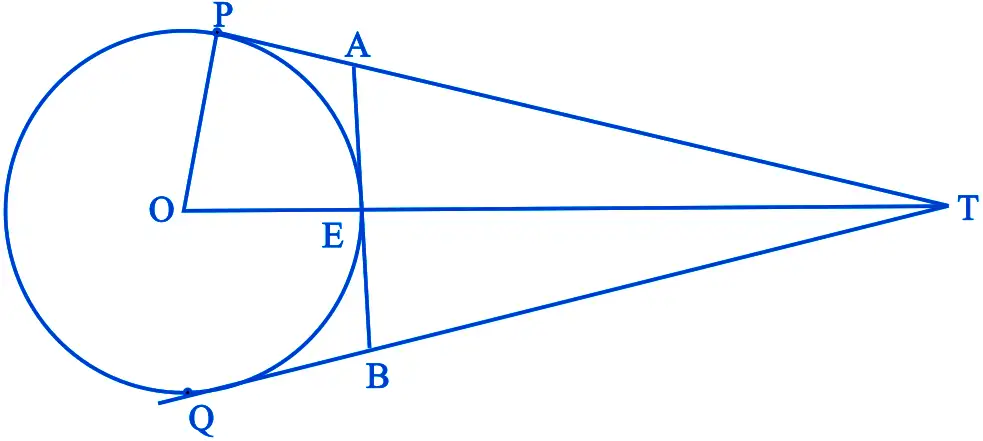
In right \(\Delta OPT\) with \(\angle OPT = 90^\circ\):
\[PT = \sqrt{OT^2 – OP^2} = \sqrt{13^2 – 5^2} = 12\text{ cm}\] \[ET = OT – OE = 13 – 5 = 8\text{ cm}\]Let \(AE = x\). Since tangents from \(A\) are equal, \(AP = AE = x\):
\[AT = PT – AP = 12 – x\]In right \(\Delta AET\) (\(OE \perp AB \implies \angle AET = 90^\circ\)):
\[AT^2 = AE^2 + ET^2 \implies (12 – x)^2 = x^2 + 8^2\] \[144 – 24x + x^2 = x^2 + 64 \implies 24x = 80 \implies x = \frac{80}{24} = \frac{10}{3}\text{ cm}\] \[AB = 2x = 2 \times \frac{10}{3} = \frac{20}{3}\text{ cm} = 6.67\text{ cm}\]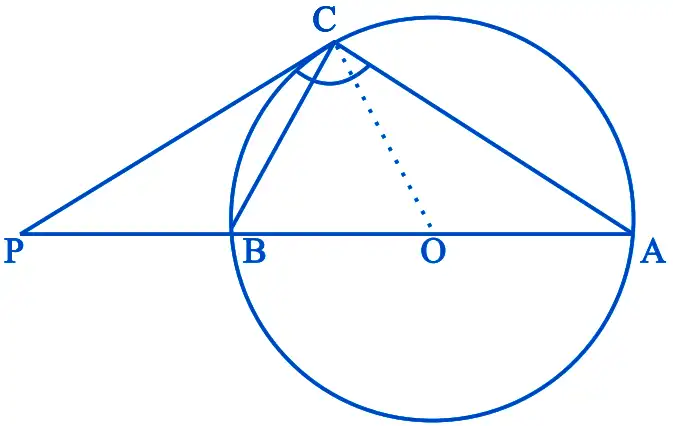
Join \(OC\). Radius \(OC \perp PC \implies \angle PCO = 90^\circ\):
\[\angle OCA = \angle PCA – \angle PCO = 110^\circ – 90^\circ = 20^\circ\]Since \(OA = OC\) (radii), \(\angle OAC = \angle OCA = 20^\circ\). Since \(AB\) is a diameter, \(\angle ACB = 90^\circ\). In \(\Delta ABC\):
\[\angle CBA = 90^\circ – \angle CAB = 90^\circ – 20^\circ = 70^\circ\]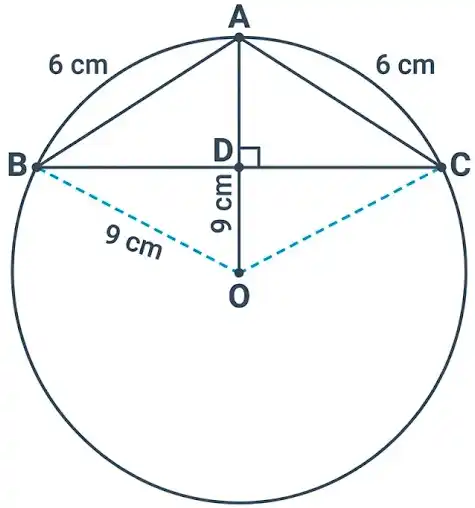
Let altitude \(AD\) pass through centre \(O\). Let \(OD = x\). Then \(AD = AO – OD = 9 – x\) (since \(AD < AO\)).
In right \(\Delta OBD\): \(BD^2 = OB^2 – OD^2 = 9^2 – x^2 = 81 – x^2\).
In right \(\Delta ABD\): \(AB^2 = AD^2 + BD^2\):
\[6^2 = (9 – x)^2 + (81 – x^2) \implies 36 = 81 – 18x + x^2 + 81 – x^2\] \[36 = 162 – 18x \implies 18x = 126 \implies x = 7\text{ cm}\] \[AD = 9 – 7 = 2\text{ cm}\] \[BD = \sqrt{81 – 7^2} = \sqrt{81 – 49} = \sqrt{32} = 4\sqrt{2}\text{ cm}\] \[BC = 2 \times BD = 8\sqrt{2}\text{ cm}\] \[\text{Area of } \Delta ABC = \frac{1}{2} \times BC \times AD = \frac{1}{2} \times 8\sqrt{2} \times 2 = 8\sqrt{2}\text{ cm}^2\]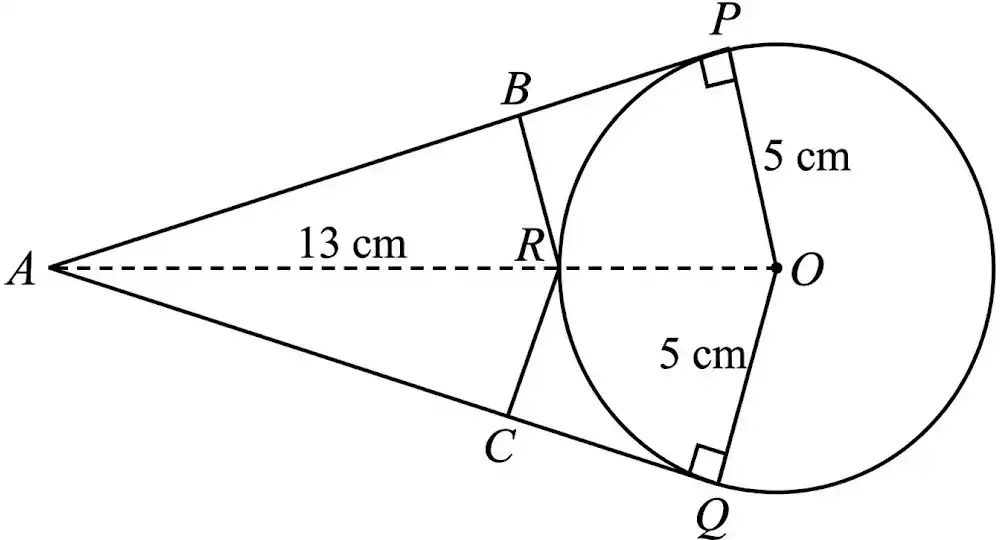
In right \(\Delta APO\) (\(\angle APO = 90^\circ\)):
\[AP = \sqrt{OA^2 – OP^2} = \sqrt{13^2 – 5^2} = 12\text{ cm}\]Tangents from \(B\) and \(C\) are equal: \(BR = BP\) and \(CR = CQ\):
\[\text{Perimeter of } \Delta ABC = AB + BC + AC = AB + (BR + RC) + AC\] \[= (AB + BP) + (AC + CQ) = AP + AQ = 12 + 12 = 24\text{ cm}\]