CBSE 2026-27 Syllabus Scope Note:
This guide features in-syllabus NCERT Exemplar questions strictly based on the current curriculum: surface areas and volumes of combinations of cuboids, cones, cylinders, spheres, and hemispheres. Questions based on the deleted topic Frustum of a Cone have been completely removed.
Exercise 12.1: Multiple Choice Questions (MCQs)
Section B — Sample 2
If a marble of radius \(2.1\text{ cm}\) is put into a cylindrical cup full of water of radius \(5\text{ cm}\) and height \(6\text{ cm}\), then how much water flows out of the cylindrical cup?
(A) \(38.8\text{ cm}^3\)
(B) \(55.4\text{ cm}^3\)
(C) \(19.4\text{ cm}^3\)
(D) \(471.4\text{ cm}^3\)
Solution: Correct Option (A)
The volume of water that flows out is equal to the volume of the submerged spherical marble:
\[V = \frac{4}{3} \pi r^3 = \frac{4}{3} \times \frac{22}{7} \times (2.1)^3 = \frac{4}{3} \times \frac{22}{7} \times 9.261 = 4 \times 22 \times 0.441 = 38.808 \approx 38.8\text{ cm}^3\]
Section B — Sample 3
A cubical ice cream brick of edge \(22\text{ cm}\) is to be distributed among some children by filling ice cream cones of radius \(2\text{ cm}\) and height \(7\text{ cm}\) up to its brim. How many children will get the ice cream cones?
(A) 163
(B) 263
(C) 363
(D) 463
Solution: Correct Option (C)
Volume of the cubical ice cream brick \(= 22^3 = 10648\text{ cm}^3\).
Volume of one ice cream cone \(= \frac{1}{3} \pi r^2 h = \frac{1}{3} \times \frac{22}{7} \times 2^2 \times 7 = \frac{88}{3}\text{ cm}^3\).
\[\text{Number of cones} = \frac{10648}{\frac{88}{3}} = \frac{10648 \times 3}{88} = 121 \times 3 = 363\]
Section B — Sample 5
The volume of the largest right circular cone that can be cut out from a cube of edge \(4.2\text{ cm}\) is:
(A) \(9.7\text{ cm}^3\)
(B) \(77.6\text{ cm}^3\)
(C) \(58.2\text{ cm}^3\)
(D) \(19.4\text{ cm}^3\)
Solution: Correct Option (D)
Diameter of the cone \(= 4.2\text{ cm} \implies r = 2.1\text{ cm}\); Height of the cone \(h = 4.2\text{ cm}\):
\[V = \frac{1}{3} \pi r^2 h = \frac{1}{3} \times \frac{22}{7} \times (2.1)^2 \times 4.2 = \frac{1}{3} \times \frac{22}{7} \times 4.41 \times 4.2 = 22 \times 0.21 \times 4.2 = 19.404 \approx 19.4\text{ cm}^3\]
Exercise 12.1 — Q1
1. A cylindrical pencil sharpened at one edge is the combination of:
(A) a cone and a cylinder
(B) frustum and cylinder
(C) hemisphere and cylinder
(D) two cylinders
Solution: Correct Option (A)
The unsharpened body is cylindrical, and the sharpened pointed tip forms a conical shape.
Exercise 12.1 — Q2
2. A surahi is the combination of:
(A) a sphere and a cylinder
(B) hemisphere and cylinder
(C) two hemispheres
(D) a cylinder and a cone
Solution: Correct Option (A)
A traditional surahi consists of a long cylindrical neck attached to a spherical base.
Exercise 12.1 — Q3
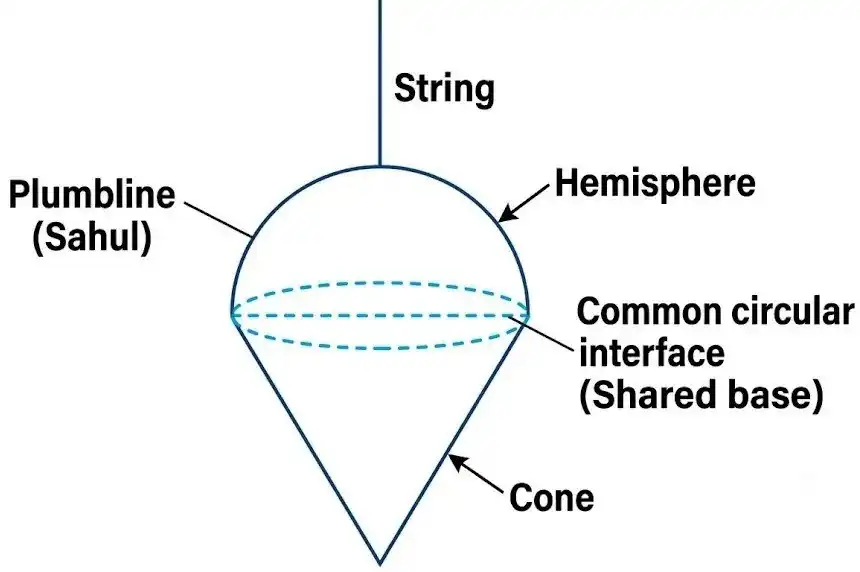
3. A plumbline (sahul) is the combination of (see Fig. 12.2):
(A) a cone and a cylinder
(B) a hemisphere and a cone
(C) frustum and cylinder
(D) sphere and cylinder
Solution: Correct Option (B)
The top portion is a hemisphere and the lower pointed portion is an inverted cone.
Exercise 12.1 — Q5
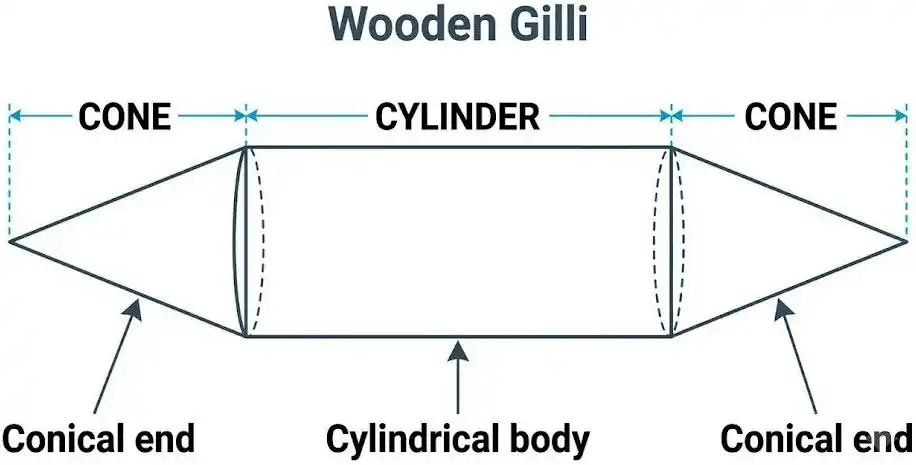
4. The shape of a gilli, in the gilli-danda game (see Fig. 12.4), is a combination of:
(A) two cylinders
(B) a cone and a cylinder
(C) two cones and a cylinder
(D) two cylinders and a cone
Solution: Correct Option (C)
It consists of a central cylinder with conical tapered ends on either side.
Exercise 12.1 — Q8
5. A cube of edge \(5\text{ cm}\) is cut into cubes of edge \(1\text{ cm}\). The ratio of the surface area of the original cube to the total surface area of all small cubes is:
(A) \(1 : 5\)
(B) \(5 : 1\)
(C) \(1 : 25\)
(D) \(1 : 125\)
Solution: Correct Option (A)
Total surface area of original cube \(= 6 \times 5^2 = 150\text{ cm}^2\).
Number of small cubes \(= \frac{5^3}{1^3} = 125\).
Surface area of one small cube \(= 6 \times 1^2 = 6\text{ cm}^2\).
Total surface area of 125 small cubes \(= 125 \times 6 = 750\text{ cm}^2\).
\[\text{Ratio} = \frac{150}{750} = \frac{1}{5} = 1 : 5\]
Exercise 12.1 — Q10
6. A solid piece of iron in the form of a cuboid of dimensions \(49\text{ cm} \times 33\text{ cm} \times 24\text{ cm}\) is moulded to form a solid sphere. The radius of the sphere is:
(A) \(21\text{ cm}\)
(B) \(23\text{ cm}\)
(C) \(25\text{ cm}\)
(D) \(19\text{ cm}\)
Solution: Correct Option (A)
Volume of cuboid \(= \text{Volume of sphere}\):
\[49 \times 33 \times 24 = \frac{4}{3} \times \frac{22}{7} \times r^3\]
\[r^3 = \frac{49 \times 33 \times 24 \times 3 \times 7}{4 \times 22} = \frac{49 \times 3 \times 6 \times 21}{2} = 49 \times 3 \times 3 \times 21 = 7^3 \times 3^3 = 21^3 \implies r = 21\text{ cm}\]
Exercise 12.1 — Q11
7. A mason constructs a wall of dimensions \(270\text{ cm} \times 300\text{ cm} \times 350\text{ cm}\) with bricks each of size \(22.5\text{ cm} \times 11.25\text{ cm} \times 8.75\text{ cm}\), and \(\frac{1}{8}\) space is covered by mortar. The number of bricks used is:
(A) 11100
(B) 11200
(C) 11000
(D) 11300
Solution: Correct Option (B)
Volume of wall \(= 270 \times 300 \times 350 = 28350000\text{ cm}^3\).
Volume occupied by bricks \(= \frac{7}{8} \times 28350000 = 24806250\text{ cm}^3\).
Volume of one brick \(= 22.5 \times 11.25 \times 8.75 = 2214.84375\text{ cm}^3\).
\[\text{Number of bricks} = \frac{24806250}{2214.84375} = 11200\]
Exercise 12.1 — Q12
8. Twelve solid spheres of the same size are made by melting a solid metallic cylinder of base diameter \(2\text{ cm}\) and height \(16\text{ cm}\). The diameter of each sphere is:
(A) \(4\text{ cm}\)
(B) \(3\text{ cm}\)
(C) \(2\text{ cm}\)
(D) \(6\text{ cm}\)
Solution: Correct Option (C)
Cylinder: \(r = 1\text{ cm}, h = 16\text{ cm} \implies V = \pi (1)^2 (16) = 16\pi\text{ cm}^3\).
\[12 \times \left(\frac{4}{3} \pi R^3\right) = 16\pi \implies 16\pi R^3 = 16\pi \implies R^3 = 1 \implies R = 1\text{ cm}\]
\[\text{Diameter} = 2R = 2\text{ cm}\]
Exercise 12.1 — Q14
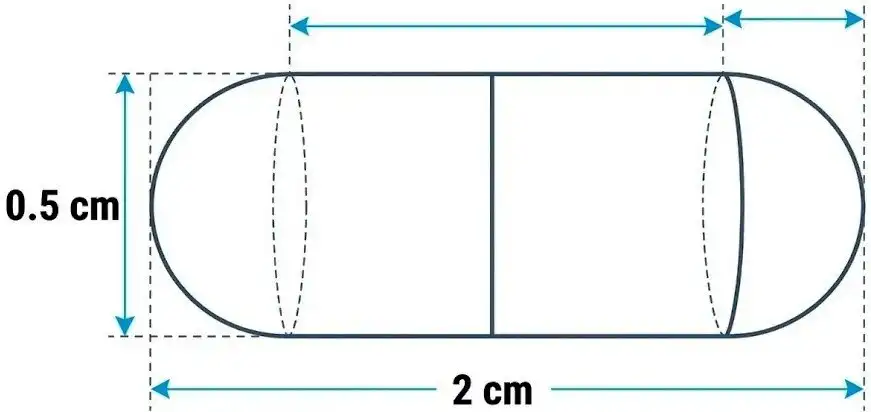
9. A medicine-capsule is in the shape of a cylinder of diameter \(0.5\text{ cm}\) with two hemispheres stuck to each of its ends. The length of entire capsule is \(2\text{ cm}\). The capacity of the capsule is:
(A) \(0.36\text{ cm}^3\)
(B) \(0.35\text{ cm}^3\)
(C) \(0.34\text{ cm}^3\)
(D) \(0.33\text{ cm}^3\)
Solution: Correct Option (A)
Radius \(r = 0.25\text{ cm}\). Length of cylindrical part \(h = 2 – 2(0.25) = 1.5\text{ cm}\).
\[V = \pi r^2 h + \frac{4}{3}\pi r^3 = \pi r^2 \left(h + \frac{4}{3}r\right) = \frac{22}{7} \times (0.25)^2 \left(1.5 + \frac{1}{3}\right) = \frac{22}{7} \times \frac{1}{16} \times \frac{5.5}{3} \approx 0.36\text{ cm}^3\]
Exercise 12.1 — Q15
10. If two solid hemispheres of same base radius \(r\) are joined together along their bases, then curved surface area of this new solid is:
(A) \(4\pi r^2\)
(B) \(6\pi r^2\)
(C) \(3\pi r^2\)
(D) \(8\pi r^2\)
Solution: Correct Option (A)
Joining two hemispheres along their bases forms a complete sphere of radius \(r\). Curved surface area \(= 2\pi r^2 + 2\pi r^2 = 4\pi r^2\).
Exercise 12.1 — Q16
11. A right circular cylinder of radius \(r\text{ cm}\) and height \(h\text{ cm}\) \((h > 2r)\) just encloses a sphere of diameter:
(A) \(r\text{ cm}\)
(B) \(2r\text{ cm}\)
(C) \(h\text{ cm}\)
(D) \(2h\text{ cm}\)
Solution: Correct Option (B)
A cylinder of radius \(r\) fits a sphere touching its curved surface whose diameter equals the width of the cylinder \(= 2r\text{ cm}\).
Exercise 12.1 — Q17
12. During conversion of a solid from one shape to another, the volume of the new shape will:
(A) increase
(B) decrease
(C) remain unaltered
(D) be doubled
Solution: Correct Option (C)
By the law of conservation of matter, total volume remains unaltered during recasting or melting.
Exercise 12.1 — Q20
13. Volumes of two spheres are in the ratio \(64 : 27\). The ratio of their surface areas is:
(A) \(3 : 4\)
(B) \(4 : 3\)
(C) \(9 : 16\)
(D) \(16 : 9\)
Solution: Correct Option (D)
\[\frac{V_1}{V_2} = \left(\frac{r_1}{r_2}\right)^3 = \frac{64}{27} \implies \frac{r_1}{r_2} = \frac{4}{3}\]
\[\frac{S_1}{S_2} = \left(\frac{r_1}{r_2}\right)^2 = \left(\frac{4}{3}\right)^2 = \frac{16}{9} = 16 : 9\]
Exercise 12.2: True / False with Reasoning
Section C — Sample 1
If a solid cone of base radius \(r\) and height \(h\) is placed over a solid cylinder having same base radius and height, the curved surface area of the shape is \(\pi r \sqrt{h^2 + r^2} + 2\pi rh\). True or False? Justify.
Solution: True
The total curved surface area of the combined solid is the sum of the curved surface area of the cone (\(\pi r l = \pi r \sqrt{h^2 + r^2}\)) and the curved surface area of the cylinder (\(2\pi rh\)).
Section C — Sample 2
A spherical steel ball is melted to make eight new identical balls. Then the radius of each new ball is \(\frac{1}{8}\) the radius of the original ball. True or False? Justify.
Solution: False
Equating volumes:
\[\frac{4}{3} \pi R^3 = 8 \times \left(\frac{4}{3} \pi r_1^3\right) \implies R^3 = 8r_1^3 \implies r_1 = \frac{R}{2} \neq \frac{R}{8}\]
The radius is \(\frac{1}{2}\) of original radius, not \(\frac{1}{8}\).
Section C — Sample 3
Two identical solid cubes of side \(a\) are joined end to end. Then the total surface area of the resulting cuboid is \(12a^2\). True or False? Justify.
Solution: False
When two cubes are joined, two faces of area \(a^2\) each are hidden:
\[\text{Total surface area} = 6a^2 + 6a^2 – 2a^2 = 10a^2 \neq 12a^2\]
Section C — Sample 4
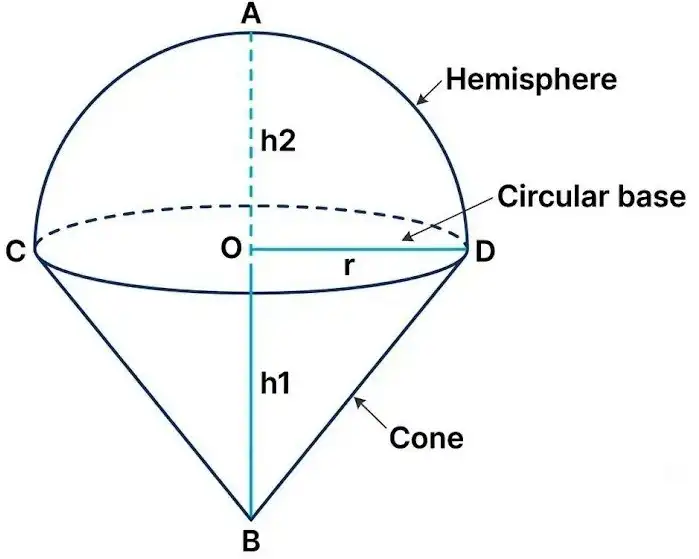
Total surface area of a lattu (top) in Fig. 12.5 is the sum of total surface area of hemisphere and total surface area of cone. True or False? Justify.
Solution: False
The flat circular base where the cone and hemisphere meet is joined internally and not exposed. The total surface area of the toy is the sum of the curved surface areas of the hemisphere and the cone.
Exercise 12.2 — Q1
1. Two identical solid hemispheres of equal base radius \(r\text{ cm}\) are stuck together along their bases. The total surface area of the combination is \(6\pi r^2\). True or False? Justify.
Solution: False
Joining two identical hemispheres along their circular flat bases creates a solid sphere of radius \(r\). Its total surface area is \(4\pi r^2\), not \(6\pi r^2\).
Exercise 12.2 — Q2
2. A solid cylinder of radius \(r\) and height \(h\) is placed over another cylinder of same height and radius. The total surface area of the shape so formed is \(4\pi rh + 4\pi r^2\). True or False? Justify.
Solution: False
The new cylinder has height \(2h\) and radius \(r\):
\[\text{Total surface area} = 2\pi r(2h) + 2\pi r^2 = 4\pi rh + 2\pi r^2 \neq 4\pi rh + 4\pi r^2\]
Exercise 12.2 — Q3
3. A solid cone of radius \(r\) and height \(h\) is placed over a solid cylinder of same base radius and height. Total surface area is \(\pi r[\sqrt{r^2 + h^2} + 3r + 2h]\). True or False? Justify.
Solution: False
The exposed surfaces are: CSA of cone \(+ \) CSA of cylinder \(+ \) 1 circular base of cylinder:
\[\text{TSA} = \pi r \sqrt{r^2 + h^2} + 2\pi rh + \pi r^2 = \pi r[\sqrt{r^2 + h^2} + 2h + r]\]
Exercise 12.2 — Q4
4. A solid ball is exactly fitted inside a cubical box of side \(a\). The volume of the ball is \(\frac{4}{3}\pi a^3\). True or False? Justify.
Solution: False
The diameter of the ball equals the side \(a\) of the cube, so radius \(r = \frac{a}{2}\):
\[V = \frac{4}{3} \pi \left(\frac{a}{2}\right)^3 = \frac{4}{3} \pi \frac{a^3}{8} = \frac{1}{6} \pi a^3 \neq \frac{4}{3}\pi a^3\]
Exercise 12.2 — Q6
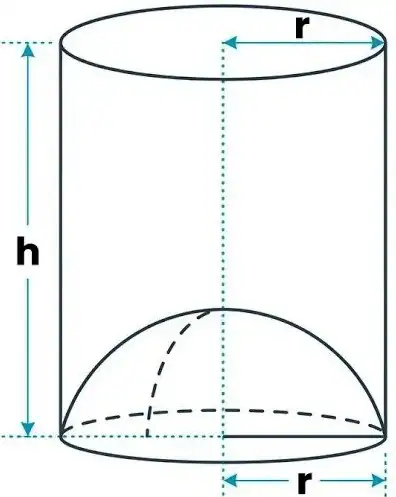
5. The capacity of a cylindrical vessel with a hemispherical portion raised upward at the bottom (see Fig. 12.7) is \(\frac{\pi r^2}{3}[3h – 2r]\). True or False? Justify.
Solution: True
\[\text{Capacity} = \text{Volume of cylinder} – \text{Volume of hemisphere} = \pi r^2 h – \frac{2}{3}\pi r^3 = \frac{\pi r^2}{3}[3h – 2r]\]
Exercise 12.3: Short Answer Problems
Exercise 12.3 — Q1
1. Three metallic solid cubes whose edges are \(3\text{ cm}, 4\text{ cm},\) and \(5\text{ cm}\) are melted and formed into a single cube. Find the edge of the cube so formed.
Solution
\[V = 3^3 + 4^3 + 5^3 = 27 + 64 + 125 = 216\text{ cm}^3\]
\[a = \sqrt[3]{216} = \mathbf{6\text{ cm}}\]
Exercise 12.3 — Q2
2. How many shots each having diameter \(3\text{ cm}\) can be made from a cuboidal lead solid of dimensions \(9\text{ cm} \times 11\text{ cm} \times 12\text{ cm}\)?
Solution
Radius of each shot \(r = 1.5\text{ cm} = \frac{3}{2}\text{ cm}\):
\[\text{Volume of one lead shot} = \frac{4}{3} \times \frac{22}{7} \times \left(\frac{3}{2}\right)^3 = \frac{4}{3} \times \frac{22}{7} \times \frac{27}{8} = \frac{99}{7}\text{ cm}^3\]
\[\text{Volume of cuboid} = 9 \times 11 \times 12 = 1188\text{ cm}^3\]
\[\text{Number of shots} = \frac{1188}{99/7} = \frac{1188 \times 7}{99} = 12 \times 7 = \mathbf{84}\]
Exercise 12.3 — Q5
3. Two identical cubes each of volume \(64\text{ cm}^3\) are joined together end to end. What is the surface area of the resulting cuboid?
Solution
Edge of each cube \(a = \sqrt[3]{64} = 4\text{ cm}\).
Dimensions of resulting cuboid: \(l = 8\text{ cm}, b = 4\text{ cm}, h = 4\text{ cm}\):
\[\text{TSA} = 2(lb + bh + hl) = 2(8 \times 4 + 4 \times 4 + 4 \times 8) = 2(32 + 16 + 32) = 2(80) = \mathbf{160\text{ cm}^2}\]
Exercise 12.3 — Q6
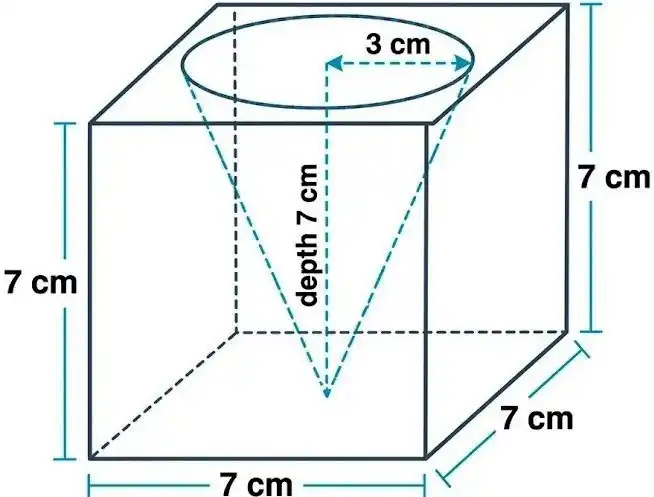
4. From a solid cube of side \(7\text{ cm}\), a conical cavity of height \(7\text{ cm}\) and radius \(3\text{ cm}\) is hollowed out. Find the volume of the remaining solid.
Solution
\[\text{Volume of cube} = 7^3 = 343\text{ cm}^3\]
\[\text{Volume of cone} = \frac{1}{3} \times \frac{22}{7} \times 3^2 \times 7 = 66\text{ cm}^3\]
\[\text{Remaining volume} = 343 – 66 = \mathbf{277\text{ cm}^3}\]
Exercise 12.3 — Q7
5. Two cones with same base radius \(8\text{ cm}\) and height \(15\text{ cm}\) are joined together along their bases. Find the surface area of the shape so formed.
Solution
Slant height \(l = \sqrt{r^2 + h^2} = \sqrt{8^2 + 15^2} = \sqrt{64 + 225} = 17\text{ cm}\):
\[\text{Total surface area} = 2 \times \text{CSA of one cone} = 2\pi r l = 2 \times \frac{22}{7} \times 8 \times 17 = \frac{5984}{7} \approx \mathbf{854.86\text{ cm}^2}\]
Exercise 12.3 — Q8
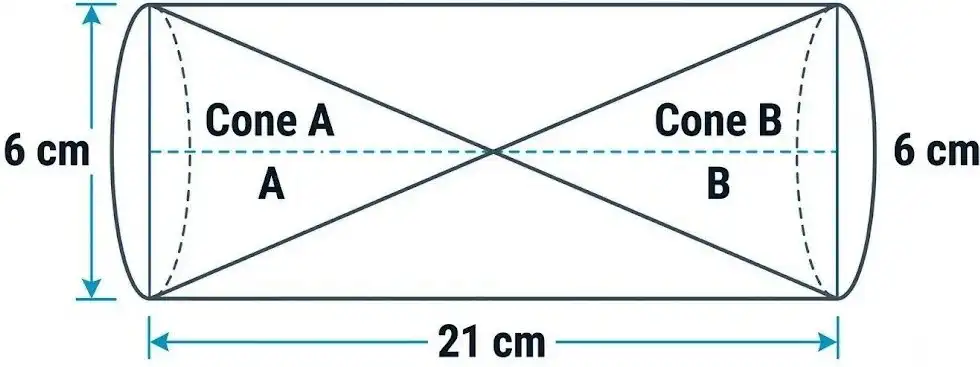
6. Two solid cones A and B are placed in a cylindrical tube as shown in Fig. 12.9. The ratio of their capacities is \(2 : 1\). Find the heights and capacities of cones, and the volume of remaining portion of cylinder.
Solution
Radius \(r = 3\text{ cm}\). Let heights be \(h_1\) and \(h_2\), with \(h_1 + h_2 = 21\text{ cm}\).
\[\frac{V_1}{V_2} = \frac{h_1}{h_2} = \frac{2}{1} \implies h_1 = 14\text{ cm}, \quad h_2 = 7\text{ cm}\]
\[V_A = \frac{1}{3} \times \frac{22}{7} \times 3^2 \times 14 = \mathbf{132\text{ cm}^3}\]
\[V_B = \frac{1}{3} \times \frac{22}{7} \times 3^2 \times 7 = \mathbf{66\text{ cm}^3}\]
\[\text{Volume of cylinder} = \frac{22}{7} \times 3^2 \times 21 = 594\text{ cm}^3\]
\[\text{Remaining volume} = 594 – (132 + 66) = 594 – 198 = \mathbf{396\text{ cm}^3}\]
Exercise 12.3 — Q9
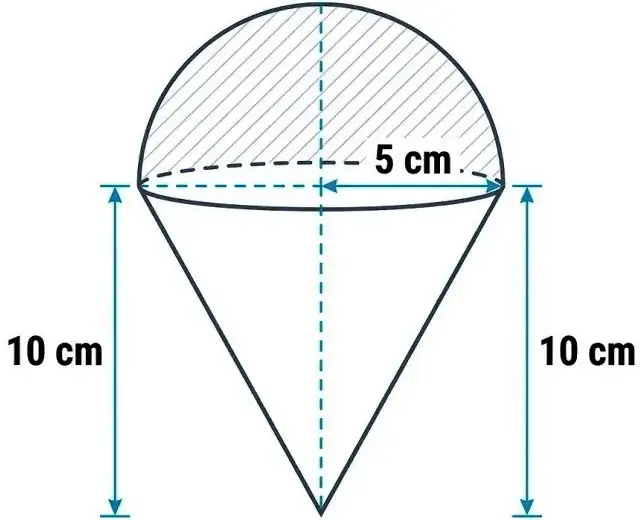
7. An ice cream cone full of ice cream has radius \(5\text{ cm}\) and height \(10\text{ cm}\) as shown in Fig. 12.10. Calculate the volume of ice cream, provided that \(\frac{1}{6}\) part is left unfilled.
Solution
Total capacity \(= \text{Volume of cone} + \text{Volume of hemisphere}\):
\[V = \frac{1}{3}\pi(5)^2(10) + \frac{2}{3}\pi(5)^3 = \frac{250\pi}{3} + \frac{250\pi}{3} = \frac{500\pi}{3}\text{ cm}^3\]
\[\text{Filled volume} = \frac{5}{6} \times \frac{500\pi}{3} = \frac{2500 \times 22}{18 \times 7} = \frac{55000}{126} \approx \mathbf{327.38\text{ cm}^3}\]
Exercise 12.3 — Q10
8. Marbles of diameter \(1.4\text{ cm}\) are dropped into a cylindrical beaker of diameter \(7\text{ cm}\) containing some water. Find the number of marbles that should be dropped so that water level rises by \(5.6\text{ cm}\).
Solution
Volume of raised water \(= \pi \left(\frac{7}{2}\right)^2 \times 5.6 = \frac{22}{7} \times \frac{49}{4} \times 5.6 = 215.6\text{ cm}^3\).
Volume of one marble (\(r = 0.7\text{ cm}\)) \(= \frac{4}{3} \times \frac{22}{7} \times (0.7)^3 = 1.4373\text{ cm}^3\).
\[n = \frac{\pi \times \frac{49}{4} \times 5.6}{\frac{4}{3}\pi \times 0.343} = \frac{68.6}{0.45733} = \mathbf{150}\]
Exercise 12.3 — Q11
9. How many spherical lead shots each of diameter \(4.2\text{ cm}\) can be obtained from a solid rectangular lead piece with dimensions \(66\text{ cm}, 42\text{ cm},\) and \(21\text{ cm}\)?
Solution
Lead shot radius \(r = 2.1\text{ cm}\):
\[\text{Volume of one shot} = \frac{4}{3} \times \frac{22}{7} \times (2.1)^3 = 38.808\text{ cm}^3\]
\[\text{Volume of lead block} = 66 \times 42 \times 21 = 58212\text{ cm}^3\]
\[\text{Number of shots} = \frac{58212}{38.808} = \mathbf{1500}\]
Exercise 12.3 — Q12
10. How many spherical lead shots of diameter \(4\text{ cm}\) can be made out of a solid cube of lead whose edge measures \(44\text{ cm}\)?
Solution
\[\text{Volume of cube} = 44^3 = 85184\text{ cm}^3\]
\[\text{Volume of one shot } (r = 2\text{ cm}) = \frac{4}{3} \times \frac{22}{7} \times 2^3 = \frac{704}{21}\text{ cm}^3\]
\[n = \frac{85184 \times 21}{704} = 121 \times 21 = \mathbf{2541}\]
Exercise 12.3 — Q13
11. A wall \(24\text{ m}\) long, \(0.4\text{ m}\) thick and \(6\text{ m}\) high is constructed with bricks of \(25\text{ cm} \times 16\text{ cm} \times 10\text{ cm}\). If mortar occupies \(\frac{1}{10}\) of volume of wall, find the number of bricks.
Solution
\[\text{Volume of wall} = 2400 \times 40 \times 600 = 57600000\text{ cm}^3\]
\[\text{Volume for bricks} = \frac{9}{10} \times 57600000 = 51840000\text{ cm}^3\]
\[\text{Volume of one brick} = 25 \times 16 \times 10 = 4000\text{ cm}^3\]
\[\text{Number of bricks} = \frac{51840000}{4000} = \mathbf{12960}\]
Exercise 12.3 — Q14
12. Find the number of metallic circular discs with \(1.5\text{ cm}\) base diameter and height \(0.2\text{ cm}\) to be melted to form a right circular cylinder of height \(10\text{ cm}\) and diameter \(4.5\text{ cm}\).
Solution
Target cylinder: \(R = 2.25\text{ cm}, H = 10\text{ cm}\).
Each disc: \(r = 0.75\text{ cm}, h = 0.2\text{ cm}\).
\[n = \frac{\pi R^2 H}{\pi r^2 h} = \frac{(2.25)^2 \times 10}{(0.75)^2 \times 0.2} = \left(\frac{2.25}{0.75}\right)^2 \times \frac{10}{0.2} = 3^2 \times 50 = 9 \times 50 = \mathbf{450}\]
Exercise 12.4: Long Answer Questions & Applications
Section E — Sample 2
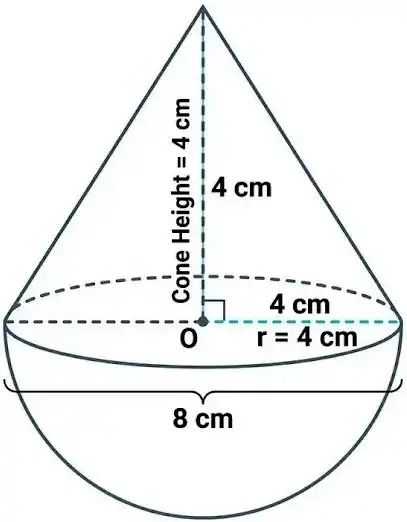
A solid toy is in the form of a hemisphere surmounted by a right circular cone (Fig. 12.11). Height of cone is \(4\text{ cm}\) and base diameter is \(8\text{ cm}\). Determine the volume of the toy, the difference in volume if a cube circumscribes it, and its total surface area.
Solution
Radius \(r = 4\text{ cm}\), height of cone \(h = 4\text{ cm}\):
\[\text{Volume of toy} = \frac{2}{3}\pi r^3 + \frac{1}{3}\pi r^2 h = \frac{1}{3}\pi(4)^2[2(4) + 4] = \frac{1}{3} \times \frac{22}{7} \times 16 \times 12 = \frac{1408}{7} = \mathbf{201.14\text{ cm}^3}\]
Edge of circumscribing cube \(= 8\text{ cm} \implies \text{Volume of cube} = 8^3 = 512\text{ cm}^3\).
\[\text{Difference in volume} = 512 – 201.14 = \mathbf{310.86\text{ cm}^3}\]
Slant height of cone \(l = \sqrt{4^2 + 4^2} = 4\sqrt{2}\text{ cm}\):
\[\text{TSA of toy} = \pi r l + 2\pi r^2 = \frac{22}{7} \times 4 (4\sqrt{2} + 8) = \mathbf{171.68\text{ cm}^2}\]
Section E — Sample 3
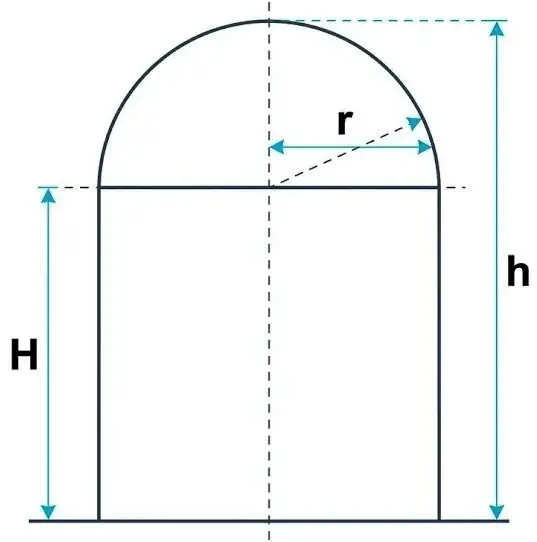
A building is in the form of a cylinder surmounted by a hemispherical dome (Fig. 12.12). The base diameter of dome is \(\frac{2}{3}\) of total height of the building. Find the height if it contains \(67\frac{1}{21}\text{ m}^3\) of air.
Solution
Let total height be \(h\). Diameter \(= \frac{2}{3}h \implies r = \frac{h}{3}\). Height of cylinder \(H = h – \frac{h}{3} = \frac{2}{3}h\).
\[\text{Total volume} = \frac{2}{3}\pi\left(\frac{h}{3}\right)^3 + \pi\left(\frac{h}{3}\right)^2\left(\frac{2}{3}h\right) = \frac{2\pi h^3}{81} + \frac{6\pi h^3}{81} = \frac{8}{81}\pi h^3\]
\[\frac{8}{81} \times \frac{22}{7} \times h^3 = \frac{1408}{21} \implies h^3 = \frac{1408}{21} \times \frac{81 \times 7}{8 \times 22} = 216 \implies h = \mathbf{6\text{ m}}\]
Exercise 12.4 — Q1
13. A solid metallic hemisphere of radius \(8\text{ cm}\) is melted and recasted into a right circular cone of base radius \(6\text{ cm}\). Determine the height of the cone.
Solution
\[\text{Volume of hemisphere} = \text{Volume of cone} \implies \frac{2}{3}\pi (8)^3 = \frac{1}{3}\pi (6)^2 h\]
\[2 \times 512 = 36 h \implies 1024 = 36 h \implies h = \frac{1024}{36} = \frac{256}{9} \approx \mathbf{28.44\text{ cm}}\]
Exercise 12.4 — Q2
14. A rectangular water tank of base \(11\text{ m} \times 6\text{ m}\) contains water up to a height of \(5\text{ m}\). If transferred to a cylindrical tank of radius \(3.5\text{ m}\), find the height of the water level.
Solution
\[\text{Volume} = 11 \times 6 \times 5 = 330\text{ m}^3\]
\[\pi r^2 h = 330 \implies \frac{22}{7} \times (3.5)^2 \times h = 330 \implies 38.5 h = 330 \implies h = \frac{330}{38.5} = \mathbf{8.57\text{ m}}\]
Exercise 12.4 — Q6
15. A heap of rice is in the form of a cone of diameter \(9\text{ m}\) and height \(3.5\text{ m}\). Find the volume of the rice and canvas cloth required to cover the heap.
Solution
Radius \(r = 4.5\text{ m}, h = 3.5\text{ m}\):
\[V = \frac{1}{3} \times \frac{22}{7} \times (4.5)^2 \times 3.5 = \frac{1}{3} \times 22 \times 0.5 \times 20.25 = \mathbf{74.25\text{ m}^3}\]
\[l = \sqrt{r^2 + h^2} = \sqrt{(4.5)^2 + (3.5)^2} = \sqrt{20.25 + 12.25} = \sqrt{32.5} \approx 5.7\text{ m}\]
\[\text{Canvas area} = \pi r l = \frac{22}{7} \times 4.5 \times 5.7 \approx \mathbf{80.61\text{ m}^2}\]
Exercise 12.4 — Q14
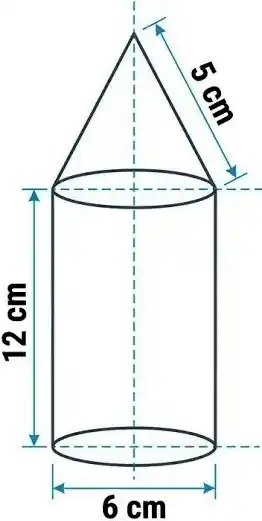
16. A rocket is in the form of a right circular cylinder closed at the lower end and surmounted by a cone. Cylinder diameter is \(6\text{ cm}\) and height is \(12\text{ cm}\). If slant height of cone is \(5\text{ cm}\), find total surface area and volume (Use \(\pi = 3.14\)).
Solution
Radius \(r = 3\text{ cm}\). Height of conical portion \(h = \sqrt{5^2 – 3^2} = 4\text{ cm}\):
\[\text{TSA} = \text{CSA of cone} + \text{CSA of cylinder} + \text{Base area of cylinder} = \pi r l + 2\pi r H + \pi r^2 = \pi r(l + 2H + r)\]
\[= 3.14 \times 3 \times (5 + 24 + 3) = 9.42 \times 32 = \mathbf{301.44\text{ cm}^2}\]
\[\text{Volume} = \pi r^2 H + \frac{1}{3}\pi r^2 h = \pi r^2 \left(H + \frac{h}{3}\right) = 3.14 \times 9 \times \left(12 + \frac{4}{3}\right) = 28.26 \times \frac{40}{3} = \mathbf{376.8\text{ cm}^3}\]
Exercise 12.4 — Q16
17. A hemispherical bowl of internal radius \(9\text{ cm}\) is full of liquid. It is filled into cylindrical bottles of radius \(1.5\text{ cm}\) and height \(4\text{ cm}\). How many bottles are needed?
Solution
\[\text{Volume of bowl} = \frac{2}{3} \pi (9)^3 = 486\pi\text{ cm}^3\]
\[\text{Volume of one bottle} = \pi (1.5)^2 (4) = 9\pi\text{ cm}^3\]
\[n = \frac{486\pi}{9\pi} = \mathbf{54}\]
Exercise 12.4 — Q17
18. A solid right circular cone of height \(120\text{ cm}\) and radius \(60\text{ cm}\) is placed upright in a cylinder full of water of height \(180\text{ cm}\) and radius \(60\text{ cm}\). Find the volume of water left.
Solution
\[\text{Volume of cylinder} = \pi (60)^2 (180) = 648000\pi\text{ cm}^3\]
\[\text{Volume of cone} = \frac{1}{3}\pi (60)^2 (120) = 144000\pi\text{ cm}^3\]
\[\text{Water left} = 648000\pi – 144000\pi = 504000\pi\text{ cm}^3 = 504000 \times \frac{22}{7} = 1584000\text{ cm}^3 = \mathbf{1.584\text{ m}^3}\]
Exercise 12.4 — Q20
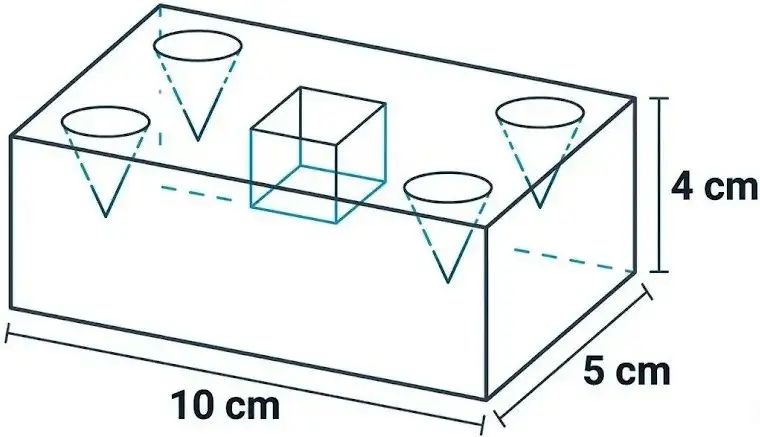
19. A wooden pen stand is a cuboid (\(10\text{ cm} \times 5\text{ cm} \times 4\text{ cm}\)) with four conical depressions (\(r = 0.5\text{ cm}, h = 2.1\text{ cm}\)) and one cubical depression of edge \(3\text{ cm}\). Find the volume of wood.
Solution
\[\text{Volume of cuboid} = 10 \times 5 \times 4 = 200\text{ cm}^3\]
\[\text{Volume of 4 conical depressions} = 4 \times \left(\frac{1}{3} \times \frac{22}{7} \times (0.5)^2 \times 2.1\right) = 4 \times (0.55) = 2.2\text{ cm}^3\]
\[\text{Volume of cubical depression} = 3^3 = 27\text{ cm}^3\]
\[\text{Volume of wood} = 200 – (2.2 + 27) = 200 – 29.2 = \mathbf{170.8\text{ cm}^3}\]