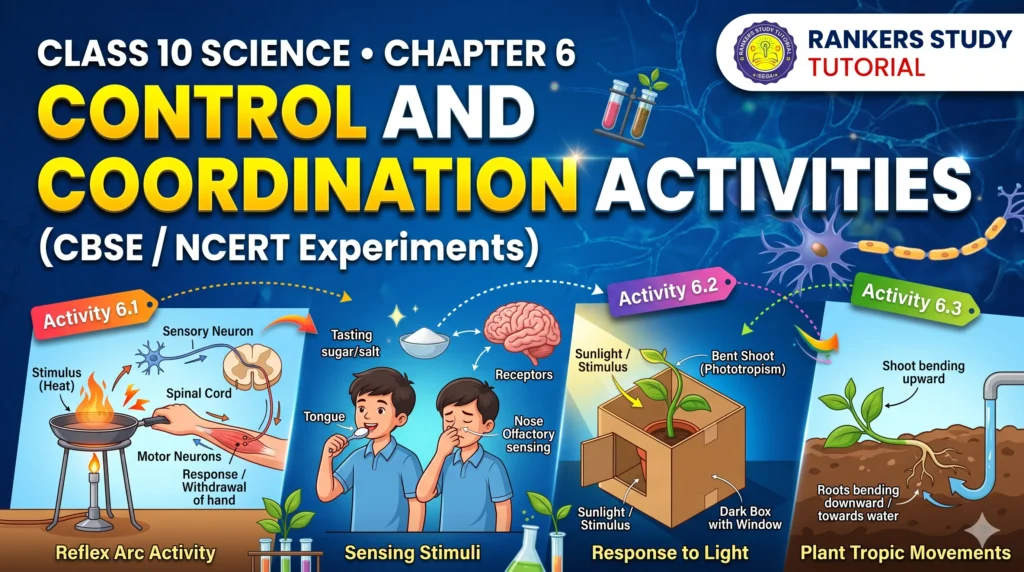
Class 10 Science Chapter 6 Activities | Control and Coordination
Activity 6.1: Interaction of Taste and Smell Senses
Investigating Gustatory and Olfactory Receptor Integration
Experimental Procedure
- Place some sugar crystals in your mouth and note how it tastes normally.
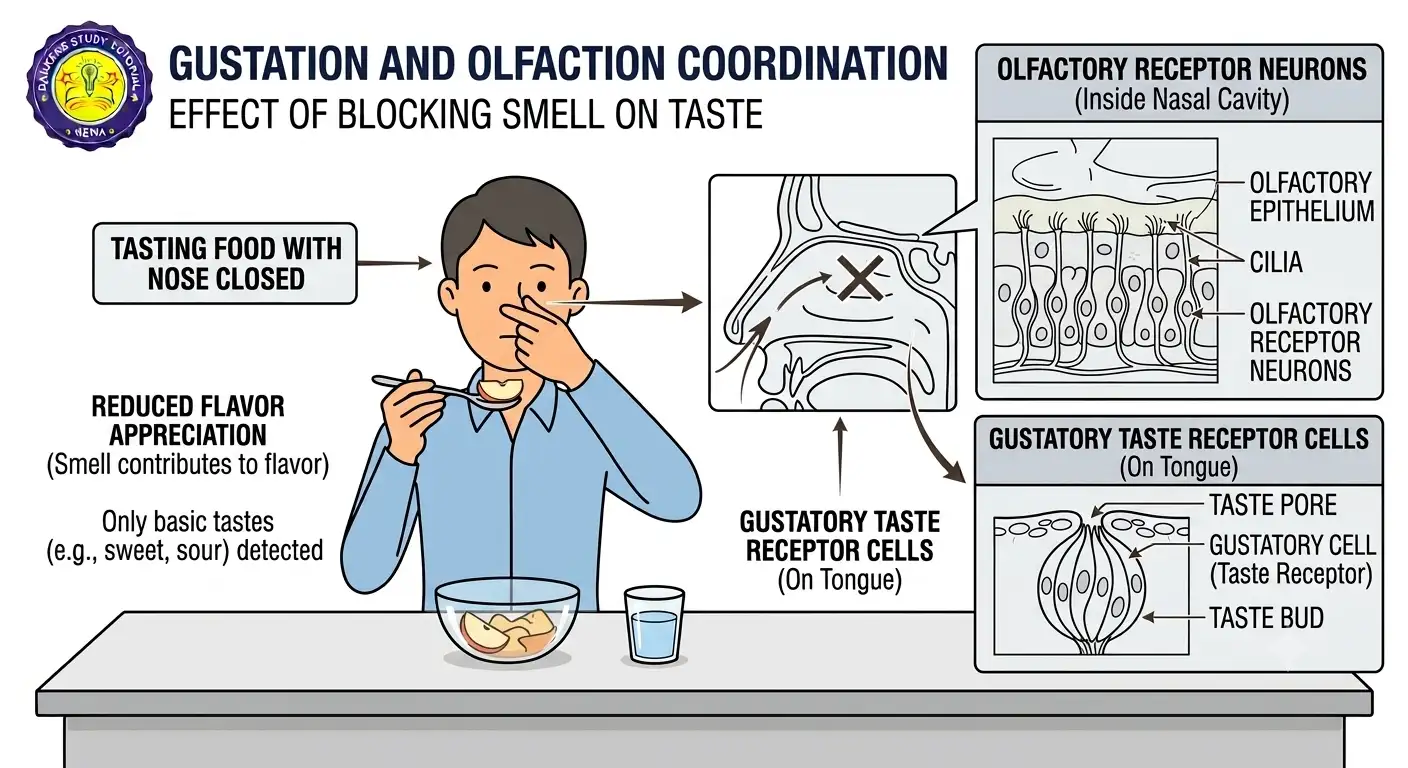
- Block your nose completely by pressing it tightly between your thumb and index finger, then consume sugar or food again.
- Compare whether you can fully appreciate food flavors or differentiate tastes when olfactory passages are obstructed.
Observations & Biological Mechanism
- Observation: Food flavor is significantly dulled when the nasal passages are blocked, demonstrating that true perception of flavor relies heavily on smell.
- Receptor Coordination: Gustatory receptors on the tongue detect basic tastes (sweet, salty, sour, bitter), while olfactory receptors in the nasal cavity detect volatile food aromas.
- Integration: The brain integrates gustatory and olfactory sensory inputs together to generate the complete perception of food flavor.
Q1: Why does food taste bland or different when a person suffers from a severe cold with a blocked nose?
Answer: A blocked nose prevents volatile aromatic molecules from reaching the olfactory receptors in the nasal cavity. Since much of what we perceive as “taste” is actually contributed by smell, blocking nasal passages severely impairs flavor appreciation.
Q2: Distinguish between gustatory receptors and olfactory receptors in terms of location and function.
Answer: Gustatory receptors are located on the tongue and detect taste stimuli, whereas olfactory receptors are located in the nasal cavity and detect smell stimuli.
Q3 (Application Based): How do nerve impulses travel across a synapse between two adjacent neurons?
Answer: When an electrical impulse reaches the axonal nerve ending, it triggers the release of neurotransmitter chemicals. These chemicals diffuse across the synaptic gap to bind with receptor sites on the dendrite of the next neuron, initiating a new electrical impulse.
Q4 (Application Based): Why are specialized nervous and muscular tissues required in multicellular animals instead of relying solely on simple diffusion?
Answer: Multicellular organisms have complex body designs where internal cells are far removed from the external environment. Simple diffusion is too slow to coordinate rapid responses, necessitating specialized nervous tissue for signal transmission and muscular tissue for rapid mechanical action.
Section 6.1.1: Reflex Action and Reflex Arc
Rapid Involuntary Responses and Spinal Cord Pathways
Core Concept Summary
- Reflex Action: A sudden, involuntary, automatic response to an environmental stimulus that protects the body from harm without requiring conscious thought.
- Reflex Arc: The pathway taken by nerve impulses from a receptor organ through sensory and relay neurons in the spinal cord to an effector muscle.
- Evolutionary Advantage: Reflex arcs evolved because the brain’s thinking process takes time; bypassing the brain allows instantaneous survival reactions (e.g., pulling hand away from a hot flame).
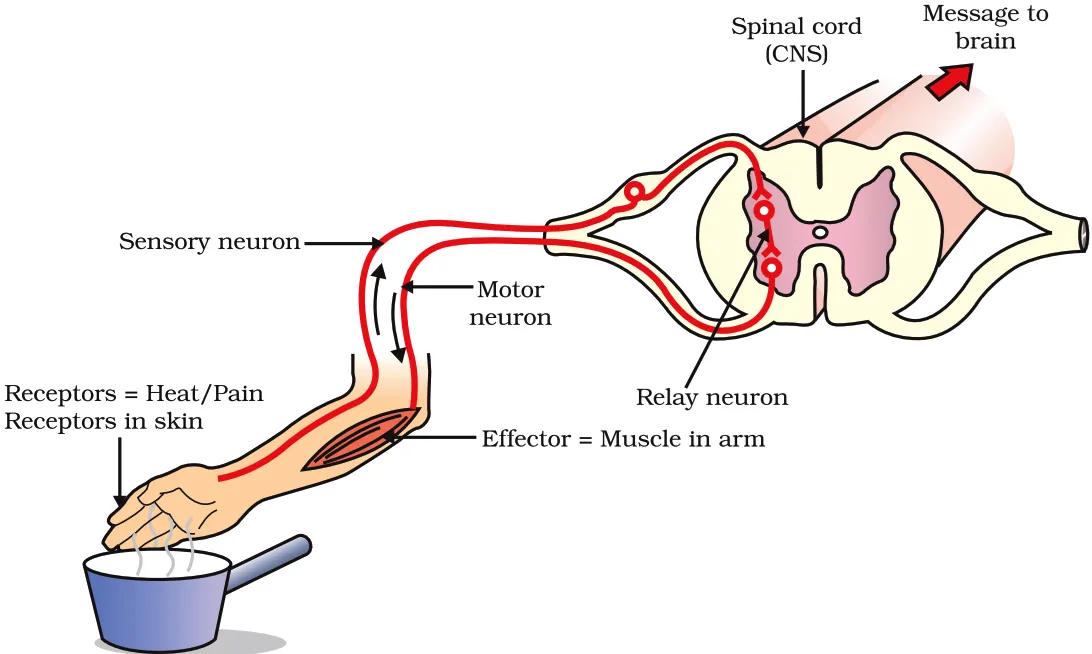
Q1: What is a reflex arc, and why is it considered more efficient than conscious brain processing for emergency responses?
Answer: A reflex arc is the neural pathway connecting sensory receptors directly through the spinal cord to motor effectors. It bypasses complex brain processing, completing responses in milliseconds to prevent severe injury.
Q2: Trace the sequence of nerve impulses when you accidentally touch a hot object.
Answer: Heat receptors in the skin detect the stimulus $\rightarrow$ sensory neuron $\rightarrow$ spinal cord (relay neuron) $\rightarrow$ motor neuron $\rightarrow$ effector arm muscle contracts to pull the hand away.
Q3 (Application Based): What is the role of the brain in a reflex action?
Answer: The reflex action itself is coordinated independently by the spinal cord for speed. However, sensory information about the event also travels upward to the brain, making us conscious of the pain and experience afterward.
Q4 (Application Based): How does a reflex action differ structurally and functionally from a voluntary action like walking?
Answer: Reflex actions are involuntary, rapid, mediated primarily by the spinal cord, and require no conscious thought. Walking is a voluntary action coordinated by the cerebrum and cerebellum, requiring conscious decision-making, skeletal muscle control, and balance maintenance.
Section 6.1.2: Human Brain Structure and Functions
Coordination Centers: Fore-brain, Mid-brain, and Hind-brain
Core Concept Summary
- Fore-brain: The main thinking part of the brain; contains regions specialized for hearing, smell, sight, integration, and hunger/fullness centers.
- Mid-brain & Hind-brain: Control involuntary actions such as blood pressure, salivation, vomiting (medulla), and precision of voluntary movements and balance (cerebellum).
- Protection: The brain is enclosed inside a bony cranium (skull) and suspended in cerebrospinal fluid for shock absorption.
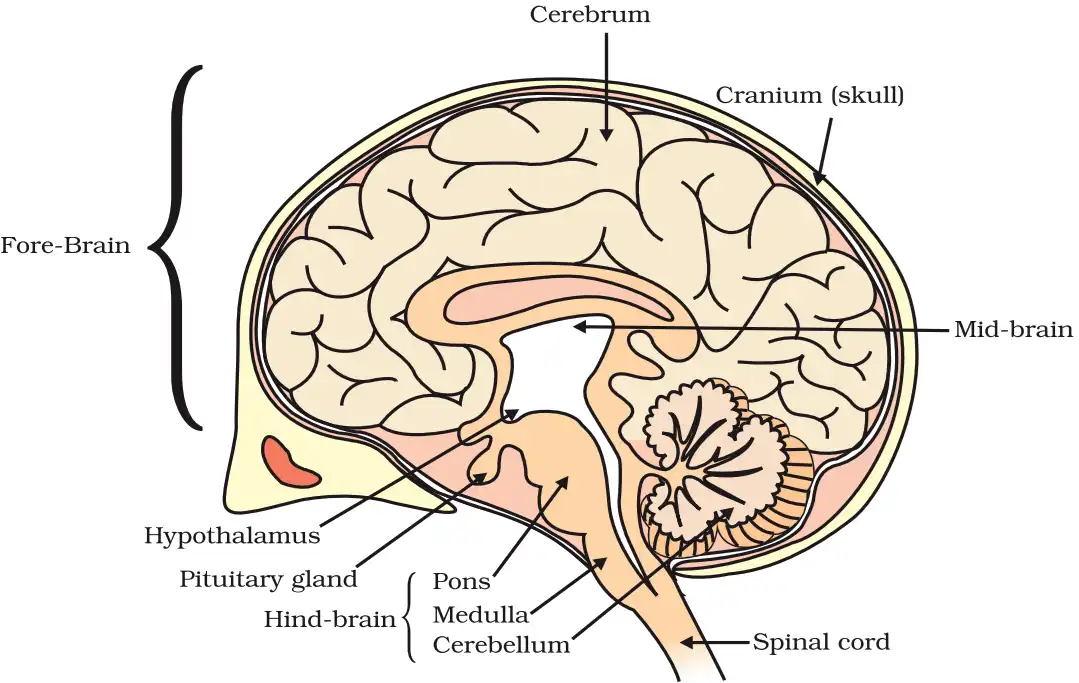
Q1: Which part of the brain is responsible for maintaining posture, equilibrium, and precision of voluntary actions?
Answer: The cerebellum, located in the hind-brain, is responsible for precision of voluntary actions and maintaining posture and balance.
Q2: Distinguish between the functions of the fore-brain and the medulla.
Answer: The fore-brain handles conscious thinking, sensory interpretation, reasoning, and voluntary actions. The medulla (in the hind-brain) controls involuntary vital functions like blood pressure, heart rate, and vomiting.
Q3 (Application Based): Why would damage to the cerebellum result in uncoordinated physical movements and stumbling?
Answer: The cerebellum coordinates muscle timing and equilibrium. Injury to this region disrupts motor coordination, making smooth tasks like riding a bicycle, walking straight, or writing impossible.
Q4 (Application Based): How is the delicate human brain protected against mechanical shocks and injuries?
Answer: The brain is enclosed within a rigid bony box called the cranium (skull) and bathed in a protective fluid-filled shock-absorbing cushion (cerebrospinal fluid).
Activity 6.2: Phototropic Movement in Plant Shoots
Directional Growth Response of Seedlings Towards Light
Experimental Procedure
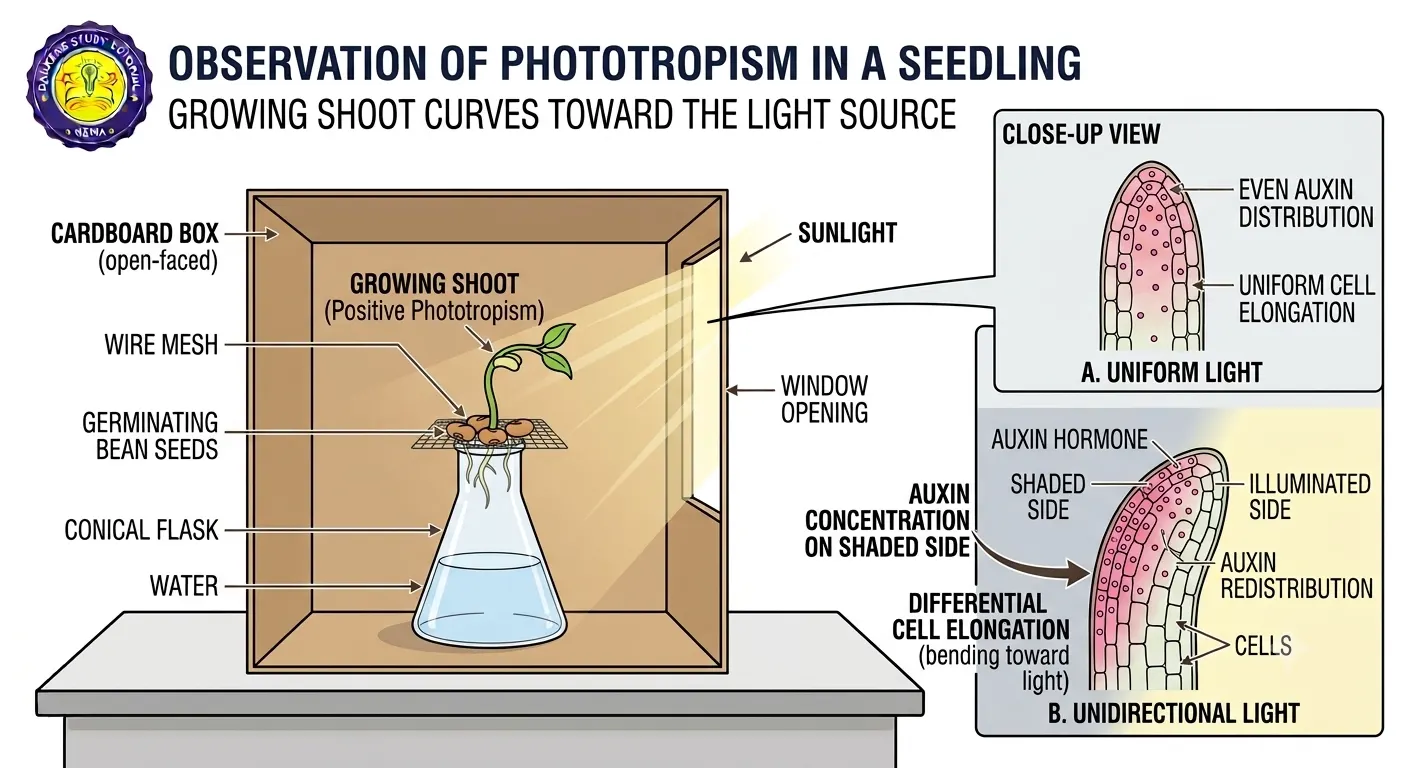
- Fill a conical flask with water and cover the neck with a wire mesh.
- Place freshly germinated bean seeds on the wire mesh.
- Enclose the flask in a cardboard box having an opening on one side facing a window source of sunlight.
- Observe seedling growth after 2 to 3 days, then rotate the flask 180 degrees and observe subsequent directional growth.
Observations & Chemical Mechanism
- Observation: Plant shoots bend and grow toward the light source (positive phototropism), while roots grow away from light into darkness (negative phototropism).
- Hormonal Action: Auxin synthesized at the shoot tip diffuses toward the shaded side, stimulating cells on that side to elongate faster, causing the shoot to curve toward light.
- Inference: Plants exhibit directional growth movements known as tropisms in response to environmental stimuli.
Q1: How do plant shoots and roots respond to directional light in Activity 6.2?
Answer: Shoots bend and grow towards light (positively phototropic), while roots grow away from light into the soil (negatively phototropic).
Q2: Name the plant hormone responsible for phototropic bending and explain how it operates.
Answer: Auxin is responsible. When light shines from one side, auxin migrates to the shady side of the shoot, stimulating cell elongation there so the plant bends toward the light.
Q3 (Application Based): What is geotropism? Give examples of positive and negative geotropism in plants.
Answer: Geotropism is directional growth in response to gravity. Plant roots grow downward in the direction of gravity (positively geotropic), while shoots grow upward away from gravity (negatively geotropic).
Q4 (Application Based): How does the movement of a sensitive touch-me-not plant (Mimosa pudica) differ fundamentally from the phototropic movement of a seedling?
Answer: Mimosa leaf drooping is rapid, non-directional, and caused by changes in leaf cell water pressure (turgor changes) with no growth involved. Phototropism is slow, directional, and driven by differential cell growth over time.
Section 6.3: Hormones in Animals and Plant Regulatory Compounds
Endocrine Glands, Feedback Mechanisms, and Chemical Coordination
Core Concept Summary
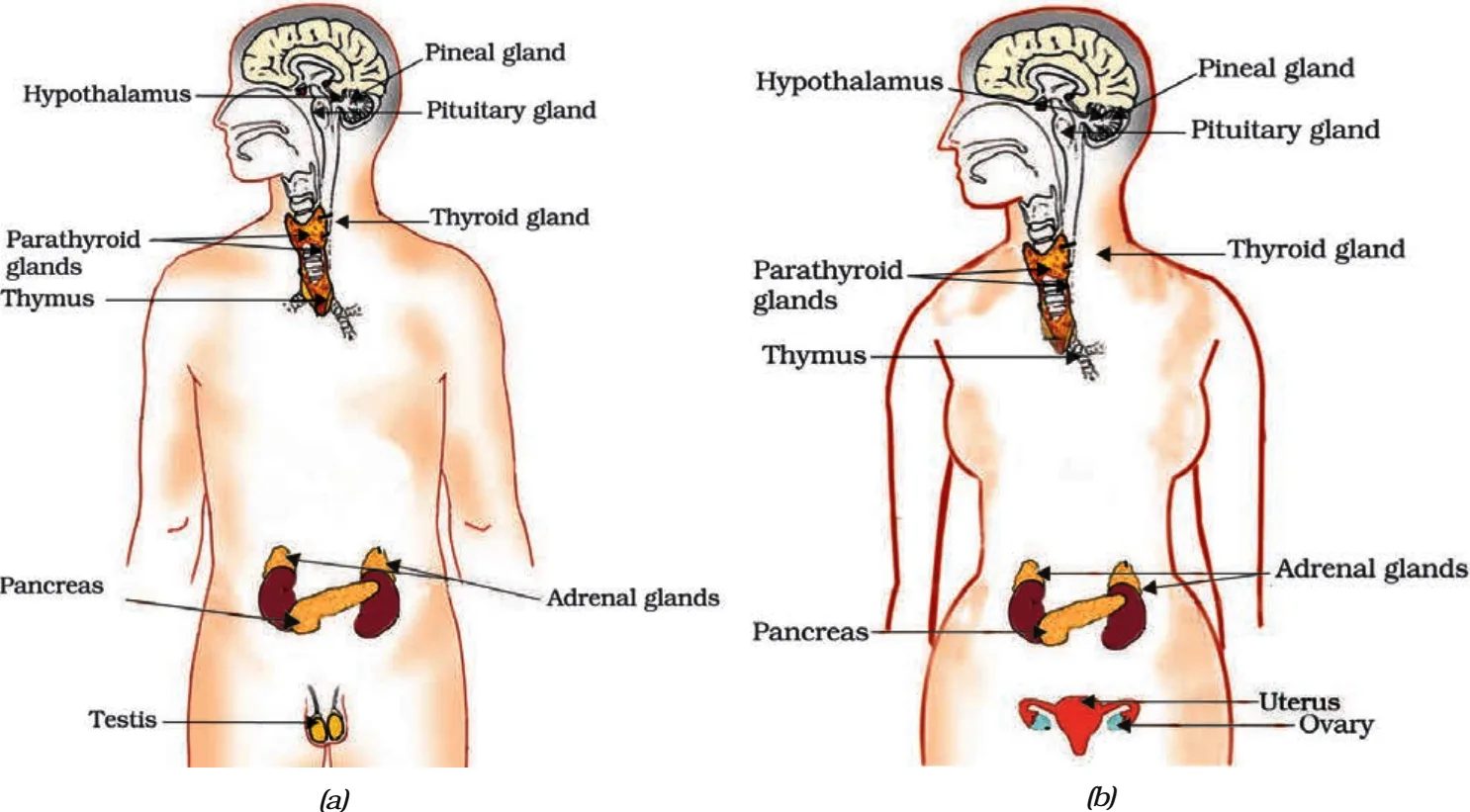
- Adrenaline (Fight or Flight): Secreted by adrenal glands; increases heart rate, breathing rate, and diverts blood to skeletal muscles during stress.
- Thyroxin: Secreted by the thyroid gland (requires iodine); regulates carbohydrate, protein, and fat metabolism. Deficiency causes goitre.
- Insulin: Secreted by the pancreas; regulates blood glucose levels. Deficiency causes diabetes.
- Feedback Mechanism: Regulates the exact timing and quantity of hormone release based on physiological demand (e.g., insulin secretion responding to blood sugar levels).
Q1: Why is iodised salt important in our daily diet?
Answer: Iodine is essential for the thyroid gland to synthesize thyroxin, which regulates general metabolism and body growth. Lack of iodine leads to goitre.
Q2: Describe how the body prepares for emergency situations when adrenaline is released into the blood.
Answer: Adrenaline accelerates heart rate, increases breathing rate, raises blood pressure, and reroutes blood from the digestive system to skeletal muscles, preparing the body for fighting or running away.
Q3 (Application Based): What is a feedback mechanism in endocrine regulation? Give an example.
Answer: A feedback mechanism is a self-regulating control system where hormone output adjusts according to physiological levels. For example, rising blood sugar levels stimulate pancreatic cells to secrete more insulin; as sugar levels drop, insulin release decreases.
Q4 (Application Based): Compare nervous and hormonal mechanisms for control and coordination in animals.
Answer: Nervous control uses rapid electrical impulses along dedicated nerve pathways for quick, short-lived responses. Hormonal control uses chemical messengers transported via blood, offering slower, widespread, and longer-lasting coordination across all body cells.