
Class 10 Science Chapter 8 Activities | Heredity
Activity 8.1: Inheritance of Human Earlobe Types
Class Survey and Pedigree Correlation of Free vs. Attached Earlobes
Experimental Procedure
- Observe the earlobes of all students in the classroom.
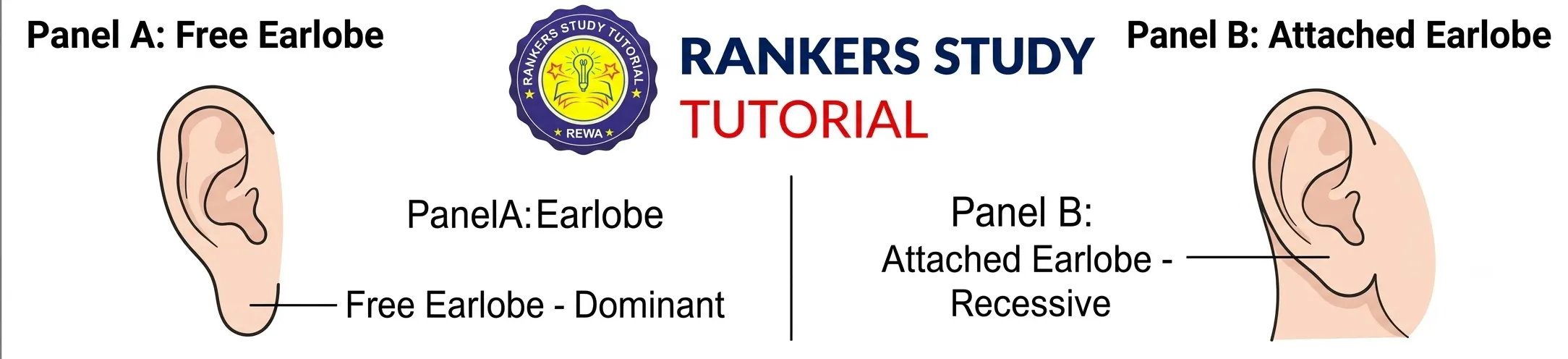
- Classify and list each student as having either free or attached earlobes (Fig. 8.2).
- Calculate the percentage frequency of students exhibiting each earlobe variant.
- Interview students to find out the earlobe types of their biological parents and correlate student traits with parental data to deduce inheritance rules.
Observations & Biological Mechanism
- Observation: Human populations exhibit two clear variants in earlobe attachment: free earlobes and closely attached earlobes.
- Inheritance Pattern: Statistical correlation with parental traits shows that free earlobes behave as a dominant trait, whereas attached earlobes behave as a recessive trait governed by nuclear genes.
- Inference: Morphological traits in humans are reliably inherited from parents according to Mendelian gene segregation rules.
Q1: What are the two structural variants of human earlobes observed in populations?
Answer: Free earlobes and attached earlobes.
Q2: Why do children bear basic features of human beings yet show distinct variations from their parents?
Answer: Children inherit a basic blueprint from both parents via maternal and paternal DNA, but the sexual combination of genes and subtle DNA copying variations generate distinct individual traits.
Q3 (Application Based): If both parents possess attached earlobes (recessive trait), can they produce a child with free earlobes? Explain.
Answer: No. Since attached earlobes are recessive, homozygous parents only carry recessive alleles (e.g., ‘ee’). They can only pass down recessive alleles to their offspring, making a dominant free-earlobe child impossible.
Q4 (Application Based): How does sexual reproduction generate greater phenotypic diversity within a population compared to asexual reproduction?
Answer: Sexual reproduction combines genetic material from two distinct individuals, merging independent chromosomal assortments and crossover variations, whereas asexual reproduction relies solely on minor DNA copying errors.
Activity 8.2: Confirming Monohybrid F2 Genotypic Ratios
Verification of Mendelian 1:2:1 Genotypic Distribution (TT, Tt, tt)
Experimental Procedure
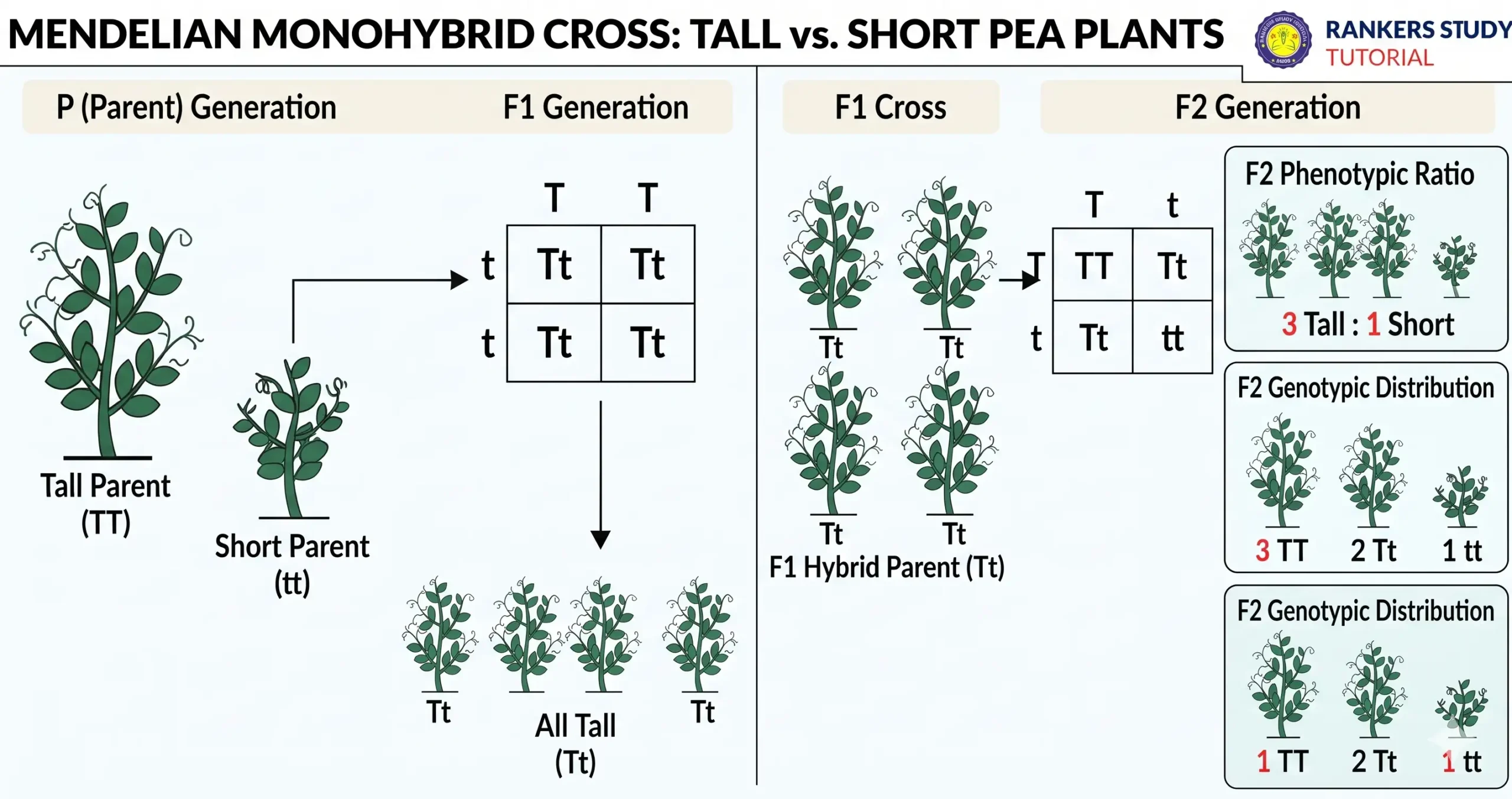
- Analyze the monohybrid cross between tall (TT) and short (tt) pea plants resulting in all tall F1 progeny (Tt) (Fig. 8.3).
- Self-pollinate F1 tall plants (Tt) to yield the F2 generation.
- Examine the phenotypic 3:1 ratio (tall to short plants) observed in the F2 generation.
- Design a confirmatory breeding test to distinguish heterozygous tall plants (Tt) from homozygous tall plants (TT).
Observations & Biological Mechanism
- Observation: F2 offspring exhibit a phenotypic ratio of 3 tall to 1 short plant, but genotypically comprise 1 TT : 2 Tt : 1 tt.
- Test Cross Principle: Crossing F2 tall plants with a homozygous recessive short plant (tt) reveals whether a tall plant is pure (TT) or hybrid (Tt) based on offspring phenotypes.
- Inference: Genes exist in pairs (alleles) that segregate independently during gamete formation.
Q1: What specific breeding experiment is used to confirm that the F2 generation has a 1:2:1 ratio of TT, Tt, and tt genotypic combinations?
Answer: A test cross, where individual tall F2 plants are crossed with a homozygous recessive short plant (tt). If all progeny are tall, the parent is TT; if half are tall and half short, the parent is Tt.
Q2: Define dominant and recessive traits based on Mendel’s monohybrid experiments.
Answer: A dominant trait (like ‘T’) expresses itself even when a single copy is present (TT or Tt). A recessive trait (like ‘t’) is expressed only when two identical copies are present (tt).
Q3 (Application Based): If a trait A exists in 10% of an asexually reproducing population and trait B exists in 60%, which trait arose earlier?
Answer: Trait B is likely to have arisen earlier. In asexual populations, successful traits accumulate and spread across generations over time, giving older traits a higher percentage representation.
Q4 (Application Based): How do genes control phenotypic traits like plant height at the molecular level?
Answer: DNA genes encode specific enzymes. An efficient enzyme produces optimal plant growth hormones (making plants tall), while an altered, less efficient gene variant produces fewer hormones (making plants short).
Section 8.2.4: Genetic Sex Determination in Humans
Role of X and Y Chromosomes in Determining Offspring Sex
Core Concept Summary
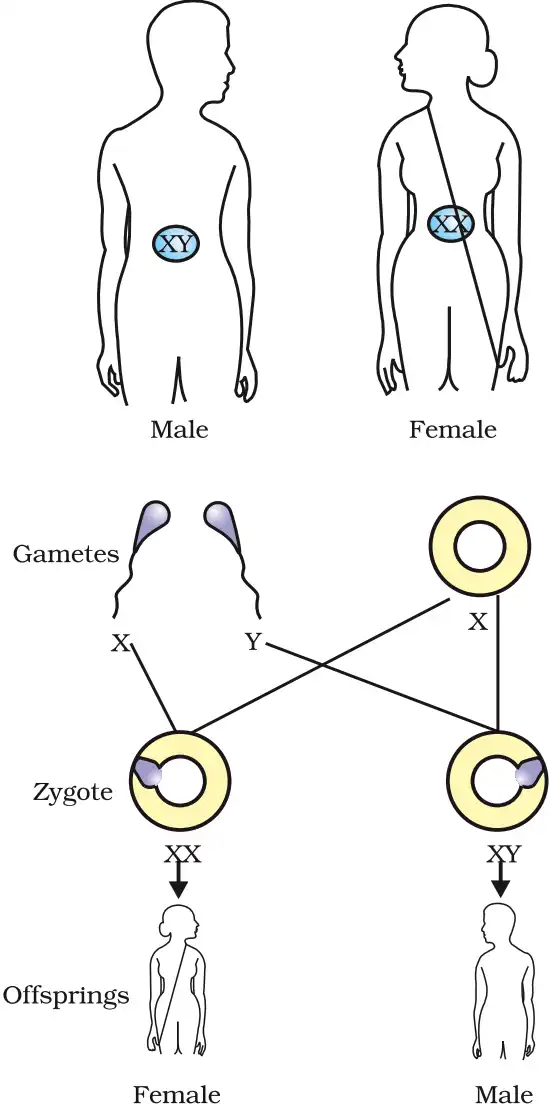
- Autosomes & Sex Chromosomes: Humans possess 22 pairs of matching autosomes and 1 odd pair of sex chromosomes.
- Female Constitution: Human females possess a homologous pair of sex chromosomes designated as XX.
- Male Constitution: Human males possess a heterologous pair of sex chromosomes designated as XY.
- Paternal Determination: All eggs carry an X chromosome; sperm carry either an X or Y chromosome, making the father solely responsible for determining the sex of the child.
Q1: How do human males and females differ in their sex chromosome constitution?
Answer: Human females have a matching pair of X chromosomes (XX), whereas males have a mismatched pair consisting of one X and one Y chromosome (XY).
Q2: Why is the sex of a newborn child determined by the father’s contribution rather than the mother’s?
Answer: Mothers only contribute an X chromosome through every egg. Fathers contribute either an X chromosome (resulting in a girl XX) or a Y chromosome (resulting in a boy XY) via sperm.
Q3 (Application Based): Do all animal species rely on genetic XX/XY chromosomes to determine sex? Explain with examples.
Answer: No. Some species rely on environmental cues; for instance, in certain reptiles, egg incubation temperature determines whether hatchlings become male or female. In other animals like snails, individuals can change sex during their lifetime.
Q4 (Application Based): How does the independent assortment of chromosomes during meiosis ensure genetic stability across sexually reproducing generations?
Answer: Meiosis halves the chromosome number so each germ-cell receives a single set. Fusion of male and female gametes restores the normal paired chromosome number, maintaining species stability.