
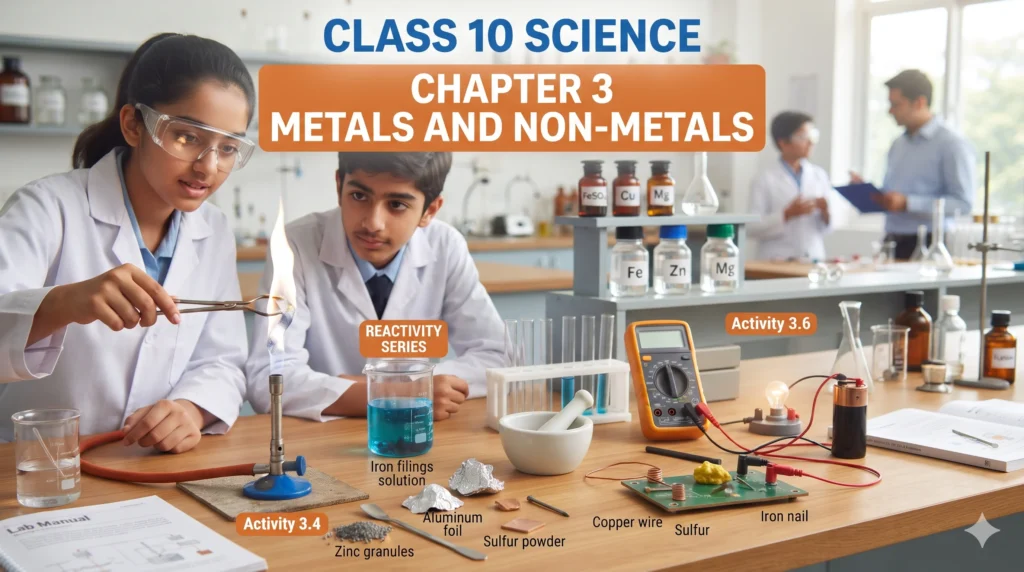
Class 10 Science Chapter 3 Activities | Metals and Non-Metals
Activity 3.1: Metallic Lustre
Observing the Surface Appearance of Metals
Experimental Procedure
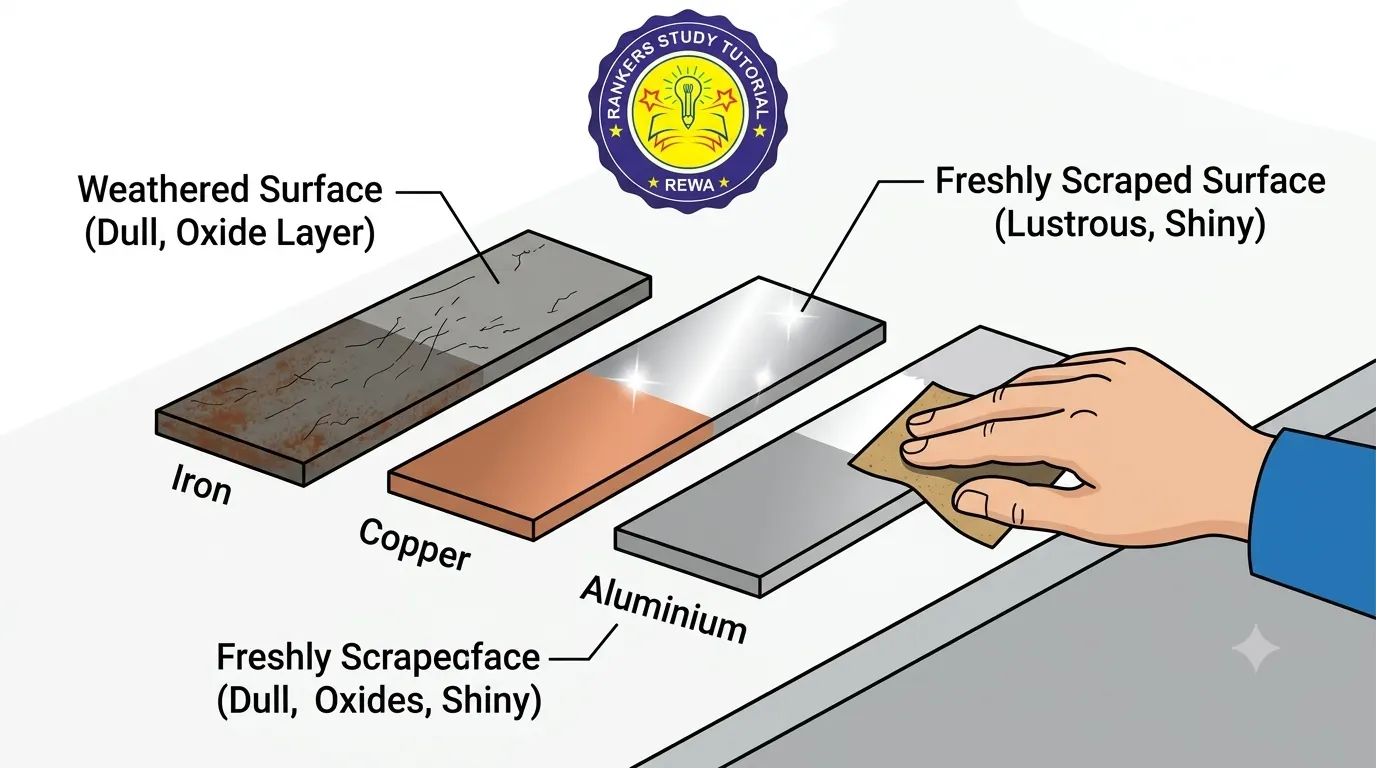
- Collect sample pieces of iron, copper, aluminium, and magnesium.
- Observe and note the initial appearance of each sample.
- Clean the surface of each metallic sample thoroughly by rubbing with sandpaper.
- Note the appearance of each sample once again after cleaning.
Observations & Chemical Mechanism
- Initial Appearance: Metal surfaces often appear dull due to the formation of a thin oxide, carbonate, or sulphide layer from atmospheric exposure.
- After Sandpapering: The freshly exposed metal surface appears shiny and bright.
- Inference: Metals in their pure state possess a characteristic shining surface, a physical property known as metallic lustre.
Q1: What is metallic lustre?
Answer: The property of metals to possess a shining, reflective surface in their pure state is called metallic lustre.
Q2 (Application Based): Why do old copper vessels or iron gates lose their shiny appearance over time when left exposed to humid air?
Answer: Metals react slowly with atmospheric moisture, oxygen, carbon dioxide, or sulphur compounds. This surface corrosion forms dull layers (such as rust on iron or green basic copper carbonate on copper), masking the underlying metallic lustre.
Q3 (Application Based): Why are freshly cut metal samples polished with sandpaper before studying their chemical reactivity in laboratory experiments?
Answer: Polishing removes protective passivating oxide or carbonate films that naturally accumulate on metal surfaces during atmospheric storage, ensuring direct and unhindered contact between the pure metal and chemical reagents.
Q4 (Application Based): Do all solid non-metals lack metallic lustre entirely? Give an exception.
Answer: No. While non-metals generally lack metallic lustre, solid iodine crystals are a notable exception because they possess a distinct, shining crystalline lustre.
Activity 3.2: Hardness of Metals
Testing the Hardness of Various Metals with a Knife
Experimental Procedure
- Take small pieces of iron, copper, aluminium, and magnesium.
- Try to cut each of these metal samples using a sharp knife and record observations.
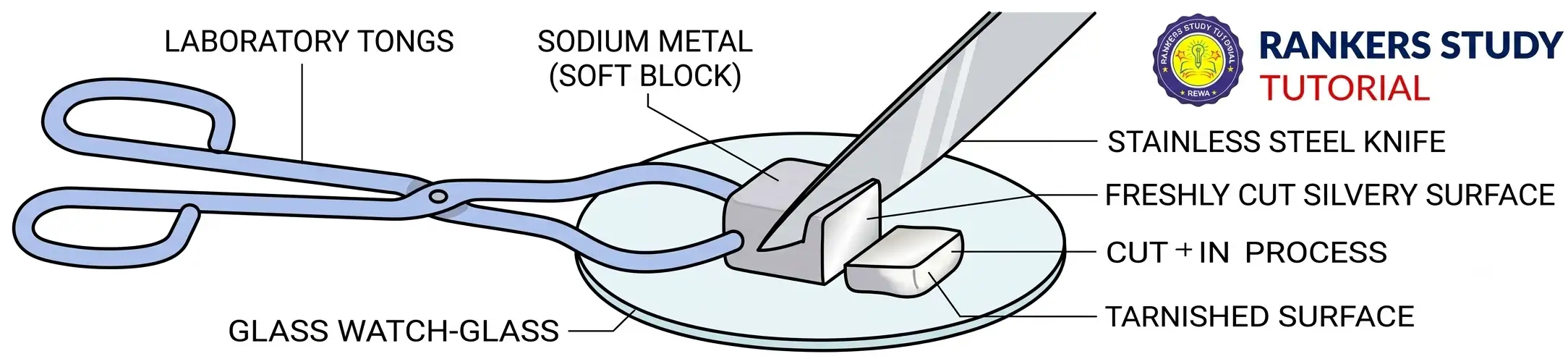
- Hold a small piece of sodium metal securely with a pair of laboratory tongs (handling it with care).
- Dry the sodium metal by pressing gently between folds of filter paper, place it on a watch-glass, and try cutting it with a knife.
Observations & Chemical Mechanism
- General Metals: Iron, copper, aluminium, and magnesium cannot be cut with a knife, showing that structural metals are generally hard.
- Alkali Metals: Sodium (along with potassium and lithium) is exceptionally soft and can be easily sliced with an ordinary knife.
- Inference: Hardness varies significantly from metal to metal.
Q1: Are all metals equally hard? Name a metal that is an exception to this general physical property.
Answer: No, metal hardness varies. Alkali metals such as sodium, potassium, and lithium are notable exceptions because they are extremely soft and can be easily cut with a knife.
Q2 (Application Based): Why is sodium metal stored immersed under kerosene oil rather than kept exposed on a laboratory shelf?
Answer: Sodium is an extremely reactive alkali metal. It reacts vigorously and exothermically with moisture and oxygen present in the air, releasing enough heat to catch fire spontaneously. Storing it under kerosene oil cuts off contact with air and moisture.
Q3 (Application Based): Structural bridge supports and railway tracks are fabricated from iron alloys rather than soft alkali metals. Which physical property dictates this engineering choice?
Answer: Structural integrity requires high mechanical hardness and tensile strength to withstand heavy compressive and shear loads. Alkali metals are far too soft and malleable to support structural loads.
Q4 (Application Based): Why must sodium metal be handled with forceps or tongs rather than bare fingers during laboratory demonstrations?
Answer: Human skin contains moisture (water). If sodium touches damp skin, it reacts exothermically to form caustic sodium hydroxide and hydrogen gas, causing severe chemical and thermal burns.
Activity 3.3: Malleability of Metals
Beating Metals into Thin Sheets with a Hammer
Experimental Procedure
- Collect sample pieces of iron, zinc, lead, and copper.
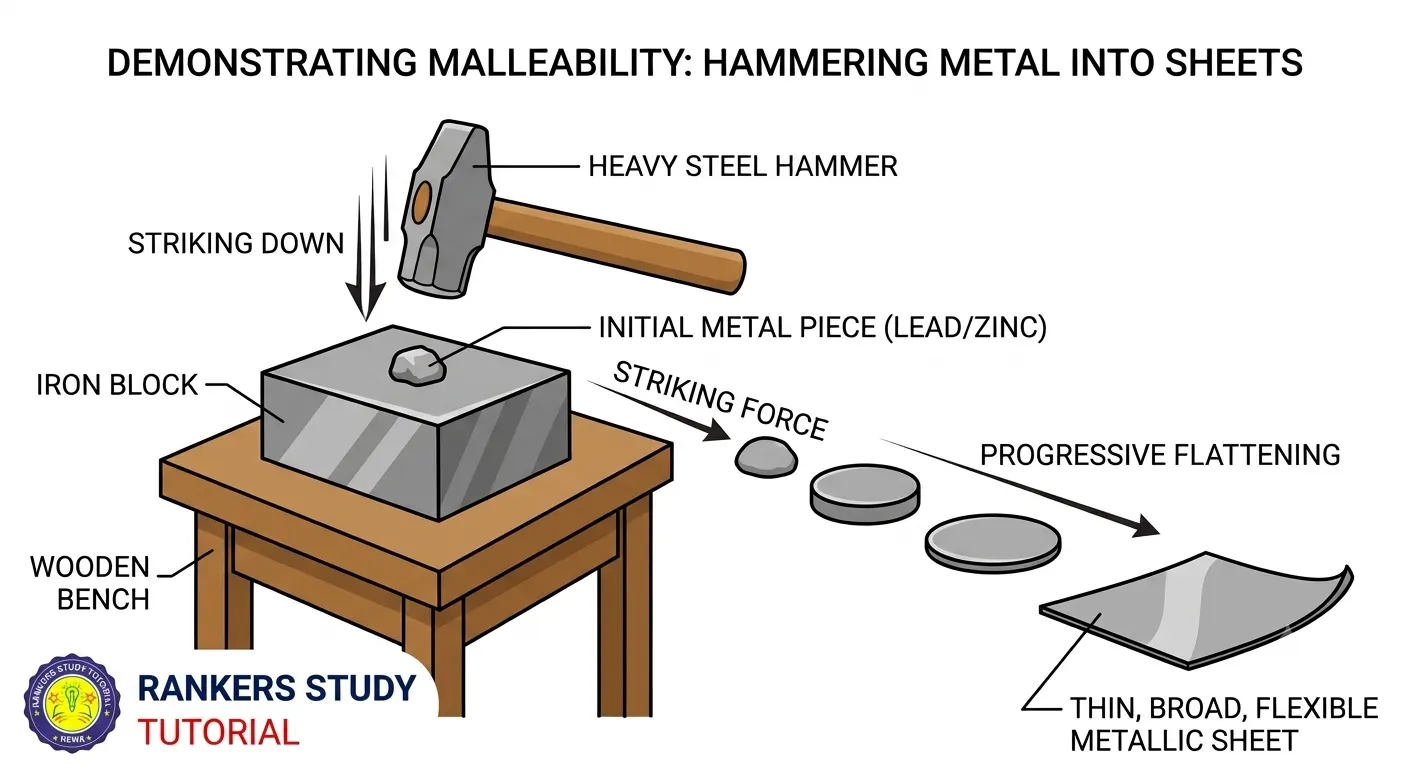
- Place any one chosen metal piece on a solid block of iron.
- Strike the metal block firmly four or five times using a heavy hammer.
- Repeat the process with the remaining metal samples and record shape modifications.
Observations & Chemical Mechanism
- Observation: The metal samples flatten out into thin sheets without shattering.
- Property Defined: The ability of metals to be beaten into thin sheets is called malleability.
- Extreme Examples: Gold and silver are acknowledged as the most malleable metals known.
Q1: Define malleability. Name the two most malleable metals.
Answer: Malleability is the physical property of metals that allows them to be beaten or rolled into thin sheets without breaking. Gold and silver are the most malleable metals.
Q2 (Application Based): Aluminium foil is widely used for wrapping food items and baked goods. Which specific physical property of aluminium makes this possible?
Answer: Aluminium’s high malleability allows it to be mechanically rolled into extremely thin, flexible, airtight sheets that seal in moisture and heat.
Q3 (Application Based): Why do non-metals like coal or sulphur shatter into powder when struck with a hammer instead of flattening into sheets?
Answer: Non-metals are non-malleable and brittle. Their atoms or molecules are held by directional covalent or weak forces that fracture under compressive stress rather than allowing layers to slide past one another.
Q4 (Application Based): Confectionery items are sometimes decorated with extremely thin silver leaf (vark). How does physical metallurgy explain the safety and feasibility of this practice?
Answer: Silver is exceptionally malleable and biologically inert in pure form. It can be beaten into microscopic leaf thicknesses (fractions of a micrometre) without toxic heavy-metal contamination, making it safe for ornamental food presentation.
Activity 3.4: Ductility of Metals
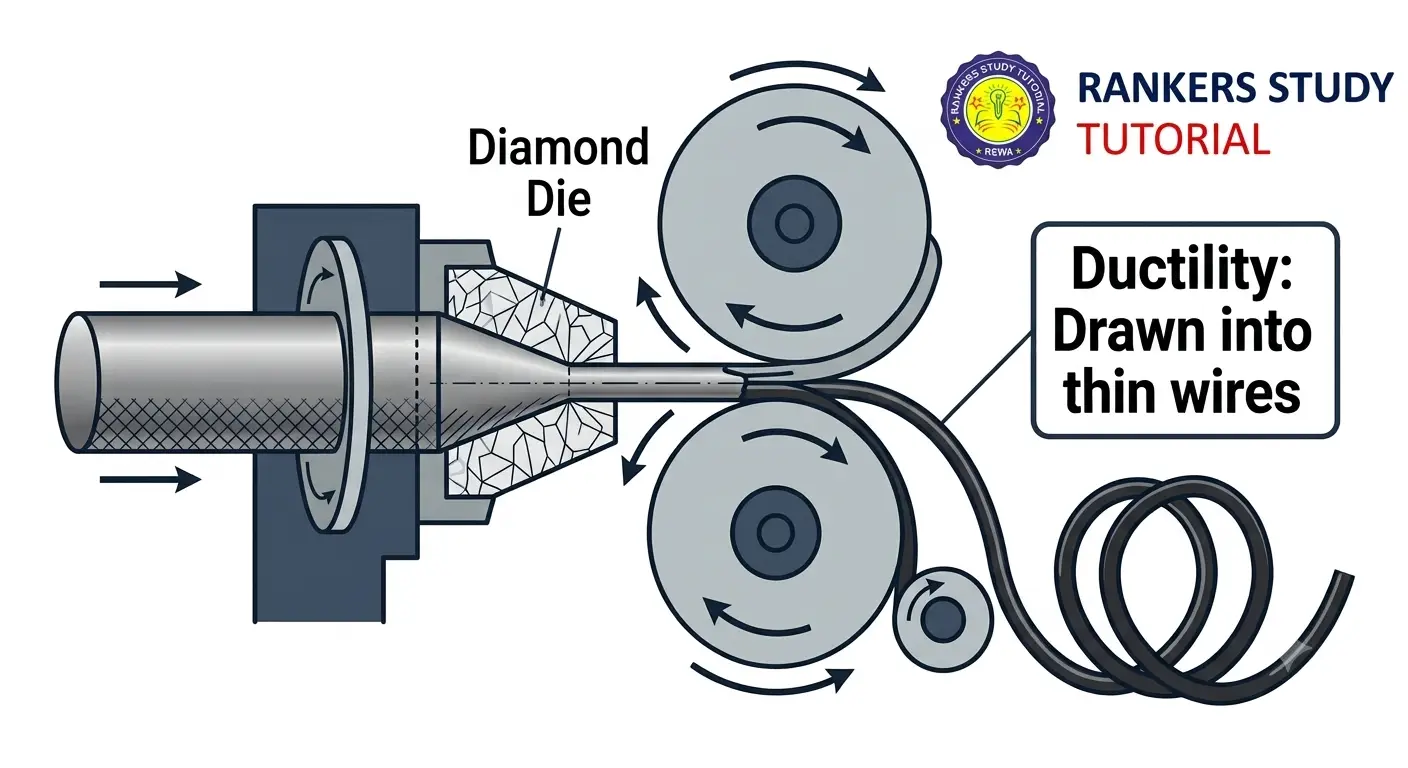
Drawing Metals into Thin Wires
Experimental Procedure
- Examine electrical wiring, household cables, and ornament wire samples observed in daily life.
- Relate the physical form of these metallic wires to the structural property of the underlying elements.
Observations & Chemical Mechanism
- Property Defined: The ability of metals to be drawn into thin wires is called ductility.
- Extreme Example: Gold is the most ductile metal. A wire approximately 2 km in length can be drawn from just 1 gram of pure gold.
Q1: Define ductility. Which metal is considered the most ductile?
Answer: Ductility is the ability of metals to be stretched or drawn into thin wires. Gold is the most ductile metal.
Q2 (Application Based): Copper and aluminium wires are universally used for domestic electrical power transmission. Which physical properties of these metals are responsible for this application?
Answer: Their high ductility allows them to be drawn into flexible wires, and their high electrical conductivity ensures efficient transmission of electric current with minimal energy loss.
Q3 (Application Based): Why can platinum and gold be drawn into fine wires for micro-circuitry and surgical filaments, while glass fibers require melting and specialized drawing?
Answer: Metals like gold and platinum possess metallic bonding with a sea of mobile electrons, allowing atomic planes to slip past each other smoothly under tensile stress (high ductility). Glass is an amorphous network solid that is brittle at room temperature and must be molten to be pulled into fibers.
Q4 (Application Based): If 1 gram of gold can be drawn into a 2 km long wire, calculate the average cross-sectional diameter or linear property implications of such microscopic wire.
Answer: This highlights the extreme ductility of gold, demonstrating that metallic lattices can maintain structural continuity and tensile strength even when stretched into nanoscale cross-sections.
Activity 3.5: Thermal Conductivity of Metals
Heat Conduction Through Metal Wires and Melting of Wax
Experimental Procedure
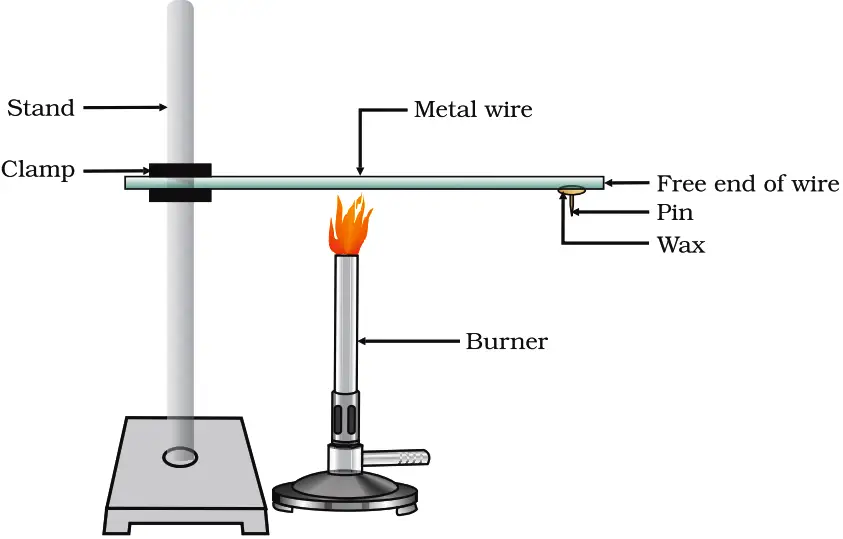
- Take an aluminium or copper wire and clamp it horizontally on a laboratory stand.
- Fix a small metal pin to the free end of the wire using a small drop of molten wax.
- Heat the wire with a spirit lamp, candle, or burner near the point where it is clamped.
- Observe what happens to the pin after some time and note whether the wire melts.
Observations & Chemical Mechanism
- Observation: Heat transfers rapidly through the metal wire; upon reaching the far end, the wax melts, causing the pin to drop off. The metal wire itself does not melt.
- Inference: Metals are good conductors of heat and possess high melting points. Silver and copper are the best conductors of heat, whereas lead and mercury are comparatively poor conductors.
Q1: Name the two metals that are the best conductors of heat, and two metals that are poor conductors.
Answer: Silver and copper are the best conductors of heat. Lead and mercury are comparatively poor conductors of heat.
Q2 (Application Based): Cooking utensils are commonly manufactured from copper or aluminium, whereas domestic hot water storage tanks are sometimes made of copper rather than steel. Why?
Answer: Copper and aluminium are excellent thermal conductors, allowing rapid transfer of heat from the burner to food. Furthermore, copper does not corrode easily when in contact with hot water, making it ideal for hot water storage tanks.
Q3 (Application Based): Why are engine heat sinks in computers and automobiles manufactured from aluminium or copper fins?
Answer: Their high thermal conductivity allows them to rapidly absorb and dissipate thermal energy away from sensitive components into the surrounding air.
Q4 (Application Based): Mercury is liquid at room temperature and is a poor thermal conductor compared to copper. Yet, why was it historically used in precision glass thermometers?
Answer: Mercury has a uniform coefficient of thermal expansion across a wide temperature range, does not wet glass walls, and remains liquid over a broad span (-39°C to 356°C), making it reliable for temperature measurement despite lower conductivity than solid metals.
Activity 3.6: Electrical Conductivity of Metals
Testing Electrical Continuity Through Metal Samples in a Circuit
Experimental Procedure
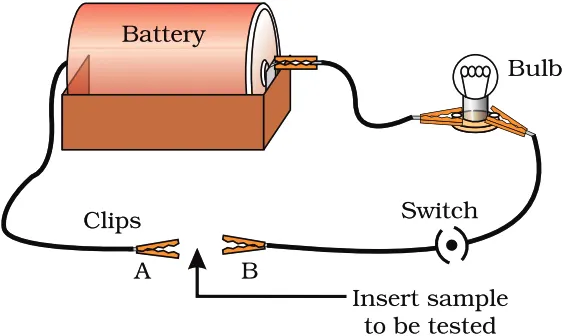
- Set up an electric circuit consisting of a battery, an electric bulb, a switch, and connecting wires with crocodile clips A and B.
- Insert the metal sample to be tested into the circuit between terminals A and B.
- Close the switch and observe whether the bulb glows.
Observations & Chemical Mechanism
- Observation: The electric bulb lights up immediately when the metal sample is inserted between clips A and B.
- Inference: Metals permit electric current to flow freely through them, proving they are good conductors of electricity.
Q1: Why do electric wires carrying current in homes have an outer coating of polyvinylchloride (PVC) or rubber?
Answer: PVC and rubber are non-metals and act as electrical insulators. Coating live metal wires prevents accidental electrical shocks and short circuits.
Q2 (Application Based): What property of metals explains why school bells are manufactured from solid metal blocks?
Answer: Metals are sonorous, meaning they produce a deep ringing sound when struck against a hard surface.
Q3 (Application Based): Silver is a better electrical conductor than copper, yet high-voltage power lines use aluminium or copper instead of silver. Explain the economic and practical reasoning.
Answer: While silver has the highest electrical conductivity, it is extremely rare, expensive, and heavy. Copper and aluminium provide very high conductivity at a fraction of the cost and weight.
Q4 (Application Based): If a piece of dry wood or plastic ruler is placed between terminals A and B in Activity 3.6, the bulb remains unlit. What does this indicate?
Answer: Wood and plastic lack mobile charge carriers (free electrons or ions), classifying them as electrical insulators.
Activity 3.7: Physical Properties of Non-metals
Comparing Carbon, Sulphur, and Iodine Against Metallic Properties
Experimental Procedure
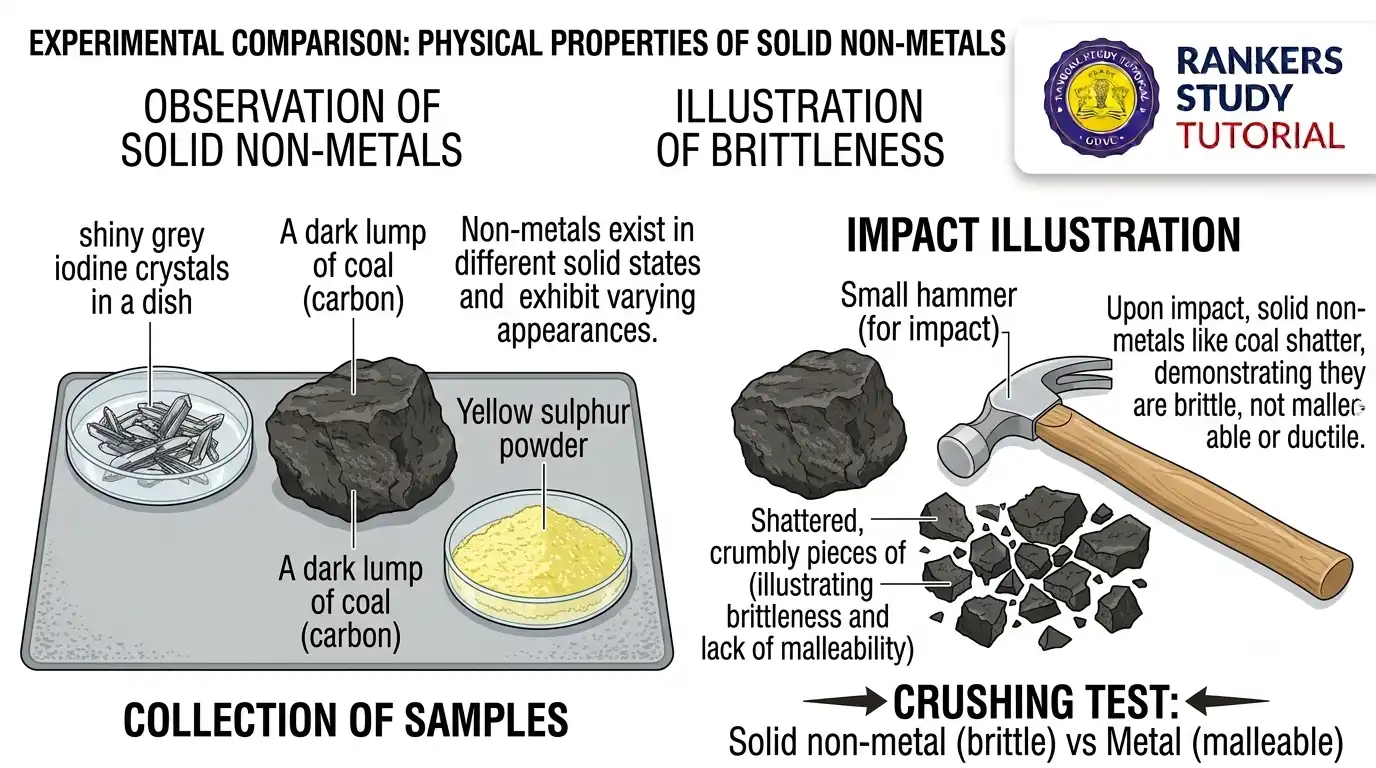
- Collect solid non-metal samples: carbon (coal/graphite), sulphur, and iodine.
- Examine their physical appearance (lustre), hardness, malleability, ductility, sonority, and electrical conductivity by repeating Activities 3.1 to 3.4 and 3.6.
- Record all observations systematically.
Observations & Chemical Mechanism
- Observation: Unlike metals, solid non-metals are generally soft and brittle, lack metallic lustre, cannot be beaten into sheets (non-malleable), cannot be drawn into wires (non-ductile), and do not conduct electricity or sound.
- Exceptions: Iodine is a non-metal that possesses lustre; graphite (an allotrope of carbon) conducts electricity; diamond is the hardest natural substance known.
Q1: State three physical properties that distinguish non-metals from metals.
Answer: Non-metals are generally non-lustrous (except iodine), brittle (non-malleable and non-ductile), and poor conductors of heat and electricity (except graphite).
Q2 (Application Based): Graphite is a non-metal, yet it is widely used to make carbon electrodes in electrolytic cells. Explain why.
Answer: Unlike most non-metals which are electrical insulators, graphite (an allotrope of carbon) has free delocalized electrons within its layered hexagonal crystal structure, making it a good conductor of electricity.
Q3 (Application Based): Diamond is an allotrope of carbon that is the hardest natural substance known with an extremely high melting point, whereas graphite is soft and slippery. How can the same element exhibit such divergent physical properties?
Answer: This is due to allotropy caused by differences in crystal bonding. In diamond, each carbon is bonded to four others in a rigid 3D tetrahedral network. In graphite, carbon atoms are bonded in flat hexagonal layers held by weak van der Waals forces that slide easily.
Q4 (Application Based): Bromine is unique among non-metals in its physical state at room temperature. State its state and color.
Answer: Bromine is the only non-metal that exists as a volatile, dark red-brown liquid at room temperature.
Activity 3.8: Acidic and Basic Nature of Oxides
Testing the Aqueous Solutions of Magnesium Oxide and Sulphur Dioxide with Litmus
Experimental Procedure
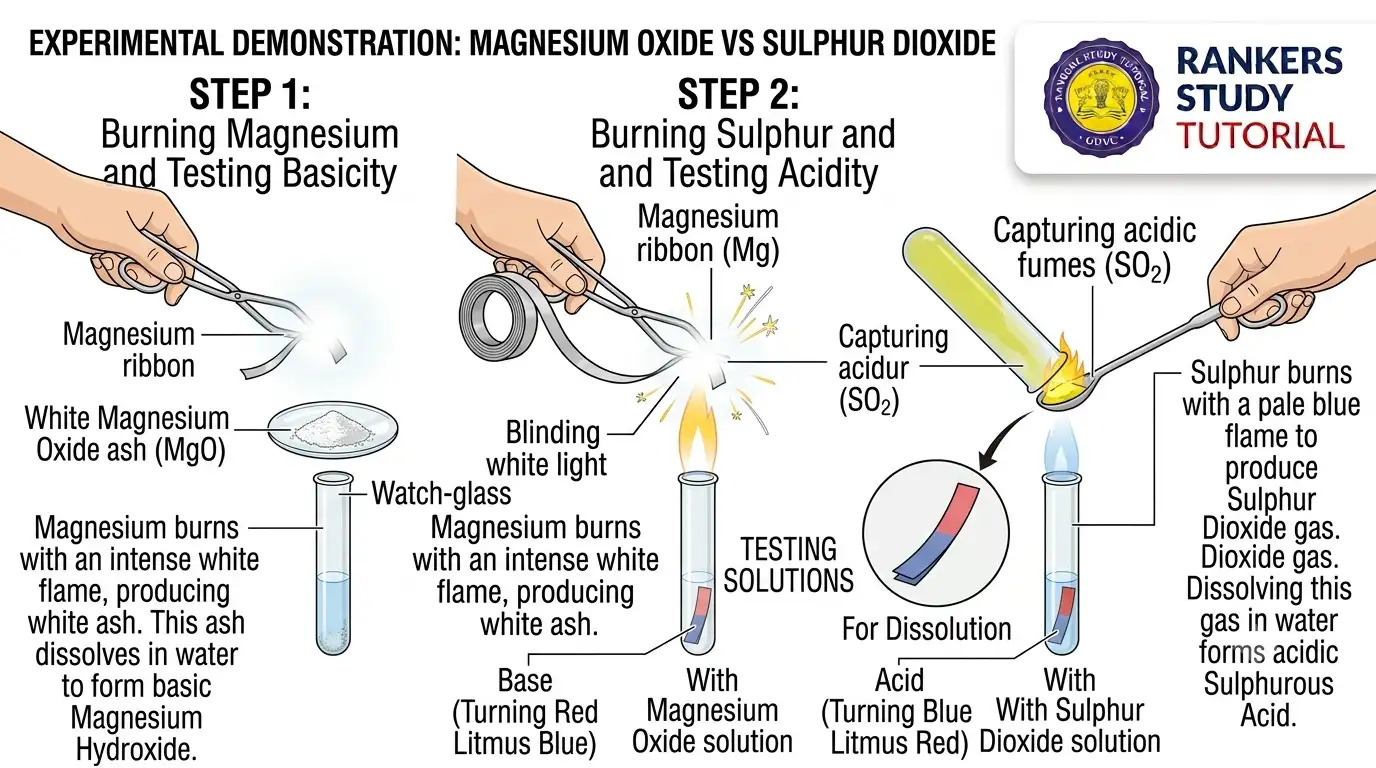
- Burn a clean magnesium ribbon in air and collect the white ash.
- Dissolve the magnesium ash in distilled water and test the resulting solution with red and blue litmus paper.
- Burn sulphur powder in a spoon and invert a test tube over it to capture the generated fumes.
- Add water to the test tube containing sulphur fumes, shake well, and test with red and blue litmus paper.
Observations & Chemical Mechanism
- Magnesium Oxide Solution: Turns moist red litmus blue, proving that metallic oxides are basic in nature:
MgO(s) + H₂O(l) → Mg(OH)₂(aq) - Sulphur Dioxide Solution: Turns moist blue litmus red, proving that non-metallic oxides are acidic in nature:
SO₂(g) + H₂O(l) → H₂SO₃(aq)
Q1: What is the nature of the oxides formed by metals and non-metals when dissolved in water?
Answer: Most metals form basic oxides that turn red litmus blue. Most non-metals form acidic oxides that turn blue litmus red.
Q2 (Application Based): What are amphoteric oxides? Give two textbook examples.
Answer: Amphoteric oxides are metal oxides that react with both acids and bases to produce salts and water. Examples include aluminium oxide (
Al₂O₃) and zinc oxide (ZnO).Q3 (Application Based): Write balanced equations for the reaction of amphoteric zinc oxide with both hydrochloric acid and sodium hydroxide.
Answer:
• With acid:
• With base:
• With acid:
ZnO(s) + 2HCl(aq) → ZnCl₂(aq) + H₂O(l)• With base:
ZnO(s) + 2NaOH(aq) → Na₂ZnO₂ + H₂O(l) (Sodium zincate)
Q4 (Application Based): Carbon monoxide (CO) and water (H₂O) are oxides that show no acidic or basic action on litmus paper. How are such non-metal oxides classified?
Answer: They are classified as neutral oxides because they neither react with acids nor bases under standard conditions and do not change litmus color.
Activity 3.9: Reactivity of Metals with Oxygen
Burning Metal Samples in Air and Evaluating Reactivity
Experimental Procedure
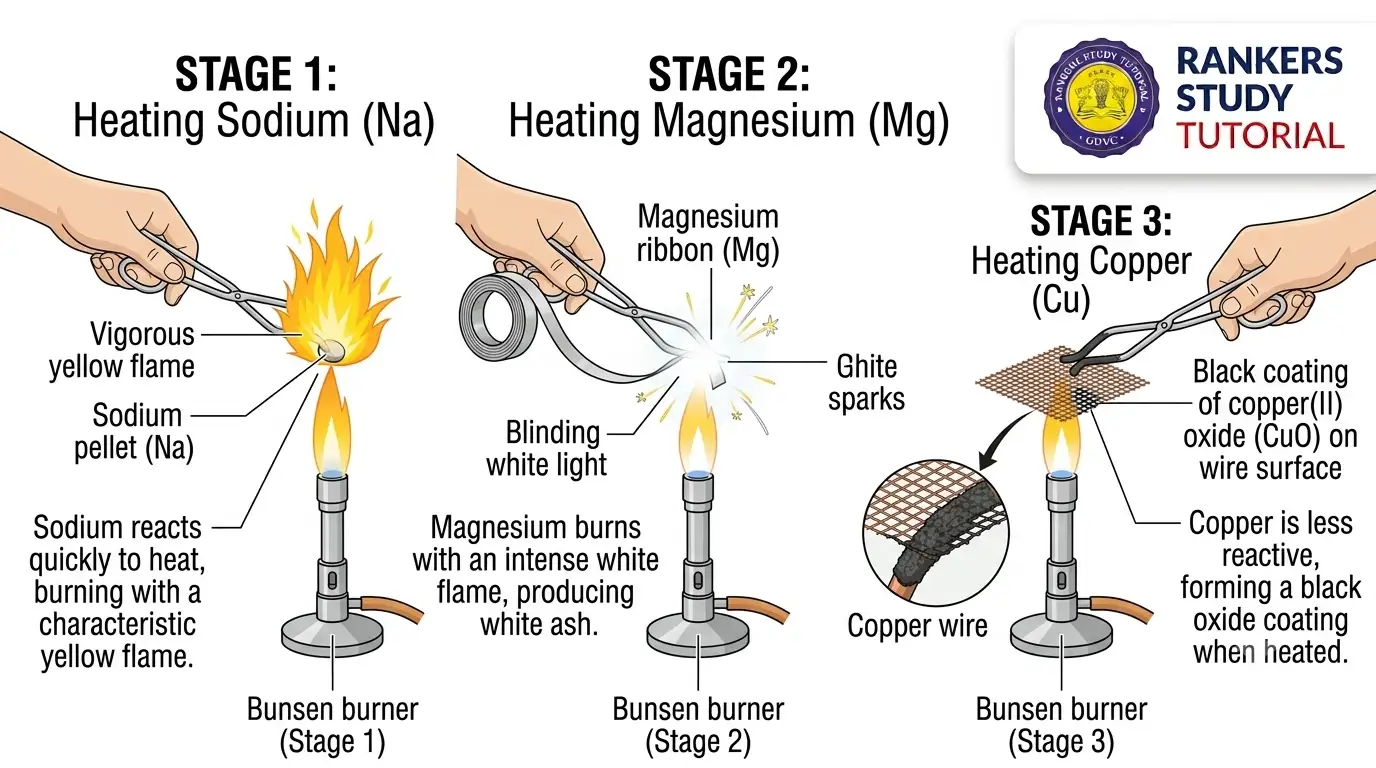
- Hold metal samples (aluminium, copper, iron, lead, magnesium, zinc, sodium) with a pair of tongs and heat them over a burner flame.
- Observe which metals catch fire easily, note their flame colors, and inspect the appearance of the residue after cooling.
- Arrange the metals in decreasing order of reactivity towards oxygen.
Observations & Chemical Mechanism
- Sodium & Potassium: React so vigorously with oxygen that they catch fire spontaneously in air and are stored under kerosene.
- Magnesium: Burns with a dazzling white flame to form white MgO.
- Copper: Does not burn, but gets coated with a black layer of copper(II) oxide:
2Cu + O₂ → 2CuO. - Silver & Gold: Do not react with oxygen even at high temperatures.
Q1: Why are sodium and potassium metals kept immersed under kerosene oil?
Answer: They react so vigorously with atmospheric oxygen that they catch fire if kept in the open. Immersion in kerosene prevents accidental fires.
Q2 (Application Based): What is anodising, and how does it protect aluminium articles from corrosion?
Answer: Anodising is the process of electrolytically forming a thick, protective oxide layer on aluminium using dilute sulphuric acid as the electrolyte. This thicker oxide layer improves corrosion resistance and can be dyed for decorative finishes.
Q3 (Application Based): Why does iron not burn when heated on a spatula, yet iron filings burn vigorously when sprinkled into a Bunsen burner flame?
Answer: Iron filings provide a massive surface-area-to-mass ratio, allowing rapid heat transfer and complete oxygen contact that enables vigorous combustion, whereas a solid iron block dissipates heat quickly and forms a protective scale.
Q4 (Application Based): Gold and platinum are used to craft high-end jewelry that maintains its mirror-like finish for centuries. What chemical property accounts for this durability?
Answer: Gold and platinum are noble metals positioned at the very bottom of the reactivity series, meaning they do not undergo oxidation or react with atmospheric oxygen, moisture, or mild acids even at elevated temperatures.
Activity 3.10: Reactivity of Metals with Water
Reaction of Metals with Cold Water, Hot Water, and Steam
Experimental Procedure
- Place small pieces of metal samples into beakers half-filled with cold water.
- Test metals that do not react with cold water in hot water.
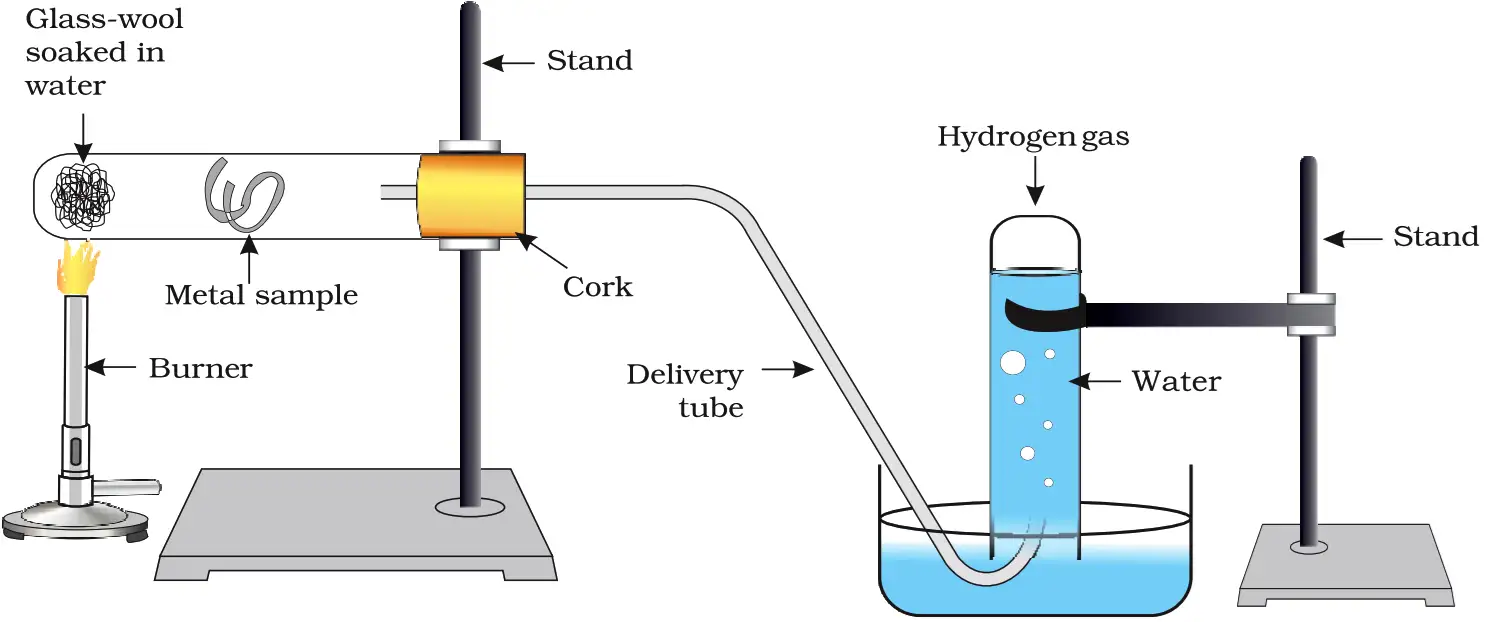
- For unreactive metals, set up the steam apparatus (Fig. 3.3) using glass-wool soaked in water and heated metal.
Observations & Chemical Mechanism
- Cold Water: Potassium and sodium react violently and exothermically, igniting the evolved hydrogen:
2Na + 2H₂O → 2NaOH + H₂↑ + Heat. Calcium reacts less violently and floats due to hydrogen bubbles sticking to its surface. - Hot Water: Magnesium reacts with hot water and floats due to hydrogen bubbles.
- Steam: Aluminium, iron, and zinc do not react with liquid water but react with steam to form metal oxides and hydrogen:
3Fe + 4H₂O(g) → Fe₃O₄ + 4H₂.
Q1: Why does calcium start floating when it reacts with water?
Answer: Hydrogen gas bubbles liberated during the reaction stick to the surface of the calcium metal, causing it to float.
Q2 (Application Based): Write the balanced chemical equation for the reaction of iron with steam.
Answer:
3Fe(s) + 4H₂O(g) → Fe₃O₄(s) + 4H₂(g).Q3 (Application Based): Why do lead, copper, silver, and gold fail to react with steam or boiling water?
Answer: These metals lie below hydrogen in the reactivity series and possess lower electropositive reducing power, making them incapable of reducing water molecules to liberate hydrogen gas.
Q4 (Application Based): If a piece of potassium metal is dropped into cold water, the reaction is extremely violent. Write the balanced equation including heat energy.
Answer:
2K(s) + 2H₂O(l)
→
2KOH(aq) + H₂(g) + Heat Energy
Activity 3.11: Reactivity of Metals with Dilute Acids
Reaction Rates and Temperature Changes with Dilute Hydrochloric Acid
Experimental Procedure
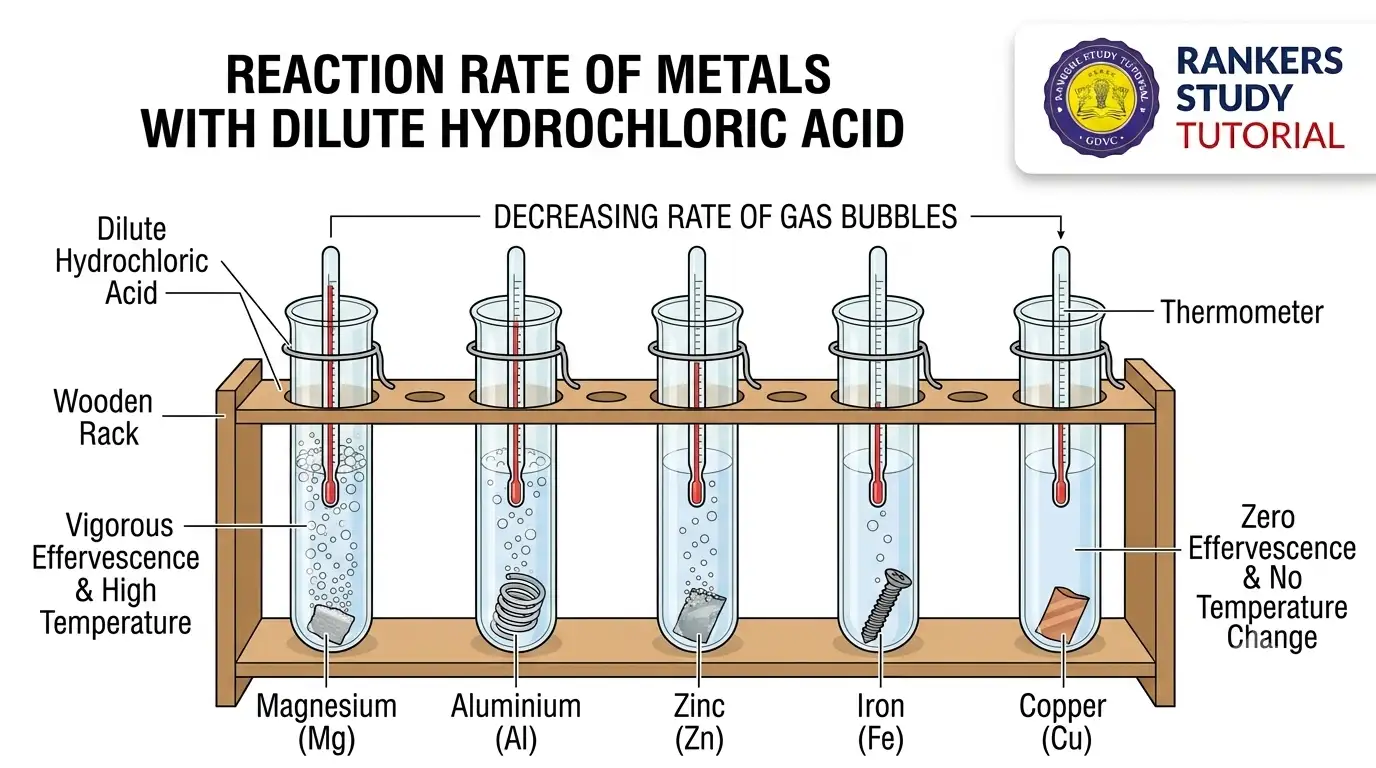
- Place clean metal samples (excluding sodium and potassium) into separate test tubes containing dilute hydrochloric acid.
- Suspend thermometers in each test tube to monitor temperature changes.
- Observe the rate at which gas bubbles evolve and rank the metals by reactivity.
Observations & Chemical Mechanism
- Bubble Rate & Temperature: Magnesium reacts most vigorously with the fastest bubble formation and highest temperature spike, followed by aluminium, zinc, and iron (
Mg > Al > Zn > Fe). - Copper: Shows no gas evolution and no temperature change, indicating no reaction with dilute HCl.
- Nitric Acid Exception: HNO₃ is a strong oxidizing agent that oxidizes evolved H₂ to water, except with Mg and Mn which liberate H₂ at very high dilutions.
Q1: Why is hydrogen gas typically not evolved when metals react with nitric acid?
Answer: Nitric acid is a strong oxidizing agent; it oxidizes the hydrogen gas produced during the reaction into water (H₂O) while being reduced to nitrogen oxides (NO₂, NO, N₂O).
Q2 (Application Based): What is aqua regia, and what is its unique capability?
Answer: Aqua regia is a freshly prepared 3:1 mixture of concentrated hydrochloric acid and concentrated nitric acid. It is a highly corrosive fuming liquid capable of dissolving noble metals like gold and platinum.
Q3 (Application Based): Magnesium and manganese are exceptions that liberate hydrogen gas when reacted with very dilute nitric acid. Explain why.
Answer: At extremely high dilutions, the oxidizing power of dilute HNO₃ drops significantly, allowing active metals like magnesium and manganese to displace hydrogen gas without complete oxidation into water.
Q4 (Application Based): How can you experimentally determine whether an unknown metal sample is more reactive than hydrogen?
Answer: Drop a sample of the metal into dilute hydrochloric or sulphuric acid. If bubbles of hydrogen gas evolve (confirmed by a pop test), the metal is more reactive than hydrogen (positioned above hydrogen in the activity series).
Activity 3.12: Metal Displacement Reactions
Displacement of Metals from Salt Solutions
Experimental Procedure
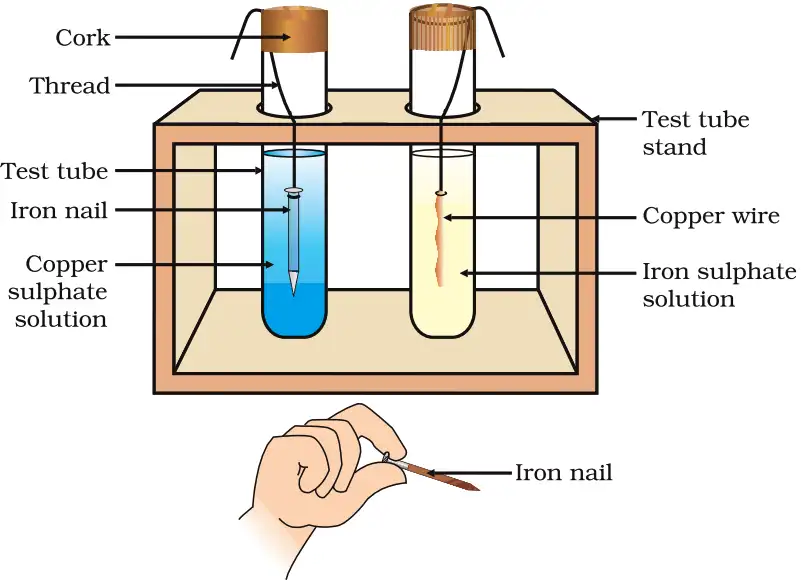
- Take a clean copper wire and an iron nail.
- Place the copper wire into an iron(II) sulphate solution and the iron nail into a copper sulphate solution (Fig. 3.4).
- Record observations after 20 minutes.
Observations & Chemical Mechanism
- Observation: The iron nail in copper sulphate gets coated with brown copper, and the blue solution fades to green. The copper wire in iron sulphate shows no reaction.
- Inference: Iron is more reactive than copper and displaces it from its salt solution.
Q1: How do displacement reactions help establish the activity series of metals?
Answer: A more reactive metal displaces a less reactive metal from its salt solution, establishing their relative positions in the reactivity series.
Q2 (Application Based): List the top 5 most reactive metals in the reactivity series in decreasing order.
Answer: Potassium (K), Sodium (Na), Calcium (Ca), Magnesium (Mg), and Aluminium (Al).
Q3 (Application Based): If a zinc rod is immersed in an aqueous solution of copper(II) sulphate, what color changes will occur in the solution and on the zinc rod?
Answer: Zinc is more reactive than copper and displaces it:
Zn + CuSO₄ → ZnSO₄ + Cu. The deep blue color of copper sulphate fades into a colorless zinc sulphate solution, and reddish-brown copper metal deposits onto the zinc rod.Q4 (Application Based): Can silver nitrate solution be stored in a copper vessel? Justify with reasoning.
Answer: No, silver nitrate cannot be stored in a copper vessel. Copper is more reactive than silver and will displace silver from solution:
Cu + 2AgNO₃ → Cu(NO₃)₂ + 2Ag↓, creating holes in the copper vessel and contaminating the solution.Activity 3.13: Properties of Ionic Compounds
Testing Melting Points, Solubility, and Electrical Conductivity of Salts
Experimental Procedure
- Collect samples of sodium chloride, potassium iodide, and barium chloride.
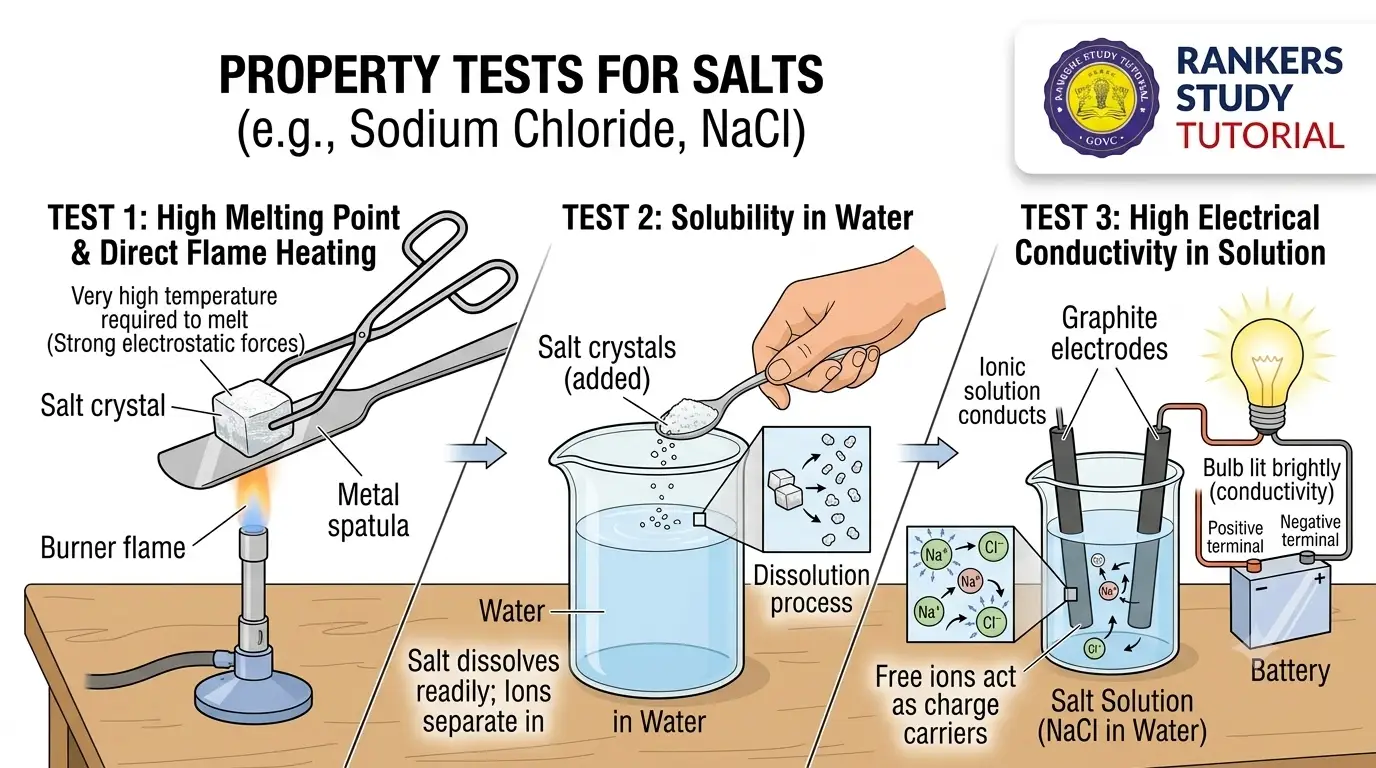
- Test their physical state, heat them on a metal spatula, test solubility in water, petrol, and kerosene, and check electrical conductivity in solution (Fig. 3.8).
Observations & Chemical Mechanism
- Physical Nature: Ionic compounds are hard, brittle solids.
- Melting & Boiling Points: High, due to strong inter-ionic electrostatic forces.
- Solubility: Soluble in polar solvents like water; insoluble in non-polar solvents like kerosene and petrol.
- Conductivity: Conduct electricity in molten state or aqueous solution due to mobile ions, but not in solid state.
Q1: Why do ionic compounds conduct electricity in the molten state but not in the solid state?
Answer: In the solid state, ion movement is restricted by a rigid crystal lattice. In the molten state, heat overcomes electrostatic forces, allowing ions to move freely and conduct electricity.
Q2 (Application Based): Why do ionic compounds possess exceptionally high melting and boiling points?
Answer: A considerable amount of thermal energy is required to overcome the strong electrostatic forces of attraction between oppositely charged ions.
Q3 (Application Based): Why are ionic solids typically brittle rather than malleable when struck with mechanical force?
Answer: When a sharp blow shifts the planes of an ionic crystal, ions of like charge (e.g., positive next to positive) are brought side by side. The resulting electrostatic repulsion causes the crystal to cleave and shatter abruptly.
Q4 (Application Based): Why do ionic compounds dissolve readily in polar solvents like water while remaining insoluble in non-polar solvents like petrol?
Answer: Water molecules are polar, with partial positive and negative charges that attract and stabilize ions, breaking down the crystal lattice. Non-polar solvents lack these dipole interactions and cannot overcome inter-ionic forces.
Activity 3.14: Conditions Necessary for Rusting
Investigating the Roles of Air and Moisture in Iron Corrosion
Experimental Procedure
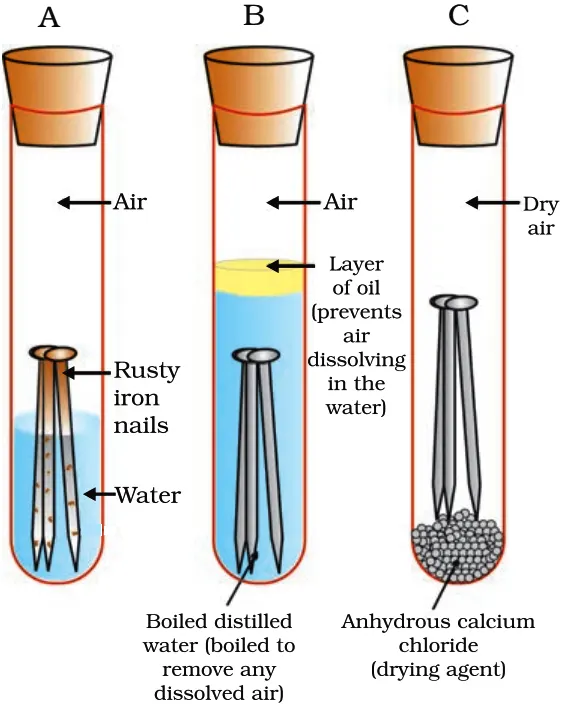
- Place clean iron nails in three test tubes labeled A, B, and C (Fig. 3.13).
- Tube A: Nails exposed to ordinary air and water.
- Tube B: Nails immersed in boiled distilled water with an oil layer to block dissolved air.
- Tube C: Nails kept with anhydrous calcium chloride to ensure completely dry air.
Observations & Chemical Mechanism
- Observation: Iron nails rust only in test tube A where both air and moisture are present; no rusting occurs in tubes B (water only) or C (dry air).
- Inference: Both oxygen and moisture are mutually required for the rusting of iron.
Q1: What are the necessary conditions for the rusting of iron?
Answer: The presence of both oxygen (air) and moisture (water) is essential for iron to rust.
Q2 (Application Based): What is galvanisation, and why does it protect steel even if the zinc coating gets scratched?
Answer: Galvanisation is coating iron or steel with a thin layer of zinc. Zinc is more reactive than iron, so it undergoes sacrificial oxidation first, protecting the underlying iron even when the outer zinc layer is breached.
Q3 (Application Based): Why is a layer of oil added to boiled distilled water in test tube B in Activity 3.14?
Answer: Boiling removes dissolved oxygen from water. Pouring an oil layer on top prevents atmospheric oxygen from dissolving back into the water, ensuring the nails are exposed exclusively to air-free water.
Q4 (Application Based): Why does anhydrous calcium chloride placed at the bottom of test tube C prevent iron nails from rusting?
Answer: Anhydrous calcium chloride is a powerful hygroscopic drying agent (desiccant) that absorbs all residual moisture vapor from the air inside the sealed test tube, creating an oxygen-only dry environment where rusting cannot occur.