
Class 10 Science Chapter 4 Activities | Carbon and its Compounds
Activity 4.1: Versatility and Presence of Carbon in Daily Life
Classification of Everyday Objects and Detection of Carbon Compounds
Experimental Procedure
- Make a list of ten common items used, worn, or consumed since morning.
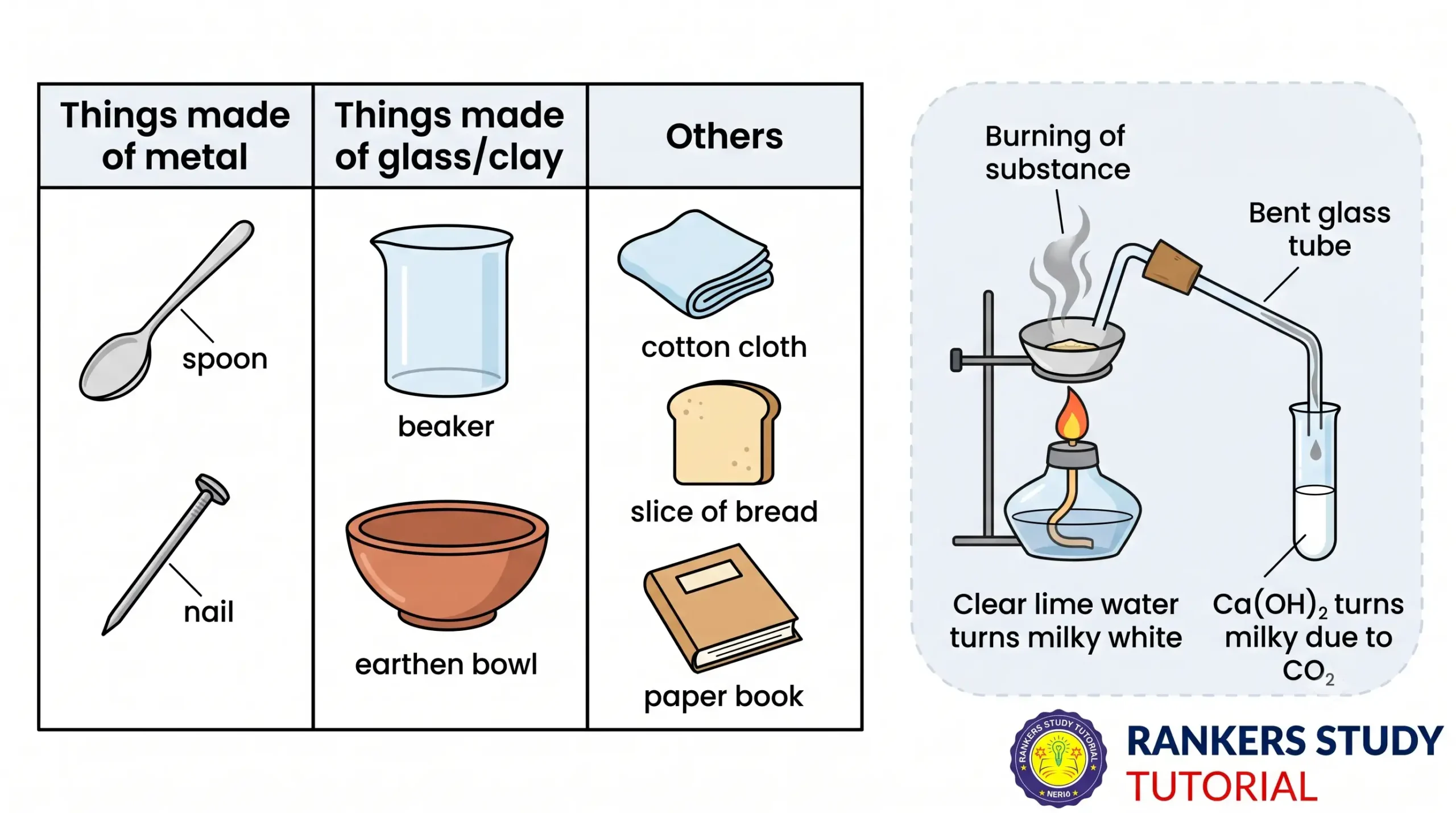
- Group these items into three designated columns: Things made of metal, Things made of glass/clay, and Others.
- Examine the items sorted into the ‘Others’ column (such as food, garments, books, and plastics).
- Burn a small representative organic sample to test for the release of combustion products.
Observations & Chemical Mechanism
- Observation: Nearly all items categorized under the ‘Others’ column originate from biological or synthetic organic sources.
- Combustion Product: Carbon-based substances burn in atmospheric oxygen to produce carbon dioxide (CO₂) and water.
- Confirmation Test: Directing the combustion gas through lime water [Ca(OH)₂] turns it milky due to insoluble calcium carbonate precipitation:
Ca(OH)₂(aq) + CO₂(g) → CaCO₃(s) + H₂O(l) - Inference: Carbon forms the structural backbone of food, clothing, medicines, books, and all living organisms despite its low abundance in the earth’s crust (0.02%) and atmosphere (0.03%).
Q1: What product is universally obtained when a carbon-containing compound undergoes combustion, and how is it confirmed chemically?
Answer: Combustion of carbon-containing compounds releases carbon dioxide gas (CO₂). Passing this gas into clear lime water turns it milky due to the formation of insoluble calcium carbonate (CaCO₃).
Q2: State the natural abundance of carbon in the earth’s crust and in the atmosphere.
Answer: Carbon is present in the earth’s crust to the extent of only 0.02% as minerals (carbonates, hydrogen carbonates, coal, and petroleum) and in the atmosphere to the extent of 0.03% as carbon dioxide.
Q3 (Application Based): A forensic scientist burns an unidentified fabric fiber. The evolved gas turns lime water turbid, and a black char residue remains. What does this confirm regarding the molecular nature of the fiber?
Answer: The release of CO₂ and the formation of a black char of unburned elemental carbon confirm that the fiber is an organic polymer constructed on a carbon skeleton, such as natural cotton (cellulose), wool/silk (protein), or a synthetic polyester/nylon chain.
Q4 (Application Based): Why does carbon form covalent bonds rather than forming C⁴⁺ cations or C⁴⁻ anions?
Answer: Carbon has atomic number 6 with electronic configuration (2, 4). Gaining 4 electrons to form C⁴⁻ would make it difficult for a nucleus with 6 protons to hold 10 electrons. Losing 4 electrons to form C⁴⁺ would require a large amount of energy to overcome nuclear pull. Carbon overcomes this by sharing its 4 valence electrons with other atoms.
Activity 4.2: Homologous Series of Alcohols
Formula Differences, Molecular Mass Increments, and Property Gradation
Experimental Procedure
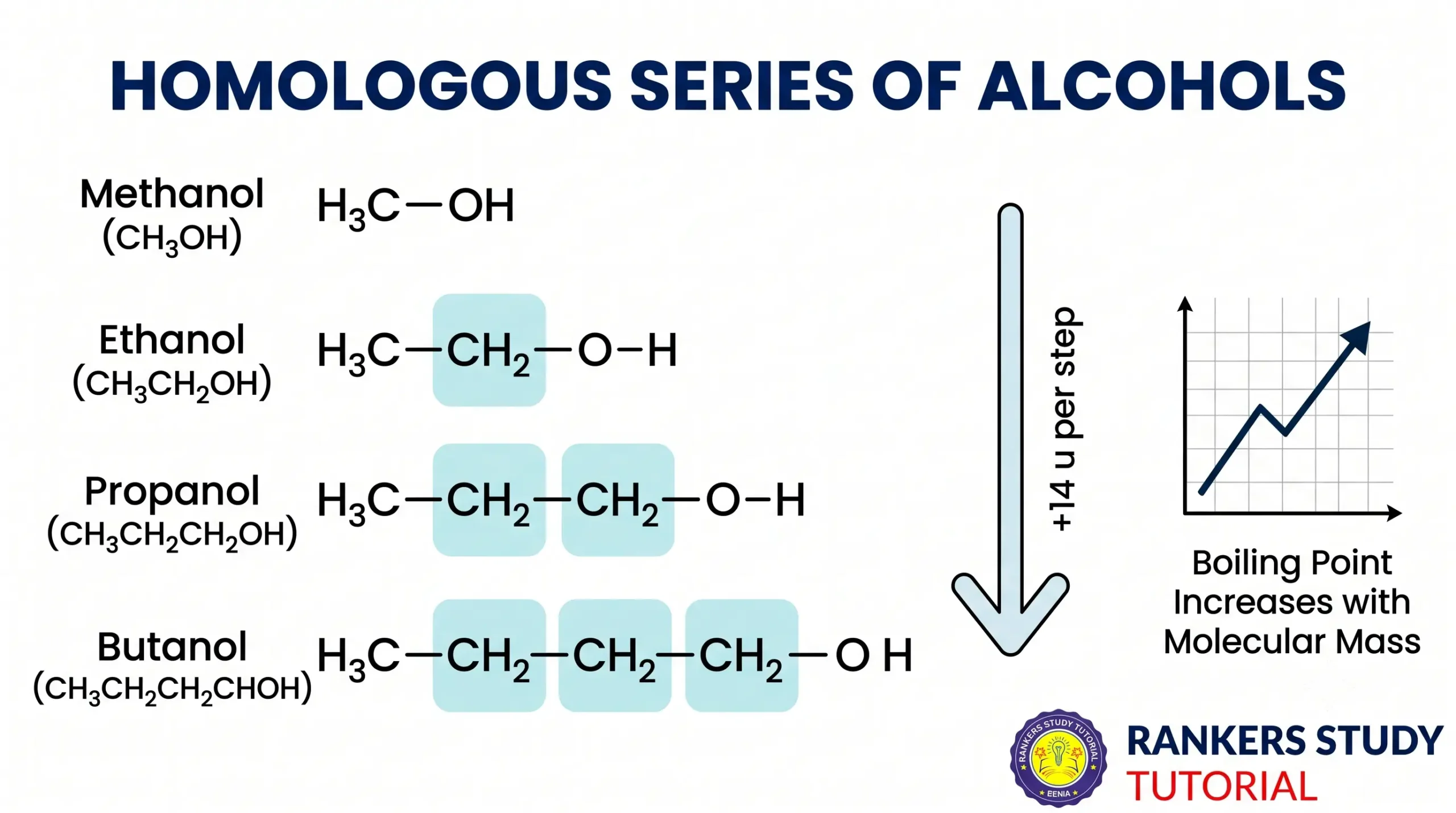
- List the chemical formulas of the first four members of the alcohol family: methanol (CH₃OH), ethanol (C₂H₅OH), propanol (C₃H₇OH), and butanol (C₄H₉OH).
- Calculate the difference in molecular formulas between consecutive pairs.
- Calculate the difference in molecular masses between consecutive pairs using C = 12 u and H = 1 u.
- Examine the regular gradation in physical properties such as boiling and melting points across the series.
Observations & Chemical Mechanism
- Formula Difference: Every pair of consecutive homologues differs by exactly one methylene unit:
-CH₂-. - Mass Difference: 1 Carbon (12 u) + 2 Hydrogens (2 × 1 u) =
14 umolecular mass difference between consecutive members. - Physical Gradation: Increasing molecular mass strengthens intermolecular attractions, producing a steady rise in melting points, boiling points, and densities.
- Chemical Uniformity: Chemical properties remain similar throughout because they are determined by the same functional group (-OH).
Q1: By what chemical formula unit and molecular mass increment do successive members of a homologous series differ?
Answer: Any two consecutive members of a homologous series differ by a
-CH₂- unit and by a molecular mass of 14 u.Q2: Why do boiling points increase systematically as one ascends a homologous series, while chemical reactivity remains largely unchanged?
Answer: Boiling points increase because increasing carbon chain length increases molecular size and surface area, increasing the strength of intermolecular attractive forces. Chemical properties remain similar because all members possess the same functional group.
Q3 (Application Based): An unknown organic liquid X has the molecular formula C₅H₁₁OH. State its IUPAC name, identify its immediate preceding homologue, and calculate its molecular mass.
Answer: Liquid X is pentanol (or pentan-1-ol). Its immediate preceding homologue is butanol (C₄H₉OH). Molecular mass of C₅H₁₁OH = (5 × 12) + (12 × 1) + 16 = 60 + 12 + 16 =
88 u.Q4 (Application Based): Write the general formula of the homologous series of (i) alkanes, (ii) alkenes, and (iii) alkynes.
Answer:
• Alkanes:
• Alkenes:
• Alkynes:
• Alkanes:
CₙH₂ₙ₊₂ (where n ≥ 1)• Alkenes:
CₙH₂ₙ (where n ≥ 2)• Alkynes:
CₙH₂ₙ₋₂ (where n ≥ 2)
Activity 4.3: Flame Characteristics of Carbon Compounds
Testing Saturated vs. Unsaturated Compounds for Soot Formation
Experimental Procedure
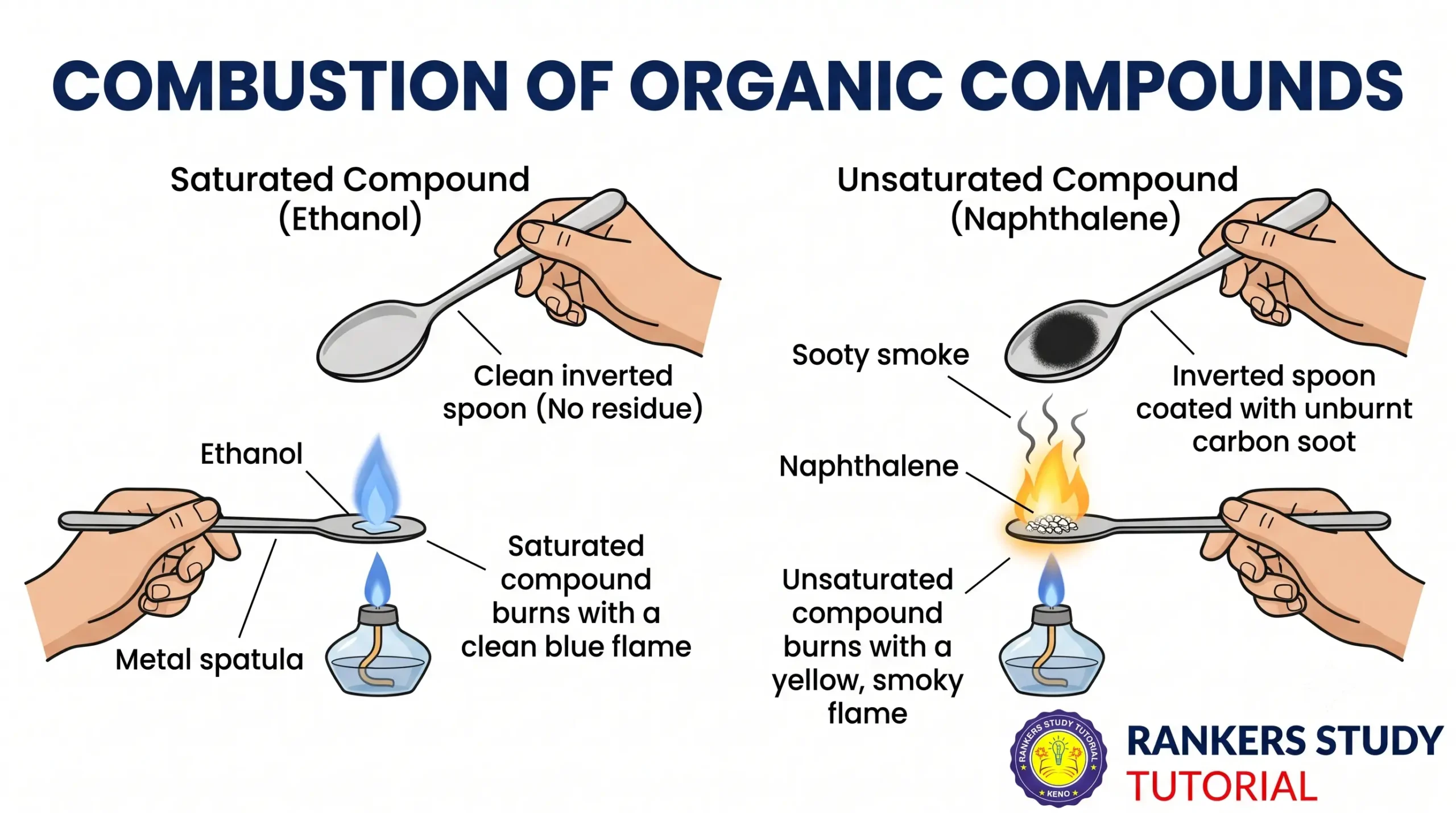
- Place small samples of ethanol, camphor, and naphthalene one by one on a clean metal spatula.
- Ignite each sample in a laboratory burner flame.
- Observe flame color and note whether black smoke is produced.
- Hold a clean metal plate directly above the flame to check for soot deposition.
Observations & Chemical Mechanism
- Ethanol (Saturated): Burns completely with a clear, non-luminous blue flame without smoke or soot deposition.
- Camphor and Naphthalene (Unsaturated/Aromatic): Burn with a luminous, yellow, smoky flame, depositing a thick black layer of unburned carbon soot on the plate.
- Chemical Reason: Unsaturated and aromatic compounds have a high carbon-to-hydrogen ratio. The atmospheric oxygen supply is insufficient for complete oxidation, causing unburned incandescent carbon particles to glow yellow and escape as black soot.
Q1: Why do saturated hydrocarbons generally produce a clean blue flame, whereas unsaturated hydrocarbons give a yellow, sooty flame?
Answer: Saturated hydrocarbons have a lower percentage of carbon and undergo complete combustion in air to form CO₂ and H₂O, producing a clean blue flame. Unsaturated and aromatic hydrocarbons have a higher percentage of carbon, leading to incomplete combustion in air and producing unburned carbon particles that glow yellow and deposit as black soot.
Q2: What is the composition of the black deposit that collects on the metal plate in Activity 4.3?
Answer: The black deposit consists of unburned elemental carbon particles (soot) resulting from incomplete combustion of the fuel.
Q3 (Application Based): A mixture of pure ethyne and oxygen is used for welding, but a mixture of ethyne and air is never used. Explain why.
Answer: Ethyne (acetylene, C₂H₂) is an unsaturated hydrocarbon with a carbon-carbon triple bond. Air contains only ~21% oxygen, which is insufficient for complete combustion, producing a smoky, sooty flame with low temperature. When mixed with pure oxygen, complete combustion occurs, generating an intensely hot oxy-acetylene flame (~3000°C) capable of melting metals for welding.
Q4 (Application Based): How can the soot test distinguish between a sample of cooking oil (unsaturated) and butter/ghee (saturated)?
Answer: Vegetable cooking oils are rich in unsaturated fatty acids; burning them on a spatula yields a luminous yellow flame with noticeable black smoke. Animal fats like butter or ghee contain predominantly saturated carbon chains and burn with a cleaner, less sooty flame.
Activity 4.4: Air-Hole Regulation of a Bunsen Burner
Effect of Oxygen Supply on Combustion Efficiency and Flame Color
Experimental Procedure
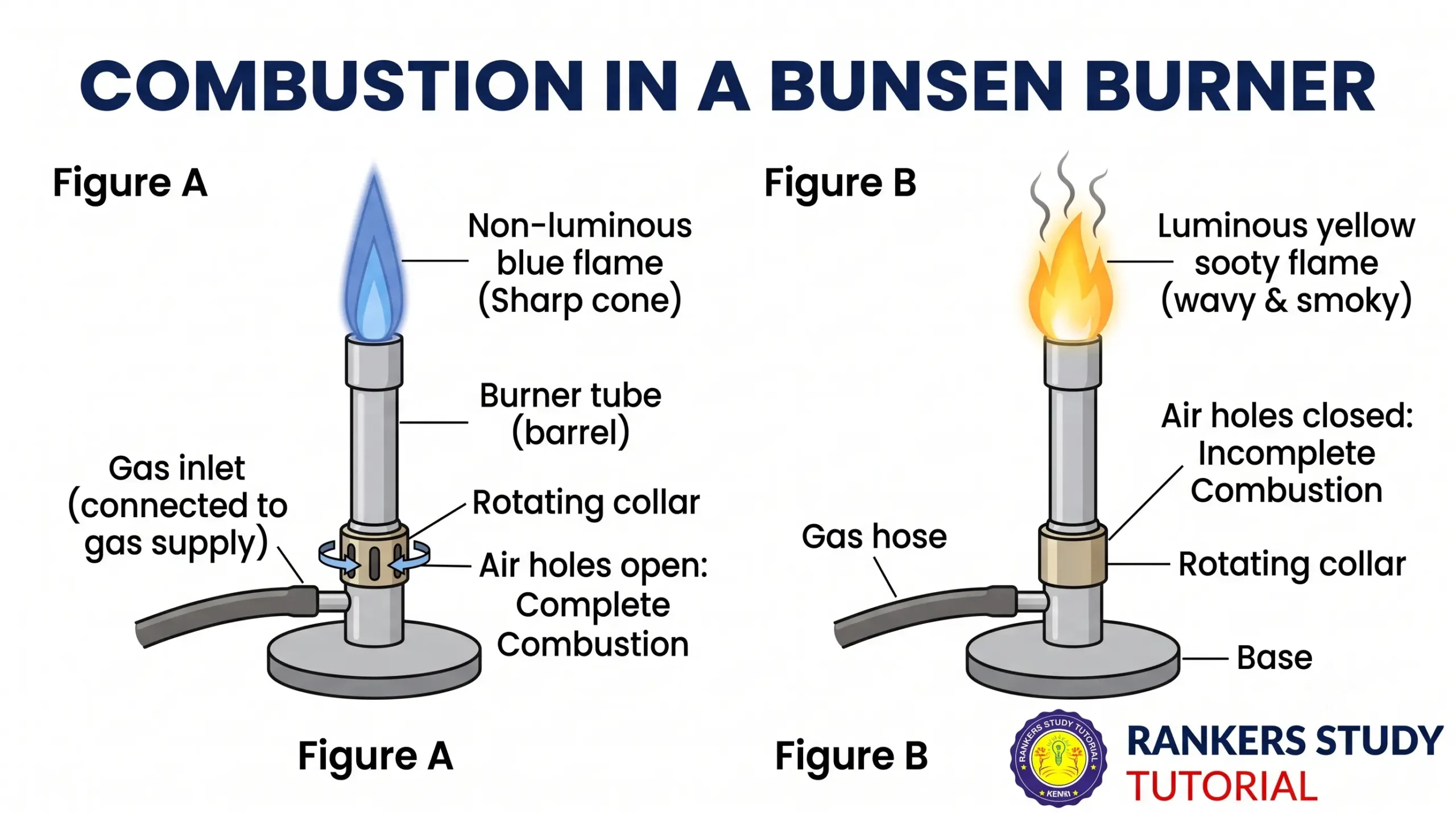
- Light a Bunsen burner in the laboratory.
- Rotate the collar at the base of the burner to fully open the air holes.
- Observe the color of the flame, sound produced, and presence or absence of smoke.
- Gradually adjust the collar until the air holes are completely blocked, and observe the flame changes.
Observations & Chemical Mechanism
- Air Holes Open: Sufficient air mixes with incoming gas. Complete combustion takes place, giving a roaring, non-luminous, hot blue flame without soot.
- Air Holes Closed: Air supply is restricted, causing incomplete combustion of the hydrocarbon fuel. The flame turns yellow, luminous, and smoky, depositing carbon soot.
- Domestic Correlation: Cooking stoves have air inlets to burn an oxygen-rich mixture; blackened cookware bottoms indicate blocked air holes.
Q1: Under what conditions does a Bunsen burner produce a yellow sooty flame versus a clean blue flame?
Answer: A yellow sooty flame is produced when the air holes are closed, limiting oxygen supply and causing incomplete combustion. A clean blue flame is produced when the air holes are wide open, supplying sufficient oxygen for complete combustion.
Q2: Why does the bottom of cooking utensils become blackened on a household gas stove over time?
Answer: Blackening occurs when the air inlet holes of the stove get blocked with grease or dirt. This restricts the inflow of oxygen, resulting in incomplete combustion of LPG and producing unburned carbon soot that coats the utensil bottom.
Q3 (Application Based): A cook observes that the flame on an LPG gas burner flickers yellow and deposits soot on vessels. What immediate practical step should be taken to restore a clean flame?
Answer: The burner head should be turned off, allowed to cool, and its air vents and tiny gas holes cleaned with a wire pin to remove blockages. Clearing the air holes restores the proper fuel-to-air ratio for complete combustion, bringing back the clean blue flame and preventing fuel wastage.
Q4 (Application Based): Why does charcoal in an open grill (angithi) glow red without an extended flame, whereas firewood burns with an active flame?
Answer: A flame is produced only when gaseous or volatile substances burn. Firewood contains volatile organic compounds that vaporize and burn with an open flame. Charcoal has had its volatile components driven off during manufacture, so it burns as solid carbon, glowing red and giving off heat without a visible flame.
Activity 4.5: Controlled Oxidation of Ethanol
Oxidation of Ethanol to Ethanoic Acid Using Alkaline Potassium Permanganate
Experimental Procedure
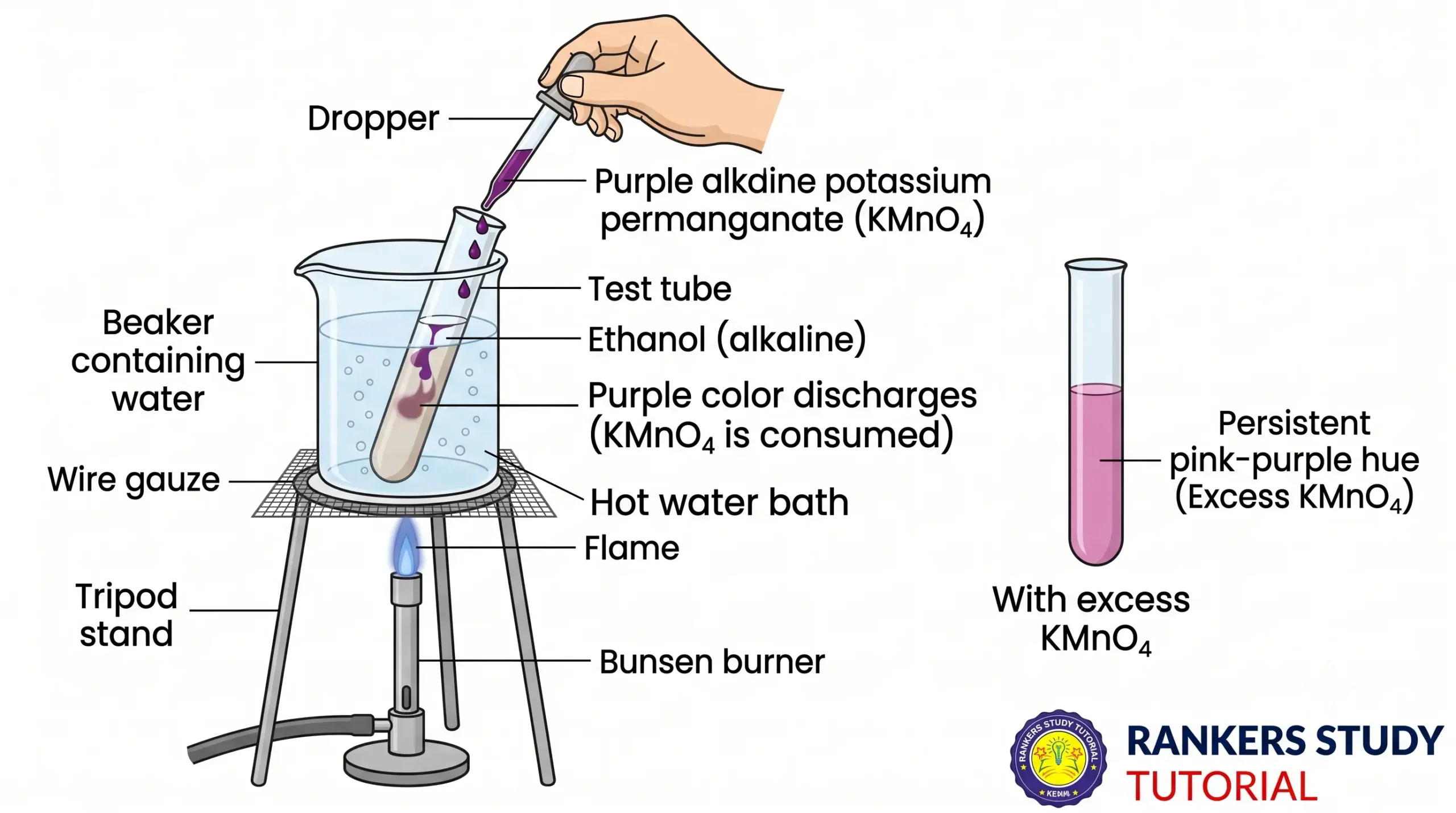
- Take about 3 mL of ethanol in a clean glass test tube.
- Warm the test tube gently inside a hot water bath.
- Add a 5% alkaline potassium permanganate (KMnO₄) solution drop by drop using a dropper while shaking the tube.
- Observe whether the purple color of KMnO₄ persists initially and what happens when excess is added.
Observations & Chemical Mechanism
- Initial Addition: The deep purple color of alkaline KMnO₄ discharges and disappears because it is consumed in oxidizing ethanol to ethanoic acid.
- Excess Addition: Once all ethanol molecules have been converted to ethanoic acid, unreacted KMnO₄ remains in the solution, causing the purple/pink color to persist.
- Chemical Equation:
CH₃-CH₂OH Alkaline KMnO₄ + Heat → or Acidified K₂Cr₂O₇ + Heat CH₃COOH - Role of Reagents: Alkaline potassium permanganate and acidified potassium dichromate supply nascent oxygen, acting as oxidizing agents.
Q1: Why does the purple color of potassium permanganate vanish initially when added dropwise to warm ethanol?
Answer: Potassium permanganate is an oxidizing agent that donates nascent oxygen to ethanol, converting it into ethanoic acid. In the process, the permanganate ion (MnO₄⁻) is reduced to a colorless manganese species, causing the purple color to discharge.
Q2: Define an oxidizing agent based on the chemical transformation observed in Activity 4.5.
Answer: An oxidizing agent is a substance that is capable of adding oxygen to or removing hydrogen from another reactant. Here, alkaline KMnO₄ supplies oxygen to oxidize the alcohol into a carboxylic acid.
Q3 (Application Based): How can roadside breathalyzer devices use the oxidation of ethanol to estimate alcohol levels in drivers?
Answer: Classical chemical breathalyzers contain acidified potassium dichromate (K₂Cr₂O₇). When exhaled breath containing ethanol vapors passes through the reagent, the alcohol is oxidized to acetic acid while orange chromium(VI) is reduced to green chromium(III). The degree of the orange-to-green color shift corresponds to the alcohol concentration in the breath.
Q4 (Application Based): Why is the direct conversion of ethanol to ethanoic acid described as an oxidation reaction, even though no combustion occurs?
Answer: The transformation involves the gain of an oxygen atom and the loss of two hydrogen atoms per molecule:
CH₃CH₂OH + 2[O] → CH₃COOH + H₂O. Since gain of oxygen and loss of hydrogen both define oxidation, it is an oxidation reaction.Activity 4.6: Reaction of Ethanol with Sodium Metal
Reaction of Sodium with Absolute Alcohol and Evolution of Hydrogen
Experimental Procedure
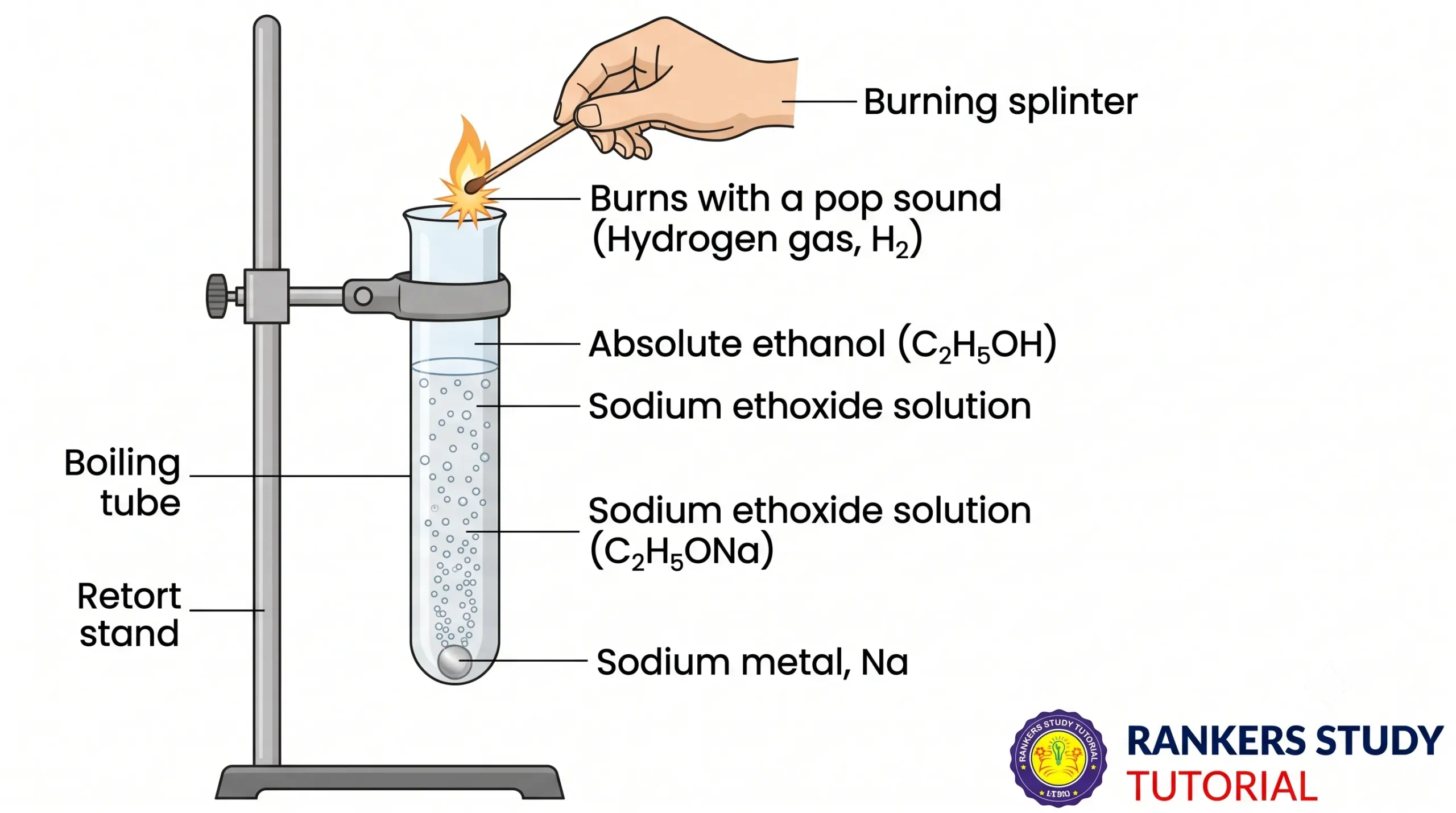
- Take about 2 to 3 mL of absolute ethanol in a clean, moisture-free test tube.
- Drop a tiny, freshly cut piece of sodium metal (about the size of a couple of rice grains) into the alcohol.
- Observe the reaction taking place on the surface of the sodium pellet.
- Bring a burning splinter near the mouth of the test tube to test the escaping gas.
Observations & Chemical Mechanism
- Observation: Effervescence occurs as bubbles of a colorless, odorless gas evolve smoothly; the piece of sodium metal slowly dissolves.
- Pop Test: A lighted matchstick brought near the tube mouth ignites the gas with a distinctive ‘pop’ sound, confirming hydrogen gas.
- Chemical Identity: Ethanol reacts with active alkali metals to form an alkoxide salt and release hydrogen.
- Chemical Equation:
2Na + 2CH₃CH₂OH → 2CH₃CH₂O⁻Na⁺ + H₂↑
Q1: Name the products formed when a piece of sodium metal is dropped into absolute ethanol.
Answer: The products formed are sodium ethoxide (
CH₃CH₂ONa), an ionic salt, and hydrogen gas (H₂).Q2: How does the reaction of sodium with ethanol compare to the reaction of sodium with water?
Answer: Sodium reacts with water violently and exothermically, causing the evolved hydrogen gas to catch fire immediately. With ethanol, the reaction proceeds much more slowly and steadily without catching fire, demonstrating that ethanol is a weaker proton donor (less acidic) than water.
Q3 (Application Based): What chemical test can be used to distinguish between ethanol and a saturated liquid hydrocarbon like hexane?
Answer: Add a small, freshly cut piece of dry sodium metal to both liquids. Ethanol will react steadily with effervescence, producing hydrogen gas that burns with a pop sound. The saturated alkane (hexane) is inert and will show no reaction.
Q4 (Application Based): What reaction takes place when ethanol is heated with excess concentrated sulphuric acid at 443 K?
Answer: Ethanol undergoes intramolecular dehydration:
CH₃-CH₂OH Hot Conc. H₂SO₄ → 443 K CH₂=CH₂ + H₂O
Concentrated sulphuric acid acts as a dehydrating agent, removing a molecule of water to produce ethene.
CH₃-CH₂OH Hot Conc. H₂SO₄ → 443 K CH₂=CH₂ + H₂O
Concentrated sulphuric acid acts as a dehydrating agent, removing a molecule of water to produce ethene.
Activity 4.7: Comparing Acetic Acid and Hydrochloric Acid
pH Comparison: Strong Mineral Acid vs. Weak Carboxylic Acid
Experimental Procedure
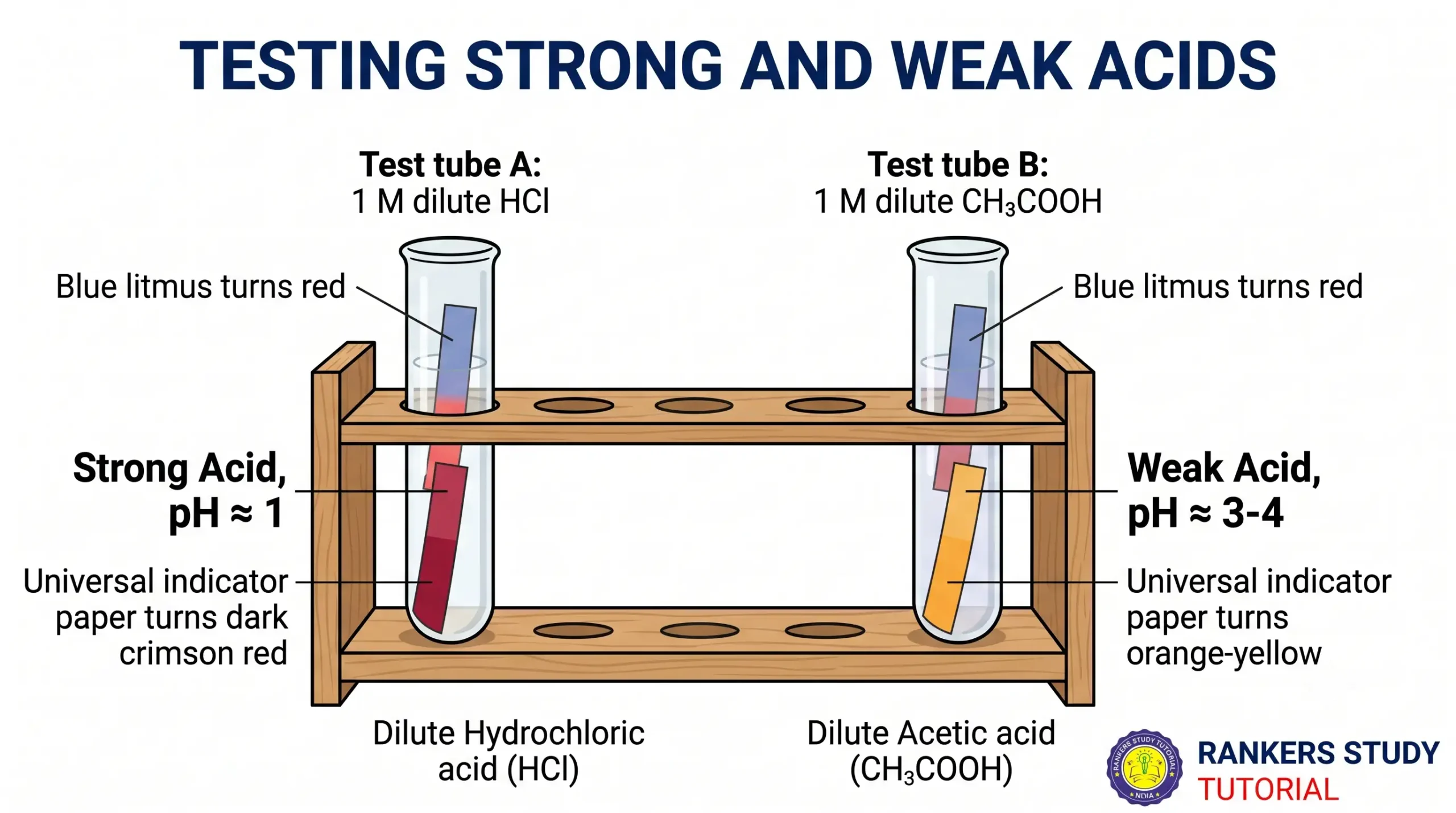
- Take 5 mL of dilute hydrochloric acid (HCl) in test tube A and 5 mL of dilute acetic acid (CH₃COOH) of equal molarity in test tube B.
- Test both acid solutions with blue litmus paper.
- Add drops of universal indicator solution (or touch with universal indicator paper) to both tubes and compare colors against a standard pH chart.
Observations & Chemical Mechanism
- Litmus Test: Both hydrochloric acid and acetic acid turn blue litmus paper red.
- Universal Indicator: Hydrochloric acid yields a dark red color (pH ~ 1), whereas dilute acetic acid shows an orange-yellow color (pH ~ 3–4).
- Inference: Although both substances are acids, HCl is a strong acid that ionizes completely into H⁺(aq) ions in solution, while acetic acid is a weak organic acid that ionizes only partially.
Q1: Do both hydrochloric acid and acetic acid test positive with blue litmus paper? Does this test reveal their relative acid strengths?
Answer: Yes, both acids turn blue litmus paper red. However, the litmus test only indicates the presence of acidity; it is a qualitative test and cannot differentiate relative acid strength or hydrogen ion concentration.
Q2: Why does universal indicator display distinct colors for equimolar solutions of HCl and CH₃COOH?
Answer: Universal indicator is a mixture of several indicators that exhibits different colors at different pH values. Hydrochloric acid dissociates completely in water, producing a high concentration of H⁺ ions (low pH, red). Acetic acid ionizes only partially, producing a lower H⁺ concentration (higher pH, orange/yellow).
Q3 (Application Based): Two equal strips of magnesium ribbon are placed in test tubes containing equal concentrations of HCl and CH₃COOH. In which tube will vigorous fizzing occur faster, and why?
Answer: Fizzing will occur much more vigorously in the test tube containing hydrochloric acid. Because HCl is a strong acid, it has a higher concentration of H⁺(aq) ions in solution, leading to a faster rate of reaction with magnesium to liberate hydrogen gas.
Q4 (Application Based): Why is glacial acetic acid so named, and how does its pure form differ from domestic vinegar?
Answer: Pure anhydrous ethanoic acid has a melting point of 290 K (17°C) and freezes into ice-like crystals during winter in cold climates, giving it the name glacial acetic acid. Domestic vinegar is a dilute 5–8% solution of ethanoic acid in water used as a food preservative.
Activity 4.8: The Esterification Reaction
Synthesis of Ethyl Ethanoate from Ethanol and Glacial Acetic Acid
Experimental Procedure
- Mix 1 mL of absolute ethanol and 1 mL of glacial acetic acid in a clean test tube.
- Add 2 to 3 drops of concentrated sulphuric acid to act as a catalyst and dehydrating agent.
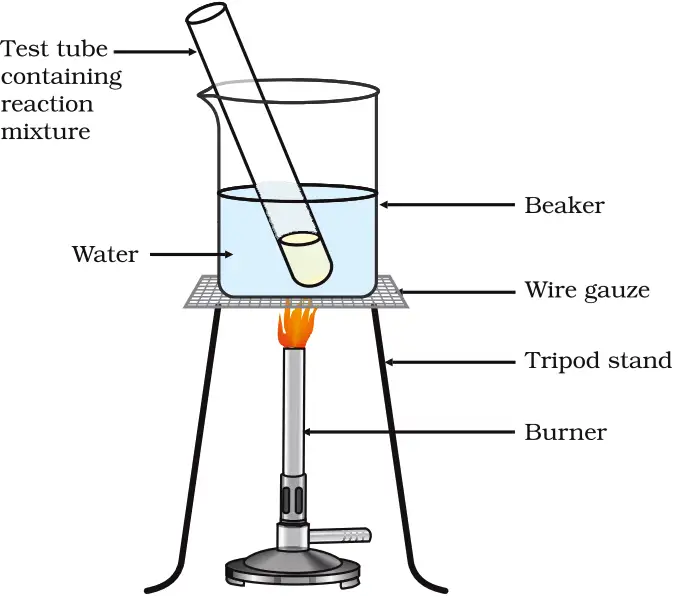
- Warm the test tube in a water bath for at least 5 minutes.
- Pour the reaction mixture into a beaker containing 20–50 mL of water, stir gently, and smell the vapor.
Observations & Chemical Mechanism
- Observation: A pleasant, fruity, sweet fragrance is produced.
- Chemical Identity: Ethanoic acid condenses with ethanol in the presence of an acid catalyst to form an ester (ethyl ethanoate) and water.
- Chemical Equation:
CH₃COOH + CH₃CH₂OH Conc. H₂SO₄ → Heat CH₃COOCH₂CH₃ + H₂O - Saponification: Treating esters with an alkali (NaOH) hydrolyzes them back into the parent alcohol and sodium salt of the carboxylic acid (soap):
CH₃COOC₂H₅ NaOH → C₂H₅OH + CH₃COONa
Q1: What is the sensory hallmark indicating that an esterification reaction has occurred?
Answer: The formation of an ester is identified by a distinct, sweet, pleasant, and fruity smell.
Q2: What is the dual role played by concentrated sulphuric acid in the esterification process?
Answer: Concentrated sulphuric acid acts as an acid catalyst to speed up the condensation reaction, and as a dehydrating agent to absorb the produced water, shifting the equilibrium forward to improve ester yield.
Q3 (Application Based): Write the chemical equation for the saponification of ethyl ethanoate using aqueous sodium hydroxide, and state its commercial use.
Answer:
CH₃COOC₂H₅ + NaOH
→
C₂H₅OH + CH₃COONa
This alkaline hydrolysis of esters is called saponification because it is used industrially with long-chain fats to manufacture soaps (sodium salts of fatty acids).
This alkaline hydrolysis of esters is called saponification because it is used industrially with long-chain fats to manufacture soaps (sodium salts of fatty acids).
Q4 (Application Based): Why is the ester reaction tube heated inside a water bath rather than directly over an open burner flame?
Answer: Ethanol is a volatile and flammable organic solvent whose vapors can catch fire if heated directly over an open flame. A hot water bath provides gentle, even, and safe heating below the ignition point of the alcohol vapors.
Activity 4.9: Reaction of Ethanoic Acid with Carbonates
Reaction of Carboxylic Acids with Sodium Carbonate and Hydrogencarbonate
Experimental Procedure
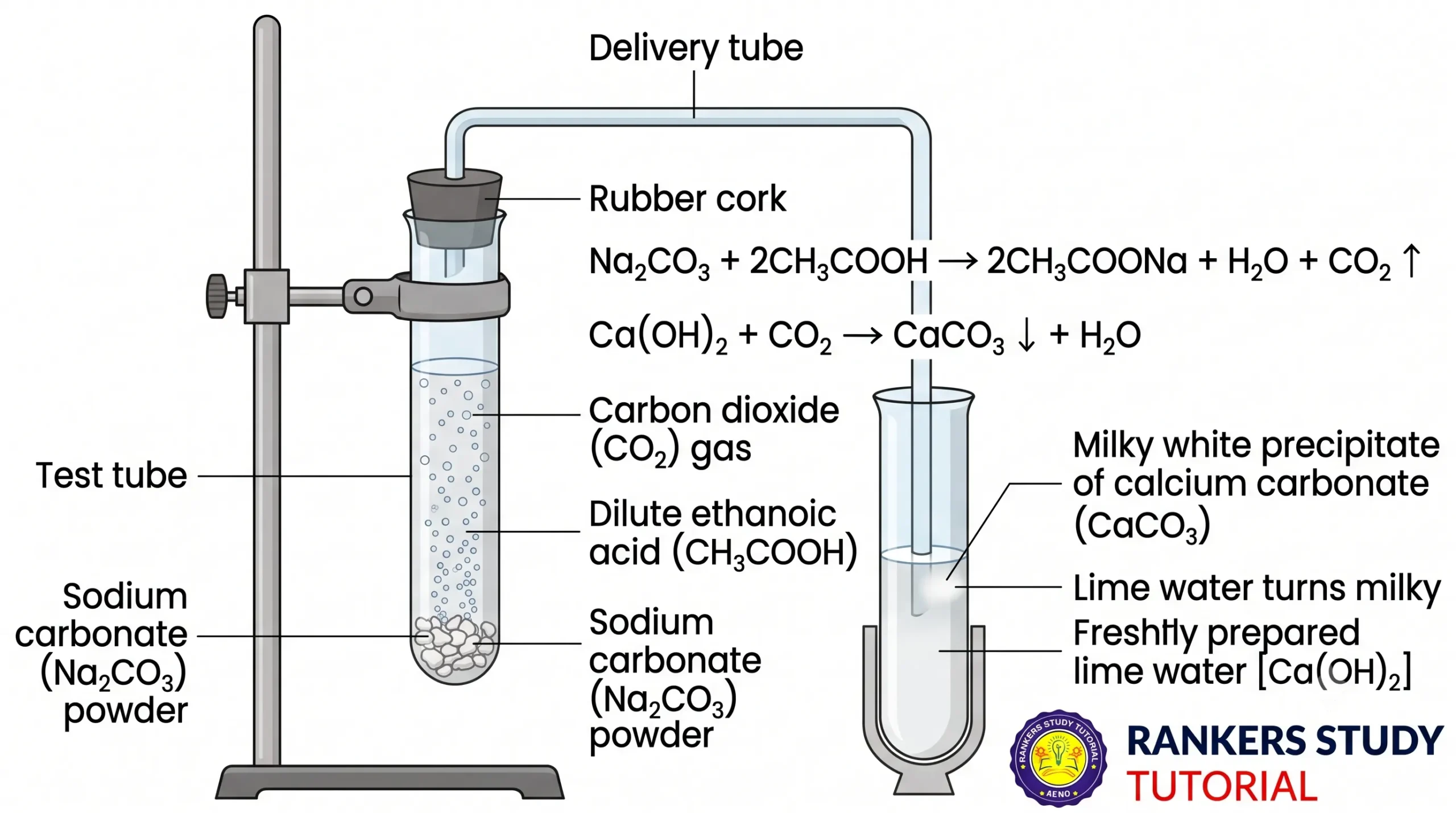
- Place a spatula of solid sodium carbonate (Na₂CO₃) into a test tube fitted with a delivery tube.
- Add 2 mL of dilute ethanoic acid (CH₃COOH) to the test tube.
- Pass the gas evolved through freshly prepared lime water [Ca(OH)₂].
- Repeat the experiment using sodium hydrogencarbonate (NaHCO₃).
Observations & Chemical Mechanism
- Observation: Brisk effervescence occurs in both cases; the gas turns clear lime water milky due to the formation of calcium carbonate.
- Chemical Identity: Ethanoic acid decomposes metal carbonates and bicarbonates, producing sodium ethanoate (sodium acetate), water, and carbon dioxide.
- Chemical Equations:
2CH₃COOH + Na₂CO₃ → 2CH₃COONa + H₂O + CO₂↑
CH₃COOH + NaHCO₃ → CH₃COONa + H₂O + CO₂↑
Q1: How can the gas evolved during the reaction of ethanoic acid with sodium carbonate be identified?
Answer: Direct the evolved gas through a delivery tube into a test tube containing freshly prepared lime water. The gas turns the lime water milky due to the precipitation of insoluble calcium carbonate, confirming it is carbon dioxide (CO₂).
Q2: Name the sodium salt formed when ethanoic acid reacts with sodium hydrogencarbonate.
Answer: The salt formed is sodium ethanoate, commonly referred to as sodium acetate (
CH₃COONa).Q3 (Application Based): How can the reaction in Activity 4.9 be used as an analytical chemical test to distinguish between an alcohol (ethanol) and a carboxylic acid (ethanoic acid)?
Answer: Add a pinch of sodium hydrogencarbonate (baking soda) to both liquid samples. Ethanoic acid reacts with brisk effervescence, releasing CO₂ gas that turns lime water milky. Ethanol does not react with sodium hydrogencarbonate and shows no effervescence.
Q4 (Application Based): When baking soda is added to kitchen vinegar, brisk bubbling occurs. Write the balanced molecular equation for this household reaction.
Answer: Vinegar contains dilute ethanoic acid. The reaction with baking soda (sodium hydrogencarbonate) is:
CH₃COOH(aq) + NaHCO₃(s) → CH₃COONa(aq) + H₂O(l) + CO₂(g)↑
CH₃COOH(aq) + NaHCO₃(s) → CH₃COONa(aq) + H₂O(l) + CO₂(g)↑
Activity 4.10: Emulsification of Oil by Soap
Cleansing Action of Soap via Oil-in-Water Emulsification
Experimental Procedure
- Take about 10 mL of distilled water each in two test tubes labeled A and B.
- Add a single drop of vegetable cooking oil to both test tubes.
- To test tube B only, add a few drops of soap solution; leave test tube A untreated.
- Shake both test tubes vigorously for the same amount of time.
- Let both test tubes rest undisturbed in a rack and monitor the separation of the oil and water layers.
Observations & Chemical Mechanism
- Test Tube A (No Soap): After shaking stops, the immiscible oil droplets coalesce quickly and separate into a distinct top oil layer over the water.
- Test Tube B (With Soap): The mixture remains cloudy and homogeneous; oil droplets stay suspended as a stable emulsion and do not readily separate.
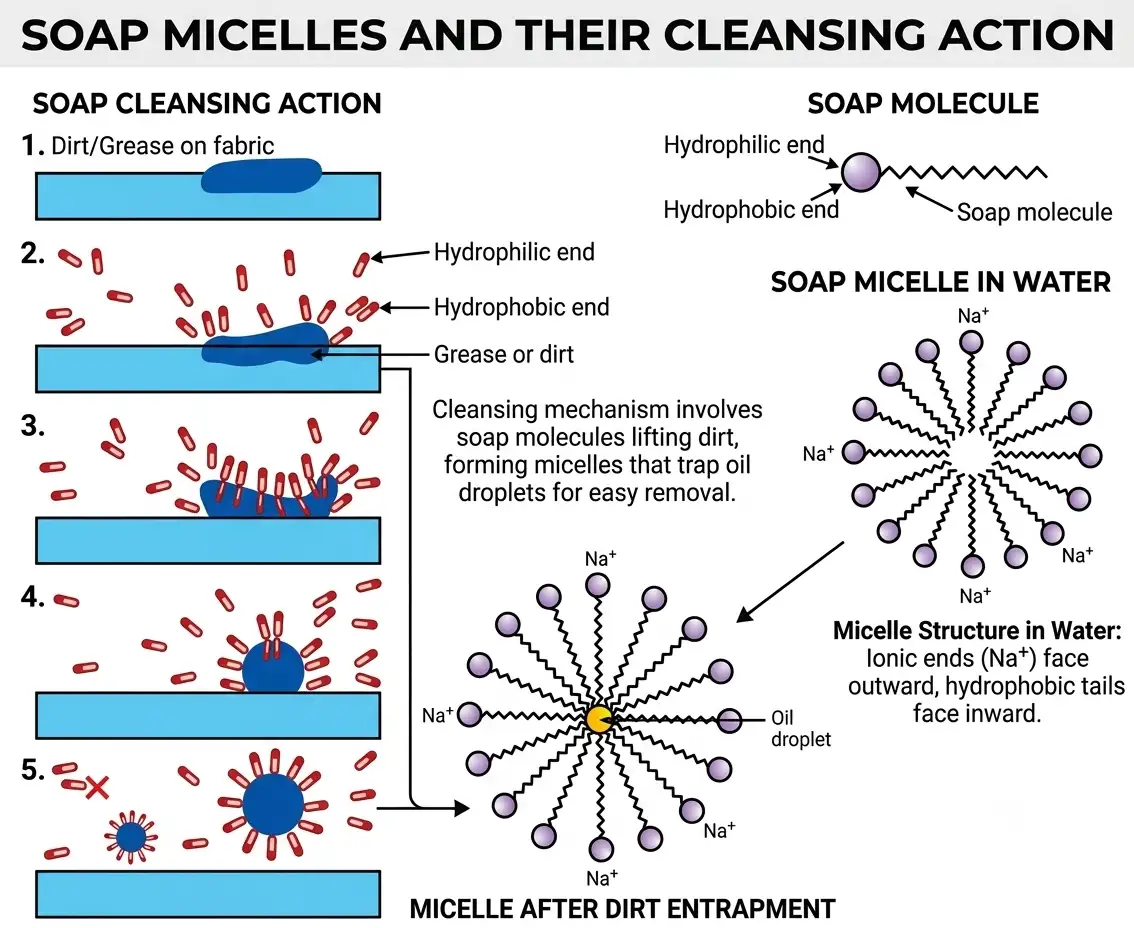
- Micelle Formation: Soap molecules have a polar ionic hydrophilic head that dissolves in water and a non-polar hydrocarbon hydrophobic tail that dissolves in the oil droplet. This forms spherical micelles with oily dirt trapped at the center, allowing the dirt to be rinsed away.
Q1: In which test tube does the oil layer separate out first upon standing, and why?
Answer: The oil layer separates out first in test tube A. Water and oil are immiscible liquids with different polarities and densities. Without an emulsifier, the agitated oil droplets coalesce rapidly to form a distinct layer on top of the water.
Q2: Describe the molecular orientation of a soap molecule inside a cleaning micelle formed in water.
Answer: The non-polar hydrophobic hydrocarbon tail points inward toward the oily dirt droplet at the core, while the charged hydrophilic ionic head (e.g., -COO⁻Na⁺) faces outward into the surrounding water.
Q3 (Application Based): Why does a soap solution in water appear cloudy or translucent rather than completely transparent?
Answer: Soap molecules aggregate in water into colloidal clusters called micelles. These colloidal micelles are large enough to scatter incident light beams (Tyndall effect), making the soap solution appear cloudy.
Q4 (Application Based): Will soap molecules form micelles if dissolved in an organic solvent like ethanol or hexane instead of water? Explain.
Answer: No, typical micelles will not form in ethanol or hexane. In non-polar hydrocarbon solvents, the hydrophobic tail dissolves naturally in the solvent, while the polar ionic heads are repelled. The molecules either remain dispersed or invert their orientation (forming reverse micelles), where the ionic heads cluster in the interior and the tails point outward.
Activity 4.11: Action of Soap in Soft vs. Hard Water
Scum Formation and Lathering Ability of Soap in the Presence of Calcium and Magnesium Ions
Experimental Procedure
- Take 10 mL of distilled water (soft water) in test tube A and 10 mL of hard water (containing dissolved calcium or magnesium salts) in test tube B.
- Add an equal number of drops (2–3 drops) of soap solution to both test tubes.
- Shake both test tubes vigorously for an identical period and compare the foam height and precipitate formation.
Observations & Chemical Mechanism
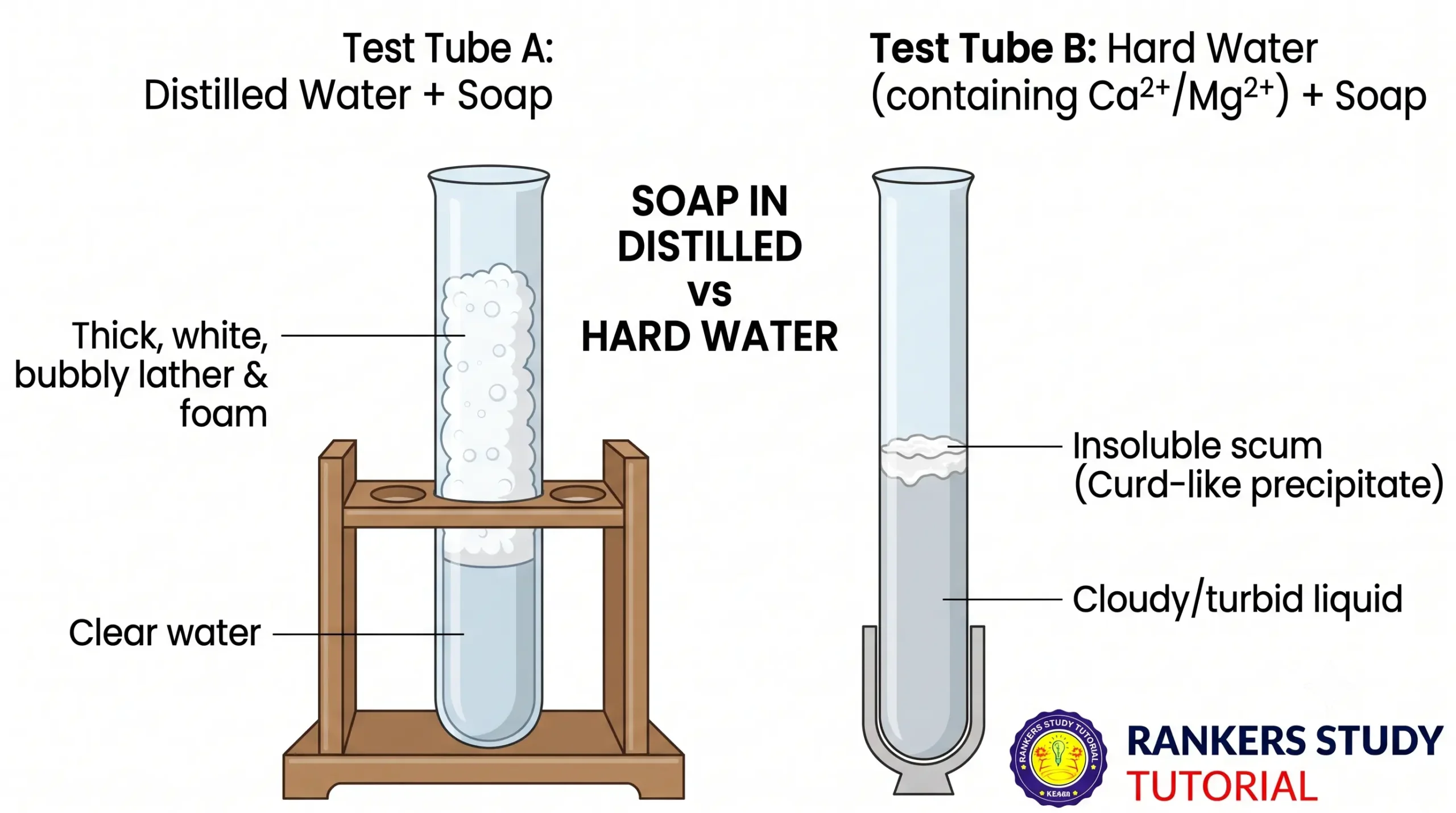
- Test Tube A (Distilled Water): Forms an abundant, thick lather (foam) easily without any curd-like precipitate.
- Test Tube B (Hard Water): Forms little lather; instead, an insoluble white, sticky, curdy precipitate (scum) forms and floats on the liquid.
- Chemical Mechanism: Soluble sodium stearate soap molecules react with dissolved Ca²⁺ and Mg²⁺ ions in hard water to form insoluble calcium and magnesium salts of fatty acids (scum):
2C₁₇H₃₅COONa + Ca²⁺ → (C₁₇H₃₅COO)₂Ca↓ (Scum) + 2Na⁺
Q1: In which test tube is more foam formed, and in which is a curdy precipitate (scum) observed?
Answer: More foam is formed in test tube A containing distilled water. A white curdy precipitate (scum) forms in test tube B containing hard water.
Q2: Why is a larger amount of soap required when washing clothes with hard water?
Answer: A significant portion of the added soap is consumed in reacting with dissolved calcium and magnesium ions to precipitate insoluble scum. Lathering and cleansing can only begin after all these multivalent mineral ions are fully precipitated, which requires extra soap.
Q3 (Application Based): Which household chemical can be added to hard water to eliminate permanent hardness before washing clothes with soap?
Answer: Washing soda (sodium carbonate decahydrate,
Na₂CO₃·10H₂O) is used to soften hard water. Carbonate ions precipitate dissolved Ca²⁺ and Mg²⁺ ions as insoluble carbonates (e.g., Ca²⁺ + Na₂CO₃ → CaCO₃↓ + 2Na⁺), removing hardness.Q4 (Application Based): Why does scum left on fabrics during laundering in hard water cause clothes to deteriorate and feel stiff?
Answer: Insoluble calcium and magnesium soap scum is sticky and does not wash away easily with water. It deposits between fabric fibers, making clothes stiff, dulling colored fabrics, and degrading textile strength over time.
Activity 4.12: Comparing Soap and Synthetic Detergent in Hard Water
Cleansing Performance and Scum Resistance of Detergents in Hard Water
Experimental Procedure
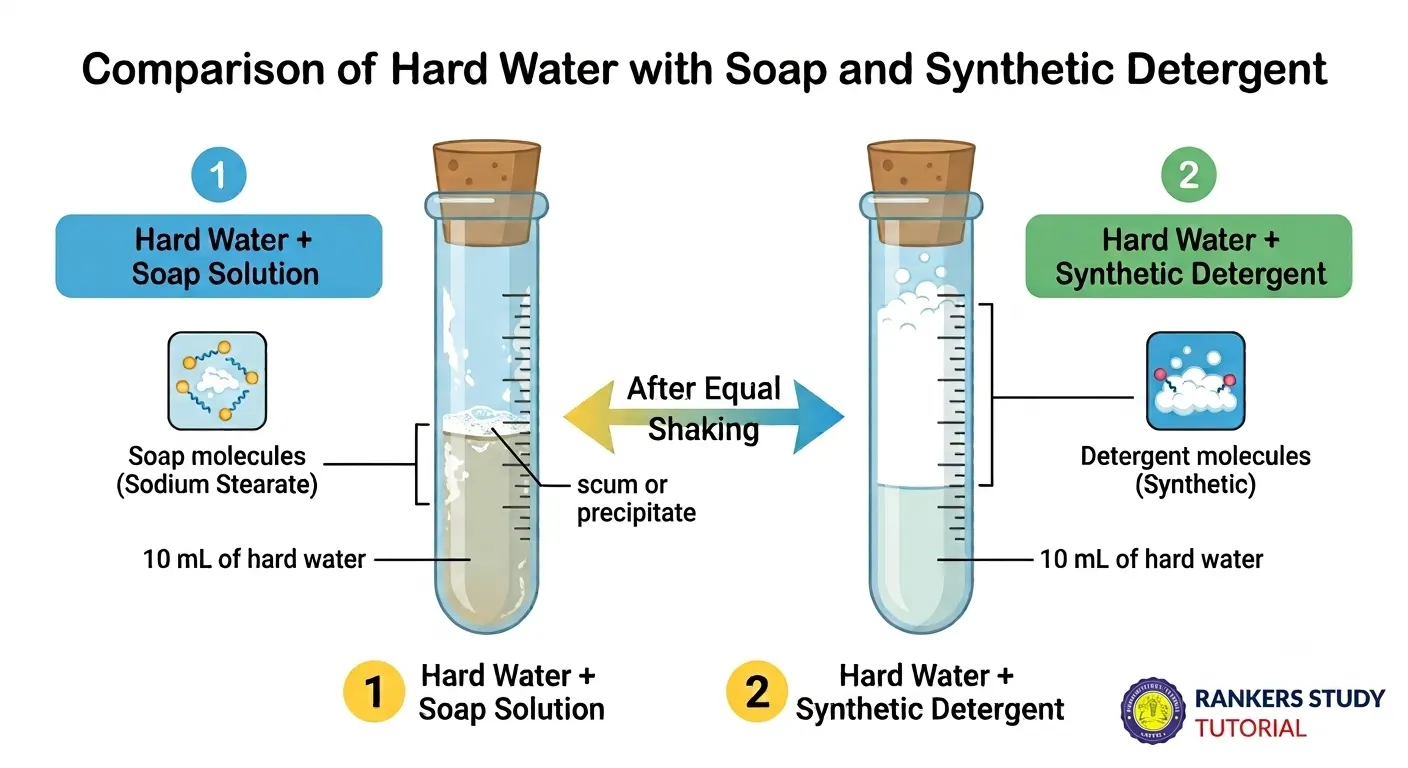
- Take two test tubes, each containing approximately 10 mL of hard water (prepared with Ca²⁺/Mg²⁺ salts).
- Add five drops of soap solution to the first test tube.
- Add five drops of synthetic detergent solution to the second test tube.
- Shake both test tubes vigorously for the same duration and compare foam formation and clarity.
Observations & Chemical Mechanism
- Soap + Hard Water: Produces little foam along with a sticky white curdy precipitate (scum).
- Detergent + Hard Water: Lathers easily and produces abundant, persistent foam with no scum.
- Chemical Distinction: Synthetic detergents are sodium salts of long-chain alkylbenzene sulphonic acids or ammonium salts with chloride/bromide ions. The charged sulphonate ends (-SO₃⁻Na⁺) do not form insoluble precipitates with calcium or magnesium ions, remaining soluble and effective in hard water.
Q1: Why do synthetic detergents remain effective cleansing agents in hard water while soaps fail?
Answer: Detergents have charged sulphonate or ammonium end-groups that do not form insoluble precipitates with the calcium and magnesium ions present in hard water. Their calcium and magnesium salts are water-soluble, so they lather freely and clean without forming scum.
Q2: Can you determine whether a water sample is hard by using a synthetic detergent? Explain.
Answer: No. Synthetic detergents produce copious foam and lather readily in both soft water and hard water without forming scum. To test for water hardness, soap must be used, as it forms distinct scum and resists lathering in hard water.
Q3 (Application Based): Why are shampoos, dishwashing liquids, and modern laundry powders formulated using synthetic detergents instead of traditional soaps?
Answer: Modern cleaning products use synthetic detergents because they remain effective in hard municipal tap water, cold water, and slightly acidic conditions without leaving insoluble scum deposits on hair, dishes, or fabrics.
Q4 (Application Based): Why is mechanical agitation (beating with paddles, scrubbing with brushes, or spinning in washing machines) necessary when laundering clothes with soap?
Answer: While the hydrophobic ends of soap micelles trap oily dirt, the micelles remain adhered to the fabric surface. Mechanical agitation dislodges the dirt-laden micelles from the weave of the cloth, suspending them in water so they can be carried away during rinsing.