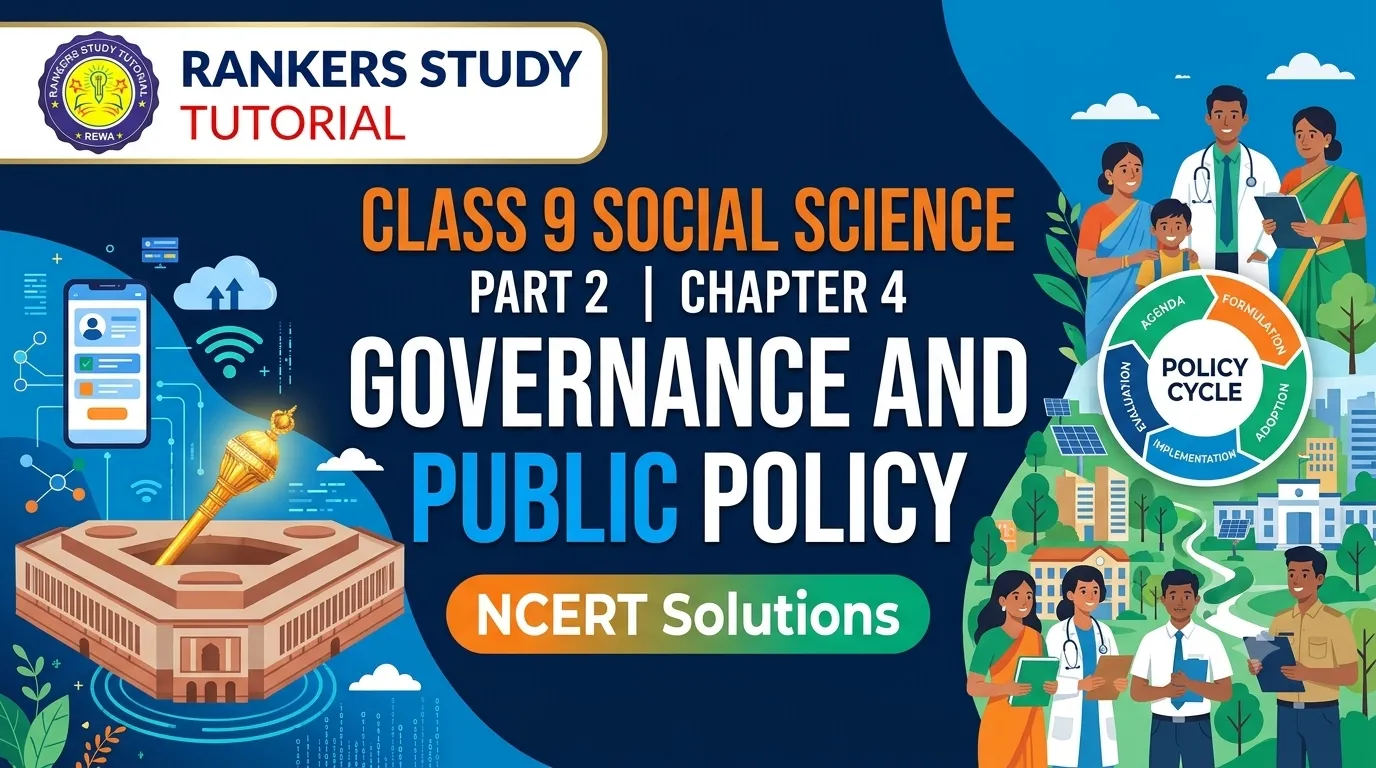
Class 9 Social Science Part 2 Chapter 4 Governance and Public Policy NCERT Solutions
Part 1: The Big Questions (Page 81)
Q1. What is governance, and how have its meaning and practice evolved over time?
Governance is the continuous process through which public decisions are made, implemented, and monitored for the welfare of the people—involving not only the government, but also citizens, the media, civil society, and private organisations.
Evolution in India: From ancient Vedic assemblies (Sabhā and Samiti), the ideal of Rājadharma, Kautilya’s Arthaśhāstra (“In the happiness of the people lies the happiness of the ruler”), and the Chola Sengol, Indian tradition always viewed governance as a moral duty. Although British colonial rule imposed top-down structures, independent India framed its Constitution around indigenous ethical ideals—such as Satyameva Jayate, Yato Dharmastato Jayah, and Mahatma Gandhi’s vision of Rām Rājya—evolving today into people-centric democratic governance strengthened by digital e-governance.
Q2. What is public policy? How does it affect our day-to-day lives, and what makes it ‘public’?
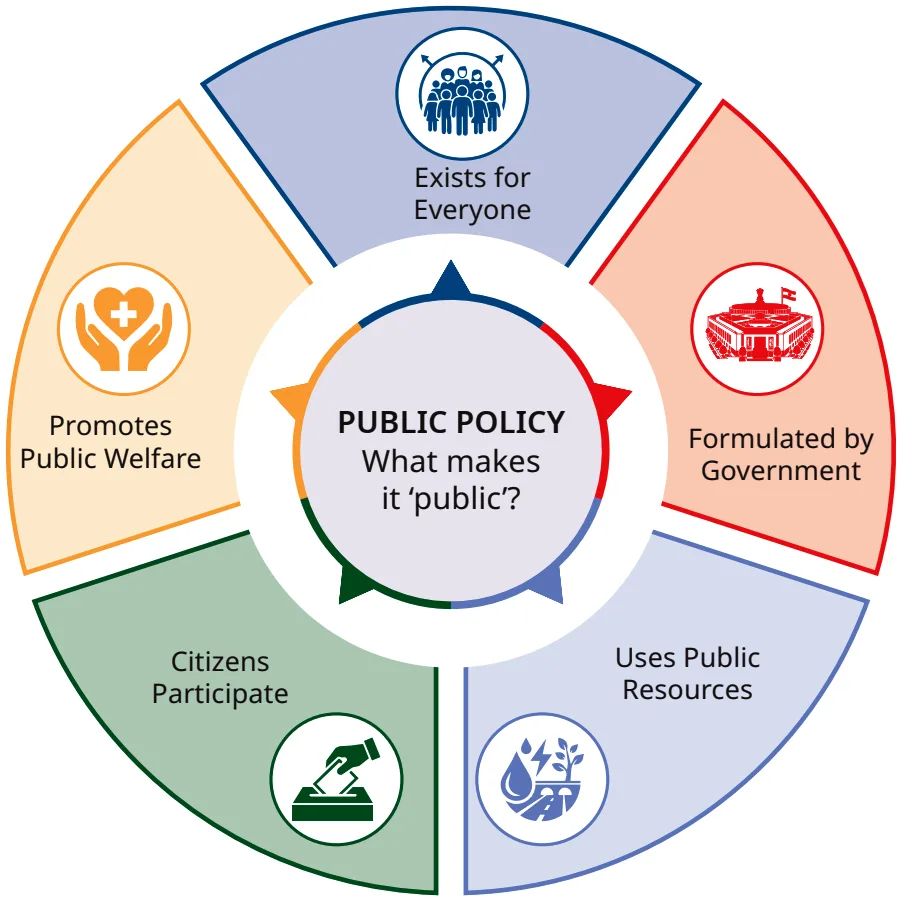
Public Policy is a planned course of action adopted by the government to solve public problems, meet people’s needs, and promote social welfare (often translated into programmes and concrete schemes).
Impact on Daily Life: Every day we rely on public policies—the roads and traffic signals we use, clean tap water, electricity in schools, public parks, free childhood vaccinations, and neighbourhood waste collection.
What Makes It ‘Public’: Unlike a private company’s or housing society’s internal rules, a policy is ‘public’ because:
- It exists for everyone in society.
- It is formulated and implemented by government institutions.
- It uses public resources and taxpayer money.
- It promotes public welfare.
- It invites citizen participation and feedback.
Q3. What are the various stages of policy-making and policy implementation?
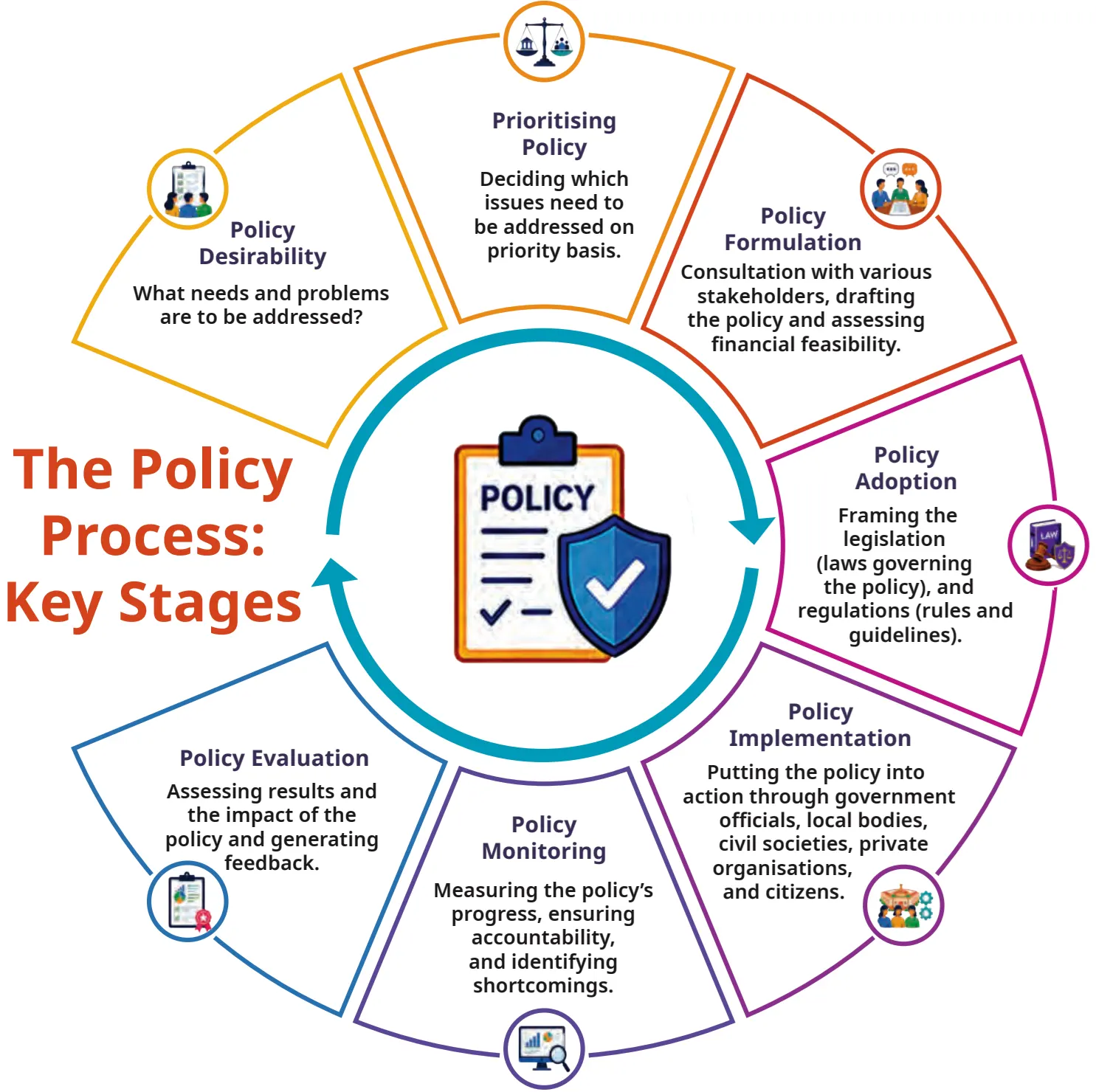
Public policy moves through a continuous seven-stage cycle:
- Policy Desirability (Problem Identification): Identifying what public needs or problems must be addressed.
- Prioritising Policy: Deciding which urgent issues need attention first.
- Policy Formulation: Consulting stakeholders and experts, drafting the policy, and checking financial feasibility.
- Policy Adoption: Framing formal legislation (laws) and regulations (rules and guidelines).
- Policy Implementation: Putting the policy into action via officials, local bodies, civil society, private firms, and citizens.
- Policy Monitoring: Tracking progress, ensuring accountability, and spotting shortcomings.
- Policy Evaluation: Assessing final results and impact, and generating feedback to improve future policies.
Q4. Who are the major contributors to policy-making and implementation?
Effective public policy is never the work of one person—it relies on six key contributors:
- Citizens: Identify local problems, vote, participate in consultations, and give feedback.
- Elected Representatives (MPs, MLAs, Councillors): Voice public concerns, make laws, and approve budgets.
- Government Officials & Ministries (Central, State, Local): Draft policies, coordinate departments, and deliver services.
- Civil Society, NGOs, Experts & Media: Research issues, raise public awareness, and monitor implementation.
- Private Sector: Contributes technical expertise, innovation, sponsorships, and Public-Private Partnerships (PPP).
- International Organisations (e.g., WHO): Share global best practices, technical know-how, and financial support.
Q5. What role do citizens play in shaping public policy and strengthening good governance?
Part 2: In-Text Questions & Activities Solved
- Who are the different people and organisations involved?
- Why cannot a single department solve the problem on its own?
- What would happen if these departments did not coordinate?
- What role can citizens play before, during, and after heavy rainfall?
- What makes the collective response effective?
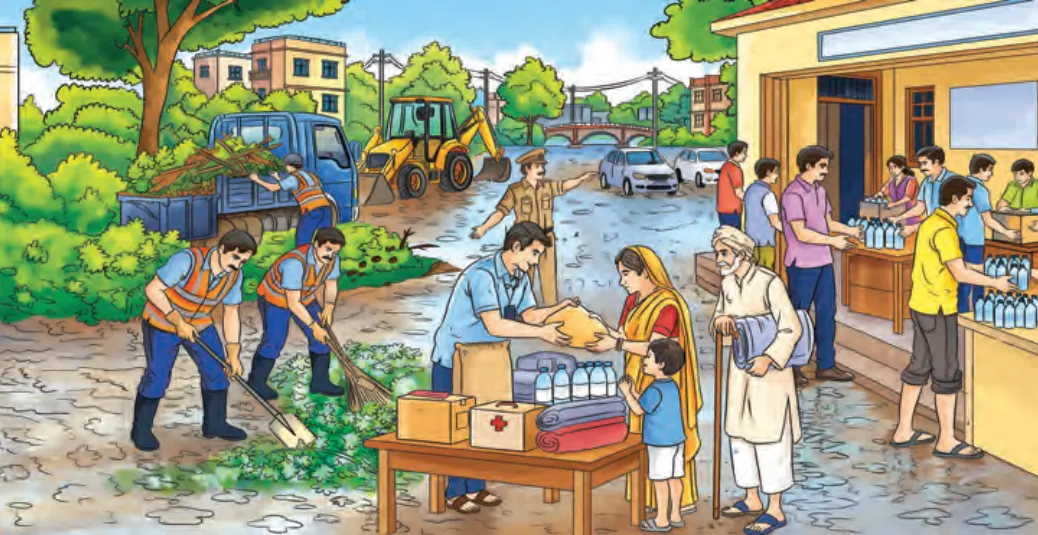
- People & Organisations Involved: Municipal Corporation, Public Works Department (PWD), Police, School Authorities, Health Workers, Elected Local Representatives, and Resident Volunteers.
- Why One Department Cannot Solve It Alone: A flood simultaneously damages roads, drains, power lines, traffic, schools, and public health—each requiring specialised skills, equipment, and authority that no single department possesses.
- If They Did Not Coordinate: Efforts would clash or fail—for example, PWD might repair a road before municipal workers clear the clogged drain underneath, causing it to flood again, while traffic jams would block ambulances and rescue vans.
- Role of Citizens:
- Before: Keep drains free of plastic waste and store emergency supplies.
- During: Help elderly/vulnerable neighbours, report flooded areas, and follow police advisories.
- After: Boil drinking water, clear stagnant water to prevent mosquitoes, and give feedback on weak drainage spots.
- What Makes It Effective: Clear communication, timely coordination, shared responsibility, transparency, and active partnership between officials and citizens.
Let’s Explore (Pages 83–84): Using the street-lighting example as a model, give two more everyday examples showing the difference between ‘government’ and ‘governance’.
- Example 1 — Waste Management: The Municipal Corporation (Government) has the authority to collect city garbage. Planning daily door-to-door collection routes, educating residents to segregate wet and dry waste, and responding quickly to citizen complaints on a mobile app is Governance.
- Example 2 — Public Schools: The Education Department (Government) builds schools and hires teachers. Ensuring teachers attend regularly, involving parents in School Management Committees (SMCs), providing clean drinking water, and tracking student learning outcomes is Governance.
- Briefly trace the historical journey of the Sengol (Fig. 4.2).
- Explain the ‘good governance model’ of two cleanest cities in India (refer to Fig. 4.3).
- Why is 25th December celebrated as National Good Governance Day, and how is it observed?

- Journey of the Sengol: Originating over 1,000 years ago under the Chola dynasty as a sceptre symbolising righteous and just rule, the Sengol was presented by Tamil Nadu’s Adheenam saints to India’s first Prime Minister, Jawaharlal Nehru, at midnight on 15 August 1947 to mark the transfer of power. In 2023, Prime Minister Narendra Modi installed it in India’s newly inaugurated Parliament building as a lasting symbol of ethical governance.
- Cleanest Cities Good Governance Model (Indore, MP & Surat, Gujarat): Both cities achieved top national cleanliness rankings through strong partnership—municipal bodies deployed GPS-tracked segregated waste vans and waste-to-energy plants, market associations banned single-use plastics, NGOs ran awareness drives, and citizens took personal pride in zero-littering and daily waste segregation.
- National Good Governance Day (25th December): This date was chosen to honour the birth anniversary of former Prime Minister Bharat Ratna Atal Bihari Vajpayee. Across districts, it is celebrated through ‘Sushasan Saptah’ (Good Governance Week), special public grievance-redressal camps, digital service awareness drives, and student debates on accountable administration.
Let’s Explore (Page 89): Complete the chart of key e-governance initiatives and add two initiatives from your state government.
| E-Governance Initiative | Primary Objective |
|---|---|
| UMANG | Unified Mobile Application for New-age Governance — a single mobile app providing access to hundreds of Central, State, and local government services. |
| Aadhaar | Provides a unique digital identity to Indian residents for fast, transparent verification and Direct Benefit Transfers (DBT) of welfare subsidies without middlemen. |
| GeM (Government e-Marketplace) | An online public procurement portal enabling government departments to buy goods and services transparently from verified sellers and MSMEs. |
| DigiLocker | A secure cloud-based platform for citizens to store, access, and share legally valid digital documents (marksheets, driving licences, certificates) paperlessly. |
| CPGRAMS | Centralized Public Grievance Redress and Monitoring System — allows citizens to lodge complaints against public authorities online and track resolution in real time. |
| APAAR | Automated Permanent Academic Account Registry (“One Nation, One Student ID”) — digitally tracks a student’s academic credits, degrees, and scholarships across institutions. |
| State Example 1: CM Helpline 181 (MP) | A toll-free helpline and portal allowing citizens of Madhya Pradesh to register grievances and seek government scheme details directly from home. |
| State Example 2: MP e-District / Lok Seva | Delivers time-bound online certificates (income, domicile, caste, birth/death) with guaranteed delivery timelines. |
Let’s Explore (Page 90): Compare the quality of life of citizens before and after e-governance across six everyday services (birth certificate, admit card, marksheets, salary, rail/flight tickets, vehicle registration).
| Service | Before E-Governance | After E-Governance |
|---|---|---|
| 1. Birth Certificate | Multiple visits to municipal offices, long queues, and paper delays. | Applied online via e-District portals and downloaded digitally. |
| 2. Admit Card | Collected physically from schools/centres; risk of loss. | Instant online download from exam board portals anytime. |
| 3. Marksheets | Paper copies easily damaged or lost; hard to verify. | Stored permanently and verified instantly via DigiLocker. |
| 4. Receiving Salary | Paid in cash or paper cheques requiring bank visits. | Credited directly and transparently into bank accounts (DBT/NEFT). |
| 5. Rail / Flight Tickets | Hours spent standing in reservation station counters. | Booked within minutes on IRCTC / airline apps from home. |
| 6. Vehicle Registration | Heavy paperwork and repeated RTO visits. | Streamlined online through the Parivahan / Vahan portal and mParivahan app. |
Note: While e-governance saves enormous time and cuts corruption, citizens without smartphones, internet, or digital literacy still need Common Service Centres (CSCs) and offline support so no one is left behind.
Let’s Explore (Pages 92–93): Identify whether each example is a ‘Policy’ or a ‘Public Policy’ and explain why.
| Example | Policy / Public Policy | Why? |
|---|---|---|
| The government introduces a sports policy. | Public Policy | Formulated by the government for the entire population using public funds to promote national sports. |
| The government launches a campaign to provide safe drinking water to every household. | Public Policy | Addresses a universal public need (clean water) across all citizens through public institutions. |
| A company allows employees to work from home twice a week. | Policy | An internal workplace rule made by a private company affecting only its own employees. |
| A municipality introduces waste segregation in the city. | Public Policy | Made by a local public authority for the environmental welfare of all city residents. |
| A housing society fixes visiting hours for guests. | Policy | Applies only to the residents of that specific private housing society, not the general public. |
| The government introduces free vaccination for children. | Public Policy | Financed by public taxes and run by government health departments for nationwide public health. |
- Form a group of volunteers to regulate traffic in rush hours.
- Write an application to the principal about the issue.
- Meet the principal, along with all class representatives, to take up the issue with the local people’s representative so that a traffic signal can be installed.
- Request the school management to construct and open another gate on the other side of the school.
- Suggest that the school shift its pick-up and drop-off point slightly away from the main gate.
- Change school timings so they do not coincide with the busiest market traffic hours.
- Which option did you choose and why?
- Can you suggest a better combined solution?
- Which stakeholders would be involved and what are their roles?
- Suggest a feedback loop so the problem does not recur.

- Chosen Option: Option 3 (meeting the principal with all class representatives to approach the local elected representative for a traffic signal and zebra crossing), because it uses democratic representation to secure a permanent, safe public-infrastructure solution.
- Better Combined Solution: Combine Option 3 + Option 5—install a pedestrian traffic signal and zebra crossing outside the school, deploy a traffic constable during peak 30-minute arrival/dispersal windows, and shift school bus/car drop-off bays slightly away from the narrow market bottleneck.
- Stakeholders & Roles:
- Students & Parents: Highlight the hazard and follow lane discipline.
- Principal & School Management: Coordinate with authorities and manage drop-off zones.
- Local Councillor / MLA: Sanction funds for the traffic signal.
- Traffic Police & Municipal PWD: Paint zebra crossings, install signals, and regulate rush-hour traffic.
- Feedback Loop: Form a joint School Road-Safety Committee (teachers, parents, student reps, and a local traffic officer) that reviews traffic flow every month and reports broken signals or illegal parking immediately.
- Arrange the stages of the policy process in sequence for upgrading the hospital.
- Which stakeholders were involved? Identify at least three.
- Identify one public building in your locality that needs better accessibility and suggest improvements.
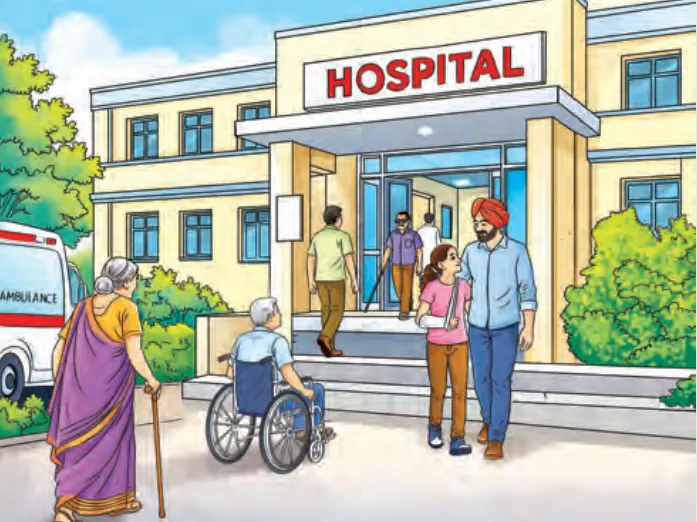
- Policy Stages in Sequence:
- Problem Identification: Patients and visitors notice the lack of ramps, handrails, and Braille signs.
- Agenda Setting / Raising the Issue: Citizens, local representatives, the disability rights NGO, and media highlight the barrier.
- Inspection & Consultation: District Administration, PWD, Health Department, doctors, architects, and PwD groups inspect and plan an inclusive design.
- Policy Adoption & Funding: The government approves funds for the upgrade.
- Implementation: Construction of ramps, lifts, handrails, tactile pathways, signboards, and accessible toilets.
- Evaluation / Outcome: The hospital becomes welcoming and accessible for seniors, PwDs, pregnant women, and children.
- Stakeholders Involved (any three):
- Citizens, patients, and senior citizens.
- Local disability rights NGO and the media.
- District Administration, PWD, and the Health Department.
- Doctors, hospital staff, and architectural experts.
- Local Public Building Improvement: Many local railway stations or post offices still have steep entrance steps. Adding gentle non-slip wheelchair ramps with sturdy handrails, tactile floor tiles for visually impaired visitors, and clear large-font signage would make them welcoming for everyone.
- If any step in policy-making and implementation is skipped, what would be the implications? Give an example.
- As a student, what role can you play in the successful implementation of Khelo Bharat Niti 2025?
- If your school is designated as the ‘state’s sports ambassador’, what actions should it take?
- Which government ministries can contribute to the success of Khelo Bharat Niti 2025, and how?
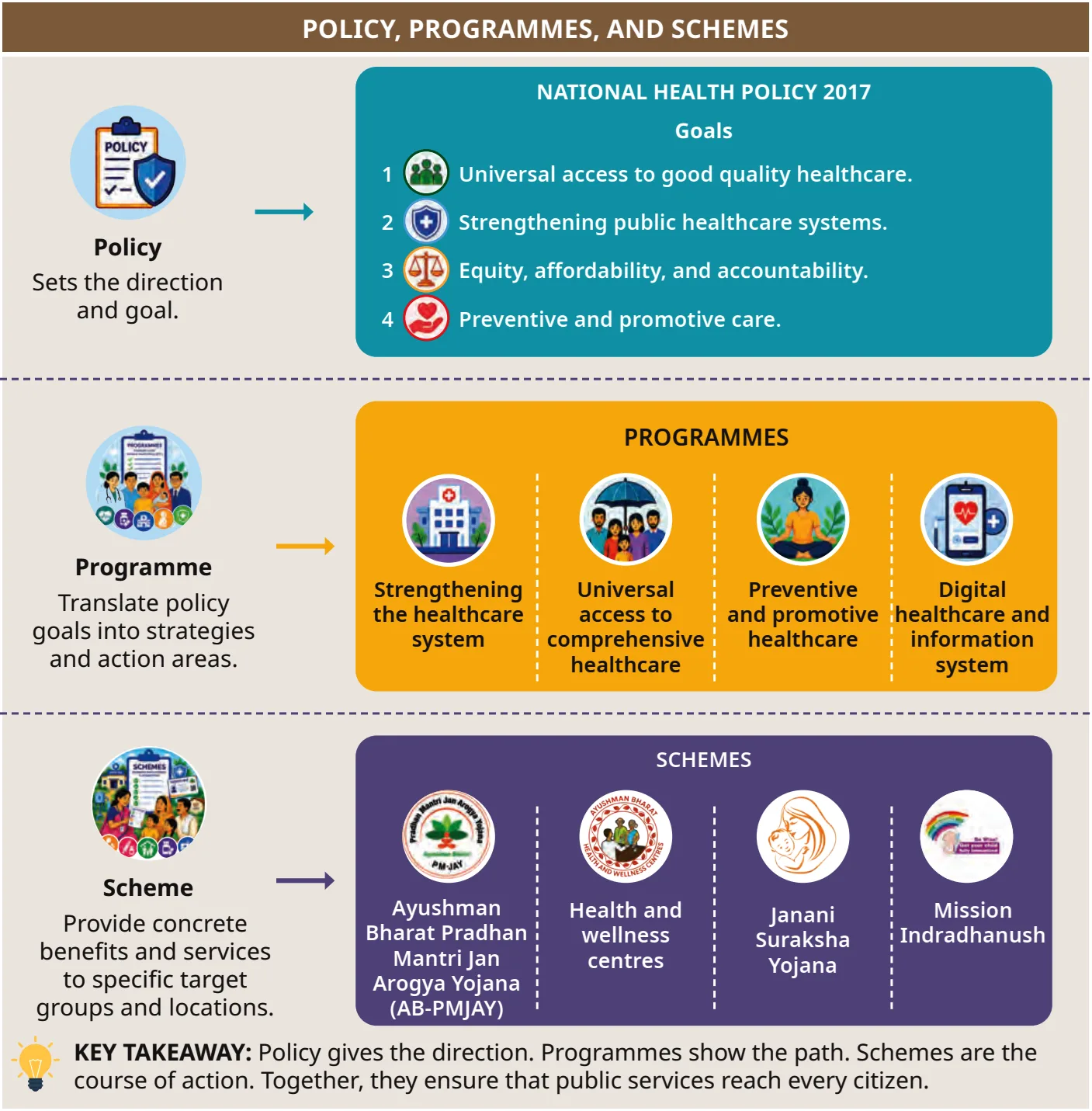
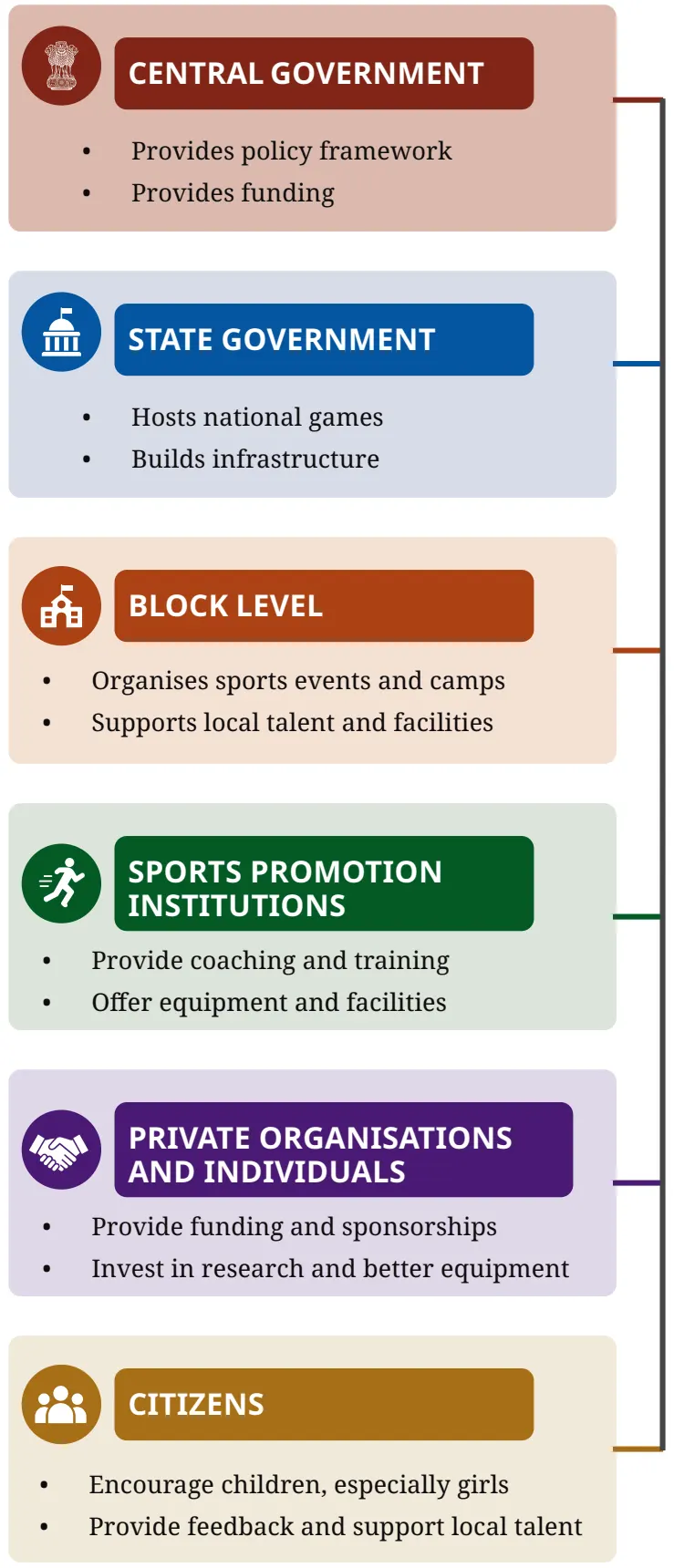
- Implications of Skipping a Policy Step: Skipping consultation leads to poorly designed policies that ignore real needs; skipping monitoring leads to wasted funds. Example: If a city builds public toilets without consulting women or monitoring daily water supply and cleaning, the toilets quickly become unusable and fail their purpose.
- Student Role in Khelo Bharat Niti 2025: Participate actively in school and block-level sports, encourage classmates (especially girls and specially abled peers) to join games, take care of school playgrounds, and share feedback on local sports facilities.
- School as ‘State’s Sports Ambassador’: Host inter-school tournaments, ensure inclusive sports periods for boys, girls, and differently abled students, invite local athletes for workshops, maintain clean sports grounds, and scout talented young players for district camps.
- Contributing Ministries:
- Ministry of Youth Affairs & Sports: Provides policy framework and funding.
- Ministry of Education: Integrates sports into school and college curricula.
- Ministry of Health: Supports sports medicine and athlete nutrition.
- Ministry of Women & Child Development: Promotes girls’ participation in sports.
- Ministries of Rural Development & Urban Affairs: Build and maintain village and city playgrounds.
Part 3: Textbook Exercises — Questions and Activities (Pages 104–106)
Q1. “Good governance is the responsibility of the government alone.” Do you agree with this statement? Give reasons to support your answer.
No, I disagree. While the government has the primary authority to enact laws and fund public services, good governance is a shared partnership between the government and society:
- Citizens must vote responsibly, obey laws, pay taxes, protect public property, and report problems.
- Media & Civil Society (NGOs) highlight hidden issues, spread awareness, and hold officials accountable.
- The Private Sector contributes innovation, clean technology, and partnerships (such as building infrastructure or sponsoring sports).
Without active citizen and community support, even the best government schemes cannot succeed on the ground.
Q2. Do you think students can contribute to good governance? Write a short note describing any five ways in which students can become more responsible and active citizens.
Yes, students play a vital role in building a culture of good governance. Five practical ways students can contribute are:
- Practising Everyday Civic Discipline: Following traffic rules, segregating waste, conserving water and electricity, and never damaging school or public property.
- Participating in School Governance: Joining student councils, Eco-Clubs, NSS, or NCC to solve campus issues like plastic waste or road safety democratically.
- Being Media Literate: Fact-checking news before sharing on social media to stop misinformation and fake news.
- Helping Others Access E-Governance: Assisting elderly family members or neighbours in using DigiLocker, UMANG, or online portals safely.
- Raising Constructive Voices: Politely reporting local civic issues (like broken streetlights or leaking taps) to municipal helplines or local representatives.
- The problem it addresses
- The major stakeholders involved
- How different actors coordinate
- The role of citizens in its success
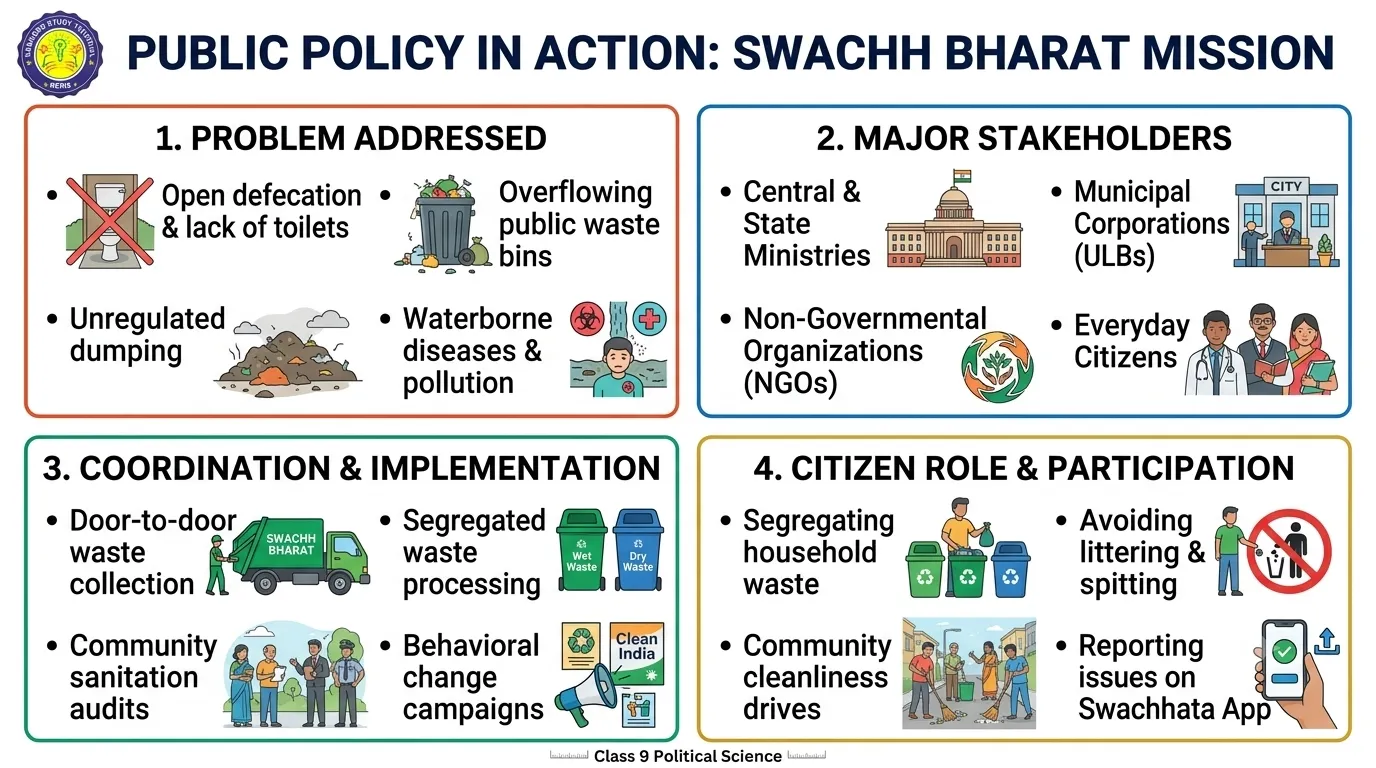
Chosen Public Policy: Swachh Bharat Mission (Clean India Mission)
| Aspect | Details for Classroom Presentation |
|---|---|
| (a) Problem Addressed | Open defecation, overflowing urban garbage dumps, poor rural/urban sanitation, and resulting waterborne diseases. |
| (b) Major Stakeholders | Union Ministries (Jal Shakti & Housing/Urban Affairs), State Governments, Gram Panchayats, Municipal Corporations, NGOs, Schools, Private Waste-Tech firms, and Citizens. |
| (c) How Different Actors Coordinate | The Centre provides funds and guidelines; States monitor targets; Municipalities/Panchayats build household/community toilets and run door-to-door waste vans; NGOs and schools run hygiene awareness campaigns. |
| (d) Role of Citizens in Its Success | Using toilets regularly, segregating wet and dry household waste daily, refusing single-use plastics, keeping streets clean, and reporting garbage spots via the Swachhata App. |
- What is governance?
- How is governance different from government?
- What is meant by public policy?
- Name any four principles of good governance.
- Governance is the process through which decisions are made, implemented, and monitored for the welfare of the people by public institutions, civil society, and citizens working together.
- Government refers to the formal institutions that hold political authority (who governs), whereas governance refers to the actual process and quality of decision-making and service delivery (how governing is carried out).
- Public policy is a planned course of action adopted and funded by the government to solve public problems, meet citizens’ needs, and promote the welfare of society as a whole.
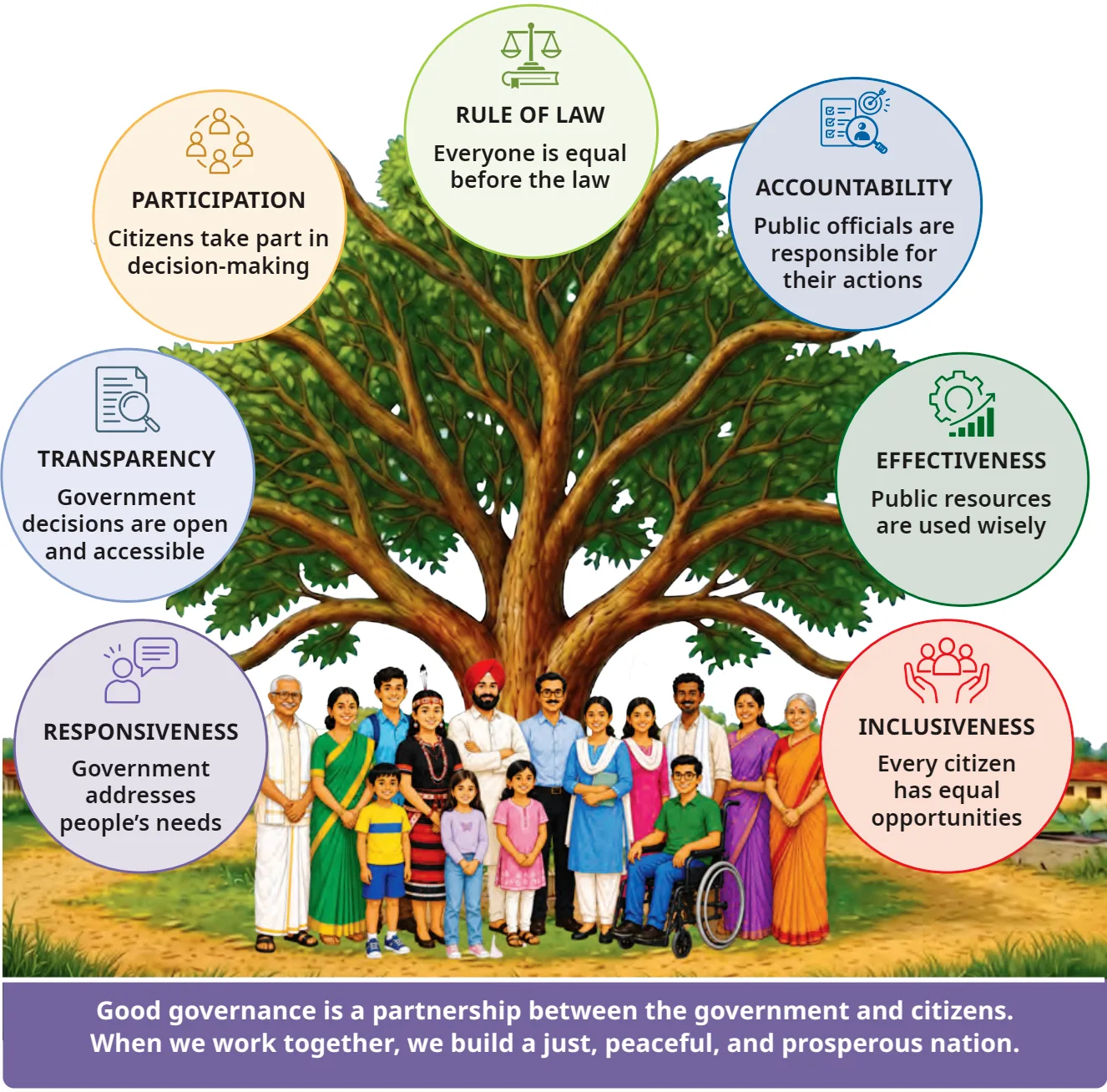
- Four key principles of good governance are: Transparency, Accountability, Participation, and the Rule of Law (along with Responsiveness, Effectiveness, and Inclusiveness).
- Government and governance
- Policy and public policy
(a) Government vs. Governance
| Basis | Government | Governance |
|---|---|---|
| Meaning | Refers to the formal institutions exercising political authority. | Refers to the process of making, implementing, and monitoring decisions. |
| Who Is Included | Includes the Legislature, the Executive, and the Judiciary. | Includes government, citizens, media, civil society, and private organisations. |
| Core Focus | Focuses on who governs. | Focuses on how governing is carried out. |
(b) Policy vs. Public Policy
| Basis | Policy (General / Organisational) | Public Policy |
|---|---|---|
| Who Makes It | Made by private bodies like schools, companies, clubs, or housing societies. | Formulated by Central, State, or Local Governments. |
| Scope & Beneficiaries | Applies only to a limited group or specific organisation (e.g., company work-from-home rule). | Applies to society at large for the benefit of all citizens (e.g., free vaccination or clean water). |
| Funding | Funded by private or organisational funds. | Financed through public money collected via taxes. |
- Improve drinking water facilities in schools.
- Improve sanitation and public toilets in schools and market areas.
- Provide tricycles for orthopaedically challenged students.
- Install open-area swings and open-air gym in public parks.
- Ensure the vaccination of stray dogs to prevent rabies.
- Ensure distribution of iron and folic acid tablets for female students in schools.
Recommended Top Three Priorities:
- (a) Improve drinking water facilities in schools — Safe drinking water is an immediate, basic survival and health need for every child every single day.
- (b) Improve sanitation and public toilets in schools and market areas — Prevents infectious diseases, protects public dignity, and keeps girls attending school regularly.
- (c) Provide tricycles for orthopaedically challenged students (or (f) iron and folic acid tablets for female students) — Upholds the good-governance principle of inclusiveness by ensuring vulnerable students enjoy equal access to education and health.
Most Important Out of the Three: (a) Safe drinking water in schools is the single most urgent priority because contaminated or missing drinking water causes immediate illness, dehydration, and school absenteeism across the entire student population.
| S. No. | Policy Action Point | Stage of Policy Cycle (Jumbled) |
|---|---|---|
| 1. | Assessing the impact of the policy | Policy implementation |
| 2. | Putting the policy into action | Policy evaluation |
| 3. | Framing the legislation | Policy adoption |
| 4. | Multi-dimensional consultation with stakeholders | Policy formulation |
| 5. | Addressing a new need of the people | Policy desirability (problem identification) |
Correctly Matched Table:
| S. No. | Policy Action Point | Correct Stage of Policy Cycle |
|---|---|---|
| 1. | Assessing the impact of the policy | Policy evaluation |
| 2. | Putting the policy into action | Policy implementation |
| 3. | Framing the legislation | Policy adoption |
| 4. | Multi-dimensional consultation with stakeholders | Policy formulation |
| 5. | Addressing a new need of the people | Policy desirability (problem identification) |
- Which stage of the policy cycle appears to be weak?
- Which organisations should coordinate to improve the programme?
- Suggest two measures that could improve the outcome.
- Weak Stage: Policy Implementation and Policy Monitoring (after planting, there was no follow-up care, accountability, or survival tracking).
- Organisations That Should Coordinate: The Forest Department, Municipal Corporation (Parks & Water Wing), local Schools & Eco-Clubs, Resident Welfare Associations (RWAs), and environmental NGOs.
- Two Measures to Improve the Outcome:
- Community “Adopt-a-Tree” Programme: Assign every sapling to nearby households, shopkeepers, or school students for regular watering and tree-guard protection.
- Geo-Tagged Survival Audits: Shift success metrics from “number of saplings planted” to “percentage of trees surviving after 2 years,” monitored through periodic geo-tagged photo checks.
- A good public policy can fail if it is not implemented properly.
- Citizen participation sometimes makes decision-making slower, but it can improve governance.
- Technology alone cannot ensure good governance.
- Agree. Even a well-intentioned, well-funded policy fails if implementation and monitoring are weak—just like the city’s tree-plantation drive in Q8 where saplings died due to lack of watering and protection.
- Agree. Consulting citizens, NGOs, and local bodies takes extra time (as seen in the multi-year consultations for NEP 2020), but it uncovers real ground-level problems, builds public trust, and results in far stronger, more inclusive policies.
- Agree. E-governance portals and apps make services faster and more transparent, but technology cannot fix poor internet access, digital illiteracy, or lack of empathy and honesty among officials. Good governance always requires both technology and ethical, accountable human effort.
- The reason for selecting the issue
- Your proposed solution
- Who should implement it?
- How will students participate?
- How will you know whether the policy has succeeded?
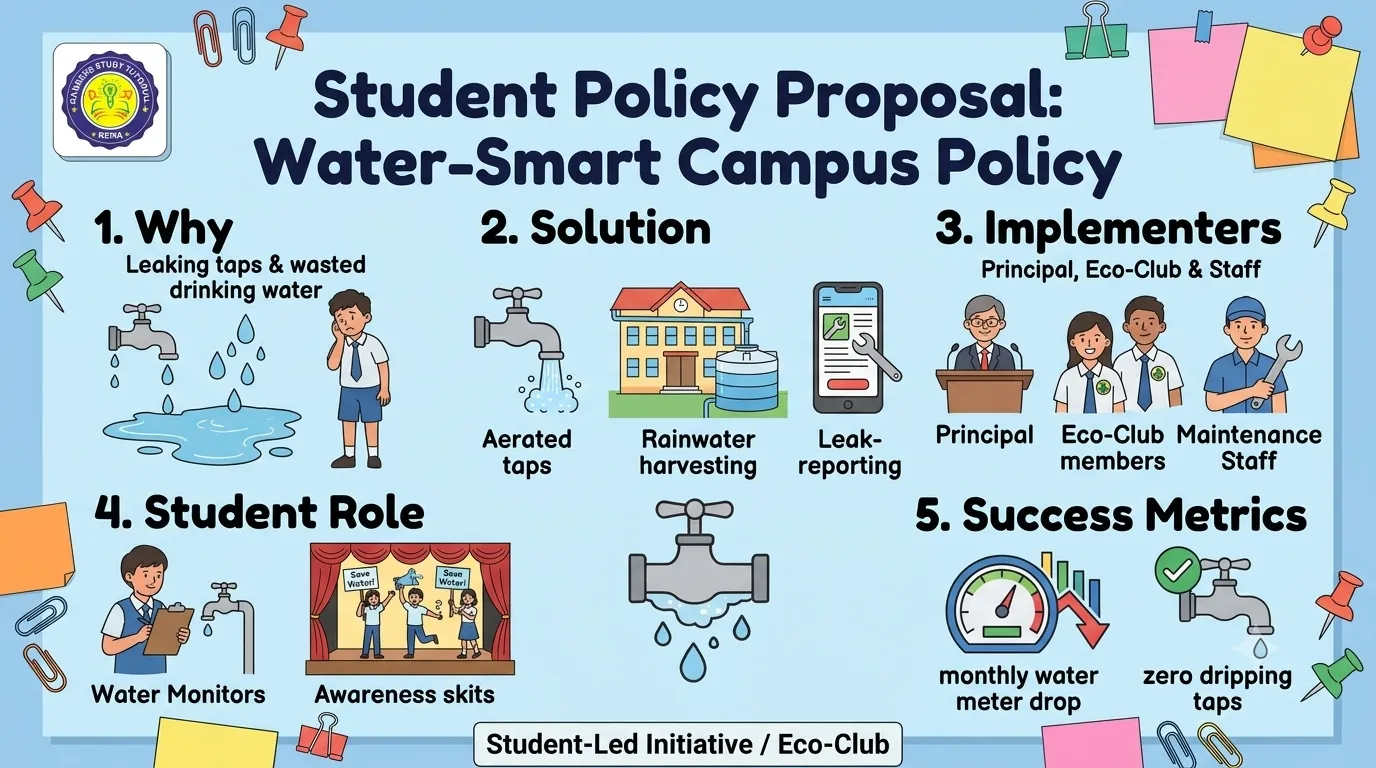
Sample Policy Proposal: “Water-Smart Campus Policy” (Addressing Water Wastage)
- Reason for Selecting the Issue: Every afternoon, leaking washroom taps and half-empty water bottles poured out after lunch waste hundreds of litres of clean drinking water across our school campus.
- Proposed Solution: Repair all leaking taps and fit water-saving aerators; install a “Leftover Water Collection Tank” near the drinking area to reuse poured-out bottle water for gardening; and set up rooftop rainwater harvesting.
- Who Should Implement It: The School Principal and Management (funding & plumbing repairs), Maintenance Staff (daily checks), and Teachers/Eco-Club Coordinators (supervision).
- How Students Will Participate: Each class appoints two rotating “Water Monitors” to check taps after recess, students empty leftover bottle water into garden buckets instead of drains, and classes perform morning-assembly skits on water conservation.
- How We Will Measure Success (Monitoring & Evaluation): Compare monthly school water-meter readings to track a 25% drop in consumption, maintain a weekly “Zero Dripping Taps” checklist, and hold a student feedback review every term.
List
Class 9 Social Science Part 2 Chapter 5 Managing Your Personal Finances NCERT Solutions
Class 9 Social Science Part 2 Chapter 4 Governance and Public Policy NCERT Solutions
Class 9 Social Science Part 2 Chapter 3 Resistance and Resilience (1000-1700 CE) NCERT Solutions
Class 9 Social Science Part 2 Chapter 2 Life on Earth NCERT Solutions
Class 9 Social Science Part 2 Chapter 1 Oceans and Life NCERT Solutions