Class 9 Social Science Part 2 Chapter 3 Resistance and Resilience (1000–1700 CE) NCERT Solutions
Part 1: The Big Questions (Page 45)
Q1. How did Indian rulers use resistance and alliances to safeguard their lands?
- Direct Military Resistance & Confederacies: Rulers like Chaulukya Queen Nāikī Devī (who defeated Muhammad Ghūrī at Kasahrada in 1178), Rāṇā Sāngā (who led a Rajput confederacy at Khanua in 1527), and the Vijayanagara rulers (who ended the Madurai Sultanate) actively confronted invaders.
- Guerrilla Warfare & Local Alliances: Mahārāṇā Pratāp allied with the Bhil community in the Aravalli hills (reclaiming Mewar after the Battle of Dewair, 1582), Chhatrapati Śhivājī used Deccan hill forts (Raigad, Sinhagad) and swift raids to build Swarājya, and Ahom commander Lachit Borphukan used Assam’s rivers and fast bāchārī boats to defeat the Mughals at Saraighat (1671).
- Diplomatic Alliances: Some Rajput rulers (like the Kachhwāhās of Amber) negotiated strategic alliances and accepted mansabs under the Mughals to protect their kingdoms, gain administrative influence, and secure patronage for temple building.
Q2. What factors contributed to the resilience of different kingdoms and communities during this period?
- Geography & Military Institutions: Rugged terrains (Aravalli hills, Deccan valleys, Brahmaputra rivers), well-stocked forts, the Ahom Paik system, and Sikh misals (and the Khalsa) helped communities withstand prolonged sieges and persecution.
- Spiritual & Cultural Adaptation: The Bhakti movement shifted worship toward non-material, portable forms like nām kīrtan and satsang in regional languages, while temple builders adapted architecture into discreet havelī temples to protect sacred traditions.
- Restoration of Sacred Sites: Local rulers and guilds repeatedly rebuilt damaged temples—such as Kumāra Kampana restoring Srirangam and Kanchipuram, and Todar Mal, Rājā Mān Singh, and later Ahilyābāī Holkar restoring Kashi Vishwanath.
- Economic Vitality: Expanding agriculture, local irrigation, thriving merchant networks, and financial tools like the hundī gave societies the resources needed to survive political instability.
Q3. How did the Bhakti tradition foster a sense of solidarity?
Q4. How did the expansion of agriculture, trade, and commerce keep the economy sound?
- Agricultural & Irrigation Growth: Farmers expanded cultivation using rope pulleys, Persian wheels, and small-scale irrigation networks (especially in the Vijayanagara Empire).
- Inland & Maritime Trade: Caravans and banjārās linked villages to cities and Central Asia, while thriving ports (Surat, Masulipatnam, Malabar, Bengal) made India the hub of the Indian Ocean trade in cotton textiles, spices, gems, and horses.
- Merchant Networks & Hundī: Powerful Indian merchant groups (such as Gujarati traders and vellalār) acted as bankers, shippers, and brokers, while money-changers (sarrāfs) operated the hundī system (bills of exchange) to make long-distance commerce safe and seamless.
Part 2: In-Text Questions & Activities Solved
- He kept his horses unbranded: Under Mughal rules (dagh), subordinate rulers had to brand their cavalry horses with the imperial Mughal seal; Pratāp refused to do so.
- He never participated in the Nauroz festival at the Mughal court.
- He never mounted guard during the emperor’s Jharokha Darshan, refusing to accept the role of a subordinate noble.
Let’s Recall (Page 58): What strategies and institutions helped Chhatrapati Śhivājī and the Marathas establish and strengthen their power (Swarājya)?
Let’s Explore (Page 64): Explore the contributions of the Nayanar saint Karaikal Ammaiyar (devotee of Śhiva) and the Alvar saint Andal (devotee of Vishṇu) to the spread of the Bhakti tradition in peninsular India.
- Karaikal Ammaiyar (Nayanar Saint): One of the earliest Tamil Śhaiva saints, she renounced worldly life to compose deeply emotional Tamil hymns in praise of Lord Śhiva. Her poetry emphasised pure, selfless love for the divine over rigid rituals.
- Andal (Alvar Saint): The only female saint among the twelve Tamil Alvars, she composed the celebrated Tiruppāvai and Nāchiyār Tirumoli in Tamil, expressing intense personal devotion to Lord Vishṇu (Krishṇa).
- How They Connected with People: By singing in everyday Tamil rather than elite scholarly language, both women saints made spirituality deeply personal, accessible to ordinary households, and inspiring for generations of devotees across South India.
Let’s Map (Page 67): Locate the present-day states associated with prominent Bhakti saints (Fig. 3.19) and share a verse or teaching you like.
| Region | Prominent Bhakti Saints | Present-Day States |
|---|---|---|
| Northern & Central | Lāl Ded (J&K); Guru Nānak (Punjab); Kabīr, Rāmānanda, Rāidās, Sūrdās, Tulsīdās (Uttar Pradesh); Mīrābāī (Rajasthan) | Jammu & Kashmir, Punjab, Uttar Pradesh, Rajasthan |
| Eastern | Jayadeva (Odisha); Chaitanya Mahāprabhu & Krittibāsa (West Bengal); Sankardev & Mādhava Kandalī (Assam) | Odisha, West Bengal, Assam |
| Western | Jñānadeva, Nāmadeva, Ekanātha, Tukārām, Muktābāī, Janābāī, Chokhamelā (Maharashtra); Narasimha Mehtā & Bhalana (Gujarat) | Maharashtra, Gujarat |
| Southern | Basavaṇṇā & Mādhavāchārya (Karnataka); Annamāchārya & Pothanā (Andhra Pradesh/Telangana); Poonthanam Namboothiri (Kerala) | Karnataka, Andhra Pradesh, Telangana, Kerala |
Example of a Famous Verse: Narasimha Mehtā’s Gujarati hymn “Vaishṇava Jana To” teaches that a true devotee is one who feels the pain of others, helps those in misery without pride, and treats everyone with humility and equality.
Daily Life Example: Almost everyone knows the rule that we should not litter or spread unverified rumours on social media. Yet, truly following it means holding onto a wrapper until we find a dustbin even when no one is watching, or refusing to forward a sensational message without fact-checking it first.
Think About It (Page 74): What made the hundī a safer and more convenient choice than physically transporting money across long distances?

Think About It (Page 76): Identify cultural and economic pillars in any community (places of faith, traditions, business, trade) and explain how they contribute to resilience facing external pressures.
Part 3: Textbook Exercises — Questions and Activities (Pages 77–79)
- Resistance always involves warfare.
- Resilience enables communities to endure difficulties and sustain resistance.
- Resistance is possible only when a kingdom has a large army.
- Resilient societies avoid all forms of conflict.
Q2. Why and how did groups such as the Sikhs, Marathas, and Rajputs assert their political power and identity during periods of changing political authority?
Why: Heavy taxation, territorial expansion by the Delhi Sultanate and Mughals, destruction of sacred sites, and religious persecution motivated these groups to protect their political sovereignty, lands, and cultural-spiritual identities.
How They Asserted Power:
- The Sikhs: Following the martyrdoms of Guru Arjan Dev and Guru Tegh Bahadur, Guru Hargobind established the Akāl Takht and the concept of mīrī-pīrī (combining spiritual and temporal authority). In 1699, Guru Gobind Singh founded the martial order of the Khalsa, and Sikhs later organised into armed confederacies called misals to defend Punjab.
- The Marathas: Inspired by Chhatrapati Śhivājī’s vision of Swarājya (self-rule), they used hill forts (Raigad, Sinhagad), swift guerrilla warfare in the Deccan, and tributary alliances to exhaust Mughal power and establish an independent state (1674).
- The Rajputs: Kingdoms like Mewar (under Rāṇā Hammīr, Mahārāṇā Kumbhā, Rāṇā Sāngā, Mahārāṇā Pratāp, and Amar Singh) built forts, forged alliances with Bhil warriors, and used Aravalli guerrilla tactics to defend their autonomy.
Q3. Why did some Rajput rulers decide to negotiate alliances with the Mughal power?
- Preserving Their Kingdoms: Alliance spared their subjects and lands from destructive prolonged warfare against a massive empire.
- Political & Military Influence: By accepting high imperial ranks (mansabs), Rajput nobles gained major administrative, military, and diplomatic positions within the Mughal Empire.
- Cultural Patronage: Peaceful relations allowed allied rulers to protect local traditions and sponsor grand temples (such as the Govind Devji Temple at Vrindavan and the reconstruction of Kashi Vishwanath).
Q4. Imagine a market in a port town of India such as Surat, Masulipatnam, or Puducherry. You are a foreign trader from Italy or France wanting to make a deal for cotton textiles. How would you secure the product, whose help would you seek, and what challenges would you face?
- How I Would Secure the Textiles: I would visit the bustling port bazaar and place bulk advance orders through established Indian merchant networks (such as Gujarati, Coromandel, or Bengali merchants) who managed supply chains linking rural cotton farmers, weavers, dyers, and bleachers.
- Whose Help I Would Seek: I would rely on dubhaśhīs (local interpreters and translators) to communicate, local brokers to negotiate fair deals with weavers, and sarrāfs (money-changers) to convert my European currency or issue a hundī.
- Challenges Faced: Bridging language barriers (requiring Portuguese, Persian, or local languages), checking uniform cloth quality and dye fastness across hundreds of weavers, navigating fluctuating commodity prices and customs duties, and competing fiercely against rival Dutch, English, and Portuguese trading companies.
Q5. Analyse the various functions of forts and fortresses (e.g., Raigad, Sinhagad, Gingee Fort). How did rulers perceive the importance of forts in terms of strategic concerns?

- Military Defence & Guerrilla Hubs: Built on steep hills or rocky terrain, forts like Raigad, Sinhagad, and Gingee (whose gateway allowed a small garrison to hold off ten thousand soldiers) served as secure bases to launch surprise attacks and safe retreats during invasions.
- Withstanding Prolonged Sieges: Equipped with thick walls, internal water reservoirs, granaries, and armouries, forts remained self-sufficient for months.
- Administrative & Fallback Capitals: Beyond warfare, forts housed royal courts, treasuries, and judicial offices, and frontier forts acted as fallback capitals to prevent total defeat.
Q6. What architectural changes occurred in temple construction during the period under study? How do these changes reflect the resilient nature of Indian civilisation?
- Instead of towering, highly visible shikharas on main roads, many new temples in northern India (Delhi, Varanasi, Rajasthan) were built along narrow lanes with entrances hidden from main streets.
- They adopted the discreet exterior of ordinary residential mansions—known as ‘havelī temples’—with simpler outer walls while preserving sacred sanctums inside.
Q7. A kingdom has limited military resources but possesses fertile agricultural land, strong local support, and detailed knowledge of its terrain. Explain two ways in which these resources could contribute to the kingdom’s resilience when faced with a threat.
- Terrain-Based Guerrilla Warfare & Local Intelligence: Detailed knowledge of hills, forests, rivers, and monsoons—combined with loyal local communities—allows a smaller force to ambush larger invading armies, cut off their supply lines, and retreat safely (just as Mahārāṇā Pratāp did with the Bhils in the Aravallis, and the Ahoms did on the Brahmaputra).
- Economic Self-Sufficiency During Prolonged Conflict: Fertile agricultural land ensures steady food supplies and tax revenue to feed soldiers and villagers, preventing starvation and enabling the kingdom to endure long sieges until the invader exhausts their resources.
Q8. Consider the statement: “A tradition becomes more resilient when people can carry it with them.” Do you agree? Explain using examples from the Bhakti tradition.
Examples from the Bhakti Tradition:
- When temple construction faced restrictions, Bhakti saints emphasised non-material, portable worship like nām kīrtan (reciting the divine Name) and community singing (sankīrtan / satsang)—as practised by Sankardev (Kīrtana Ghosha), Chaitanya Mahāprabhu, and Guru Nānak.
- By translating epics and composing hymns in local household languages—such as Tulsīdās’s Rāmcharitmānas in Awadhi, Atukuri Molla’s Telugu Rāmāyaṇa, and Eknāth’s Marathi verses—spiritual wisdom lived inside every home, making Indian culture deeply resilient.
Q9. Voices from the Past: Choose any two (A Bhakti saint, A Rajput soldier, An Ahom commander, A Maratha administrator, A merchant, or A Jat leader) and write a short first-person account explaining what resilience means from that person’s perspective.
1. An Ahom Commander (at Saraighat, 1671):
“When the mighty Mughal fleet sailed up the Brahmaputra, many thought Assam would fall. But to me, resilience is knowing our own land better than any invader ever could. Our swift bāchārī river boats, our Paik soldiers, and the monsoon currents of our river are our greatest shields. Even when they briefly took Garhgaon, we never surrendered our spirit—we adapted, struck at the right moment, and kept our homeland free for six centuries.”
2. A Bhakti Saint:
“To me, resilience does not need a sword or a stone wall. When times grow harsh and temples are threatened, we carry the divine inside our hearts. Through simple songs in the people’s own language and evening satsangs where rich and poor sit as equals, we keep hope, dignity, and devotion alive in every humble home.”
Q10. Design a Fort: As a military architect advising a ruler, draw a labelled plan of a fort (including Residential complex, Defensive walls, Water source, Food storage, Escape route, Watchtower, and Administrative area) and explain how your design helps withstand a long siege.
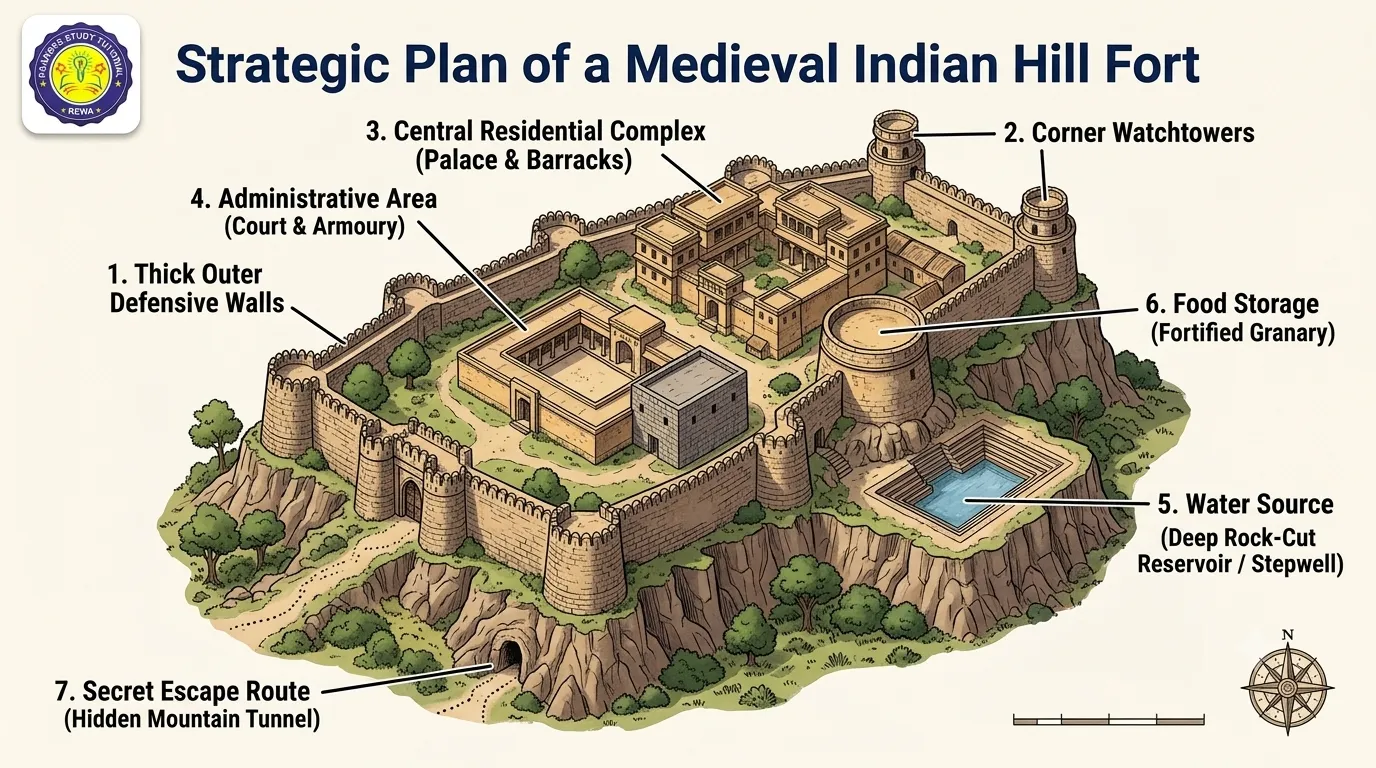
- Thick Defensive Walls & Watchtowers: High stone ramparts with narrow, angled gateways prevent enemy armies from storming inside, while corner watchtowers spot approaching forces miles away.
- Internal Water Source & Food Storage: Deep rock-cut rainwater reservoirs and fortified granaries keep soldiers and citizens fed and hydrated for months even if invaders cut off outside supply lines.
- Central Residential & Administrative Areas: Placing the palace, barracks, armoury, and governance offices safely at the core ensures law, order, and troop coordination continue smoothly under attack.
- Hidden Escape Route: A secret mountain tunnel allows messengers to fetch allied reinforcements—or lets the ruler evacuate safely to a fallback fort to continue resistance if the walls are ever breached.
List

Class 9 Social Science Part 2 Chapter 5 Managing Your Personal Finances NCERT Solutions
Class 9 Social Science Part 2 Chapter 4 Governance and Public Policy NCERT Solutions
Class 9 Social Science Part 2 Chapter 3 Resistance and Resilience (1000-1700 CE) NCERT Solutions

Class 9 Social Science Part 2 Chapter 2 Life on Earth NCERT Solutions

Class 9 Social Science Part 2 Chapter 1 Oceans and Life NCERT Solutions