Class 9 Social Science Part 1 Chapter 8 Building Blocks in Economics: The Problem of Choice NCERT Solutions
Part 1: The Big Questions (Page 183)
Q1. What does economics deal with?
Q2. What are the key questions in economics?
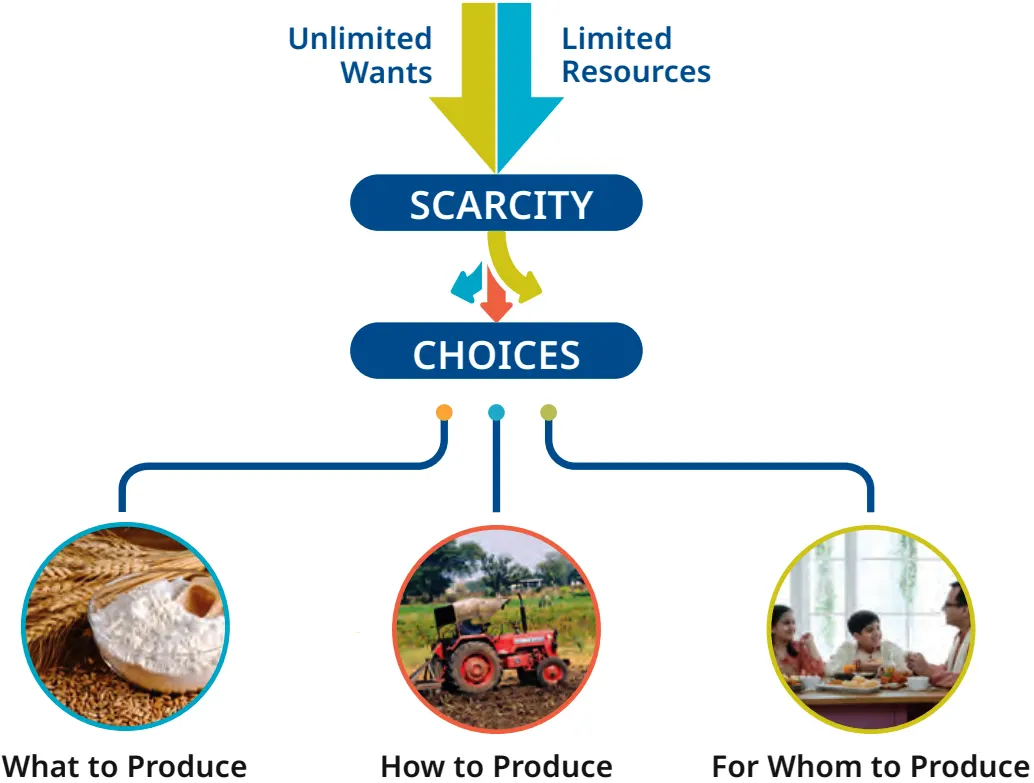
- What to Produce (and in what quantities): Deciding which goods and services to make—for example, whether farmers should grow water-intensive sugarcane for higher short-term profit or drought-resistant millets for long-term sustainability.
- How to Produce: Choosing the right mix of factors of production (land, labour, capital, technology)—whether to use labour-intensive methods (more workers, as in handicrafts) or capital-intensive methods (more machines, as in automobile manufacturing).
- For Whom to Produce: Deciding which consumer groups will benefit from the goods produced, based on their needs, tastes, and purchasing power (e.g., affordable school shoes vs. formal leather office shoes).
Q3. How do different economic systems address these questions?
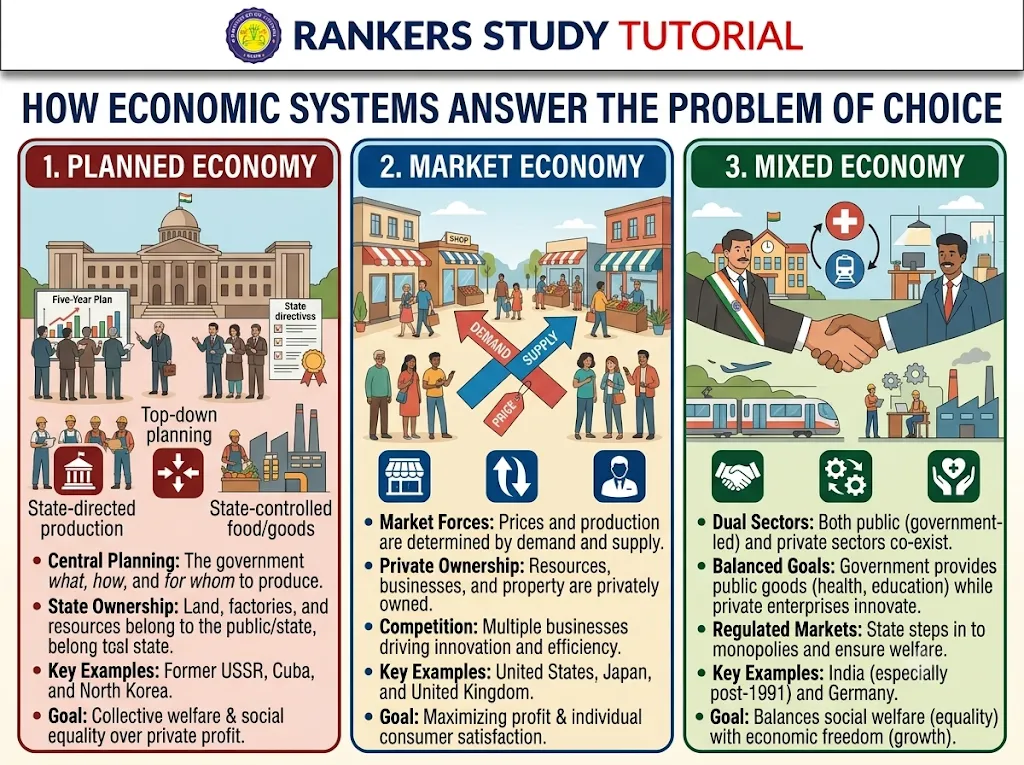
- Planned Economy: A central government authority owns most resources (land, factories, banks) and decides what, how, and for whom to produce, as well as the prices (e.g., former Soviet Union, North Korea, Cuba).
- Market Economy: Private individuals and companies own resources, and the forces of demand and supply decide production and prices. The government acts mainly like a referee, maintaining law and order and providing public goods (e.g., USA, Japan, Hong Kong).
- Mixed Economy: Combines both systems—private businesses drive competition and innovation, while the government regulates unfair practices, protects consumers, provides public goods, and runs welfare programmes (e.g., India post-1991, China post-1978, Germany, Sweden).
Part 2: In-Text Questions & Activities Solved
- List three things your parents bought this month. Can you classify them into needs or wants?
- Do you think having too many wants may create problems? Why or why not?
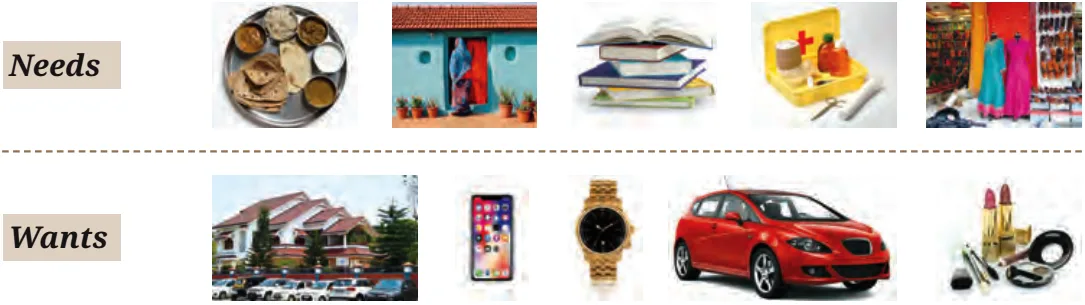
- Three Monthly Purchases Classified:
- Groceries and fresh vegetables — Need (essential for daily survival and health).
- School textbooks and medicines — Need (essential for education and well-being).
- A new smartwatch / restaurant dinner — Want (adds comfort and enjoyment, but not essential for survival).
- Problems of Too Many Wants: Yes, chasing unlimited wants without prioritising can create serious problems. For households, it leads to overspending, debt, and lack of savings for emergencies. For society and the planet, excessive consumption drives over-extraction of natural resources, pollution, and environmental degradation.
- Ask your parents about how they make choices for everyday purchases. What is the opportunity cost of making a particular decision?
- How do you decide to spend your time? Is time a scarce resource?
- Everyday Household Choice & Opportunity Cost: When my parents plan our monthly budget, they first set aside money for fixed needs (groceries, electricity bills, school fees, savings). If they decide to spend ₹2,000 on a weekend movie and dinner outing, the opportunity cost is the next best alternative they gave up—such as buying a new pair of sports shoes or adding that ₹2,000 to our emergency savings fund.
- Is Time a Scarce Resource? Yes, time is one of our scarcest resources because everyone has strictly 24 hours in a day. I prioritise my time by finishing schoolwork and revision first, then setting aside time for outdoor sports and hobbies. If I spend an extra two hours scrolling on a phone, the opportunity cost is the sleep or exam preparation I gave up.
Think About It (Page 189): Should the government allocate more funds to healthcare and education or to defence and space exploration? Why or why not?
- In your opinion, should the government completely stay out of enterprise decisions?
- Can you think of an example where government action helped or harmed an industry or sector?
- Should the government completely stay out? No. While private enterprises need freedom to innovate and compete, a complete absence of government oversight can lead to monopolies, unsafe products, worker exploitation, and environmental pollution. The government should act as a fair referee—enforcing safety laws, consumer protection, and fair competition without micromanaging daily business decisions.
- Examples of Government Action:
- Helped: India’s 1991 economic reforms removed excessive licensing (“License Raj”), allowing private Indian IT, telecom, and automobile industries to boom globally.
- Harmed: Before 1991, overly strict permits, quotas, and heavy regulations discouraged private entrepreneurs from expanding factories or adopting modern technology, slowing down industrial growth.
Part 3: Textbook Exercises — Questions and Activities (Pages 193–194)
Q1. Why do you think people’s wants keep changing over time? How does this affect production in an economy? Why cannot all our wants be satisfied?
- Why wants keep changing: Human wants evolve constantly due to rising incomes, new technology, changing lifestyles, and social trends—for example, someone who owns a bicycle soon wants a motorbike, and later a car.
- Effect on production: Changing wants push businesses to continuously innovate, upgrade designs, and shift resources toward newer products (such as smartphones and electric vehicles) while phasing out outdated goods.
- Why all wants cannot be satisfied: Because human wants are unlimited, whereas the natural and human-made resources (land, labour, capital, time) needed to produce goods are limited (scarce) and have alternative uses.
Q2. ‘Human wants are unlimited and keep changing’. How do you think this constant desire for more creates pressure on the environment? Can the fulfilment of wants and the extraction of resources be balanced?
Pressure on the Environment: The endless demand for new gadgets, fast fashion, larger vehicles, and packaged goods forces industries to extract more minerals, cut down forests, pump out groundwater, and burn more fossil fuels—causing climate change, pollution, and biodiversity loss.
Can we balance wants and resources? Yes, through sustainable development. Societies can balance needs and nature by shifting to renewable energy (solar/wind), choosing drought-resistant crops (like millets over water-intensive sugarcane where water is scarce), recycling materials, avoiding wasteful consumption, and accounting for long-term environmental opportunity costs.
Q3. Can you think of a resource in your region that is scarce but used wastefully? How could it be managed better?
Scarce Resource Used Wastefully: Freshwater / Groundwater. In many towns and farming belts, groundwater levels are falling rapidly, yet water is often wasted through leaking pipes, flood-irrigating water-intensive crops, or washing vehicles with running hoses.
How to Manage It Better:
- Promote drip and sprinkler irrigation in agriculture to cut water wastage by up to 40%.
- Make rooftop rainwater harvesting and local check dams mandatory to recharge groundwater.
- Fix leaking municipal pipelines promptly and encourage households to reuse greywater for gardening.
Q4. Which economic system—market, planned, or mixed—do you think gives people the most freedom? Which economic system is best suited for promoting innovation? Why?
- Most Economic Freedom: A Market Economy gives individuals and businesses the highest degree of economic freedom, because people can freely own property, start any business, choose their jobs, and buy or sell goods without government targets or strict permits.
- Best Suited for Innovation: Both Market Economies and well-balanced Mixed Economies strongly promote innovation. In these systems, multiple private firms compete for customers—driving them to invent better technologies, improve product quality, and lower costs to earn profits. (In contrast, strict planned economies restrict competition, leaving little motivation to innovate.)
Q5. Critically examine why pure economic systems rarely exist in reality. Assess the limitations of such systems and justify why a mixed economy is often considered a more practical and effective approach in real-world contexts.
Why Pure Systems Rarely Exist & Their Limitations:
- Limitations of a Pure Planned Economy: Total government control through strict permits and targets kills private competition, discourages innovation, creates bureaucratic delays, and often fails to match what consumers actually want.
- Limitations of a Pure Market Economy: Completely unregulated markets focus only on profit. Private firms will not build non-profitable public goods (like streetlights, rural roads, or national defence), and monopolies or unaffordable prices can leave poor and vulnerable citizens without basic healthcare or education.
Why a Mixed Economy is More Practical: A mixed economy (like India post-1991, Germany, or Sweden) combines the strengths of both while correcting their weaknesses. Private enterprises drive efficiency, job creation, and innovation, while the government steps in to enforce fair competition, protect consumers, provide public goods, and run welfare programmes for the poor.
- Demand
- Opportunity cost
- Production
- Inflation
Because the student’s ₹100 is limited, choosing one option means sacrificing the next best alternative—this value of what is given up is called opportunity cost.
Q7. How does understanding opportunity cost improve the quality of economic decision-making?
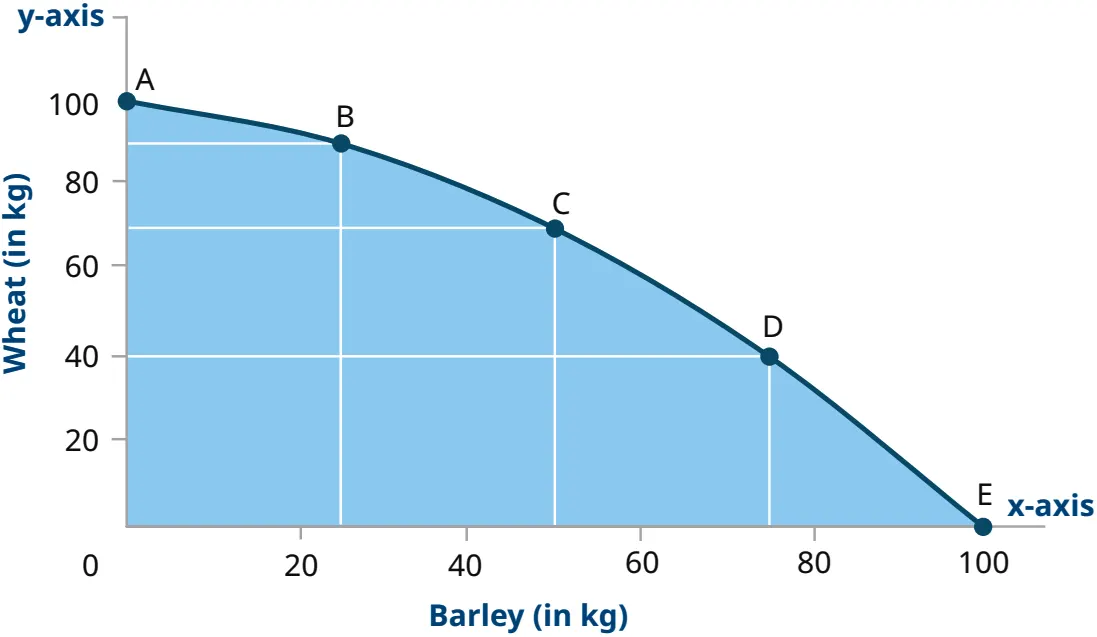
Q8. Can effective economic decisions be made without reliable data? Support your answer with an example.
Example: Every year before presenting the Union Budget, India’s Ministry of Finance publishes the Economic Survey of India. It analyses real data on agriculture, inflation, employment, health, and infrastructure—giving policymakers an accurate blueprint to decide where to increase welfare spending or boost industry.
Q9. Analyse how a country’s present economic choices can shape its long-term future. Why is it important to consider future consequences while making economic decisions today?
Q10. Activity: Identify a news article from any newspaper about a product or commodity (such as vegetables, fruits, fuel, or electronics) where producers or companies are deciding how much to produce or supply. Write 2–3 sentences explaining the example and why the production decision was made.
A recent business news report highlighted that major Indian automobile companies are increasing their production of electric two-wheelers and cars while gradually reducing output of certain petrol models. This production decision was made because rising petrol prices, government green-energy subsidies, and growing environmental awareness have sharply increased consumer demand for electric vehicles. By shifting their limited capital and factory space toward EVs, companies aim to meet changing consumer wants and stay competitive in the market.
List
Class 9 Social Science Part 2 Chapter 2 Life on Earth NCERT Solutions
Class 9 Social Science Part 2 Chapter 1 Oceans and Life NCERT Solutions
Class 9 Social Science Part 1 Chapter 8 Building Blocks in Economics: The Problem of Choice NCERT Solutions
Class 9 Social Science Part 1 Chapter 7 Elections NCERT Solutions
Class 9 Social Science Part 1 Chapter 6 Democracy NCERT Solutions