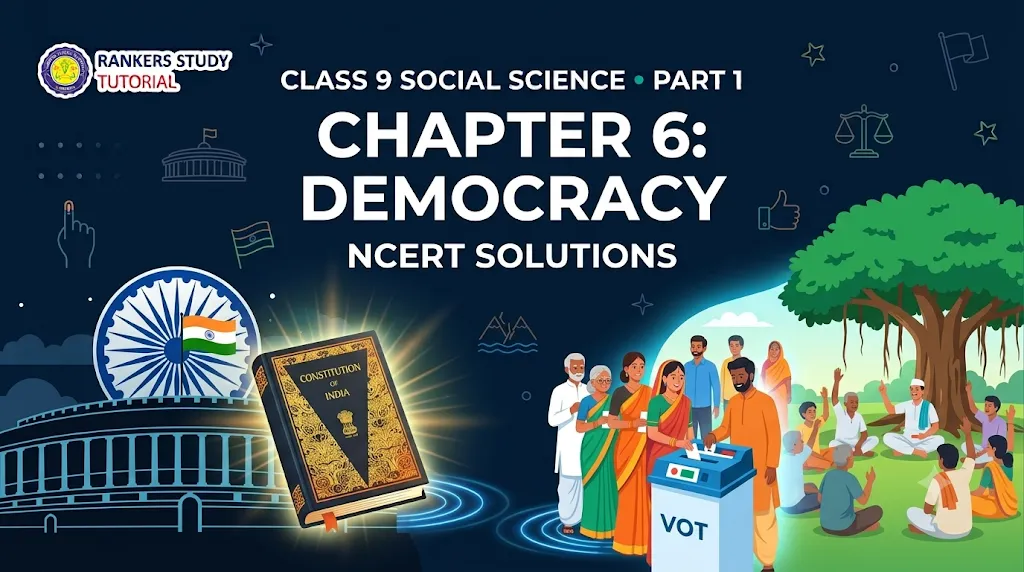
Class 9 Social Science Part 1 Chapter 6 Democracy NCERT Solutions
Part 1: The Big Questions (Page 137)
Q1. How has the idea of democracy evolved over time and shaped our understanding of it today?
Q2. What are the different forms of democracy, and how are they practised in India and other parts of the world?
- Direct Democracy: Citizens directly vote on major policies and decisions (practised in Switzerland, though difficult for very large countries).
- Representative (Indirect) Democracy: Citizens elect representatives through periodic elections to govern on their behalf. It has two major models:
- Parliamentary Democracy: The Executive (Prime Minister and Council of Ministers) is drawn from and accountable to the Legislature (practised in India, Canada, and the United Kingdom).
- Presidential Democracy: The President is directly elected by the people and functions independently of the Legislature (practised in the United States of America).
Q3. What are the essential features of a democracy and how do they extend beyond government institutions?
Beyond Government Institutions: True democracy extends into everyday social life. It lives through grassroots Gram Sabhas, civil society organisations, NGOs, cooperatives, trade unions, free media, and responsible daily civic behaviour—such as respecting others’ rights, following public rules, and verifying information before sharing it.
Q4. What are the challenges faced by Indian democracy?
Part 2: In-Text Questions & Activities Solved
- Why is it important that the ultimate source of power rests with the people in a democracy?
- How does people’s participation through voting strengthen popular sovereignty?
- When ultimate power rests with the people, rulers cannot act like unchecked monarchs—they must work for public welfare and respect citizens’ rights to stay in office.
- Voting through Universal Adult Franchise allows every adult citizen (18 and above) to grant or withdraw a government’s mandate peacefully, proving that the state derives its authority directly from the people.
- Identify the differences among Fundamental Rights, Fundamental Duties, and Directive Principles of State Policy (DPSP).
- Discuss the significance of the Right to Education (Article 21A), added in 2009.
- Differences: Fundamental Rights are legally enforceable in courts and protect individual freedom and equality against state abuse. Directive Principles of State Policy (DPSP) are non-enforceable guidelines directing the government to build a fair welfare state (e.g., Article 46). Fundamental Duties are moral obligations of citizens to respect the Constitution, promote harmony, and protect public property.
- Right to Education (Article 21A): By guaranteeing free and compulsory education for all children aged 6 to 14, Article 21A empowers children from poor and marginalised families with literacy, equal opportunity, and the awareness needed to participate meaningfully in democracy.
Think About It (Page 142): What do you think would happen if the same organ of the government made laws, implemented them, and enforced them?
Let’s Explore (Page 145): Fill in the second column of the table with suitable examples of key features of democracy from your state, town, or village.
| Features of Democracy | Examples from Local / State Level |
|---|---|
| Popular Sovereignty | Villagers and city residents aged 18+ voting in Gram Panchayat, Municipal, State Assembly, and Lok Sabha elections. |
| Rule of Law | Traffic police issuing the exact same fine to a wealthy businessman or local politician as to an ordinary citizen for breaking traffic rules. |
| Separation of Powers | The State Legislative Assembly passes a law, state officials implement it, and the High Court can strike it down if it violates the Constitution. |
| Fundamental Rights | Children aged 6–14 receiving free education in local government schools (Article 21A), and citizens peacefully holding public meetings. |
| Accountability & Transparency | Parliamentary Question Hour, auditing of government accounts, and citizens filing RTI applications to check local road-building budgets. |
| Multi-Party System | Candidates from national parties, regional parties, and independents competing peacefully in local and state elections. |
Let’s Explore (Page 148): Select your ideal team from Fig. 6.5 (‘Youth for Democracy’ festival) and give reasons for your selection.
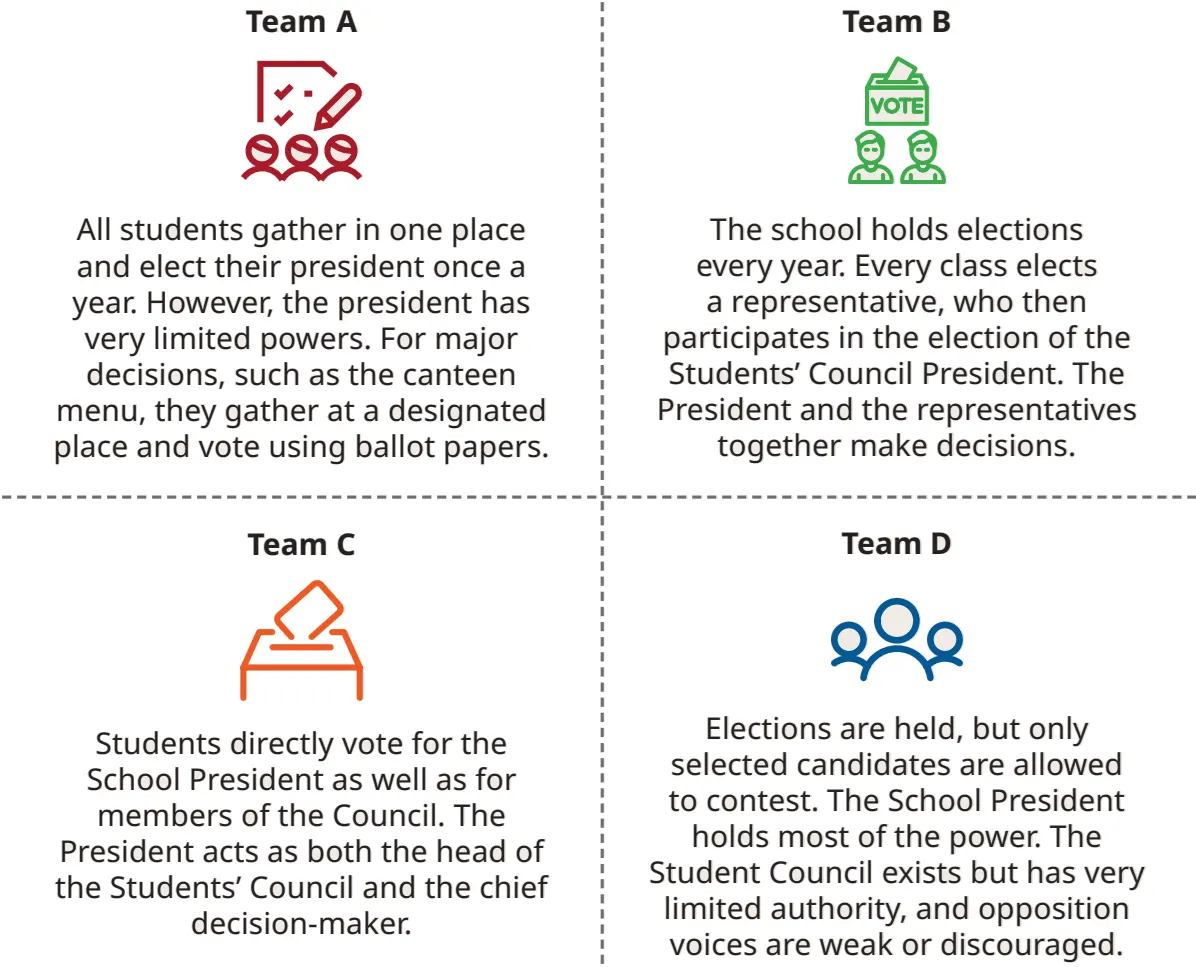
Team B is the most balanced and practical model for a large school or nation because every class elects its own representative, ensuring fair representation for all groups. The President is chosen by and works collectively with the elected representatives rather than holding unchecked power. (By contrast, Team D is clearly undemocratic because it restricts candidates and suppresses opposition voices.)
Let’s Explore (Page 149): Choose any two of India’s neighbouring countries and evaluate whether they are Democratic, Partially democratic, or Non-democratic.
- 1. Sri Lanka (Democratic): Holds regular multi-party elections where citizens directly elect the President and Parliament; multiple political parties compete, and citizens generally have the right to express opinions and criticise government policies.
- 2. China (Non-democratic / One-party system): While local-level elections occur, the country is ruled by a single political party (the Chinese Communist Party); citizens cannot freely form opposition parties or openly criticise the national leadership.
Let’s Explore (Page 152): Identify examples from the Jethipura (Gujarat) and South Manubankul (Tripura) case studies that reflect participation, fairness, limiting power, and peaceful resolution.
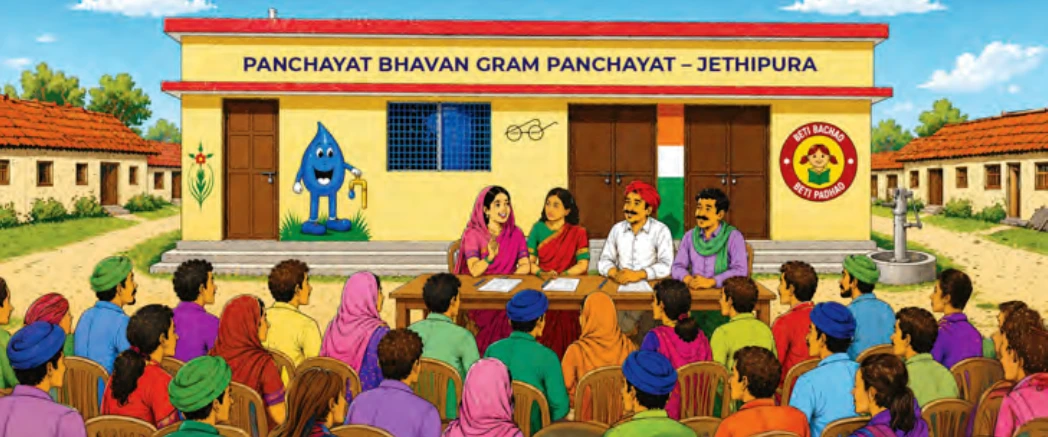
- Participation: Jethipura organised regular and Special Gram Sabhas as well as Mahila Sabhas with full quorum, while South Manubankul actively involved women in self-help groups and decision-making.
- Fairness & Inclusion: Jethipura ensured active participation from Scheduled Castes, Scheduled Tribes, and women; South Manubankul focused on health, sanitation, and livelihoods for women.
- Limiting Concentration of Power & Peaceful Discussion: Decisions on education, sanitation, and welfare schemes were taken collectively in open village assemblies with proper record-keeping rather than by a single leader.
Let’s Explore & Think About It (Pages 153–154): (1) Discuss the advantages of increased representation of women in the legislature. (2) Discuss the contributions of grassroots leaders like Chaudhary Charan Singh and Babu Jagjivan Ram.
- Advantages of Women’s Representation: Having more women in Panchayats, Municipalities, and Legislatures ensures that policies address vital issues like maternal healthcare, girls’ education, clean drinking water, sanitation, and workplace safety. It also breaks social prejudices and makes democracy truly representative of half the population.
- Grassroots Leaders: Chaudhary Charan Singh championed farmers’ rights, rural land reforms, and agricultural welfare, giving rural India a strong voice in national policy. Babu Jagjivan Ram worked tirelessly for the social upliftment, equal rights, and political empowerment of Scheduled Castes and marginalised communities.
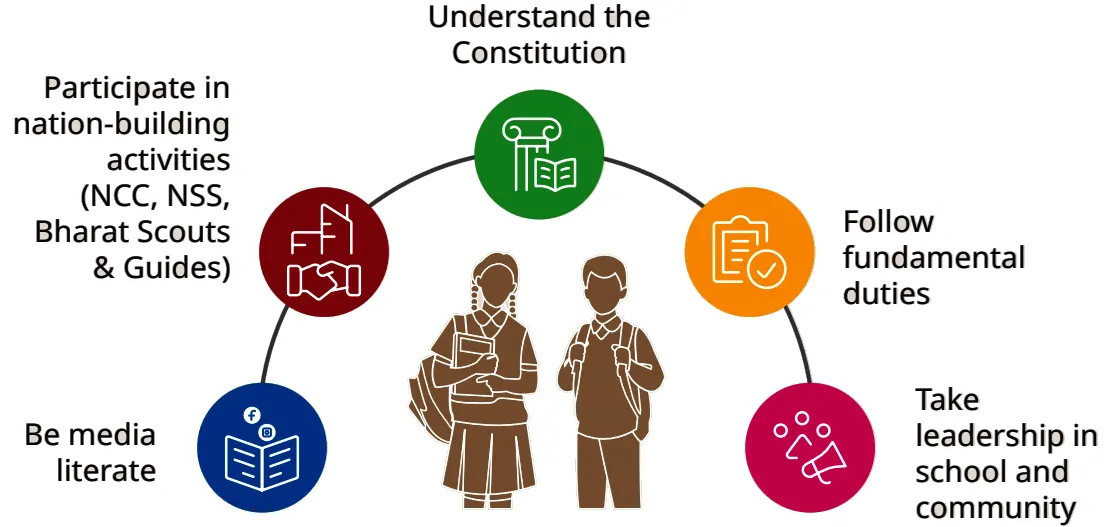
Let’s Explore (Page 155–156) & Think, Discuss, Act (Page 157): (1) Why is accurate information important in a democracy, and how does fake news harm it? (2) What digital and non-digital ways can youth use to participate in democracy (Fig. 6.9)?
- Importance of Accurate Information: Citizens need verified facts to judge government performance and vote wisely. Misleading posts on social media (such as edited videos or unverified health/communal rumours) create panic, manipulate public opinion, and spark social conflict. Always fact-check before forwarding.
- Youth Participation (Digital & Non-Digital): Non-digital: Joining NCC, NSS, or Bharat Scouts & Guides, participating in school councils, and leading local cleanliness or tree-plantation drives. Digital: Practising media literacy, reporting fake news, using official government portals (like MyGov) to share constructive feedback, and raising awareness about Fundamental Duties online.
Part 3: Textbook Exercises — Questions and Activities (Pages 158–159)
- Which democratic values are reflected in this situation?
- How does voting help resolve differences of opinion?
- Why is the majority decision important in a democracy?
- Mention responsibilities of elected representatives after a decision is made.
- Democratic Values Reflected: Open deliberation and discussion, respect for diverse opinions, equality (one member, one vote), peaceful conflict resolution, and collective decision-making.
- How Voting Resolves Differences: When everyone cannot agree, voting provides a fair, transparent, and peaceful way to measure what most members prefer without resorting to arguments or force.
- Importance of Majority Decision: It ensures that decisions reflect the will of the larger group rather than a single powerful individual, giving the final choice legitimacy and broad support.
- Responsibilities After a Decision: Elected representatives must implement the decision honestly and fairly, respect the views of those who voted differently (the minority), keep everyone informed, and remain accountable for the final outcome.
Q2. How would democracy be affected if citizens stopped following laws and civic responsibilities? Explain with an example.
Example: If people ignore traffic laws, damage public buses during protests, or spread unverified rumours on social media, it leads to accidents, loss of taxpayer-funded public property, and social conflict—weakening the very foundations of a peaceful democracy.
- A law is passed without public discussion
- Citizens vote to choose their representatives
- A court gives a final judgment
- A minister takes an independent decision
Why: Popular sovereignty means that the ultimate source of power and authority lies with the people. When citizens cast their votes in free and fair elections to choose their representatives, they directly exercise this supreme authority.
- Laws are applied equally to all
- Courts review government actions
- Powerful individuals are treated above the law
- Citizens challenge laws through legal means
The core principle of the Rule of Law is that every person—regardless of wealth, status, or rank—is equal before the law and must follow the same legal procedures.
Q5. Why is the Rule of Law essential for protecting democracy?
Q6. Is voting alone enough to make a country democratic? Support your answer with examples from the chapter.
- Example 1 (Team D in Fig. 6.5): Even though Team D holds elections, only selected candidates are allowed to contest, the President holds almost all power, and opposition voices are suppressed—making it undemocratic.
- Example 2 (Grassroots & RTI): As seen in Jethipura and South Manubankul Gram Panchayats, and through tools like the RTI Act (2005) and PIL, a living democracy requires transparency, accountability, Rule of Law, and everyday citizen participation beyond polling day.
- How can this strengthen democracy?
- How can it weaken democracy if used irresponsibly?
- How it strengthens democracy: Social media gives ordinary citizens a fast, accessible platform to voice public grievances, raise awareness about local issues (like broken roads or water shortages), debate government policies, and hold leaders accountable in real time.
- How it weakens democracy: If used irresponsibly, social media rapidly spreads fake news, misinformation, and hate speech. This can mislead voters, create public panic, incite social conflicts, and erode trust in democratic institutions.
Q8. Write a paragraph on what democracy means to you as a young citizen.
Q9. Activity: Conduct a model parliament session or Gram Sabha in class on local issues—cleanliness, responsibilities towards public property, or school safety.
- Assign Roles: Choose a Sarpanch (chairperson), Secretary (to record minutes), and Ward Members; the rest of the class acts as Gram Sabha citizens.
- Check Quorum & Present Issue: Confirm attendance (quorum) and discuss plastic waste clogging village/school drains.
- Debate & Vote: Invite suggestions (installing separate wet/dry dustbins, weekly student-led cleanliness drives, fines for littering), discuss pros and cons respectfully, and pass the final action plan by majority vote.
- Its role in democracy
- How it ensures accountability and participation.
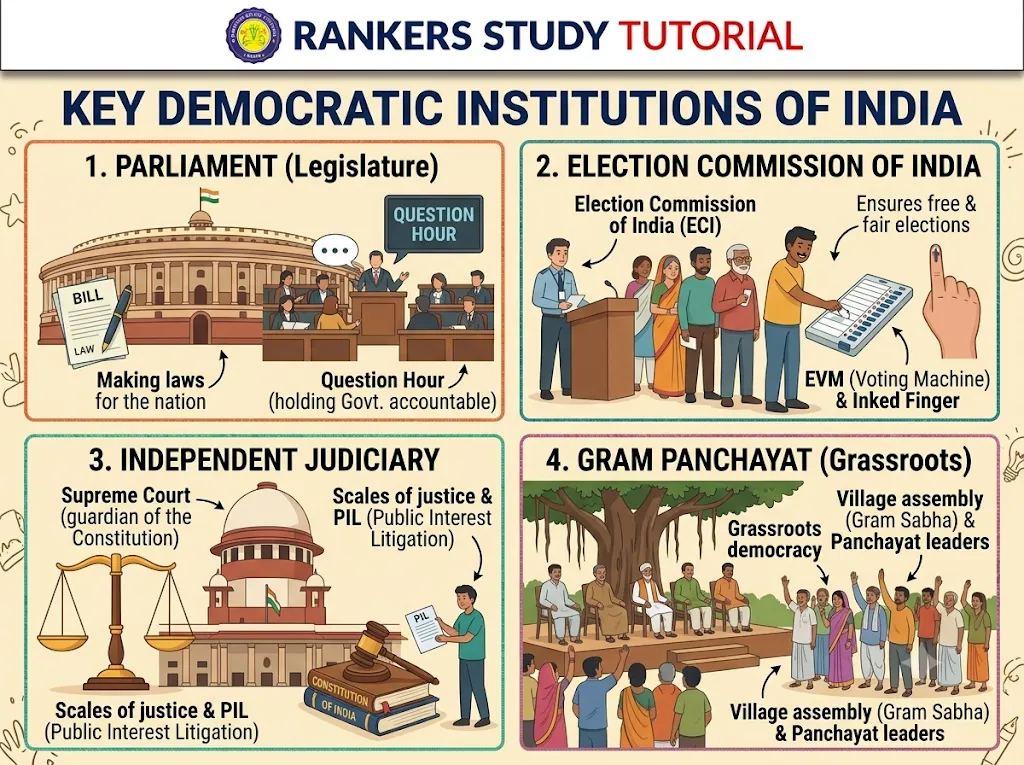
Chosen Institution: The Parliament of India
- Role in Democracy: Parliament is the supreme legislative body of India. It represents the diverse voices of over 140 crore citizens, debates national issues, makes and amends laws (including constitutional amendments under Article 368), and approves the national budget.
- Ensuring Accountability & Participation: Parliament holds the Executive (Prime Minister and Council of Ministers) directly accountable through mechanisms like Question Hour, parliamentary debates, and committees. Citizens participate indirectly by electing their MPs every five years and directly by engaging with public consultations and parliamentary bills.
Q11. What role does the Constitution play in strengthening democracy in India?
- It establishes Popular Sovereignty through Universal Adult Franchise for all men and women from Day 1.
- It guarantees six enforceable Fundamental Rights and prohibits discrimination based on religion, race, caste, sex, or place of birth.
- It ensures Separation of Powers and an independent judiciary to prevent misuse of authority.
- It promotes Federalism and Decentralisation (Union, State, Panchayati Raj, Municipalities, ADCs, and PESA) while remaining flexible enough to evolve through lawful amendments (Article 368).
Q12. What challenges do you think democracy in India faces today?
- Socio-Economic Barriers: Illiteracy, poverty, gender inequality, and social discrimination still prevent many citizens from participating equally in public life.
- Misinformation & Fake News: The rapid spread of unverified rumours on social media can mislead voters and create social tension.
- Regionalism & Implementation Gaps: Narrow regional divides and slow or uneven implementation of laws can weaken public trust in institutions.
- Civic Indifference: Damage to public property, breaking public rules, and apathy toward community issues weaken democratic culture from within.
List
Class 9 Social Science Part 2 Chapter 2 Life on Earth NCERT Solutions
Class 9 Social Science Part 2 Chapter 1 Oceans and Life NCERT Solutions
Class 9 Social Science Part 1 Chapter 8 Building Blocks in Economics: The Problem of Choice NCERT Solutions
Class 9 Social Science Part 1 Chapter 7 Elections NCERT Solutions
Class 9 Social Science Part 1 Chapter 6 Democracy NCERT Solutions