Class 9 Social Science Part 2 Chapter 5 Revision Notes: Managing Your Personal Finances
1. Introduction to Personal Finance (व्यक्तिगत वित्त का परिचय)
Money (पैसा) एक important resource है जिसे efficiently utilize करना चाहिए। Childhood से adulthood तक, money management की understanding बहुत ज़रूरी है। Personal finance का मतलब है अपनी needs और wants को पूरा करने के लिए individual के पैसों का planning और management करना। इसमें smart financial decisions शामिल हैं—जैसे कितना spend करना है, कितना save करना है, कहाँ invest करना है, और future needs (जैसे buying a house या higher education) के लिए कैसे prepare करना है।

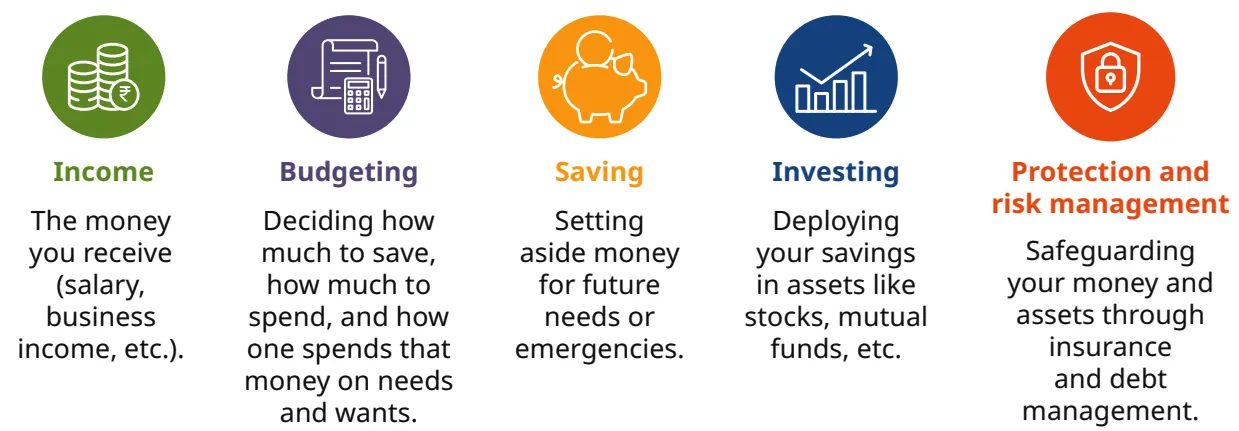
The 5 Pillars of Personal Finance (पर्सनल फाइनेंस के 5 स्तंभ)
- Income (आय): The money you receive (salary, business income, rent, interest, dividends). यह personal finance का starting point है, क्योंकि income के बिना spend, save, या invest करना possible नहीं है।
- Budgeting (बजट बनाना): Deciding how much to save, how much to spend, and prioritizing needs and wants.
- Saving (बचत): Setting aside money for future needs or unexpected emergencies.
- Investing (निवेश): Deploying savings in assets (like stocks, mutual funds) to generate returns and grow wealth.
- Protection and risk management (सुरक्षा और जोखिम प्रबंधन): Safeguarding money and assets through insurance and debt management.
🤔 Think About It
Have you ever thought about earning your own money? What kind of skill would you require and which work would you choose?
🎯 Competency-Based Questions (CBSE Level)
Q1. [Conceptual] What is the primary definition of “Personal Finance”?
Ans: Personal finance refers to the planning and management of an individual’s money to meet their needs and wants, involving smart decisions on spending, saving, investing, and preparing for future financial needs.
Q2. [Fact-Based] Identify the 5 pillars of personal finance.
Ans: Income, Budgeting, Saving, Investing, and Protection & risk management.
Q3. [Assertion-Reason] Assertion (A): Income is considered the fundamental starting point of personal finance.
Reason (R): Without income, an individual cannot spend, save, or invest money to achieve financial goals.
Ans: Both A and R are correct, and R is the correct explanation of A.
Q4. [Case-Based] A college student participates in an ‘Earn While You Learn’ programme by taking up a part-time internship. Besides financial support, what two non-monetary benefits does this provide?
Ans: It helps them gain practical skills and work experience, providing a better understanding of the real-world workplace.
Q5. [Analytical] How does the pillar of “Protection and risk management” safeguard an individual’s financial future?
Ans: It safeguards money and assets through insurance (against unexpected emergencies) and responsible debt management, ensuring that sudden losses do not destroy a person’s savings or financial stability.
2. Budgeting and Saving (बजट बनाना और बचत करना)
2.1 Budgeting (Planning Expenses)
Budgeting means planning in advance how income will be spent. एक budget एक written plan है जिसका उद्देश्य income और expenses को balance करना है। Budgeting unnecessary spending (जैसे impulse shopping या excessive eating out) को control करने में मदद करता है और लोगों को अपनी means (औकात/संसाधनों) के भीतर जीने में मदद करता है। Financial goals में school trip, higher education, या emergency fund के लिए बचत शामिल हो सकती है。
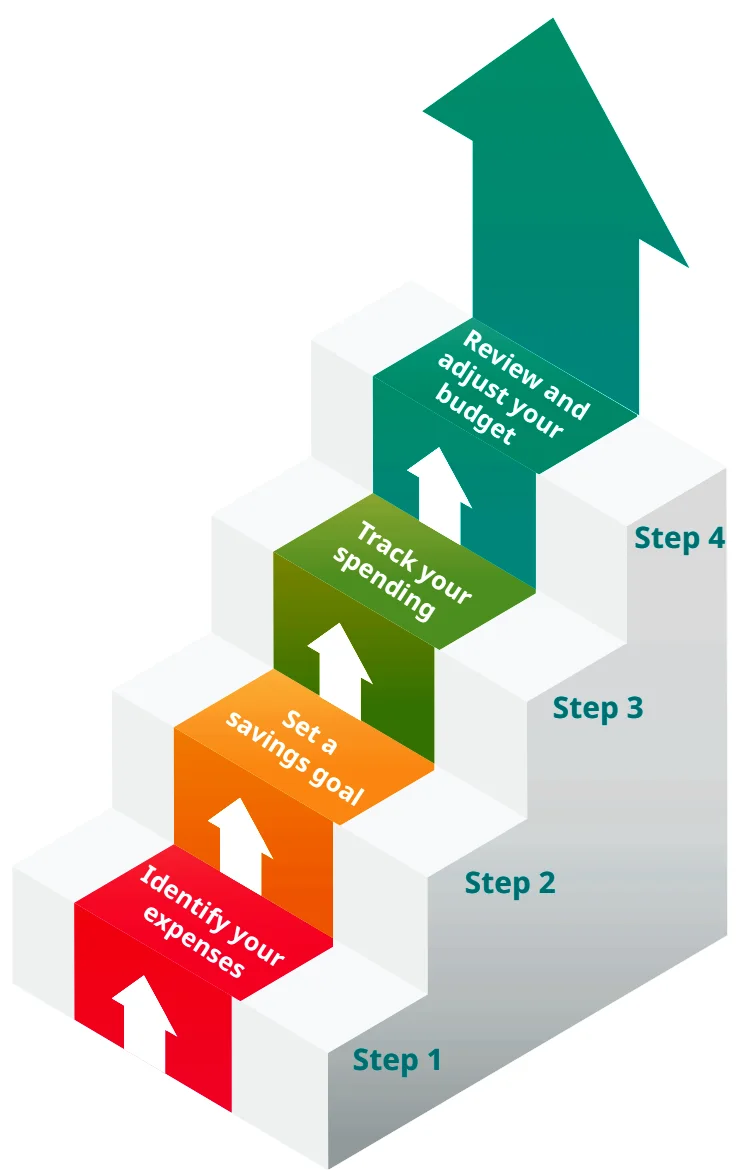
📚 4 Steps in Budgeting (बजट बनाने के 4 कदम)
- Identify your expenses (अपने खर्चों को पहचानें): List all monthly expenses (large and small) to understand where your money goes.
- Set a savings goal (बचत का लक्ष्य निर्धारित करें): Decide how much to save and by when (e.g., saving ₹500/month for a ₹3,000 bicycle).
- Track your spending (अपने खर्च को ट्रैक करें): Compare actual spending with the budget regularly to identify areas of overspending.
- Review and adjust your budget (समीक्षा करें और बदलें): Periodically update the budget to reflect changes in income, expenses (like rising transport costs or medical expenses), or new goals.
🤔 Think About It
Suppose you and your friends need to buy new badminton rackets. How would you manage your budget to cover the cost? Would you cut back on other expenses, use your savings, or borrow?
2.2 Saving (बचत)
Saving means keeping aside a part of one’s income for future use. यह समय के साथ जमा हुआ financial surplus है। Savings comfortable living और uncertainties (emergencies) के लिए crucial हैं। लोग future investments (जैसे fixed deposits, stocks, या real estate) करने के लिए भी save करते हैं।
🤔 Think About It
What would you do if you received ₹100 today? Would you spend it on a want or a need? Financial experts often suggest saving first and spending what is left. Do you agree? Do you think individuals with low income can also save?
🎯 Competency-Based Questions (CBSE Level)
Q1. [Sequence-Based] Arrange the four steps of budgeting in the correct logical order.
Ans: 1. Identify your expenses -> 2. Set a savings goal -> 3. Track your spending -> 4. Review and adjust your budget.
Q2. [Analytical] Why is reviewing and adjusting a budget periodically considered an essential step in financial planning?
Ans: Income, expenses (like unexpected medical bills or rising transport costs), and financial goals change over time. Regular reviews ensure the budget remains realistic, effective, and aligned with current financial realities.
Q3. [Assertion-Reason] Assertion (A): Financial experts recommend the formula “Expenses = Income – Savings.”
Reason (R): This ensures that you prioritize setting aside money for future goals and emergencies before spending on immediate wants.
Ans: Both A and R are correct, and R is the correct explanation of A.
Q4. [Case-Based] Rahul wants to buy a new bicycle costing ₹3,000 in six months. What specific action must he take in his monthly budget to achieve this?
Ans: He must “Set a savings goal” and save exactly ₹500 each month to accumulate ₹3,000 by the end of six months.
Q5. [Fact-Based] What is the primary purpose of creating a budget?
Ans: A budget is a written plan that aims to balance income and expenses, control unnecessary spending, and help people live within their means.
3. Investing and the Power of Compounding (निवेश और चक्रवृद्धि की शक्ति)
Investing means putting savings into assets to protect their value and generate returns. जहाँ cash रखने से greater liquidity मिलती है, वहीं investing wealth बढ़ाता है और पैसों को inflation (मुद्रास्फीति/महंगाई) से बचाता है। If inflation is 6%, a ₹1,000 bag will cost ₹1,060 next year. यदि आपका पैसा सिर्फ घर पर रखा है (cash), तो आपकी purchasing power (क्रय शक्ति) समय के साथ गिर जाती है।
📚 Important Definitions
Liquidity (तरलता): How quickly and easily an asset can be converted into cash (or cash equivalent) without affecting its value.
Inflation (मुद्रास्फीति): The increase in prices of goods and services over time, which reduces the purchasing power of money.
Purchasing Power (क्रय शक्ति): The real-world value of money, measured by the quantity of goods/services a single unit of currency can buy. High purchasing power means higher standard of living.
Compounding (चक्रवृद्धि): The process where an investment’s earnings (interest/dividends) are reinvested to generate their own additional earnings over time.
The Power of Early Investments (Compounding)
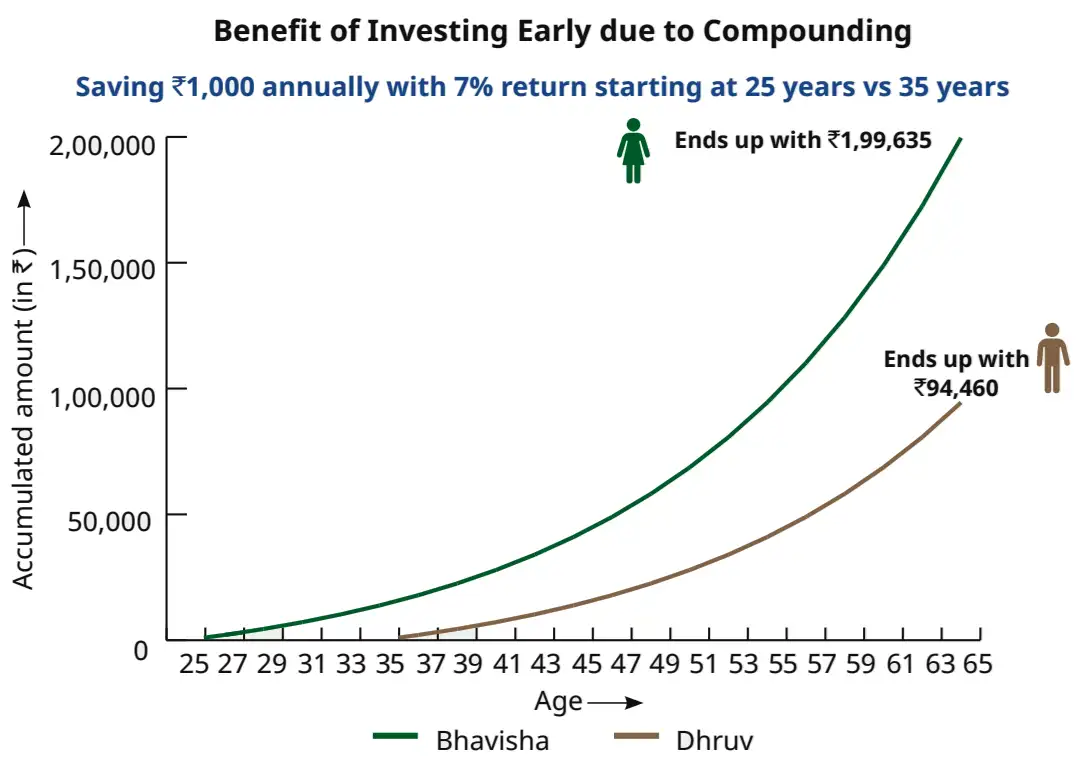
Compounding means earning returns not just on the original principal, but also on the returns already earned. Compounding के कारण, जल्दी निवेश (early investments) शुरू करने से बड़ा अंतर आता है। For example, Bhavisha (starts at age 25) and Dhruv (starts at age 35) both save ₹1,000 annually at 7%. By age 65, Dhruv has only about 40% of the money Bhavisha has, because Bhavisha’s money had more time to compound.
🔍 Let’s Explore
In Fig. 5.4, the curves are flatter in the beginning and tend to become steeper in the later years. Why do you think that happens?
🎯 Competency-Based Questions (CBSE Level)
Q1. [Case-Based] Person A starts investing ₹2,000 per year at age 20. Person B starts investing ₹2,000 per year at age 40. At age 60, Person A has significantly more than double the wealth of Person B, despite both investing the same annual amount. What financial principle explains this massive difference?
Ans: The principle of Compounding. Person A’s earlier investments had 20 extra years to earn returns on the principal, and those returns continued to generate their own additional earnings over time.
Q2. [Analytical] Why is it dangerous to keep all your long-term savings in a highly liquid form, like cash in a cupboard?
Ans: While cash has high liquidity, it earns no returns. Over time, inflation (the general increase in prices) will severely erode the purchasing power of that cash, meaning it will buy fewer goods in the future than it can today.
Q3. [Assertion-Reason] Assertion (A): The purchasing power of money decreases over time due to inflation.
Reason (R): As prices rise, the same amount of money can buy fewer goods and services than before.
Ans: Both A and R are correct, and R is the correct explanation of A.
Q4. [Conceptual] What is the primary difference between simply saving money in a piggy bank versus investing it?
Ans: Saving in a piggy bank keeps the nominal value intact but loses purchasing power over time due to inflation. Investing deploys the money into assets to generate returns, protecting its value and allowing it to grow faster than inflation.
Q5. [Fact-Based] What do we call the process where an investment’s earnings generate their own additional earnings over time?
Ans: Compounding.
4. Common Investment Options & Risk Management (निवेश के विकल्प और जोखिम प्रबंधन)
4.1 Common Investment Options
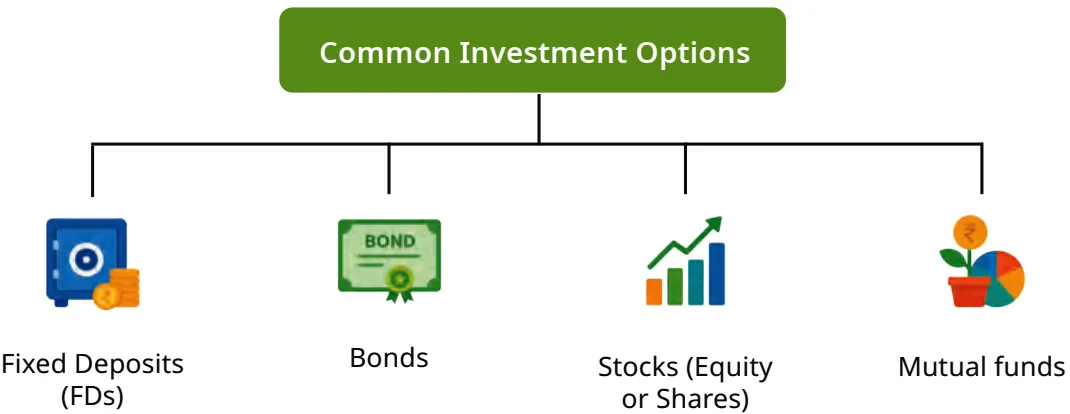
- Fixed Deposits (FDs): Depositing a lump sum in a bank/post office for a fixed period at a fixed interest rate. Very safe, assured returns, but relatively lower interest. Other safe, government-backed options: Public Provident Fund (PPF), National Savings Certificate (NSC), Sukanya Samriddhi Yojana.
- Bonds: Lending money to the government or a company (corporate bonds) for a fixed period. You earn regular interest and get the principal back at maturity. Government bonds are generally safer than corporate bonds.
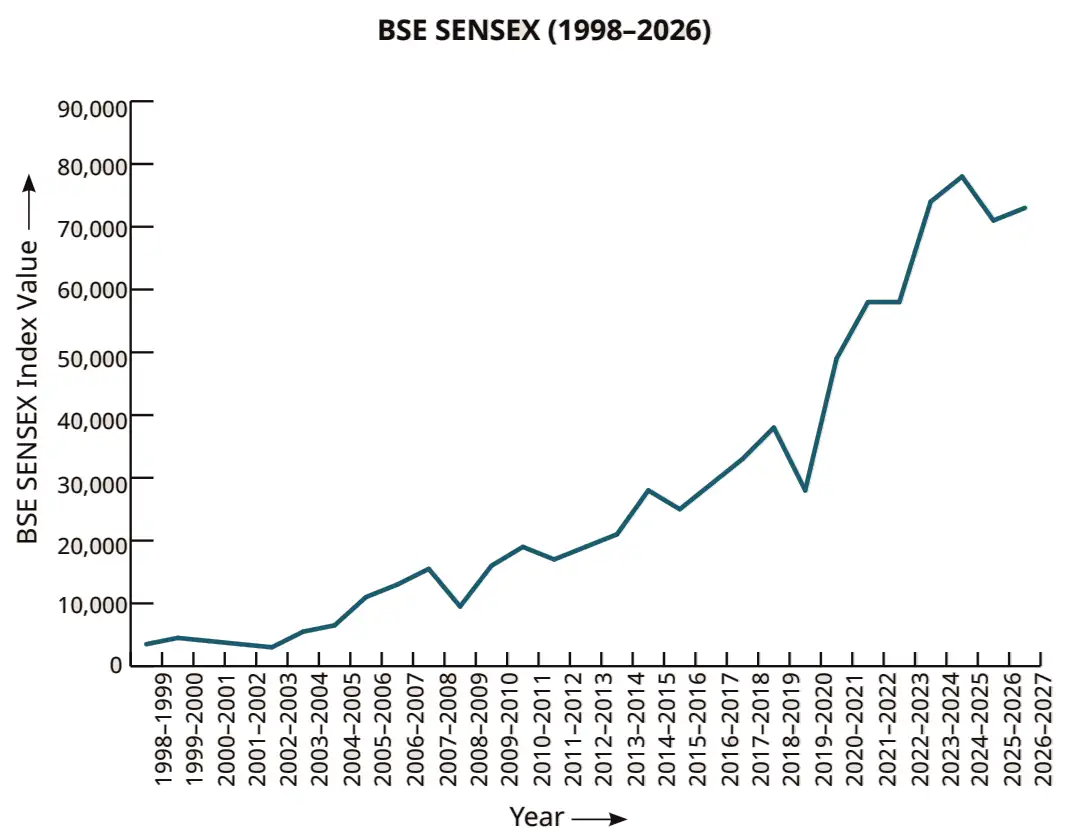
- Stocks (Equity/Shares): Buying shares means becoming a part-owner of a company. Returns come from dividends and share price increases. High risk (prices fluctuate with market conditions and company performance) but high potential returns over the long term. BSE SENSEX (Stock Exchange Sensitive Index) tracks 30 large, financially sound companies on the Bombay Stock Exchange.
- Mutual Funds: Pool money from many investors and invest in a basket of shares or bonds, managed by professional fund managers. It reduces risk through portfolio diversification and is good for people lacking market knowledge or time.
🔍 Let’s Analyse
The BSE SENSEX graph fluctuates over short time periods, however, it goes up significantly in the long run. Why do these fluctuations happen?
🤔 Think About It
“Mutual fund investments are subject to market risks. Please read all scheme-related documents carefully before investing.” Why is this disclaimer included?
4.2 Risk, Return, and Trade-Offs
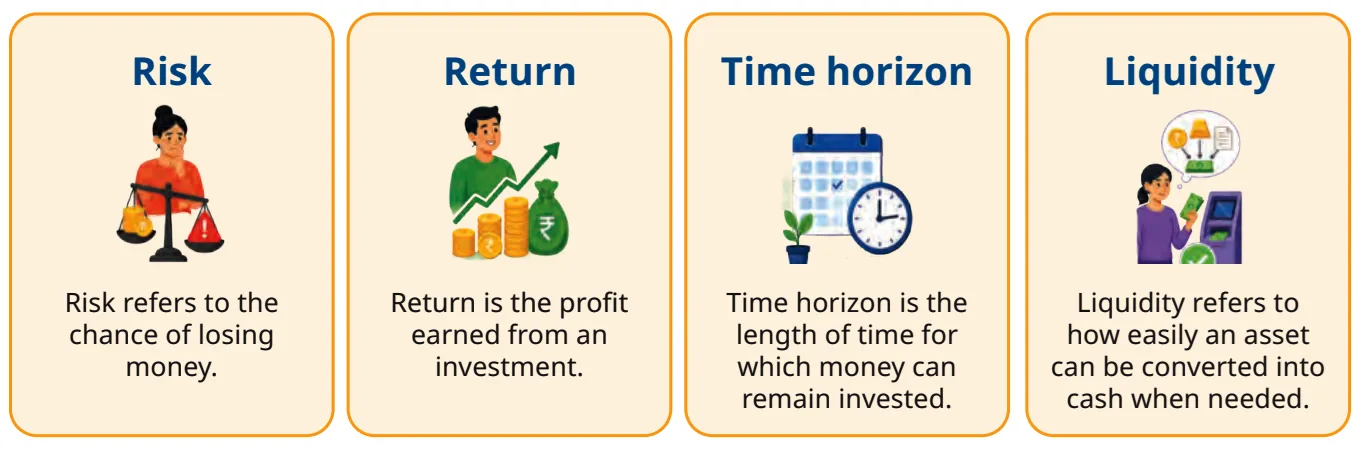
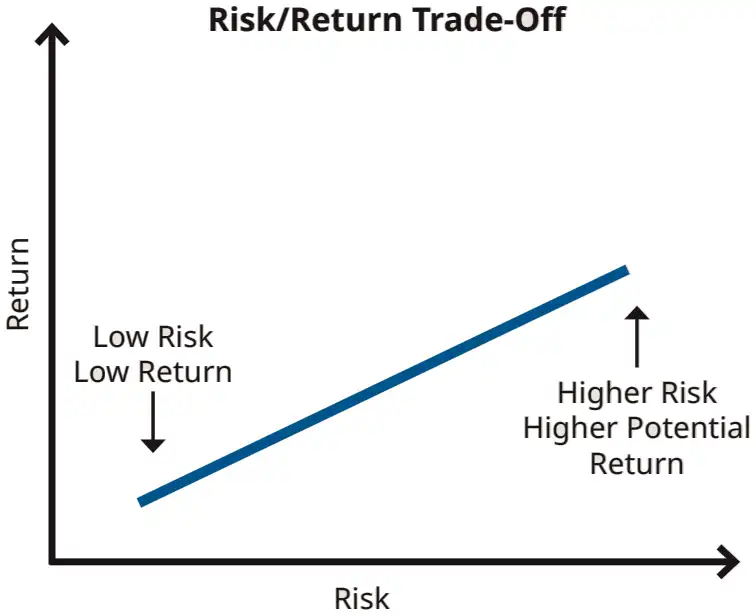
Before investing, consider four critical factors: Risk (chance of losing money), Return (profit earned), Time Horizon (length of time money remains invested), and Liquidity (how easily an asset can be converted into cash).
Risk/Return Trade-Off: Generally, lower-risk investments (like FDs) offer lower returns. Higher-risk investments (like stocks) offer higher potential returns. Investments should closely match an individual’s financial goals and risk tolerance.
🎯 Competency-Based Questions (CBSE Level)
Q1. [Conceptual] What is the primary benefit of investing in a Mutual Fund rather than buying individual stocks directly?
Ans: Mutual funds offer “portfolio diversification” by spreading investments across different types of assets, which reduces overall risk. They are also managed by professional fund managers, making them suitable for people lacking market knowledge or time.
Q2. [Assertion-Reason] Assertion (A): Stocks (Equity) are considered a high-risk investment option.
Reason (R): Share prices fluctuate constantly due to market conditions, company performance, and economic changes, meaning investors can potentially lose their principal amount.
Ans: Both A and R are correct, and R is the correct explanation of A.
Q3. [Application] If a retiree wants a very safe investment with a guaranteed, stable income and no risk to their principal amount, which two investment options from the chapter should they choose?
Ans: Fixed Deposits (FDs) and Government Bonds, as they offer assured returns and are low-risk options suitable for stable income.
Q4. [Matching] Match the investment terms with their definitions: (a) Maturity period (b) Corporate bonds (c) BSE SENSEX.
Ans: (a) Duration between issue date and principal repayment. (b) Debt securities issued by companies to raise capital. (c) Benchmark index of the Bombay Stock Exchange tracking 30 large, financially sound companies.
Q5. [Analytical] Explain the “Risk/Return Trade-Off” principle using Fixed Deposits and Stocks as examples.
Ans: The principle states that higher risk is associated with higher potential returns. Fixed Deposits carry very low risk but offer lower returns. Stocks carry high risk (potential loss of money) but offer the potential for much higher returns over the long term.
5. Insurance, Borrowing, and Taxes (बीमा, उधार और कर)
5.1 Protection and Risk Management (Insurance)
Life uncertainties (illness, accidents, property damage) से भरी है। Insurance (बीमा) एक legal contract है जहाँ एक individual insurance company को regular premium देता है, जो बदले में specific losses के लिए financial compensation provide करती है। यह risk sharing के सिद्धांत (principle) पर काम करता है (कई लोग common pool में पैसा डालते हैं ताकि नुकसान उठाने वालों की मदद हो सके)।
- Health Insurance: Covers medical/hospitalization expenses (medicines, diagnostic tests). Govt scheme: Ayushman Bharat Pradhan Mantri Jan Arogya Yojana provides coverage to eligible low-income households.
- Life Insurance: Provides financial support to dependents if the breadwinner passes away (helps meet daily expenses and repay loans).
- General Insurance: Covers property losses. Examples: Motor insurance (vehicle accidents), Property insurance (fire/flood/earthquake), Crop insurance (natural disasters/pests), Cattle insurance.

5.2 Borrowing and Credit (उधार लेना)
Borrowing productive purposes (जैसे education loan) के लिए helpful हो सकता है, लेकिन unnecessary consumer goods के लिए misuse करने पर यह debt burden (कर्ज का बोझ) बन सकता है। Responsible borrowing means taking loans only when necessary and repaying them on time.
🤔 Think About It
An EMI (equated monthly instalment) includes both the principal and interest. Why might a family choose to buy a refrigerator on EMI even if it costs more in the long run? Can having too many EMIs affect savings?
5.3 Taxes (कर)
Taxes वे compulsory payments हैं जो individuals और businesses द्वारा government को public services (schools, hospitals, transport, defence) fund करने के लिए दिए जाते हैं। Paying taxes honestly is a citizen’s responsibility.
- Direct Taxes: Paid directly on income/profits (e.g., Income Tax).
- Indirect Taxes: Added to the price of goods/services (e.g., GST).
Personal Income Tax: यह annual earnings (financial year: 1 April to 31 March) पर दिया जाता है। India में progressive taxation system है, जिसका अर्थ है कि अधिक कमाने वाले अधिक tax rate देते हैं, ताकि income inequality (आय असमानता) को कम किया जा सके। यह slab system को follow करता है।
Taxable Income = Annual Salary – Standard Deduction (Under Income-tax Act).
इसे Central Board of Direct Taxes (CBDT) (under Ministry of Finance) administer करता है。

- Up to ₹4 lakh = Nil (0%)
- ₹4 lakh to ₹8 lakh = 5%
- ₹8 lakh to ₹12 lakh = 10%
- ₹12 lakh to ₹16 lakh = 15%
- ₹16 lakh to ₹20 lakh = 20%
- ₹20 lakh to ₹24 lakh = 25%
- Above ₹24 lakh = 30%
🔍 Let’s Analyse
Sai’s taxable income is ₹3,80,000 in a financial year. How much income tax does he have to pay according to the tax slabs?
🎯 Competency-Based Questions (CBSE Level)
Q1. [Conceptual] Explain the basic principle of “risk sharing” on which all insurance companies operate.
Ans: Risk sharing works by collecting small, regular premium payments from a large pool of people. When an unexpected loss (like an accident, property damage, or illness) happens to a few individuals in that pool, the collected funds are used to provide them with massive financial compensation.
Q2. [Analytical] Why does the Indian government use a “progressive taxation” system for personal income tax rather than charging everyone the exact same flat rate?
Ans: Progressive taxation aims to reduce income inequality in the country. The underlying principle is that wealthier individuals have a greater financial capacity and can afford to contribute a larger share of their earnings to fund public services without it severely impacting their basic standard of living.
Q3. [Assertion-Reason] Assertion (A): Borrowing money to buy unnecessary luxury items can lead to a severe debt burden.
Reason (R): Every EMI repayment includes both the principal amount and the interest charged by the lender, which reduces the borrower’s future monthly income available for savings.
Ans: Both A and R are correct, and R is the correct explanation of A.
Q4. [Case-Based] Priya earns ₹14,00,000 annually. She receives a standard deduction of ₹75,000. Calculate her final “Taxable Income” before applying the tax slabs.
Ans: Her Taxable Income is calculated by subtracting the standard deduction from her annual salary: ₹14,00,000 – ₹75,000 = ₹13,25,000.
Q5. [Fact-Based] Which government body under the Ministry of Finance is responsible for administering the laws relating to direct taxes in India?
Ans: The Central Board of Direct Taxes (CBDT).
The Big Questions (Chapter Objectives Solved)
1. What is personal finance and why is it important for individuals?
2. What are the pillars of personal finance?
3. What are some common savings and investment options?
4. How can you protect your savings and assets?
5. What is income tax?
List
Class 9 Social Science Part 2 Chapter 6 From Ideas to Startups Revision Notes
Class 9 Social Science Part 2 Chapter 5 Managing Your Personal Finances Revision Notes

Class 9 Social Science Part 2 Chapter 4 Governance and Public Policy Revision Notes

Class 9 Social Science Part 2 Chapter 3 Resistance and Resilience Revision Notes

Class 9 Social Science Part 2 Chapter 2 Life on Earth Revision Notes