Class 9 Social Science Part 2 Chapter 5 Managing Your Personal Finances NCERT Solutions
Part 1: The Big Questions (Page 107)
Q1. What is personal finance and why is it important for individuals?
Why it is important: Because money is a limited resource, managing it wisely helps individuals live within their means, control unnecessary spending, beat inflation, achieve long-term goals (like higher education or buying a home), and stay financially secure during unexpected crises.
Q2. What are the pillars of personal finance?
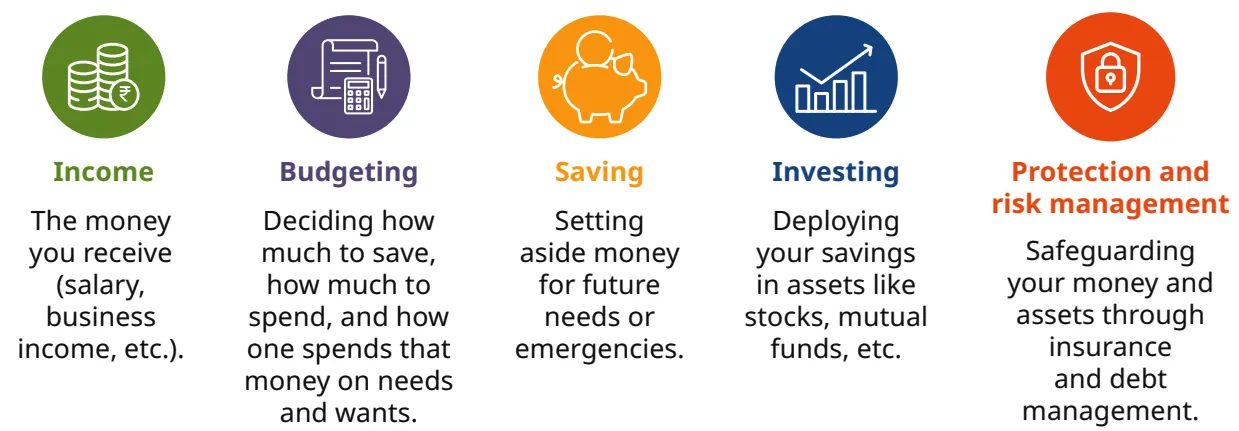
- Income (Earnings): Money received regularly or occasionally (salary, business profits, rent, interest, dividends).
- Budgeting: Planning in advance how to balance income, expenses, and savings across needs and wants.
- Saving: Setting aside a portion of income for future goals and emergencies.
- Investing: Deploying savings into assets (FDs, bonds, stocks, mutual funds) to grow wealth and beat inflation.
- Protection & Risk Management: Safeguarding savings and assets through insurance and responsible debt management.
Q3. What are some common savings and investment options?
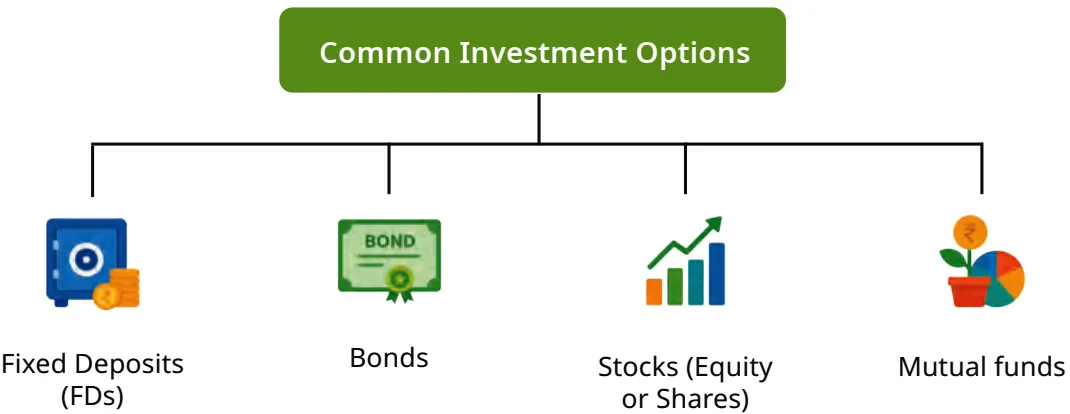
- Fixed Deposits (FDs) & Government Schemes: Bank/post office FDs, Public Provident Fund (PPF), National Savings Certificate (NSC), and Sukanya Samriddhi Yojana—very safe with assured, steady returns.
- Bonds: Lending money to governments or companies for a fixed maturity period in exchange for regular interest payments.
- Stocks (Equity / Shares): Buying part-ownership in a company; carries higher market risk but offers the highest long-term return potential.
- Mutual Funds: Pooling money from many investors into a diversified basket of shares and bonds managed by professional fund managers.
Q4. How can you protect your savings and assets?
- Insurance (Risk Sharing): Paying regular premiums for Health Insurance (covering hospital bills, e.g., Ayushman Bharat), Life Insurance (supporting dependents if the breadwinner passes away), and General Insurance (protecting vehicles, homes, crops, and cattle against accidents, fire, or natural disasters).
- Responsible Borrowing: Taking loans only for productive purposes (like education) and avoiding excessive EMIs on unnecessary luxury goods that drain savings.
Q5. What is income tax?
Part 2: In-Text Questions & Activities Solved
Think About It (Page 108): Have you ever thought about earning your own money? What kind of skill would you require and which work would you choose?
Think About It (Page 109): Suppose you and your friends need to buy new badminton rackets for an upcoming tournament because the old ones have worn out. How would you manage your budget to cover the cost?
Let’s Explore (Page 109): Think of all your expenses and prepare your monthly/weekly budget using the template on Page 122.
- What would you do if you received ₹100 today? Would you spend it on a want or a need?
- Financial experts suggest “saving first and spending what is left.” Do you agree?
- Do you think individuals with low income can also save? Why or why not?
- With ₹100 today: I would save at least ₹40–₹50 first for a future goal, and use the remaining amount on a genuine need (like a notebook or geometry tool) rather than an impulse want.
- Save First, Spend Later: Yes, I strongly agree. If you spend first and try to save whatever is left over, impulse purchases usually leave nothing behind. Setting aside savings first guarantees steady progress toward future goals and emergencies.
- Can low-income individuals save? Yes. Even setting aside a very small amount regularly—like ₹10 or ₹20 a day in a post office recurring deposit or self-help group—gradually builds a crucial emergency cushion over time.
- Why are the curves flatter in the beginning and steeper in the later years?
- What are typical bank Fixed Deposit (FD) interest rates in India?
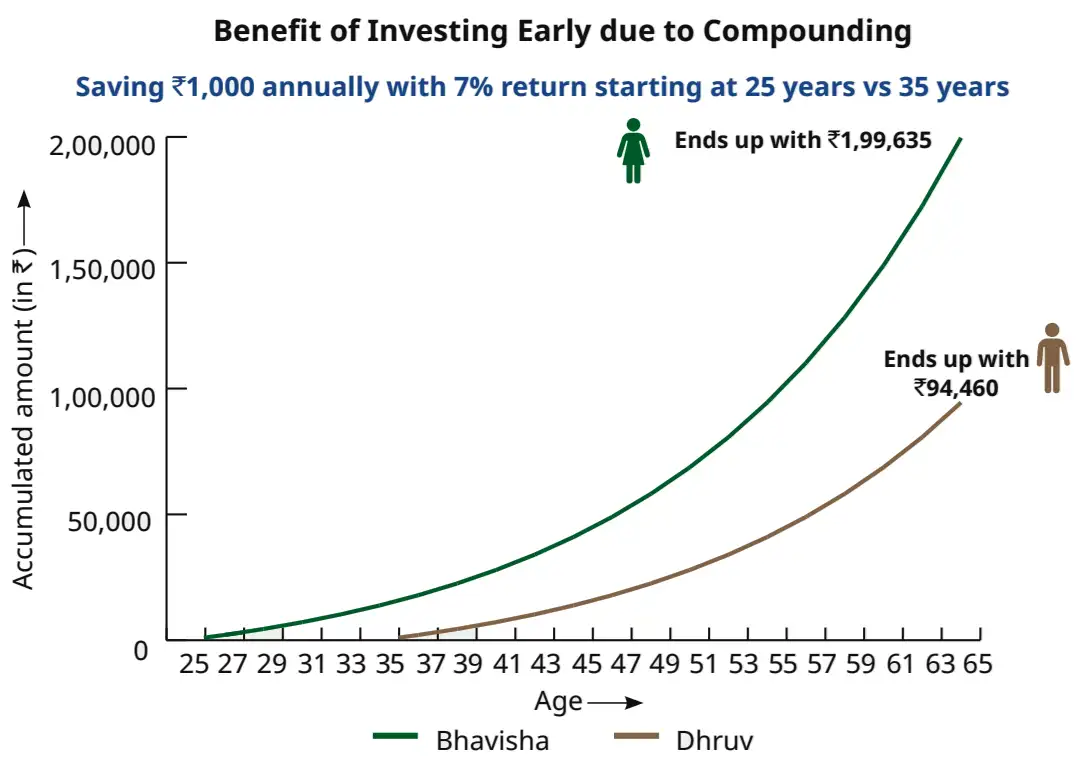
- Why curves turn steeper later: In the early years, the accumulated amount is small, so 7% annual interest adds only a modest sum (making the curve flat). Over decades, compounding means you earn interest not just on your original savings, but also on all the previous years’ interest—causing the total wealth to snowball rapidly and making the curve shoot steeply upward.
- Typical Bank FD Rates: Major Indian banks (like SBI, HDFC, ICICI) generally offer around 6.5% to 7.25% per annum on 1-to-5-year Fixed Deposits for regular citizens, with an extra 0.50% for senior citizens.
- Looking at the BSE SENSEX graph (Fig. 5.6), why does the stock market fluctuate in the short term while rising significantly over the long run?
- Why do mutual fund ads always include the disclaimer: “Mutual fund investments are subject to market risks. Please read all scheme-related documents carefully before investing”?
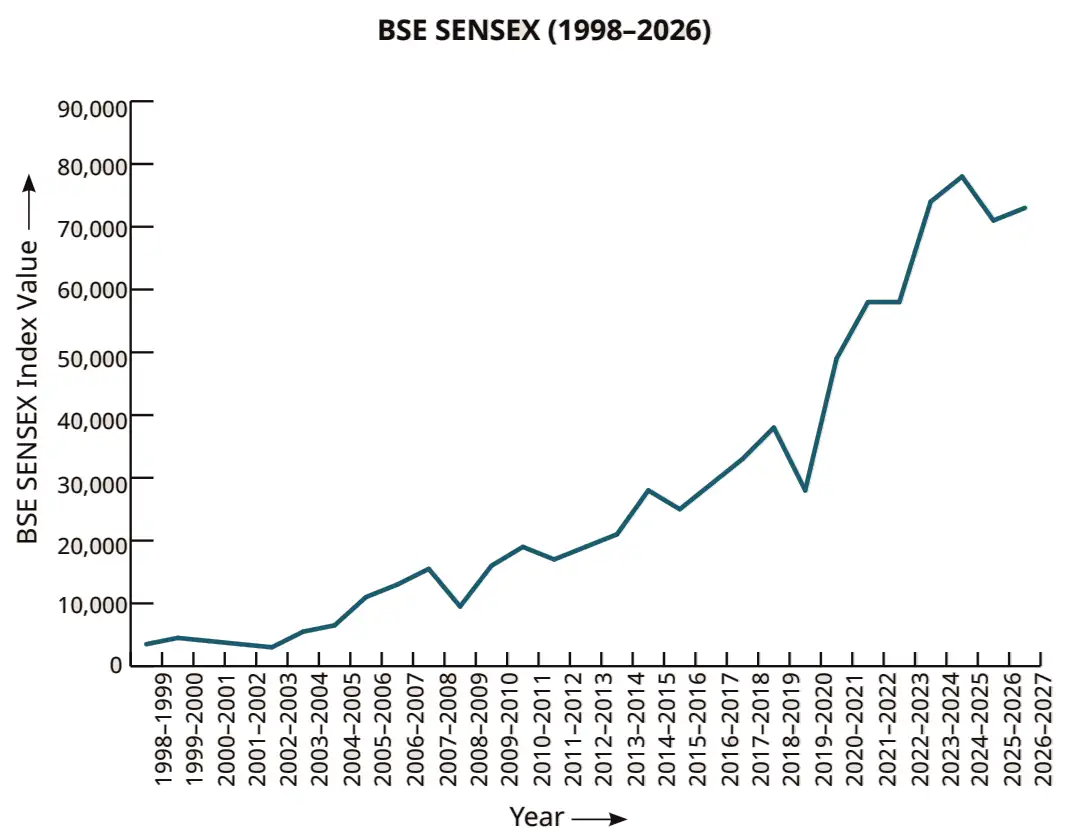
- Short-Term Fluctuations vs. Long-Term Growth: In the short run, stock prices bounce up and down due to quarterly company profits, interest rate changes, global crises (like the 2008 financial crash or 2020 COVID-19 pandemic), or investor sentiment. Over the long run, as India’s economy and top companies grow and earn higher profits, the overall index trends strongly upward.
- Why the Disclaimer Is Included: It is a mandatory investor-protection warning reminding people that mutual funds do not guarantee fixed returns like bank FDs—their value rises and falls with the market, so investors must understand the risks and rules before putting in their hard-earned money.
- Why might a family choose to buy something on EMI even if it costs more in the long run?
- Can having too many EMIs affect savings and emergency funds?
- Why choose EMI: An EMI breaks a large upfront expense into smaller, manageable monthly payments, allowing a family to use an essential appliance immediately without emptying their entire emergency savings at once.
- Danger of Too Many EMIs: Yes. Juggling too many monthly EMIs eats up most of a family’s monthly income, leaves nothing for savings or medical emergencies, and can trap the household in a stressful debt cycle if an unexpected expense arises.
| Annual Income (₹) | Tax Rate (%) |
|---|---|
| Up to ₹4 lakh | Nil |
| ₹4 lakh – ₹8 lakh | 5% |
| ₹8 lakh – ₹12 lakh | 10% |
| ₹12,00,001 – ₹16,00,000 | 15% |
| ₹16,00,001 – ₹20,00,000 | 20% |
| ₹20,00,001 – ₹24,00,000 | 25% |
| Above ₹24,00,000 | 30% |
- Sai’s taxable income is ₹3,80,000 in a financial year. How much income tax does he have to pay according to the above tax slabs?
- Briefly describe the procedure to file an Income Tax Return (ITR) in India.
- Sai’s Income Tax: ₹0 (Nil). Under the New Tax Regime (FY 2025–26), annual taxable income up to ₹4,00,000 falls in the Nil (0%) tax slab. Since Sai’s taxable income (₹3,80,000) is below ₹4,00,000, he does not have to pay any income tax.
- Procedure to File an Income Tax Return (ITR):
- Log in to the official Income Tax e-Filing portal (incometax.gov.in) using PAN and password.
- Select the Assessment Year and appropriate ITR form (e.g., ITR-1 for salaried individuals).
- Verify pre-filled salary, bank interest, and TDS details (using Form 16 and AIS).
- Claim eligible deductions (like the ₹75,000 standard deduction), check tax calculation, and pay any balance tax.
- Submit the return and complete e-Verification (via OTP or net banking) to finish filing.
Part 3: Textbook Exercises — Questions and Activities (Pages 121–124)
Q1. Why is managing money wisely important for all individuals irrespective of their income?
Q2. How can budgeting help people balance their present needs with their future financial goals? Give examples.
- Student Example: To buy a ₹3,000 bicycle in six months, a student budgets to save ₹500 every month by limiting pocket-money spending on snacks.
- Family Example: A family allocates monthly income first toward fixed present needs (groceries, rent, school fees) and fixed savings (for higher education or emergencies), leaving a controlled amount for entertainment.
Q3. School Reopening Budget Activity: Your parents have given you ₹3,000 to prepare for the new school year. Prepare a complete budget using the textbook template and check whether it stays within ₹3,000.
| School Reopening Budget (Total Amount Given: ₹3,000) | |
|---|---|
| Expense Item | Estimated Amount (₹) |
| School bag | ₹750 |
| Books (NCERT Textbooks) | ₹600 |
| Uniform and shoes | ₹950 |
| Notebooks (10 copies) | ₹350 |
| Pens | ₹80 |
| Pencils & Geometry box | ₹100 |
| Art supplies | ₹120 |
| Total Expenses | ₹2,950 |
| Savings Left Over | ₹50 |
Budget Check: Total expenses (₹2,950) stay safely within the ₹3,000 limit, leaving ₹50 in savings (which can be kept in a piggy bank or used for a small extra stationery item).
Q4. Why is saving alone often not enough to build wealth in the long run? How do investments help increase the value of money over time?
How Investments Help: Investing puts your savings to work in interest-bearing or growth assets (FDs, bonds, mutual funds, stocks) that earn returns faster than inflation. Thanks to compounding, those returns earn additional returns year after year, steadily multiplying your wealth.
Q5. Investment Planning Activity: Suppose you saved ₹1,500 out of ₹3,000 birthday cash gifts. Calculate sample 1-year returns if invested in a diversified combination (₹500 in FD, ₹800 in stocks/mutual funds, ₹200 in gold) and explain why each option is suitable or unsuitable.
| Investment Option | Amount Invested | Sample Annual Return Rate | Estimated 1-Year Return | Suitability Analysis |
|---|---|---|---|---|
| Fixed Deposit (FD) | ₹500 | ~7% p.a. | ₹35 | Suitable for safety: Guaranteed, risk-free return; protects capital. |
| Stock Market / Equity | ₹800 | ~12% p.a. (variable) | ₹96 | Suitable for long-term growth: High return potential, but risky in the short term. |
| Gold | ₹200 | ~10% p.a. (variable) | ₹20 | Suitable as inflation hedge: Holds value well during economic uncertainty. |
| Total | ₹1,500 | — | ₹151 (Total: ₹1,651) | Balanced portfolio combining safety, growth, and diversification. |
Q6. How does inflation affect the value of money over time? Why should people consider inflation while making financial decisions?
Why consider inflation: If people ignore inflation when planning for long-term goals (like college tuition 10 years from now or retirement), their savings will fall short of actual future costs. Factoring in inflation helps investors choose options that earn returns higher than the inflation rate.
Q7. Different investment options involve different levels of risk and return. Do you think taking higher risks is always the best way to earn higher returns? How should a person decide which investment option is most suitable for them?
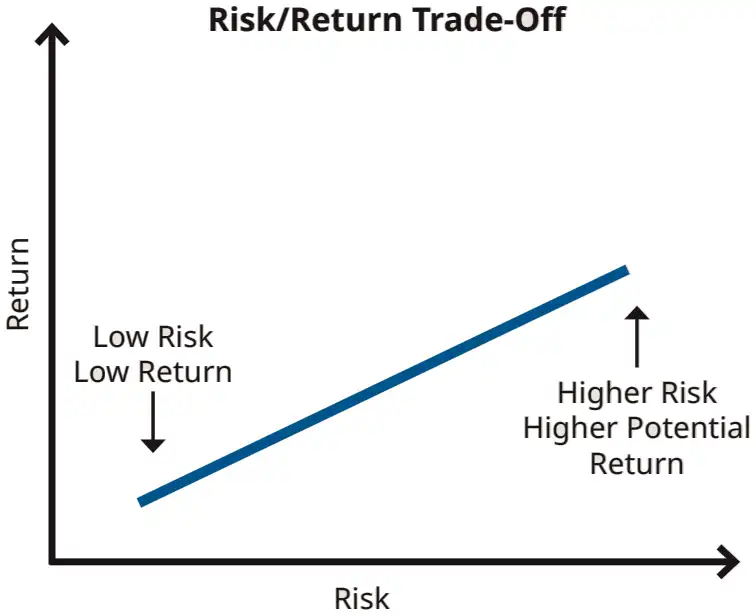
No, taking higher risk is not always the best way to earn higher returns. As shown in the Risk/Return Trade-Off (Fig. 5.9), higher-risk options like shares only offer higher potential returns—they also carry a much greater chance of losing money if market prices fall, especially when you need funds urgently.
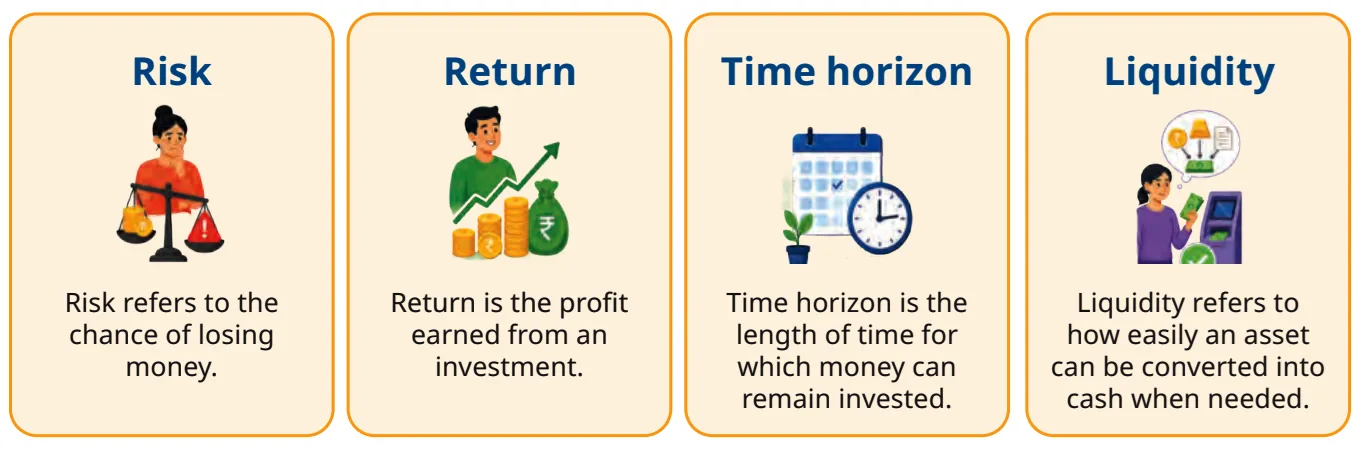
How to Decide the Most Suitable Investment Option: A person should match their financial goals with the four key factors shown in Fig. 5.8:
- Risk (Risk Tolerance): Assess how much chance of losing money you are comfortable taking. Low-risk options like Fixed Deposits (FDs) protect capital, while Mutual Funds reduce risk through diversification, and Shares (Equity) carry the highest risk.
- Return: Check whether the expected profit matches your financial goal and beats inflation over time.
- Time Horizon: Consider how long your money can stay invested. Short-term goals (1–3 years) suit safer options like FDs or government bonds, while long-term goals (5–10+ years) can handle the ups and downs of mutual funds or shares.
- Liquidity: Evaluate how quickly and easily the investment can be converted back into cash without losing value if an emergency arises.
Q8. Why do people buy insurance policies even though they may never face a major loss? How does insurance provide financial security?
How it provides financial security: Insurance works on risk sharing—many policyholders pay small, affordable regular premiums into a common pool. When an insured family suffers a covered loss, the insurer pays the heavy medical, repair, or family-support costs, allowing the household to recover without falling into debt.
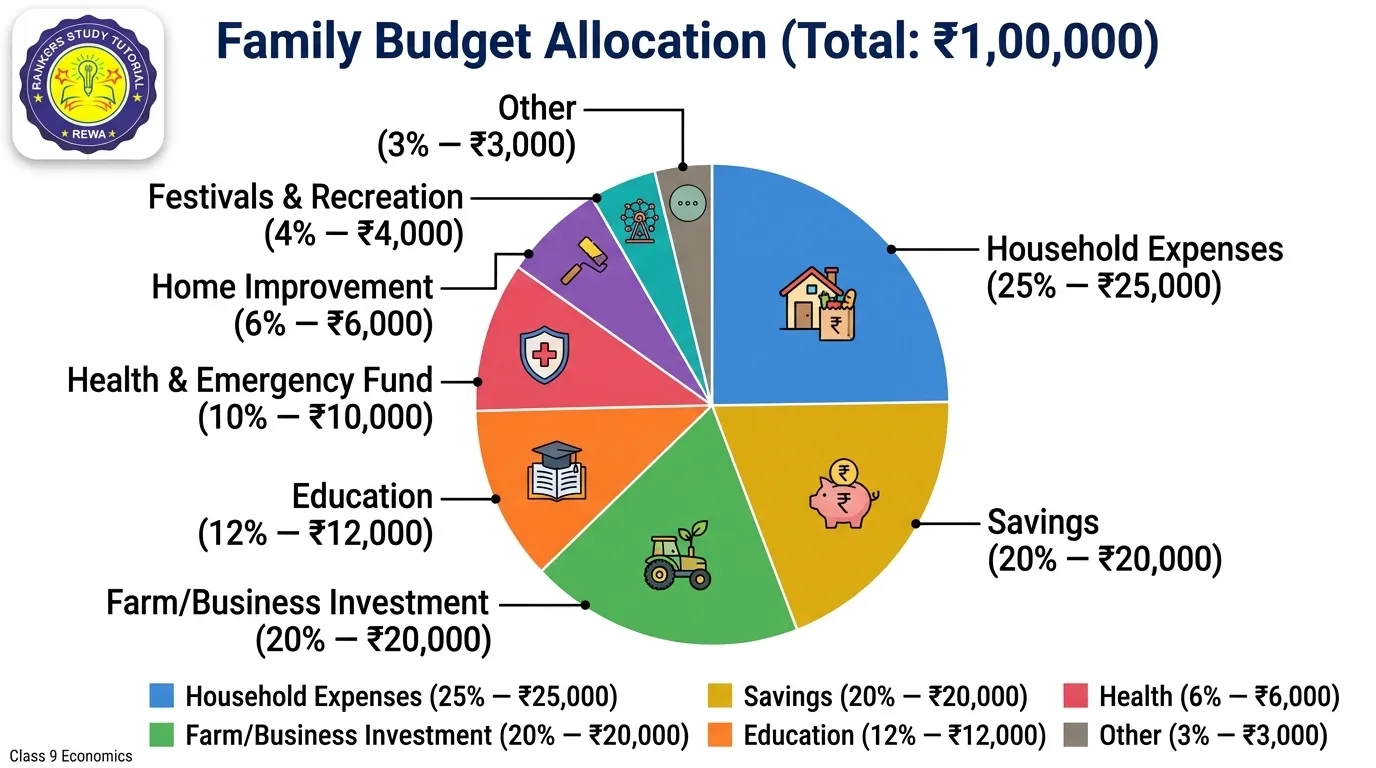
Step 1: Family Budget Allocation (₹1,00,000 — Following “Save First, Spend Later”)
| Category | Amount (₹) | Percentage (%) |
|---|---|---|
| Savings (Set aside first) | ₹20,000 | 20% |
| Household expenses | ₹25,000 | 25% |
| Farm or business investment | ₹20,000 | 20% |
| Education | ₹12,000 | 12% |
| Health and emergency fund | ₹10,000 | 10% |
| Home improvement | ₹6,000 | 6% |
| Festivals and recreation | ₹4,000 | 4% |
| Other | ₹3,000 | 3% |
| Total | ₹1,00,000 | 100% |
Step 2: Needs vs. Wants Classification
- School fees: Need — Essential for children’s education and future career.
- New mobile phone: Want (unless replacing a broken phone needed for work) — Upgrading for features is a comfort, not a survival necessity.
- Better seeds or livestock feed: Need — Essential productive investment to sustain family income.
- Festival celebrations: Want — Brings cultural joy and bonding, but spending can be adjusted to fit the budget.
- Water storage tank: Need — Essential for safe household drinking water and sanitation.
Step 3: Save for the Future (Compound Interest Calculation)
Given: Principal (P) = ₹30,000; Rate (r) = 8% = 0.08; Time (n) = 5 years.
A = 30,000 × (1 + 0.08)⁵
A = 30,000 × (1.08)⁵
A = 30,000 × 1.469328 = ₹44,079.84 (approx. ₹44,080)
1. Amount after 5 years = ₹44,079.84 (or ₹44,080)
2. Interest earned = A − P = ₹44,079.84 − ₹30,000 = ₹14,079.84 (or ₹14,080)
Step 4: Save First, Spend Later
Following the financial rule Expenses = Income − Savings, our family sets aside ₹20,000 as savings first out of ₹1,00,000, leaving ₹80,000 strictly for planned expenses, investments, and emergencies. This prevents impulse spending and builds steady financial security.
Step 5: Reflection
- Percentage saved: We saved 20% directly (₹20,000) plus set aside 10% (₹10,000) for the health/emergency fund.
- Needs vs. Wants: Household expenses, education, health, water storage, and farm/business inputs were needs; festival extras, recreation, and luxury upgrades were wants.
- How savings improve security: Savings protect the family from taking high-interest loans during sudden illness, crop loss, or emergencies.
- How compound interest grows money: Compound interest adds each year’s earned interest back to the principal, so the family earns “interest on interest,” accelerating wealth growth every year.
List
Class 9 Social Science Part 2 Chapter 5 Managing Your Personal Finances NCERT Solutions
Class 9 Social Science Part 2 Chapter 4 Governance and Public Policy NCERT Solutions

Class 9 Social Science Part 2 Chapter 3 Resistance and Resilience (1000-1700 CE) NCERT Solutions

Class 9 Social Science Part 2 Chapter 2 Life on Earth NCERT Solutions

Class 9 Social Science Part 2 Chapter 1 Oceans and Life NCERT Solutions