Class 9 Social Science Part 1 Chapter 5 State and Society up to 1000 CE NCERT Solutions
Part 1: The Big Questions (Page 95)
Q1. How did society and state organise themselves prior to 1000 CE?
- Organisation of Society: Society was primarily regulated by shared customs, traditions, and ethical values rather than formal laws alone. It was structured around family and kinship units (kula, grāma, visha, jana, and gotra), functional social categories (varṇa and later jāti), the four stages of life (āśhramas), and the four life goals (purushārthas).
- Organisation of the State: The state evolved into a structured political system governed by formal rules, taxation (usually one-sixth of agricultural produce), and law enforcement. As described in Kautilya’s Arthaśhāstra, the state functioned as an organic whole of seven limbs (Saptāmga), led by a ruler supported by a council of ministers (mantri-parishad), provincial and district officers, and highly autonomous village assemblies (such as Chola variyams).
Q2. How did states and societies emerge and spread to different parts of the Indian subcontinent?
Q3. How did the ideas of dharma and chakravarti samrāṭ help create unity in social values and governance, and promote the idea of the Indian subcontinent as one political entity?
- Unity in Social Values through Dharma: In early India, dharma (and its Pāli form dhamma) meant duty, righteousness, and moral conduct that upholds all beings. From Ashoka’s edicts promoting compassion and non-violence to the 10th-century Chola Uttaramerur inscription requiring village election candidates to have “honest earnings” and a “pure mind,” dharma united rulers and citizens across regions under a shared ethical standard.
- Pan-Indian Vision through Chakravarti Samrāṭ: Terms like Jambudvīpa, Bhāratavarsha, Prithivī, and chakravarti kshetra—defined in the Arthaśhāstra as “the area lying between the Himalayas and the sea”—expressed the aspiration of universal sovereignty across the subcontinent. Rituals such as the Ashvamedha yajña and conquests by rulers like Chera king Nedunjeral Adan and Chola emperor Rajendra I (who took the title Gangaikonda) reinforced the idea of the subcontinent as one connected geopolitical entity.
Q4. How did different social, administrative, and occupational groups take shape over time and come together culturally?
Part 2: In-Text Questions & Activities Solved
Let’s Explore (Page 96–97): Follow the timeline at the bottom of each page. Share one event you would like to explore further and document: (1) What happened? (2) When did it happen? (3) Why does it matter?
- What happened? Nālandā Mahāvihāra, one of the world’s earliest and greatest residential universities, was established in Bihar during the Gupta period.
- When did it happen? 427 CE (5th century CE).
- Why does it matter? It attracted thousands of scholars and students from India and across Asia (including Chinese travellers like Xuanzang) to study philosophy, logic, medicine, astronomy, and grammar, proving India’s global leadership in higher education and intellectual exchange.
Let’s Recall (Page 100): The name ‘Bharata’ first appears in the Rigveda in reference to the ‘Bharata jana’. What does this tell us about how early communities identified themselves and their rulers?
Think About It (Page 101): Do the roles of the rājā and the assemblies (sabhā, samiti, vidhata) in Vedic times suggest a principle similar to modern constitutions and parliaments? Were early Indian governance systems guided by people’s participation?
Let’s Analyse (Page 102–103): Why did settlements become heavily concentrated in the Ganga region during the first millennium BCE, accompanied by iron implements, PGW, and NBPW pottery?
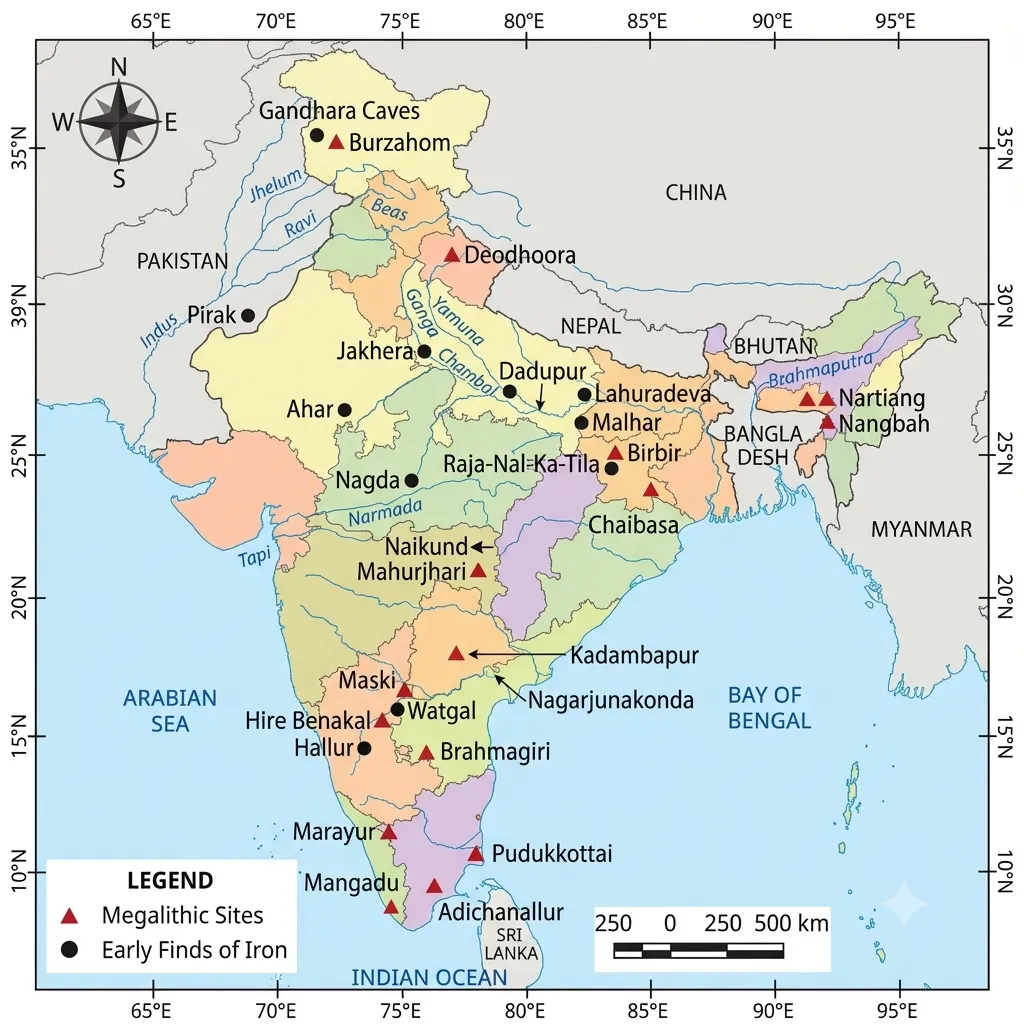
- Use of Iron Implements: Durable iron axes and ploughshares enabled communities to clear dense forests in the Ganga basin and plough heavy, rich alluvial soils effectively.
- Agricultural Surplus & Paddy Cultivation: Fertile river plains and abundant rainfall boosted grain output and crop variety—especially high-yielding paddy (rice)—capable of feeding much larger settled populations.
- Advanced Material Culture & Trade: Food surplus freed artisans to specialise in crafts like Painted Grey Ware (PGW) and glossy black Northern Black Polished Ware (NBPW), accelerating urbanisation and trade.
Think About It (Page 108): Texts such as the Mahābhārata and Arthaśhāstra describe the king’s duties as protecting people and ensuring justice. Why was this important, and what does it reveal about ruler-subject relations?
Think About It (Page 111): Why do you think different rulers (Ashoka, Rudradāman I, and Skandagupta) chose to record their inscriptions on the same stone (Junagadh Rock) instead of a new one?
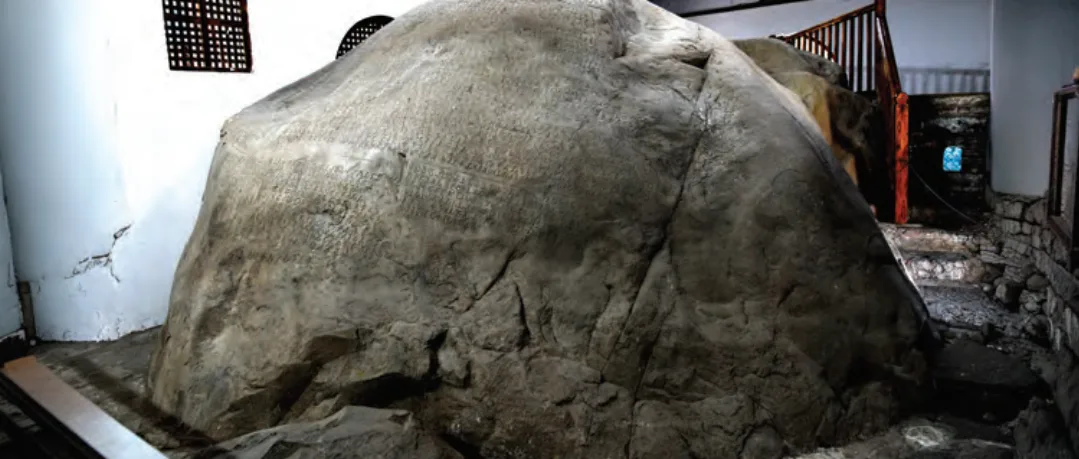
Think About It (Page 112): How would dividing a kingdom into provinces, districts, and villages have helped rulers manage their empires? What similarities exist with governance in India today?
Modern Similarities: This closely mirrors India’s current federal structure: Union Government (like the imperial centre) → States (like Bhuktis / Mandalams) → Districts (like Adhishthānas / Nādus) → Tahsils / Blocks (like Vithis / Kūrrams) → Gram Panchayats (like Grāmas / Urs).
Let’s Explore (Page 118–119): Based on Rigveda 9.112.3 (“I am a poet; my father is a physician, my mother is a grinder of corn…”), answer: (1) What occupations are mentioned and what does this indicate? (2) How does it challenge fixed status by birth? (3) What occupations exist today, and what does comparing interpretations teach us about history?
- Occupations Mentioned: Three distinct occupations appear within one family—a poet (intellectual), a physician (medical), and a corn grinder (manual/domestic). This indicates that early Vedic society had considerable occupational diversity and flexibility.
- Challenge to Fixed Birth Status: Because parents and their child in the exact same household followed three completely different professions, this primary source directly proves that occupations were not strictly hereditary or fixed by birth during the early Vedic period.
- Contemporary Occupations & Historical Evidence: Today, members of the same family freely work as software engineers, teachers, doctors, entrepreneurs, or artists. Comparing different group interpretations reminds us that historians must read sources carefully—recognising both what a text reveals (evidence) and what it leaves out (its limits)—and cross-check multiple sources before drawing conclusions.
Let’s Explore (Page 126): Compare your school life with the life of a student in a gurukula in early India (routine, subjects, teacher relationship, discipline, living arrangements, advantages, and challenges).
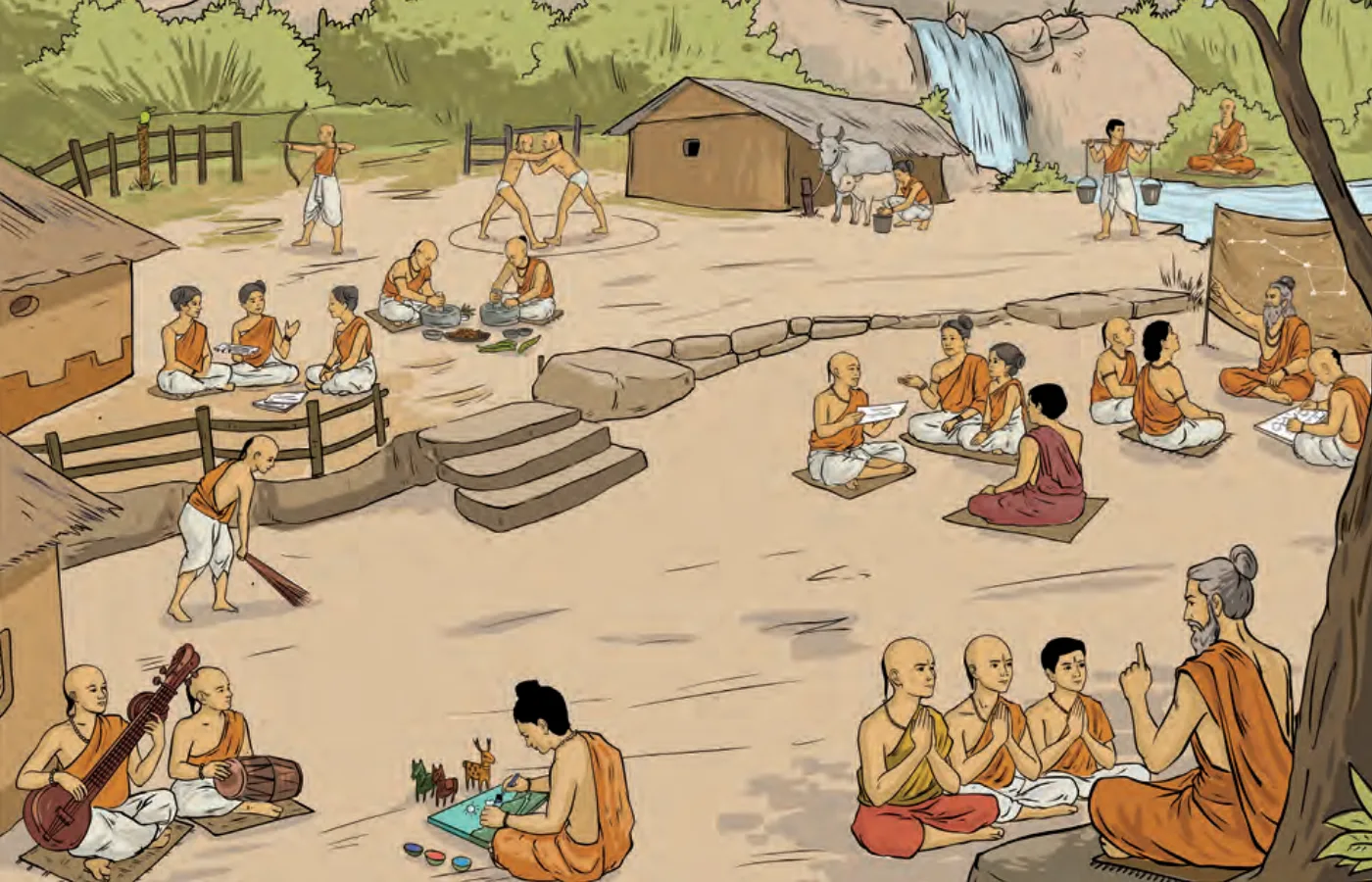
| Aspect | Early Indian Gurukula | Modern School Life |
|---|---|---|
| Living & Routine | Residential life at the guru’s home in nature; disciplined routine of chores, yoga, meditation, and study. | Students live at home with family and attend fixed daytime classes. |
| Subjects Studied | Vedas, grammar, logic, ethics, mathematics, medicine, astronomy, music, painting, and archery. | Standardised modern curriculum: Science, Maths, Social Science, Languages, Computer Science, and Sports. |
| Teacher Relationship | Sacred, family-like mentorship (guru-śhiṣhya paramparā) with close personal guidance. | Structured classroom teaching across multiple subject teachers. |
| Advantages & Challenges | Advantage: Holistic character building and life skills. Challenge: Limited capacity and away from family. |
Advantage: Wide universal access, labs, and digital tools. Challenge: Exam pressure and less one-on-one mentoring. |
Think About It (Page 129): Why do you think irrigational structures like dams and canals were considered so important that their construction was recorded in inscriptions?
Part 3: Textbook Exercises — Questions and Activities (Pages 134–135)
Q1. How did political organisation change from the Vedic period to the age of large empires such as the Mauryas and the Guptas? Explain the administrative system of the early Indian states.
- Vedic Clan Polities: Early Vedic society was organised into kin-based clans (janas) led by a clan chief (rājā) who worked in consultation with tribal assemblies (sabhā, samiti, vidhata).
- Janapadas & Mahājanapadas (1000–300 BCE): With iron tools and expanding agriculture, kinship ties gave way to territorial states—first janapadas and then 16 larger mahājanapadas comprising both monarchies (rājyas) and republics (gaṇas/samghas).
- Large Empires (Mauryas & Guptas): Magadha grew into the vast Mauryan Empire, followed later by the Guptas. These empires developed structured administrative systems with regular taxation (one-sixth of produce), a standing army, a council of ministers (mantri-parishad), and decentralised tiers—dividing the realm into provinces (bhuktis), divisions (vishayas), districts (adhishthānas), groups of villages (vithis), and self-reliant villages (grāmas).
Q2. Describe the role of the king, important officers, and the methods used to govern large territories.
- Role of the King: The king (rājā, mahārāja, or samrāṭ) was the supreme protector of the realm. Guided by dharma, he defended subjects from external threats, maintained internal law and order, administered impartial justice, and promoted public welfare works like irrigation.
- Important Officers: Because “one wheel does not move the carriage,” the king relied on a mantri-parishad (council of ministers) including the mantri (head of civil administration), treasurer, chief tax collector, chief legal advisor, commander-in-chief, and—during the Gupta era—the sāndhivigrahika (minister of peace and war) and kumārāmātyas. At lower levels served district governors (pradeśhikas), city governors, and village headmen (grāmikas).
- Methods of Governance: Empires balanced central monarchy with decentralised local governance. District officers consulted local bankers, caravan traders, and artisans (as recorded in the Damodarpur copper plates), while autonomous village assemblies (like Chola variyams) handled local taxes, irrigation, roads, and disputes.
Q3. After studying this chapter, what do you think were the most important features of the state and society in India before 1000 CE?
- Decentralised Governance & Local Autonomy: Even under mighty empires like the Mauryas, Guptas, Pallavas, and Cholas, villages remained self-reliant units governed by local assemblies.
- Ethical Foundation: Governance and daily life were anchored in moral principles like dharma, rita (cosmic harmony), and samatva (principle of sameness).
- Dynamic Economy: Agriculture supported by major irrigation works formed the base, while overland routes (Uttarāpatha, Dakshiṇāpatha), maritime ports, metallic coins, and banking guilds (śhreṇīs) drove vibrant commerce.
- Cultural Continuity & Intellectual Richness: Despite political shifts, holistic education (gurukulas and universities like Takshaśhilā and Nālandā), Sanskrit and Tamil literature, and devotional traditions like Bhakti flourished continuously.
Q4. What do early texts such as the Rigveda, Arthaśhāstra, and the Mahābhārata reveal about political and social life?
- Rigveda: Reveals early kin-based clans (janas and pañchajana), consultative assemblies (sabhā, samiti, vidhata), nature worship, flexible occupations within a single family (9.112.3), and the respected intellectual role of women sages like Apālā and Lopāmudrā.
- Arthaśhāstra (by Kautilya): Offers a systematic treatise on statecraft—outlining the seven constituents of a state (Saptāmga), ministerial councils, land classification and taxation, regulated trade, active leadership, and the pan-Indian geopolitical ideal of chakravarti kshetra.
- Mahābhārata (especially Śhānti Parva): Highlights the moral responsibilities of a king (rāja-dharma), impartial justice, severe penalties for serious crimes, early references to Bhakti, and the ethical ideal of samatva—that a true ruler works for the welfare of all beings.
Q5. What can we learn from early Indian society about varṇa and the role of women?
- About Varṇa: Originally, the fourfold varṇa structure (Brāhmaṇas, Kshatriyas, Vaishyas, Śhūdras) was a functional division valuing knowledge, political leadership, economic activity, and service—not a rigid birth-based cage. Early Vedic verses, Buddhist texts like the Sutta Nipāta, and inscriptions like Mandsaur (473 CE) show notable occupational and social mobility before roles gradually became more rigid.
- About the Role of Women: During the Vedic period, women enjoyed high respect, composed Rigvedic hymns (Apālā, Viśhvavārā, Ghoshā, Lopāmudrā), and attended gatherings like the sabhā. Although their status fluctuated and declined in later periods, historical records still highlight remarkable women—such as Vākāṭaka regent Prabhāvatī Gupta, Sangam poetesses Avvaiyār and Vennikuyattiyar, women donors on votive inscriptions, and Chola queen Sembiyan Mahādevī—who shaped governance, economy, and culture.
Q6. Explain how assemblies like sabhā and samiti limited the power of the rājā. Which modern institutions perform similar functions today?
Modern Equivalents: Today, Parliament and State Legislative Assemblies perform the policy-making and oversight role of the Samiti, while the Independent Judiciary (Supreme Court and High Courts) performs the judicial and constitutional-check role similar to the Sabhā. At the village level, the Gram Sabha reflects the participatory spirit of the Vidhata.
Q7. What do the terms varṇa and jāti refer to in early Indian society? How were they different, and what factors may have contributed to the formation of various jātis?
Key Difference: While the number of varṇas was permanently fixed at four, there was no limit on the number of jātis—they kept multiplying as new professions and communities emerged.
Factors behind the rise of Jātis: Intermarriage among different varṇas, migrating communities adopting endogamy (marrying strictly within their own group), territorial and regional differences, and the emergence of new specialised crafts and occupations.
Q8. Why do you think education in early India emphasised both knowledge and moral values? How might this have benefited society?
Benefits to Society: Combining skill with ethics ensured that educated individuals used their knowledge responsibly. Rulers governed with fairness, doctors and artisans served honestly, families maintained harmony, and communities treated nature with reverence rather than greed.
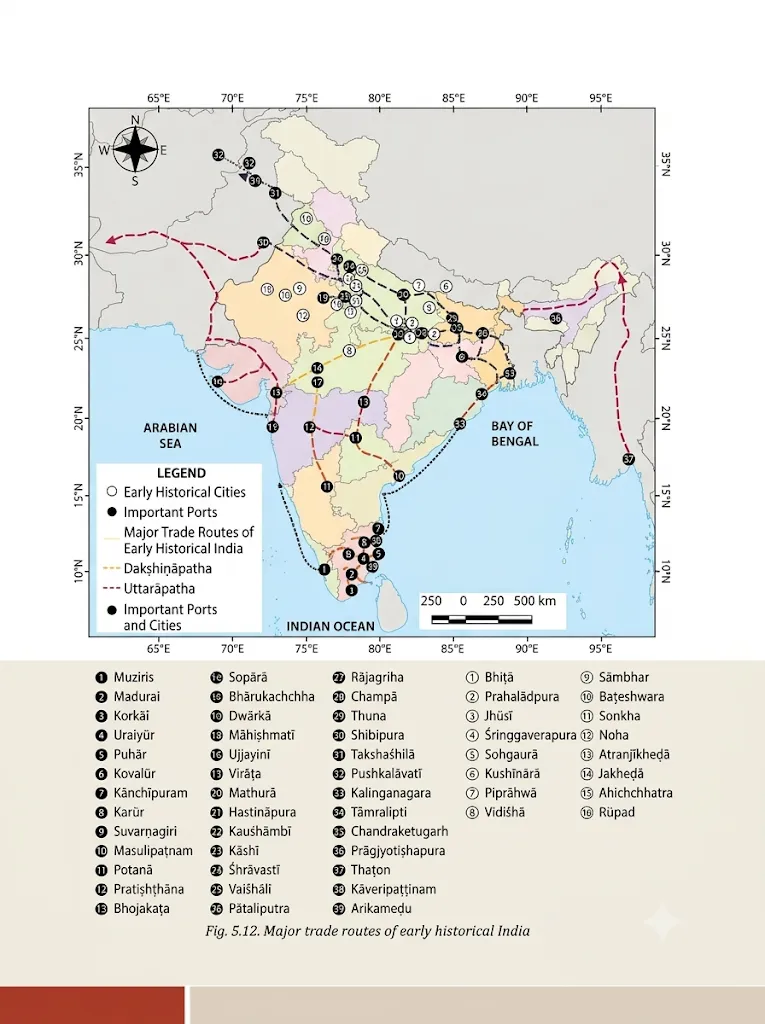
Q9. Look at the major trade routes of early India (Fig. 5.12). How do you think these routes helped people in the exchange of goods, skills, beliefs, and cultural practices?
Q10. What might have been the advantages and challenges of ruling a large empire in the absence of modern communication systems?
- Advantages: A vast empire unified diverse regions under one law and currency, secured long-distance trade routes (boosting commerce and revenue), pooled resources for massive public works (like irrigation dams and universities), and offered stronger defence against external invasions.
- Challenges: Without telephones, railways, or the internet, messages and royal orders took weeks or months to reach distant provinces. Monitoring far-off governors was difficult (risking rebellion or corruption), responding quickly to border attacks or famines was slow, and rulers had to rely heavily on local autonomy and trustworthy regional officials.
Q11. Many ideas about governance come from texts composed by scholars and advisors of the king. What might be some limitations of relying only on such sources?
- Ideal vs. Reality: Such texts often describe how a king should ideally govern rather than how rulers actually behaved in everyday life.
- Elite Bias: Written by and for the ruling elite, they may exaggerate royal virtues while overlooking the struggles, hardships, or viewpoints of ordinary farmers, artisans, women, and marginalised groups.
- Need for Cross-Checking: To build a balanced picture of the past, historians must combine literary texts with archaeological remains, inscriptions, coins, and foreign travellers’ accounts.
Q12. Read the Nashik cave inscription (2nd century CE) of Ushavadāta and answer questions (a) to (c).
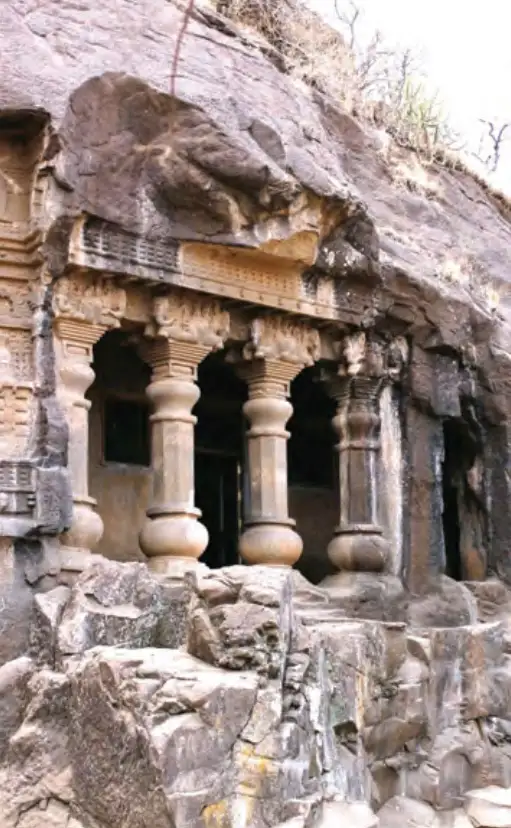
- (a) What does this source tell us about the economic role of guilds? It shows that guilds (śhreṇīs) were not merely craft associations; they also functioned as well-organised banks, credit institutions, and trustees that accepted large monetary deposits, invested them securely, and paid a fixed monthly rate of interest in perpetuity.
- (b) Why were guilds trusted with money deposits? Guilds were permanent, financially stable organisations with strong internal discipline enforced by guild courts. Even if kings or dynasties changed, guilds continued operating reliably across generations, ensuring that perpetual endowments remained safe.
- (c) Identify the donor and the donees:
• Donor: Ushavadāta (son of Dinika and son-in-law of the Shaka king Nahapāna).
• Donees: Members of the Buddhist Samgha (of any sect and any origin) dwelling in the Nashik cave.
Q13. Mark and locate on the map of India the following important centres: Pāṭaliputra, Nāśhik, Ujjayinī, Vikramśhilā, Kānchīpuram, Mathurā, Rājgriha.
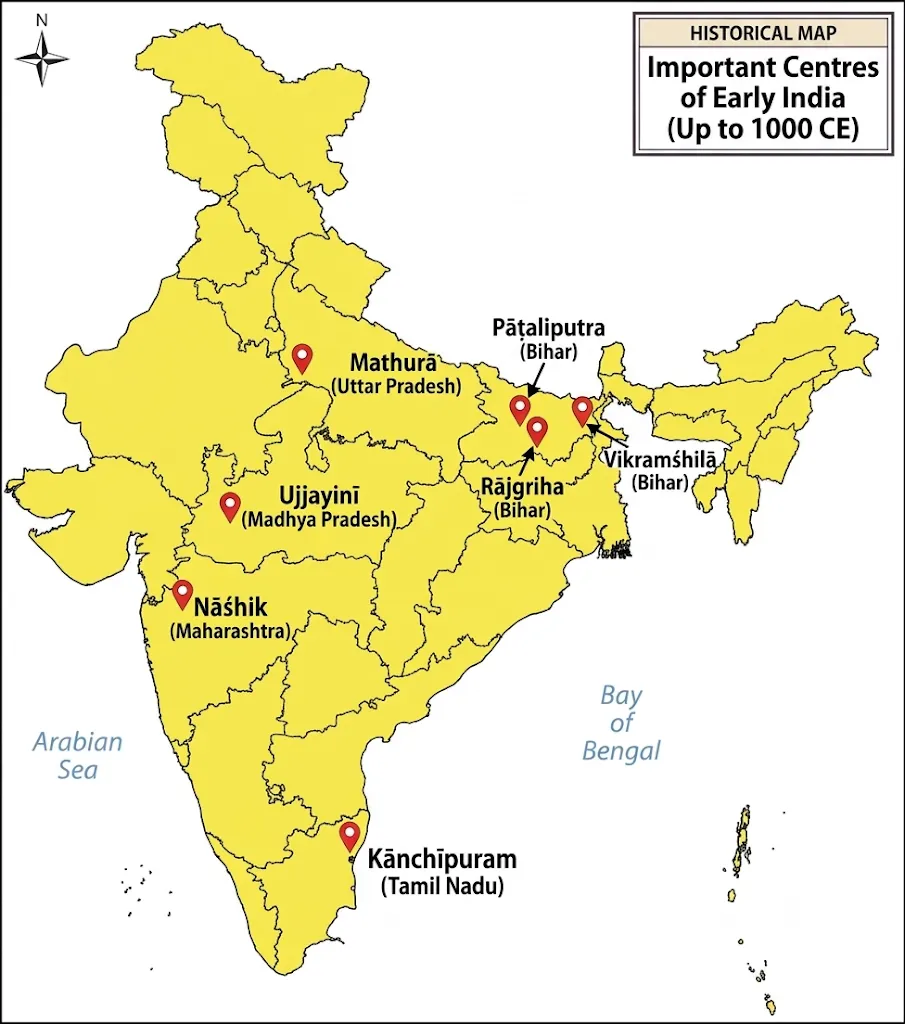
- Pāṭaliputra: Present-day Patna, Bihar (on the southern bank of the Ganga; Mauryan & Gupta capital).
- Rājgriha: Present-day Rajgir, Bihar (southeast of Patna; early capital of Magadha).
- Vikramśhilā: Bhagalpur district, eastern Bihar (famous ancient university established by the Pālas).
- Mathurā: Western Uttar Pradesh (on the Yamuna River; major textile and trade hub on Uttarāpatha).
- Ujjayinī: Present-day Ujjain, western Madhya Pradesh (major centre of learning and trade on Dakshiṇāpatha).
- Nāśhik: Northwestern Maharashtra (famous for rock-cut caves and guild banking inscriptions).
- Kānchīpuram: Northern Tamil Nadu (Pallava capital, major temple and learning centre).
Q14. Prepare a short presentation or poster on one of the following: (a) Life in Vedic society, (b) Early education system (gurukula), (c) Trade and guilds in early India, (d) Role of women in early Indian society.
- Title Banner: “Engines of Prosperity: Trade Networks & Guilds in Early India”
- Section 1 — Major Trade Routes: Highlight Uttarāpatha (North) and Dakshiṇāpatha (South), plus bustling ports like Muziris, Kāveripattinam, and Arikamedu connecting India with Rome and Central Asia.
- Section 2 — Key Commodities & Hubs: Textiles (Mathurā, Kāśhī, Kāmarūpa), spices (pepper, turmeric from Chera region), gems, pearls, ivory, and regulated salt—traded using silver punch-marked coins.
- Section 3 — Power of Guilds (Śhreṇīs): 18 types mentioned in Jataka tales; fixed fair prices, ensured quality via guild courts, acted as trusted banks (Nashik cave inscription), and sponsored art (Vidiśhā ivory workers carving Sanchi Stupa’s southern gateway).
List
Class 9 Social Science Part 1 Chapter 2 Shaping of the Earth’s Surface NCERT Solutions
Class 9 Social Science Part 1 Chapter 5 State and Society up to 1000 CE NCERT Solutions
Class 9 Social Science Part 1 Chapter 3 Atmosphere and Climate NCERT Solutions
Class 9 Social Science Part 1 Chapter 9 The Price Puzzle: What Drives the Market NCERT Solutions
Class 9 Social Science Part 1 Chapter 1 Understanding Social Science Revision Notes