Class 9 Social Science Part 1 Chapter 9 Revision Notes: The Price Puzzle (मूल्य पहेली)
Have you ever wondered why vegetables are expensive in the morning but cheaper in the evening? (क्या आपने कभी सोचा है कि सब्जियां सुबह महंगी और शाम को सस्ती क्यों होती हैं?) Or why the same flight seat costs ₹3,000 one day but ₹9,000 on another? Prices do not change randomly; वे लोगों की जरूरतों (what people want), उपलब्धता (availability), seasons, festivals, और trends पर react करती हैं। Market में सभी वस्तुओं और सेवाओं की कीमतें (prices of all goods and services) दो शक्तिशाली शक्तियों द्वारा निर्धारित की जाती हैं: Demand (माँग) and Supply (आपूर्ति).
1. Demand (माँग)
जैसे ही आम का मौसम (mango season) आता है, prices are generally high, इसलिए लोग उन्हें कम मात्रा में खरीदते हैं (people tend to buy in smaller quantities)। But when prices start falling, people prefer to buy larger quantities. Demand (माँग) केवल किसी वस्तु को खरीदने की इच्छा (desire to buy) नहीं है; it requires the willingness complemented by the ability or purchasing power to buy it.
📚 Important Definitions
Purchasing Power (क्रय शक्ति): It is a measure of how much one unit of a particular currency can buy at a particular time. (मुद्रा की एक इकाई किसी विशेष समय में कितना खरीद सकती है, इसका मापक)।
Demand (माँग): The quantity of a product that people are willing and able to buy at a particular price, depending on their needs, preferences, season, trend, and income.
Law of Demand (माँग का नियम): The inverse relationship between the price of a product and its quantity demanded. (उत्पाद की कीमत और माँगी गई मात्रा के बीच विपरीत संबंध)।

Individual Demand vs. Market Demand
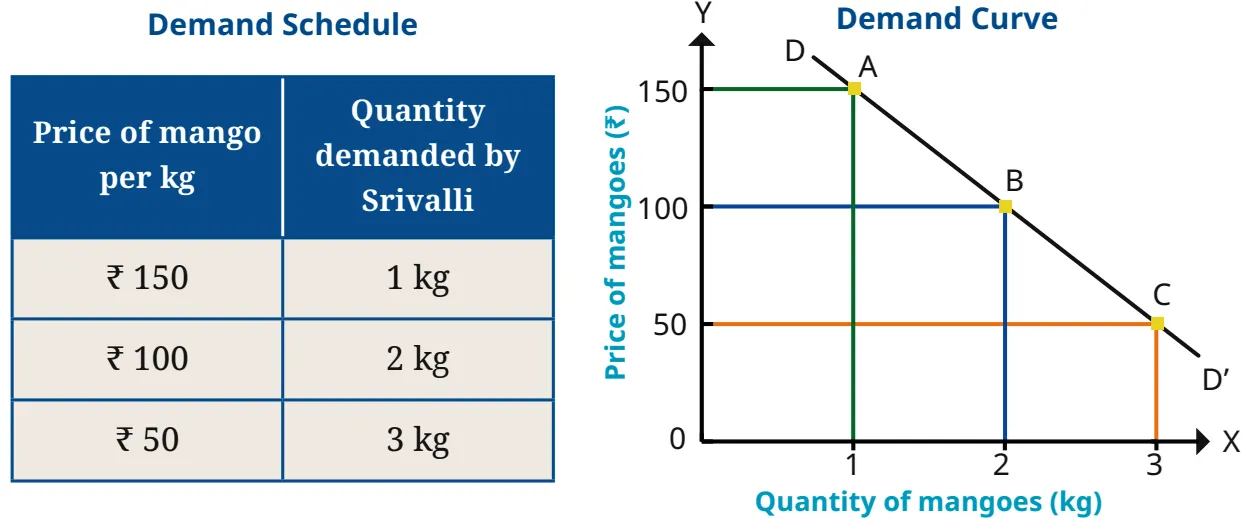
Individual Demand (व्यक्तिगत माँग): The quantity of a good that an individual consumer wants to buy at different prices. (उदाहरण के लिए: Srivalli bought 1kg mangoes at ₹150, 2kg at ₹100, and 3kg at ₹50).
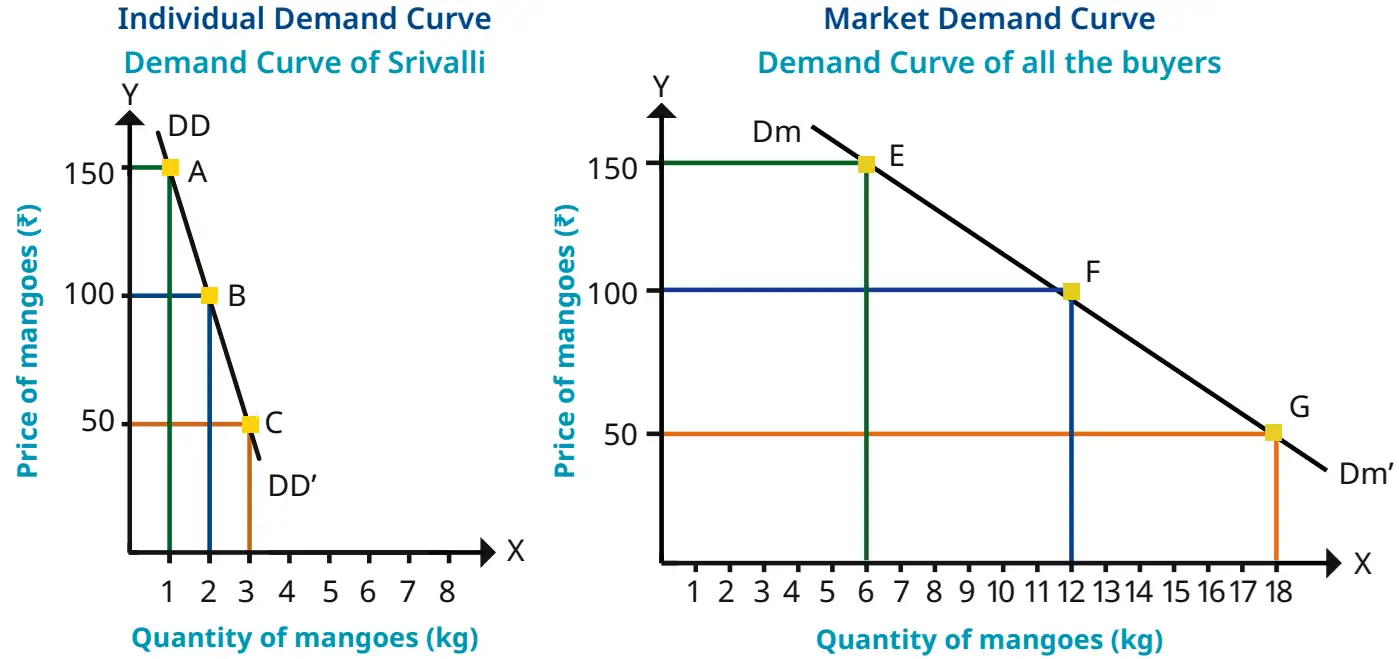
Market Demand (बाजार की माँग): The total quantity of goods demanded by all potential buyers at different prices. यह सभी individual demands का योग (sum) है।
| Price (₹) | Q1 (Srivalli) | Q2 (Alex) | Q3 (Israt) | Market Demand (Qd) |
|---|---|---|---|---|
| 150 | 1 kg | 2 kg | 3 kg | 6 kg |
| 100 | 2 kg | 4 kg | 6 kg | 12 kg |
| 50 | 3 kg | 6 kg | 9 kg | 18 kg |
💡 Don’t Miss Out!
Did you notice that the market demand curve is flatter (चपटा) than an individual demand curve? Why is that?
Other Determinants of Demand (माँग के अन्य निर्धारक)
The demand for a product does not necessarily change only because of price. Many other factors influence demand (कई अन्य कारक माँग को प्रभावित करते हैं):
- Price of related goods (संबंधित वस्तुओं की कीमत):
- Substitute Goods (स्थानापन्न वस्तुएं): These can replace each other (e.g., tea and coffee). If tea becomes expensive, people switch to coffee (लोग कॉफी की ओर रुख करते हैं), increasing its demand.
- Complementary Goods (पूरक वस्तुएं): These are used together (e.g., cars and petrol, smartphones and earphones). If movie tickets become expensive, the demand for popcorn in cinemas falls.
- Income of the consumer (उपभोक्ता की आय): When household income rises, consumers can afford to buy more or choose higher-quality products (बेहतर गुणवत्ता वाले उत्पाद).
- Taste and preference (स्वाद और प्राथमिकता): Specific individual preferences, like loving mangoes over oranges regardless of price.
- Population size and composition (जनसंख्या का आकार): More children mean a higher demand for sports shoes (खेल के जूतों की अधिक माँग), while more elderly people imply a higher demand for medical care.
- Seasonality (मौसमी प्रभाव): Demand changes depending on weather, festivals, and cultural habits (e.g., sweaters in winter).
- Future price expectations (भविष्य की कीमत की उम्मीदें): If consumers expect prices to fall soon, वे अपनी खरीदारी टाल देते हैं (they postpone purchases). If they expect prices to rise, they buy immediately.
🤔 Think About It
What happens when you consume the first mango? It tastes delicious. The second one is good? The third one? You are barely interested. Why do you think this happens?
🔍 Let’s Explore
Create your own demand schedule for buying notebooks at different prices. At what price would you buy the most? At what price would you stop buying altogether? Ask family if they postponed buying a product because of future expectations.
🎯 Competency-Based Questions (Demand)
Q1. [Scenario-Based] Suppose the price of petrol suddenly increases by ₹30 per litre. What is the most likely immediate impact on the demand for large petrol-engine cars?
Ans: The demand for petrol-engine cars will decrease because cars and petrol are complementary goods (पूरक वस्तुएं). An increase in the price of one reduces the demand for the other.
Q2. [Assertion-Reason] Assertion (A): The market demand curve is generally flatter than an individual demand curve.
Reason (R): Market demand aggregates the individual demand of many consumers, making the total quantity more responsive to price changes.
Ans: Both A and R are correct, and R is the correct explanation of A.
Q3. [Analytical] If a consumer expects the price of gold to skyrocket next month due to a global crisis, how will this expectation affect their current demand for gold today?
Ans: Their current demand for gold today will increase significantly (काफी बढ़ जाएगी) as they buy immediately before prices rise.
Q4. [Conceptual] How does the principle of “Diminishing Marginal Utility” explain the downward slope of the demand curve?
Ans: As a consumer consumes successive units, the additional satisfaction decreases (अतिरिक्त संतुष्टि घट जाती है). Therefore, they will only buy more units if the price is lowered.
Q5. [Fact-Based] Identify whether Tea and Coffee are Substitute goods or Complementary goods.
Ans: Substitute goods (स्थानापन्न वस्तुएं).
2. Supply (आपूर्ति)
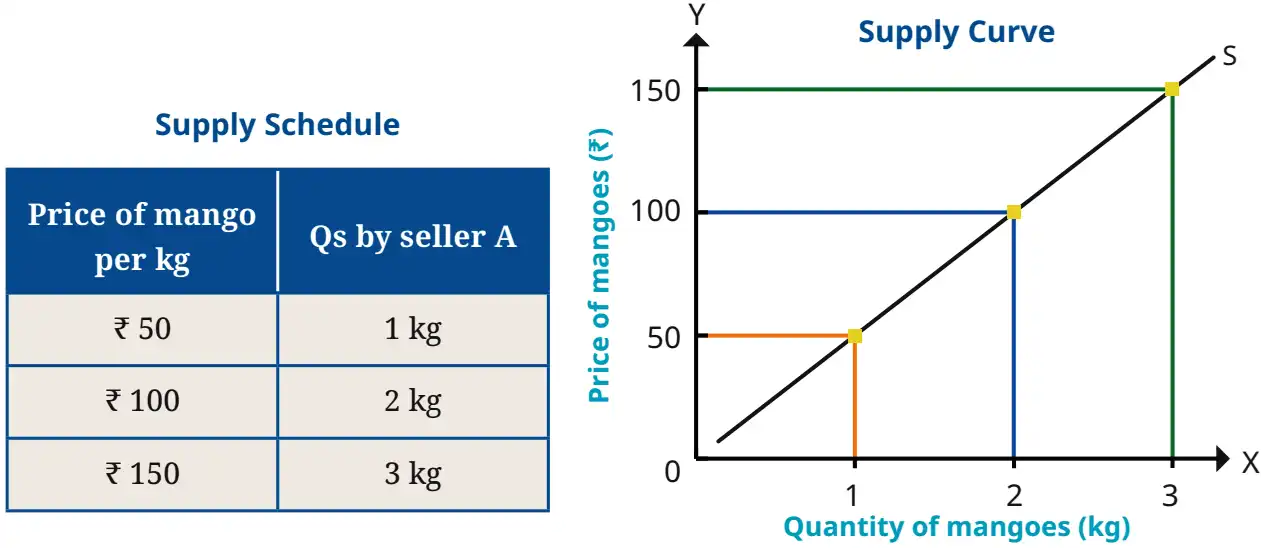
Supply is the quantity of a product that sellers are willing and able to offer at a particular price (वह मात्रा जो विक्रेता एक विशेष कीमत पर बेचने के इच्छुक हैं).
📚 Important Definition
Law of Supply (आपूर्ति का नियम): As price increases, quantity supplied increases, and as price decreases, quantity supplied falls. This direct relationship exists because higher prices increase profitability (उच्च कीमतें लाभ बढ़ाती हैं), incentivising producers to increase output.
Individual Supply and Market Supply
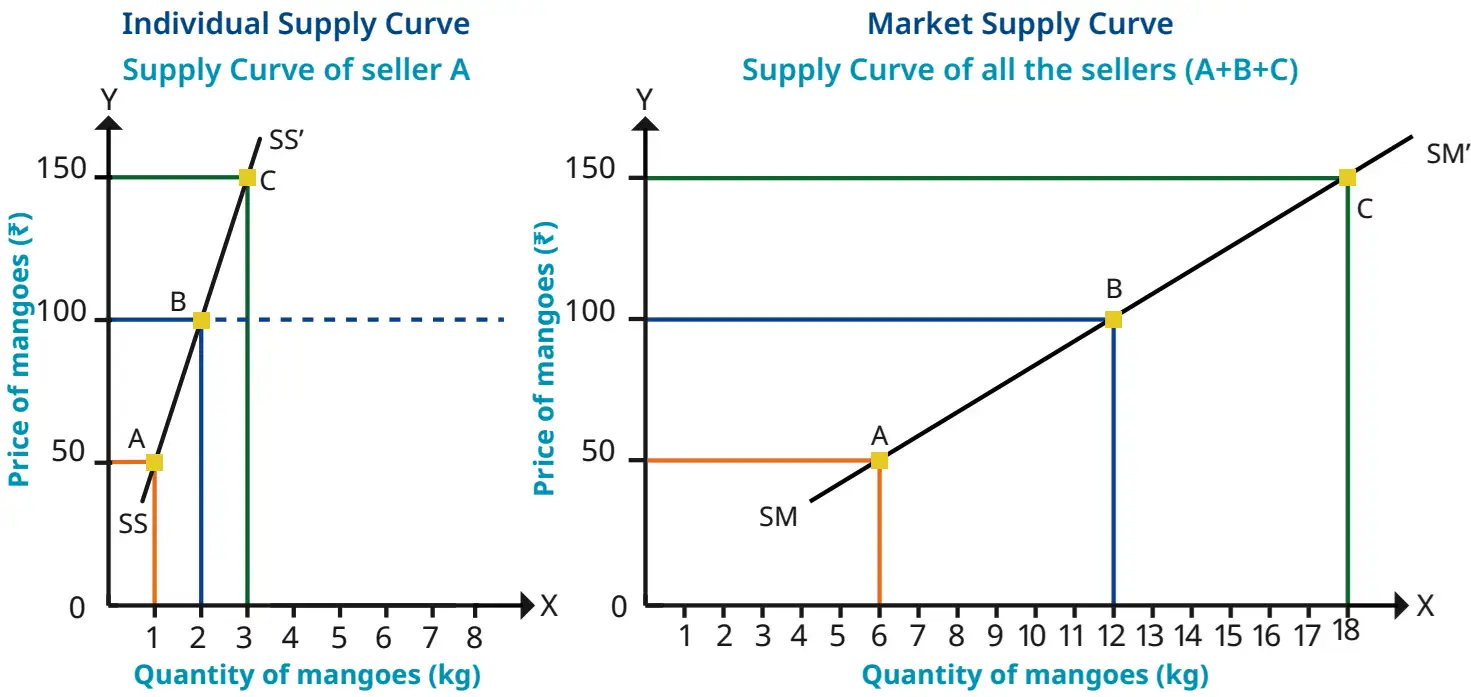
Individual Supply: The quantity a particular seller offers at different prices.
Market Supply: The sum of all individual supplies (e.g., combining the supply of Seller A, Seller B, and Seller C). The market supply curve is upward-sloping (ऊपर की ओर झुकाव वाला).
Other Determinants of Supply (आपूर्ति के अन्य निर्धारक)
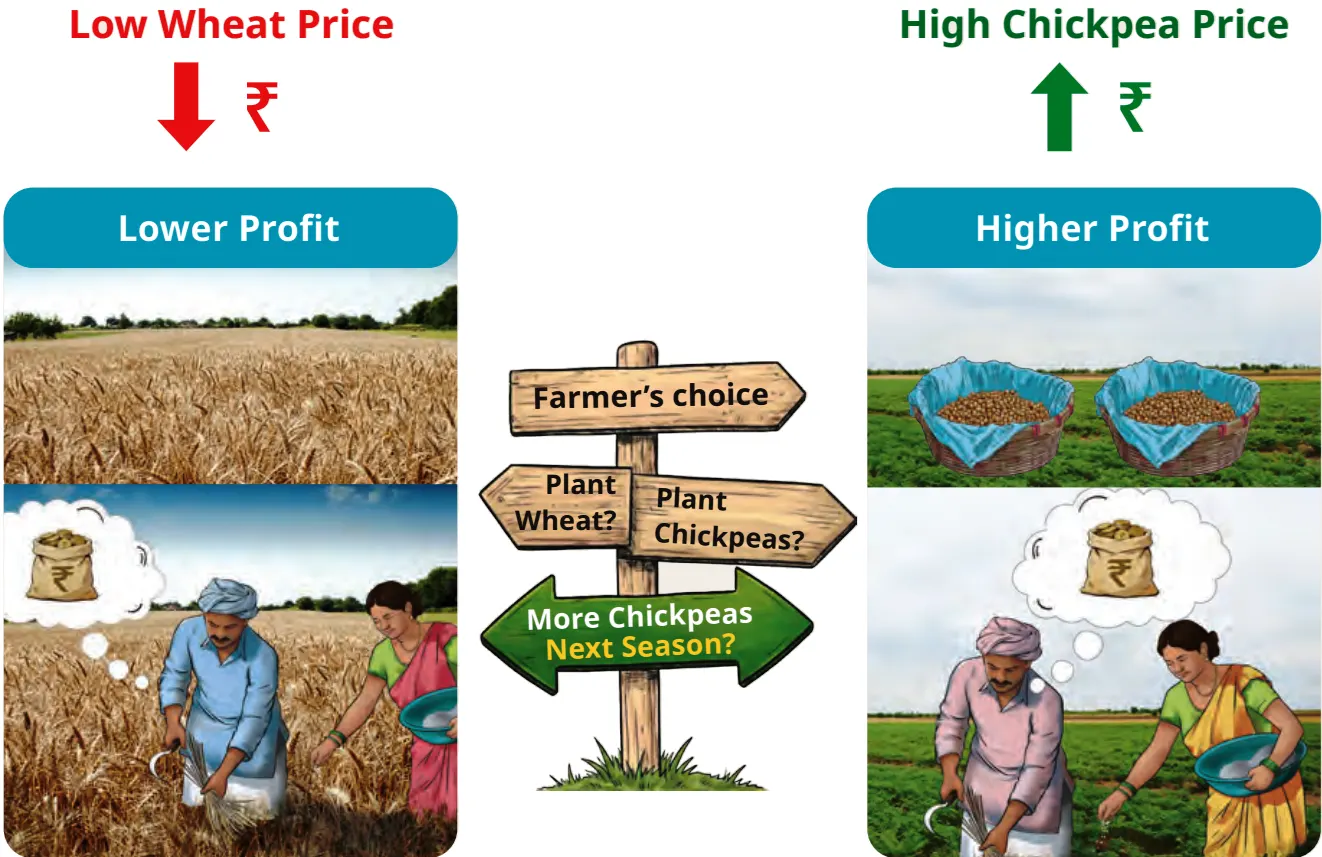
- Price of related goods: If wheat prices are low but chickpea prices are high, a farmer will grow more chickpeas in the next season (लाभप्रदता के आधार पर विकल्प चुनना).
- Number of sellers in the market (बाजार में विक्रेताओं की संख्या): More sellers lead to higher competition and increased market supply, which can make prices fall.
- Technology (तकनीक): Improvement in technology (e.g., drip irrigation, weather sensors, cold storage) reduces the cost of production (उत्पादन की लागत को कम करता है), allowing producers to supply more.
- Future expectations: If producers expect demand to boom, they produce more. If potato wholesalers expect prices to rise during peak season, they might hold back supply now (hoarding – जमाखोरी) to sell later.
🔍 Let’s Explore
What happens to the supply of a product in case of a change in the cost of inputs, discovery of an alternate input, depletion of resources, change in weather, disaster, etc.?
• Cost of inputs rises: Profitability falls, causing supply to decrease (आपूर्ति घट जाती है).
• Alternate input discovered: Production becomes cheaper, increasing supply.
• Depletion of resources/Disasters (आपदा): Natural disasters destroy crops, severely reducing market supply and causing shortages.
🎯 Competency-Based Questions (Supply)
Q1. [Scenario-Based] A farmer historically grows wheat. This year, the market price of chickpeas has surged, while wheat prices remained stagnant. Assuming the farmer wants to maximize profit, what economic decision will he make?
Ans: He will allocate more resources to plant chickpeas (चना) instead of wheat, as supply depends on the profitability of alternatives.
Q2. [Assertion-Reason] Assertion (A): Technological advancements generally lead to an increase in the market supply of goods.
Reason (R): Improved technology reduces the overall cost of production (उत्पादन लागत), allowing sellers to supply more.
Ans: Both A and R are correct, and R is the correct explanation of A.
Q3. [Analytical] Why does the supply curve generally slope upwards from left to right?
Ans: It demonstrates the Law of Supply: as prices increase, producers have a higher financial incentive (profit) to increase output (उत्पादन बढ़ाने के लिए वित्तीय प्रोत्साहन).
Q4. [Case-Based] If potato wholesalers expect the price of potatoes to skyrocket next month, what immediate action might they take regarding their current supply?
Ans: They will hold back their current supply (hoard it – जमाखोरी) to sell it later at higher prices.
Q5. [Fact-Based] Give an example of a technological improvement in agriculture that can increase crop supply.
Ans: Drip irrigation (ड्रिप सिंचाई) or cold storage facilities.
3. Market Equilibrium (बाजार संतुलन)
Every market involves negotiation between what buyers are willing to pay and what sellers are willing to accept. Prices are determined by the interaction between demand and supply (माँग और आपूर्ति की परस्पर क्रिया).
📚 Important Definitions
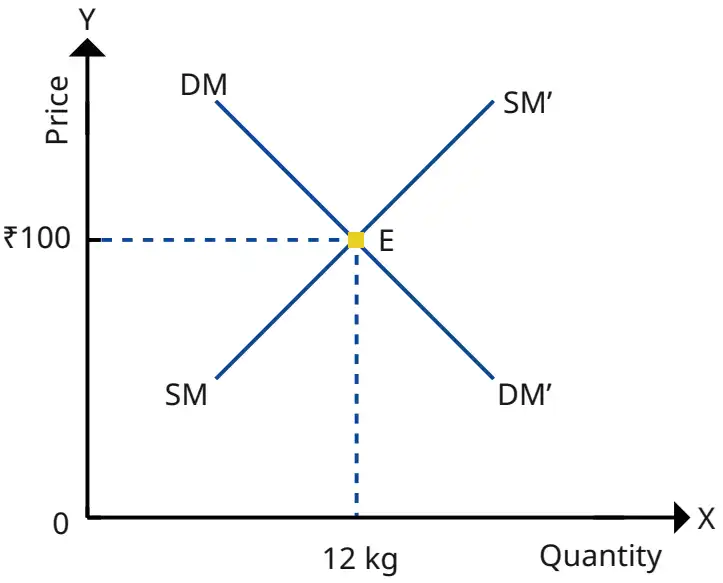
Market Equilibrium (बाजार संतुलन): The point where the supply of goods equals demand ($Qs = Qd$). At this point, the market is ‘cleared’, meaning there is no excess supply (surplus) or excess demand (shortage).
Revenue (राजस्व): The total amount of money a business earns from the sale of goods or services before any expenses are deducted.
| Price (₹) | Quantity Demanded (Qd) in kg | Quantity Supplied (Qs) in kg | Comparison | Outcome (परिणाम) |
|---|---|---|---|---|
| 40 | 38 | 6 | Qs < Qd | Excess Demand (Shortage – कमी) |
| 100 | 12 | 12 | Qs = Qd | Market Equilibrium (संतुलन) |
| 150 | 8 | 43 | Qs > Qd | Excess Supply (Surplus – अधिशेष) |
Does Market Equilibrium Exist in the Real World?
In theory, equilibrium is a stable intersection point. But in the real world, markets are dynamic (गतिशील). Changes in technology, wages, weather, natural disasters, and political events constantly alter conditions. The market is always in a process of adjusting to a new equilibrium (नए संतुलन की ओर बढ़ना), and never fully settles permanently.
💡 Case Study: Tariffs by Hotels (Dynamic Markets)
Hotels do not charge the same price (tariff) for rooms all the time. Their prices change according to demand, season, and situations.
• Off-season weekday (July): ₹1,500 per night
• Weekend tourist season (Dec): ₹8,000 per night
• New Year’s Eve (very high demand): ₹25,000 per night
If a group tour cancels its booking, the hotel may reduce the tariff by 40% overnight to quickly fill empty rooms (खाली कमरों को भरने के लिए).
🤔 Think About It
Can you think of another real-life example (other than hotels) where prices change frequently? Explain why.
🔍 Let’s Analyse
Observe the market equilibrium graph below showing demand and supply shifts. What do points A, B, C, and F indicate?
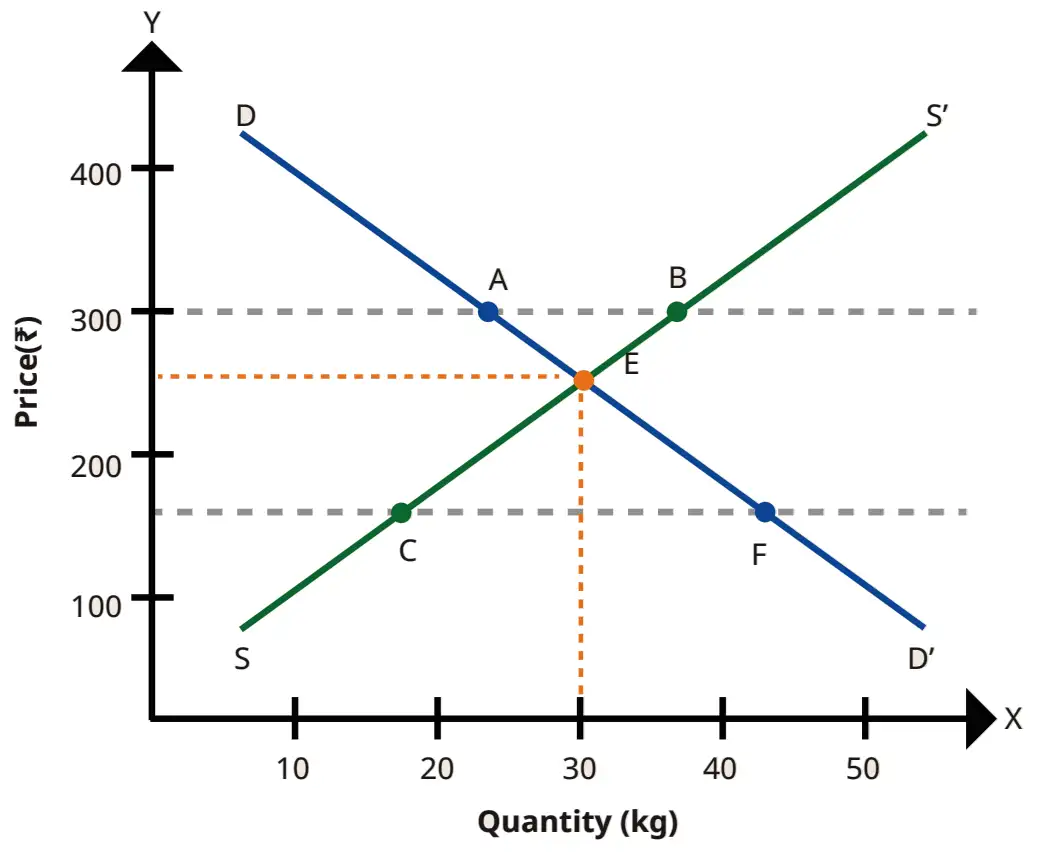
• Point E: Represents Market Equilibrium (where Qd = Qs).
• Points A and B: At the higher price, Point A shows low demand, and B shows high supply. The gap represents Excess Supply (Surplus – अधिशेष).
• Points F and C: At the lower price, Point C shows low supply, and F shows high demand. The gap represents Excess Demand (Shortage – कमी).
🎯 Competency-Based Questions (Equilibrium)
Q1. [Scenario-Based] During the early days of the COVID-19 pandemic, demand for face masks skyrocketed while supply chains broke. What immediate market outcome occurred?
Ans: An extreme “Excess Demand” (shortage – कमी) occurred, driving mask prices up significantly until suppliers could adjust.
Q2. [Assertion-Reason] Assertion (A): Market equilibrium in the real world is never permanently stable.
Reason (R): Real-world markets are constantly affected by dynamic changing conditions like weather, trends, and technology.
Ans: Both A and R are correct, and R is the correct explanation of A.
Q3. [Analytical] According to Table 9.3, what happens in the market if the price of mangoes is set at ₹150?
Ans: Quantity supplied (43kg) vastly exceeds quantity demanded (8kg), creating an Excess Supply (Surplus) which will eventually force sellers to lower prices.
Q4. [Conceptual] What specific condition defines “Market Equilibrium”?
Ans: The point where Quantity Demanded ($Qd$) is exactly equal to Quantity Supplied ($Qs$).
Q5. [Fact-Based] If a massive group tour cancels at a hotel in Goa, does this represent a sudden drop in supply or a sudden drop in demand?
Ans: A sudden drop in demand (which leaves the hotel with excess supply of empty rooms).
4. Role of Government in the Economy (अर्थव्यवस्था में सरकार की भूमिका)
India is the fourth-largest economy in the world. It is a market-based, regulated economy. While prices depend on demand and supply, markets do not always work fairly. When essential goods like medicines become very expensive (अत्यधिक महंगी हो जाती हैं), government intervention is required to ensure fairness and equity, especially for vulnerable groups.
📚 Important Definitions
Price Ceiling (मूल्य सीमा): An imposed price control setting the maximum amount a seller can charge (e.g., capping sanitiser prices at ₹100 during COVID-19).
Price Floor (मूल्य तल): An imposed limit on how low a price can be charged (e.g., Minimum Wage for workers to prevent exploitation).
Monopoly (एकाधिकार): A market structure with a single seller controlling the entire supply of a unique product, allowing them to set unfair prices.
Hoarding (जमाखोरी): Accumulation of goods beyond necessity to create artificial shortages and drive up prices.
Black Marketing (कालाबाजारी): The illegal trade of goods and services that are banned or hoarded.
Provision of Public Goods (सार्वजनिक वस्तुएं)
Public goods are services provided by the government for the benefit of all citizens, such as roads, public parks, streetlighting, and national defence (राष्ट्रीय रक्षा). Private companies usually do not provide these because they do not generate direct profit, and citizens may think “If others pay, I can use it without paying” (Free-rider problem).
🔍 Let’s Explore
Choose a good/service provided by the government. Who benefits? Why is it difficult for a private company to provide it? What if the government stops?
Limitations of Government Intervention (सरकारी हस्तक्षेप की सीमाएं)
Although government regulations are required when markets are inefficient, excessive intervention (अत्यधिक सरकारी हस्तक्षेप) can have adverse effects:
- Price distortions and reduced producer incentives (मूल्य विकृतियां): If the government fixes the maximum price for wheat far below market level, farmers lose motivation to produce, leading to massive food shortages (अन्न की कमी).
- Compliance burdens (अनुपालन का बोझ): Extensive regulations, licenses, and permits hurt small businesses and hamper the Ease of Doing Business.
- Discourages innovation (नवाचार को हतोत्साहित करना): Heavy price controls reduce the financial incentives to invest in new ideas or better technology.
🎯 Competency-Based Questions (Government Role)
Q1. [Scenario-Based] During a pandemic, a shopkeeper buys all the available fever medicine and hides it to create a fake shortage, selling it in secret at triple the price. What two illegal practices is this?
Ans: Hoarding (जमाखोरी – accumulating stock to create a shortage) and Black Marketing (कालाबाजारी – selling hoarded goods illegally at exorbitant prices).
Q2. [Assertion-Reason] Assertion (A): Setting a minimum wage for laborers is an example of a government Price Floor.
Reason (R): A Price Floor protects vulnerable workers by legally preventing employers from paying them less than a mandated survival wage.
Ans: Both A and R are correct, and R is the correct explanation of A.
Q3. [Analytical] Why are public goods like “National Defense” strictly provided by the government and not by private corporations?
Ans: Because it is impossible to exclude non-paying citizens from the protection of national defense, making it completely unviable for private firms to generate direct profit from it.
Q4. [Conceptual] What is a major negative consequence if the government sets a “Price Ceiling” on a crop far below the natural market equilibrium price?
Ans: It creates price distortion (मूल्य विकृति). Farmers will lose the motivation to grow that crop because they can no longer make a profit, leading to severe agricultural shortages.
Q5. [Fact-Based] Name a regulator ensuring transparency in the telecommunications sector in India.
Ans: TRAI (Telecom Regulatory Authority of India).
The Big Questions (Chapter Objectives Solved)
1. What are the factors that influence the demand for and supply of goods and services in a market?
2. How are prices of goods and services determined through demand and supply interactions?
3. What is market equilibrium, and does it exist in the real world?
4. How and why does the government intervene in the market?
List
Class 9 Social Science Part 1 Chapter 8 Building Blocks in Economics – The Problem of Choice Revision Notes
Class 9 Social Science Part 1 Chapter 9 The Price Puzzle: What Drives the Market Revision Notes

Class 9 Social Science Part 2 Chapter 6 From Ideas to Startups Revision Notes

Class 9 Social Science Part 2 Chapter 5 Managing Your Personal Finances Revision Notes

Class 9 Social Science Part 2 Chapter 4 Governance and Public Policy Revision Notes