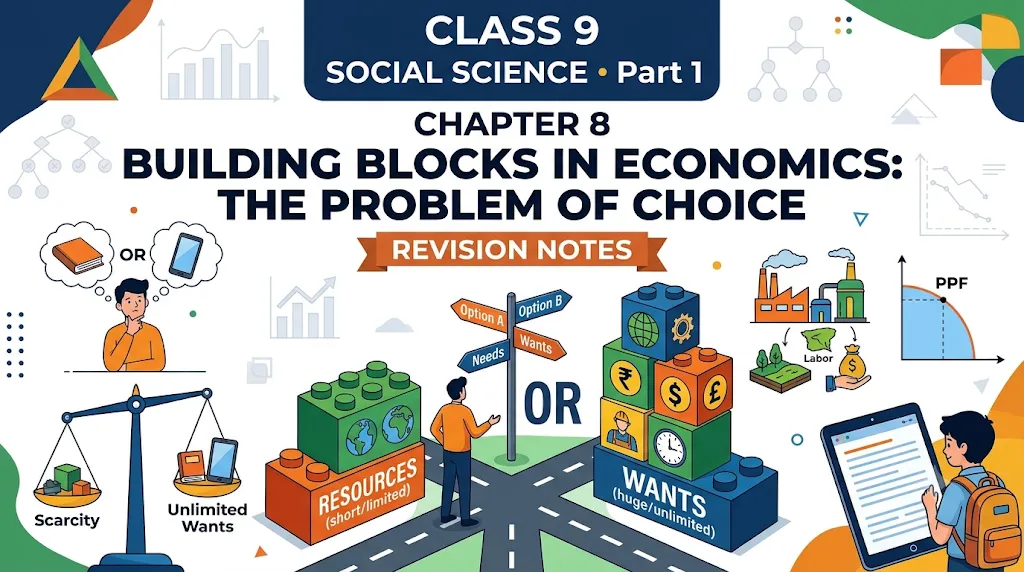
Class 9 Social Science Part 1 Chapter 8 Revision Notes: The Problem of Choice
If you had to choose (यदि आपको चुनना हो), would you spend your pocket money on snacks or save it for a new pair of shoes? If your school library had only 5 copies of a new book but 20 students wanted it, who should get it first? These are examples of economic choices (आर्थिक विकल्प) that individuals, enterprises, and governments have to make.
1. Needs, Wants and Limited Resources (आवश्यकताएं, इच्छाएं और सीमित संसाधन)
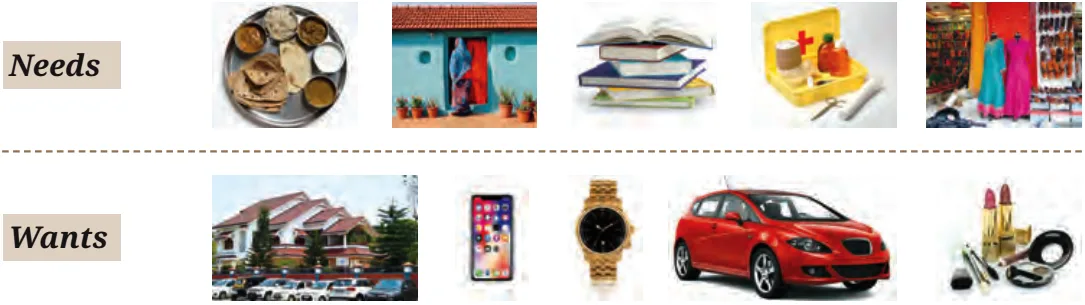
हमारी कुछ प्राथमिकताएं Needs (आवश्यकताएं) हैं, such as essentials like food, water, and shelter. While others are Wants (इच्छाएं), like gadgets, vacations, or luxury items. Human wants are unlimited and keep changing (मानवीय इच्छाएं असीमित हैं और बदलती रहती हैं). For example, people may want to upgrade from a bicycle to a motorbike and then to a car.
📚 Important Definitions
Market (बाजार): A place where buying and selling of products and services takes place. It could be a physical market or a virtual one on the internet (यह एक भौतिक बाजार हो सकता है या इंटरनेट पर एक आभासी बाजार).
Resources (संसाधन): Factors used for the production of goods and services. These can be natural (प्राकृतिक), like water and coal, or human-made (मानव निर्मित), like capital and technology.
Opportunity Cost (अवसर लागत): When one alternative is chosen, the other options are given up. The value of what is given up is known as the opportunity cost (छोड़े गए विकल्प का मूल्य अवसर लागत कहलाता है).
Choices and Resources (विकल्प और संसाधन)
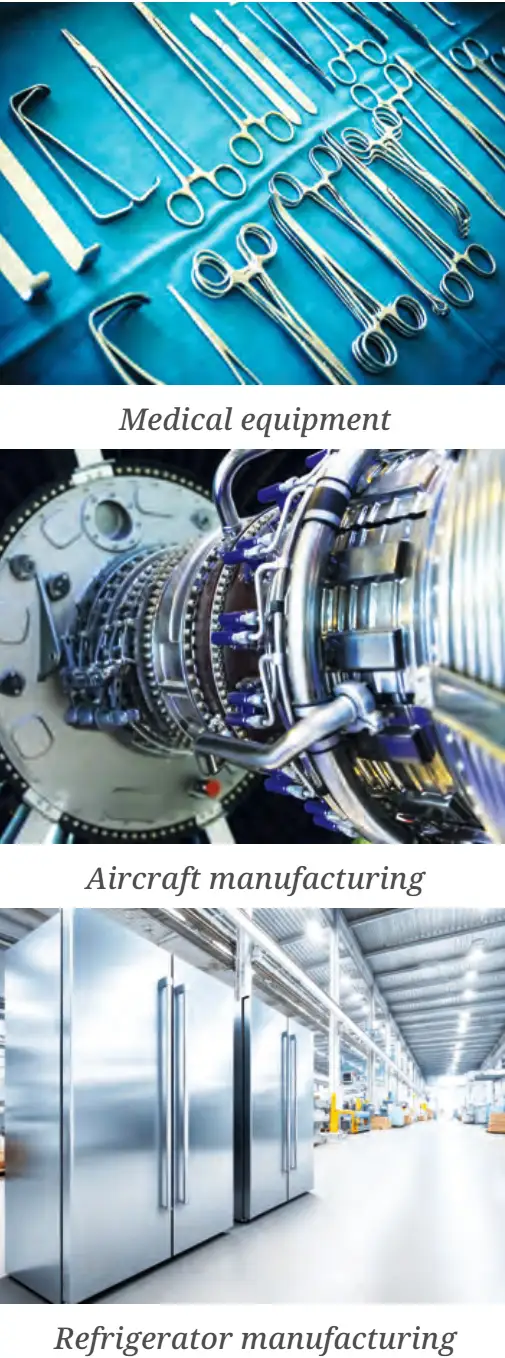
Resources are required to satisfy human needs and wants. However, both natural and human-made resources are limited in quantity (संसाधन सीमित मात्रा में उपलब्ध हैं). They can be put to many alternative uses. Economies have to decide how to use scarce resources in the best possible way to improve people’s quality of life.
Production Possibility Curve (PPC)
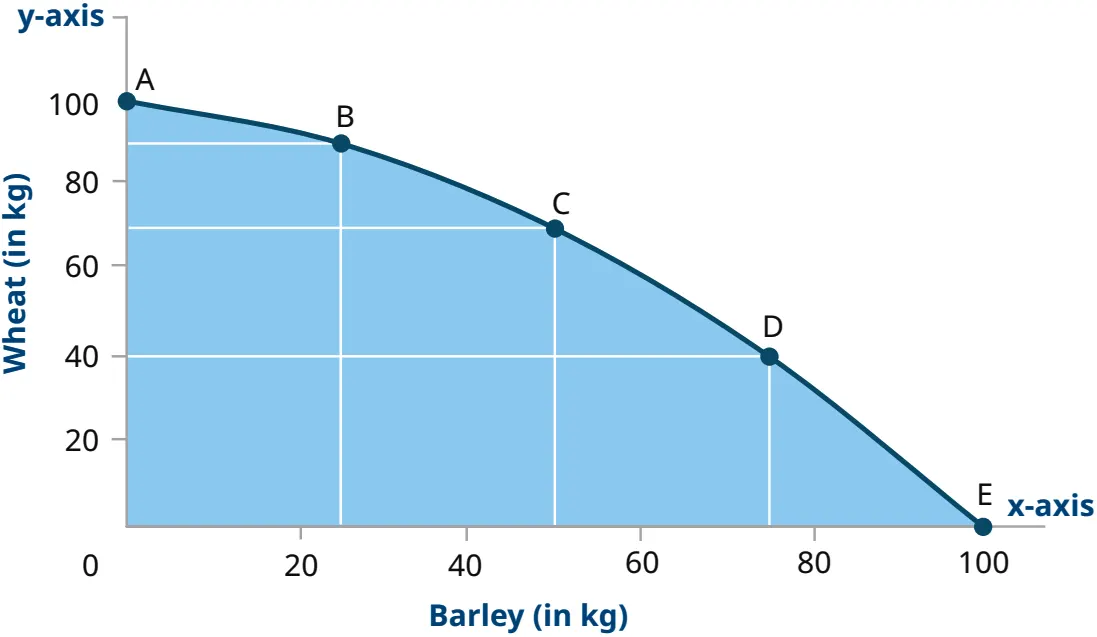
To understand the trade-offs in using limited resources, economists use the Production Possibility Curve (अर्थशास्त्री व्यापार-नापसंद को समझने के लिए PPC का उपयोग करते हैं).
- Definition of PPC (उत्पादन संभावना वक्र): The curve showing different combinations of goods that can be produced using all available resources.
- Example: A farmer has a piece of land and can choose to grow either barley or wheat on it. With limited land, water, and labour, the farmer must decide how much of each crop to produce.
- As the farmer produces more barley, some wheat must be sacrificed—this is the opportunity cost (अवसर लागत) of growing barley.
- All the points on the PPC show the maximum output that can be produced through the efficient use of resources by avoiding wastage.
| Combination (संयोजन) | Barley (in kg) | Wheat (in kg) |
|---|---|---|
| A | 0 | 100 |
| B | 25 | 90 |
| C | 50 | 70 |
| D | 75 | 40 |
| E | 100 | 0 |
🎯 Competency-Based Questions (Section 1)
Q1. [Scenario-Based] A student has ₹100 and must choose between buying a notebook for school or saving the money to buy a tennis racket later. If the student buys the notebook, what economic concept represents the sacrificed tennis racket?
Ans: Opportunity cost. The value of what is given up (the tennis racket) when an alternative is chosen is the opportunity cost.
Q2. [Assertion-Reason] Assertion (A): Human wants are unlimited and constantly changing.
Reason (R): Both natural and human-made resources are limited in quantity.
Ans: Both A and R are correct, but R is not the correct explanation of A. While both statements are true economic realities, human psychology drives changing wants, not just resource scarcity.
Q3. [Analytical] Based on the Production Possibility Curve for the farmer, if the farmer moves from combination C (50kg barley, 70kg wheat) to combination D (75kg barley, 40kg wheat), what is the opportunity cost of gaining those 25kg of barley?
Ans: The opportunity cost is 30kg of wheat (70kg – 40kg) that must be sacrificed to produce the extra barley.
Q4. [Conceptual] What do all the points plotted directly on the Production Possibility Curve (PPC) represent for an economy?
Ans: They represent the maximum output that can be produced through the efficient use of resources by avoiding wastage.
Q5. [Matching] Which of the following is considered a “Need” rather than a “Want” according to basic economics?
Ans: Essentials like food, water, and shelter are Needs. Gadgets, vacations, and luxury items are Wants.
2. What does Economics Deal with? (अर्थशास्त्र किससे संबंधित है?)
The word Economics comes from the Greek word ‘oikonomia’. This is composed of two words: ‘oikos’, which is usually translated as ‘household’; and ‘nemein’, which is best translated as ‘management’ (अर्थशास्त्र शब्द ग्रीक शब्द ‘ओकोनोमिया’ से आया है, जिसका अर्थ है घरेलू प्रबंधन).
- The discipline of Economics deals with how choices are made by optimising the use of limited resources to satisfy needs and wants.
- It explains how different economic entities (विभिन्न आर्थिक संस्थाएं) interact in an economy.
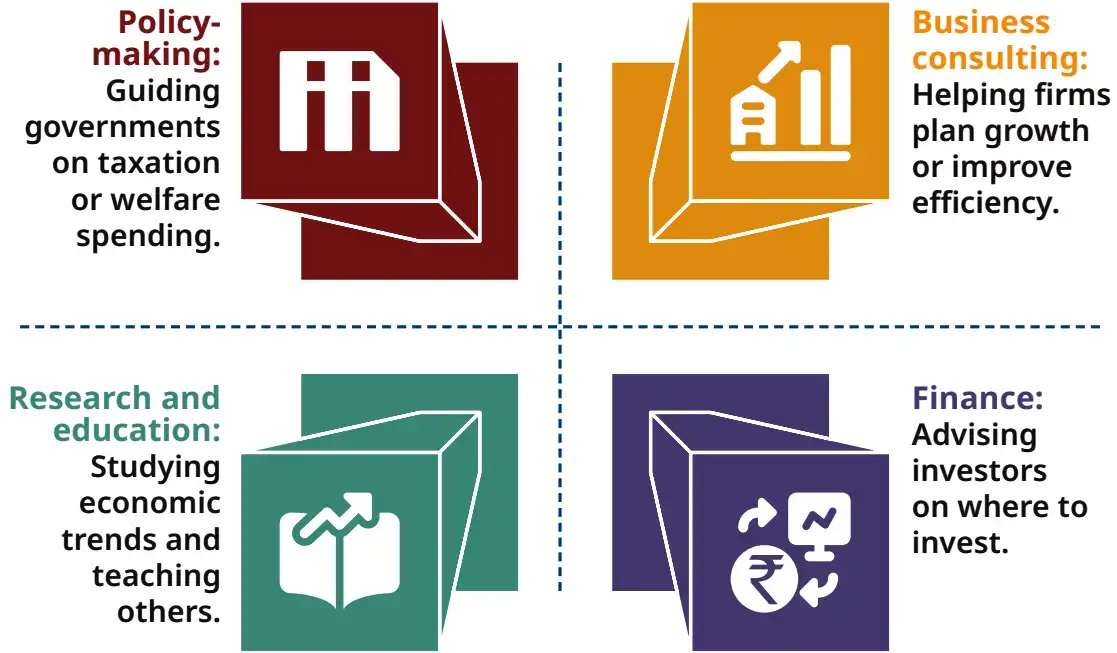
- Good decisions rely on data and analysis, not guesswork (निर्णय डेटा और विश्लेषण पर निर्भर करते हैं, अनुमान पर नहीं). Economists use data from government reports such as economic surveys and financial statements.
📚 Important Definitions
Economy (अर्थव्यवस्था): The state of a country or region in terms of the production and consumption of goods and services, and the flow of money.
Economic Entities (आर्थिक संस्थाएं): One who participates in an economic activity, for example, producers, consumers, government, and enterprises.
Data (डेटा): Facts and statistics collected together for reference or analysis.
Surveys (सर्वेक्षण): A systematic method for collecting and analysing data related to the economic conditions and behaviours of populations.
💡 Economic Survey: A Report on Indian Economy
The Economic Survey of India is an important annual document prepared by the Ministry of Finance and presented in Parliament before the Union Budget. It reviews the country’s economic performance during the past year and analyses various sectors like agriculture and industry (यह पिछले वर्ष के दौरान देश के आर्थिक प्रदर्शन की समीक्षा करता है). It acts as a blueprint for the upcoming Union Budget by providing crucial insights for policymakers.
🎯 Competency-Based Questions (Section 2)
Q1. [Scenario-Based] The government uses revenue from taxation to decide whether to spend more on building new highways or funding government hospitals. What must they rely on to make this good decision?
Ans: They must rely on data and analysis from reports and surveys, not guesswork.
Q2. [Assertion-Reason] Assertion (A): Economists strictly rely on guesswork to advise investors on where to invest.
Reason (R): The word Economics comes from Greek words meaning ‘household management’.
Ans: A is False, R is True. Economists rely on data and analysis (like financial statements), not guesswork, to help entities make decisions.
Q3. [Fact-Based] Which important annual document is prepared by the Ministry of Finance and presented in Parliament before the Union Budget?
Ans: The Economic Survey of India.
Q4. [Conceptual] What is meant by the term “Economic Entities” in the context of an economy?
Ans: Economic entities are those who participate in economic activities, such as consumers, producers, governments, and enterprises.
Q5. [Analytical] Why do enterprises study market trends and new innovations using collected data?
Ans: Enterprises study trends and innovations to better serve customers and maximise their profits by making informed, optimized choices.
3. Key Questions in Economics (अर्थशास्त्र के प्रमुख प्रश्न)
Any mismatch between unlimited wants and limited resources gives rise to three key questions that the discipline of economics seeks to address.
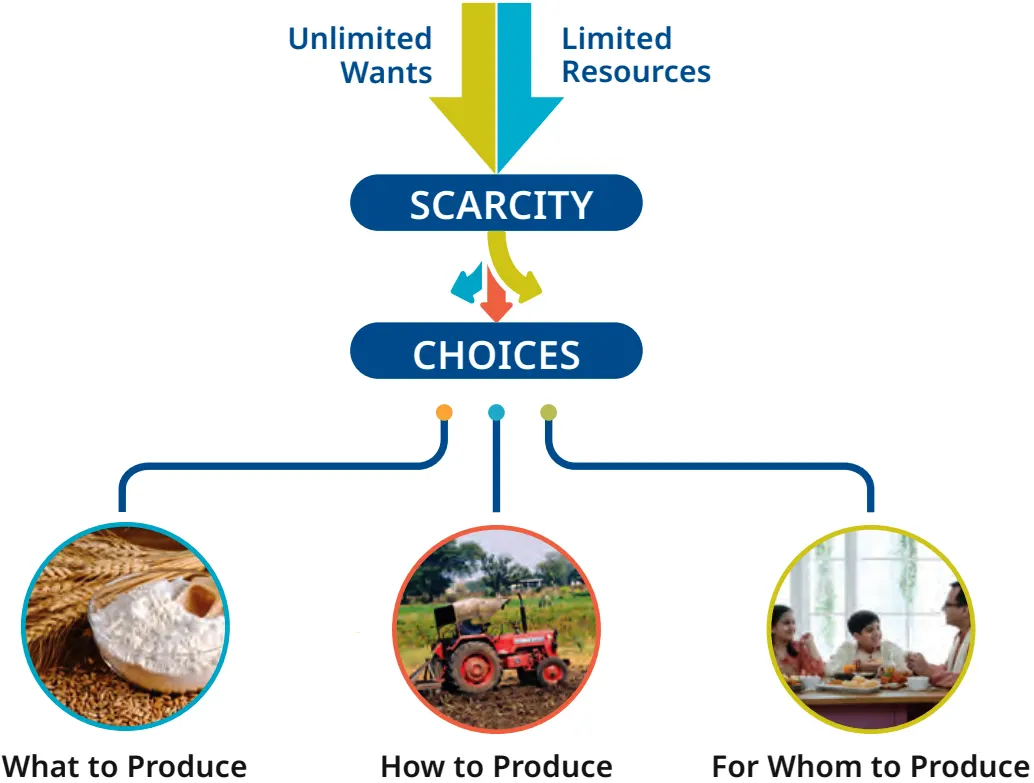
A. What to Produce and for Whom? (क्या उत्पादन करें और किसके लिए?)
This fundamental question concerns which goods and services, and in what quantities, should be produced to meet the needs of the economy over a given period (यह तय करता है कि अर्थव्यवस्था की जरूरतों को पूरा करने के लिए कौन सी वस्तुएं उत्पन्न की जानी चाहिए).
- Trade-offs (समझौता): Should farmers produce water-intensive crops such as sugarcane and paddy, or drought-resistant crops such as millets and pulses? Producing sugarcane yields high profits, but the opportunity cost is the forgone gains from saved water and improved soil health that millets would provide.
- For Whom (किसके लिए): Since resources are limited, producers decide which group of consumers they want to serve based on needs and purchasing power. For example, school shoes are for students (affordable and durable), office-wear shoes are for professionals, and sports shoes are for athletes.
B. How to Produce? (कैसे उत्पादन करें?)
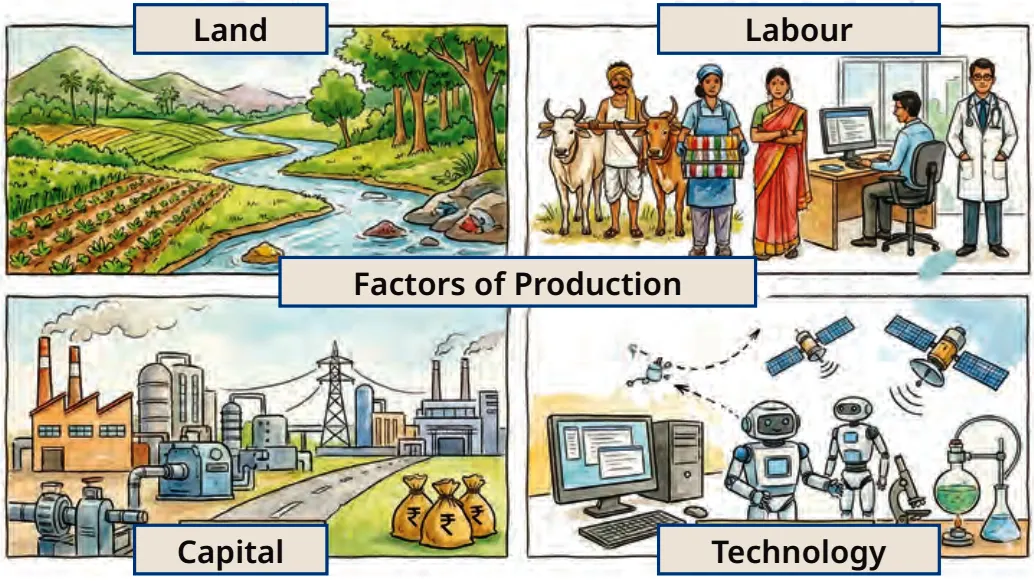
After deciding what to produce, the next question is how to produce it—which methods, resources, and technologies should be used. Producers must select the right mix of factors of production (उत्पादकों को उत्पादन के कारकों का सही मिश्रण चुनना होगा).
- Labour-intensive (श्रम-गहन): Using more workers and less machinery (श्रमिकों का अधिक उपयोग). Often used in agriculture and handicrafts. Customised or designer clothes also require skilled labour.
- Capital-intensive (पूंजी-गहन): Using more machines and technology and less workers (मशीनों का अधिक उपयोग). Often used in steel and automobile manufacturing, and for mass-produced garments.
🎯 Competency-Based Questions (Section 3)
Q1. [Scenario-Based] A farmer decides to plant sugarcane instead of millets because it yields higher immediate profits. What is the long-term opportunity cost of this decision?
Ans: The opportunity cost is the forgone gains from saved water, improved soil health, and sustainable agriculture that millets would have provided.
Q2. [Assertion-Reason] Assertion (A): Producing customized designer clothes usually requires capital-intensive manufacturing methods.
Reason (R): Customised clothes require skilled labour, whereas mass-produced garments are better suited for machines.
Ans: A is False, R is True. Designer clothes require skilled labour (labour-intensive), not capital-intensive machine methods.
Q3. [Analytical] A garment manufacturer completely switches from manual sewing workers to automated robotic machines because human labor became too expensive. Which key economic question is the manufacturer directly addressing here?
Ans: “How to Produce?” By shifting the mix of factors of production from labour-intensive to capital-intensive, they are answering how the goods will be made.
Q4. [Conceptual] A company decides to make sports shoes utilizing special rubber soles specifically targeted for athletes. Which key economic question does this decision reflect?
Ans: “For Whom to Produce”.
Q5. [Matching] Which factors of production are most heavily utilized in a “Capital-Intensive” industry like automobile manufacturing?
Ans: Machines and technology (Capital and Technology), rather than large numbers of manual workers (Labour).
4. Economic Systems and How Choices are Made
The system that defines the mechanisms for the production, consumption, and distribution of goods, services, and resources is known as the economic system of a country (वह प्रणाली जो संसाधनों के उत्पादन और वितरण को परिभाषित करती है).
1. Planned Economy (नियोजित अर्थव्यवस्था)
- In a planned economy, a central planning authority of the government makes all major economic decisions in the market.
- The government has ownership in most resources and sectors like land, factories, banks, and transport (सरकार का भूमि, कारखानों और बैंकों पर स्वामित्व होता है).
- With limited private ownership, it restricts competition among private enterprises, leading to little motivation to improve quality or innovate.
- Examples: The former Soviet Union, North Korea, and Cuba.
2. Market Economy (बाजार अर्थव्यवस्था)
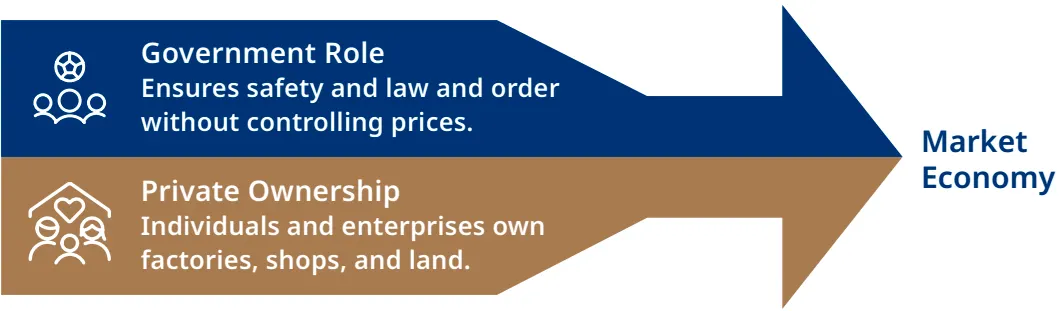
- The questions of what, how, and how much to produce are addressed mainly by the forces of demand and supply with little government intervention (निर्णय माँग और आपूर्ति की शक्तियों द्वारा तय होते हैं).
- The government acts like a referee; it ensures safety and law and order, and it does not control prices or production.
- The ownership of factories, shops, and land largely rests with individuals and private companies.
- Examples: The United States of America, Japan, and Hong Kong.
3. Mixed Economy (मिश्रित अर्थव्यवस्था)
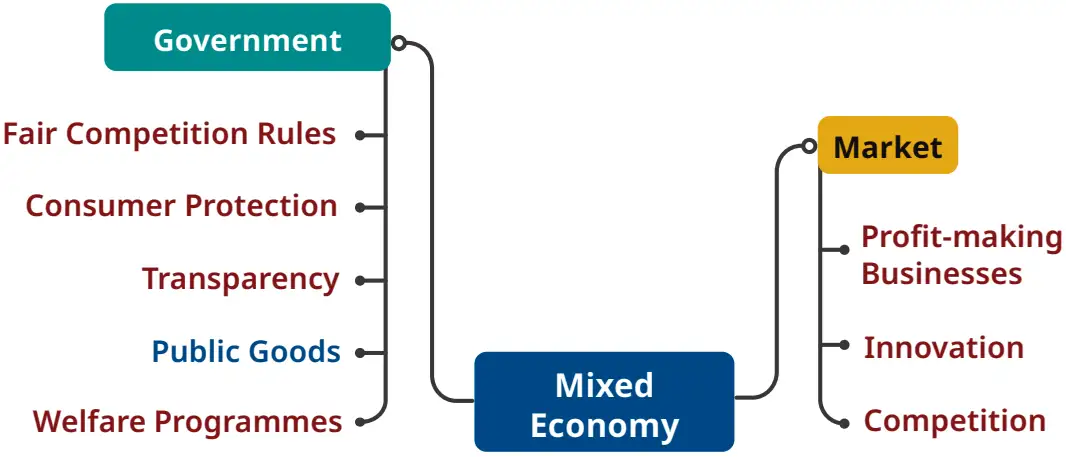
- A mixed economy combines features of both market and planned economies.
- Private individuals, enterprises, and the government play important roles in making economic choices (निजी व्यक्ति और सरकार दोनों महत्वपूर्ण भूमिका निभाते हैं).
- Public Goods (सार्वजनिक वस्तुएं): Goods and services that are available to all individuals without anyone being excluded, such as parks, roads, and police services.
- Examples: India (post-1991), China (post-1978), Germany, and Sweden.
💡 India’s Economic Evolution
In the decades after Independence, India followed a more state-led approach similar to a planned economy. The government regulated production through licenses and permits, controlling heavy industries. However, by 1991 the country faced serious economic difficulties. The government introduced major economic reforms that reduced regulations, encouraged private enterprise, and opened the economy to global trade (सरकार ने नियमों को कम किया और निजी उद्यमों को प्रोत्साहित किया). These reforms shifted India towards a more market-oriented mixed system.
🎯 Competency-Based Questions (Section 4)
Q1. [Scenario-Based] A country’s central planning commission strictly owns all farmlands and factories, deciding exactly how much bread and steel will be produced this year and at what price it will be sold. What type of economic system is this?
Ans: A Planned Economy.
Q2. [Assertion-Reason] Assertion (A): In a pure market economy, the government strictly controls the prices of daily goods to help the poor.
Reason (R): Market economies address economic choices mainly through the forces of demand and supply.
Ans: A is False, R is True. In a market economy, the government acts like a referee and does not control prices; prices are determined by demand and supply.
Q3. [Analytical] Why do planned economies often suffer from a lack of innovation and poor product quality compared to market economies?
Ans: Because the government owns most resources and heavily regulates enterprises through permits, which prevents new businesses from entering the market. This restricts competition, giving existing enterprises little motivation to innovate or improve quality.
Q4. [Conceptual] Public goods like street lights and public parks are typically provided by the government in a Mixed Economy. What is the defining characteristic of a “Public Good”?
Ans: Public goods are services available to all individuals without anyone being excluded, and their use by some people does not prevent others from using them.
Q5. [Fact-Based] Following the serious economic difficulties of 1991, India introduced major economic reforms. What was the primary effect of these reforms on India’s economic system?
Ans: It shifted India from a heavily state-led (planned) approach towards a more market-oriented mixed economic system by reducing regulations and encouraging private enterprise.
The Big Questions (Chapter Objectives Solved)
1. What does economics deal with?
2. What are the key questions in economics?
3. How do different economic systems address these questions?
List
Class 9 Social Science Part 1 Chapter 8 Building Blocks in Economics – The Problem of Choice Revision Notes
Class 9 Social Science Part 1 Chapter 9 The Price Puzzle: What Drives the Market Revision Notes
Class 9 Social Science Part 2 Chapter 6 From Ideas to Startups Revision Notes
Class 9 Social Science Part 2 Chapter 5 Managing Your Personal Finances Revision Notes

Class 9 Social Science Part 2 Chapter 4 Governance and Public Policy Revision Notes