Class 9 Social Science Part 1 Chapter 6 Revision Notes: Democracy (लोकतंत्र)
Democracy (लोकतंत्र) is a form of government जहाँ power और authority का ultimate source देश के citizens के पास होता है। Citizens अपने representatives को free and fair elections के माध्यम से चुनते हैं। यह system freedom, equality, justice, rights, and duties के सिद्धांतों पर आधारित है। 140 crore से अधिक population और 96.8 crore से अधिक voters (2024) के साथ, India (Bharat) दुनिया का सबसे बड़ा participatory democracy है।
एक democracy में लोगों के rights को सुरक्षित रखने के लिए Constitution (संविधान) की भूमिका सबसे महत्वपूर्ण होती है। Constitution of India को 26 November 1949 को adopt किया गया था और यह 26 January 1950 को लागू (came into force) हुआ। यह Fundamental Rights की guarantee देता है और सुनिश्चित करता है कि religion, race, caste, sex, या place of birth के आधार पर किसी के साथ discrimination न हो।
1. Tracing Democratic Traditions from Early Times (प्राचीन लोकतांत्रिक परंपराएँ)
India में democratic ethos अचानक पैदा नहीं हुआ, बल्कि यह एक long historical process के माध्यम से विकसित हुआ है:
- Vedic Period Assemblies: Vedic period में Sabha, Samiti, और Vidhata जैसी assemblies होती थीं, जहाँ collective decision-making किया जाता था। Early republican states (gaṇas या samghas) में king कोई independent या absolute ruler नहीं होता था, बल्कि वह assemblies, ministers, और officers के परामर्श (consultation) से शासन करता था।
- Rigveda (Aikyamatya Sūktam): Rigveda का verse 10.191.3 हमें collective thinking, shared discussion, consultation, consensus, और unity of purpose का महत्व समझाता है।
- Bauddha Samghas: Gautama Buddha द्वारा स्थापित monastic communities में open debate और discussion को बढ़ावा दिया जाता था। Members अपने leader को voting के माध्यम से चुनते थे, जो collective decision-making का बेहतरीन उदाहरण है।
- Colonial Rule & Independence Struggle: Foreign invasions और 19th century में British colonisation ने political structures को बदल दिया और लोगों की governance में participation को सीमित कर दिया। हालांकि, ब्रिटिश शासन के खिलाफ लंबे freedom struggle ने लोगों में democratic ideas को फिर से मजबूत किया।
- The Constituent Assembly (संविधान सभा): 1946 में गठित Constituent Assembly ने 2 years, 11 months, और 18 days में दुनिया का सबसे लंबा written Constitution तैयार किया। Constituent Assembly Debates (CAD) में हमारी indigenous traditions के साथ-साथ global democratic values को भी शामिल किया गया।
- Article 368 (Constitutional Amendments): हमारा संविधान कोई rigid legal code नहीं है। Article 368 के तहत Parliament समय की बदलती socio-political जरूरतों के अनुसार इसमें lawful amendments कर सकती है, बिना liberty, equality, justice, और fraternity के मूल मूल्यों से समझौता किए। Practical Example: Parliament ने Article 368 का उपयोग करके Right to Education (Article 21A) और local bodies में Women’s Reservation को जोड़ा।
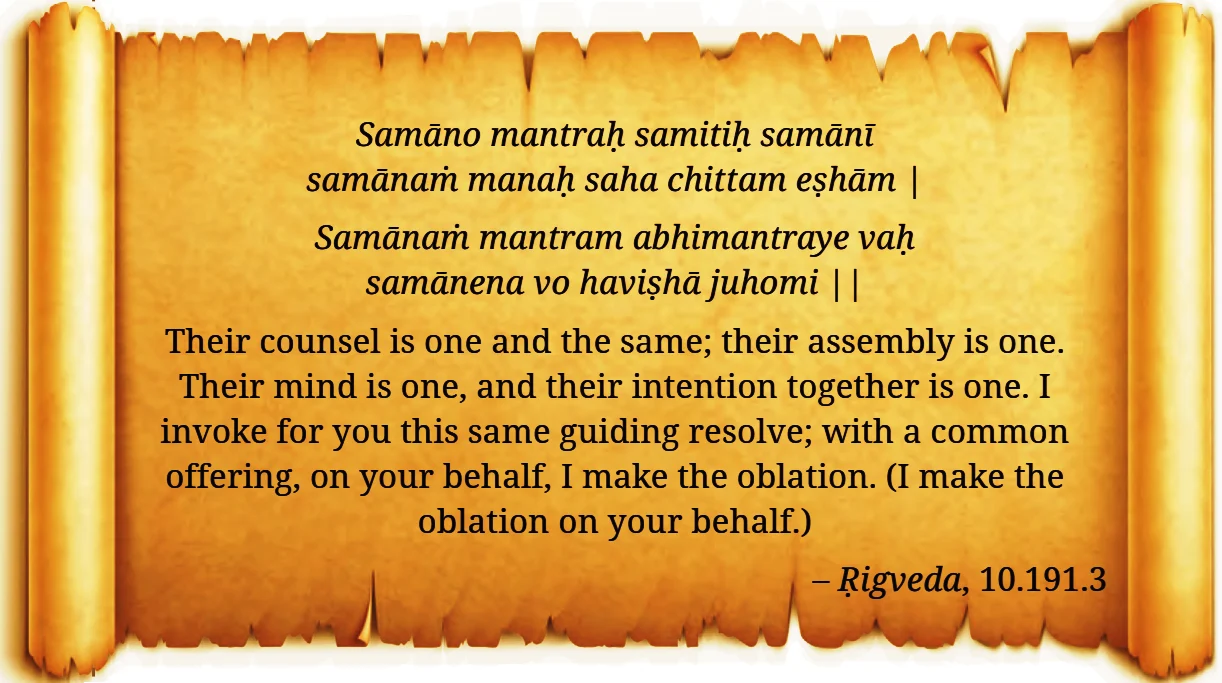
“Samāno mantraḥ samitiḥ samānī, samānam manaḥ saha chittam eṣhām…” — यह verse counsel, assembly, mind, और resolve की unity पर जोर देता है, जो साबित करता है कि consultation और shared responsibility भारत की प्राचीन सांस्कृतिक परंपरा में गहराई से जुड़े हैं।
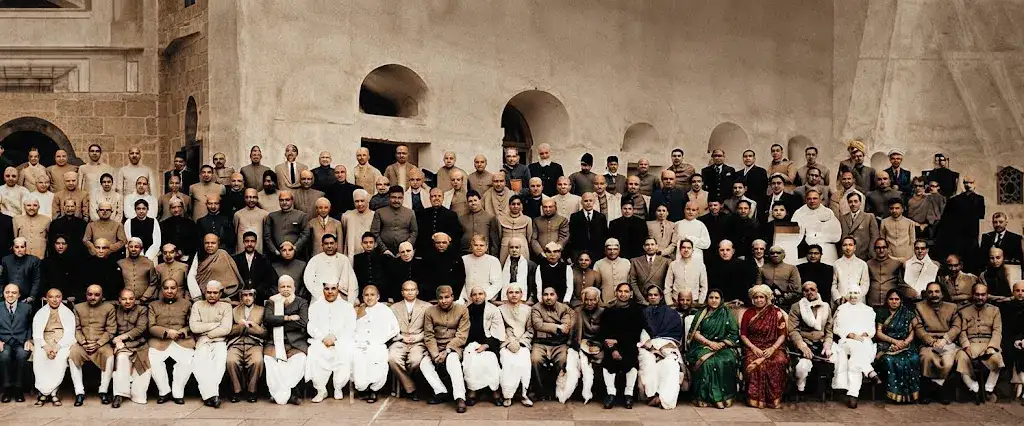
1946 में गठित Constituent Assembly में देश भर के leaders शामिल थे, जिन्होंने हर constitutional provision पर विस्तार से debate करके भारत को एक robust और inclusive democracy दिया।
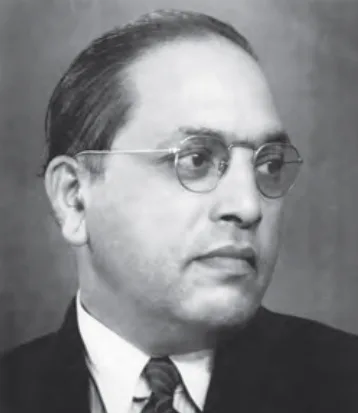
Drafting Committee के Chairman के रूप में Dr. B.R. Ambedkar ने भारत के Constitution को आकार दिया और social justice, equality, व Fundamental Rights की मजबूत सुरक्षा सुनिश्चित की।
🎯 Competency-Based Questions (Section 1)
Q1. [Scenario-Based] A historian discovers an ancient record describing a monastic community where members regularly debated policies and voted to select their leader. Which ancient Indian institution does this describe?
Ans: The Bauddha Samghas (monastic communities established by Gautama Buddha), which practised debate, discussion, and collective decision-making through voting.
Q2. [Assertion-Reason] Assertion (A): The Constitution of India is a rigid legal code that can never be changed.
Reason (R): Article 368 provides for lawful amendments so that the Constitution remains flexible and responsive to changing socio-political needs.
Ans: A is False, R is True. The Constituent Assembly designed the Constitution as a dynamic, flexible document capable of evolving through Article 368 without compromising its fundamental values.
Q3. [Analytical] How does the Aikyamatya Sūktam of the Rigveda prove that democratic values are not entirely foreign to India?
Ans: The verse emphasizes collective thinking, shared discussion, and unity of purpose in an assembly, proving that democratic principles like consultation and consensus have deep indigenous roots in India’s ancient traditions.
Q4. [Conceptual] What were the Sabha, Samiti, and Vidhata in the Vedic period?
Ans: They were ancient assemblies in the Vedic period that involved collective decision-making and advised the king.
Q5. [Fact-Based] State the exact dates when the Constitution of India was adopted and when it came into force, along with the time taken to draft it.
Ans: Adopted on 26 November 1949; came into force on 26 January 1950. It took 2 years, 11 months, and 18 days to draft.
2. Principles of Democracy & Key Constitutional Articles (लोकतंत्र के सिद्धांत)
एक thriving democracy कुछ non-negotiable principles पर टिका होता है, जिन्हें Indian Constitution के विभिन्न Articles और Acts के माध्यम से सुरक्षित किया गया है:
- Popular Sovereignty (लोकप्रिय संप्रभुता): इसमें State अपनी ultimate authority जनता से प्राप्त करता है। 18 years और उससे अधिक आयु के हर citizen को secret ballot द्वारा vote देने का अधिकार है, जिसे Universal Adult Franchise कहते हैं। Example: General Elections में वोट देकर नई सरकार चुनना या बदलना।
- Rule of Law (कानून का शासन): कोई भी व्यक्ति law से ऊपर नहीं है। सभी disputes का निपटारा court में Procedure Established by Law (Article 21) के तहत होता है, न कि किसी के personal influence से। Example: कानून तोड़ने पर एक बड़े मंत्री या अमीर व्यक्ति पर भी वही कानूनी कार्रवाई होती है जो एक आम नागरिक पर होती है।
- Fundamental Rights (मौलिक अधिकार): ये 6 rights अदालत में enforceable हैं और नागरिकों की dignity व freedom की रक्षा करते हैं:
- Right to Equality (Articles 14–18): कानून के सामने समानता (equality before law) देता है और untouchability व discrimination को रोकता है। Example: किसी भी जाति या धर्म का योग्य नागरिक सरकारी नौकरी के लिए आवेदन कर सकता है।
- Right to Freedom (Articles 19–22): इसमें freedom of speech, assembly, movement, और personal liberty (Article 21) शामिल हैं। 2009 में जोड़ा गया Article 21A (Right to Education) 6 से 14 वर्ष के बच्चों को free and compulsory education देता है। Example: एक गरीब परिवार का 10 साल का बच्चा सरकारी स्कूल में मुफ्त शिक्षा पाने का कानूनी हकदार है।
- Right Against Exploitation (Articles 23–24): यह human trafficking, forced labour, और खतरनाक कामों में child labour पर रोक लगाता है। Example: किसी 12 साल के बच्चे से फैक्ट्री में काम कराना दंडनीय अपराध है।
- Right to Freedom of Religion (Articles 25–28): नागरिकों को किसी भी धर्म को शांतिपूर्ण ढंग से मानने और प्रचार करने की आजादी देता है।
- Cultural and Educational Rights (Articles 29–30): Minorities को अपनी language, script, और culture बचाने तथा अपने educational institutions चलाने का अधिकार देता है।
- Right to Constitutional Remedies (Article 32 & Article 226): यदि किसी के Fundamental Rights का उल्लंघन होता है, तो वह सीधे Supreme Court (Article 32) या High Court (Article 226) जा सकता है।
- Separation of Powers (शक्तियों का पृथक्करण): सरकार के तीन अंगों—Legislature (laws बनाना), Executive (laws लागू करना), और Judiciary (laws की व्याख्या करना)—के बीच power बाँटी गई है ताकि checks and balances बना रहे। Independent Judiciary किसी भी unconstitutional law को रद्द कर सकती है और Public Interest Litigation (PIL) के जरिए जनहित में न्याय दिलाती है। Example: किसी नदी को प्रदूषित करने वाली फैक्ट्री के खिलाफ कोर्ट में PIL दायर करना।
- Accountability & Transparency: Periodic elections, संसद में Question Hour, और Right to Information (RTI) Act, 2005 के माध्यम से सरकार को जनता के प्रति जवाबदेह बनाया जाता है।
- Multi-Party System: कई political parties जो विभिन्न socio-cultural और regional interests का प्रतिनिधित्व करती हैं, Representation of the People Act, 1951 के नियमों के तहत चुनाव लड़ती हैं। 50% से अधिक seats जीतने वाली party या coalition सरकार बनाती है, और सबसे बड़ा विपक्षी समूह Opposition बनता है।
- Safeguarding Vulnerable Groups (Article 46): यह State को निर्देश देता है कि वह weaker sections, विशेष रूप से Scheduled Castes (SCs) और Scheduled Tribes (STs) के educational और economic interests को बढ़ावा दे और उन्हें social injustice व exploitation से बचाए। Example: SC/ST छात्रों के लिए सरकारी scholarships और hostels की सुविधा।
- Role of Media: Newspapers, news channels, और social media जनता की आवाज उठाते हैं और लोगों को जागरूक रखते हैं, इसलिए Media को ‘Fourth Pillar of Democracy’ कहा जाता है।
📚 Important Legal Definitions
Equality before law: Every individual irrespective of status, identity, or rank is treated equally by the law.
Equal protection of law: All persons in similar circumstances shall be treated equally by law without arbitrary discrimination.
Procedure established by law (Article 21): Strict adherence to duly enacted and valid laws. “No person shall be deprived of life or personal liberty except according to procedure established by law.”
Public Interest Litigation (PIL): A legal action initiated in a court of law for the enforcement of public interest.
Civil Society: Voluntary groups, NGOs, and community associations that function interdependently within society.
Question Hour: The first hour of a parliamentary session when members ask questions to the government to hold it accountable.
Quick Reference: Important Constitutional Articles & Acts with Practical Examples
| Article / Act | Core Provision | Practical Real-Life Example |
|---|---|---|
| Article 21 & 21A | Protection of life & personal liberty; Free & compulsory education (6–14 yrs) | Police cannot detain a citizen without legal procedure; a 9-year-old receives free schooling in a govt school. |
| Articles 32 & 226 | Right to Constitutional Remedies (Supreme Court & High Courts) | A journalist approaches the High Court (Art. 226) if their peaceful newspaper is unlawfully shut down. |
| Article 46 | Educational & economic protection of SCs, STs, and weaker sections | Post-matric scholarships and reservation in educational institutions for SC/ST students. |
| Article 243(d) & 243(t) | At least 1/3rd (33%) seats reserved for women in Panchayats & Municipalities | A woman Sarpanch leading village water conservation and sanitation drives in her Panchayat. |
| Articles 352, 356, 360 | National Emergency, President’s Rule, and Financial Emergency | Imposition of the 1975–77 National Emergency under Article 352. |
| Article 368 | Power of Parliament to amend the Constitution | Amending the Constitution to add the Right to Education (86th Amendment) or Anti-Defection Law. |
| RPA, 1951 | Regulates political parties, election conduct, and bans corrupt practices | Disqualifying a candidate caught bribing voters or appealing for votes on religious grounds. |
| PESA Act, 1996 | Extends Panchayati Raj to tribal areas, empowering the Gram Sabha | A tribal village Gram Sabha deciding how to manage and sell minor forest produce locally. |
| RTI Act, 2005 | Empowers citizens to seek official information from public authorities | A resident filing an RTI to check the exact budget and contractor details for a broken local road. |
🤔 Think About It: Popular Sovereignty & Separation of Powers
1. Why is it important that the ultimate source of power rests with the people?
2. What would happen if the same organ of government made laws, implemented them, and enforced them?
1. When ultimate power rests with the people, the government must work for public welfare rather than selfish interests. Voting allows citizens to grant or withdraw legitimacy, keeping leaders accountable.
2. If one organ held all three powers, it would lead to a dangerous concentration of power and dictatorship. Without checks and balances, citizens would have no independent judiciary to protect their Fundamental Rights against arbitrary actions.
🔍 Let’s Explore: Fundamental Rights, Duties & DPSP
Identify the differences among Fundamental Rights, Fundamental Duties, and Directive Principles of State Policy (DPSP).
Democratic Processes, Institutions, and Values
| Process | Institutions | Democratic Values |
|---|---|---|
| Legislative Process | Legislature (Parliament, State Legislature, Local bodies) | Representation, Deliberation, Dissent |
| Electoral Process | Election Commission of India (ECI) | Participation, Equality |
| Judicial Process | Courts (Supreme Court, High Courts, District Courts) | Rule of law, Equality, Justice |
| Participatory Processes | Media, Civil Society | Debate and discussion, Freedom of expression |
| Accountability Mechanisms | CAG, CIC, Lokpal, CVC | Transparency |
| Decentralisation | Rural and Urban local bodies | People’s participation at grassroots level |
| Federalism | Division of powers between Centre and States via written Constitution | Devolution of power |
🎯 Competency-Based Questions (Section 2)
Q1. [Scenario-Based] A citizen believes that a newly passed parliamentary law violates their Right to Freedom. Under which constitutional articles can they approach the Supreme Court or High Court for remedies?
Ans: Article 32 (for approaching the Supreme Court) and Article 226 (for approaching a High Court).
Q2. [Assertion-Reason] Assertion (A): Media is often referred to as the ‘fourth pillar of democracy’.
Reason (R): It keeps citizens informed, acts as the voice of the masses, and raises public issues to hold the government accountable.
Ans: Both A and R are true, and R is the correct explanation of A.
Q3. [Analytical] How does the ‘Question Hour’ in Parliament strengthen the democratic principle of accountability?
Ans: During the first hour of a parliamentary session, elected members ask direct questions to ministers regarding government policies and actions, forcing the executive to explain and justify its work publicly.
Q4. [Conceptual] What is the difference between ‘Equality before law’ and ‘Equal protection of law’?
Ans: ‘Equality before law’ means every individual is treated equally regardless of status or rank, whereas ‘Equal protection of law’ means all persons in similar circumstances must be treated equally without arbitrary discrimination.
Q5. [Fact-Based] Name four accountability institutions in India that promote transparency.
Ans: Comptroller and Auditor General (CAG), Central Information Commission (CIC), Lokpal, and Central Vigilance Commission (CVC).
3. Types of Democracy (लोकतंत्र के प्रकार)
हालांकि सभी democracies के fundamental principles समान होते हैं, लेकिन अलग-अलग देश इसे अपने political structure और citizen participation के अनुसार अलग-अलग तरीकों से लागू करते हैं:
- Direct Democracy (प्रत्यक्ष लोकतंत्र): इसमें citizens अधिकतर decision-making processes में सीधे भाग लेते हैं। बड़े देशों में इसे लागू करना कठिन होता है। Example: Switzerland.
- Representative / Indirect Democracy (प्रतिनिधि लोकतंत्र): इसमें लोग periodic elections के जरिए अपने representatives चुनते हैं, जो उनकी ओर से शासन करते हैं। Example: India. इसके दो प्रमुख रूप हैं:
- Parliamentary Democracy: इसमें Executive के members Legislature का ही हिस्सा होते हैं और उसके प्रति accountable होते हैं। लोग सीधे Legislature को चुनते हैं, Executive को नहीं। Examples: India, Canada, United Kingdom.
- Presidential Democracy: इसमें Executive (President) Legislature से independent होता है और President को सीधे जनता द्वारा चुना जाता है। Example: United States of America (USA).
📚 Important Definitions
Federalism (संघवाद): A system of government in which power and responsibilities are shared between the union and the state governments (via Union, State, and Concurrent lists), while residual powers remain with the union government.
Sovereignty (संप्रभुता): Derived from the Latin word superanus (‘supreme’). It refers to the supreme, final, and independent legal authority of a State over its territory and citizens.
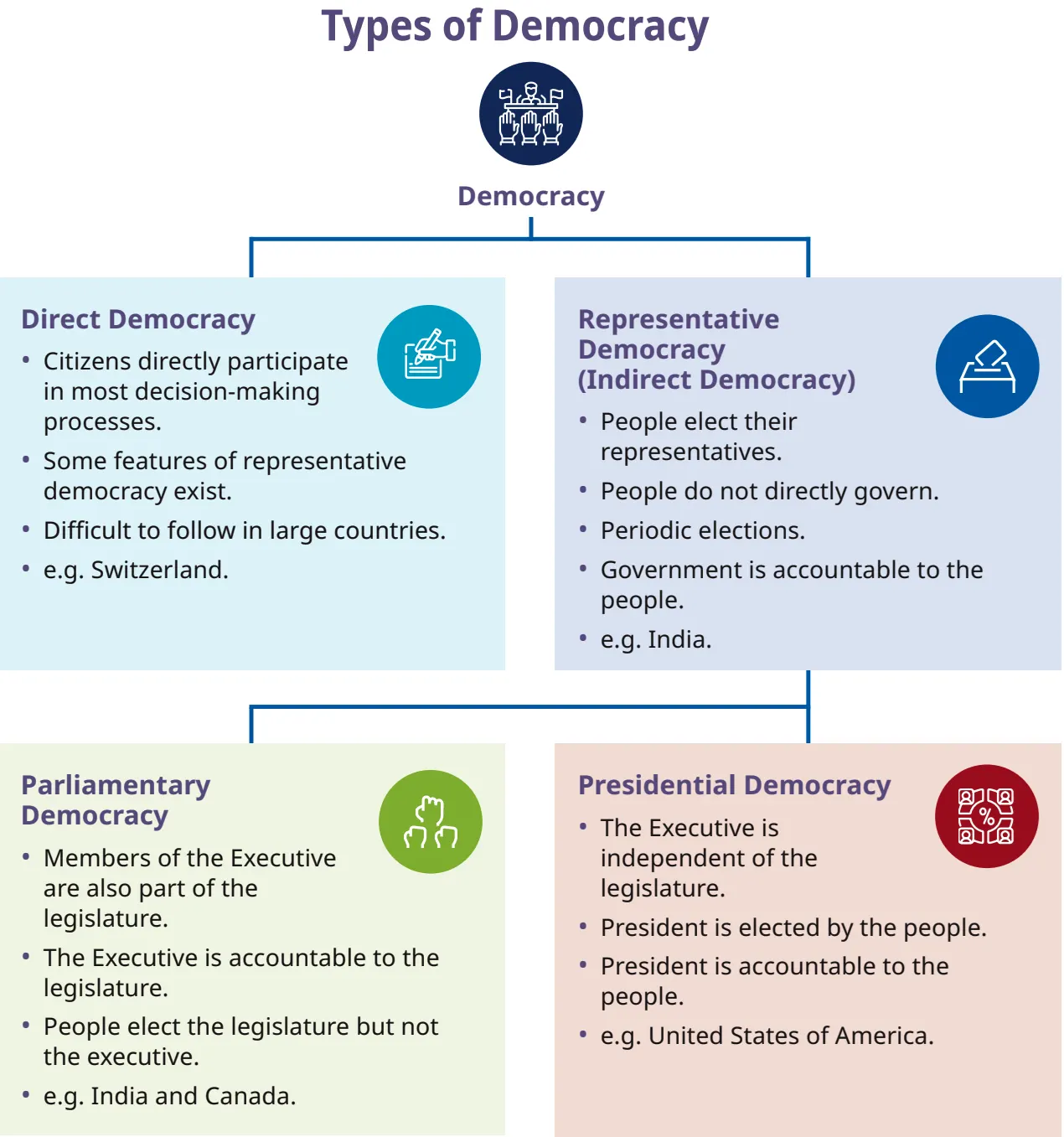
यह flowchart दिखाता है कि democracies में power कैसे structure होती है: Direct Democracy में जनता सीधे नीतियों पर vote करती है (Switzerland), जबकि Representative Democracy में चुने हुए leaders शासन करते हैं—चाहे Parliamentary model (India, Canada) से या Presidential model (USA) से।
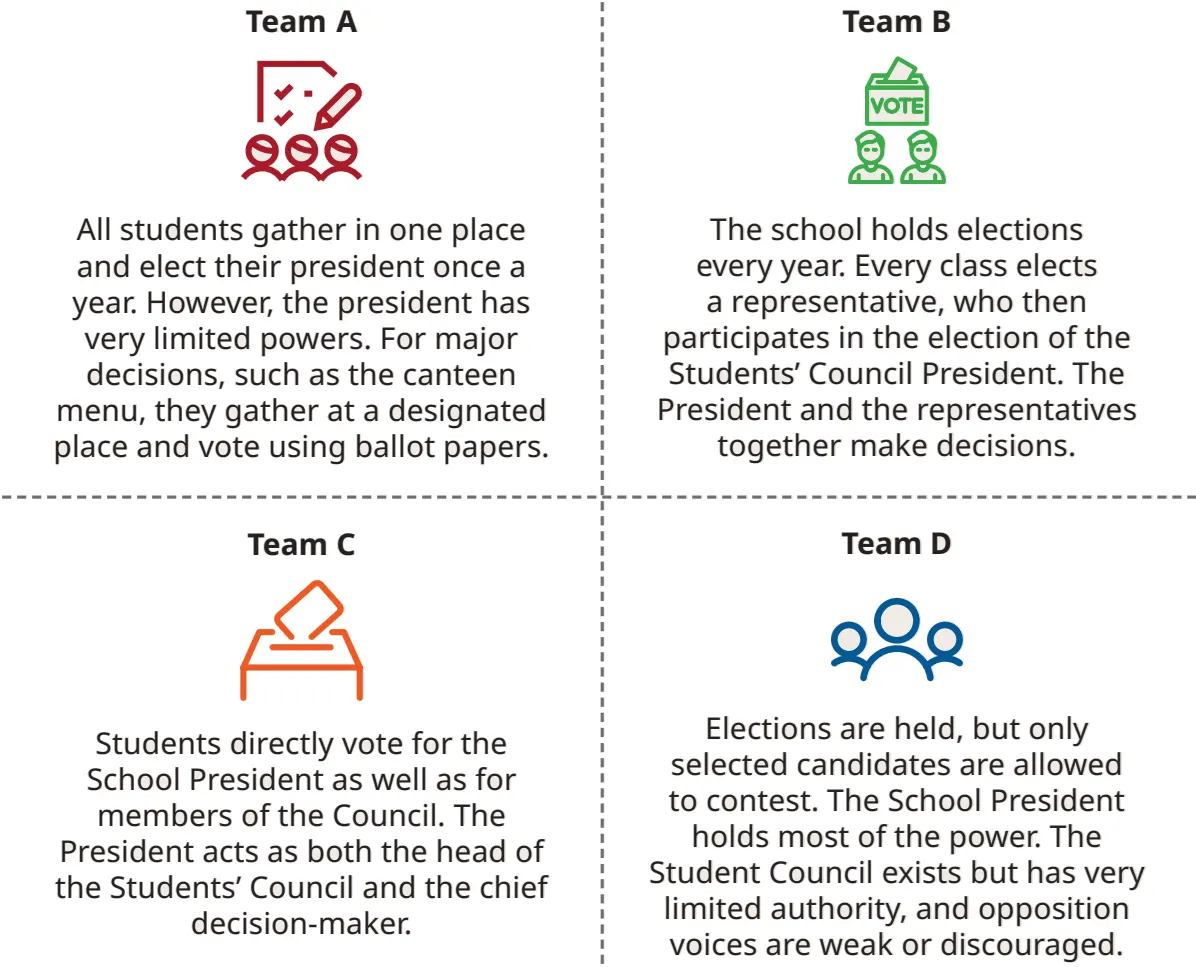
ये चारों school council models असली दुनिया के systems को दर्शाते हैं: Team A Direct Democracy है (जहाँ सभी छात्र canteen menu पर सीधे vote करते हैं), Team B Parliamentary Democracy है (जहाँ class reps मिलकर President चुनते हैं), Team C Presidential Democracy है (President और Council दोनों के लिए सीधा vote), और Team D एक undemocratic model है जहाँ opposition को दबाया जाता है।
🔍 Let’s Explore: Selecting the Ideal Team (Fig. 6.5)
Select your ideal team from Fig. 6.5 and give reasons for your selection.
Global Comparison of Democracies
| Country | Type of Democracy | Head of State / Government | Key Features |
|---|---|---|---|
| India | Representative (Parliamentary) | President (Head of State), Prime Minister (Head of Govt) | Multi-party, Written Constitution, Fundamental Rights & Duties, Federalism |
| Canada | Representative (Parliamentary) | Governor-General (for Monarch), Prime Minister (Head of Govt) | Federalism, Multi-party system |
| United Kingdom | Representative (Parliamentary with Constitutional Monarchy) | Monarch (Head of State), Prime Minister (Head of Govt) | Unwritten constitution, Parliamentary Sovereignty, Multi-party system |
| Switzerland | Direct Democracy | Federal Council (Executive), President (Head of Govt) | Written constitution with multiple parties |
| USA | Representative (Presidential) | President (Head of State & Government) | Written constitution, Two major parties |
🎯 Competency-Based Questions (Section 3)
Q1. [Scenario-Based] In a school council (Team D), elections are held, but only a few selected candidates are allowed to contest, the President holds almost all power, and opposition voices are discouraged. Can this be called a true democracy?
Ans: No. Even though elections are held, restricting candidates, concentrating power in one person, and suppressing opposition violate the core principles of free, fair, and accountable democracy.
Q2. [Assertion-Reason] Assertion (A): Direct democracy is difficult to practise in very large countries like India.
Reason (R): It is logistically impossible for over 140 crore citizens to gather and vote directly on every single policy decision.
Ans: Both A and R are true, and R is the correct explanation of A.
Q3. [Analytical] State one major structural difference between the Parliamentary Democracy of India and the Presidential Democracy of the USA.
Ans: In India’s Parliamentary system, the Executive (Prime Minister and Council of Ministers) is part of the Legislature and accountable to it, whereas in the USA’s Presidential system, the Executive (President) is independent of the Legislature and directly elected by the people.
Q4. [Conceptual] What does the term “Sovereignty” mean in political science?
Ans: Derived from the Latin word ‘superanus’ (supreme), sovereignty refers to the supreme, final, and independent legal authority of a State over its territory and citizens.
Q5. [Fact-Based] Which country listed in the chapter operates a Parliamentary Democracy with a Constitutional Monarchy and an unwritten constitution?
Ans: The United Kingdom (UK).
4. Democracy in Practice: India’s Living Democracy (भारत का जीवंत लोकतंत्र)
India’s democracy दुनिया में अपने विशाल scale, depth, और inclusiveness के लिए खास पहचान रखता है:
- Massive Scale (2024): 96.8 crore से अधिक registered voters; औसतन एक MP लगभग 25 lakh लोगों (2019) का प्रतिनिधित्व करता है; 22 scheduled languages में elections होते हैं और symbols का उपयोग किया जाता है ताकि हर नागरिक स्वतंत्र रूप से वोट दे सके; one million से अधिक polling stations (दूरदराज के पहाड़ों और जंगलों में एक अकेले voter के लिए भी); और 2,800 से अधिक registered political parties।
- Three-Tier System & Tribal Governance: भारत में Union, State, और Local (Panchayati Raj & Municipalities) का तीन-स्तरीय सिस्टम है। Tribal heritage की रक्षा के लिए North-East में Autonomous District Councils (ADCs) हैं जिन्हें legislative/judicial powers मिली हैं, जबकि अन्य राज्यों के tribal areas में PESA Act (1996) लागू है, जो Gram Sabha को मुख्य decision-making body बनाता है।
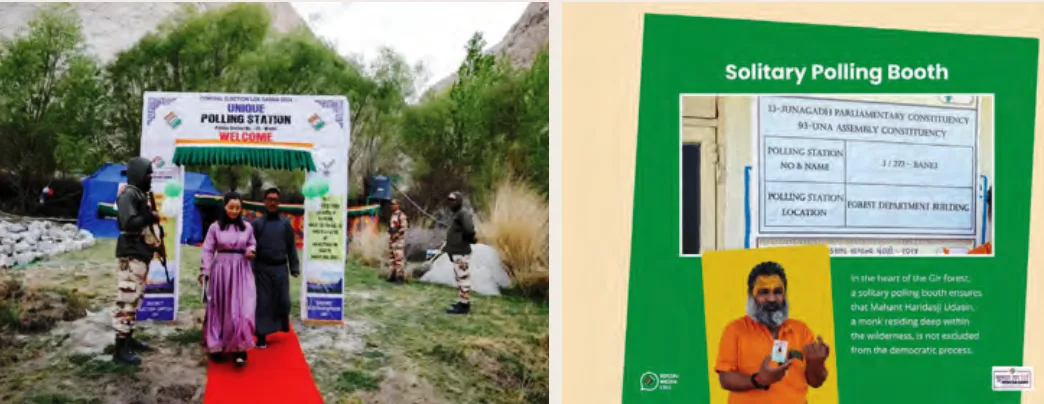
यह photograph भारतीय लोकतंत्र की inclusiveness को दर्शाता है—गुजरात के Gir forest के अंदर रहने वाले एकमात्र voter (Mahant Haridasji Udasin) के लिए भी अलग से solitary polling booth बनाया जाता है ताकि कोई भी नागरिक voting से वंचित न रहे।
Case Studies: Democracy at the Grassroots
- 1. Jethipura Gram Panchayat (Sabarkantha, Gujarat): इसे 2019 में Nanaji Deshmukh Rashtriya Gaurav Gram Sabha Puraskar (NDRGGSP) से सम्मानित किया गया। इसने नियमित और Special Gram Sabhas, Mahila Sabhas आयोजित किए, पर्याप्त Quorum सुनिश्चित किया, और education व sanitation के फैसलों में SCs, STs, और women को सक्रिय रूप से शामिल किया।
- 2. South Manubankul Gram Panchayat (Tripura): महिलाओं की भागीदारी, self-help groups, health, livelihoods, और cleanliness पर बेहतरीन काम करने के कारण Ministry of Panchayati Raj ने इसे राष्ट्रीय स्तर पर “Women-Friendly Panchayat” के रूप में मान्यता दी।
📚 Important Definitions
Quorum (कोरम): The presence of the minimum number of members in the meetings of an assembly to make the proceedings valid.
Cooperatives (सहकारी समितियाँ): Groups formed by people to work together for a common benefit; members share profits and responsibilities equally.
Legislation (कानून निर्माण): Laws made by the government that help maintain order and regulate society.
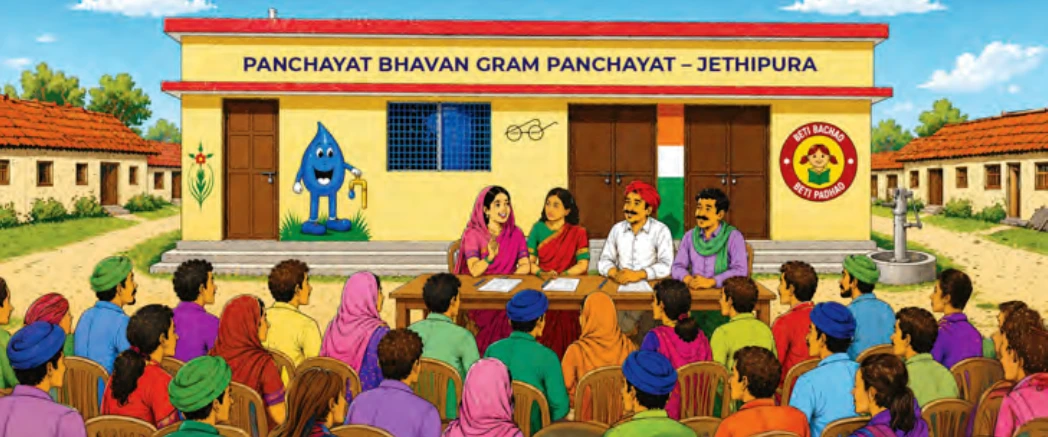
Grassroots democracy यह साबित करता है कि लोकतंत्र केवल हर 5 साल में vote डालने तक सीमित नहीं है—citizens Gram Sabhas और cooperatives के जरिए सीधे गाँव के विकास और welfare में भाग लेते हैं।
Women’s Voting Rights & Reservation
Britain (1928) और USA (1920) के विपरीत, जहाँ women को voting rights पाने के लिए दशकों तक struggle करना पड़ा, भारत ने 1950 में Constitution लागू होते ही बिना किसी भेदभाव के सभी पुरुषों और महिलाओं को Universal Adult Franchise दे दिया।
Social prejudices को दूर करने और महिलाओं की राजनीतिक भागीदारी बढ़ाने के लिए Article 243(d) (Panchayats) और Article 243(t) (Municipalities) में महिलाओं के लिए कम से कम one-third (33%) reservation है। इससे आगे बढ़कर, 21 States और 2 UTs ने Panchayats में, तथा 17 States और 1 UT (2023 तक) ने Urban Local Bodies में 50% reservation लागू किया है।
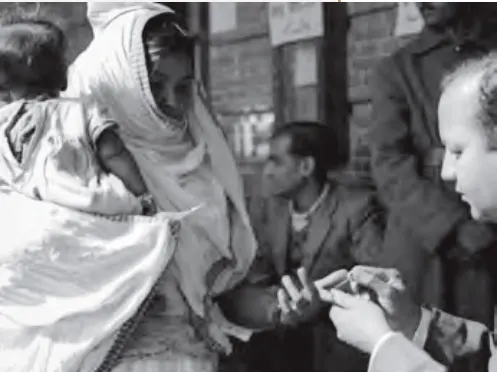
1952 के पहले General Election की यह historic photograph दिखाती है कि गणतंत्र के पहले दिन से ही भारतीय महिलाओं को पुरुषों के बराबर राजनीतिक अधिकार मिले।
💡 Don’t Miss Out: The Right to Information (RTI) Act, 2005
Citizens, journalists, और civil society की लगातार मांग तथा parliamentary committees की समीक्षा के बाद RTI Act, 2005 पारित हुआ। यह Act नागरिकों को सरकारी विभागों से official records मांगने का अधिकार देता है (national security के safeguards के साथ)। Practical Example: कोई भी नागरिक RTI दायर करके यह पता लगा सकता है कि उसके इलाके के सरकारी स्कूल या सड़क निर्माण पर कितना बजट खर्च हुआ।
🤔 Think About It: Leaders Who Strengthened Grassroots Democracy
Explore the contributions of eminent Indian leaders like Chaudhary Charan Singh and Babu Jagjivan Ram who worked towards strengthening grassroots democracy.
🎯 Competency-Based Questions (Section 4)
Q1. [Scenario-Based] A Gram Sabha meeting is called to decide on village sanitation funds, but very few villagers attend, falling below the minimum required attendance. Which term refers to this minimum required number of members?
Ans: Quorum. Without an adequate quorum, the proceedings of an assembly meeting are not considered valid.
Q2. [Assertion-Reason] Assertion (A): Indian women had to wage decades of violent protests after 1950 to secure the right to vote.
Reason (R): When the Constitution of India came into force in 1950, Universal Adult Franchise was granted to all men and women equally.
Ans: A is False, R is True. Unlike Britain (1928) or the USA (1920), Indian women received voting rights immediately in 1950 without prolonged legal battles.
Q3. [Analytical] How do the PESA Act (1996) and Autonomous District Councils (ADCs) strengthen Indian democracy?
Ans: They decentralise power and protect tribal heritage by empowering Gram Sabhas and granting legislative/judicial authority to tribal communities to govern themselves according to their customs.
Q4. [Conceptual] How does the Right to Information (RTI) Act, 2005 empower ordinary citizens?
Ans: It gives citizens the legal right to access information held by public authorities and government departments, thereby strengthening transparency and holding the government accountable.
Q5. [Fact-Based] Which two Constitutional Articles mandate at least one-third reservation for women in Panchayats and Municipalities respectively?
Ans: Article 243(d) for Panchayats and Article 243(t) for Municipalities.
5. Challenges to Democracy & Role of Youth (चुनौतियां और युवाओं की भूमिका)
यद्यपि India ने representation और participation में बड़ी प्रगति की है, फिर भी इसे कई practical challenges का सामना करना पड़ता है—जैसे illiteracy, poverty, regionalism, gender inequality, social discrimination, कानूनों के implementation में कमी, और social media पर फैलती fake news व misinformation। Public property को नुकसान पहुँचाना या public issues के प्रति indifference दिखाना democratic values को कमजोर करता है।
The National Emergency (1975–1977)
Indian democracy की सबसे बड़ी परीक्षा June 1975 में हुई, जब बढ़ती inflation, unemployment, और protests के बीच Indira Gandhi के नेतृत्व वाली सरकार ने ‘internal disturbance’ के आधार पर National Emergency (Article 352) लागू कर दी। इस दौरान अधिकतर Fundamental Rights suspend हो गए, press पर censorship लगी, और कई political leaders को गिरफ्तार किया गया। Jayaprakash Narayan (Lok Nayak) ने विशेष रूप से Bihar और Gujarat में छात्रों व नागरिकों के mass movements का नेतृत्व किया। 1977 में Emergency हटने के बाद हुए चुनावों में जनता ने शांतिपूर्ण तरीके से ruling government को हराकर भारतीय लोकतंत्र की resilience (मजबूती) साबित की।
📚 Emergency Provisions & Civic Responsibility
Emergency Articles: Article 352 (National Emergency), Article 356 (President’s Rule in states), and Article 360 (Financial Emergency).
Civic Responsibility (नागरिक उत्तरदायित्व): Respecting others’ rights, using social media responsibly, abiding by laws, appreciating diversity, and participating in nation-building activities like NSS, NCC, and Bharat Scouts & Guides.
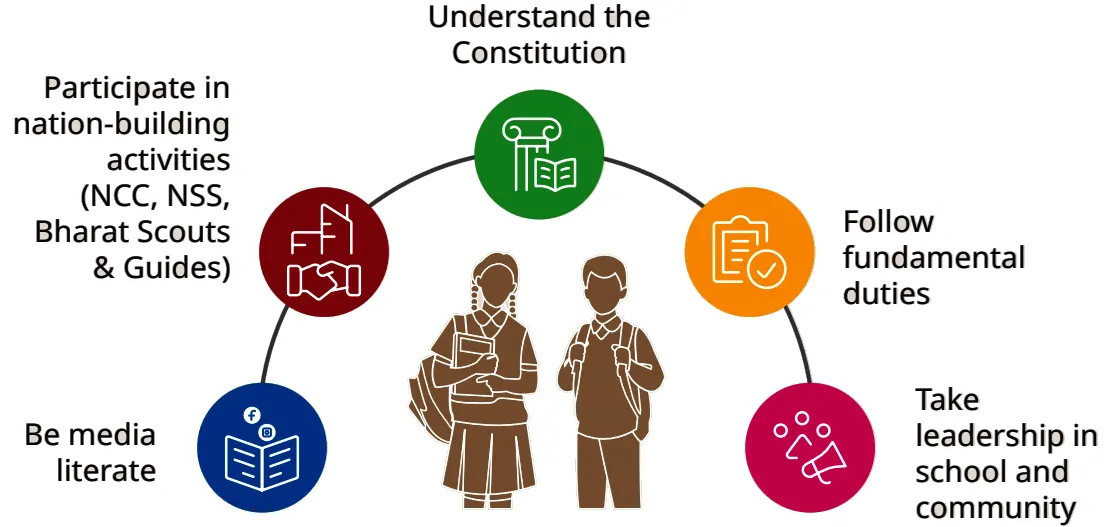
Young citizens पाँच प्रमुख तरीकों से democracy को मजबूत बना सकते हैं: Constitution को समझना, Fundamental Duties का पालन करना, school/community में leadership लेना, media literate बनना (news को fact-check करना), और NCC, NSS व Bharat Scouts & Guides जैसी nation-building activities में भाग लेना।
🔍 Let’s Explore: Misinformation on Social Media
Why is access to accurate and authentic information important in a democracy, and how can fake news weaken it?
🎯 Competency-Based Questions (Section 5)
Q1. [Scenario-Based] A student forwards an unverified message on a WhatsApp group claiming a false rumour about a local community, causing panic. Which democratic responsibility has the student failed to uphold?
Ans: Media literacy and responsible use of social media, which are essential parts of civic responsibility in a democracy.
Q2. [Assertion-Reason] Assertion (A): The 1977 General Elections demonstrated the ultimate resilience of Indian democracy.
Reason (R): After the Emergency was lifted, citizens peacefully used the ballot to vote out the ruling government that had suspended civil liberties.
Ans: Both A and R are true, and R is the correct explanation of A.
Q3. [Analytical] How do youth programmes like NSS and NCC contribute to strengthening democracy?
Ans: They instil civic responsibility, social awareness, teamwork, leadership, and respect for democratic ideals through organised community service and nation-building activities.
Q4. [Conceptual] Who was popularly known as ‘Lok Nayak’, and what role did he play during the 1975–77 Emergency?
Ans: Jayaprakash Narayan. He was a political leader and socialist thinker who mobilised students and citizens in mass movements, especially in Bihar and Gujarat, to defend democratic values.
Q5. [Fact-Based] Match the Constitutional Articles with the type of Emergency: (a) Article 352, (b) Article 356, (c) Article 360.
Ans: (a) Article 352 — National Emergency; (b) Article 356 — President’s Rule; (c) Article 360 — Financial Emergency.
The Big Questions (Chapter Objectives Solved)
1. How has the idea of democracy evolved over time and shaped our understanding of it today?
2. What are the different forms of democracy, and how are they practised in India and other parts of the world?
3. What are the essential features of a democracy and how do they extend beyond government institutions?
4. What are the challenges faced by Indian democracy?
List
Class 9 Social Science Part 1 Chapter 3 Atmosphere and Climate Revision Notes
Class 9 Social Science Part 1 Chapter 4 Early Humans and Beginning of Civilisation Revision Notes
Class 9 Social Science Part 1 Chapter 5 States and Society upto 1000 CE Revision Notes
Class 9 Social Science Part 1 Chapter 6 Democracy Revision Notes
Class 9 Social Science Part 1 Chapter 7 Elections Revision Notes