Class 9 Social Science Part 1 Chapter 5 Revision Notes: State and Society up to 1000 CE
Second millennium BCE से हमें archaeological evidence के साथ-साथ literary sources (जिनमें Rigveda सबसे प्राचीन है) मिलने लगते हैं, जो हमें past के social, political, cultural, और moral dimensions की गहरी जानकारी देते हैं। इस chapter में हम देखेंगे कि कैसे early kin-based social organisation (jana, kula) विकसित होकर territory-based janapadas, mahājanapadas, और अंततः Mauryas, Guptas (Northern India), तथा Cholas (Southern India) जैसे बड़े empires में बदल गए। साथ ही, हम ashvamedha yajña, chakravarti samrāṭ, और dharma जैसे निरंतर चलने वाले (continuity) मूल्यों को भी समझेंगे।
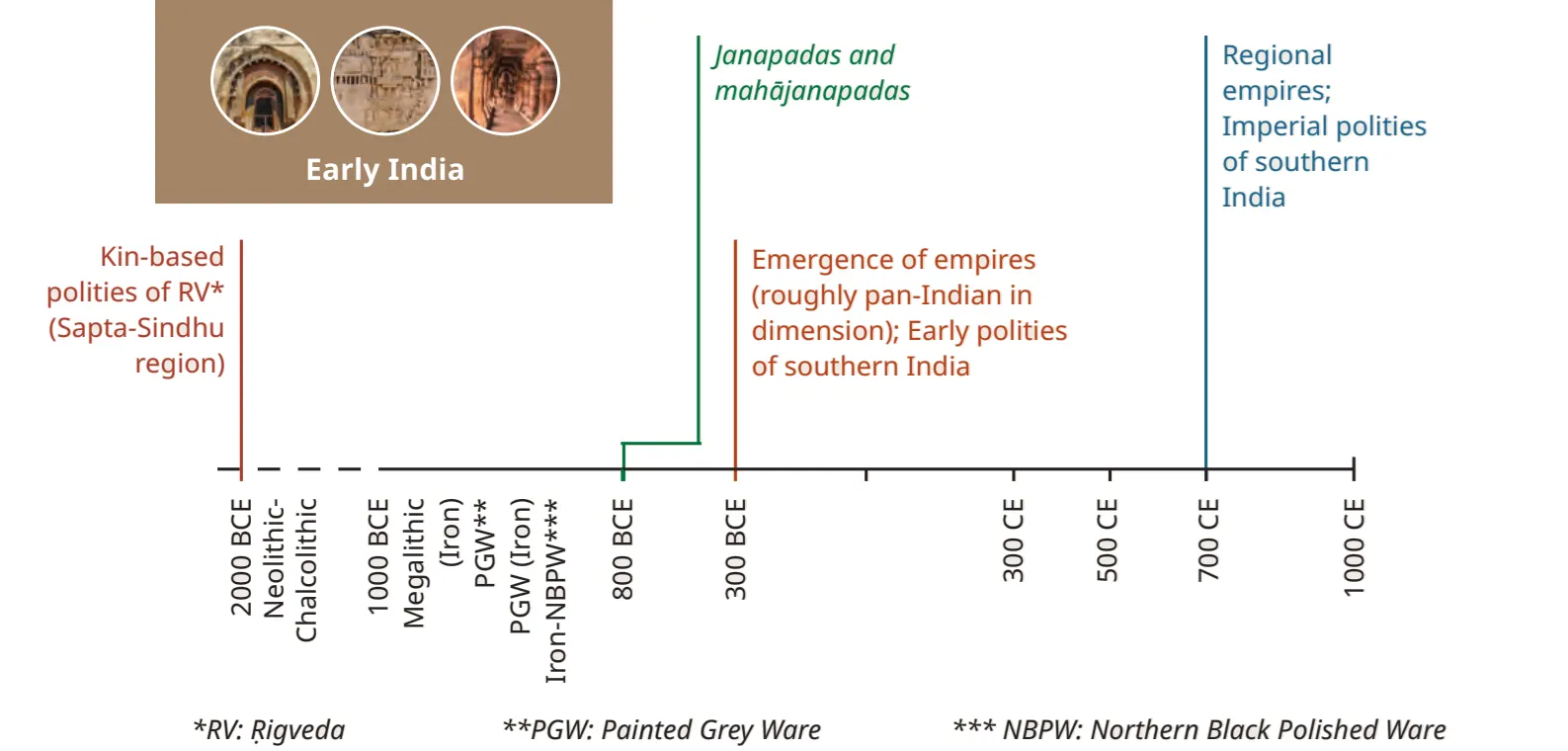
This timeline traces India’s political evolution from early kin-based Rigvedic polities in the Sapta-Sindhu region through the Iron Age (Megalithic, PGW, NBPW), the rise of Janapadas and Mahājanapadas, pan-Indian empires, and regional/imperial South Indian powers up to 1000 CE.
Master Chronology: Political & Cultural Developments (Up to 1000 CE)
| Time Period | Political Developments | Cultural & Religious Developments |
|---|---|---|
| 2000 – 500 BCE | Early Vedic kin-based polities (janas) → Janapadas | Vedic period; Upanishads (1500–300 BCE) |
| 600 – 300 BCE | Rise of 16 Mahājanapadas; 321 BCE: Foundation of Mauryan Empire by Chandragupta Maurya | Life of Gautama Buddha and Mahāvīra |
| 300 BCE – 300 CE | 272–232 BCE: Aśhoka’s reign; 185 BCE: Shunga Empire (Pushyamitra Shunga); 1st c. BCE: Khāravela; Early kingdoms of Tamilakam (Cheras, Cholas, Pāndyas); 30–375 CE: Kushāṇas; 78 CE: Saka Era; 106–130 CE: Gautamīputra Śhātakarṇi | Philosophy of Dhamma (272–232 BCE); Sangam literature composed; Udaygiri & Khandagiri caves (1st c. BCE) |
| 250 – 600 CE | 250–510 CE: Vākāṭakas; 275 CE: Pallavas established; 320–550 CE: Guptas; 350–1140 CE: Kāmarūpa; 475–776 CE: Maitrakas; 510–606 CE: Maukharīs; 543 CE: Chalukyas (Pulakeśhin I) | Faxian’s visit & Kālidāsa (300–400 CE); 427 CE: Nālandā University; 480 CE: Vallabhī University; 500 CE: Āryabhaṭa; 550 CE: Rāvaṇaphāḍī cave temple |
| 600 – 1000+ CE | 606 CE: Harshavardhana annexes Kannauj; 630–668 CE: Narasimhavarman I; 712 CE: Arab conquest of Sindh; 724–760 CE: Lalitāditya Muktāpīḍa; Tri-partite powers: Gurjara-Pratihāras (730–1036 CE), Pālas (750–1161 CE), Rāshṭrakūṭas (753–982 CE); 985–1014 CE: Rājarāja I (Chola) | 629–645 CE: Xuanzang’s visit; Mahabalipuram rock-cut temples (630–668 CE); Martanda Sun Temple, Kashmir (724–760 CE); Kailasa Temple, Ellora (756–773 CE); Vikramśhilā University (783–820 CE); Brihadeeshwara Temple, Thanjavur (985–1014 CE) |
1. Early Indian State, Society & The Vedic Period (वैदिक काल)
📚 Society vs. State (समाज और राज्य)
Society (समाज): A system of social relationships among individuals who share a common territory, culture, and a shared sense of belonging. It includes families/households, institutions like marriage, and is primarily regulated by customs and practices rather than formal laws.
State (राज्य): An organised political system based on formal rules and laws, with well-defined rights and duties of rulers and subjects, governance mechanisms, and institutions for enforcing law and order.
The Beginnings: The Vedas & Their Four Parts
Harappan script के अभी तक decipher न होने के कारण, Vedas Indian literature का सबसे प्राचीन ज्ञात संग्रह (earliest known corpus) हैं। सदियों तक ये oral form में सुरक्षित रहे। Historians के बीच Rigveda की रचना तिथि (fifth to second millennium BCE) पर चर्चा रही है। इसकी रचना northwestern subcontinent के Sapta-Sindhu क्षेत्र (Indus River, उसकी five tributaries, और Sarasvatī) में हुई थी—जहाँ Sindhu-Sarasvatī civilisation फली-फूली थी। दिलचस्प बात यह है कि Rigveda और Sindhu-Sarasvatī सभ्यता दोनों ही copper (ताँबे) से परिचित थे।
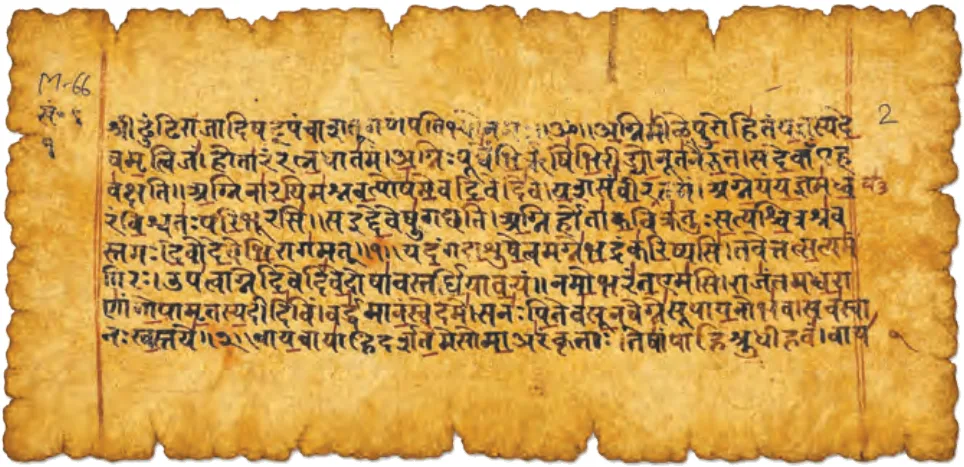
Composed orally centuries before being written down, the Rigveda is foundational to Indian culture, preserving 1,028 hymns that illuminate early Indian social, political, economic, and religious life.
| The Four Vedas | Core Focus & Content |
|---|---|
| 1. Rigveda | Earliest Veda containing some of the world’s oldest surviving poetic compositions. It has 1,028 hymns (sūktas) praising deities and reflecting on universal thoughts (creation, cessation, birth, death). |
| 2. Yajurveda | Elaborates the performative aspects of yajñas and hymns referred to in the Rigveda; includes prose explanations. |
| 3. Sāmaveda | Hymns drawn from the Rigveda, carefully arranged for musical recitation; forms the foundation for the seven svaras (notes) of Indian music. |
| 4. Atharvaveda | Contains a wide range of hymns—some to ward off evil, and others related to the treatment of physical and mental ailments. |
Each Veda has four parts: (1) Samhitās (hymns for invoking deities and offering oblations in yajña), (2) Brāhmaṇas (prose explanations for ritual performances), (3) Āraṇyakas (araṇya = forest; philosophical speculations of forest sages), और (4) Upanishads (delving into the Self / Ātman and Ultimate Universal Being / Brāhman). Note: Brāhman is a philosophical concept, Brāhmaṇas are ritual texts, and Brāhmaṇas/Brahmins is a varṇa category.
Political Institutions in the Vedic Period
Early Vedic society kinship ties से जुड़े clans में बँटी थी जिन्हें janas कहा जाता था। Rigveda में लगभग 30 janas का उल्लेख है, जिनमें से पाँच—Yadu, Turvaśha, Puru, Anu, और Druhyu—को सामूहिक रूप से pañchajana (‘five peoples’) कहा गया है। इस काल में rājā मुख्य रूप से एक clan chief था जो युद्ध में समूह का नेतृत्व और सदस्यों की सुरक्षा करता था। Rigveda और Atharvaveda में तीन प्रमुख assemblies का उल्लेख है:
| Assembly | Composition & Primary Role |
|---|---|
| Sabhā | A smaller body composed of select elites; primarily served a judicial function. |
| Samiti | A larger assembly representing the broader population; focused on policy decisions and political affairs. |
| Vidhata | A popular gathering attended by members of the community (janas); served as a forum for discussions on warfare and political matters. |
🔍 Let’s Recall: The ‘Bharata Jana’
The name ‘Bharata’ first appears in the Rigveda in reference to the ‘Bharata jana’ (people ruled by the Bharatas). What does this tell us about how early communities identified themselves and their rulers?
🤔 Think About It: Vedic Assemblies & Modern Democracy
Do the roles of the rājā and the assemblies (sabhā, samiti, vidhata) in Vedic times suggest a principle similar to modern constitutional checks and people’s participation?
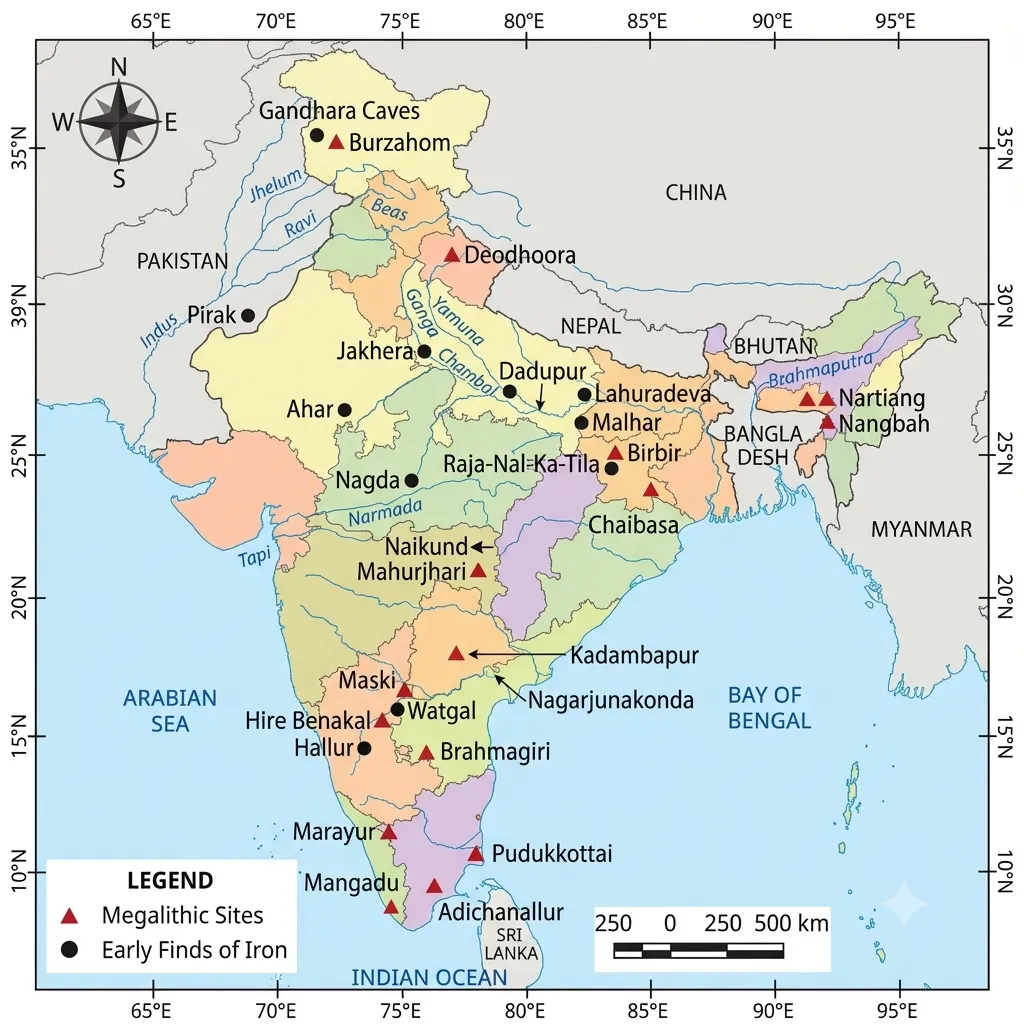
This archaeological map reveals the widespread emergence of Iron Age settlements and Megalithic sites across the subcontinent, with a dense concentration of settlements emerging in the fertile Ganga valley.
🔍 Let’s Analyse: Growth of Settlements in the Ganga Plains (Fig. 5.3)
During the first millennium BCE, settlements became heavily concentrated in the Ganga region, accompanied by iron implements, PGW pottery, and NBPW ‘deluxe ware’ (middle Ganga, from Prayagraj to eastern Bihar). What were the crucial factors behind this change?
🎯 Competency-Based Questions (Section 1)
Q1. [Scenario-Based] A musicologist is researching the earliest origins of the seven musical notes (svaras) in Indian classical music. Which Vedic text should they study?
Ans: The Sāmaveda, whose chanting tradition forms an important foundation for the system of the seven svaras.
Q2. [Assertion-Reason] Assertion (A): During the first millennium BCE, settlements became heavily concentrated in the Ganga plains.
Reason (R): The increasing use of iron implements helped clear forests and expand agriculture, especially paddy cultivation.
Ans: Both A and R are true, and R is the correct explanation of A.
Q3. [Analytical] Distinguish clearly between the terms Brāhman, Brāhmaṇas (texts), and Brāhmaṇas/Brahmins.
Ans: ‘Brāhman’ is the philosophical concept of the Ultimate Universal Being; ‘Brāhmaṇas’ are prose texts explaining Vedic rituals; and ‘Brāhmaṇas/Brahmins’ refers to a social varṇa category.
Q4. [Conceptual] What was the primary difference between the Sabhā and the Samiti in early Vedic polity?
Ans: The Sabhā was a smaller body of select elites performing judicial functions, whereas the Samiti was a larger assembly representing the broader population that focused on policy and political affairs.
Q5. [Fact-Based] What is NBPW, and where in India is its ‘deluxe ware’ particularly evidenced in the second half of the first millennium BCE?
Ans: NBPW stands for Northern Black Polished Ware, a smooth, glossy black pottery evidenced particularly in the middle Ganga region (from present-day Prayagraj to eastern Bihar).
2. Early Kingdoms, Republics & Ideals of Kingship (महाजनपद और राजधर्म)
लगभग 1000 BCE से 600 BCE के बीच Vedic polity kinship-based identity से territorial identity में बदली, जिसे janapada (‘where a people first set its feet’) कहा गया। अब भूमि, agriculture, और trade routes पर नियंत्रण महत्वपूर्ण हो गया। 600 BCE से 300 BCE के बीच 16 बड़े राज्य उभरे जिन्हें mahājanapadas कहा गया:
The 16 Mahājanapadas: Kamboja, Gandhāra, Matsya, Kuru, Śhūrasena, Pañchāla, Vatsa, Kosala, Kāśhī, Malla, Vrijji, Magadha, Anga, Chedi, Avanti, और Ashmaka। इनमें Magadha (वर्तमान बिहार) अपनी strategic location, fertile plains, और मजबूत शासकों के कारण सबसे शक्तिशाली बना, जिससे आगे चलकर Mauryan Empire का उदय हुआ।
इस समय उत्तर भारत में दो प्रकार की राजनीतिक व्यवस्थाएँ थीं: Monarchical states (rājyas) और Republican states (gaṇas or samghas)। दक्षिण भारत (Deccan) में Mauryas के बाद Sātavāhana Empire लगभग 500 वर्षों (2nd c. BCE – 3rd c. CE) तक रहा। सुदूर दक्षिण (Tamilakam) में चार प्रमुख polities थीं जिनका उल्लेख Ashokan inscriptions में भी मिलता है:
- Cholas: Lower Kaveri river valley (Royal Emblem: Tiger).
- Pāndyas: Tamraparni and Vaigai river valleys (Royal Emblem: Fish).
- Keralaputras (Cheras): Kerala region (Royal Emblem: Bow).
- Satiyaputras: Northern part of Tamil Nadu.
Sangam Literature (300 BCE–300 CE)—सबसे प्राचीन तमिल साहित्य—में Chera, Chola, और Pāndya शासकों को “Vendar of Tamilakam” (three crowned kings) कहा गया है। इन poems में Vedic yajñas और epic traditions का भी उल्लेख है। (इन्हें कई सदियों बाद उभरे later imperial Cholas/Cheras/Pāndyas से भ्रमित नहीं करना चाहिए।)
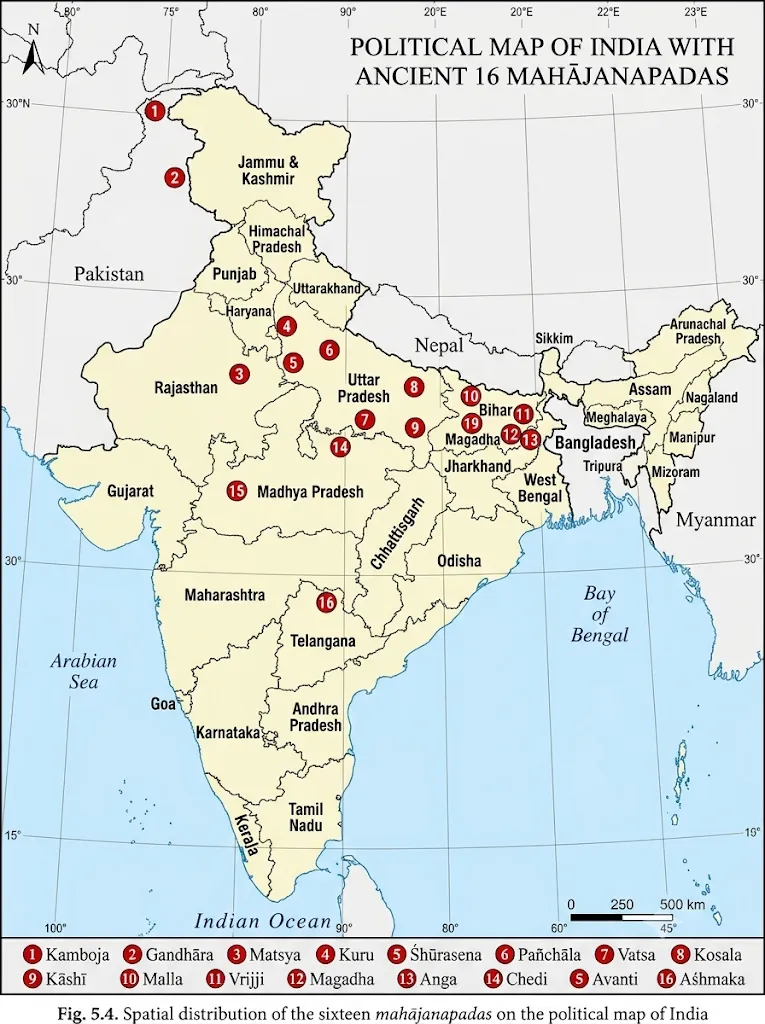
This map illustrates the geographic shift of political prominence from the northwest to the fertile Ganga plains (Magadha, Kosala, Vrijji), central India (Avanti, Chedi), the Deccan (Ashmaka), and the rice-growing valleys of Tamilakam.
Duties and Ideals of the King (राजा के कर्तव्य और आदर्श)
- Titles & Active Leadership: 6th century BCE से राजाओं ने rājā, mahārāja, और samrāṭ जैसी उपाधियाँ लीं। Kautilya’s Arthaśhāstra कहता है: “Only if a king is himself energetically active, do his officers follow him energetically.” Yajurveda के coronation oath में राजा को मजबूत और कमजोर के बीच निष्पक्ष न्याय (impartial justice) करने और आपदाओं से रक्षा करने की सलाह दी गई है।
- Justice in Śhānti Parva (Mahābhārata): यह राजा को ethical conduct और न्याय का मार्गदर्शन देता है। राजा का कर्तव्य abduction, robbery, theft, और adultery जैसे अपराधों में न्याय करना था। गंभीर अपराधों—जैसे killing of a cow, acts of treachery (देशद्रोह), और intoxicating liquor के सेवन—के लिए कठोर दंड, यहाँ तक कि capital punishment तक का प्रावधान था। हालांकि kingship आमतौर पर hereditary थी, लेकिन राजाओं के चुने जाने (elected) या निकाले जाने (expelled) के संदर्भ बताते हैं कि royal authority हमेशा absolute नहीं थी।
- Pan-Indian Geopolitical Ideal (Chakravarti Samrāṭ): प्रारंभिक राजाओं की राजनीतिक चेतना पूरे उपमहाद्वीप तक थी, जिसे Jambudvīpa, Bhāratavarsha, Ashvamedha & Rājasūya yajña, Prithivī (Prakrit: pathivī), और chakravarti kshetra के माध्यम से व्यक्त किया गया।
- Ashoka ने अपने edict में लिखा कि उनके “energetic exertions” (pakama / parākrama) से पूरे Jambudvīpa के आध्यात्मिक जीवन में बदलाव आया।
- Arthaśhāstra Prithivī (chakravarti kshetra) को “the area lying between the Himavat (Himalayas) and the sea” के रूप में परिभाषित करता है।
- Sangam काल के Chera राजा Nedunjeral Adan ने adhirāja की उपाधि ली और हिमालय तक विजय का वर्णन मिलता है; इसी तरह 11th c. CE में Chola राजा Rājendra I ने गंगा क्षेत्र जीतकर Gangaikonda की उपाधि ली।
🤔 Think About It: Rulers, Protection, and Justice
Texts like the Mahābhārata and Arthaśhāstra emphasize protecting people and ensuring justice. Why was this important, and what does it reveal about governance?
Council of Ministers & Kautilya’s Saptāmga Theory
Arthaśhāstra कहता है: “One wheel does not move the carriage” — यानी शासन के लिए सहयोग और एक multi-layered administrative system जरूरी है। इसके केंद्र में mantri-parishad (council of ministers) थी, जिसमें treasurer, chief tax collector, chief legal advisor, और commander-in-chief शामिल होते थे। एक Ashokan inscription बताता है कि सम्राट की अनुपस्थिति में भी council जनहित में स्वतंत्र निर्णय ले सकती थी। Kautilya ने राज्य को 7 अंगों (Saptāmga) का एक organic whole माना:
- Swāmi (the king), Amātya (councillors, ministers & high officials), Janapada (territory & population), Durga (fortified towns & cities), Kosha (treasury/wealth), Danda (forces of defence & law and order), और Mitra (allies).
🎯 Competency-Based Questions (Section 2)
Q1. [Scenario-Based] An 11th-century South Indian monarch conducts a military expedition all the way to the Ganga valley and adopts the title ‘Gangaikonda’. Who is this ruler, and what political ideal does this reflect?
Ans: Chola ruler Rajendra I. It reflects the enduring pan-Indian geopolitical ideal of the chakravarti kshetra (exercising sovereignty across the Indian subcontinent).
Q2. [Assertion-Reason] Assertion (A): Royal succession in early India was strictly absolute and always hereditary without exception.
Reason (R): Historical texts contain references to kings being elected or even expelled, and Ashoka’s inscriptions show the council of ministers taking decisions in the emperor’s absence.
Ans: A is False, R is True. Royal authority was not always absolute, and governance relied on ministerial councils and ethical duties.
Q3. [Analytical] How does Kautilya’s Arthaśhāstra define the ‘chakravarti kshetra’ (Prithivī)?
Ans: It defines it as “the area lying between the Himavat (Himalayas) and the sea,” representing the domain of a universal paramount ruler over the entire Indian subcontinent.
Q4. [Conceptual] Name the four key officials typically included in the ‘mantri-parishad’ (council of ministers) in early Indian states.
Ans: The treasurer, the chief tax collector, the chief legal advisor, and the commander-in-chief of the army.
Q5. [Fact-Based] Which four southern polities are mentioned in the Ashokan inscriptions?
Ans: The Cholas, Pāndyas, Keralaputras (Cheras), and Satiyaputras.
3. Administration of Empires & Ethical Foundations (प्रशासन और नैतिकता)
💡 Don’t Miss Out: Junagadh Rock Inscription (Gujarat)
Girnar (Gujarat) के पास स्थित Junagadh Rock Inscription अद्वितीय है क्योंकि इस एक ही चट्टान पर लगभग 700 वर्षों के अंतराल में तीन राजवंशों के शिलालेख हैं: (1) Mauryan सम्राट Ashoka (3rd c. BCE, Prakrit में Dhamma के Major Rock Edicts), (2) Western Satrap शासक Rudradāman I (c. 150 CE, Sanskrit में military achievements और Sudarshana Lake की मरम्मत), और (3) Gupta सम्राट Skandagupta (5th c. CE, झील के पुनर्निर्माण का रिकॉर्ड)।
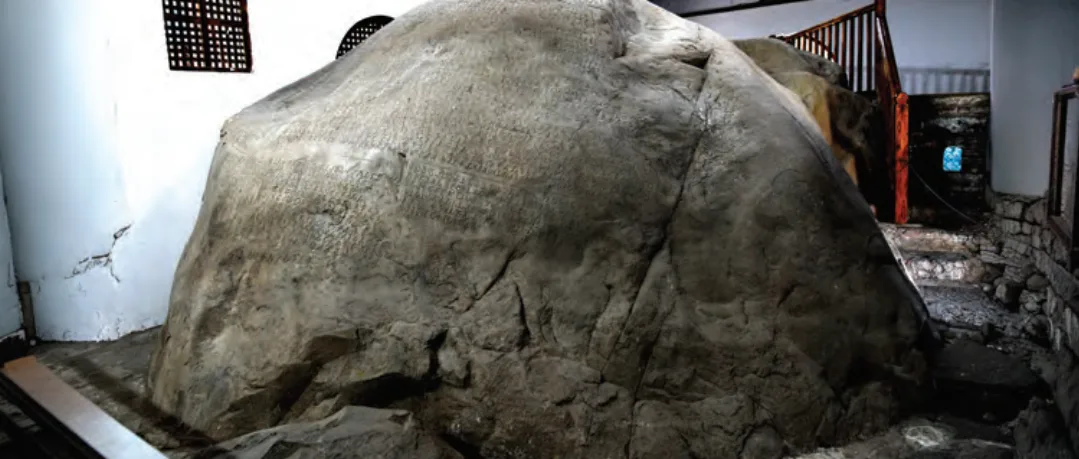
Preserving 700 years of history on a single boulder, this site showcases the enduring commitment of different dynasties to public welfare works like maintaining the Sudarshana Lake.
🤔 Think About It: Why Record Inscriptions on the Same Stone?
Why do you think different rulers (Ashoka, Rudradāman I, Skandagupta) chose to record their inscriptions on the same stone instead of a new one?
How Were Empires Administered? (साम्राज्यों का प्रशासन)
- Provincial & District Officers: Sātavāhana empire में administrative divisions को āhāras (headed by amātyas) और गाँव के मुखिया को grāmika कहते थे। District governors (pradeśhikas) judicial और administrative कार्य करते थे और अक्सर bankers, caravan leaders, artisans, और scribes से सलाह लेते थे। शहरों के अपने governors होते थे जो revenue collection और law & order संभालते थे।
- Gupta Administration: Guptas ने mantri (head of civil administration) के साथ-साथ एक नया पद sāndhivigrahika (minister of peace and war) और provincial/local स्तर पर kumārāmātyas बनाए। Kumaragupta I के Damodarpur copper plates के अनुसार district office में 5 सदस्य थे: head district officer, chief banker, chief caravan trader, chief artisan, और chief of revenue collection।
- Pallavas (c. 275–897 CE) & Chalukyas of Badami (c. 543–753 CE): दोनों ने centralised monarchy और decentralised local governance का मेल अपनाया। Pallavas ने tax-free Brahmadeya villages दिए, जहाँ village assemblies की छोटी समितियाँ (variyams) irrigation, gardens, और temple management संभालती थीं। Chalukyas ने Brahmin settlements को agrahārams के रूप में भूमि दान दी—इनमें Aihole और Badami शिक्षा के प्रमुख केंद्र बने।
- Tri-partite Struggle (8th–10th c. CE): उत्तर और पश्चिम भारत में Gurjara-Pratihāras की राजधानी Kannauj (वर्तमान UP) पर नियंत्रण के लिए तीन बड़ी शक्तियों—Gurjara-Pratihāras, Pālas, और Rāshṭrakūṭas—के बीच लंबा संघर्ष चला। इन तीनों में ही गाँव सबसे छोटी और self-reliant इकाई थी।
- Imperial Cholas (9th–11th c. CE): अपनी कुशल प्रशासनिक और राजस्व प्रणाली के लिए प्रसिद्ध Chola साम्राज्य Mandalams → Valanādus → Nādus → Urs में बँटा था। Village assemblies बिना सरकारी patronage के revenue collection, land management, irrigation, road construction, और record maintenance जैसे सभी कार्य स्वतंत्र रूप से करती थीं।
| Administrative Level (300–800 CE) | Northern India Terms | Southern India Terms |
|---|---|---|
| Province | Bhukti | Mandala / Mandalam |
| Division | Vishaya / Bhoga | Kottam / Valanādu |
| District | Adhishthāna / Pattana | Nādu |
| Group of Villages (Modern Tahsil) | Vithi | Pattalā / Kūrram |
| Village (Lowest Unit) | Grāma | Ur |
🤔 Think About It: Administrative Divisions — Past & Present
How did dividing a kingdom into provinces, districts, and villages help rulers manage empires, and how is it similar to India today?
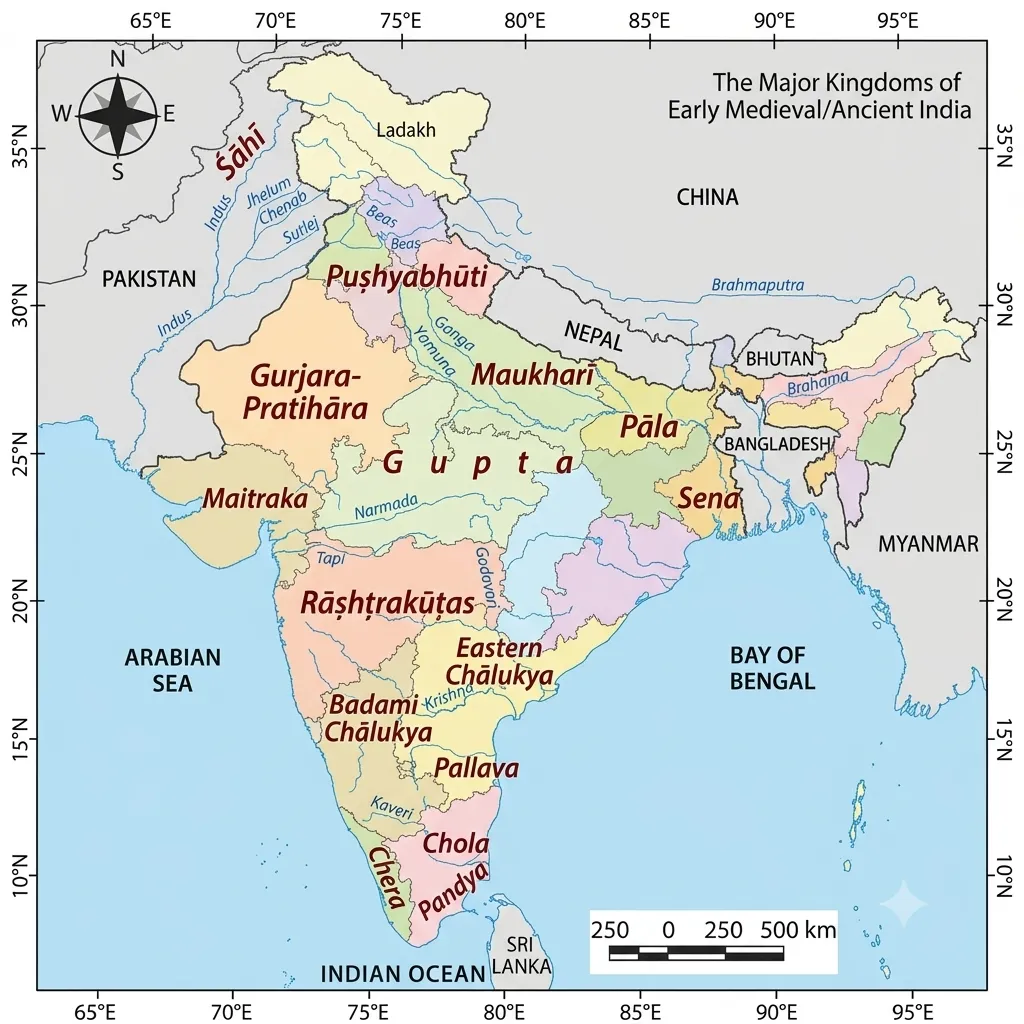
This map shows the rich regional diversity of Indian polities after 300 CE, from the Guptas and Pushyabhūtis in the north to the Rāshṭrakūṭas, Chalukyas, Pallavas, and Cholas in the Deccan and south.
💡 Chola Village Governance: Uttaramerur Inscription & Kudavolai
10th century CE का Uttaramerur inscription (Parantaka I), जो Kanchipuram (Tamil Nadu) के Vaikuntha Perumal Temple में है, Kudavolai (‘ballot pot’) ग्राम चुनाव प्रणाली का सजीव वर्णन करता है। पात्र उम्मीदवारों के नाम palm leaves पर लिखकर एक बड़े घड़े में रखे जाते थे और सार्वजनिक सभा में एक छोटा बच्चा पत्तियाँ निकालकर variyams (tank/irrigation committee, justice, taxes) के सदस्य चुनता था। उम्मीदवारों के लिए “honest earnings” और “pure of mind” जैसी नैतिक योग्यता अनिवार्य थी।
Ethics: The Foundation of Law and Life
- Bhagavad Gītā & Samatva: Bhagavad Gītā knowledge, faith, action, और virtue पर जोर देती है। Samatva (principle of sameness) के अनुसार सभी शरीर एक ही तत्व से बने हैं और सभी चेतनाएँ एक supreme consciousness का रूप हैं—जिसे Vedas satya (true) और rita (right) कहते हैं। महाकाव्य (epics) भेदभाव की आलोचना करते हैं और एक अच्छे शासक को “one who works for the welfare of all beings” बताते हैं।
- Rita (ऋत): Rigveda में वर्णित all-pervading cosmic order जो प्रकृति और समाज में harmony व moral balance बनाए रखता है।
- Dharma / Dhamma (धर्म): संस्कृत मूल dhṛi (जिससे dharati / पृथ्वी बना है) से निकला dharma केवल religion नहीं, बल्कि duty, obligation, righteousness, और moral conduct है। Mahābhārata में भीष्म कहते हैं: “Whatever upholds all beings is dharma” (जैसे लोहे का धर्म डूबना और लकड़ी का धर्म तैरना है)। Ashoka के edicts (dhamma — परिवार में सम्मान, अहिंसा, करुणा), Kāmandaka की Nītisāra, और Bāṇabhaṭṭa की Kādambarī (दुनिया के पहले उपन्यासों में से एक) राजनीति और नैतिकता के गहरे संबंध को दर्शाते हैं।
🎯 Competency-Based Questions (Section 3)
Q1. [Scenario-Based] In a 10th-century Tamil village, names of honest candidates are written on palm leaves, placed inside a pot, and drawn by a young child in front of the temple gathering to form a tank irrigation committee. What is this election system called?
Ans: The Kudavolai (‘ballot pot’) system of the Chola period, documented in the Uttaramerur inscription of Parantaka I.
Q2. [Assertion-Reason] Assertion (A): The Gupta district administration involved local citizens in decision-making.
Reason (R): The Damodarpur copper plates record that the district office included the chief banker, chief caravan trader, and chief artisan alongside the district officer.
Ans: Both A and R are true, and R is the correct explanation of A.
Q3. [Analytical] Why did Kannauj become the centre of the famous ‘Tri-partite Struggle’ between the 8th and 10th centuries CE, and which three powers were involved?
Ans: Kannauj was a highly coveted political capital in Northern India. The three powers involved were the Gurjara-Pratihāras, the Pālas, and the Rāshṭrakūṭas.
Q4. [Conceptual] Explain the distinction between ‘Rita’ and ‘Dharma’ in early Indian ethical thought.
Ans: ‘Rita’ refers to the all-pervading cosmic order that maintains harmony and balance in nature and society, whereas ‘Dharma’ (from the root dhṛi) refers to individual and social duty, obligation, righteousness, and moral conduct that upholds all beings.
Q5. [Fact-Based] What new ministerial post was introduced during the Gupta period to handle peace and war?
Ans: Sāndhivigrahika (minister of peace and war).
4. Social Structures, Women, Bhakti & Education (समाज, भक्ति और शिक्षा)
Varṇa, Jāti, and Social Mobility
Early Vedic texts में सामाजिक पहचान केवल जन्म से नहीं, बल्कि ethnicity, geographic region, village affiliation, gotra, language, और विशेष रूप से occupation से बनती थी। Occupations flexible थे—जैसा कि Rigveda (9.112.3) में दिखता है:
🔍 Let’s Explore: Interpreting Rigveda 9.112.3 Like Historians
1. What occupations are mentioned in the family? What does this indicate?
2. How does this verse challenge the idea that social status and occupation were fixed by birth?
1. Three distinct occupations are mentioned within a single household: poet (intellectual/literary), physician (medical), and grinder of corn (manual/domestic). This indicates remarkable occupational diversity and flexibility in early Vedic society.
2. Because three members of the exact same family pursued completely different professions, this primary source directly challenges the assumption that occupations were rigidly hereditary or strictly fixed by birth in the early Vedic era.
चार varṇas का सबसे पहला उल्लेख Rigveda के Book 10 के Purushasūkta में मिलता है। यह मूल रूप से एक functional division था जहाँ knowledge को सर्वोच्च स्थान, फिर political power, और फिर wealth को स्थान दिया गया:
- Brāhmaṇas: वेदों का अध्ययन व अध्यापन, yajñas कराना, और dāna (दान) देना व लेना।
- Rājanya (Kshatriyas): युद्ध, प्रजा की रक्षा, न्याय प्रशासन, शास्त्र अध्ययन, और yajñas का आयोजन।
- Vaishyas: Agriculture, pastoralism, और trade जैसी आर्थिक गतिविधियाँ, साथ ही दान और अध्ययन।
- Śhūdras: अन्य varṇas की सहायता; हालांकि व्यावहारिक रूप से वे agriculture, animal husbandry, trade, और arts & crafts में भी सक्रिय थे।
बौद्ध ग्रंथ Sutta Nipāta कहता है: “No brāhmaṇa is such by birth… A brāhmaṇa is such by his deeds.” समय के साथ intermarriage, migration, endogamy (अपने समूह में विवाह), और क्षेत्रीय अंतर के कारण अनेक jātis उभरीं (जहाँ varṇas 4 पर fixed थे, jātis की संख्या असीमित थी)।
Social & Occupational Mobility: कई महान राजवंश—Nandas, Mauryas, Śhungas, Sātavāhanas, Vākāṭakas, Guptas, और Pushyabhūtis—विभिन्न सामाजिक पृष्ठभूमियों से आए। Mandsaur Stone Inscription (473 CE) गुजरात (Lata) से मध्य प्रदेश (Dashapura) आए silk weavers की guild का उल्लेख करता है जो archery और astrology में भी निपुण थे। संगम साहित्य Tolkāppiyam (Arasar, Vanigar, Velar, Antanar) और Paṭṭinappālai (merchants, salt-makers, fishermen, artisans, warriors) भी occupation-based fluid society को दर्शाते हैं।
📚 Important Social Definitions
Endogamy: The social custom of marrying strictly within one’s own social group, community, clan, or tribe.
Patrilineal: A social system wherein family identity and inheritance are passed down strictly through the male line.
Votive Inscription: Text engraved on stone, metal, or other materials dedicating a gift, sculpture, or structure to a deity or sacred place.
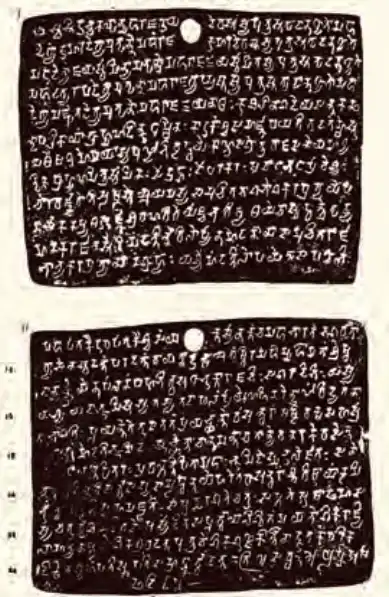
This copper-plate inscription provides direct epigraphic evidence of occupational mobility, recording brāhmaṇas serving actively as land managers.
Family, Four Āśhramas, Purushārthas & Role of Women
- Social Structure: Kula (family) → Grāma (village) → Visha (headed by viśhapati) → Jana (protected by rājā). Gotra एक patrilineal clan (एक वैदिक ऋषि से जुड़ा वंश) था जो विवाह नियमों को भी तय करता था।
- Four Āśhramas & 16 Samskāras: जीवन को चार आश्रमों—Brahmacharya (studentship), Gṛihastha (householder), Vānaprastha (forest life), और Samnyāsa (renunciation)—तथा shodasha samskāras (16 rites of passage) में बाँटा गया था।
- Four Purushārthas (जीवन के चार लक्ष्य): Dharma (righteousness), Artha (material well-being), Kāma (fulfilment of desires), और Moksha (liberation)। धन (artha) की प्राप्ति तभी उचित मानी जाती थी जब वह dharma (समाज कल्याण) से निर्देशित हो।
- Role of Women: Vedic काल में महिलाओं का उच्च स्थान था—वे शिक्षा, rituals, chariot races, और sabhā में भाग लेती थीं। Apālā, Viśhvavārā, Ghoshā, और Lopāmudrā ने Rigveda के मंत्र रचे, और Ushā (goddess of dawn) व Aditi (mother of gods) पूजनीय थीं। Manu-smriti (3.56) कहता है: “Where women, verily, are honoured, there gods rejoice.” यद्यपि बाद में उनकी स्थिति में उतार-चढ़ाव आया, फिर भी Prabhāvatī Gupta (Chandragupta II की पुत्री, Vākāṭaka regent जिसने अपने नाम से land grants जारी किए), पोस्ट-मौर्य काल की महिला दानदाताओं (votive inscriptions), Sangam काल की श्रमिक व विदुषी महिलाओं (paddy husking, spinning, salt production; कवयित्री Avvaiyār और Vennikuyattiyar — woman potter; women bards/dancers), और Chola रानी Sembiyan Mahādevī ने समाज व मंदिर निर्माण में बड़ा योगदान दिया।
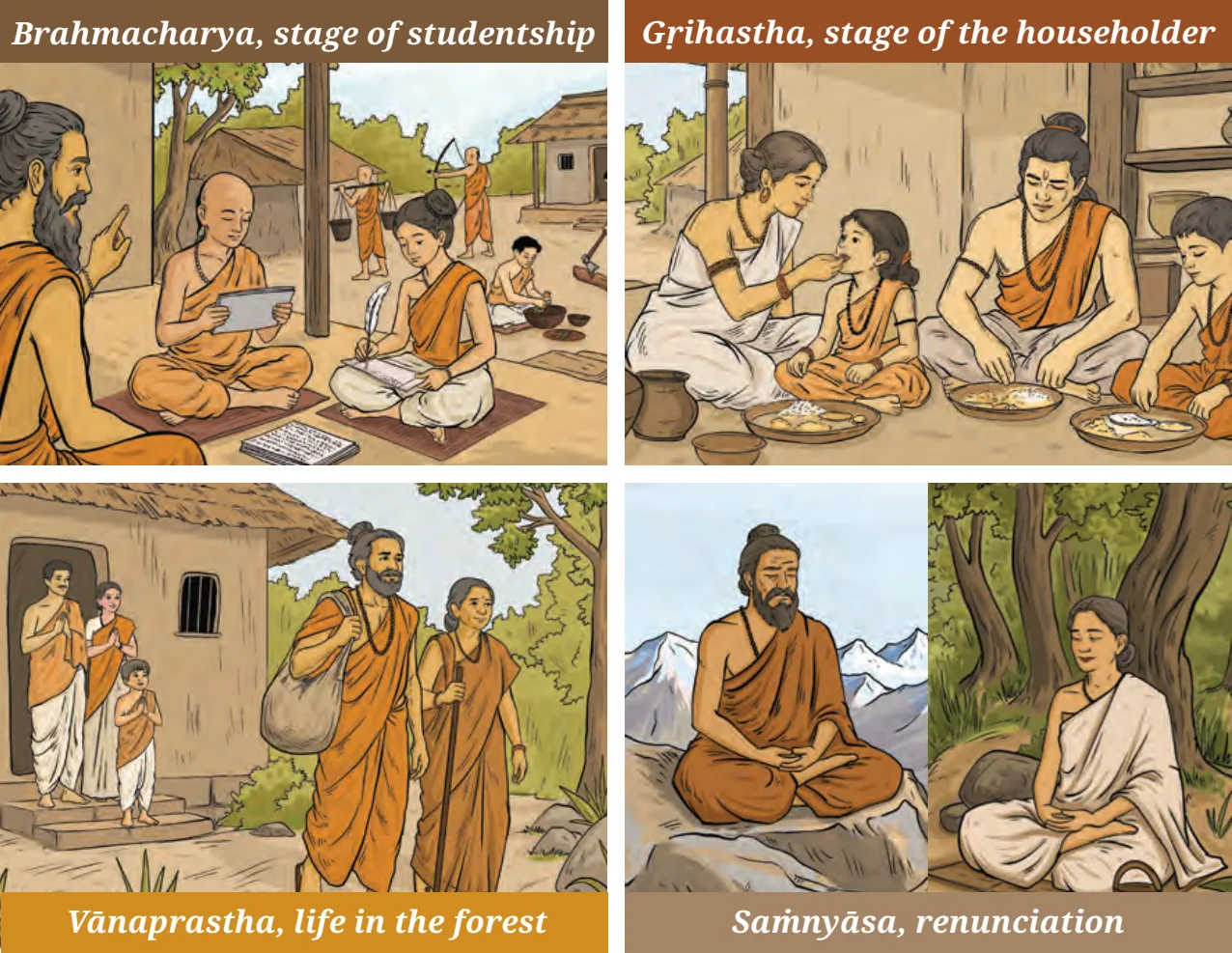
The āśhrama system was designed to provide balanced social, moral, and spiritual fulfilment across different stages of human life.
Religious Life, Renunciants & Emergence of Bhakti
Vedic pantheon में कोई कठोर hierarchy नहीं थी और प्रकृति के तत्वों (sun, rain, fire, earth, dawn) की पूजा yajñas द्वारा की जाती थी—जिसकी निरंतरता आज भी Chhath और Makar Sankranti जैसे पर्वों में दिखती है।
💡 Renunciants & The Bhakti Tradition
• Renunciants (त्यागी/श्रमण): First millennium BCE के मध्य में parivrājaka (wanderer), bhikshu (living by alms), और shramaṇa (one who strives) की परंपरा उभरी, जिनमें Gautama Buddha और Mahāvīra प्रमुख थे (त्याग का भाव vānaprastha और samnyāsa में भी था)।
• Bhakti (भक्ति): Vishṇu, Śhiva, और Śhakti जैसे personal deities से सीधा भक्तिपूर्ण जुड़ाव, जो जटिल वैदिक कर्मकांडों के बिना सभी वर्गों व महिलाओं के लिए खुला था। Mahābhārata में इसके प्रारंभिक संदर्भ हैं, लेकिन 6th century के तमिल क्षेत्र में 12 Ālvārs (Vishṇu के भक्त) और 63 Nāyanmārs (Śhiva के भक्त) ने विशाल तमिल भक्ति साहित्य रचकर इसे जन-आंदोलन बनाया।
The Quest for Knowledge: Gurukula, Universities & Literary Heritage
प्राचीन भारत में शिक्षा का उद्देश्य केवल नौकरी नहीं, बल्कि sattvaśhuddhi (purity of self), truth, humility, dharma, और व्यावहारिक कौशल (Vedas, grammar, logic, philosophy, ethics, mathematics, medicine, astronomy, music, painting, yoga, archery) का समग्र विकास था। Guru-śhiṣhya paramparā में छात्र guru/āchārya के परिवार के सदस्य की तरह gurukula में अनुशासित जीवन जीते थे।
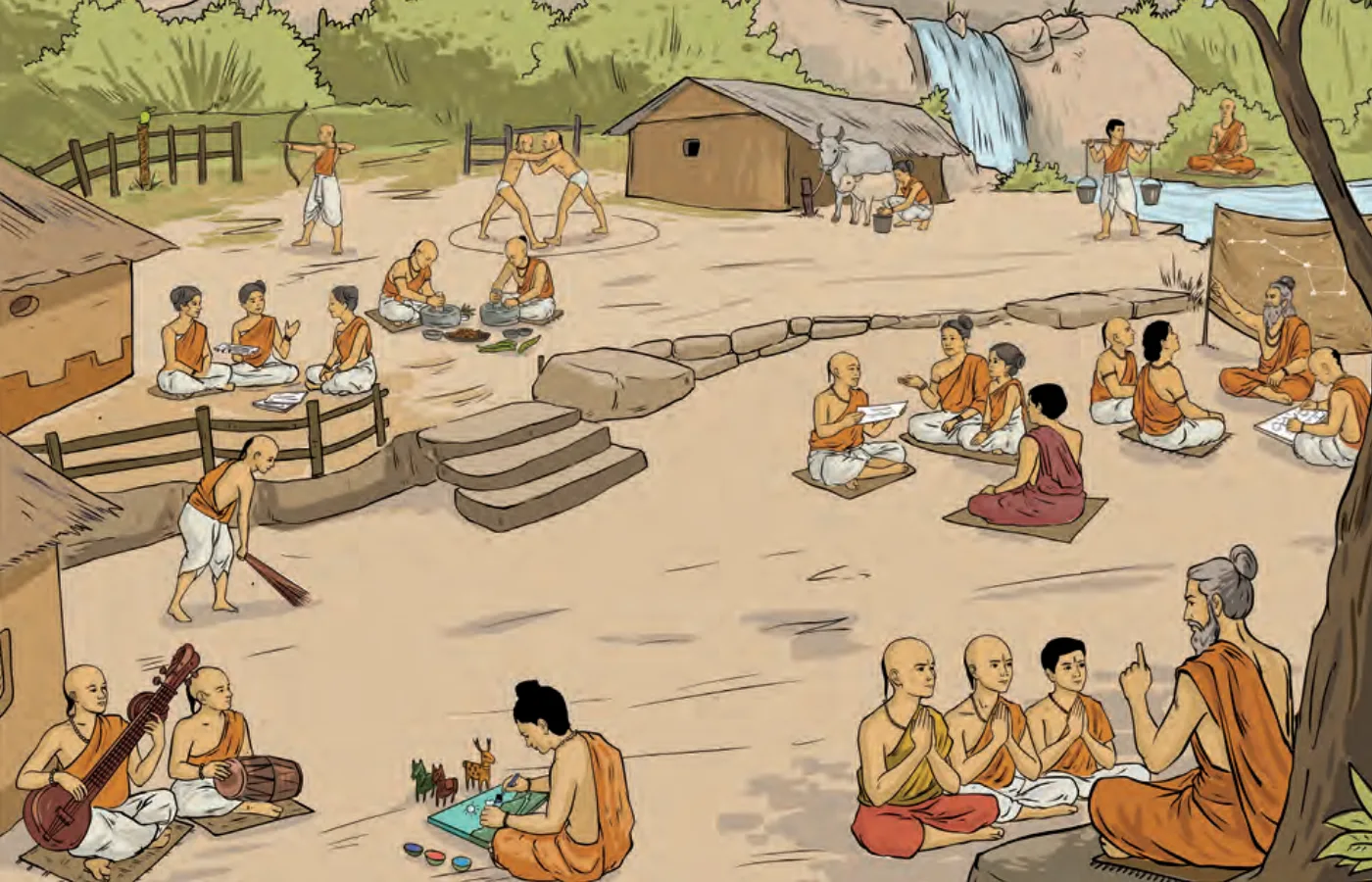
Students in a gurukula combined academic learning (scriptures, astronomy, logic) with arts, music, physical training (archery, wrestling), yoga, and everyday community service.
🔍 Let’s Explore: Modern School vs. Early Indian Gurukula
Compare your school life with the life of a student in a gurukula (daily routine, subjects, teacher relationship, living arrangements).
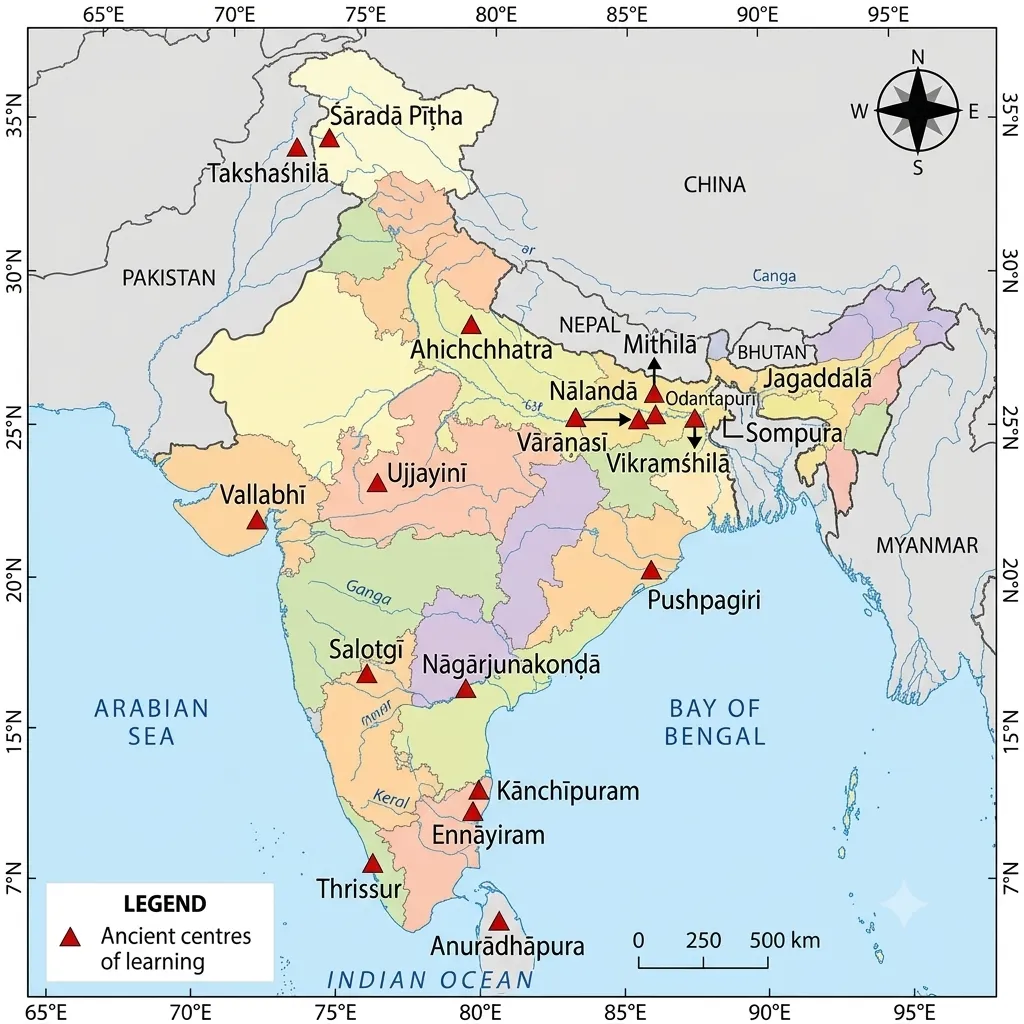
Centres of higher learning like Takshaśhilā, Śhāradā Pīṭha, Nālandā, Vikramśhilā, Vallabhī, Ujjayinī, and Kānchīpuram attracted scholars from across India and abroad.
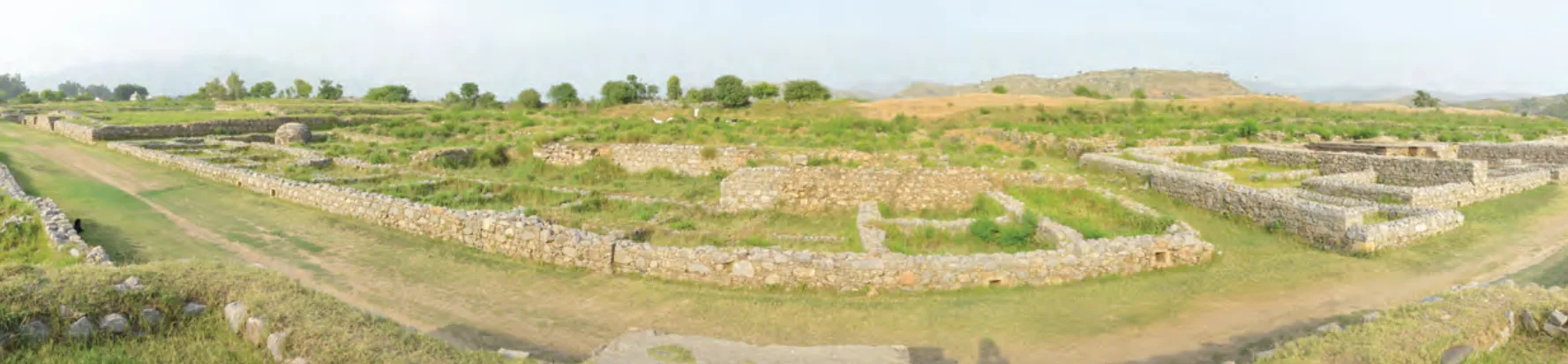
Takshaśhilā featured a massive, well-planned urban campus with organised housing, drainage, and waste management systems.
Literary Heritage of Early India
| Category | Notable Works & Authors |
|---|---|
| Sanskrit Grammar & Metrics | Pāṇini’s Ashṭādhyāyī, Piṅgala’s Chhandaśhāstra, Patañjali’s Mahābhāshya |
| Smriti Literature (Dharma, Law & Ethics) | Manu-smriti, Yājñavalkya Smriti, Nārada Smriti, Vishṇu Smriti |
| Classical Medicine | Charakasamhitā and Sushrutasamhitā |
| Sanskrit Poetry & Kāvya | Kālidāsa’s Raghuvamsha and Kumārasambhava |
| Tamil Literature | Tiruvalluvar’s Tirukkural; Tamil epics Silappadikāram and Maṇimēkalai; Sangam texts covering love (akam) and war/public life (puram) |
🎯 Competency-Based Questions (Section 4)
Q1. [Scenario-Based] A royal woman from the Gupta dynasty rules as regent in the Vākāṭaka kingdom and issues official land grants in her own name. Who is this historical figure?
Ans: Prabhāvatī Gupta, daughter of the Gupta ruler Chandragupta II.
Q2. [Assertion-Reason] Assertion (A): The Bhakti movement gained widespread popularity across different sections of society.
Reason (R): Bhakti offered a direct devotional connection with personal deities without requiring elaborate Vedic rituals, and was accessible regardless of class or gender.
Ans: Both A and R are true, and R is the correct explanation of A.
Q3. [Analytical] How does the Mandsaur Stone Inscription (473 CE) demonstrate occupational mobility during the Gupta period?
Ans: It records a guild of silk weavers who migrated from Lata (Gujarat) to Dashapura (Madhya Pradesh) and were proficient not only in weaving, but also in archery, astrology, and other professions.
Q4. [Conceptual] In the Sangam literary tradition, what do the two major poetic themes ‘akam’ and ‘puram’ represent?
Ans: ‘Akam’ deals with personal themes of love and inner life, while ‘puram’ covers war, heroism, political organisation, and public life.
Q5. [Fact-Based] Name the four Vedic women sages to whom several Rigvedic hymns are traditionally attributed.
Ans: Apālā, Viśhvavārā, Ghoshā, and Lopāmudrā.
5. Economy: Agriculture, Irrigation, Trade & Guilds (अर्थव्यवस्था और व्यापार)
Agriculture, Land Revenue & Irrigation
Mauryan और post-Mauryan काल में Agriculture अर्थव्यवस्था की रीढ़ थी। गाँवों में व्यक्तिगत खेत (individual holdings), साझा चरागाह (common pastures), और बागीचे (groves) होते थे; कुछ विशेष जंगल कानून द्वारा सुरक्षित थे। Basic land tax आमतौर पर उपज का one-sixth (1/6th) था। Kautilya ने भूमि को cultivated, wasteland/fallow, high & dry, sown fields, और groves में वर्गीकृत किया। प्रमुख फसलों में rice, pulses, wheat, linseed, mustard, saffron, sugarcane, vegetables, और fruits शामिल थे।
- Literary Sources on Farming: Nāgasena द्वारा रचित बौद्ध ग्रंथ Milindapañho में खेती के 8 चरणों (तैयारी व निराई से कटाई व ओसाई तक) का वर्णन है। Deccan की काली मिट्टी (black soil) में cotton की खेती बढ़ी। संस्कृत कोष Amarakośha में जंगल, फसलों और खाद पर अलग अध्याय है। Sangam साहित्य Chera क्षेत्र में jackfruit, pepper, turmeric, ragi, और sugarcane की प्रचुरता बताता है।
- Irrigation Infrastructure: Chandragupta Maurya के गवर्नर Pushyagupta ने Saurāshṭra (Gujarat) में Sudarshana Lake पर बांध बनवाया। दक्षिण में Karikala Chola ने Grand Anicut (Kallanai) बनवाया, जो आज भी उपयोग में है।
🤔 Think About It: Why Were Irrigation Works Recorded in Inscriptions?
Why do you think irrigational structures like dams and canals were considered so important that their construction was recorded in inscriptions?
Trade Routes, Ports & Guilds (Śhreṇīs)
Arthaśhāstra के अनुसार Magadha उत्तर, मध्य और दक्षिण भारत के साथ textiles, gems, coral, pearls, metals, और minerals का व्यापार करता था। Salt (नमक) का उत्पादन राज्य द्वारा सख्ती से नियंत्रित था, और राज्य ने व्यापार मार्गों की सुरक्षा व मिलावट (adulteration) रोकने के उपाय किए। 6th century BCE तक दो महान थल मार्ग—Uttarāpatha और Dakshiṇāpatha—विकसित हुए। तमिल महाकाव्य Silappadikāram भी Kanchipuram से Poompuhar (Kaveripattinam) और Kanchipuram से Kanyakumari तक के मार्गों का वर्णन करता है।
प्रमुख बंदरगाहों—Muziris, Kāveripattinam, Arikamedu, और Masulipatnam—ने भारत को समुद्री और मध्य एशियाई मार्गों से Rome और अन्य क्षेत्रों से जोड़ा। Mathurā, Kāśhī, और Kāmarūpa वस्त्र उद्योग (silk, cotton, wool, linen) के बड़े केंद्र बने।
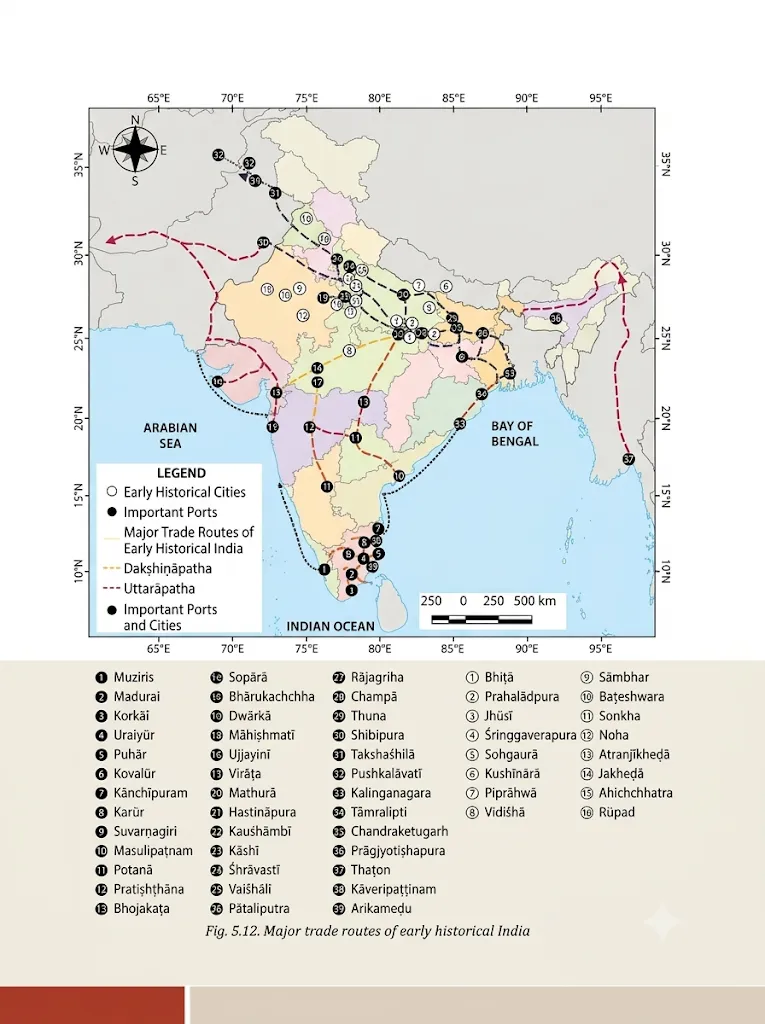
These trans-regional overland and maritime routes integrated inland craft hubs with major coastal ports, facilitating the vibrant exchange of goods, skilled artisans, and cultural ideas.
Guilds (Śhreṇīs): एक ही व्यवसाय या शिल्प से जुड़े कारीगरों व व्यापारियों के संगठनों को śhreṇīs कहा जाता था। इसी समय silver punch-marked coins चलन में आए। Jataka साहित्य में 18 types of guilds का उल्लेख है। Guilds वस्तुओं की गुणवत्ता व कीमत तय करती थीं, guild courts के माध्यम से अनुशासन रखती थीं, और banks, financiers, व trustees के रूप में काम करती थीं।
💡 Guilds as Banks & Art Patrons
• Nashik Cave Inscription (2nd c. CE): Shaka राजा Nahapāna के दामाद Uśhavadāta ने Govadhana की weavers’ guilds में 3,000 kāhāpaṇas जमा किए, जिस पर मिलने वाले मासिक ब्याज से बौद्ध भिक्षुओं के वस्त्र और जीवन-यापन का खर्च चलता था।
• Sanchi Stupa: Vidiśhā के ivory workers’ guild ने सांची के महान स्तूप के दक्षिणी तोरण द्वार (southern gateway) और रेलिंग पर पत्थर की मूर्तियाँ तराशीं।
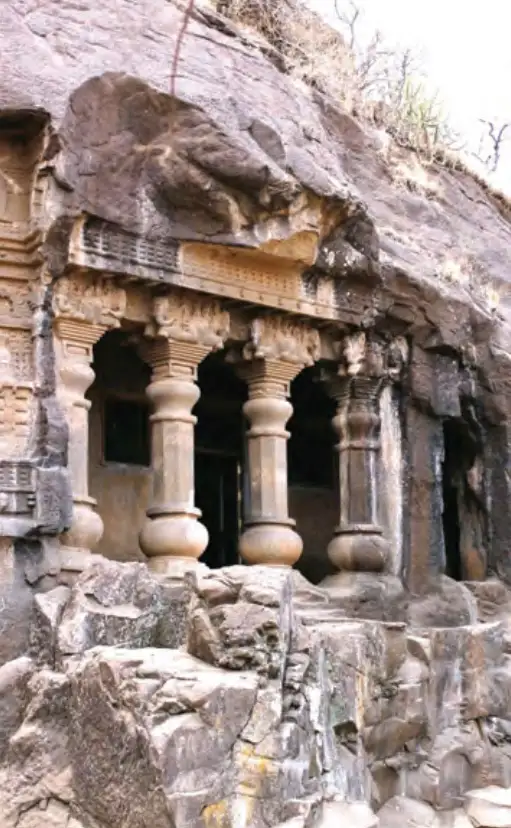
The Nashik cave inscriptions prove that craft guilds enjoyed immense public trust, securely investing perpetual endowments to generate steady interest for religious and charitable causes.
🎯 Competency-Based Questions (Section 5)
Q1. [Scenario-Based] A royal donor in the 2nd century CE deposits 3,000 silver coins with two local weavers’ associations so that the fixed monthly interest can permanently fund monks living in a nearby cave. What economic function of guilds does this illustrate?
Ans: It illustrates that guilds (śhreṇīs) functioned as trusted banks, financiers, and trustees capable of securely investing funds and paying fixed interest.
Q2. [Assertion-Reason] Assertion (A): Early Indian states invested heavily in building dams, canals, and reservoirs.
Reason (R): Agriculture was the backbone of the economy and the primary source of state revenue (usually one-sixth of the produce).
Ans: Both A and R are true, and R is the correct explanation of A.
Q3. [Analytical] Which craft guild was responsible for carving the stone sculptures on the southern gateway of the Great Stupa at Sanchi, and what does this show?
Ans: The guild of ivory workers from Vidiśhā. It shows that craft guilds played an active role in both artistic production and religious/welfare patronage.
Q4. [Conceptual] Name three important textile production hubs in early India mentioned in the chapter.
Ans: Mathurā, Kāśhī, and Kāmarūpa.
Q5. [Fact-Based] Which Buddhist text attributed to Nāgasena describes eight detailed stages of agricultural operations?
Ans: The Milindapañho.
The Big Questions (Chapter Objectives Solved)
1. How did society and state organise themselves prior to 1000 CE?
2. How did states and societies emerge and spread to different parts of the Indian subcontinent?
3. How did the ideas of dharma and chakravarti samrāṭ help create unity in social values and governance, and promote the idea of the Indian subcontinent as one political entity?
4. How did different social, administrative, and occupational groups take shape over time and come together culturally?
List
Class 9 Social Science Part 1 Chapter 5 States and Society upto 1000 CE Revision Notes

Class 9 Social Science Part 1 Chapter 6 Democracy Revision Notes
Class 9 Social Science Part 1 Chapter 7 Elections Revision Notes
Class 9 Social Science Part 1 Chapter 8 Building Blocks in Economics – The Problem of Choice Revision Notes

Class 9 Social Science Part 1 Chapter 9 The Price Puzzle: What Drives the Market Revision Notes