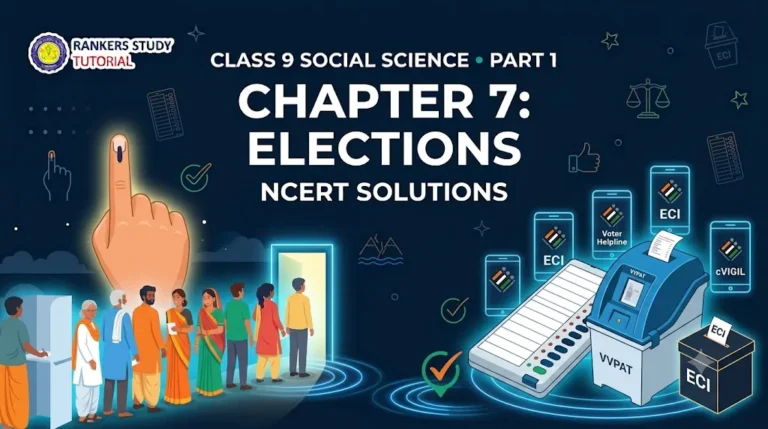
Class 9 Social Science Part 1 Chapter 7 Elections NCERT Solutions
Part 1: The Big Questions (Page 161)
Q1. Why are elections essential to a democratic system?
Q2. How do electoral systems and rules shape political representation and fairness?
- In India’s First-Past-The-Post (FPTP) system (used for Lok Sabha and Vidhan Sabha), the candidate with the most votes in a constituency wins, which makes voting simple and helps form stable governments.
- In Proportional Representation (PR) (such as the Single Transferable Vote used for Rajya Sabha, Vidhan Parishad, President, and Vice President), seats are shared in proportion to vote shares, giving fair representation to smaller groups and states.
- Rules like Delimitation ensure that every constituency represents a roughly equal population so that each citizen’s vote carries equal weight.
Q3. What role do institutions and laws play in ensuring free and fair elections?
Q4. What challenges do elections face in practice, and how can these challenges affect democracy?
Part 2: In-Text Questions & Activities Solved
Fig. 7.1 (Page 162): Fill in the two empty boxes to indicate why elections are important for democratic functioning, and discuss how each one is ensured through elections.
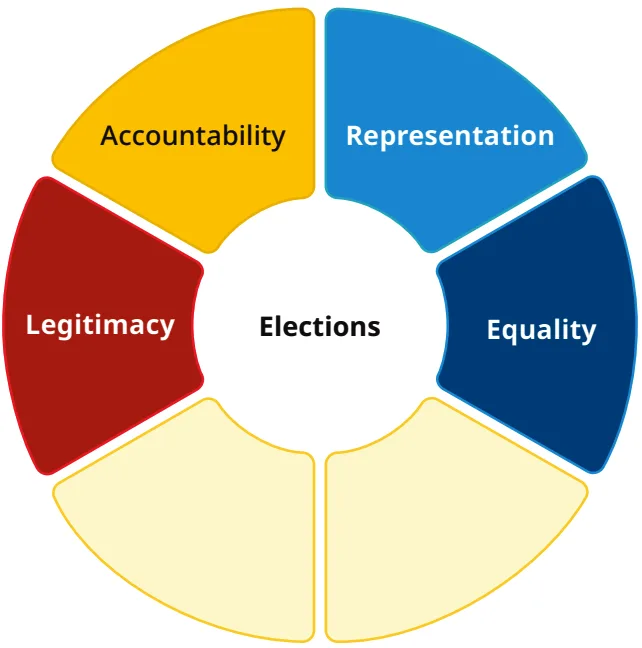
Alongside Accountability, Representation, Legitimacy, and Equality, the two empty boxes can be filled with:
- Citizen Participation: Ensures that every eligible citizen (18+) actively takes part in choosing leaders and shaping public policies.
- Peaceful Transfer of Power (or Meaningful Choice): Allows voters to change governments smoothly through the ballot box rather than force or conflict.
Let’s Explore (Page 165): Select six countries from different continents and prepare a brief case study on the type of electoral system operating in each country.
| Country (Continent) | Electoral System Used | How It Works |
|---|---|---|
| India (Asia) | FPTP (Lok Sabha) & PR-STV (Rajya Sabha) | Highest vote-getter wins in each Lok Sabha constituency; proportional representation for Upper House. |
| United Kingdom (Europe) | First-Past-The-Post (FPTP) | Voters elect one MP per constituency; the candidate with the most votes wins. |
| France (Europe) | Two-Round Majority System | A candidate must win over 50% of votes; if not, the top two compete in a second runoff round. |
| South Africa (Africa) | Proportional Representation (Party List) | Voters vote for a political party; National Assembly seats are allotted in proportion to national vote share. |
| Brazil (South America) | Majority (President) & Open-List PR (Legislature) | Two-round majority vote for President; proportional seat allocation for Congress. |
| Australia (Oceania) | Preferential Voting / STV | Voters rank candidates in order of preference (1, 2, 3…) until a candidate secures a majority. |
Don’t Miss Out (Page 166): Article 82 mandates a Delimitation Commission (1952, 1963, 1973, and 2002). Why was there a long interval between 1973 and 2002?
Think About It (Page 168): Find out the steps and list of required documents to register yourself as a voter when you turn 18.
- Registration Steps: Visit the ECI’s online portal (voters.eci.gov.in) or open the Voter Helpline App → Fill out Form 6 (for new voters) → Upload a passport-size photo and required documents → Submit and track the application until a Booth Level Officer (BLO) verifies your details and issues your EPIC (Voter ID card).
- Required Documents: Proof of Age (Birth Certificate, Class 10 Marksheet, or Passport) and Proof of Residence (Utility bill, Ration Card, Bank Passbook, or Rent Agreement).
Let’s Explore (Page 168): Who are classified as ‘service voters’ and can vote using ETPBS (Electronically Transmitted Postal Ballot System)?
- Choose any three states (including yours). Identify state parties, their symbols, and their major manifesto agenda.
- Compare the policy preferences of two major political parties across Education, National Security, Social Welfare, Environment, Economy, and Health.
1. Sample Three States & State Parties:
- Tamil Nadu — DMK (Rising Sun) / AIADMK (Two Leaves): Focus on social justice, state autonomy, free bus travel for women, and higher education scholarships.
- West Bengal — All India Trinamool Congress (Flowers & Grass): Focus on women’s welfare (Lakshmir Bhandar), girl-child education (Kanyashree), and regional cultural identity.
- Andhra Pradesh — Telugu Desam Party (Bicycle): Focus on IT/infrastructure development, farmer support, and youth skill development.
2. Sample Policy Comparison Chart (2024 Lok Sabha Manifestos):
| Policy Area | Party 1 (e.g., BJP) Viewpoint | Party 2 (e.g., INC) Viewpoint | Credible Source |
|---|---|---|---|
| Education | Full implementation of NEP 2020, expansion of IITs/AIIMS, and digital learning. | Increased public spending on schools/universities and student scholarship expansion. | Official Party Manifestos (2024) |
| National Security | Border infrastructure modernisation, self-reliance in defence (Atmanirbhar Bharat). | Modernising armed forces and reviewing military recruitment schemes. | Official Party Manifestos (2024) |
| Social Welfare | Direct Benefit Transfers (DBT), free ration (PMGKAY), and housing (PM Awas Yojana). | Cash transfers for poor women (Mahalakshmi scheme) and legal guarantee for MSP. | Official Party Manifestos (2024) |
| Environment | Solar rooftop push (PM Surya Ghar), green hydrogen, and net-zero target by 2070. | Strengthening environmental protection laws and green energy transition. | Official Party Manifestos (2024) |
| Economy | Manufacturing hubs (Make in India), highways/railways, and startup ecosystem. | Focus on MSMEs, apprenticeship rights for youth, and job creation. | Official Party Manifestos (2024) |
| Health | Expanding Ayushman Bharat health insurance (including all seniors aged 70+). | Universal free healthcare insurance model and expanding public hospitals. | Official Party Manifestos (2024) |
Let’s Explore (Page 176): Find out the approximate number of Recognised National Parties, State Parties, and Registered Unrecognised Political Parties (RUPP) in India (via ECI).
| Year | Alliance Won | Leading National Party | Key Ally / State Parties |
|---|---|---|---|
| 1977 | Janata Party (First national coalition) | Janata Party (merged opposition) | Shiromani Akali Dal, CPI(M) (outside support) |
| 1999 | National Democratic Alliance (NDA) | BJP | TDP, JD(U), Shiv Sena, DMK, BJD |
| 2004 | United Progressive Alliance (UPA) | INC | RJD, DMK, NCP, LJP (Left Front outside support) |
| 2009 | United Progressive Alliance (UPA) | INC | AITC, DMK, NCP, National Conference |
| 2014 | National Democratic Alliance (NDA) | BJP | Shiv Sena, TDP, LJP, Shiromani Akali Dal |
| 2019 | National Democratic Alliance (NDA) | BJP | JD(U), Shiv Sena, LJP, AIADMK |
| 2024 | National Democratic Alliance (NDA) | BJP | TDP, JD(U), Shiv Sena, LJP (RV), JD(S) |
Let’s Analyse (Page 178): Look at the road to free and fair elections (Fig. 7.13). Fill in the empty potholes with more challenges and explain how to overcome them.
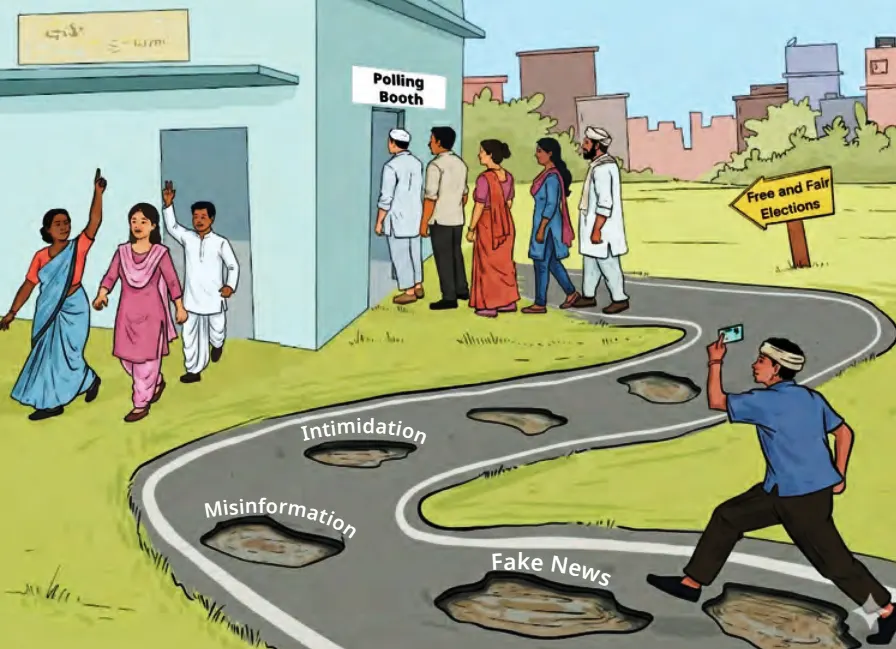
- Additional Challenges for the Empty Potholes: (1) Money Power (bribing voters and excessive campaign spending); (2) Muscle Power / Criminalisation; and (3) Caste & Communal Appeals (or Voter Apathy / Low Turnout).
- How to Overcome Them: Strictly enforcing spending limits and RPA 1951 rules, using the cVIGIL App to report violations immediately, promoting voter education and fact-checking to beat fake news, and encouraging every eligible citizen to vote fearlessly without inducement.
Part 3: Textbook Exercises — Questions and Activities (Pages 179–182)
- People with Disabilities (PwDs)
- Service Voters
- Senior Citizens — above 85 years of age
- Prisoners
- Persons in preventive detention
- People with Disabilities (PwDs): Ramps, wheelchairs, and volunteers at polling stations; Braille-enabled EVMs; the dedicated Saksham App for easy registration and polling-booth navigation; and Home Voting for PwDs with a benchmark disability of 40% or more.
- Service Voters: The ETPBS (Electronically Transmitted Postal Ballot System) allows armed forces and eligible service personnel posted away from home to receive and cast postal ballots electronically.
- Senior Citizens (85+): Nationwide Voting from Home facility (extended across India in the 2024 General Elections) so elderly citizens can vote safely and comfortably at home.
- Prisoners: Under Section 62(5) of the Representation of the People Act, 1951, persons confined in prison (whether convicted or under trial) are currently not permitted to vote.
- Persons in Preventive Detention: Unlike regular prisoners, individuals held under preventive detention retain their right to vote and are allowed by the ECI to cast their vote through a postal ballot.
Q2. What are the various functions of the Election Commission of India? Which of these functions is most important for the conduct of free and fair elections? Explain.
Key Functions of the ECI:
- Preparing, updating, and verifying accurate electoral rolls (including Special Intensive Revision — SIR).
- Deciding election schedules and dates considering weather, exams, harvests, and festivals.
- Registering political parties, classifying National/State parties, allotting election symbols, and settling symbol disputes.
- Enforcing the Model Code of Conduct, curbing corrupt practices, deploying EVMs/VVPATs, counting votes, and declaring results.
Most Important Function: Ensuring free, fair, and impartial conduct of elections (enforcing the Model Code of Conduct and preventing bribery, intimidation, or rigging) is the most vital function, because without fairness and transparency, citizens would lose trust in the entire democratic system.
Q3. Elections are the soul of a democracy. Do you agree? Why or why not?
Q4. Explain at least three differences between the national and state/regional political parties.
| Basis | National Political Party | State / Regional Political Party |
|---|---|---|
| Geographic Presence | Operates across multiple states and has a nationwide footprint. | Primarily active within one or a few specific states. |
| ECI Recognition Criteria | Must win at least 6% valid votes in 4+ states + 4 Lok Sabha seats, OR 2% Lok Sabha seats from 3+ states, OR be a State Party in 4+ states. | Must win 6% votes + 2 Assembly seats, OR 6% votes + 1 Lok Sabha seat, OR 3% Assembly seats (min. 3), OR 8% total valid votes in that state. |
| Election Symbol | Its reserved symbol is protected exclusively across the entire country. | Its reserved symbol is protected only within the state(s) where it is recognised. |
- Opportunity to choose my representative
- Makes me a responsible person
- Opportunity to change the non-performing representative
- Strengthens democracy
Suggested Descending Order (Most Important to Least):
- (d) Strengthens democracy: High, honest voter turnout is the ultimate foundation of a vibrant, legitimate democracy.
- (a) Opportunity to choose my representative: Voting lets me directly pick leaders whose vision and policies align with public welfare.
- (c) Opportunity to change the non-performing representative: It acts as a peaceful check, ensuring leaders stay accountable.
- (b) Makes me a responsible person: Fulfilling my constitutional right and duty builds active, proud citizenship.
Q6. What is the Special Intensive Revision (SIR) initiative of the ECI? Explain the objectives and the necessity of conducting SIR.
Objectives & Necessity:
- To ensure no eligible citizen is left out—especially young citizens who have just turned 18.
- To ensure no ineligible name remains—by deleting duplicate entries, deceased voters, and people who have permanently shifted residence.
- To give citizens a fair window to file claims or objections before the final voter list is published, ensuring clean and error-free elections.
Q7. Match the political party name with its symbol.
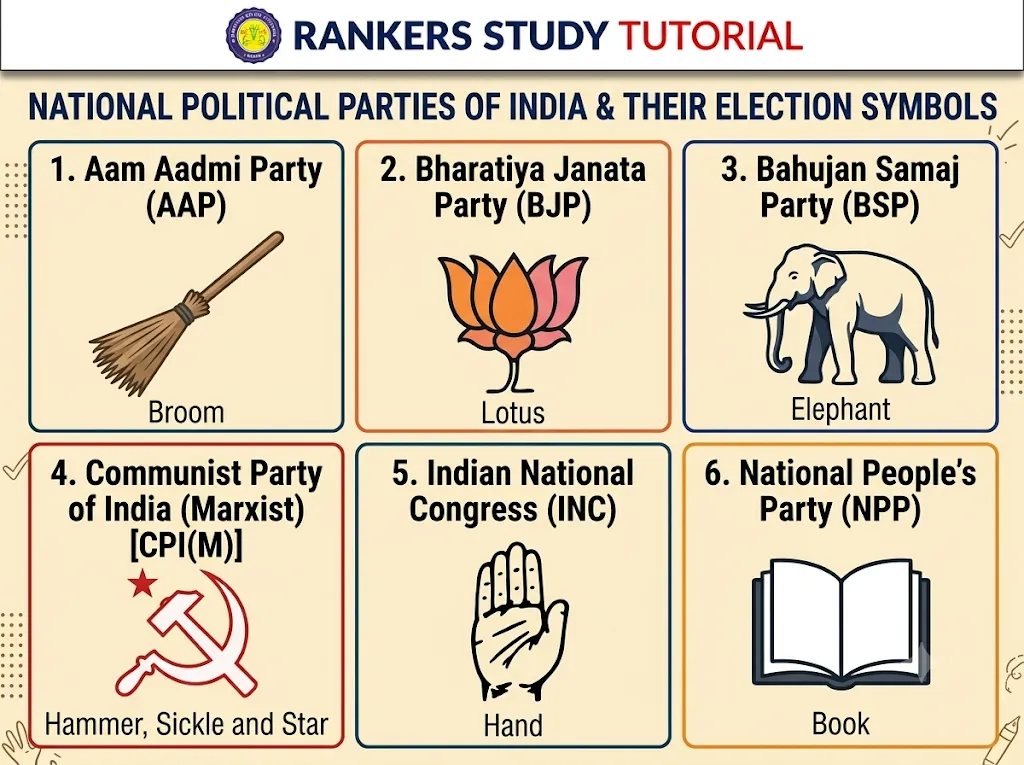
| Political Party Name | Correct Election Symbol |
|---|---|
| Aam Aadmi Party (AAP) | Broom |
| Bharatiya Janata Party (BJP) | Lotus |
| Bahujan Samaj Party (BSP) | Elephant |
| Communist Party of India (Marxist) [CPI (M)] | Hammer, Sickle and Star |
| Indian National Congress (INC) | Hand |
| National People’s Party (NPP) | Book |
- What initiatives were taken by the ECI to enable the voters to cast their vote?
- If Ishani was allowed to vote even without carrying her Voter ID card or Aadhaar card, which other document might she be carrying that is valid for voting?
- Cite the examples of violations of the Model Code of Conduct.
- Give a suitable title to the passage.
- Find out how the police and army personnel cast their votes.
- ECI Initiatives: Online voter registration portal, wheelchair and volunteer assistance for her disabled elder brother, police security at the polling station, VVPAT slip verification for transparency, acceptance of alternative ID documents, and Home Voting for her 89-year-old grandmother.
- Alternative Valid ID Documents: Ishani could have carried her Passport, Driving Licence, PAN Card, Bank/Post Office Passbook with photograph, or a Smart Card issued by the RGI.
- Violations of the Model Code of Conduct (MCC): Active campaigning—distributing pamphlets and raising slogans in large groups—on the day before polling violates the mandatory 48-hour silence period. Pasting campaign posters and wall writing everywhere also violates rules against defacing public property.
- Suitable Title: “Ishani’s First Vote: Inclusive and Transparent Elections in Action”.
- How Police & Army Personnel Vote: Army personnel posted away from home are classified as service voters and vote via ETPBS (postal ballot). Police personnel on election duty cast their votes using an Election Duty Certificate (EDC) (if deployed within their own constituency) or a Postal Ballot (if deployed outside their constituency).
| Dimension | Country A | Country B | Country C |
|---|---|---|---|
| Political Dimension | Written constitution, periodic elections, voting rights, party system varies from two-party to multi-party. | Written constitution, periodic elections, voting rights, one political party. | Written constitution, monarchy, no voting rights, no political party. |
| Economic Dimension | Average standard of living. | Above-average standard of living. | High standard of living. |
- What is the difference between having a voting right in a country with a multi-party system and another with a single-party system?
- In which of the above countries would you like to stay and why?
- Multi-Party vs. Single-Party Voting: In a multi-party system (Country A), voters have a meaningful choice among competing parties with different policies and can peacefully vote out an underperforming government. In a single-party system (Country B), voting is merely a formality because citizens have no real alternative party to choose from.
- Preferred Country: I would choose to live in Country A. Even though its economic standard of living is currently average, it guarantees genuine democratic freedoms, a written constitution, and real multi-party elections—giving citizens the power to demand better governance, protect their rights, and work together to improve their economy over time.
Q10. What are the challenges to conducting free and fair elections?
- Spread of fake news and misinformation on social media misleading voters.
- Voter intimidation, muscle power, and undue influence on vulnerable groups.
- Money power, bribery, and distribution of illegal inducements.
- Divisive appeals made in the name of caste, religion, or language.
- Logistical hurdles in reaching remote mountains, forests, deserts, and islands.
Q11. On the Stage (Classroom Activity): Elections are to be held in your school for Head Girl, Head Boy, and Sports Captain. Assume the roles of Election Commissioner, Returning Officer, Polling Agent, Candidate, Campaigner, Polling Officer, Police Personnel, and Journalist to perform a free, fair, and transparent election.
Complete Role-Play Guide for Classroom Performance:
- 1. Election Commissioner (1 student): Announces election dates, enforces the School Model Code of Conduct (no campaigning during class hours or defacing walls), and declares final results.
- 2. Returning Officer (1 student): Receives nomination forms from candidates, checks eligibility (attendance/discipline), allots election symbols (e.g., Book, Bat, Globe), and supervises vote counting.
- 3. Candidates & Campaigners (6–8 students): Present short 1-minute manifestos promising practical improvements (clean drinking water, better sports gear, library hours) without making false promises or personal attacks.
- 4. Polling Officers (3 students): Officer 1 verifies student ID against the class voter roll; Officer 2 applies indelible ink (marker) on the left index finger; Officer 3 hands over the secret ballot paper or manages the mock EVM.
- 5. Polling Agents (2–3 students): Representatives of candidates who sit quietly inside the booth to observe that no fake voting occurs and that the ballot box is sealed fairly.
- 6. Police Personnel / Volunteers (2 students): Maintain an orderly queue outside the booth and ensure a peaceful, intimidation-free environment.
- 7. Journalist (1–2 students): Interviews first-time student voters outside the booth and presents an unbiased “Election Day Report” at the end of the activity.
Q12. Project Activity: Make short videos or audios on topics like ‘My Vote My Nation’, ‘No Voter to be Left Behind’, or ‘How to Eliminate the Ill of Money Power’.
Three Ready-to-Record 60-Second Script Outlines:
- “My Vote, My Nation”: Open with a shot of an inked finger → Explain how one vote chooses leaders who build our schools, roads, and hospitals → Conclude with the National Voters’ Day pledge to vote fearlessly without caste or religion bias.
- “No Voter to Be Left Behind”: Highlight ECI’s inclusive milestones—Gir Forest’s solitary polling booth for a single voter, Braille EVMs and the Saksham App for PwDs, and Home Voting for 85+ senior citizens → End with the slogan: “Every single voice counts!”
- “How to Eliminate the Ill of Money Power”: Show a quick skit of a citizen politely refusing a cash bribe during campaigning → Explain that accepting money sells away 5 years of good governance → Show how to report bribery instantly using the ECI’s cVIGIL App.
- Some promises made in the Election manifesto
- Percentage of votes polled
- Number of seats won
- Number of women who contested
- Number of women candidates elected
Step-by-Step Project Template (Example: Madhya Pradesh Legislative Assembly — 2018 vs. 2023):
| Parameter (Chosen Party: e.g., BJP) | 2018 Assembly Election | 2023 Assembly Election | Authentic Source |
|---|---|---|---|
| (a) Key Manifesto Promises | Agricultural income support, road/power infrastructure, youth employment. | Ladli Behna monthly aid, MSP bonus for wheat/paddy, medical colleges. | Official Party Manifesto & Newspapers |
| (b) Percentage of Votes Polled | 41.02% | 48.55% | ECI Statistical Report (eci.gov.in) |
| (c) Number of Seats Won (out of 230) | 109 seats | 163 seats | ECI Statistical Report (eci.gov.in) |
| (d) Women Candidates Contested | 24 women candidates | 28 women candidates | ECI Candidate Affidavit Portal |
| (e) Women Candidates Elected | 11 women MLAs | 21 women MLAs | ECI Statistical Report (eci.gov.in) |
Tip: Students from other states can visit eci.gov.in → Election Results → Statistical Reports to fill in the exact figures for their own state and chosen party.
Q14. Do you think ‘One Nation, One Election’ can improve the efficiency of the electoral process? Divide the class into two groups—one to examine its potential advantages and the other to analyse its limitations.
| Group 1: Potential Advantages | Group 2: Potential Limitations |
|---|---|
|
• Massive Cost Savings: Dramatically cuts government and party spending on frequent separate elections. • Governance Continuity: Reduces repeated halts in development projects caused by frequent Model Code of Conduct periods. • Less Administrative Strain: Frees teachers, police, and civil servants from repeated election duties. • Higher Voter Turnout: Voting once every five years may reduce voter fatigue. |
• Local Issues Overshadowed: National wave issues could drown out important state and regional concerns. • Logistical & Security Burden: Deploying millions of EVMs, VVPATs, and security forces simultaneously across all states is a massive challenge. • Constitutional Complexity: Handling mid-term falls of state or central governments without breaking the synchronised cycle is difficult. • Impact on Federalism: Smaller regional parties may struggle to compete financially against national campaigns. |
List
Class 9 Social Science Part 2 Chapter 2 Life on Earth NCERT Solutions
Class 9 Social Science Part 2 Chapter 1 Oceans and Life NCERT Solutions
Class 9 Social Science Part 1 Chapter 8 Building Blocks in Economics: The Problem of Choice NCERT Solutions
Class 9 Social Science Part 1 Chapter 7 Elections NCERT Solutions
Class 9 Social Science Part 1 Chapter 6 Democracy NCERT Solutions